Key Takeaways
- This article explains the complete liquid glucose manufacturing process from maize starch, covering typical plant setup in India, major machinery including ion exchange systems, approximate capital-cost structures across land, building, fixed assets and utilities, and how a detailed project report supports bank loan applications and investor decisions.
- Maize starch is the dominant raw material, accounting for 65–72% of total operating expenses. Energy and water are additional major cost drivers. Industry trends favour professionally managed glucose manufacturing units supplying B2B segments such as confectionery, bakery, beverages and the pharmaceutical industry.
- Readers will find practical guidance on feasibility studies, financial projections, DSCR requirements (minimum 1.25 for most bank loans), ROI, IRR, net present value, working capital assessment and the key factors banks evaluate before sanctioning project finance for a glucose manufacturing plant.
- All financial frameworks, cost discussions and illustrative numbers in this article are indicative. Serious promoters should obtain a customised detailed project report tailored to their specific capacity, location, raw material sourcing and business plan.
- This guidance is written from the professional perspective of CA Manish Gugliya, FCA, DISA (ICAI), a practising Chartered Accountant with more than 20 years of experience in DPR preparation and project finance advisory.
Introduction – Liquid Glucose Manufacturing Plant Project Report & DPR
Industrial liquid glucose, also known as glucose syrup, is a concentrated aqueous solution of glucose, maltose and higher saccharides produced by the controlled enzymatic or acid hydrolysis of starch. In India, maize starch is the most widely used feedstock, though broken rice and cassava starch also serve as raw materials in certain regions.
A glucose manufacturing plant can operate as a stand-alone unit purchasing maize starch from external suppliers, or as part of an integrated maize wet milling complex that processes raw maize grain into starch, gluten, fibre and downstream derivatives. The choice between these configurations substantially affects project cost, working capital, operational complexity and long-term margins.
Liquid glucose is primarily used in the confectionery industry, but its applications extend to bakery products, processed foods, beverages, dairy, pharmaceuticals, the paper industry and textiles. In every case, B2B buyers require consistent quality, reliable supply and competitive pricing, making operational excellence a non-negotiable requirement.
A liquid glucose manufacturing plant project report or DPR is a professionally prepared document that combines technical process details, machinery requirements, project cost, financial projections, bankability analysis, and market assessment into a single coherent framework. It is not a generic template but a customised financial and technical blueprint that helps promoters, lenders and investors make informed decisions.
What Is Liquid Glucose and How Is It Manufactured?
Liquid glucose is a clear, viscous syrup characterised by its dextrose equivalent (DE) and solids concentration, typically measured in Brix. Commercial food-grade glucose syrups in India normally contain 70–85% dry solids by weight, with DE values ranging from approximately 38–44 for standard grades to 60–65 or higher for sweeter formulations.
DE indicates the degree of starch hydrolysis. A higher DE means a greater proportion of simple sugars (primarily glucose), resulting in higher sweetness, lower viscosity and greater fermentability. Brix measures the total dissolved solids concentration. The ratio of glucose, maltose and higher saccharides in the finished syrup determines its functional properties: sweetness, bodying effect, humectancy, crystallisation control and shelf-life contribution.
It is important to distinguish between related products:
- Liquid glucose is a mixed saccharide syrup with varying DE, used primarily for its functional properties rather than pure sweetness.
- Dextrose monohydrate or anhydrous dextrose is crystalline glucose with DE effectively at 100.
- Maltodextrin is a low-DE starch hydrolysate used as a thickener, filler or carrier.
- High-fructose corn syrup (HFCS) is produced by isomerising glucose into fructose for enhanced sweetness.
Typical food and pharma grade specifications include parameters such as colour (water-white to pale yellow), clarity, DE range, sulphated ash below 0.5%, controlled pH, and strict microbial limits. Process control is critical to achieving repeatable DE, Brix and quality parameters batch after batch.
Liquid Glucose Industry and Market Opportunities in India
Direct application markets for liquid glucose include confectionery, pharmaceuticals, and food processing. The food industry accounts for the largest share of consumption, followed by pharmaceuticals and industrial applications. Demand is primarily B2B and contract-driven, with institutional buyers requiring stable supply and specification compliance.
Liquid glucose competes with and complements sugar and other sweeteners. Its value lies in humectancy, body, crystallisation prevention and shelf-life extension rather than pure sweetness. India’s domestic demand for liquid glucose is approximately 4,000 MT annually, and the market for maize based liquid glucose is growing, partly driven by health trends favouring controlled sweetness and functional ingredients. At a global level, Asia-Pacific holds 42.6% of the global liquid glucose market, reflecting the region’s large food processing base.
The competitive landscape features integrated maize processors that produce starch plus derivatives, standalone glucose manufacturers buying starch from third parties, and increasing interest from MSMEs establishing regional glucose manufacturing units. Price trends in glucose syrup broadly follow maize and starch prices, making raw material cost management a central concern.
Key industry trends include closer quality requirements from organised food and pharma companies, pressure on pricing, importance of long-term supply agreements, and investment opportunities in backward integration (setting up maize starch plus glucose) and forward integration (moving from glucose into sorbitol, maltodextrin or HFCS). Market potential analysis should include demand forecasting for liquid glucose across various sectors including confectionery, the beverage industry and pharmaceutical applications.
Raw Materials Required for Liquid Glucose Manufacturing
Raw material planning is a key factor in any glucose manufacturing business plan because maize starch and energy costs largely determine cost of production per kg. The primary raw material for glucose production is maize starch, which accounts for 65–72% of total operating expenses. India’s maize production is estimated at 55.093 million tonnes for 2025–26, ensuring broad availability of the feedstock.
The main raw materials and consumables include:
| Raw Material / Consumable | Function | Major Cost Driver |
|---|---|---|
| Maize starch (purchased or captive) | Primary substrate for hydrolysis | Starch price, quality, moisture |
| Process water | Slurry preparation, washing, utilities | Volume, treatment cost |
| Alpha-amylase | Liquefaction enzyme | Dosing rate, starch quality |
| Glucoamylase (and pullulanase) | Saccharification enzyme | Target DE, residence time |
| Acids / alkalis | pH adjustment | Process recipe |
| Activated carbon | Colour and odour removal | Syrup grade, recycle rate |
| Filtration aids | Clarification | Solids load |
| Ion-exchange resins | Mineral and colour removal | Regeneration frequency |
| Boiler fuel (coal, gas, biomass) | Steam generation | Evaporation load |
| Packing materials (drums, IBCs, tankers) | Product dispatch | Customer packaging requirements |
Maize starch quality – including moisture, protein content and whiteness – significantly affects syrup colour, filtration load and overall yield. Some promoters consider captive starch production by setting up an upstream maize starch manufacturing plant to improve raw material requirements control and potentially lower effective input costs, though this substantially increases project cost and complexity.
Liquid Glucose Manufacturing Process and Flow Chart
The production process for liquid glucose involves a defined sequence of various unit operations: starch slurry preparation, enzymatic liquefaction, saccharification, filtration, decolourisation, ion exchange, evaporation and final storage. The dual-enzyme process is preferred for producing high-purity liquid glucose over older acid hydrolysis methods because it offers better product control, higher yields, lower corrosion and superior colour in the finished syrup.
Process Flow: Maize Starch → Slurry Preparation → Enzymatic Liquefaction → Saccharification → Filtration & Clarification → Carbon Treatment → Ion Exchange → Evaporation & Concentration → Storage & Dispatch
Starch Slurry Preparation
Dry maize starch is mixed with treated process water in agitated slurry tanks to achieve a controlled solids concentration, typically in the 35–40% w/w range. The starch slurry must be uniform in density to ensure accurate enzyme dosing downstream. Temperature control, pH pre-adjustment and de-aeration are carried out at this stage. Consistent slurry density directly affects conversion efficiency and stable capacity utilisation in the glucose manufacturing unit.
Enzymatic Liquefaction
Alpha-amylase is added to break down native starch polymers into shorter dextrins. This is typically done using a jet cooker and holding tubes or a temperature-controlled reactor. Automatic temperature and pH control, along with proper residence-time design, prevent enzyme denaturation and optimise energy usage. Better liquefaction improves viscosity reduction, filtration characteristics and overall conversion yield, which directly impacts manufacturing cost per kg and plant margins.
Saccharification
Saccharification converts dextrins into glucose using glucoamylase, and sometimes pullulanase, operated at lower temperature for longer residence time to reach the target DE. Agitation, pH control, enzyme dosage and time-temperature profiles influence DE, sweetness, viscosity and fermentable sugar levels, making this unit operation a key control point for product customisation. Modern automation can adjust dosing based on inline DE or reducing-sugar measurements. Process technology selection at this stage influences the yield and purity of the final liquid glucose.
Filtration and Clarification
The saccharified liquor passes through pressure filters or filter presses to remove insoluble impurities, proteins and lipids that would otherwise cause haze. Well-designed filtration reduces load on downstream ion exchange systems and effluent treatment, lowering operational costs and improving consistency.
Decolourisation and Purification
Activated carbon treatment removes colour bodies and odour, improving appearance for food and pharma grades. Ion exchange systems – cation and anion resin columns – then remove minerals and residual colour, reducing ash content and improving electrical conductivity parameters. Automated resin regeneration cycles with conductivity-based controls maintain throughput, though resin life and regeneration chemicals form a recurring operating cost.
Evaporation and Concentration
Clarified syrup is concentrated using multiple-effect or falling-film evaporators under vacuum to reach the desired 80–85% dry solids while avoiding caramelisation. Steam economy, condensate recovery and heat integration significantly impact energy cost per tonne of liquid glucose produced. Higher-efficiency evaporator configurations require larger initial fixed assets but reduce long-term operating expenses.
Final Product Storage and Packaging
Finished syrup is stored in stainless-steel or rubber-lined tanks with temperature control to maintain pumpable viscosity. Typical dispatch modes in India include bulk road tankers for large buyers and HDPE drums or IBCs for medium customers. Quality control testing – DE, Brix, pH, colour and microbiology – is completed before batch clearance. Traceability and batch records are essential for pharma and export buyers.
Promoters considering an integrated maize wet milling complex should note that liquid glucose is one of several high-value derivatives that can be produced alongside starch, gluten and fibre from the same facility.
Liquid Glucose Manufacturing Plant Machinery and Equipment
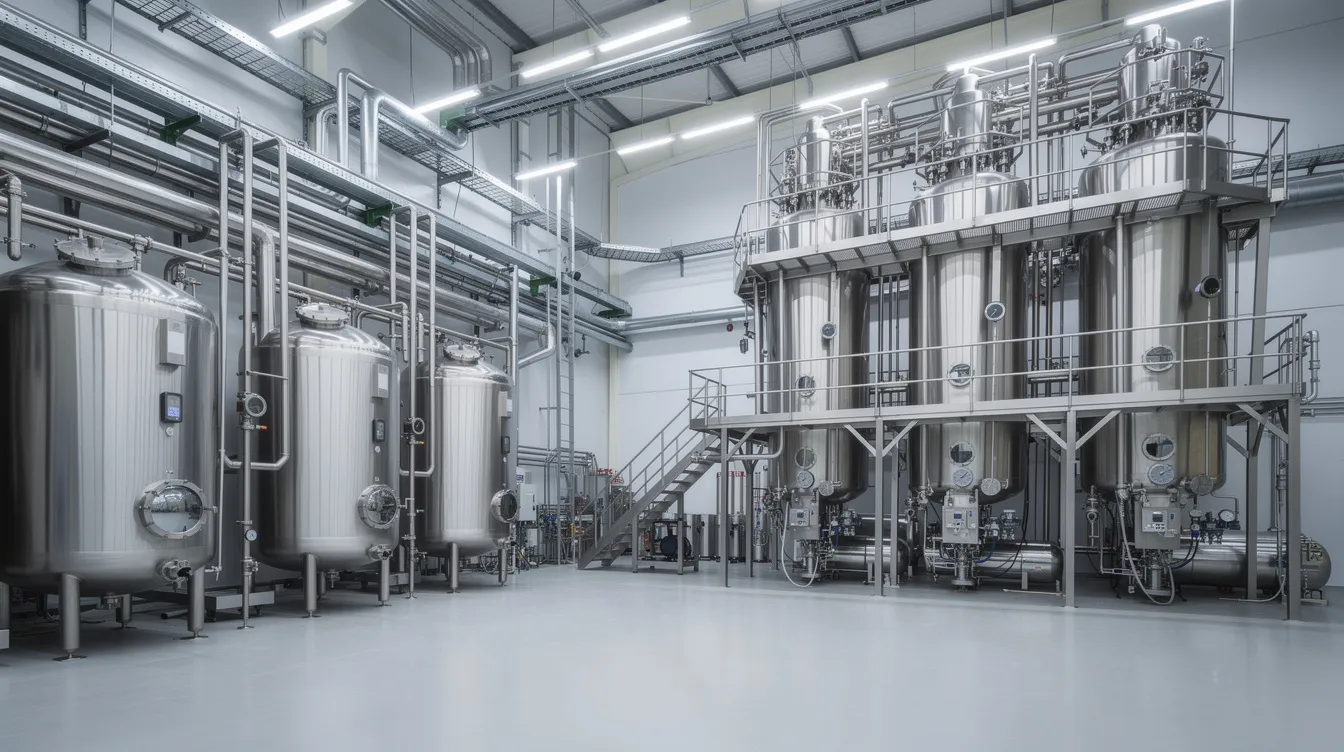
Key equipment in liquid glucose production includes slurry tanks, liquefaction units, and filtration systems, along with saccharification vessels, carbon treatment columns, ion exchange systems, multi-effect evaporators, product storage tanks, boilers, water treatment plants, cooling towers, CIP systems, PLC/SCADA automation and packing facilities.
| Equipment Group | Process Function | Key Selection Factors |
|---|---|---|
| Slurry mixing tanks | Starch-water mixing | Capacity, agitator type, SS construction |
| Jet cooker / liquefaction reactor | Starch breakdown | Temperature rating, pressure design |
| Saccharification vessels | Dextrin to glucose conversion | Residence time, agitation, temperature control |
| Pressure filters / filter press | Solids removal | Throughput, filter area, automation |
| Carbon treatment vessels | Colour and odour reduction | Carbon loading capacity, contact time |
| Ion-exchange columns | Mineral, colour polishing | Resin volume, regeneration automation |
| Multi-effect evaporator | Concentration to 80–85% solids | Number of effects, steam economy |
| Boiler | Steam generation | Fuel type, capacity, emission compliance |
| Water treatment plant | Process water quality | Softening, deionisation capacity |
| CIP system | Equipment cleaning | Coverage, chemical dosing, automation |
| PLC / SCADA | Process monitoring and control | Integration level, sensor network |
Machinery cost can account for a substantial portion of fixed assets. Choices around local versus imported systems, semi-automatic versus fully automatic lines, and energy-efficient evaporators affect both initial investment and payback period. Stainless steel is standard for all product-contact surfaces. Machinery layout and selection must comply with food-hygiene design principles to satisfy FSSAI and major buyer audits.
Liquid Glucose Plant Capacity Planning
Typical plant scales in India range from small units around 10–25 TPD finished syrup to medium plants of 50–100 TPD and larger integrated facilities at 200 TPD and above. Annual production capacity for maize-based liquid glucose plants is generally projected between 20,000–80,000 MT, depending on the scale of operations. These figures are illustrative; capacity planning for a liquid glucose plant includes estimating production based on market demand, logistics and raw material availability.
| Parameter | Small Plant | Medium Plant | Large / Integrated |
|---|---|---|---|
| Finished syrup (TPD) | 10–25 | 50–100 | 200+ |
| Annual operating days | ~300 | ~300 | ~300 |
| Shifts per day | 2–3 | 3 | 3 |
| Year 1 utilisation (%) | 50–60 | 55–65 | 60–70 |
| Starch requirement (approx.) | Proportional | Proportional | Proportional |
It is important to distinguish between finished syrup tonnage (at 80–85% solids) and dry-solids basis tonnage. Financial projections, energy consumption and raw material requirements per tonne should be calculated on a consistent basis. Market absorption, logistics radius and future expansion potential should all be considered during feasibility studies.
Land, Building and Infrastructure Requirements
Land requirements vary by plant capacity, level of integration and local zoning norms. Even a 25–50 TPD stand-alone glucose plant needs well-planned building and utility spaces. The plant layout should facilitate efficient material movement and maintain hygienic separation between processes.
Major blocks include: production building for wet sections, evaporator and tank farm, raw-material stores, boiler house, utilities block (water treatment, cooling, compressor room), effluent treatment plant, finished-goods storage, laboratory, administrative block, internal roads and provision for future expansion. Site selection should consider reliable water and power availability, approach roads for bulk tankers, proximity to maize-starch suppliers, and local Pollution Control Board norms. Utility requirements including water, power and steam access are essential infrastructure considerations.
Liquid Glucose Manufacturing Plant Setup Cost in India
Setting up a glucose plant requires significant capital investment. Initial setup costs for glucose plants range from ₹25 lakh to ₹2 crore for smaller configurations. A small-scale glucose unit costs approximately ₹20–40 lakh to set up, while medium and large plants require substantially higher total capital investment. For reference, a 75 MT/day rice glucose syrup plant in India has been reported with total capital expenditure of approximately ₹36.83 crore.
| Cost Head | Description |
|---|---|
| Land and site development | Industrial plot, levelling, fencing |
| Building and civil works | Factory building, stores, office, ETP area |
| Plant and machinery | Core processing equipment |
| Boiler and utilities | Steam, cooling, compressed air |
| Electrical installations | Transformers, panels, wiring |
| Water treatment and ETP | Feed water plant, effluent treatment |
| Storage tanks and material handling | Product tanks, loading facilities |
| Laboratory equipment | QC testing instruments |
| Pre-operative and preliminary expenses | Consultancy, interest during construction |
| Contingency | Typically 5–10% of project cost |
| Margin for working capital | As per bank norms |
For a small stand-alone plant with purchased starch, land and building may form a lower share of project cost. For a larger integrated maize wet milling and glucose complex, civil and processing equipment costs rise substantially. Capital investments must be carefully evaluated against projected cash flows before committing funds.
Liquid Glucose Plant Project Cost and Means of Finance
Once total project cost is estimated – including margin money for working capital – promoters must finalise the funding structure. Typical elements include promoter contribution (equity and unsecured loans), term loans from banks, working capital limits (cash credit, WCDL) and, in some cases, subordinated debt. Project funding decisions should balance promoter resources with debt-servicing capacity.
| Source | Illustrative Share |
|---|---|
| Promoter equity / own funds | 25–35% of project cost |
| Term loan | 55–65% of project cost |
| Working capital (separate facility) | As assessed |
The debt equity ratio, interest during construction, front-end fees and contingency must all be factored into funding requirements. Even small mismatches between project cost and total funding sources are scrutinised during bank appraisals. Professional project finance advisory and loan structuring can help optimise the capital structure for glucose manufacturing units.
Liquid Glucose Manufacturing Cost of Production Per Kg
Understanding cost of production per kg is central to any glucose manufacturing plant project report, as it drives pricing, profitability, break-even and DSCR calculations. Operating costs are primarily driven by raw material consumption.
Variable costs include maize starch (largest component), enzymes, processing chemicals, boiler fuel and steam, electricity, water, effluent treatment, packaging costs and freight. Fixed or semi-fixed costs include salaries and wages, repairs and maintenance, factory overheads, quality control, insurance and administrative expenses. Labor costs, while not the largest category, form a meaningful portion of total cost for plants with multiple shifts.
| Cost Element | Nature | Approximate Share |
|---|---|---|
| Maize starch | Variable | 65–72% of operating cost |
| Enzymes and chemicals | Variable | 5–8% |
| Energy (fuel + electricity) | Variable/Semi-fixed | 10–15% |
| Labour | Semi-fixed | 3–6% |
| Packaging and dispatch | Variable | 2–4% |
| Overheads, maintenance, QC | Fixed/Semi-fixed | Balance |
Gross profit margins for liquid glucose range between 18–26%, depending on raw material cost, starch prices, plant efficiency and capacity utilisation. EBITDA is derived after deducting all operating expenses from revenue. Depreciation and interest are then deducted to arrive at net profit. Operating costs increase significantly by the fifth year due to inflation and market fluctuations, and projected operating costs must account for this escalation in any serious financial model.
Working Capital Requirements for a Liquid Glucose Manufacturing Plant
Working capital for a glucose manufacturing unit represents funds blocked in raw-material inventory, work-in-progress, finished goods and receivables, minus supplier credit and other current liabilities.
Key components include:
- Inventory holding for maize starch, enzymes and chemicals (typically 15–30 days)
- Processing cycle time from starch to finished syrup (2–4 days)
- Finished goods holding for B2B dispatch (7–15 days)
- Credit terms to institutional buyers (30–60 days or more)
- Credit received from suppliers (15–30 days)
Risk points include extended receivable days due to large FMCG or pharma buyers and concentration among a few major customers. Adequate working capital limits are essential to avoid forced production shutdowns. CMA data preparation captures these working-capital assumptions and is evaluated by bankers when finalising working-capital limits and margin requirements.
Liquid Glucose Plant Financial Projections and Profitability
A bankable DPR should carry 5–7 year financial projections reflecting gradual ramp-up in capacity utilisation – for example, 50–60% in Year 1, rising over the next 2–3 years – with realistic selling prices and escalating costs. Financial projections assess capital investment and operating costs together, providing income and expenditure projections that form the backbone of any loan appraisal.
Projected financial statements must include: Profit & Loss account, cash-flow statement, balance sheet, depreciation schedule, term-loan amortisation schedule, and key ratios including gross profit margin, EBITDA margin, net margin and DSCR. Revenue should be calculated as capacity × utilisation × selling price. Raw material cost links to starch consumption ratios and current market rates. Financial projections also include ROI and NPV assessments for evaluating the project’s long-term attractiveness.
Profitability will differ considerably between a small 20–25 TPD plant and a 100+ TPD integrated facility. Gross profit margins for liquid glucose typically range from 18–26%. Investors should rely on customised projections built through structured financial modelling rather than spreadsheets with ad-hoc numbers.
DSCR, Break-Even Analysis, ROI, IRR and Payback Period
Lenders and investors use multiple financial indicators to assess viability, not just net profit. The Debt Service Coverage Ratio must be ≥ 1.25 for most bank loan approvals. DSCR is calculated as:
DSCR = Cash Available for Debt Service ÷ (Term Loan Principal Repayment + Interest)
Lower selling prices or higher starch and energy costs can push DSCR below acceptable levels, jeopardising loan serviceability. Break-even analysis identifies the capacity utilisation at which fixed costs are fully covered. For glucose processing plants, break-even points have been reported in the 45–59% utilisation range depending on scale and technology.
Return on Investment (ROI), Internal Rate of Return (IRR), net present value and payback period should all be evaluated using consistent cash-flow projections. Sensitivity analysis evaluates the impact of variable costs and pricing on project viability – for example, assessing what happens if starch prices rise by 5–10% or selling prices decline. No universal ROI or IRR can be guaranteed. These metrics are scenario-dependent and must be modelled for each project’s specific circumstances.
Bank Loan and Project Finance for Liquid Glucose Manufacturing Plants
Banks in India appraise industrial projects by evaluating promoter background, technical feasibility, market feasibility, detailed project cost, means of finance, implementation schedule, projected financials, DSCR and security. A comprehensive DPR should articulate both technical feasibility and financial viability of the project, supported by machinery quotations, market assessment and realistic financial analysis.
CMA data preparation is necessary for bank loan applications related to project finance, particularly for loans above threshold limits. Inconsistencies between DPR, CMA Data and loan application can lead to delays. The project implementation schedule outlines the sequence of activities required to start production and is reviewed by banks for feasibility.
Professional bank finance DPR and loan proposal assistance and CMA Data preparation for bank loans improve proposal quality but do not guarantee sanction. Final decisions rest with the bank after full appraisal.
Business Plan for a Liquid Glucose Manufacturing Plant
A commercially oriented business plan differs from a technical-financial DPR. The business plan focuses on target markets, customer segments, product positioning, competitive landscape, pricing and credit policies, distribution channels and growth strategy. For a glucose manufacturing unit, this means identifying specific buyer segments – confectionery manufacturers, beverage companies, pharma formulators, regional sweet manufacturers – and building relationships through consistent quality and competitive terms.
Operational aspects include human resource requirements, organisation structure, production planning, quality assurance frameworks and a continuous-improvement culture. A well-structured business plan aligned with the DPR is useful for banks, equity investors and internal management alike.
Equity Investment and Investor Funding for Larger Liquid Glucose Projects
While many small and medium glucose plants in India are funded through bank loans and promoter equity, large integrated processing complexes or expansion projects may consider external equity or strategic investors. Investor expectations include a robust financial model with realistic assumptions, sensitivity scenarios, clear articulation of market opportunity and governance.
Investor-ready documentation enhances the chances of securing funding for new projects, especially for brownfield expansion or multi-plant strategies. An investor-ready DPR can communicate the project convincingly. Business valuation may be required where a promoter is diluting equity.
Licenses, Registrations and Statutory Approvals
Statutory requirements vary by state, local authority and plant scale. Regulatory approvals for liquid glucose production may include factory licenses and environmental consents, and promoters must obtain professional compliance advice for their specific location.
Typical registrations include:
- Business constitution and PAN
- GST registration
- Udyam registration for eligible MSMEs
- FSSAI licence for food-grade production
- Pollution Control Board consents (Consent to Establish and Consent to Operate)
- Factory registration under the Factories Act
- Fire safety NOC
- Boiler registration and inspections
- Building plan approvals
- Labour law registrations (ESI/EPF)
Industrial and environmental clearances are essential for establishing a liquid glucose manufacturing plant. Effluent management is critical for compliance with environmental standards, as wastewater from glucose manufacturing can have high BOD/COD requiring proper treatment. Pharma-oriented grades may involve additional regulatory oversight through buyer audits.
Liquid Glucose Manufacturing Plant Feasibility Study and Project Viability
A feasibility study for a glucose manufacturing plant should cover technical, financial, market, locational and regulatory aspects before committing large capital. A Detailed Project Report serves as a technical and financial blueprint for investors and lenders alike.
Core components include:
- Technical feasibility: process route, technology, capacity, utilities and infrastructure
- Raw material availability: proximity to maize starch suppliers, water, power and fuel
- Market feasibility: customer mapping, competitor analysis, price trends, market segmentation
- Financial feasibility: project cost, profitability, DSCR, IRR, costs project economics
- Organisational readiness and promoter capability
Sensitivity analysis – evaluating the impact of ±5–10% changes in starch price, selling price, capacity utilisation and interest cost – helps gauge robustness. Customised feasibility reports support promoters and lenders in making informed investment decisions.
Major Risks in Liquid Glucose Manufacturing
Like any agro-processing business, glucose manufacturing carries raw-material, market, operational, financial and regulatory risks.
| Risk | Mitigation Strategy |
|---|---|
| Maize/starch price volatility | Long-term supply contracts, buffer inventory |
| Energy cost escalation | Efficient evaporators, biomass fuel, waste heat recovery |
| Process inefficiency / low yield | Enzyme optimisation, process monitoring, skilled operators |
| Quality failures / rejections | Robust quality control, HACCP, FSSAI compliance |
| Machinery breakdown | Preventive maintenance, critical spares inventory |
| Working capital shortages | Conservative leverage, adequate bank limits |
| Customer concentration | Diversified buyer base, multiple segments |
| Delayed receivables | Credit policy enforcement, receivable monitoring |
| Environmental compliance | Proper ETP, PCB consents, waste management |
| Increasing demand not met | Scalable capacity design, expansion planning |
Transportation requirements and logistics planning also affect both costs and customer service reliability. Risk management is an integral part of a robust DPR and is reviewed by banks alongside financial projections.
Who Should Invest in a Liquid Glucose Manufacturing Plant?
A glucose manufacturing plant is particularly suitable for existing maize starch manufacturers seeking downstream integration, agro-processors experienced in maize processing and grain handling, food-ingredient companies, and investors building a cluster of starch-based products. Investment opportunities exist for both stand-alone operations and integrated complexes.
Stand-alone glucose units buying maize starch involve lower initial investment but higher dependence on suppliers. Integrated wet milling plus glucose plants carry higher project cost but offer better value-addition, by-product revenues and raw material control. Smaller MSMEs may start with modest capacity focused on a limited regional market, while larger ventures may consider multi-product, multi-derivative facilities delivering increasing demand across food processing, confectionery and pharma sectors. A glucose manufacturing business, when well-planned, can be a profitable business over the medium to long term.
Professional DPRs and feasibility studies help promoters match project scale with their resources and long-term goals.
How CA Manish Gugliya Can Assist With Liquid Glucose Manufacturing Plant DPR and Finance
With more than 20 years of professional experience in DPR preparation, project finance advisory, CMA Data and financial modelling for manufacturing and agro-processing projects in India, I work closely with promoters to build credible, customised project documentation.
Specific support for liquid glucose projects includes:
- Preparation of customised, bank-ready detailed project reports
- Project cost estimation and means-of-finance planning
- 5–7 year financial projections, cash flow and DSCR analysis
- CMA Data preparation and working capital assessment
- Project feasibility and viability evaluation
- Assistance in structuring loan proposals and interacting with lenders
- Preparation of investor-oriented financial documents where equity funding is targeted
All analysis is tailored to project-specific assumptions, capacity and location. Serious promoters are welcome to initiate a consultation via WhatsApp or through the enquiry options on ProjectReportBank.com.
Frequently Asked Questions
What minimum plant capacity is practical for a new liquid glucose manufacturing unit in India?
While micro-scale plants below roughly 10 TPD finished syrup are technically possible, they may struggle with economies of scale in machinery, energy and overheads. Many serious MSME promoters consider capacities in the 20–50 TPD range as a practical starting point, subject to local market demand, raw material sourcing and finance availability. The choice should be supported by a financial analysis that evaluates break-even utilisation and DSCR at the proposed capacity.
Can I start with a small glucose manufacturing plant and later expand the capacity?
Modular design is common in the industry. Promoters can begin with moderate capacity while designing civil works, utilities and layout to accommodate additional saccharification tanks, filters or evaporator effects in future. This phased approach reduces initial capital risk while preserving the option for growth once market presence and stable demand are established.
How does captive maize starch versus purchased starch change project viability?
Captive starch extraction can offer better control over quality and, in some market phases, lower effective input cost due to by-product revenues (gluten, fibre, germ oil). However, it substantially increases project cost, working capital and operational complexity. For many first-time promoters, purchased starch may be more practical, with starch integration considered at a later stage after stabilising glucose production operations.
What payback period do banks and investors generally expect for glucose projects?
Acceptable payback periods vary by lender and investor profile. Industrial projects are often evaluated on medium-term horizons of 5–7 years, with emphasis on sustainable DSCR rather than very short-term payback promises. Banks look for the DSCR to remain at or above 1.25 throughout the repayment period. Realistic projections with transparent assumptions are always preferable to optimistic numbers.
How long does it take to prepare a customised liquid glucose manufacturing plant DPR?
Timelines depend on the availability of technical inputs from the promoter – capacity, machinery suppliers and quotations, location data, market assumptions. A professional DPR with financial modelling and CMA Data typically takes several working days to a few weeks, allowing adequate time for discussions, assumption validation and revisions. The objective is a document that supports genuine investment decisions, not a rushed template.
Conclusion – Planning a Financially Viable Liquid Glucose Manufacturing Plant
A successful liquid glucose manufacturing project in India demands alignment of technical design, raw material strategy, market positioning, plant capacity, capital investment, working capital and sound financial projections. The unit operations involved – from starch slurry preparation through enzymatic hydrolysis, clarification, ion exchange, evaporation and packaging – must be designed for consistent output, cost efficiency and quality assurance.
Industry opportunities exist across food processing, confectionery, bakery, the beverage industry, pharma and industrial applications. However, profitability depends on efficient operations, quality consistency, cost control and realistic pricing assumptions. Gross profit margins between 18–26% are achievable, but they require disciplined management of raw material cost, energy consumption and capacity utilisation.
The central role of a comprehensive, professionally prepared detailed project report – supported by feasibility studies, CMA Data and robust financial models – cannot be overstated. A well-constructed DPR provides the financial analysis that lenders and investors require to evaluate opportunities cost and revenue potential.
Serious entrepreneurs and industrial investors considering a liquid glucose manufacturing plant are encouraged to seek professional advisory support through Project Report Bank before finalising investment commitments. A structured consultation can help translate your project concept into a credible, bankable financial proposal.