Equipment, furniture, fixtures and operating supplies represent one of the largest – and most frequently underestimated – capital investments in any luxury hotel project. Luxury hotels distinguish themselves through an elevated level of comfort and personalized service, and that positioning is impossible without the right assets in place. Luxury hotels provide high-end amenities and advanced equipment to maximize guest comfort, and every piece of furniture, every kitchen appliance, every technology system contributes to the guest experience that justifies premium room rates.
In my experience preparing hotel project reports and DPRs, incorrect equipment budgeting leads to project cost overruns, additional promoter contribution demands, delayed opening dates, insufficient term-loan sanctions, working-capital pressure, and – most damaging – a compromise in the hotel’s market positioning that undermines long term ROI.
FF&E typically represents 10%–20% of total project cost, and OS&E usually accounts for 3%–6% of total project cost. Together, these categories form a significant share of your capital plan.
The actual investment depends on factors including number of rooms, hotel category, room size, interior specifications, brand standards, restaurant and bar count, banquet capacity, spa and gym facilities, swimming pool, laundry arrangements, kitchen capacity, imported vs domestic equipment, technology level, and location.
All costs in this article are indicative planning estimates for the Indian market. Actual quotations from suppliers must be obtained before finalizing any DPR or investment decision.
Explore Luxury / 4-Star & 5-Star Hotel Project Report Guides
Explore our complete Luxury, 4-Star and 5-Star Hotel Project Report and DPR guides covering setup cost, equipment, project cost, revenue, financial projections, occupancy, feasibility, project finance and bank loan assessment.
What Is FF&E in a Luxury Hotel?
FF&E stands for Furniture, Fixtures, and Equipment – the moveable assets that are not permanently attached to the building structure. In practical terms, this includes beds, mattresses, headboards, wardrobes, desks, chairs, sofas, decorative lighting, mirrors, TVs, minibars, electronic safes, restaurant furniture, banquet furniture, lobby seating, and office furniture.
FF&E is a critical CAPEX component because it directly shapes guest satisfaction and determines the operational readiness of every department. Luxury hotel interior designs often focus on comfort and technologically advanced features, and it is the FF&E budget that funds these differentiators. From a project-finance perspective, FF&E is treated as depreciable fixed assets and must be clearly identified in a hotel project report / DPR for bank loan.
How We Categorize Hotel Equipment & FF&E
A complete FF&E budget includes both OS&E and FF&E estimates. For DPR purposes, I generally recommend separating hotel assets into four distinct categories:
| Category | Meaning | Examples | Nature of Cost |
|---|---|---|---|
| FF&E | Furniture, Fixtures & Equipment | Beds, chairs, wardrobes, TVs, restaurant tables | Capital expenditure (depreciable) |
| OS&E | Operating Supplies & Equipment | Linens, pillows, duvet covers, crockery, cutlery, utensils, cleaning supplies | Opening / operating requirement |
| Plant & Machinery | Major technical systems | Kitchen equipment, laundry machinery, HVAC, lifts, heating systems | Capital expenditure |
| IT & Technology | Hotel technology infrastructure | PMS, servers, Wi-Fi, POS, CCTV, electronic locks | CAPEX / technology investment |
OS&E stands for Operating Supplies and Equipment. OS&E includes consumables like linens and kitchen supplies. For a midscale hotel, OS&E typically represents 25%–40% of the FF&E total. In luxury hotels, that ratio may shift because FF&E values are much higher per room.
FF&E requires detailed technical drawings and factory audits before manufacturing can begin, while OS&E can generally be procured closer to opening. Keeping these categories separate prevents double counting, ensures accurate depreciation schedules, and helps banks assess the cost structure clearly – a point I explain further when discussing how banks assess a hotel term loan proposal.
Complete Luxury Hotel Equipment Categories
Guest Room Furniture & FF&E
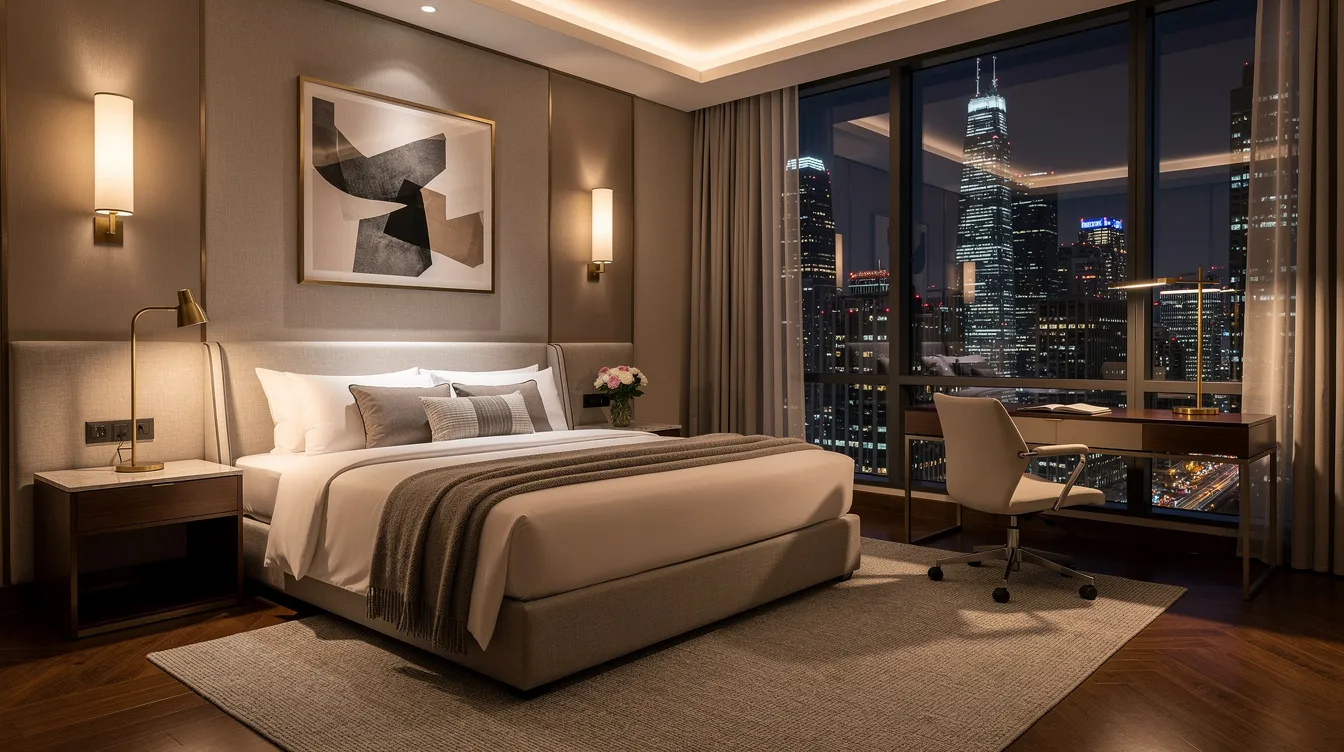
Guest rooms are the revenue engine of any hotel, and their furniture and equipment set the tone for guest comfort. Luxury hotel rooms typically include high-thread-count linens and premium mattresses – specifically, high quality mattresses from reputed manufacturers that ensure durability and comfort across thousands of guest nights.
A complete guest room equipment list covers:
- Luxury bed frame with upholstered headboard
- Premium mattress, mattress protector, pillows, duvet covers
- Bedside tables with integrated reading lights
- Wardrobe with electronic safe, minibar, luggage rack
- Writing desk and ergonomic chair
- Lounge chair or sofa with coffee table
- Full-length mirror, decorative mirrors
- Blackout curtains, sheer curtains, carpets or rugs
- Smart television (43″–55″), telephone, tea/coffee maker
- Hair dryer, iron and ironing board
- Decorative lighting, artwork
Luxury hotel room technology includes smart room controls for lighting and temperature. Luxury hotels commonly provide personalized welcome amenities to enhance guest experience, and many hotels now install advanced air purification systems for improved guest comfort.
Indicative per-room cost ranges:
| Specification Level | Furniture Set Per Room | Key Differentiators |
|---|---|---|
| Premium 4-star | ₹90,000 – ₹1,50,000 | Engineered wood, standard upholstery, quality materials |
| 5-star luxury | ₹2,00,000 – ₹3,50,000 | Solid wood, premium fabrics, smart controls |
| High-end luxury / branded | ₹3,50,000 – ₹5,00,000+ | Bespoke/imported, designer lighting, integrated tech |
Guest Bathroom Equipment & Fixtures
Luxury hotels usually have spacious bathrooms finished with premium materials such as imported marble or natural stone. Luxury hotel bathrooms commonly include premium fixtures and high-quality toiletries. Many luxury hotels feature multi-jet rain showers and illuminated makeup mirrors as standard guest amenities.
Key bathroom items (movable FF&E/OS&E, separate from civil costs):
- Vanity accessories, magnifying mirror, bathroom amenities set-up
- Premium towel racks, robe hooks, bathroom accessories
- Hair dryer, weighing scale
- Shower systems and fittings (often part of interior/civil budget)
A promoter should separately identify which bathroom items fall under civil/interior cost and which are movable FF&E to avoid double counting in the DPR.
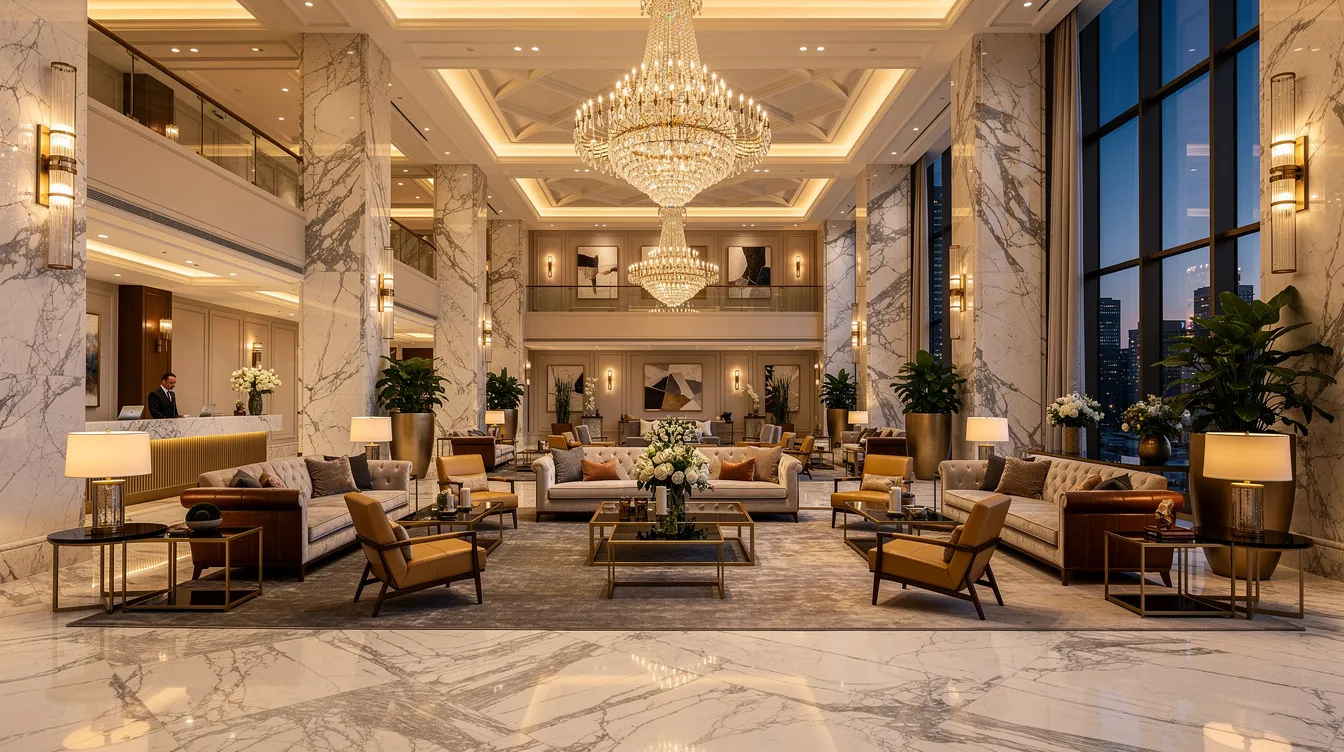
Lobby & Reception Furniture
The lobby defines first impressions. Luxury hotels provide 24-hour concierge services for personalized guest assistance, and the reception area must support this function with appropriate furniture and equipment.
Key items include reception counters, concierge desks, lobby sofas, lounge chairs, centre tables, side tables, decorative furniture, artwork, feature lighting, luggage trolleys, bell desk equipment, and digital display systems. Luxury hotels often have a 24-hour valet parking service for guest convenience, requiring a dedicated bell desk and valet station.
For a luxury hotel lobby, budget ₹15–50 lakh depending on the scale of common areas and interior positioning. Statement furniture pieces alone can range from ₹25,000 to ₹1,50,000+ each.
Restaurant & Coffee Shop Furniture
Luxury hotels typically offer fine-dining restaurants and chic cocktail lounges. The food service infrastructure requires dining tables, dining chairs, buffet counters, hostess stations, service stations, crockery storage, serving utensils, and outdoor seating where applicable.
A premium restaurant dining set (table + 4 chairs) costs ₹35,000–₹80,000 per set. Seating capacity directly drives investment – a 120-cover all-day restaurant requires significantly more furniture than a 40-cover specialty restaurant. Budget ₹10–30 lakh per restaurant depending on covers and positioning.
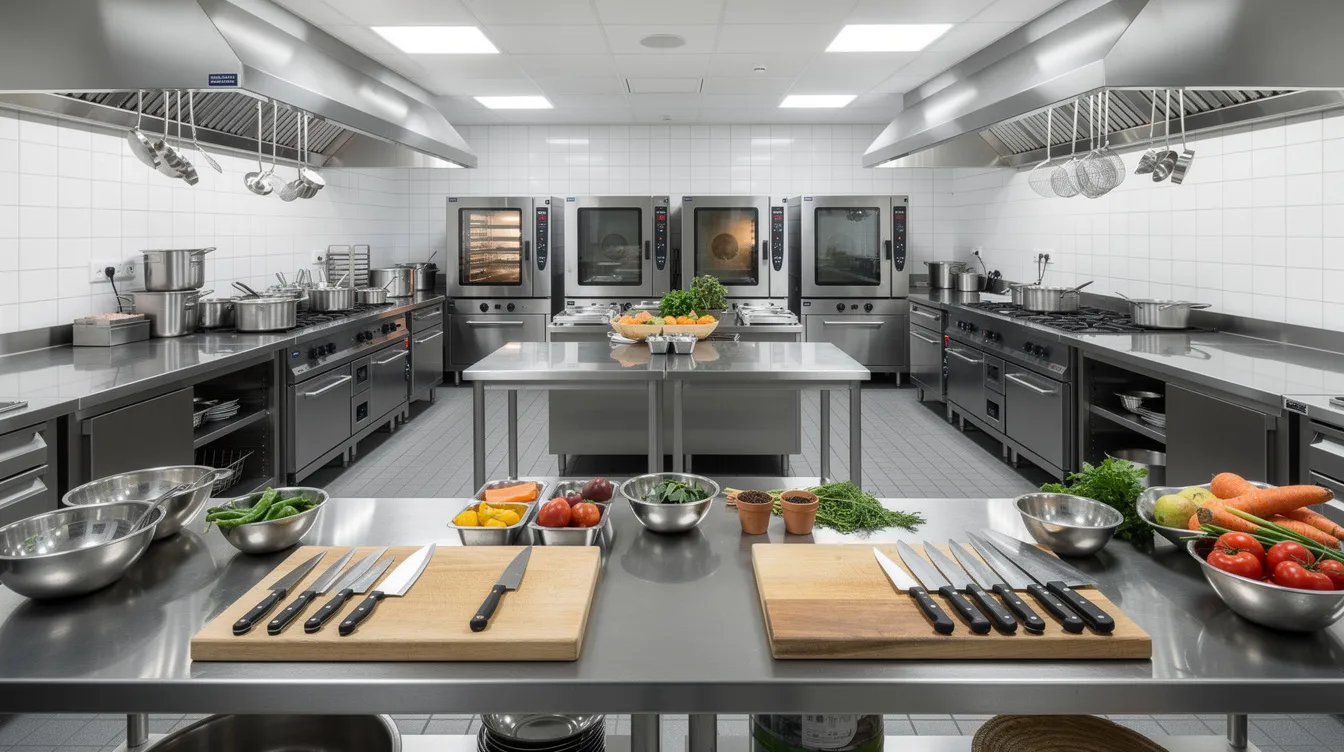
Commercial Kitchen Equipment
A complete kitchen equipment checklist is essential for hotel openings. This is typically one of the highest-cost equipment categories and a major spend area that hotel owners frequently underestimate.
Core equipment includes:
- Cooking ranges (5–8 burner): ₹25,000–₹4,00,000+ depending on specification
- Combi ovens (premium): ₹15,00,000–₹25,00,000+
- Smart ovens that adjust heat in real time to prevent cooking errors
- Deep fryers, griddles, salamanders, steamers
- Walk-in cold rooms: ₹3,00,000–₹10,00,000
- Reach-in refrigerators, deep freezers: ₹50,000–₹2,00,000 per unit
- Preparation tables, vegetable prep machines, cutting boards, knives
- Bakery equipment, bain-marie, food warmers
- Commercial dishwashers – ENERGY STAR certified dishwashers use up to 40% less water and power
- Exhaust systems, stainless steel tables, storage racks, commercial sinks
Induction cook tops use significantly less energy than gas alternatives, making them increasingly popular in hotel kitchens focused on operational efficiency. High-quality equipment can cut energy costs by up to 30%. For example, Burnham Beeches Hotel reduced energy consumption by 33% with efficient kitchen and building systems.
A full hotel kitchen (with banquet, pastry, and cold-kitchen sections) typically costs ₹50 lakh to ₹2 crore for equipment alone. Installation, exhaust work, and commissioning add 20–40% above equipment-only quotes. For detailed comparisons with mid-market properties, refer to our guide on 3-Star Hotel Equipment, Furniture & FF&E List with Cost.
Banquet & Conference Equipment
Large banquet facilities can materially increase hotel CAPEX. Equipment includes banquet tables, stackable banquet chairs, portable stage systems, podiums, professional audio systems, video projectors, LED displays, conference boards and tools, portable partitions, and buffet service equipment.
A 500-person banquet hall with full AV infrastructure can require ₹30–80 lakh in furniture and equipment alone, depending on the quality of AV systems and furniture grade.
Housekeeping, Laundry & Back Office Equipment
Housekeeping covers trolleys, industrial vacuum cleaners, floor cleaning machines, scrubbers, polishers, linen trolleys, and waste handling systems. Cleaning robots now help maintain hygiene in high-traffic hotel areas, supplementing manual operations in many hotels.
Laundry is a significant investment decision. An in-house laundry with industrial washing machines, dryers, flatwork ironers, steam presses, and folding equipment can cost ₹25–75 lakh for a luxury hotel. Outsourcing reduces initial CAPEX but increases operating costs. From a project-finance perspective, the choice affects both the total cost estimate and long-term profitability – factors I detail when preparing hotel financial projections for DPR.
Back office furniture for desks, chairs, storage, computers, printers, and communication systems across GM office, accounts, HR, and sales typically runs ₹5–15 lakh.
Spa, Gym & Pool Equipment
Luxury hotels have state-of-the-art fitness centers with modern cardiovascular equipment – treadmills, cross trainers, exercise bikes, strength machines, and free weights. Luxury hotels often feature full-service spas equipped with multiple treatment rooms, massage beds, steam and sauna rooms, and salon equipment. The investment difference between a basic hotel gym (₹10–20 lakh) and a destination spa (₹50 lakh–₹2 crore+) is substantial.
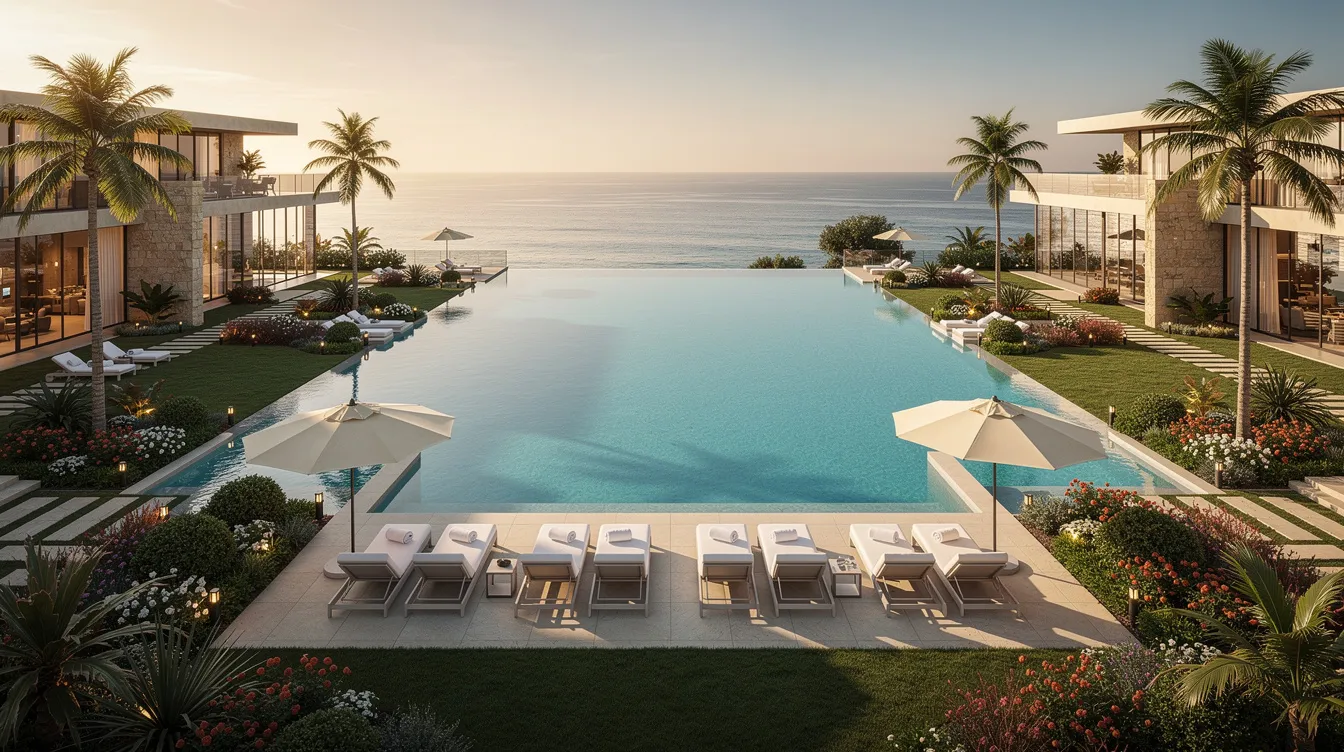
Luxury hotels typically offer temperature-controlled swimming pools with poolside service. Pool equipment – filtration, pumps, cleaning systems, loungers, umbrellas, and safety equipment – should be budgeted separately from pool civil construction costs.
Hotel IT & Technology Equipment
Luxury hotels provide high-speed internet connectivity throughout the property. Core systems include a Property Management System (PMS), POS systems, servers or cloud infrastructure, Wi-Fi networking, electronic door locks, IP telephony, CCTV, access control, and digital signage.
Luxury hotels often feature comprehensive security systems for guest safety, including CCTV, access control, fire detection, fire alarms, emergency equipment, and in some cases baggage scanners. HVAC systems account for up to 50% of hotel energy use, so selecting efficient heating and cooling appliances directly impacts operations.
Technology investment varies substantially by hotel positioning – a plan for a 4-star hotel might allocate ₹20–40 lakh, while a luxury property with smart room controls and integrated guest-room automation might spend ₹50 lakh–₹1.5 crore+.
Quick Equipment Cost Comparison by Department
| Department | Major Items | Indicative Range (Luxury, 100 rooms) | Key Cost Driver |
|---|---|---|---|
| Guest Rooms | Furniture, TV, minibar, safe, décor | ₹2.0–5.0 crore | Room category & room type |
| Lobby & Reception | Seating, counters, décor, lighting | ₹15–50 lakh | Interior positioning |
| Restaurant(s) | Furniture, buffet, service stations | ₹20–60 lakh | Seating capacity |
| Kitchen | Commercial cooking, refrigeration, prep | ₹50 lakh–₹2 crore | F&B capacity & cuisines |
| Banquet | Furniture, AV, stage, partitions | ₹30–80 lakh | Banquet hall capacity |
| Laundry | Washing, drying, pressing, folding | ₹25–75 lakh | In-house vs outsourced |
| Spa & Gym | Treatment, fitness, pool equipment | ₹20 lakh–₹1.5 crore | Hotel positioning |
| IT & Security | PMS, POS, networking, CCTV, locks | ₹30 lakh–₹1.5 crore | Technology level |
| Housekeeping | Trolleys, machines, cleaning systems | ₹5–15 lakh | Floor count & area |
| Back Office | Desks, chairs, computers, printers | ₹5–15 lakh | Staff count |
These are indicative ranges for the Indian market. Actual costs depend on the hotel’s specific scope, brand requirements, and procurement strategy.
How to Plan Your Luxury Hotel Equipment Budget
FF&E Cost Per Room Analysis
Hotel developers and the hotel industry at large use cost per key for preliminary budgeting. Based on Indian market data:
| Hotel Positioning | FF&E Cost Per Key (Room) | Notes |
|---|---|---|
| Upper midscale / premium | ₹4–7 lakh | Standard quality materials, domestic sourcing |
| 4-star / upscale | ₹7–12 lakh | Premium interiors, moderate tech |
| 5-star luxury | ₹12–18 lakh | High-end furniture, smart controls, premium F&B |
| Ultra-luxury / branded | ₹18–30 lakh+ | Bespoke, imported, extensive public areas |
These figures represent FF&E allocation per room, not total development cost per room. A luxury hotel’s total development cost (excluding land) averages ₹2.36 crore per key as per Hotelivate’s construction cost surveys, of which FF&E is roughly 19.8%–20.9%.
A hotel with 100 standard rooms has a different FF&E budget than one with suites – the room mix between standard, deluxe, and suite categories directly impacts per-key costs.
Model Hotel Examples
| Category | 50-Room Luxury | 100-Room Luxury | 150-Room 5-Star |
|---|---|---|---|
| Guest Room FF&E | ₹4–5 crore | ₹7–10 crore | ₹10–14 crore |
| Public Area FF&E | ₹1–2 crore | ₹2–4 crore | ₹3–5 crore |
| Kitchen Equipment | ₹50–80 lakh | ₹80 lakh–₹1.5 crore | ₹1–2 crore |
| Restaurant Furniture | ₹15–30 lakh | ₹25–60 lakh | ₹40–80 lakh |
| Banquet Equipment | ₹15–40 lakh | ₹30–80 lakh | ₹50 lakh–₹1 crore |
| Laundry | ₹15–30 lakh | ₹25–50 lakh | ₹35–75 lakh |
| IT & Technology | ₹20–40 lakh | ₹30–80 lakh | ₹50 lakh–₹1.2 crore |
| Spa, Gym & Pool | ₹15–40 lakh | ₹25–75 lakh | ₹40 lakh–₹1 crore |
| Housekeeping & Back Office | ₹8–15 lakh | ₹10–25 lakh | ₹15–30 lakh |
| Illustrative Total | ₹8–12 crore | ₹15–25 crore | ₹25–40 crore |
Doubling rooms does not double every category. Kitchen, lobby, pool, and IT infrastructure see economies of scale, while guest room FF&E scales roughly linearly.
4-Star vs 5-Star Equipment Comparison
| Parameter | 4-Star Hotel | 5-Star / Luxury Hotel |
|---|---|---|
| Room furniture | Premium engineered wood | Luxury/custom solid wood, bespoke |
| Mattresses | Branded, standard | Premium imported, pillow-top |
| Bathroom | Premium sanitary ware | Imported marble, rain showers, standalone tubs |
| Technology | Standard digital locks, TVs, Wi-Fi | Smart controls, guest tablets, mood lighting |
| Restaurant FF&E | Premium, functional | Luxury, designer, specialty fit-outs |
| Banquet AV | Moderate | Advanced LED, professional sound |
| Spa/Gym | Standard facility | Extensive, multi-treatment rooms |
| FF&E per key | ₹7–12 lakh | ₹12–30 lakh+ |
The differences are not just cosmetic – they directly impact the hotel revenue model because higher CAPEX must be justified by higher ARR and occupancy. Understanding hotel occupancy, ARR, RevPAR and break-even analysis is essential before committing to luxury-level equipment costs.
Which Equipment Category Should You Prioritize?
From a procurement perspective, guest room FF&E, kitchen equipment, and IT systems deserve the earliest attention because they carry the longest lead times. Custom furniture production can take 45 to 90 days, and imported items may require months including shipping and customs clearance. Missing the opening date because of delayed equipment procurement is a costly mistake.
Procurement strategy matters. Reliable suppliers become long-term partners for hotels – especially when periodic replacement and quality inspection are factored in. Industry trade shows help discover vetted suppliers with proven manufacturing capability. FF&E procurement must meet global standards for brand compliance, particularly for internationally branded properties. Finding the right supplier early saves significant costs and delays.
Domestic vs imported equipment: Indian-manufactured furniture and kitchen equipment offer strong value. Imported lighting, specialty sanitary ware, and certain technology systems cost more due to freight, customs duty, and longer lead times, but may be required by brand standards. For a 4 star hotel equipment list, most items can be domestically sourced without compromising quality.
Contingency planning: I recommend keeping 10%–15% contingency for price escalation, freight, installation, exchange-rate risk on imports, and design modifications. This is not padding – it is realistic budgeting.
FF&E replacement reserve: Furniture, mattresses, televisions, soft furnishings, and operating supplies require periodic replacement. The hotel industry standard is to maintain an FF&E reserve expressed as 1%–5.5% of annual revenue, depending on positioning. Lenders and investors evaluate this reserve when assessing long-term project viability – a factor examined during hotel feasibility study and project viability assessment.
Equipment Role in Hotel Project Finance
FF&E and equipment must be integrated within the overall hotel project cost and means of finance alongside land, construction, civil work, electrical, plumbing, HVAC, lifts, interiors, pre-operative expenses, interest during construction, and working-capital margin. The goal is a project cost structure where no major category is double counted or omitted.
What Banks Examine
From a bank appraisal perspective, lenders assess the reasonableness of equipment cost relative to hotel category, number of rooms, revenue potential, ARR assumptions, occupancy, DSCR, and repayment capacity. Banks expect item-wise estimates supported by vendor quotations. Excessive luxury CAPEX without corresponding revenue potential weakens project viability and can result in loan rejection.
For clients preparing a luxury hotel DPR, I recommend obtaining at least three detailed quotations for every major equipment category – including freight, installation, warranty, and AMC terms. Understanding hotel project finance and bank loan requirements early prevents last-minute scrambling.
Common Mistakes to Avoid
In my experience preparing hotel project reports, the most common budgeting mistakes include:
- Budgeting only guest room furniture while ignoring kitchen, banquet, and IT
- Mixing FF&E with OS&E or double counting interiors and furniture
- Using unrealistic online equipment prices without freight, installation, or taxes
- Ignoring laundry equipment when an in-house facility is planned
- Forgetting that a business hotel with large banquet operations will need significantly more equipment per key than a boutique property
- Overlooking pre-opening supplies – a complete FF&E budget must plan for both categories
- Not accounting for the difference between room types – standard hotel rooms vs suites have very different budgets
Expert Perspective
I often see promoters who spend months perfecting the building design while treating equipment budgeting as a last-minute exercise. This is a fundamental error. Equipment investment affects total project cost → means of finance → term loan → depreciation → profitability → cash flow → DSCR → repayment capacity. Every equipment decision ripples through your financial projections. Developers who cut costs on critical equipment frequently pay more in replacement and guest complaints within the first two years of operations.
Final Thoughts
There is no universal FF&E budget that applies to every luxury hotel. The investment must be determined by hotel category, number of hotel rooms, room positioning, F&B capacity, banquet facilities, amenities, technology integration, brand standards, location, and procurement strategy.
The equipment schedule should ultimately be integrated with the project’s total cost estimate, means of finance, hotel financial projections, revenue assumptions, cash flow, DSCR, and bank-loan requirement.
If you are planning a 4-star, 5-star, or luxury hotel project in India, approach equipment budgeting with the same rigor you apply to construction cost estimation. It will make the difference between a bankable, well-planned project and an incomplete one.
- CA Manish Gugliya, ProjectReportBank.com
Frequently Asked Questions
What is FF&E in a hotel?
FF&E stands for Furniture, Fixtures, and Equipment – moveable assets such as beds, wardrobes, TVs, chairs, tables, decorative lighting, and restaurant furniture that are not part of the building structure.
How much does luxury hotel FF&E cost per room?
For luxury and 5-star hotels in India, FF&E cost per key ranges from approximately ₹12–30 lakh, depending on specifications, brand requirements, and import content. Upscale 4-star properties typically range ₹7–12 lakh per key.
What is included in a 5-star hotel equipment list?
A 5-star hotel equipment list covers guest room furniture, bathroom fixtures, lobby and reception furniture, restaurant and bar furniture, commercial kitchen equipment, banquet and AV systems, housekeeping equipment, laundry machinery, spa and gym equipment, pool equipment, IT infrastructure, and security systems.
How much does it cost to furnish a luxury hotel room in India?
A luxury hotel room furniture set (bed, side tables, wardrobe, desk, chair, lounge seating, décor) costs ₹2,00,000–₹5,00,000+ per room, depending on whether items are domestically fabricated or imported/bespoke.
Is kitchen equipment included in hotel FF&E?
Heavy kitchen equipment such as cooking ranges, combi ovens, and cold rooms is typically classified under Plant & Machinery in a DPR. Smaller kitchen items like utensils and appliances may fall under OS&E. Classification varies by project.
What is the difference between FF&E and OS&E?
FF&E covers capital assets (furniture, fixtures, equipment) that are depreciated. OS&E covers operating supplies like linens, crockery, cutlery, and cleaning supplies – items that are consumed or replaced frequently during operations.
How much should be budgeted for hotel furniture?
For a 100-room luxury hotel in India, guest room furniture alone may cost ₹2–5 crore. Adding lobby, restaurant, banquet, conference, and back office furniture can push the furniture budget to ₹4–8 crore.
What equipment is required for a 100-room luxury hotel?
A 100-room luxury hotel needs guest room FF&E, kitchen equipment for multiple outlets, banquet and conference equipment, laundry machinery, housekeeping equipment, spa and gym equipment, pool systems, IT infrastructure, and security systems. Total equipment and FF&E budget: approximately ₹15–25 crore.
Does a bank finance hotel furniture and equipment?
Yes. Banks finance furniture and equipment as part of the overall term loan for hotel projects. However, banks require item-wise cost estimates, vendor quotations, and evidence that the budget is consistent with the proposed hotel’s category and revenue potential.
Are imported hotel equipment eligible for term-loan finance?
Yes, imported equipment is generally eligible. Banks may require proforma invoices, CIF values, and details on customs duty. Currency fluctuation risk should be addressed in the DPR.
How are hotel equipment costs shown in a DPR?
Equipment costs should appear as separate line items under project cost – typically categorized as FF&E, Plant & Machinery, IT & Technology, and OS&E. Each category should have supporting quotations, specifications, and an implementation timeline.
How much contingency should be kept for hotel FF&E?
A contingency of 10%–15% on FF&E and equipment costs is reasonable, covering price escalation, freight variations, installation contingencies, design modifications, and exchange-rate movements on imported items.
What is an FF&E reserve?
An FF&E reserve is an annual allocation (typically 1%–5.5% of hotel revenue) set aside for periodic replacement of furniture, mattresses, televisions, carpets, and other items subject to wear and tear. Investors and lenders evaluate this reserve when assessing long-term project sustainability.
Is FF&E cost included in hotel cost per room?
Yes. When the hotel industry references “cost per key,” it typically includes FF&E along with construction, interiors, MEP, and other development costs – excluding land. FF&E as a separate component usually represents 19.8%–20.9% of total development cost for luxury hotels.
What quotations are required for a hotel bank-loan project report?
Banks expect detailed vendor quotations for all major equipment and furniture categories – including unit prices, quantities, freight, installation charges, warranty terms, and AMC. At least two to three competitive quotations per major category strengthen the DPR’s credibility.
Explore More Luxury / 4-Star & 5-Star Hotel Project Report Guides
Continue exploring our Luxury, 4-Star and 5-Star Hotel DPR guides covering setup cost, equipment, project cost, revenue, financial projections, occupancy, feasibility, project finance and bank loan assessment.