
Key Takeaways
- There is no single standard luxury hotel setup cost in India. Figures depend on room count, star category, city, land cost, built-up area, facility mix and brand positioning. All numbers in this article are planning benchmarks, not universal quotations.
- As a broad indicator for 2025–26 conditions: a 4-star city hotel may require approximately ₹1.0–₹1.75 crore per key (excluding very expensive metro land), while a 5-star hotel may fall in the range of ₹1.75–₹3.0 crore per key or higher depending on location and brand standards. Construction and architecture costs for luxury hotels can range from ₹1.5 crore to ₹3 crore per key.
- Total project cost = Land + Construction + Interiors + MEP/Plant + FF&E/OS&E + Pre-Operative & Interest During Construction + Contingency + Working Capital Margin. Each head must be individually estimated for a credible DPR.
- Cost per key (cost per room) is the primary benchmark used by developers and banks, but actual budgets must flow from a detailed cost estimation and project-specific BOQs-not from rules of thumb alone.
- Before committing ₹50–₹300 crore or more to a luxury hotel project, promoters should evaluate feasibility, DSCR and bankability through a structured luxury hotel project report. Setting up a luxury hotel in India requires substantial capital expenditure, and these projects are capital-intensive, often taking years to complete.
Explore Luxury / 4-Star & 5-Star Hotel Project Report Guides
Explore our complete Luxury, 4-Star and 5-Star Hotel Project Report and DPR guides covering setup cost, equipment, project cost, revenue, financial projections, occupancy, feasibility, project finance and bank loan assessment.
Introduction – What Does “Luxury Hotel Setup Cost in India” Really Mean?
Luxury hotel setup cost in India varies widely. A 50-room boutique hotel in a Tier-2 heritage city and a 200-key internationally branded five star hotel on Mumbai’s waterfront are both “luxury hotels”-yet their investment profiles differ by hundreds of crores. Costs vary widely based on city and brand positioning, room count, category (4-star vs 5-star), and whether the project is a business hotel, leisure resort or urban luxury property. Initial investments for luxury hotels can be significantly influenced by land acquisition alone.
Three related terms are often used interchangeably but mean different things. Hotel setup cost refers to the capital needed to bring the property to commercial opening-land, construction, interiors, FF&E, MEP and external works. Total project cost adds eligible pre-operative expenses, interest during construction (IDC), contingency and working capital margin. Project investment further includes any non-capitalised items funded by the promoter, such as opportunity cost of owned land.
From a project finance and DPR perspective, a bankable luxury hotel DPR must convert physical and design decisions into a structured capital expenditure and financing plan. This article focuses on 4-star and 5-star hotel construction costs, interior fit-out, FF&E and related investment components-not generic hospitality industry guidance. Construction costs vary by hotel type and location, and the figures here are illustrative planning estimates.
Major Cost Components in a Luxury Hotel Project
Any serious cost estimation for a luxury hotel in India must break the development cost into specific heads for bank appraisal. These major cost components form the backbone of every DPR:
- Land and site development
- Civil construction and structural works (hard costs)
- Interior finishes and fit-out
- MEP / plant and machinery
- FF&E (Furniture, Fixtures & Equipment) and OS&E (Operating Supplies & Equipment)
- External works, landscaping and parking
- Professional fees, approval costs and project management fees
- Pre-operative and pre-opening expenses
- Interest during construction (IDC)
- Contingency and escalation provision
- Working capital margin
These heads cover both direct costs and indirect costs. In a luxury hotel project report submitted to banks, each component appears as a separate line item with supporting BOQs, vendor quotations and phased expenditure schedules. The distinction between hard costs (construction, MEP, FF&E) and soft costs (consultancy, approvals, pre-opening) is important for lenders evaluating overall project costs.
Land and Site Development Cost
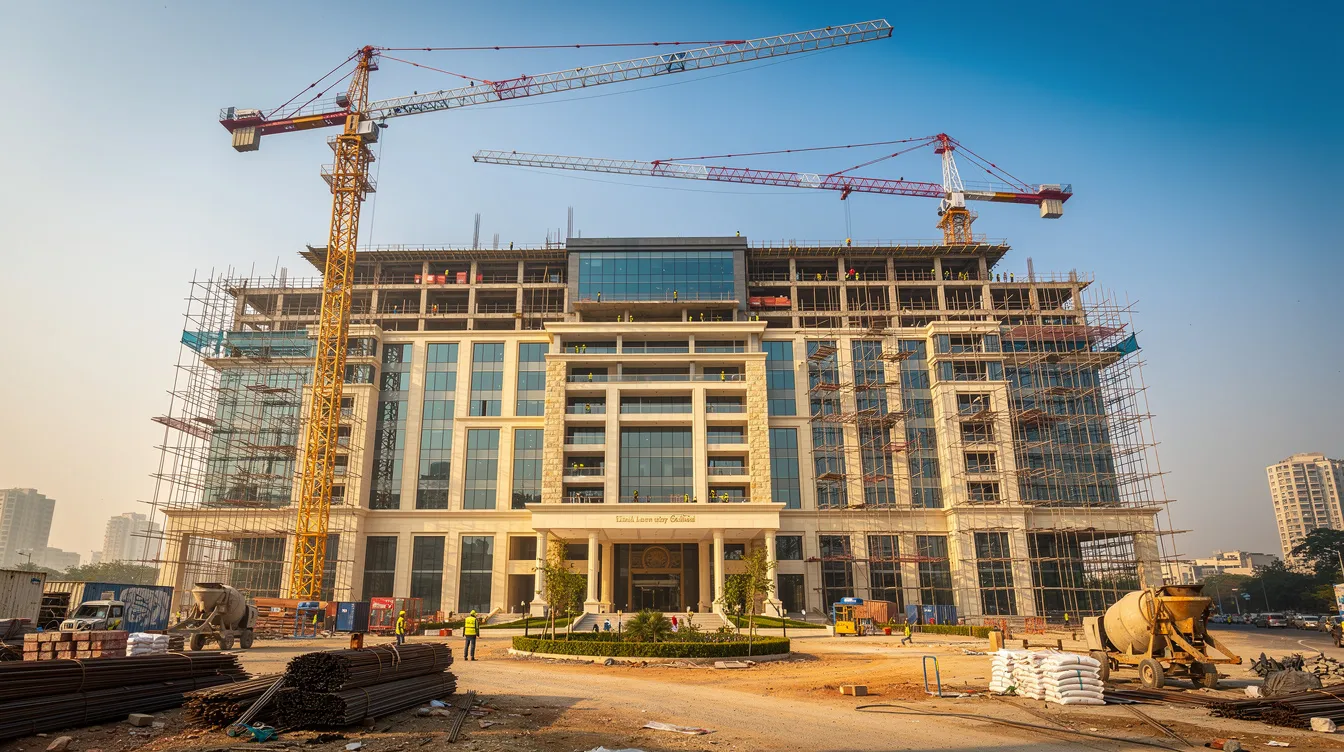
For luxury hotels in metros like Mumbai, Delhi NCR, Bengaluru and Hyderabad, land costs can easily exceed the building cost. Land costs can account for 50–60% of total hotel expenses in prime locations, while in Tier-2 or Tier-3 cities, land purchase might represent only 10–25% of total outlay. This single variable makes it nearly impossible to quote a “standard” luxury hotel setup cost without specifying location.
Concrete components include:
- Land purchase price, stamp duty and registration
- Conversion charges (agricultural to commercial, where applicable)
- External development charges levied by local authorities
- Boundary wall, site levelling, filling and grading
- Internal roads, driveways and parking (surface and basement)
- Landscaping and hardscaping
- Storm-water drainage and rainwater harvesting
- Utility connections-power, water, sewerage, gas, telecom
Consider the contrast: a 2,500 sq. yard plot in Jaipur or Indore may cost ₹5–₹15 crore, whereas a comparable 1-acre parcel near Gurugram’s NH-48 or a seafront plot in North Goa could run ₹50–₹200+ crore, fundamentally altering the per-key investment.
Where the promoter already owns the land, DPRs often reflect a notional land value for IRR and viability analysis. However, bank funding may exclude or only partially consider promoter-owned land, so cost estimates should be shown both “with land” and “without land.”
Environmental clearances are necessary before hotel construction, and you need building permits to open a hotel in India. Regulatory approvals and compliance can inflate capital costs. Delayed approvals-change of land use, environmental clearance, fire NOC-extend the project period and add materially to IDC and overall development costs.
Civil Construction and Hotel Building Structure
Civil construction is the largest single hard cost in hotel construction, covering the building shell and core, basements, structural works and services shafts. Core construction costs typically encompass 40–50% of the budget for luxury hotels, and direct costs typically represent 70–80% of the total construction budget.
Functional areas that must be individually costed include:
- Guest rooms and corridors
- Lobby, reception and lounges
- Multiple restaurants, bars and kitchens
- Banquet halls and pre-function areas
- Meeting and conference rooms
- Back-of-house: staff areas, lockers, service corridors
- Administrative offices
- Laundry, stores and plant rooms
- Parking (surface and multi-level basement)
- Swimming pool deck and structure
- Spa and recreational facilities
Luxury hotel construction costs are typically around ₹9,000 to ₹15,000+ per square foot of built-up area in Indian metros (including fit-out), according to recent industry data. For the core building shell alone (excluding interiors and FF&E), costs in major cities range from ₹4,500–₹7,000 per square foot depending on specification, with luxury hotels requiring larger gross floor area per room compared to non-luxury hotels.
Why is hotel construction cost per square foot higher than ordinary commercial buildings? Basements with higher waterproofing specs, MEP-intensive floor plates, column-free banquet spans, seismic and fire-safety requirements, and larger service cores all push costs up. A compact 100-key business hotel with limited basements will cost materially less per key than a resort-style property with low-rise spread, extensive landscaping and water features.
Interiors, Fit-Out and Luxury Finishes
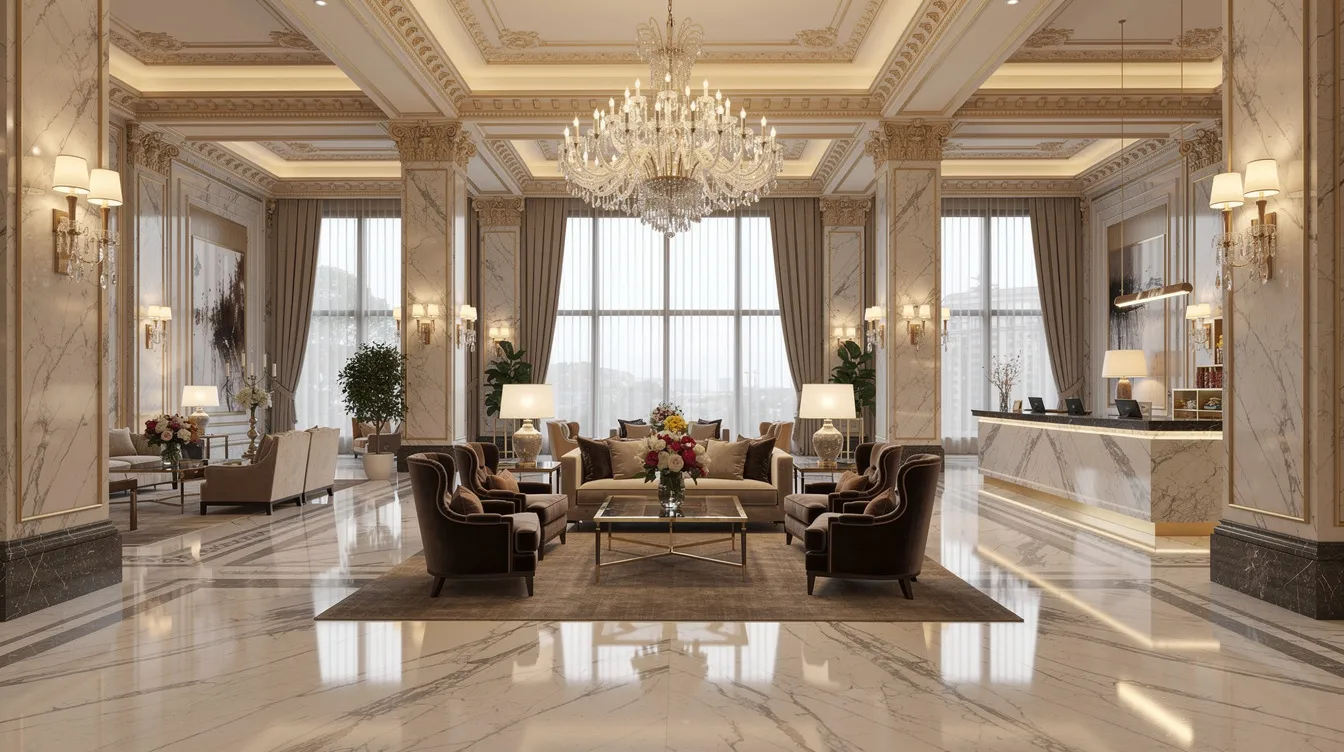
In luxury hotel development cost, interior finishes can sometimes rival or exceed bare construction cost-particularly for 5-star hotels with premium flooring, imported stone, custom panelling and luxury bathroom specifications. Brand standards and positioning significantly impact luxury hotel setup costs at this stage.
Key interiors to budget for:
- Guest room interiors: wardrobes, headboards, premium bathrooms with stone tiles, glass shower partitions
- Suite interiors with enhanced joinery and furnishings
- Lobby design: stone flooring, feature walls, decorative lighting
- Restaurant and bar interiors; banquet and pre-function fit-out
- Spa and wellness interiors
- Public area ceilings, wall finishes and artwork
As a planning-level ballpark: interiors and fit-out for a quality 4-star hotel might range ₹1,500–₹2,500 per square foot, whereas a 5-star with imported finishes and international design firms may run ₹2,500–₹4,000+ per square foot depending on scope. These are indicative ranges and shift with market conditions, building materials availability, and transportation costs for specialty items.
Interior choices significantly differentiate a four star versus five star hotel construction cost. High-end design changes mid-project are among the most common causes of cost escalation and should be controlled through clear BOQs and strict change-control protocols.
MEP, Plant & Machinery – The Technical Backbone
MEP (Mechanical, Electrical, Plumbing) and plant and machinery commonly represent 20–30% of total luxury hotel construction cost in India. These systems are the technical backbone of guest comfort, safety and operational efficiency.
Key systems include:
- Central HVAC / chiller plant or VRV/VRF systems
- Electrical distribution, transformers, HT/LT panels
- Diesel generator (DG) backup sets
- Guest lifts and service elevators
- Fire detection and fire-fighting systems (fire safety certificates are required for hotel operations)
- Plumbing, water supply and hot water systems (boilers/heat pumps)
- Sewage treatment plant (STP) and effluent treatment
- Water treatment / RO plant
- Kitchen exhaust and fresh air handling
- Laundry machinery
- CCTV, access control and security systems
- IT/data cabling and networking infrastructure
- Building management system (BMS) and property management system (PMS)
Modern hotels require a property management system, and technology setup costs range from ₹10,000 to ₹50,000 per room. Smart hotel systems-including smart TVs, keyless locks, and in-room automation-can add ₹25,000 to ₹50,000 per room. Essential technology also includes booking engines and payment gateways for direct bookings and guest satisfaction.
Higher star hotels need greater redundancy, higher-capacity HVAC, more lifts, and larger kitchens and laundries. For example, a 100-room 5-star may require two 500–600 KVA DG sets, 4–6 guest lifts and 2 service lifts-specifications that push MEP budgets well beyond those of a smaller 4-star property. Lenders scrutinise these components carefully when reviewing hotel construction cost estimates.
Furniture, Fixtures, FF&E and OS&E
FF&E (Furniture, Fixtures & Equipment) refers to moveable items with high aesthetic or durability requirements: beds, sofas, desks, minibars, safes, decorative lighting and bathroom fittings. OS&E (Operating Supplies & Equipment) covers operational consumables: linen, crockery, cutlery, glassware, kitchen smallwares, housekeeping trolleys and uniforms.
Areas to budget:
- Guest room furniture, mattresses, TVs, in-room technology
- Bathroom fixtures and accessories
- Lobby, lounge, restaurant and bar furniture
- Banquet tables, chairs and staging equipment
- Office and back-of-house furniture
- Spa, pool and recreational facilities furniture
FF&E typically costs between ₹40 lakh to ₹1 crore per room for luxury properties, though FF&E costs usually account for around 10% of the overall budget. For a mid-to-upper 4-star hotel, FF&E and OS&E may broadly range from ₹8–₹15 lakh per key. For a branded international 5-star, expect ₹15–₹30 lakh per key or more, depending on brand standards and import content. A comprehensive planning resource on luxury hotel equipment, furniture and FF&E cost provides detailed category-wise breakdowns.
Mis-budgeting FF&E is a frequent cause of funding gaps. A detailed FF&E schedule-with vendor quotes-should form a core part of the luxury hotel project report.
Pre-Operative, Pre-Opening Expenses and Interest During Construction
Beyond pure construction costs, a realistic luxury hotel setup cost in India must include all pre-operative expenses incurred until commercial opening. Operational pre-opening expenses typically require 10–15% of the total project cost. Pre-opening expenses include staff training and marketing, directly affecting initial costs.
Typical items:
- Architectural, structural and MEP consultancy fees; interior design fees
- Project management fees and statutory approval fees
- Branding, technical services and franchise fees (franchise fees significantly increase hotel opening costs)
- Company incorporation and legal expenses
- Recruitment and HR costs; pre-opening staff salaries and training programs
- Trial runs and soft-opening operations
- Initial marketing and launch events
- Administration, office overheads and travel
- Licensing requirements vary by state and local authorities; FSSAI registration is needed if serving food in hotels
Interest during construction (IDC) deserves special attention. For a 30–42 month development period, IDC on term loans can represent 8–15% of total project cost, especially if approvals or construction are delayed. Banks typically treat IDC and pre-operative expenses as part of eligible project cost for hotel project finance, subject to norms, and these must be built into the DPR. Underestimating pre-opening expenses often leads to a last-minute cash crunch.
Contingency Provision and Escalation
- Luxury hotel projects in India usually run 30–40+ months from concept to opening. A structured contingency for cost escalation is essential, not optional.
- Typical practice: 5–10% contingency on hard costs (construction + MEP + interiors), sometimes with a separate escalation assumption for multi-year projects. Material costs and labor costs have been inflating at 8–12% year-on-year in recent years.
- Common triggers: changes required by international brands, upgrades in building materials and finishes, additional basement or parking, expanded banquet or spa, or regulatory changes in fire and environmental norms.
- Lenders look for a realistic contingency in the project cost. Without it, the project risks under-financing and mid-project funding gaps.
Working Capital Requirement After Opening
Project completion does not end cash requirements. Luxury hotels may need a working capital buffer to sustain operations during the stabilisation period-often 12–18 months before occupancy and revenue reach maturity.
Main items:
- Opening stock of F&B and housekeeping consumables
- Payroll buffer for first 3–6 months (payroll costs are among the largest fixed operational costs in luxury hospitality; luxury hotels require a high staff-to-room ratio, often 2:1 or higher)
- Staffing costs typically account for 25–35% of direct costs
- Utilities-power, gas, water-can significantly impact operational costs, especially in peak seasons
- Routine maintenance and repairs
- Marketing, OTA commissions and travel-agent credit
- Insurance costs add 10–15% to the operational budget
- Operational costs can range from 1–5% of total project costs as operating reserves during ramp-up
For a 4-star or 5-star hotel, plan for at least 3–6 months of operating expenses as working capital, partly funded through bank working capital limits and partly through promoter margin money. Underestimating working capital can force promoters to divert funds from other businesses, hurting both hotel operations and loan servicing.
4-Star Hotel Setup Cost in India – Illustrative Scenarios
The figures below are indicative planning ranges for 2025–26 conditions, assuming a mid-tier Indian city or secondary metro location. Land cost is excluded from per-key numbers. Globally, a 4-star hotel costs approximately $260 to $410 per square foot, and construction costs for a 100-room 4-star hotel average around $31.82 million in international benchmarks-though Indian costs differ based on local conditions.
| Rooms | Indicative Built-Up Area (sq. ft) | Approx. Cost Per Key (Excl. Land) | Indicative Total Project Cost (Excl. Land) |
|---|---|---|---|
| 50 | 75,000–1,00,000 | ₹1.20–₹1.75 crore | ₹60–₹90 crore |
| 75 | 1,10,000–1,50,000 | ₹1.10–₹1.60 crore | ₹85–₹120 crore |
| 100 | 1,50,000–2,00,000 | ₹1.00–₹1.50 crore | ₹100–₹150 crore |
| 150 | 2,25,000–3,00,000 | ₹0.95–₹1.40 crore | ₹140–₹210 crore |
Assumptions: efficient site layout; G+4 to G+8 structure; moderate-quality interiors with domestic finishes; single specialty restaurant plus all-day dining; medium-sized banquet hall; fitness centre without extensive spa; standard room service facilities.
Why can two 100-room 4-star hotels have different project costs? Built-up area per key, extent of banquet and F&B facilities, basement parking requirements, and brand standards all create variance. Not all hotels with the same room count have the same cost profile. Smaller projects (50 rooms) suffer from higher per-key costs because fixed infrastructure and public-area costs are spread over fewer rooms.
5-Star Hotel Setup Cost in India – Illustrative Scenarios
Five star hotel setup cost in India rises because of larger room sizes (often 40–50 sq. m or more), premium interiors, multiple restaurants, larger banquet and convention spaces, full spa with treatment rooms, swimming pool, sophisticated MEP systems, higher FF&E standards and elaborate landscaping. Luxury hotels need more space per room compared to non-luxury hotels. A 5-star hotel can cost $332 to $550 per square foot in international terms, and construction costs for a 100-room 5-star hotel can exceed $60 million globally.
| Rooms | Indicative Built-Up Area (sq. ft) | Approx. Cost Per Key (Excl. Land) | Indicative Total Project Cost (Excl. Land) |
|---|---|---|---|
| 50 | 1,00,000–1,40,000 | ₹2.00–₹3.00 crore | ₹100–₹150 crore |
| 75 | 1,50,000–2,00,000 | ₹1.85–₹2.80 crore | ₹140–₹210 crore |
| 100 | 2,00,000–2,75,000 | ₹1.75–₹2.50 crore | ₹175–₹250 crore |
| 150 | 3,00,000–4,00,000 | ₹1.60–₹2.30 crore | ₹240–₹345 crore |
Features that push up 5-star hotel construction cost include double-height lobbies, specialty and rooftop restaurants, premium kitchens, convention-quality banqueting, a full spa, elaborate water features, and luxury properties with imported stone and veneer finishes. In prime CBD locations of Mumbai, Delhi NCR or Bengaluru, if land is purchased at market rates, all-in 5-star hotel investment per key can escalate far beyond these construction-based ranges-sometimes to ₹4–₹5+ crore per key when land is included.
Actual hotel construction cost must be validated through project-specific BOQs, vendor quotations and detailed estimates before financial closure.
4-Star vs 5-Star Hotel Investment – Comparative View
Star classification is only one driver of luxury hotel investment in India, but it shapes room size, FF&E standards, F&B mix and cost per key. A well-positioned 4-star with efficient construction costs and strong demand in the tourism sector can be financially more attractive than an overbuilt 5-star in a weak market-especially when assessed on DSCR and IRR.
| Parameter | 4-Star Hotel | 5-Star Hotel |
|---|---|---|
| Room size (typical) | 28–35 sq. m | 40–55+ sq. m |
| Lobby & public areas | Moderate scale | Grand, double-height |
| Interior & material grade | Good domestic finishes | Premium, often imported |
| FF&E per key | ₹8–₹15 lakh | ₹15–₹30+ lakh |
| F&B outlets | 1–2 restaurants | 3–5 restaurants + bars |
| Banquet facilities | 1 hall + meeting rooms | Multiple halls + convention |
| Spa, pool & recreation | Fitness + basic pool | Full spa, pool, more amenities |
| Cost per key (excl. land) | ₹1.0–₹1.75 crore | ₹1.75–₹3.0+ crore |
| Operating cost intensity | Moderate | High (higher staff-to-room ratio) |
| Target customer | Business travellers, mid-premium leisure | Corporate, luxury leisure, MICE |
A boutique hotel concept can blur the 4-star/5-star boundary-higher interior cost per key but lower room count, producing a different investment profile for urban hotels or leisure hotels.
Cost Per Key / Cost Per Room – How to Use This Metric
Cost per Key = Relevant Hotel Development Cost ÷ Number of Saleable Guest Rooms (Keys)
Investors, lenders and valuers in the Indian hotel industry rely on cost-per-key benchmarks to quickly compare hospitality projects. The metric is used in bank appraisals, valuation reports and investment committee memos. But the variant matters:
- Cost per key excluding land – most commonly quoted in industry reports
- Cost per key including land – reflects the promoter’s total investment
- Replacement cost per key – used in acquisition and asset valuation
Numeric example: a 100-room new hotel with ₹180 crore total development cost excluding land has a cost per key of ₹1.8 crore. If land worth ₹70 crore is added, the all-in cost per key rises to ₹2.5 crore. The construction cost for a 100-room 3-star hotel averages $22.1 million globally, while a 3-star hotel costs $190 to $375 per square foot-illustrating how dramatically costs escalate with star category.
Limitation: cost per room does not capture hotel revenue potential, occupancy, ARR or market depth. Two hotels with the same cost per key may have vastly different financial feasibility depending on location, concept and guest satisfaction factors.
Project Cost & Means of Finance Structure
Total project cost as it appears in DPRs typically includes: land (if financed), site development, building and civil works, interior works, MEP/plant and machinery, kitchen and laundry equipment, FF&E and OS&E, external works, professional fees, pre-operative expenses, IDC, contingency and working capital margin.
Typical means of finance:
- Promoter equity contribution
- Unsecured or subordinated promoter loans
- Bank term loan (banks typically finance 60 to 75% of hotel project costs)
- Institutional or NBFC finance (non banking financial companies)
- Possible strategic investor equity from private investors
- Separate working capital limits for operations
Promoters must contribute 25 to 40% of hotel project costs as equity. Equity financing is commonly used alongside loans for hotels. Government schemes can support hotel project financing in India, particularly for projects in underserved tourism destinations. A comprehensive business plan strengthens funding applications.
A separate detailed resource on luxury hotel project cost and means of finance covers financing structures in greater depth.
Revenue Potential, Occupancy, ARR and Break-Even – Why Setup Cost Is Only Half the Story
Deciding whether a luxury hotel investment in India is justified requires connecting setup cost to hotel revenue and profitability-not just calculating construction cost. Operating costs and associated costs of running the hotel business must be projected alongside revenue.
- Room revenue: driven by occupancy percentage and Average Room Rate (ARR/ADR)
- F&B revenue from restaurants, bars and room service
- Banquet and event income
- Spa and wellness revenue from recreational facilities
- Other operating income: parking, rentals, business centre
RevPAR (Revenue per Available Room) = Occupancy × ARR. This single metric drives break-even analysis and operating leverage. A dedicated guide on the luxury hotel revenue model covers revenue streams in detail, while the resource on luxury hotel occupancy, ARR, RevPAR and break-even analysis explains how to calculate achievable performance.
Financial Projections in the Luxury Hotel DPR
After estimating setup cost and revenue assumptions, promoters must prepare integrated financial projections for at least 7–10 years for bank appraisal:
- Projected Profit & Loss (with occupancy and ARR-based revenue build-up)
- Projected Balance Sheet (reflecting asset creation and loan balances)
- Projected Cash Flow statement
- Supporting schedules for depreciation, interest and loan repayment
DSCR (Debt Service Coverage Ratio) = Net Cash Available for Debt Service ÷ Annual Debt Service. Lenders focus heavily on DSCR because it indicates whether the hotel can comfortably service its debt. IRR and payback period provide additional viability signals. The dedicated resource on luxury hotel financial projections for DPR covers formats, assumptions and ratios in depth.
Feasibility, Bank Loan and How Banks Assess Luxury Hotel Projects
Spending ₹100–₹300 crore on a 4-star or 5-star hotel without a proper feasibility study is risky, regardless of how attractive the average construction costs appear. The hotel development must be commercially viable-not just architecturally impressive.
Feasibility assessment covers:
- Local and regional demand: corporate, leisure, MICE segments
- Competitor supply and pipeline (including guest houses and budget hotels)
- Achievable occupancy and ARR; realistic F&B and banquet potential
- Operating cost structure and staffing costs
- Overall project IRR and DSCR under conservative scenarios and sensitivity/risk factors
Banks evaluating project finance for a luxury hotel consider:
- Promoter background, financial strength and existing property holdings
- Clear land title, approvals and building permits status
- Detailed cost estimation, implementation schedule and project management quality
- Reasonableness of room count and facility mix
- Revenue assumptions benchmarked to market; operating profitability
- DSCR pattern and debt service capacity
- Collateral, security and sensitivity analysis
Detailed guidance is available in the luxury hotel feasibility study and project viability resource, the guide on bank loan and project finance for a luxury hotel, and the resource explaining how banks assess a luxury hotel term loan proposal.
Illustrative Luxury Hotel Project Cost Example (100-Room City Hotel)
The following is a purely illustrative example of a 100-room upscale 5-star-equivalent hotel in a Tier-1 fringe or strong Tier-2 city. Land is shown separately. All figures are planning estimates only.
| Cost Head | Indicative Amount (₹ Crore) |
|---|---|
| Land (assumed separate value) | 40–80 (varies enormously) |
| Site development & external works | 5–8 |
| Civil construction (building shell) | 55–75 |
| Interior finishes & fit-out | 25–40 |
| MEP / Plant & machinery | 20–30 |
| Kitchen & laundry equipment | 4–6 |
| FF&E & OS&E | 15–25 |
| IT, security & PMS | 2–4 |
| Professional & approval fees | 3–5 |
| Pre-operative & pre-opening expenses | 8–12 |
| Interest during construction (IDC) | 12–20 |
| Contingency (5–8% of hard costs) | 6–10 |
| Working capital margin | 4–6 |
| Total Project Cost (excl. land) | ~₹160–₹240 crore |
| Total with land (indicative) | ~₹200–₹320 crore |
Illustrative means of finance (excluding land, assuming ₹200 crore project cost):
| Source | Amount (₹ Crore) | % of Project Cost |
|---|---|---|
| Promoter equity | 60–70 | ~30–35% |
| Bank term loan | 130–140 | ~65–70% |
| Total | 200 | 100% |
Actual luxury hotel setup cost and financing structure must be customised to each project. Lenders expect professionally prepared cost estimates with upfront costs, detailed timelines and sensitivity analysis.
Cost Overruns, Underestimated Items and Risk Management
From a project finance perspective, many hotel projects in India face overruns not because of core brick and mortar costs alone but due to design drift, delays and underestimated soft costs.
Common causes of escalation:
- Delayed approvals and environmental clearances
- Contractor mobilisation issues and labor costs inflation
- Design changes during construction; upgrades to more expensive construction materials
- Additional basements, parking or banquet space mid-project
- Sharp increases in steel, cement and material costs
- Extended development periods increasing IDC and additional costs
Frequently underestimated items:
- Pre-opening payroll, training and recruitment (especially with high staff-to-room ratios)
- Full FF&E and OS&E scope, including back-of-house
- IT systems, property management system and PMS licensing
- Security and CCTV
- Licences, utility deposits (electricity, gas), signage
- Staff accommodation; landscaping beyond basic scope
- Initial marketing, branding and launch costs
- Adequate contingency and working capital (operating reserves)
Underestimation leads to funding gaps, cost overruns and sometimes stalled projects-adversely affecting DSCR and lender confidence. Risk mitigation includes fixed-price contracts where feasible, detailed BOQs, strict change-control, periodic cost reviews and energy efficiency measures to control long-term operating costs.
DPR Quality, Bankability and Professional Perspective (CA Manish Gugliya)
As a Chartered Accountant and project finance consultant, I believe a well-prepared luxury hotel DPR must logically link: project concept and location → detailed project cost → means of finance → implementation schedule → realistic revenue and operating assumptions → profitability → cash flows → DSCR and repayment capacity. Green building practices and modern construction methods can also improve long-term viability.
- Projections are estimates, not guarantees. The role of a CA and DPR consultant is to prepare, review and analyse assumptions and financial models-not to “certify” future profits.
- Promoters should involve financial and technical professionals early-before locking in land and brand contracts-to avoid committing to a hotel project that cannot sustain the required debt.
- Luxury hotel investment should be treated as a long-term operating business, not just a real estate construction project. Loan servicing depends on stable operating cash flows generated by the hotel business, not on building value alone. The upper mid market segment and leisure hotels each carry distinct risk profiles that must be assessed individually.
Conclusion – Putting Luxury Hotel Setup Cost in the Right Perspective
Luxury hotel setup cost in India depends far more on configuration-room count, cost per key, built-up area per room, facility mix and prime location characteristics-than on the label “4-star” or “5-star” alone. Two properties with the same star rating can differ by ₹50–₹100 crore in total cost based on design ambition, brand requirements and city.
The composite investment formula in simple terms: Number of Rooms × Cost per Key (covering building, interiors, MEP and FF&E) + Land and Site Development + Pre-Operative & IDC + Contingency + Working Capital Margin = Total Luxury Hotel Investment. Every component requires project-specific estimation, not industry averages.
Promoters should base decisions on a structured DPR, feasibility study and realistic financial projections rather than thumb rules or average costs alone. From my perspective as CA Manish Gugliya, the defining question is not only “How much will the hotel cost to build?” but: “Can the proposed hotel generate sufficient and sustainable cash flow to justify this investment and service the proposed debt over its life?” That question-answered rigorously-separates viable hospitality projects from expensive mistakes.
FAQs – Luxury Hotel Setup Cost in India
These FAQs address common practical questions for serious 4-star and 5-star hotel investors, covering areas beyond the main narrative.
How much does it typically cost to build a 100-room 4-star or 5-star hotel in India?
In a Tier-2 city with moderate land cost, a 100-room 4-star hotel might broadly require ₹100–₹150 crore excluding expensive CBD land, while a 5-star with larger rooms and more amenities might need ₹175–₹250 crore excluding land, under 2025–26 level assumptions. In top metros or coastal resort locations, land alone can range from ₹50–₹300+ crore, pushing the final cost substantially higher. These figures include building, interiors, MEP, FF&E, pre-operative expenses, IDC, contingency and initial working capital. Serious promoters should commission a project-specific cost estimation and DPR rather than relying solely on generic ranges.
Does luxury hotel setup cost in India usually include land value?
Most industry benchmarks for cost per key are quoted “excluding land” because land values vary dramatically between markets and even within a city. For bank loan appraisal, total project cost can be presented both ways-with land value (to show total investment) and without land (to focus on development cost eligible for term finance). Where land is already owned, CAs often show a notional land value in the DPR for IRR and viability analysis, but lenders may or may not finance that portion. Promoters must be clear whether their budgeting and payback calculations are on a “with land” or “without land” basis.
How long does it usually take to complete a 4-star or 5-star hotel project in India?
From land acquisition and concept to opening, a typical greenfield luxury hotel project may take 30–42 months under normal conditions, sometimes extending to 48–54 months if approvals or funding are delayed. Broadly: 6–9 months for design, approvals and financial closure; 18–24 months for core civil construction; and 6–12 months overlapping for interiors, MEP commissioning, FF&E installation and pre-opening preparations. Every month of delay adds to interest during construction and can significantly increase the overall development cost, so conservative timelines should always be built into IDC and contingency planning.
Is it cheaper to convert an existing building into a luxury hotel instead of building new?
Adaptive reuse of an existing property-commercial or residential-can reduce structural construction costs, but often requires substantial investment in reconfiguration, MEP upgrades and compliance with fire and hotel norms. Limitations in floor plate, ceiling heights, shaft locations and parking can reduce operating efficiency and revenue potential compared to a purpose-built hotel. Conversion feasibility must weigh incremental capex against long-term room revenue, F&B and banquet potential; sometimes a new hotel is preferable despite higher upfront construction cost. A preliminary technical and financial feasibility study should precede the decision between greenfield, brownfield or conversion options.
What promoter contribution is generally required for a bank-financed luxury hotel?
Indian banks typically expect 25–35% of the eligible project cost from promoter equity and subordinated sources, with 65–75% coming as term loan-though exact ratios depend on project risk, lender policy and promoter profile. Higher-risk locations, very large ticket sizes or first-time promoters may face tighter leverage norms and may need additional collateral support. Banks also examine whether equity is brought in upfront in line with construction milestones, rather than back-ended relative to loan disbursement. A well-structured means-of-finance plan backed by realistic financial projections and DSCR analysis is essential for sanction of any 4-star or 5-star hotel project in the Indian hospitality industry.
Explore More Luxury / 4-Star & 5-Star Hotel Project Report Guides
Continue exploring our Luxury, 4-Star and 5-Star Hotel DPR guides covering setup cost, equipment, project cost, revenue, financial projections, occupancy, feasibility, project finance and bank loan assessment.