Key Takeaways
- DSCR (Debt Service Coverage Ratio) is a core test banks use to judge whether a General Hospital’s projected cash accrual will comfortably cover term-loan principal and interest obligations throughout the repayment period.
- For a new 10–50 bed hospital in India, lenders typically examine year-wise DSCR, average DSCR and minimum DSCR across the entire loan tenure-not just overall profitability on paper.
- DSCR for a hospital project is usually calculated from projected Profit After Tax plus non-cash expenses like depreciation and interest on the term loan, divided by the annual term-loan repayment schedule (principal plus interest).
- Realistic assumptions on bed occupancy, OPD/IPD mix, operating expenses, staffing costs and interest rates are far more important than a “high” DSCR created through aggressive or unsupported projections.
- A bankable General Hospital DPR should integrate project cost, means of finance, hospital cash flow projections, working capital requirement and term-loan repayment into one consistent DSCR analysis.
Explore General Hospital DPR Guides
Explore our complete series on General & Small Hospital project planning, cost, financial projections, repayment capacity and bank finance.
Introduction: Why Profit Alone Is Not Enough for a Hospital Loan
As a practising Chartered Accountant, I have worked on numerous hospital project reports over the years, and one of the most common misconceptions I encounter is this: promoters believe that if their projected Profit & Loss Account shows a positive bottom line, the bank will sanction the term loan. That is simply not how it works.
When you apply for a business loan or term loan for a General Hospital, the lender is not just looking at whether you will be profitable. The bank needs to know whether your projected hospital cash flow and cash accrual will generate sufficient income to meet yearly debt service-meaning both interest and principal repayments-for the full repayment tenure. Showing profit in an accounting sense is necessary, but it is not the same as demonstrating repayment capacity.
Hospital projects-whether 10-bed, 20-bed, 30-bed or 50-bed-involve substantial capital expenditures on land, building, interiors and medical equipment, along with a long operational stabilisation period. These projects demand careful financial planning. The debt service coverage ratio, commonly known as DSCR, is one of the primary tools lenders use to assess whether a hospital can sustain its debt obligations. DSCR is crucial for strategic financial planning and growth of any hospital venture.
In this article, I will explain what general hospital DSCR means, how it is calculated, what lenders typically look for, what factors influence it, and how it fits into a professionally prepared General Hospital DPR for bank finance.

What Is DSCR in a General Hospital Project?
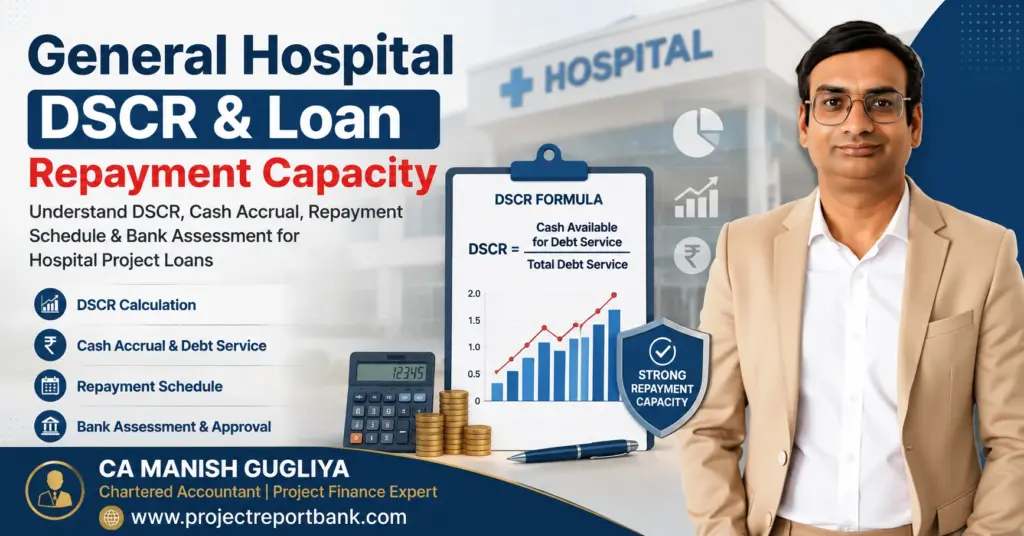
The debt service coverage ratio measures how many times a hospital’s cash available for debt service covers its annual debt service (principal plus interest). In its simplest form, DSCR is calculated by dividing net operating income by total debt service. Here, net operating income equals revenue minus certain operating expenses, adjusted for non-cash items relevant to the project.
For hospital project finance, “Cash Available for Debt Service” is typically built from cash accrual: Profit After Tax plus Depreciation plus Interest on Term Loan, along with any other relevant non-cash adjustments. This is different from simply looking at net profit on the Profit & Loss statement.
“Total Debt Service” means all scheduled term-loan principal instalments plus the interest obligation for that specific year, as per the sanctioned repayment schedule. Total debt service includes both interest and principal payments due during that period.
It is important to distinguish between three related but different concepts:
- Profitability is what your Profit & Loss Account shows after all expenses and taxes.
- Cash accrual adds back non-cash charges like depreciation to arrive at the actual cash generated from operations.
- Debt servicing ability is the capacity to make obligatory cash payments-principal repayments and interest payments-on time from that cash accrual.
A hospital can show accounting profit yet still struggle with loan instalments. For example, if a 30-bed hospital earns ₹50 lakh net profit but has ₹55 lakh in annual principal and interest obligations, repayment pressure is real despite the profit figure. Heavy working-capital needs or delayed insurance collections can make the situation worse.
Why DSCR Is Important for a Hospital Bank Loan
DSCR helps assess a company’s ability to repay loans-and in our context, a hospital’s ability to service its term loan. When Indian banks and NBFCs evaluate a hospital term-loan proposal, the DSCR ratio tells them whether projected operating performance will produce enough cash to cover debt payments with a reasonable margin of safety.
A higher DSCR generally indicates more financial flexibility for a hospital. If occupancy falls short or expenses rise unexpectedly, a hospital with stronger DSCR has more cushion. Most lenders prefer a DSCR of 1.25 or higher for adequate financial safety, and lenders often require a minimum DSCR of 1.2 to 1.25 in their internal appraisal guidelines.
However, DSCR is only one part of the assessment. Banks also evaluate promoter contribution, project cost, means of finance, collateral, the borrower’s credit history and clinical experience, hospital location, working capital adequacy and statutory approvals. In many bank appraisals, minimum DSCR and average DSCR conditions are embedded in internal credit notes, even if they are not always mentioned explicitly in the sanction letter.
How to Calculate DSCR for a General Hospital
The methodology may vary slightly across banks, but the core logic remains consistent in project finance for hospitals. Income taxes complicate DSCR calculations somewhat, which is why the computation starts with Profit After Tax rather than pre-tax profit.
The typical build-up for “Cash Available for Debt Service” in a hospital project:
- Start with Projected Profit After Tax
- Add back Depreciation and Amortisation (non-cash expenses)
- Add back Interest on Term Loan
- Adjust for other non-cash items, if applicable
“Total Debt Service” normally includes only long-term term-loan principal instalments due in the year plus interest on that term loan. To calculate total debt service, you sum the principal payments and interest for each year as per the repayment schedule. The formula considers interest payments and principal together.
Illustrative Formula (Project Finance Approach):
DSCR = (Profit After Tax + Depreciation + Interest on Term Loan) ÷ (Annual Principal Repayment + Annual Interest on Term Loan)
This is an indicative project-finance approach, not a single fixed formula prescribed identically by every lender. Some banks may use EBITDA-based formats or adjust for non operating income, but the core concept remains the same. When preparing a General Hospital Project Report for bank loan, the DSCR sheet must tie back exactly to the projected Profit & Loss, Cash Flow and term-loan repayment schedule.
General Hospital DSCR Calculation – Practical Example
Let me illustrate with a hypothetical 30-bed General Hospital in India, using stabilised Year 3 figures.
| Particulars | Illustrative Amount |
|---|---|
| Profit After Tax | ₹65.00 lakh |
| Depreciation | ₹28.00 lakh |
| Interest on Term Loan | ₹22.00 lakh |
| Cash Available for Debt Service | ₹115.00 lakh |
| Principal Repayment | ₹30.00 lakh |
| Interest on Term Loan | ₹22.00 lakh |
| Total Debt Service | ₹52.00 lakh |
| DSCR | 2.21 times |
Step-by-step: Cash Available = ₹65 + ₹28 + ₹22 = ₹115 lakh. Total Debt Service = ₹30 + ₹22 = ₹52 lakh. DSCR = ₹115 ÷ ₹52 = 2.21 times. A DSCR of 1.20 means income covers 120% of debt payments; here, at 2.21 times, the hospital generates well over double its required debt payments.
A DSCR of at least 2.00 is considered very strong, so from a bank perspective this stabilised-year figure would typically be comfortable. However, this is only illustrative-actual acceptable DSCR depends on lender policy, debt structure, and project specifics.

Year-Wise DSCR vs Average DSCR
Hospital cash flows are not uniform across years. Early years typically show lower occupancy and weaker DSCR, while later years improve as operations stabilise. Banks therefore examine year-wise DSCR, minimum DSCR (the weakest single year) and average DSCR across the entire loan tenure.
| Financial Year | Cash Available (₹ lakh) | Principal (₹ lakh) | Interest (₹ lakh) | Total Debt Service (₹ lakh) | DSCR |
|---|---|---|---|---|---|
| Year 1 | 52.00 | 20.00 | 26.00 | 46.00 | 1.13 |
| Year 2 | 72.00 | 25.00 | 24.00 | 49.00 | 1.47 |
| Year 3 | 115.00 | 30.00 | 22.00 | 52.00 | 2.21 |
| Year 4 | 125.00 | 35.00 | 18.00 | 53.00 | 2.36 |
| Year 5 | 130.00 | 40.00 | 14.00 | 54.00 | 2.41 |
| Average | 1.92 |
Notice that the average DSCR of 1.92 looks comfortable, but Year 1 DSCR is only 1.13-close to the threshold where many banks get cautious. The interplay between rising principal instalments, declining interest and gradually improving occupancy creates this pattern. When preparing hospital DSCR projections, ensure no year-wise DSCR dips to a level that would cause practical repayment difficulty.
What Is a Good DSCR for a Hospital Project?
There is no single mandatory DSCR applicable to every lender or every General Hospital project. Policies vary with the financial institution, risk appetite and loan terms.
A DSCR of 1.00 means income equals debt service obligations-leaving zero margin for error. A DSCR below 1.00 indicates financial difficulties, meaning the hospital cannot cover its debt from operations. A DSCR above 1.25 is generally considered good, while a DSCR of 1.5 or higher indicates strong debt-servicing capacity and financial health.
Acceptable DSCR depends on project size, location risk, occupancy assumptions, promoter profile, collateral, repayment tenure and the hospital’s overall financial health. DSCR is considered alongside other financial ratios such as debt to equity ratio, interest coverage ratio and project IRR, as well as qualitative aspects like promoters’ clinical and managerial experience.
How Hospital Revenue Drives Loan Repayment Capacity
Loan repayment ultimately comes from patient-related revenue, not from capital infusion. The DSCR will be as robust or weak as the underlying revenue model. Patient volume shifts impact a hospital’s operating margins and DSCR directly. DSCR is influenced by factors including payer mix and reimbursement rates, making revenue assumptions critical. Efficient revenue-cycle management supports DSCR by accelerating cash flow from operations.
OPD Revenue
Outpatient consultations are typically the main entry point for building a patient base and referrals. Daily OPD footfall multiplied by average consultation charges feeds directly into cash inflow supporting debt service.
IPD Revenue
Inpatient revenue from admitted patients-room rent, nursing charges, procedure fees-usually contributes the largest share of hospital revenue and has the most significant impact on DSCR, especially for 20–50 bed general hospitals.
Bed Occupancy
Bed occupancy percentage (occupied beds ÷ total beds) is the single most sensitive assumption. Higher occupancy improves revenue, EBITDA and cash accrual, thereby strengthening hospital DSCR.
Average Revenue per Occupied Bed
DSCR depends on both occupancy and ARPOB (Average Revenue per Occupied Bed). Pricing must be realistic relative to local market conditions and payer mix-overstating ARPOB produces artificially strong projections.
Diagnostic Revenue
Radiology and laboratory diagnostics (X-ray, ultrasound, CT scan, pathology) typically generate relatively high-margin revenue that strengthens operating surplus and the hospital’s debt servicing capacity.
Pharmacy and Other Ancillary Revenue
Pharmacy margins, consumables sales, physiotherapy and ambulance services add incremental revenue streams that can modestly enhance DSCR when accurately projected.
Procedure and Surgery Revenue
Procedure-heavy specialties-orthopaedics, general surgery, gynaecology-can significantly boost revenue per bed. However, assumptions on volume and case mix must reflect realistic catchment demand, not aspirational figures. For a deeper understanding of how hospital revenues are built up, refer to the guide on General Hospital Revenue Model & Financial Projections.
Effect of Bed Occupancy on Hospital DSCR
Small variations in occupancy can materially change hospital DSCR and loan repayment comfort. Consider a 30-bed hospital under three scenarios:
- At 40% occupancy (12 occupied beds/day): Revenue is limited, but fixed costs like salaries, electricity and maintenance remain largely constant. Operating surplus may barely cover debt service, pushing DSCR close to 1.0 or below.
- At 55% occupancy (16–17 beds): Revenue rises meaningfully while most costs remain stable. Cash accrual improves and DSCR moves into a more comfortable range.
- At 70% occupancy (21 beds): Revenue scales further against the same fixed-cost base, producing significantly stronger operating margins and robust DSCR.
For a new General Hospital, it is prudent to assume conservative occupancy in initial years-perhaps 30–40% in Year 1-gradually increasing over 3–4 years. During bank discussions, promoters should be prepared to justify occupancy assumptions with local demand data and competition mapping.
Hospital Operating Costs and Their Effect on Repayment Capacity
Underestimating hospital operating expenses is one of the most common reasons for overstated DSCR in project reports. Hospitals face substantial fixed costs and capital requirements, which directly affect DSCR.
Major cost heads include: doctors’ remuneration (fixed and revenue-sharing), nursing and paramedical staff salaries, technicians, administrative staff, housekeeping, security, biomedical waste management, oxygen and medical gases, medicines and consumables, electricity, water, maintenance, repairs, insurance, marketing and IT infrastructure. High labor costs account for 50% to 60% of a hospital’s operating expenses, making salary estimation critical.
Many of these operating costs are relatively fixed in the short term, so at lower occupancy they squeeze margins and weaken projected DSCR. Operational efficiency in managing these costs directly influences repayment capacity. A bank appraiser will often sensitise salary, consumables and utility cost assumptions to test whether the project retains sufficient loan repayment capacity under less favourable conditions.

How Term Loan Structure Affects DSCR
The same hospital project can show very different DSCR depending on the financing structure. Understanding this relationship is essential.
Loan Amount
A higher loan amount increases principal outstanding and yearly instalments. If cash accrual does not rise proportionately, DSCR declines. This is why the total debt relative to earning capacity matters more than the absolute loan amount.
Interest Rate
Even a 1–2% change in interest rates can meaningfully change yearly interest obligations, especially during early years when the outstanding principal is highest. DSCR models should factor in the possibility of floating-rate increases.
Repayment Tenure
Shorter tenure means higher annual principal payments but lower total interest over the loan life. Longer tenure reduces annual instalments and improves DSCR in early years, at the cost of more cumulative interest. As per Central Bank of India’s HOPE 4.0 scheme, hospital term loans can extend up to 15 years including moratorium.
Moratorium
The moratorium period is when principal repayment does not begin or is reduced. It helps the hospital during the ramp-up phase, though interest still accrues and must be serviced. Loan terms typically specify these conditions, along with any processing fees, guarantee fee or upfront fee.
Instalment Structure
Banks in India may use equated quarterly instalments, stepped schedules or back-loaded structures for long term loans. Front-loaded schedules compress early-year DSCR while back-loaded ones improve initial coverage but increase later obligations.
Promoter Contribution
Higher promoter equity means lower term-loan requirement and more comfortable DSCR. Excessive leverage can push DSCR below comfortable levels. Most bank schemes require 20–30% promoter contribution for hospital projects, and this directly affects the debt structure.
Moratorium Period and Hospital Stabilisation
A new General Hospital generally requires time for recruitment of doctors and nurses, TPA tie-ups, building referral networks and public awareness. During this initial phase, occupancy and revenue remain below stabilised levels-putting pressure on available cash flow for debt service.
An appropriately structured moratorium period (subject to lender approval) allows the hospital to focus on operational stabilisation before heavy principal instalments begin. This can significantly improve early-year DSCR and reduce financial stress during ramp-up.
Banks examine whether the moratorium requested is genuinely justified by project timelines-construction, commissioning, regulatory approvals and expected ramp-up-rather than merely a way to postpone repayment. Even during moratorium, interest accrues and is payable per sanctioned terms, and DSCR calculations must reflect this accurately.
DSCR and Hospital Cash Accrual
Cash accrual differs from accounting profit. Under accrual based accounting guidance, depreciation is a non-cash charge that reduces reported profit but does not consume actual cash. Cash accrual-Profit After Tax plus depreciation and similar non-cash items-represents the operating cash flow available before debt servicing.
A hospital with heavy medical equipment and building investment may show moderate profit but still have healthy cash accrual for debt servicing, because depreciation adds back a substantial amount. DSCR focuses on how much cash remains after operating and non-cash costs, before servicing term-loan principal and interest-not on net-worth growth or balance sheet ratios alone.
Consistent positive cash accrual over the loan tenure is essential to sustain acceptable DSCR, particularly in capital-intensive general hospitals where long term debt commitments span 7–15 years.
DSCR vs Working Capital – Do Not Confuse the Two
DSCR primarily relates to term-loan repayment capacity, while working capital deals with day-to-day liquidity for inventory, receivables and the operating cycle. These are separate assessments, and DSCR does not account for all financial obligations, particularly short term debt and current debt obligations related to working capital.
Consider a hospital with acceptable DSCR on projections but facing cash-flow stress because delayed payments from insurance companies and TPAs were not factored into working-capital planning. DSCR may not reflect actual cash availability in such situations, and the hospital faces liquidity pressure despite strong projected profitability.
Banks assess working-capital limits (like CC or overdraft) separately from term-loan DSCR. Both short term loans for working capital and long term loans for project finance must be adequately planned. Promoters seeking a comprehensive understanding of operating-cycle funding should refer to the guide on General Hospital Working Capital Requirement.
Connection Between Financial Projections and DSCR
DSCR cannot be calculated in isolation. It is derived from integrated financial projections covering revenue, cost, profitability, cash flow and loan structure. The key assumptions-patient volume, bed occupancy, ARPOB, tariff structure, salary levels, consumables as a percentage of revenue and utility costs-flow into the projected Profit & Loss Account, then into EBITDA, depreciation, interest and taxation, and finally into cash accrual which feeds the DSCR calculation.
A proper hospital projection model should include projected Profit & Loss, balance sheet and Cash Flow for 5–7 years, tied to the term-loan repayment schedule and DSCR working. These financial statements must be internally consistent-the company’s financial trend across years should tell a coherent story.
Project Cost, Means of Finance and Their Impact on DSCR
DSCR is strongly influenced by total project cost and the chosen means of finance. The chain is straightforward: higher project cost leads to higher term-loan requirement (if equity is limited), which increases annual debt service and lowers DSCR, unless the additional investment generates proportionally higher revenue.
A balanced debt to equity ratio is critical so that DSCR remains within comfortable levels throughout the repayment period. Excessive borrowing for non-critical features-lavish interiors or underutilised high-end equipment-can stress DSCR without meaningfully increasing revenue. When the hospital’s finances show heavy leverage, even minor revenue shortfalls can trigger repayment difficulty.
For a detailed discussion on project cost and funding structure, promoters can refer to the guide on General Hospital Project Cost & Means of Finance.
Hospital Equipment Investment and Debt Servicing
Medical equipment-OT tables, anaesthesia workstations, patient monitors, ventilators, imaging equipment, lab analysers-is a major component of capital cost in a General Hospital. Capital expenditures and operational efficiency significantly affect hospital DSCR.
Larger equipment investment adds to depreciation (which increases cash accrual) but also increases the loan amount and annual debt service. The net impact on DSCR depends on how much additional revenue the equipment generates. Some high-end machines may be financed separately through equipment loans or vendor finance with specific repayment terms-these must be included in the overall DSCR analysis if obligations are significant.
I generally advise promoters to evaluate revenue potential and utilisation before investing in expensive equipment purely for prestige, as idle assets still create repayment obligations that weaken DSCR. For detailed equipment-wise cost guidance, refer to the Small Hospital Equipment List & Cost in India.
Hospital Size, Setup Cost and Repayment Capacity
DSCR and loan repayment capacity differ significantly between a 10-bed nursing home and a 50-bed General Hospital. A smaller hospital may have lower project cost and a smaller term loan, but its revenue base is also limited. A 30–50 bed hospital has higher setup cost and total debt but greater potential to scale revenue and improve DSCR after stabilisation-existing units of an established chain may find this easier than first-time promoters.
Bank appraisal considers whether the chosen bed strength and specialties are appropriate for the catchment population, competition and promoter capability. Promoters should test DSCR at realistic occupancy levels before finalising bed count. For bed-wise setup cost details, refer to the guide on Small Hospital Setup Cost in India – 10, 20, 30 & 50 Bed Hospital.
Sensitivity Analysis for Hospital Loan Repayment
DSCR should first be computed under a base-case scenario and then tested under adverse conditions. Sensitivity analysis is a structured way to check whether hospital repayment capacity holds up if key assumptions move unfavourably. Seasonal income fluctuations can also affect DSCR accuracy, and business cycles may cause temporary revenue dips.
Lower-than-Expected Occupancy
A 10–15% drop in occupancy from projected levels reduces revenue while leaving most fixed operating costs unchanged, directly eroding cash available for debt service and compressing DSCR.
Lower Revenue per Patient
Tariff pressure or a higher share of low-paying insurance schemes can lower ARPOB, shrinking DSCR even when patient volumes meet projections.
Higher Staff Cost
Competition for qualified doctors and nurses can push salary bills above projections. Since labor costs represent 50–60% of operating costs, even a moderate increase materially reduces surplus available for debt service.
Higher Consumable Cost
If medicines and consumables cost a higher percentage of revenue than assumed-common in procedure-heavy hospitals-margins and DSCR shrink accordingly. Unexpected expenses in this category are not uncommon.
Increase in Interest Cost
Floating-rate term loans expose the hospital to interest rate risk. A 1–2% increase raises yearly interest obligations, particularly in initial years, creating financial stress on debt servicing capacity.
Delay in Operational Stabilisation
If occupancy ramp-up takes longer than projected-break-even shifting from Year 2 to Year 3, for instance-early-year DSCR may fall below comfortable levels unless moratorium and working capital are adequate.

Common Reasons for Weak DSCR in Hospital Projects
From my experience reviewing hospital DPRs, these are the most frequent causes of weak DSCR:
- Excessive project debt: Over-leveraging relative to revenue potential inflates annual debt service beyond what cash accrual can support.
- Insufficient promoter contribution: Lower equity means higher term loan and larger instalments.
- Over-ambitious Year 1 occupancy: Assuming 60–70% occupancy from Day 1 when 30–40% is realistic for a new hospital.
- Underestimated salaries: Not budgeting for market-rate compensation for specialists and nursing staff.
- Underestimated utilities and maintenance: Ignoring electricity, oxygen, AMC and biomedical waste costs.
- Inadequate working capital: Cash gets trapped in receivables and inventory, starving debt service.
- Overly short repayment tenure: Short tenure produces high annual principal payments, weakening early-year DSCR.
- Minimal moratorium: Starting full principal repayment before revenue stabilises.
A DSCR below 1.0 indicates potential financial distress, and a low DSCR signals an operational deficit and increased risk of default. A deteriorating DSCR can lead to credit rating downgrades and increased borrowing costs. Low DSCR can also force hospitals to limit capital investments and operational capacity, creating a downward cycle. Covenant violations occur if a hospital’s DSCR falls below lender-mandated thresholds specified in loan agreements.
Many weak DSCR cases arise from copy-paste assumptions not tailored to local realities-something banks quickly identify during appraisal.
How to Improve Hospital Loan Repayment Capacity
The goal is to genuinely strengthen project viability, not manipulate projections to show artificially high DSCR. Projections should never be inflated merely to reach a “target DSCR” figure.
Practical measures include:
- Right-sizing the project to realistic local demand
- Improving promoter equity contribution to reduce total debt
- Phasing departments and beds rather than launching everything simultaneously
- Choosing an appropriate repayment tenure matched to revenue ramp-up
- Seeking a reasonable moratorium (subject to lender assessment)
- Controlling capital expenditure on non-revenue-generating items
- Using conservative revenue assumptions backed by market data
- Budgeting salaries at realistic local levels with inflation provision
- Testing projections under sensitivity scenarios before approaching lenders
- Ensuring adequate working capital planning alongside term-loan structuring
Sensitivity-tested projections help promoters and lenders agree on a debt level and repayment schedule that the hospital’s finances can sustain comfortably.
How Banks Assess Hospital Repayment Capacity
DSCR sits within a broader credit analysis framework. Lenders use DSCR to evaluate a borrower’s creditworthiness, but lenders determine loan approval based on a comprehensive analysis of multiple factors.
Typical appraisal elements include:
- Promoter background, clinical experience and credit history
- Hospital location and demand potential
- Detailed project cost and means of finance
- Collateral or security offered
- Statutory and regulatory approvals
- Projected Profit & Loss, Cash Flow and DSCR statements
- Break-even analysis
- Working-capital assessment
- The company’s financial trend across projection years
- Group cash flows, existing borrowings and repayment history
Even a numerically good DSCR does not guarantee loan approval. Qualitative risks-weak promoter track record, regulatory issues, unrealistic assumptions-can still lead to modifications or rejection. Financial analysts at the bank will cross-verify assumptions against industry benchmarks and may also evaluate other ratios like sinking fund payments adequacy if applicable.
DSCR in a General Hospital DPR
A well-prepared General Hospital DPR for bank finance includes an integrated DSCR analysis embedded within term-loan assessment. Key DPR components typically include project background, promoter profile, bed strength and department mix, project cost, means of finance, revenue model assumptions, projected Profit & Loss Account, projected balance sheet, projected Cash Flow, term-loan repayment schedule, interest calculations, DSCR statement, sensitivity analysis and break-even analysis.
DSCR tables should reconcile exactly with the term-loan amortisation schedule and projected Cash Flow statements. Internal consistency-bed occupancy in the technical section matching financial projections, for instance-is as important as the DSCR numbers themselves. DSCR can be influenced by accounting methods used in the projections, so transparency in methodology builds credibility.
In my experience, DPRs where DSCR is calculated carefully and transparently, using assumptions that are clearly explained, tend to receive more constructive responses from lenders. Banks appreciate when the company’s operating income projections, available cash flow and repayment schedule tell a consistent, verifiable story.
Practical Example – From Hospital Revenue to Loan Repayment
Let me walk through a simplified flow for a hypothetical 20-bed General Hospital:
Patient Volume → Revenue → Operating Expenses → Operating Surplus → Profit After Tax → Cash Accrual → Debt Service → DSCR
Assume 12 occupied beds per day (60% occupancy), with average billing of ₹4,000 per occupied bed per day. Monthly revenue works out to approximately ₹14.40 lakh (12 × ₹4,000 × 30), or about ₹1.73 crore annually.
Monthly operating costs-staff salaries, consumables, electricity, maintenance, housekeeping and administrative overheads-total roughly ₹9.50 lakh. Annual operating costs come to approximately ₹1.14 crore. After depreciation (₹18 lakh), interest (₹15 lakh) and estimated taxes, Profit After Tax may be around ₹15 lakh.
Cash accrual = ₹15 lakh (PAT) + ₹18 lakh (Depreciation) + ₹15 lakh (Interest) = ₹48 lakh. If total debt service (principal + interest) is ₹32 lakh, DSCR = ₹48 ÷ ₹32 = 1.50 times.
This simplified illustration helps non-finance readers visualise how daily operations translate into annual DSCR and loan repayment capacity. An actual bankable DPR uses a much more detailed model, but the logic remains the same.
Common Mistakes While Preparing Hospital DSCR Projections
- Assuming full or very high occupancy from Month 1 without a realistic ramp-up period
- Not aligning the moratorium period and repayment schedule with the construction and commissioning timeline
- Using generic salary slabs unrelated to local market rates
- Miscalculating term-loan interest (on opening balance instead of average outstanding, or vice versa)
- Mis-timing principal instalments relative to the actual disbursement and moratorium structure
- Double-counting or omitting depreciation in the cash accrual computation
- Project cost in one section not matching the means-of-finance table elsewhere in the DPR
- DSCR computed on a debt structure different from what is shown in the repayment schedule
- Ignoring lease payments, sinking funds or other recurring commitments that affect cash flow
Such inconsistencies reduce lender confidence and may lead to requests for complete reworking of projections. I always advise promoters and consultants to cross-check all linked schedules before sharing the DPR with banks.
Professional Perspective of CA Manish Gugliya
DSCR for a General Hospital should be treated as an outcome of realistic planning, not as a number to be “fixed” by tweaking assumptions. In my practice, I have seen hospital projects where modest but honest DSCR, backed by strong promoters and realistic assumptions, received better bank support than over-optimistic projections showing inflated ratios.
Professional preparation of hospital financial projections involves detailed discussions on capacity, specialties, staffing model, local tariffs, payer mix, project cost and financing structure-well before the DSCR statement is prepared. A sound DPR helps the promoter decide whether to proceed, postpone, resize or restructure the project based on genuine repayment capacity rather than enthusiasm alone. It also helps evaluate whether hospital expansion plans are financially sustainable before committing additional capital.
No consultant can guarantee loan approval or sanction. But a carefully prepared, internally consistent DPR-one where DSCR flows naturally from verified assumptions-significantly improves the quality of discussions with banks and any financial institution involved in the appraisal.
Frequently Asked Questions
What is DSCR in a hospital project?
DSCR (Debt Service Coverage Ratio) in a hospital project measures how many times the hospital’s yearly cash available for debt service covers its yearly term-loan principal plus interest. It is calculated by dividing net operating income (adjusted for non-cash items) by total debt service. Lenders focus on DSCR because it directly indicates whether the hospital can cover debt payments from its operations. A DSCR above 1.25 is generally considered good for loans, meaning the hospital generates a reasonable cushion above its debt obligations.
How is DSCR calculated for a hospital bank loan?
The typical DSCR calculation for a hospital uses Profit After Tax plus Depreciation plus Interest on Term Loan as the numerator, divided by total principal and interest payable in that year as per the repayment schedule. Some banks may use slightly different formats, but the underlying logic remains: compare cash generated from operations against required debt payments. DSCR of 1.25 or above is generally considered good by most lenders.
What is a good DSCR for a hospital project?
A “good” DSCR depends on lender policy and project risk. Many lenders prefer a reasonable cushion-a minimum DSCR of 1.2 to 1.25 in the weakest year and an average moderately above that. A DSCR of 1.5 or higher indicates strong capacity, while a DSCR below 1.00 indicates insufficient income to cover debts. Banks also look at year-wise DSCR patterns and qualitative factors like promoter experience and collateral.
Can a hospital get a loan with a low DSCR?
A marginal DSCR does not automatically mean rejection. Banks may ask for higher promoter contribution, longer repayment tenure, additional collateral or revised project sizing. However, the hospital’s overall repayment capacity still needs to be satisfactory. A DSCR below 1.0 consistently would indicate that the hospital cannot service its debt from operations, which would be a serious concern for any lender.
Is DSCR included in a hospital DPR submitted to banks?
Any serious General Hospital DPR or Hospital Project Report for bank loan should contain a detailed term-loan repayment schedule and DSCR analysis, supported by integrated financial projections including Profit & Loss, balance sheet and Cash Flow statements. This is a standard part of project appraisal in practice, and most banks expect it as part of a complete financial proposal.
Conclusion – Assess Repayment Capacity Before Finalising Hospital Debt
Before finalising project size, term-loan amount or lender, hospital promoters should carefully evaluate whether projected operations will generate sufficient cash accrual-year after year-to service debt comfortably. A hospital project should not be financed merely on the basis of expected profitability. Its projected cash generation must be capable of covering the proposed debt service throughout the repayment period.
DSCR provides a structured way to test this relationship between hospital cash flow and debt obligations, but its reliability depends entirely on the realism of assumptions used in the DPR. As a Chartered Accountant working extensively with hospital project reports, I believe a robust General Hospital DPR should logically connect project cost, means of finance, revenue model, operating expenses, working capital requirement, cash accrual and repayment schedule into one consistent financial model.
Treat DSCR not as a hurdle to clear for loan approval, but as a planning tool to right-size debt and structure repayment in a way that supports both hospital sustainability and timely loan repayment. That approach serves promoters, lenders and ultimately the patients who depend on a financially stable hospital.
Explore All General Hospital DPR Guides
Continue exploring our complete series on General & Small Hospital project planning, setup cost, equipment, financial projections, repayment capacity and bank finance.