Medical equipment typically represents 25–35% of total hospital project cost in India. Yet the actual investment varies dramatically depending on bed capacity, specialties offered, ICU facilities, number and type of operation theatres, diagnostic and laboratory services, emergency capabilities, and whether you choose new or refurbished machines. A small hospital needs core emergency, diagnostic, surgical, and ward equipment for operations – but a 10-bed clinic and a 50-bed multispecialty hospital require fundamentally different configurations.
This article provides a practical, department-wise medical equipment list with indicative price ranges, bed-wise investment scenarios, and guidance on how equipment costs are treated in a hospital DPR and bank loan proposal.
Key Takeaways
- A small hospital requires a strategic mix of diagnostic, therapeutic, and life-support equipment matched to its planned services.
- Indicative equipment investment ranges from ₹0.70–1.5 crore (10 beds) to ₹7–15 crore (50 beds).
- Entry-tier vs premium equipment can cause a 3–5× cost difference for comparable clinical capability.
- Core hospital services should dictate the necessary medical equipment to procure – avoid purchasing expensive items without adequate patient volume.
- Equipment cost is only one component; a proper DPR connects it with revenue projections, DSCR, and repayment capacity.
Explore General Hospital DPR Guides
Explore our complete series on General & Small Hospital project planning, cost, financial projections, repayment capacity and bank finance.
How We Determined Essential Hospital Equipment
The equipment list below reflects evaluation criteria used in actual hospital DPR preparation: clinical necessity, patient safety, regulatory compliance (including Indian Public Health Standards that outline specific facility equipment requirements), revenue generation potential, and cost-effectiveness. WHO emphasizes that equipment selection must account for infrastructure and health-worker availability – so this list prioritizes what is practical for small hospitals in India, not aspirational purchases.
Therapeutic equipment is vital for treatment and recovery, while diagnostic equipment identifies diseases and monitors body functions. The process of categorizing items as essential vs optional depends on hospital type, services, and projected patient volumes. Considerations around new vs refurbished equipment are discussed in a later section.
Small Hospital Equipment List at a Glance
All figures are indicative planning estimates, not vendor quotations. Prices vary by brand, specification, city, taxes, and installation.
| Department / Category | Major Equipment | Indicative Investment Range | Priority |
|---|---|---|---|
| General Ward | Hospital beds, monitors, oxygen, suction, examination items | ₹8–30 lakh | Essential |
| Emergency / Casualty | Crash cart, defibrillator, ECG, monitors, resuscitation | ₹10–35 lakh | Essential |
| ICU (per bed) | ICU bed, ventilator, multipara monitor, pumps | ₹3.5–32 lakh per bed | Service-dependent |
| Operation Theatre (per OT) | OT table, lights, anaesthesia workstation, instruments | ₹45 lakh–4.5 crore per OT | Service-dependent |
| Laboratory | Hematology & biochemistry analysers, microscope, centrifuge | ₹10–50 lakh | Essential / Scalable |
| Diagnostic Imaging | X-ray, ultrasound, ECG | ₹25–80 lakh | Essential / Outsourceable |
| Maternity / Labour Room | Labour table, fetal monitor, infant warmer | ₹8–25 lakh | If maternity offered |
| CSSD & Sterilization | Autoclave, washers, packing | ₹8–35 lakh | If surgical services |
| Medical Gas System | Oxygen cylinders/concentrators/pipeline | ₹5–65 lakh | Essential |
| Furniture & Non-Medical | Beds, desks, IT, CCTV, UPS | ₹10–40 lakh | Essential |
Essential Hospital Equipment by Department
General Ward Equipment List
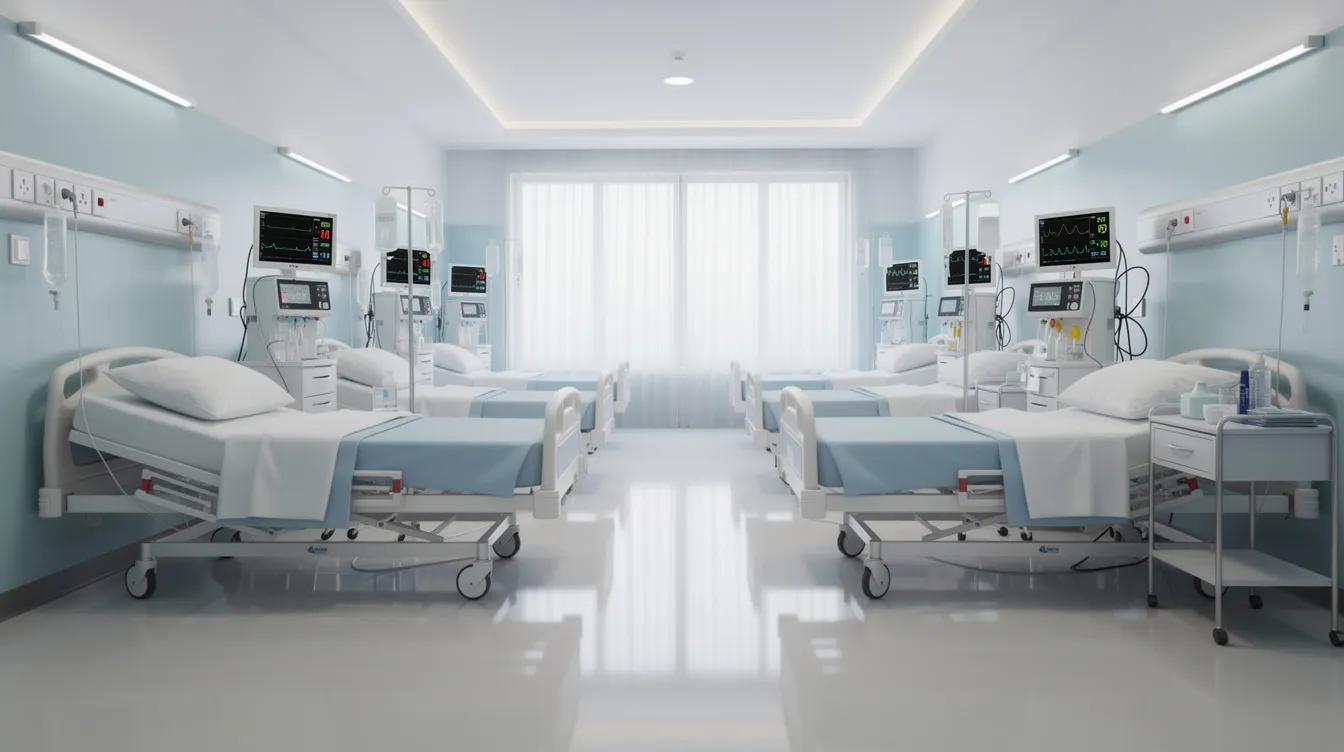
Hospital beds are adjustable for patient safety and comfort – manual beds cost ₹10,000–25,000 each, while motorized ICU-type beds reach ₹1,50,000. Each bed typically needs a mattress (₹5,000–20,000), bedside locker, over-bed table, and IV stand. Stethoscopes are essential tools for doctors and nurses, along with BP cuffs – blood pressure monitors provide accurate readings for patient assessments. Digital thermometers are replacing conventional mercury thermometers across hospitals. Oxygen concentrators (₹50,000–1,50,000) or cylinder arrangements, suction units, wheelchairs, stretchers, and nursing station supplies complete the ward setup.
Emergency and Casualty Equipment
Emergency equipment is indispensable in every hospital and clinic. Emergency medical equipment includes crash carts stocked with essential drugs and tools, defibrillators, and multipara monitors. Essential items for emergency care include oxygen cylinders, nebulizers, and ECG machines. Emergency and critical care equipment includes defibrillators, mechanical ventilators, and suction machines. Monitoring devices are essential in ICUs and emergency departments.
Additional items: infusion pumps that deliver fluids, medications, or nutrients into a patient’s circulatory system, syringe pumps, emergency stretchers, and resuscitation equipment (ambu bags, intubation sets). During COVID-19, PPE became crucial for healthcare workers – PPE includes masks, gowns, gloves, and surgical goggles, with the Indian government recommending 3-ply masks for infection control. WHO recommends surgical masks for healthcare workers. PPE kits were scarce during the first wave of COVID-19, highlighting the importance of maintaining adequate supplies and awareness of procurement timelines.
ICU Equipment List and Cost
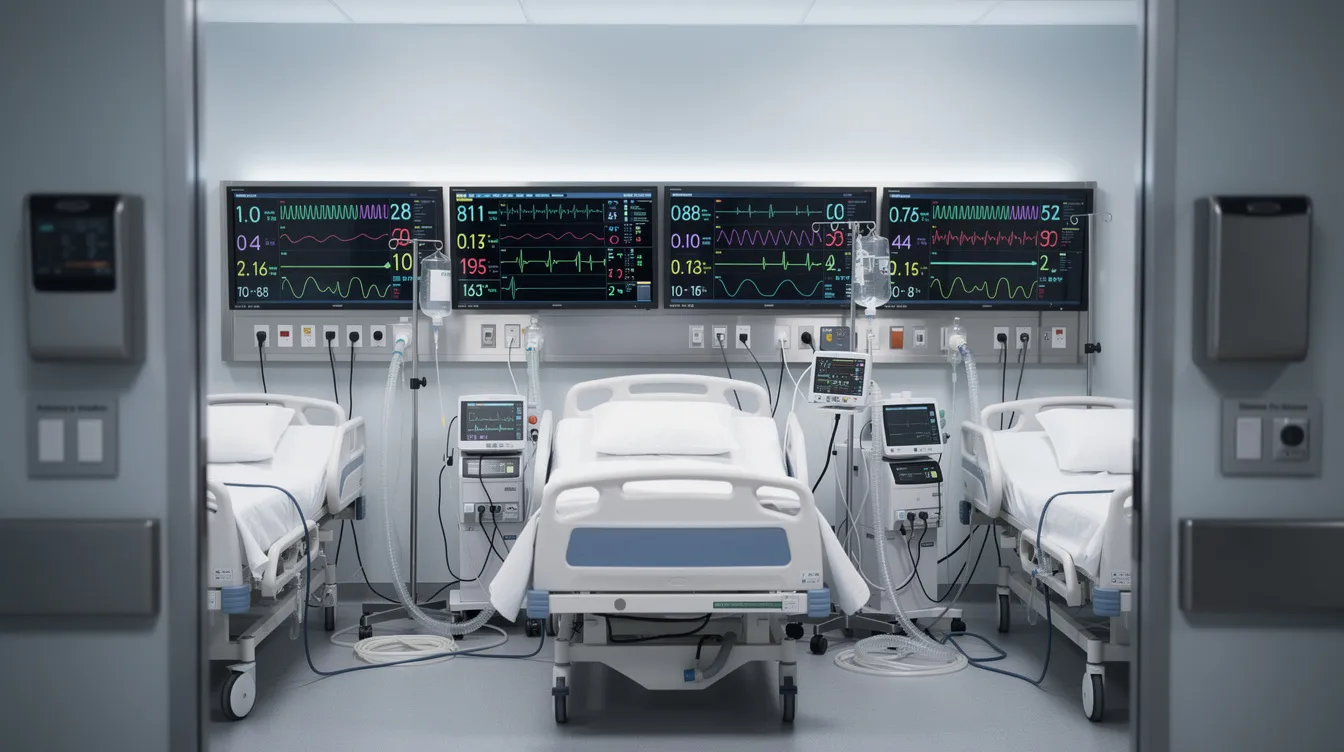
Monitoring equipment is crucial in ICUs and emergency departments. Each ICU bed requires a complete monitoring unit, ventilator, infusion and syringe pumps, suction, and oxygen supply. Pulse oximeters diagnose oxygen saturation in human blood – oximeters are essential for monitoring blood oxygen levels at every ICU bedside.
Per-ICU-bed indicative investment:
| Tier | Investment Range |
|---|---|
| Entry / Basic | ₹3.5–6 lakh |
| Mid-tier | ₹6–14 lakh |
| Premium / Imported | ₹14–32 lakh |
Central monitoring stations, ABG analysers (₹10–30 lakh), and defibrillators add to the department cost. Not every small hospital requires a full ICU – a 10-bed hospital may start with 1–2 high-dependency beds instead.
Operation Theatre Equipment List
Surgical equipment is essential in operation theatres. Key items include an OT table (₹1.5–7 lakh), OT lights providing adequate illumination for procedures, and an anaesthesia workstation. Anesthesia machines deliver precise mixtures of medical gases while monitoring patient respiration. Surgical lights and tables are essential for safe medical procedures.
Additional requirements: electrosurgical/cautery units, suction machines, surgical instruments (forceps, clamps, scissors, and other surgical tools), instrument trolleys, scrub station, and patient transfer trolley. Surgical instruments are necessary for performing surgeries in hospitals – a comprehensive set typically costs several lakh rupees. Syringes, tissue handling instruments, and sterile drapes are vital consumable categories.
A basic OT may cost ₹45–80 lakh, while a modular OT can reach ₹4.06 crore per theatre as documented in government model DPRs.
Labour Room and Maternity Equipment
This section applies only where maternity services are proposed. Equipment includes labour/delivery tables (₹1–4 lakh), fetal monitors, infant warmers, delivery instruments, baby weighing scales, and phototherapy units. Ultrasound machines are used in obstetrics, emergency trauma, and cardiology. A full NICU requires considerably more equipment than a basic newborn-care area – one model DPR estimates NICU equipment at ₹85 lakh. Resuscitation equipment for both mother and infant must be available.
Diagnostic Equipment for Small Hospital
Digital medical equipment improves patient diagnosis and treatment. Digital X-ray machines provide rapid imaging for fractures and trauma assessment (₹18–80 lakh depending on specification). Ultrasound machines range from ₹12–65 lakh. ECG machines cost ₹50,000–2 lakh. Diagnostic equipment identifies diseases and monitors body functions – but expensive imaging like CT or MRI should only be included if patient volume justifies the investment.
Glucometers help diabetes patients monitor blood sugar levels and are an inexpensive but essential addition. Some hospitals use infrared thermometers for rapid screening at entry points.
Own vs outsource: If projected imaging volumes are low, outsourcing diagnostic services to a nearby platform or centre avoids heavy capital expenditure while maintaining access for patients.
Pathology Laboratory Equipment
Laboratory equipment is used for diagnostic tests and analysis. Core items include a hematology analyser (₹3–8 lakh), biochemistry analyser (₹5–15 lakh), microscope (₹30,000–80,000), centrifuge (₹40,000–1.5 lakh), refrigerator, incubator, and sample collection equipment. The difference between a basic in-house lab and a larger diagnostic facility is significant – a basic lab might cost ₹10–15 lakh, while a fully equipped pathology facility can exceed ₹50 lakh.
CSSD and Sterilization Equipment
High-pressure autoclaves are used for sterilizing surgical instruments. CSSD requirements include steam sterilizers, instrument washers, packing and sealing machines, and storage systems. A 200-bed hospital CSSD equipment cost was approximately ₹35.4 lakh – smaller hospitals can expect proportionally lower costs but must still maintain compliance with infection control standards.
Oxygen and Medical Gas System
A reliable hospital needs a medical oxygen system and suction system. Options range from oxygen cylinders and concentrators (simple, lower capital) to manifold systems and central oxygen pipelines with medical gas outlets (higher capital, suitable for 30+ beds with ICU). Vacuum systems for suction are typically integrated with centralized gas infrastructure. Final engineering specifications should be determined by qualified technical professionals.
Hospital Furniture and Non-Medical Equipment
Items displayed under this category in a DPR’s fixed-asset schedule include doctor tables and chairs, nursing station furniture, waiting area seating, storage cabinets, office furniture, computers, printers, and billing systems. Hospital security service equipment such as CCTV, along with UPS/inverter and backup power, are also budgeted here. These items may appear separately from medical machinery in the means of finance.
Bed-Wise Hospital Equipment Investment
10 Bed Hospital Equipment List and Cost
A 10-bed hospital typically offers general medicine, minor procedures, and emergency stabilization. Equipment investment: ₹70 lakh–₹1.5 crore. High-cost facilities like CT imaging or advanced OT should be outsourced initially. Focus on ward beds, basic monitoring, emergency equipment, small laboratory, and possibly digital X-ray and ultrasound.
20 Bed Hospital Equipment List and Cost
Adding a small OT, 1–2 ICU/HDU beds, and an expanded lab increases investment to ₹1.5–3.5 crore. This scale justifies owning basic imaging equipment and establishing a functional CSSD. Patient monitors, ventilators, and anaesthesia workstation become necessary additions.
30 Bed Hospital Equipment List and Cost
A 30-bed general hospital with 2–4 ICU beds, one OT, emergency services, and in-house diagnostics requires ₹3–7 crore in equipment. Central medical gas systems become practical. The types of surgical procedures offered significantly affect OT equipment investment at this scale.
50 Bed Hospital Equipment List and Cost
At 50 beds with 5–10 ICU beds, at least one full OT, and comprehensive diagnostics, equipment investment typically ranges ₹7–15 crore. Advanced imaging (CT scanner), larger laboratory automation, and multiple monitoring stations may be justified depending on specialization and projected volumes.
Bed-Wise Hospital Equipment Cost Comparison
| Hospital Size | Indicative Equipment Investment | Typical Configuration |
|---|---|---|
| 10 Beds | ₹0.70–1.5 crore | General ward, emergency, basic lab, basic imaging |
| 20 Beds | ₹1.5–3.5 crore | + Small OT, 1–2 ICU beds, expanded diagnostics |
| 30 Beds | ₹3–7 crore | + 2–4 ICU beds, full OT, central gas, CSSD |
| 50 Beds | ₹7–15 crore | + 5–10 ICU beds, advanced imaging, multiple OTs possible |
Actual investment depends on speciality, brand, capacity, technology, taxes, installation, and commercial terms. Entry-tier vs premium equipment choices can cause 3–5× cost variation.
How to Choose the Right Equipment for Your Hospital
Choose Based on Hospital Services and Specialization
Your comprehensive medical equipment list must flow directly from planned services. A hospital offering only general medicine and emergency stabilization does not need a laparoscopic OT setup. Projected patient volumes and service utilization should determine every purchase decision.
Choose Based on Financial Capacity and Project Viability
From a project-finance perspective, equipment investment must be balanced against projected revenue and profitability. The availability of financing options – outright purchase, equipment lease, or term-loan-funded procurement – affects cash flow. Every major equipment decision should be evaluated for its impact on DSCR and loan repayment capacity.
Choose Based on New vs Refurbished Equipment Strategy
Refurbished equipment can save 50–70% on price but carries risks: limited warranty, potential regulatory concerns, and higher maintenance cost. Lenders may scrutinize refurbished equipment more carefully. For ICU ventilators, OT machines, and imaging systems, new equipment is generally preferred for patient safety. For hospital furniture, store fixtures, and non-critical items, refurbished options may be acceptable.
Hospital Equipment Cost Estimation for Project Reports
In a hospital DPR, the equipment cost estimation process follows these steps:
- Finalize proposed hospital services and bed capacity
- Identify departments and prepare a department-wise hospital equipment list
- Determine quantities based on bed count and patient volume projections
- Obtain current vendor quotations – do not simply copy another hospital’s list
- Separate medical equipment from furniture and other fixed assets
- Include freight, installation, and civil-work costs where applicable
- Map equipment expenditure with the means of finance
Medical equipment planning should include consumables, spare parts, and accessories in recurring OPEX projections. Government e-procurement portals (accessible via www addresses) often require performing security verification steps, and some portals use a security service that verifies legitimate users, protecting against malicious bots. Once security verification is successful, tender price data displayed on the page can serve as useful benchmarks – though one must read these carefully and continue checking that amounts represent actual purchase cost, not just EMD or bot-filtered data. When a procurement platform verifies and responds with a ray ID, it confirms legitimate access to tender information that is otherwise free to browse.
Equipment Quotations for Bank Loan and Project Finance
When presenting equipment for bank appraisal purposes, vendor quotations should clearly state equipment description, quantity, unit price, applicable taxes, installation charges, and payment terms. Lenders evaluate whether proposed machinery is appropriate for the hospital’s capacity and projected operations. The quotation package typically maps to promoter contribution (20–30%) and proposed term loan.
How Equipment Investment Affects Hospital Profitability
The relationship is direct: Equipment Investment → Depreciation → Interest Cost → Capacity Utilisation → Revenue → Cash Accrual → DSCR → Repayment Capacity. Purchasing expensive equipment without sufficient patient volume weakens financial viability. In practice, equipment utilization rates – how many scans per day, surgeries per month, ICU bed occupancy – are what a lender verifies during appraisal. Blood tests, imaging, and surgery are major revenue drivers, so equipment investment must be aligned with realistic demand projections. Hospitals need blood pressure monitors for accurate patient assessment, but a ₹2 crore CT scanner sitting idle three days a week destroys returns.
Which Equipment Strategy Is Best for You?
- Phased purchase if starting with basic services and expanding over time
- Comprehensive package if targeting full-service operations from day one with adequate capital
- Equipment leasing if capital conservation is priority, especially for high-cost imaging
- Selective refurbished where clinically appropriate, cost-effective, and lender-acceptable
Equipment Cost vs Total Small Hospital Setup Cost
Equipment cost is a vital part of total hospital project cost but not the whole picture. Other components include land, building construction, interior development, electrical installations, HVAC, plumbing, medical gas pipeline, fire and safety systems, furniture and fixtures, IT systems, pre-operative expenses, deposits, contingencies, and working capital margin. For a detailed breakdown of all project cost components across different hospital scales, refer to the guide on small hospital setup cost in India – 10, 20, 30 and 50-bed hospital.
How CA Manish Gugliya Can Assist with Hospital DPR
CA Manish Gugliya provides professional assistance in preparing customized hospital project reports and DPRs for bank finance through ProjectReportBank.com. Services cover project cost estimation, medical equipment investment planning, means of finance structuring, revenue and operating expense assumptions, projected P&L, balance sheet, cash flow, DSCR computation, break-even analysis, term-loan repayment schedules, CMA Data preparation, and financial feasibility and sensitivity analysis. The focus is on preparing a bankable, realistic DPR – not a generic template.
Frequently Asked Questions
What equipment is required for a small hospital? A small hospital needs ward beds, emergency equipment, basic diagnostic and laboratory items, oxygen and suction systems, sterilization equipment, and hospital furniture. Personal protective equipment is crucial for healthcare workers’ safety – gloves, mask, gowns remain essential supplies at every scale.
How much does hospital equipment cost in India? Depending on bed count and services, hospital equipment cost ranges from ₹70 lakh (basic 10-bed) to ₹15 crore or more (50-bed multispecialty). Prices vary by brand, specification, and city.
How much equipment is required for a 10-bed hospital? A 10-bed hospital typically requires basic ward equipment, emergency setup, small lab, and possibly X-ray and ultrasound – total equipment investment around ₹70 lakh–1.5 crore.
What is the equipment cost for a 20-bed hospital? Approximately ₹1.5–3.5 crore, including a small OT, ICU beds, and expanded diagnostics.
What equipment is needed for a 30-bed hospital? Full OT, ICU (2–4 beds), emergency department, laboratory, imaging, and central gas system – approximately ₹3–7 crore.
What is the equipment investment for a 50-bed hospital? Approximately ₹7–15 crore with multiple ICU beds, OTs, advanced diagnostics, and comprehensive laboratory.
What is the cost of setting up an ICU? Per-ICU-bed equipment cost ranges from ₹3.5 lakh (entry) to ₹32 lakh (premium), excluding civil and infrastructure work.
Can hospital equipment be financed through a bank loan? Yes. Equipment forms part of fixed assets in the project cost and is typically financed through a combination of promoter contribution and term loan.
Should a small hospital buy or lease expensive medical equipment? Leasing conserves capital and may be appropriate for high-cost imaging equipment where patient volume is uncertain. Purchase makes sense when utilization is projected to be high and the hospital can share the time burden of ownership.
Is hospital equipment cost included in total project cost? Yes. Medical equipment, furniture, and other fixed assets are all components of total project cost in a hospital DPR.
Final Thoughts
There is no universal equipment budget for a small hospital. The appropriate investment is determined by bed capacity, planned medical services, department configuration, projected patient volume, equipment specifications, and overall financial viability. A properly prepared hospital DPR should connect equipment investment with projected revenue, profitability, cash accrual, DSCR, and repayment capacity – not treat the equipment list as an isolated purchase schedule. If you are planning to set up a hospital in India, invest the time to build a customized project report based on your actual hospital configuration rather than relying on generic templates. That distinction is what separates a bankable DPR from a rejected one.
Explore All General Hospital DPR Guides
Continue exploring our complete series on General & Small Hospital project planning, setup cost, equipment, financial projections, repayment capacity and bank finance.