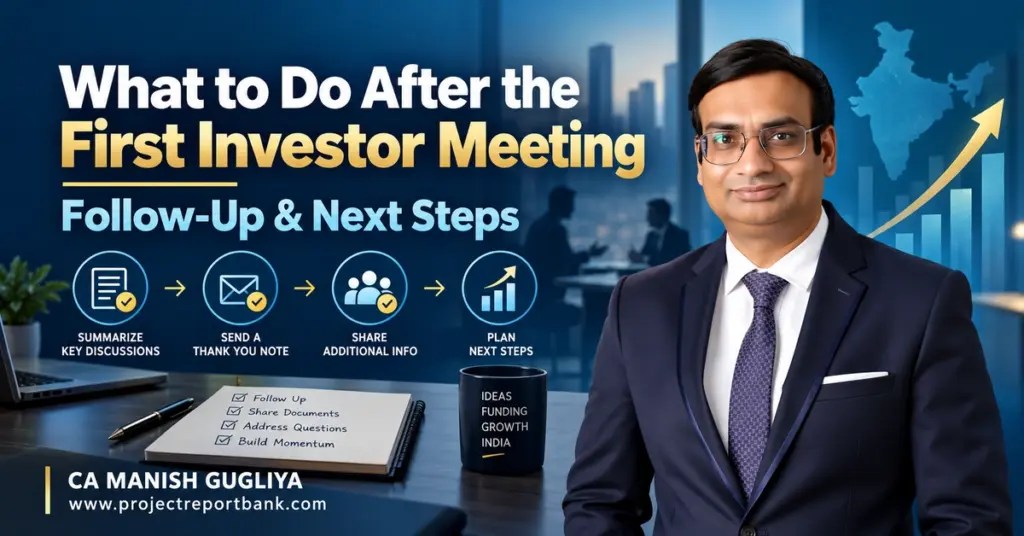
Key Takeaways
- Send a professional thank-you and follow up email within 24 to 48 hours after the meeting. Most deals die within 48 hours of the first meeting due to poor follow-up.
- Conduct an internal debrief the same day: capture meeting notes detailing investor interests and questions, separate facts from assumptions, and assign responsibilities for pending information.
- Evaluate the investor’s actual interest objectively before planning intensive follow ups. Not every positive conversation leads to funding; only documented next steps (second meeting, due diligence, term sheet) indicate real progression.
- Prepare and share promised materials promptly-investor-ready DPR, updated financial projections, pitch deck, valuation assumptions-while reserving sensitive documents for later due diligence stages with appropriate access controls.
- A disciplined investor follow-up process, supported by consistent financial documentation and realistic projections, improves the quality of future opportunities but never guarantees investment.
Introduction – The First Investor Meeting Is Over. What Happens Next?
The first investor meeting for a ₹5–15 crore manufacturing or MSME project often feels like the most significant milestone in the fundraising process. You have explained your project, shared your vision and answered initial questions. The conversation went well.
What happens next is where most projects either build momentum or lose it entirely.
A positive discussion, an expression of investor interest, or even a request for documents should not be interpreted as an investment commitment. These are simply signals that the proposal has moved to the next evaluation step. The fundraising process averages 6 months for early-stage companies, and the first meeting is only the opening move in a much longer sequence.
Strong preparation for the first investor meeting sets the foundation for this post-meeting phase. But the real work begins now: managing investor follow ups, sharing requested materials, preparing for due diligence and responding to feedback with consistent, credible financial information.
This article provides a step-by-step, India-focused framework for what to do after the first investor meeting, covering follow up cadence, documentation, valuation review and practical examples relevant to serious project promoters.

Immediate Actions Within 24–48 Hours After the First Investor Meeting
The first 24–48 hours after a meeting are a window for structured thinking, not emotional reactions. Delayed follow-ups beyond 48 hours signal disinterest to investors who are evaluating multiple opportunities simultaneously. Follow up promptly after a first investor meeting.
Internal debrief (same day):
Capture meeting notes detailing investor interests and questions. Record investor concerns and feedback for future reference. Write down exactly what the investor asked-whether it was about project feasibility, promoter contribution, DSCR, capacity utilisation or exit possibilities.
Separate facts from assumptions. If the investor asked for three years of audited financials, that is a fact. If you felt they seemed impressed with your margins, that is an assumption. This distinction matters when planning your response.
Assign responsibilities:
- Finance team: update financial projections, verify assumptions in the financial model
- Technical team: refine capacity, machinery or process assumptions if questioned
- CA or adviser: check tax compliance, regulatory points, ROC filing status
Draft the follow up message outline:
Before sending the final investor follow up email, prepare a brief outline covering: thank you, summary of key points discussed, list of promised materials to be attached, and one clear proposed next step. This ensures your first follow up is thoughtful rather than reactive.
Evaluate the Investor’s Actual Interest
Before planning intensive investor follow ups, promoters must objectively assess where the investor actually stands. Investors notice when a promoter invests excessive energy pursuing a lead that was merely polite.
Not every encouraging comment represents genuine interest. Phrases like “very interesting” or “we will get back to you” are common courtesies, not commitments. Only documented steps-a second meeting, formal due diligence, a term sheet discussion-indicate real progression in the investor’s process.
Use a clear sales funnel approach to track investor interactions and categorise investor responses:
| Response Type | Typical Signals | Recommended Action | Follow Up Cadence |
|---|---|---|---|
| Polite / No clear next step | Generic praise, no questions, no follow-up requests | Light follow ups with progress updates | Bi-weekly or monthly |
| Information-seeking | Requests for pitch deck, DPR, projections | Share requested materials within 3–5 days, propose second meeting | Weekly |
| Conditional interest | Questions on valuation, deal terms, wants to meet technical team | Prepare valuation analysis, sensitivity data, legal readiness | As agreed, typically weekly |
| Strong progressing interest | Partner meeting scheduled, due diligence discussion, timeline given | Formalise data room, schedule meetings, prepare for term sheet | Per agreed timeline |
Even a current “no” can become a future opportunity. Keep investors updated with regular progress updates after initial meetings. When you achieve meaningful progress-confirmed customers, revenue growth, capacity milestones-a brief update can re-open investor conversations that previously did not progress.
Send a Professional Post-Meeting Thank-You and Follow-Up Email
Send a thank-you note within 24 to 48 hours after the meeting. Timely follow-ups demonstrate professionalism and responsiveness to investors. A follow-up email should be sent within 24-48 hours after a meeting-ideally within 24 hours for high-priority discussions.
Personalised follow-ups increase investor engagement by 40-60% compared to generic messages. Include specific details from the investor meeting in follow-ups rather than sending the same message to every investor.
Sample investor follow up email:
Subject: XYZ Manufacturing – Follow-Up & Documents from Our Meeting on [Date]
Dear [Investor Name],
Thank you for taking the time to discuss our ₹15 crore agro-processing project on [Date]. I appreciated your questions on raw-material sourcing and capacity utilisation, which have helped us refine our assumptions.
As discussed, I am attaching our updated project summary and initial financial projections. We are also preparing the detailed sensitivity analysis on raw-material pricing that you requested, and will share it within this week.
I would welcome the opportunity for a follow up call or second meeting at your convenience to walk through the updated financial model and address any further questions. Please let me know a suitable time.
Best regards, [Promoter Name]
Key practices:
- Use a clear subject line that reflects the follow-up purpose
- Keep follow-up emails concise and focused on one ask
- Summarise key takeaways from the meeting in your follow-up
- Include promised materials in your follow-up email
- Propose a clear next step in your follow-up communication
- Address any open questions raised during the meeting
Avoid over-selling, introducing aggressive new claims, or sharing confidential documents without an agreed protocol. For a more detailed guide on follow up cadence and managing unanswered emails, refer to the complete guide on how to follow up with investors.
Prepare and Share the Documents Requested by Investors
There is an important difference between documents shared immediately after the first meeting and detailed materials reserved for formal due diligence. Not everything should be sent at once. Use concise, relevant documentation when communicating with investors at this stage.
Early-stage documents (share within 3–7 days):
- Investor-ready Detailed Project Report (DPR) with project cost, means of finance, promoter contribution, capacity and revenue projections
- Concise investor pitch deck summarising market opportunity, business model, team, use of funds and expected returns
- 3–5 year financial projections covering revenue, margins, cash flow and DSCR
- Basic company and promoter profile, including incorporation details and professional background
Promoters who have already prepared an investor-ready DPR checklist will find this stage considerably smoother. The post-meeting documentation builds upon the investor introduction email and one-page teaser shared before or during the initial outreach.
Sensitive materials (share during formal due diligence with access controls):
- Integrated financial modelling files with detailed assumptions
- Customer contracts, supplier agreements, machinery quotations
- Detailed historical financial statements, bank statements, tax records
- Land title deeds, environmental clearances, regulatory licences
For promoters who need professional assistance preparing or updating these documents, investor-ready DPR and fundraising assistance services can help ensure consistency and credibility across all materials.
Respond Professionally to Investor Questions and Objections
How you handle investor questions after the first meeting directly affects whether a second meeting or due diligence is offered. Follow-ups should address any unanswered questions from the meeting with verified, data-backed responses.
Common categories of investor concerns:
- Market demand assumptions and customer acquisition strategy
- Production capacity utilisation ramp-up and manufacturing process efficiency
- Raw-material cost volatility and pricing power
- Working capital cycle, receivable periods, inventory holding
- Promoter contribution and skin in the game
- DSCR, cash flow adequacy and debt-servicing capacity
- Valuation justification and investor exit route
- Customer acquisition costs and repeat customers potential
Practical example: Consider a proposed ₹12 crore food processing plant. The investor asked about demand assumptions and what happens if raw wheat prices increase by 15%. Rather than responding with vague assurances, the promoter should present a sensitivity analysis showing margins at different raw-material price levels, a ramp-up schedule (say 50% utilisation in Year 1, 80% in Year 2), break-even volume at each price point, and evidence such as historical supplier quotes or Letters of Intent from potential buyers.
Before replying, verify that the numbers in your financial model, DPR and verbal statements are consistent. Any discrepancy discovered during due diligence undermines credibility. For deeper techniques on handling objections, refer to the guide on how to handle investor questions and objections.
Prepare for a Second Investor Meeting
A second meeting is typically triggered when the investor requests more detailed financials, wants to meet co-founders or the technical team, or wishes to discuss specific risks, valuation or deal structure. This represents genuine progression in investor conversations and should be treated accordingly.
Propose a clear agenda in your follow up email:
- Points to clarify from the first meeting
- Walk-through of updated financial projections or financial model
- Time allocated for investor questions on specific risk areas
- Discussion of indicative valuation or investment focus areas
Additional participants who may join depending on the investor’s request:
- Chartered Accountant or financial adviser for projections, valuation and capital planning
- Technical consultant for plant and machinery, manufacturing process and capacity
- Operations head for production planning and supply chain
- Marketing or sales lead for customer acquisition and revenue growth strategy
For promoters looking to expand their investor pipeline beyond the current conversation, structuring a systematic approach to getting investor meetings in India can run in parallel with this follow-up process.
Before the second meeting, share a clean updated pitch deck, re-confirm time and mode (video or physical), and prepare specific responses to every concern flagged in the first meeting. A partner meeting or partner conversation with the investor’s internal team often follows a successful second discussion.
Understand the Investor Due Diligence Process
The journey from first meeting to investment involves several distinct stages: introductory discussion, preliminary review, formal due diligence, commercial negotiation and signing of investment documents. This article focuses on the steps between the first meeting and early due diligence.
Main due diligence types:
- Financial: Historical accounts, projected financial statements, cash flow analysis, bank finance and loan structuring, DSCR
- Legal: Company law compliance, ROC filings, contracts, licences, securities, cap table verification
- Commercial: Market size, competition, customer references, demand validation
- Technical: Plant and machinery verification, capacity, manufacturing process, supplier quotations
- Management: Promoter background, team capability, senior hire plans, operational competence
In India, the depth of due diligence depends on ticket size and investor type. Angel investors or venture capitalists at seed stage may conduct lighter diligence focused on promoter pedigree and early traction. PE firms, strategic investors or family offices investing ₹5–15 crore typically engage external advisers and internal investment committees for a thorough review across all categories.
Promoters should start preparing early by organising documents, maintaining consistency across DPR, financial statements and projections, and conducting an internal project feasibility study. Ignoring preparation for due diligence creates negative impressions. Moving into due diligence indicates serious interest but still does not guarantee funding.
Review Valuation, Equity Dilution and Funding Expectations
Investor feedback after the first meeting frequently challenges the promoter’s initial valuation or equity dilution expectations. This is normal and should be anticipated, especially for MSME and manufacturing projects where comparable transaction data may be limited.
Simple numerical illustration:
- Promoter proposes ₹5 crore investment at a pre-money valuation of ₹20 crore → investor receives approximately 20% equity (₹5 crore ÷ ₹25 crore post-money)
- Investor counters with a pre-money valuation of ₹12 crore → for the same ₹5 crore, equity dilution becomes approximately 29.4% (₹5 crore ÷ ₹17 crore post-money)
The difference-9.4 percentage points of equity-has significant implications for promoter control, governance rights, future funding rounds and exit value. If too much equity is given in the current round, subsequent fundraises may dilute the promoter’s ownership to uncomfortable levels.
Promoters who need a formal, defensible business valuation should engage professional support rather than relying on informal benchmarks. The funding amount itself should be aligned with realistic project cost, means of finance and DSCR analysis-a topic covered in detail in the guide on equity funding amount and capital planning in India.
I advise project promoters not to accept any valuation simply because the cheque size looks attractive. The right funding structure should support the project’s economics, not compromise the promoter’s long-term position.
Create a Structured Investor Follow-Up Timeline
Converting the earlier principles into a practical, date-based follow up cadence helps promoters maintain consistent communication without appearing desperate. Maintain a follow-up cadence based on company progress rather than arbitrary calendar reminders.
Illustrative timeline:
- Within 24–48 hours: Send thank-you follow up email with meeting summary and any immediately available documents. Overly aggressive follow-ups appear desperate and unprofessional, so keep this communication measured and professional.
- Within 7 days: Share all requested materials-updated DPR, financial projections, sensitivity analysis. Address any open questions with verified data. Ask investors for their decision process and expected timeline after meetings.
- Weeks 2–3: If no response, send one follow up message with a specific new data point-a clarified assumption, a new customer acquisition, updated market information. Vague follow ups lead to confusion and loss of momentum. Follow-ups should include new information or updates rather than repeating the same ask.
- Weeks 3–5+: If interest continues, move the conversation forward into due diligence preparation, second meeting scheduling, or term sheet discussions. If the investor remains silent, a final follow up politely asking for a status update is appropriate.
Follow-ups keep you top of mind with investors evaluating multiple opportunities. For promoters managing multiple investor conversations simultaneously, professional fundraising advisory and investor outreach services can help structure communication across the entire investor pipeline.

Common Mistakes After the First Investor Meeting
Many good projects lose momentum due to avoidable post-meeting errors. Assuming the deal is secured prevents maintaining relationship momentum-and this is perhaps the most common mistake I observe.
Specific mistakes to avoid:
- Sending daily follow ups or multiple messages per week without new information
- Ignoring specific investor questions or failing to address concerns raised during the meeting
- Changing financial projections frequently without clear justification-investors pass on projects where the numbers shift with every email
- Prematurely negotiating valuation concessions over email before investor interest is confirmed
- Sharing confidential contracts, customer references or bank statements without NDAs or agreed access protocols
- Overstating profitability, expected IRR or revenue growth without supporting assumptions
- Treating verbal enthusiasm as a commitment-most deals die within 48 hours due to poor follow-up, not because the investor was uninterested
- Using generic follow up templates from the internet that do not match the actual project numbers or the investor’s specific investment focus
The risk of inconsistent figures between DPR, financial model and verbal responses cannot be overstated. Serious investors will test assumptions, cross-check documents and identify discrepancies. Disciplined documentation, realistic assumptions and professional guidance from a CA or financial adviser can prevent many of these mistakes.
Investor Meeting Follow-Up Checklist
This checklist can be printed or copied into a task tracker immediately after any investor meeting.
- Circulate internal meeting notes – Responsible: Promoter/Founder – Deadline: Same day – Status: ☐
- Prepare and send follow up email – Responsible: Promoter – Deadline: Within 24 hours – Status: ☐
- Update DPR and financial projections based on investor feedback – Responsible: Finance team/CA – Deadline: 3–5 days – Status: ☐
- Verify consistency across DPR, financial model, pitch deck and verbal statements – Responsible: CA/Financial adviser – Deadline: 3 days – Status: ☐
- Compile and share all requested documents – Responsible: Assigned team members – Deadline: 5–7 days – Status: ☐
- Prepare valuation discussion points and sensitivity analysis – Responsible: CA/Promoter – Deadline: 7 days – Status: ☐
- Schedule follow up call if agreed during the meeting – Responsible: Promoter – Deadline: As committed – Status: ☐
- Review investor fit before further engagement (investment focus, ticket size, sector alignment) – Responsible: Promoter/Adviser – Deadline: 3 days – Status: ☐
- Log investor in CRM or spreadsheet with next follow up date, interest level, notes on previous conversations and outstanding items – Responsible: Promoter – Deadline: Same day – Status: ☐
Following this investor meeting follow-up checklist helps maintain discipline and build transparency and reliability in investor communications across the fundraising process.
Practical Example – ₹15 Crore Manufacturing Project Seeking Equity Funding
This is a hypothetical example using internally consistent numbers. It does not represent an actual client case or guaranteed fundraising outcome.
Project setup: A promoter plans a ₹15 crore agro-processing plant in Maharashtra. The means of finance: ₹5 crore equity from an external investor, ₹8 crore term loan from a bank, and ₹2 crore promoter contribution. Capacity utilisation is projected at 40% in Year 1, ramping to 75% by Year 3.
First meeting summary: The promoter shared an initial pitch deck and summary DPR with a PE-focused family office. Key discussion points included market demand for processed agro-products, project location advantages, machinery suppliers, expected DSCR of 1.8x, and projected IRR of 22%. The investor asked specific questions about the working capital cycle, raw-material sourcing risks, promoter skin-in-the-game and how revenue growth assumptions were derived.
Post-meeting timeline:
- Same day: Internal debrief. Noted the investor’s pain point around raw-material price volatility and capacity ramp-up assumptions. Identified that the investor’s view on customer acquisition costs and new customer acquisitions needed more supporting data.
- Within 24 hours: Sent a thoughtful follow up email thanking the investor, summarising key points, attaching the existing DPR and proposing a second meeting in two weeks.
- Within 5 days: Shared updated financial projections with sensitivity analysis showing margins at ±10% and ±15% raw-material price changes, refined capacity utilisation assumptions, and confirmed promoter contribution sources. These projections were prepared with professional support from a financial projections and financial modelling adviser to ensure consistency.
- Week 2: Proposed a second meeting agenda including a walk-through of the integrated financial model, introduction to the technical consultant, and discussion on indicative valuation.
Two possible outcomes:
(a) The investor moves into formal due diligence, requests access to the data room, and initiates a partner conversation internally before issuing a draft term sheet.
(b) The investor passes for now but indicates willingness to revisit once the project achieves first-year revenue targets or confirmed customer orders-a path forward that keeps the relationship alive for future opportunities. This investor rejection is not a dead end but rather a signal to demonstrate momentum with concrete milestones before re-engaging.
Frequently Asked Questions
How soon should I follow up after my first investor meeting?
Send your follow-up email within 24 hours, or at most within 48 hours. Follow up within 1-2 days after an investor meeting to demonstrate professionalism. Delayed follow-ups signal disinterest, and most deals lose momentum within the first 48 hours.
What documents should I send after meeting an investor?
At the early stage, share your investor-ready DPR summary, pitch deck, 3–5 year financial projections and a basic promoter profile. Reserve detailed financial modelling files, customer contracts and historical bank statements for later due diligence stages, ideally through a secure data room with appropriate confidentiality controls.
How do I know whether an investor is genuinely interested?
Look for specific follow up questions about valuation, timeline discussions, requests to meet your technical team, or initiation of internal partner review. General comments like “very interesting” without a clear next step are often polite responses. Track investor responses systematically rather than relying on subjective impressions from the pitch meeting.
What if an investor does not respond after the meeting?
Send one reminder after about two weeks, including a relevant update or clarified assumption-not the same email or a vague check-in. Leverage industry insights or updates to connect with investors post-meeting. If there is still no response after a final follow up, accept the silence as a decision and focus on other potential investors. Treat fundraising as an operating process with multiple parallel conversations, not dependence on a single lead.
Should I share my complete financial model immediately?
Generally, no. Share summary financial projections and key assumptions initially. The complete integrated financial model, with detailed cost sheets and modelling files, is typically shared after the investor has demonstrated information-seeking or conditional interest, and usually after a confidentiality agreement is in place. Premature sharing can lead to misinterpretation or risk without corresponding commitment.
When does investor due diligence normally begin?
Formal due diligence typically begins after the investor is satisfied with initial responses, has held a second meeting or introductory call with key team members, and is considering a term sheet. For ₹5–15 crore equity deals in India, this may be several weeks after the first meeting, depending on the investor’s internal process. Practices vary significantly between angel investors, venture capitalists, PE firms and family offices.
Does a successful first investor meeting mean funding is approved?
No. A successful first meeting means the proposal has moved to the next evaluation step. Actual investment requires successful due diligence, agreed valuation, negotiated term sheet, legal documentation and board or investment committee approval. Many preliminary signals are expressions of interest, not commitments. Build lasting investor relationships by treating each interaction as part of a long-term fundraising story rather than a single transaction.
How CA Manish Gugliya and Project Report Bank Can Assist
In my professional experience, the promoters who progress most effectively from a first meeting to due diligence and term sheet discussions are those who have rigorous, consistent financial documentation prepared in advance-not those who scramble to assemble numbers after investor questions arrive.
Through Project Report Bank, I provide professional support across the services most relevant to this post-meeting phase:
- Investor-ready DPR and fundraising assistance with customised project-specific analysis
- Financial projections and integrated financial modelling that withstand investor scrutiny
- Business valuation for equity dilution planning and negotiation
- Project feasibility and viability studies
- Investor pitch deck preparation aligned with your DPR and financial model
Project Report Bank does not guarantee funding approval or investor introductions. The focus is on preparing credible, internally consistent documentation and sound financial analysis that supports serious investor conversations, helping early stage founders and established promoters alike.
If you are a project promoter with an estimated project cost, proposed means of finance and a current fundraising stage, I encourage you to share your project details through the website enquiry or WhatsApp option for an initial professional review.
Conclusion – Turning the First Meeting into a Professional Funding Process
The first investor meeting opens a conversation. What follows-disciplined follow up, realistic financial projections, clear documentation and measured communication-determines whether that conversation leads to a funded project.
Maintain regular communication with interested investors, but ensure every follow up adds relevant context or new information. Build lasting relationships by treating investor relations as a two-way street involving ongoing engagement, not a transactional pitch. Even where immediate funding does not materialise, keeping the door open for future opportunities through periodic, substantive updates is a sound long-term strategy. Personalise follow-up messages to reflect investor interests and the specific details of your previous conversations.
I advise readers to review their most recent investor meeting, prepare a 24–48 hour follow up plan using the checklist in this article, and consider engaging a professional adviser for DPR, financial modelling and valuation support where needed. The path forward from a first meeting to a funded project requires patience, preparation and professional rigour.
CA Manish Gugliya, FCA, DISA (ICAI) is a practising Chartered Accountant with over 20 years of professional experience in project reports, financial projections, project finance, feasibility analysis and financial advisory. Through ProjectReportBank.com, he provides professional assistance to entrepreneurs and businesses across India.