Key Takeaways
- Total grain based animal feed plant setup cost in India includes land, civil works, plant and machinery, utilities, pre-operative expenses and working capital margin-not merely the machinery purchase price.
- For 2025–26 conditions, a commercial 5 TPH grain-based animal feed manufacturing plant typically requires a total project cost in the range of approximately ₹18–28 crore, depending on location, automation level and project scope (excluding land in metro locations).
- Raw materials such as maize, wheat bran, oilseed meals, DDGS and feed additives form 75–85% of operating costs, making procurement strategy as important as machinery selection.
- Gross profit margins for industrial feed plants typically range between 15–25%, while net profit margins tend to fall within 5–12% under normal operating conditions.
- A bankable Detailed Project Report, realistic financial projections and CMA data are essential for securing term loan and working capital limits from Indian banks.
Introduction: Grain Based Animal Feed Plant Setup Cost & Investment Context in India
India produced approximately 57.7 million tonnes of compound animal feed in 2025, with broiler, layer and dairy feeds accounting for the overwhelming majority of output. The global animal feed market was valued at USD 548.1 billion in 2025 and is projected to reach USD 702.75 billion by 2034, growing at a CAGR of 2.8% from 2026 to 2034. This rising demand, fuelled by protein consumption growth and modern farming techniques, creates permanent demand for organized animal feed manufacturing across the country.
For any serious project promoter, understanding the grain based animal feed plant setup cost is not merely an academic exercise. The total capital investment extends well beyond the machinery quotation-it includes land acquisition, civil construction, utility infrastructure, EPC expenses, pre-operative costs and margin money for working capital. Plant capacity, level of automation, chosen production technology (mash versus pellet) and raw material strategy together determine both capital expenditure and long-term operating cost structure.
Promoters must evaluate operating margins, working capital adequacy, debt servicing capacity and financial viability before committing substantial capital. At Project Report Bank, led by CA Manish Gugliya, FCA, DISA (ICAI), we assist entrepreneurs and industrial investors in preparing realistic, bankable project assessments grounded in defensible assumptions rather than promotional estimates.
What Is a Grain-Based Animal Feed Manufacturing Plant?
A grain-based animal feed manufacturing plant purchases cereals, oilseed by-products and approved additives, then processes these through grinding, mixing and often pelleting to produce finished feed for livestock, poultry, swine, aquatic species and other animals. The industrial business model depends on sourcing competitively, maintaining consistent formulation quality and distributing efficiently to dairy cooperatives, poultry integrators, pig farms and regional distributors.
Major raw materials used in India include maize (the primary raw material for animal feed production), broken rice, wheat bran, rice bran, barley, DDGS, soybean meal, rapeseed or canola meal, groundnut cake, mineral mixtures, vitamins, amino acids and approved feed additives. Soybean meal and oil cake are key ingredients that provide the protein fraction essential to nutritionally balanced feed formulations.
Key finished products include cattle feed, buffalo feed, poultry feed (broiler growth feed, layer feed, breeder feed), pig feed, dairy concentrate and species specific nutrition solutions for goats, fish feed and specialty feed segments. The main feed types are:
- Mash feed – ground and mixed without pelleting; simple process, lower plant cost
- Compounded feed – balanced formulation with multiple ingredients; may be mash or pelleted
- Concentrate feed – high-nutrient formulation mixed with local roughage by the farmer
- Pelleted feed – steam-conditioned and compressed; better feed efficiency and logistics
- Crumbled feed – pellets broken into smaller particles for young chicks or specific species
The choice of target animal species influences formulation complexity, required particle size, processing steps and cost structure. A plant producing broiler feed requires finer grinding and tighter quality controls than one producing cattle feed alone. Readers planning an integrated animal feed mill or an industrial cattle feed manufacturing plant can refer to those detailed project analyses for species-specific considerations.
Plant Capacity Options and Industrial Scale (1, 3, 5 and 10 TPH)
Plant capacity in a feed mill is expressed in TPH (tonnes per hour), but nameplate capacity differs materially from realistic saleable output. Downtime for preventive maintenance, power cuts, changeovers between cattle feed and poultry feed formulations, and quality losses typically reduce actual output by 5–15% compared to the rated capacity.
Annual production capacity can range from low metric tons for small plants to over 100,000 MT for large facilities. The capacity of a small-scale grain-based feed plant typically ranges from 1 to 2 metric tons per day at the entry level, while animal feed plant capacity for commercial operations ranges from 20,000 to 100,000 MT annually across different animal species.
| Parameter | 1 TPH | 3 TPH | 5 TPH | 10 TPH |
|---|---|---|---|---|
| Rated hourly capacity | 1 MT | 3 MT | 5 MT | 10 MT |
| Operating hours/day (single shift) | 8 | 8 | 8 | 8 |
| Theoretical daily output | 8 MT | 24 MT | 40 MT | 80 MT |
| Operating days/year | 300 | 300 | 300 | 300 |
| Annual rated capacity | 2,400 MT | 7,200 MT | 12,000 MT | 24,000 MT |
| Year 1 utilisation (typical) | 55–65% | 55–65% | 60–70% | 55–65% |
| Year 3–5 utilisation (target) | 80–90% | 80–90% | 80–90% | 80–90% |
| Operators per shift | 4–6 | 6–10 | 8–14 | 12–20 |
| Typical use case | Regional cattle feed, local dairy | Multi-district, contract manufacturing | State-level brand, multi-species | Large-scale, leading animal feed manufacturers |
Plants of 1 and 3 TPH generally cater to regional markets and local livestock farming clusters, while 5–10 TPH plants serve multi-district or state-level demand and may also undertake contract manufacturing for established brands. Capacity selection should be driven by a market study, raw material availability, distribution strategy and funding comfort-not merely by technical feasibility. For plants operating double shifts, the annual production capacity figures above effectively double, provided the market absorbs the additional volume.
Grain Based Animal Feed Plant Setup Cost in India – Major Investment Components
This section addresses the core question facing every project promoter: what does it actually cost to set up a grain-based animal feed manufacturing facility in India under 2025–26 conditions? The answer depends on capacity, automation, location, feed type and project scope.
Each major investment component requires separate estimation:
Land and site development – Industrial land cost varies dramatically by state and proximity to urban centres. Site development includes boundary walls, internal roads, drainage and landscaping.
Civil construction – Production building, raw material godowns, finished goods warehouse, administration block, quality-control laboratory and utility block. For a 5 TPH plant, covered area may range from 8,000–15,000 sq ft for production alone, with additional warehousing.
Raw material receiving and storage infrastructure – Intake pits, pre-cleaning screens, magnetic separators and covered godowns. Where seasonal grain procurement is planned, industrial grain storage silos can be a strategic addition.
Core process equipment – Hammer mills, batch weighers, mixers, pellet mills with conditioners, coolers, crumblers, screeners, conveyors, elevators, bins and bagging lines. This is the heart of the animal feed manufacturing plant.
Automation and controls – PLC, MCC panels, SCADA systems and recipe management software where provided.
Utilities – Boiler (for steam in pelleting), air compressor, dust collection, chimney, electrical panels, DG set for backup power. Heavy power consumption is a significant factor in operating feed plants, requiring substantial electricity supply.
Support infrastructure – Laboratory, weighbridge, forklifts, pallet trucks, handling hoists.
Installation, commissioning and EPC – Engineering, project management, structural platforms, cabling, piping and performance guarantee test runs.
Pre-operative expenses – Interest during construction, salaries before commercial production, consultancy, trial runs.
Contingency and escalation – Typically 5–10% of fixed assets.
Working capital margin – Stock of raw materials, finished goods inventory, receivables and minimum cash balance.
Indicative Total Project Cost Ranges (FY 2025–26)
| Capacity | Indicative Total Project Cost (₹ crore) | Assumptions |
|---|---|---|
| 1 TPH | ₹3–6 crore | Semi-automatic, pellet line, standard civil, excluding metro land |
| 3 TPH | ₹8–15 crore | Medium automation, pellet + mash, grid power + DG backup |
| 5 TPH | ₹18–28 crore | Automatic batching, PLC, pellet line, standard infrastructure |
| 10 TPH | ₹30–50 crore | Fully automated, multi-line, extensive storage and handling |
These ranges are illustrative for mid-2025 to 2026 conditions and exclude land in metro or coastal zones, specialised extrusion lines for aquatic feed or nutritionally balanced pet food production, high-rise automated warehousing, or rail siding infrastructure.
For context, the minimum investment for a 20,000 MT/year plant starts at approximately USD 4.5 million, a mid-size plant with 60,000 MT/year capacity requires around USD 9 million, and large-scale facilities can require investments of approximately USD 12 million. Production capacity affects feed mill costs by 35–55% of total CapEx. At the entry level, the average cost to set up a small grain-based animal feed plant can range from ₹20 lakh to ₹50 lakh for very basic mash-only setups, while a typical medium-sized grain-based feed plant may require an investment of ₹1.31 crore to ₹2.17 crore for semi-automatic operations.
Fixed Capital Investment and Total Project Cost Structure
Indian banks and financial institutions distinguish between fixed capital investment (the gross block of assets), total project cost (fixed assets plus margin for working capital) and total funding requirements (including interest during construction and any cash losses during ramp-up).
A structured project cost table for an illustrative 5 TPH pellet-based feed manufacturing plant is presented below:
| Cost Head | Indicative Amount (₹ lakh) |
|---|---|
| Land and site development | 150–350 |
| Building and civil works | 250–450 |
| Plant and machinery (including taxes, freight, insurance) | 800–1,200 |
| Electrical and utility installation | 80–150 |
| Furniture, fixtures, laboratory and office equipment | 25–50 |
| Vehicles, weighbridge and material handling | 40–80 |
| Preliminary and pre-operative expenses | 60–120 |
| Contingency and escalation | 80–150 |
| Interest during construction (IDC) | 50–100 |
| Total fixed capital investment | 1,535–2,650 |
| Margin money for working capital | 250–500 |
| Total project cost | 1,785–3,150 |
All figures are illustrative for 2025–26 conditions. Actual amounts depend on quotations, location, automation level and implementation schedule. A report’s cost breakdown includes plant and machinery, working capital and land development expenses as separate evaluable heads.
The exact apportionment must be refined in a customised DPR and CMA data based on supplier quotations, site-specific civil estimates and the promoter’s chosen financing structure.
Machinery Cost and Automation Investment for an Animal Feed Manufacturing Plant
Machinery costs represent the largest portion of capital expenditure in a feed plant-typically accounting for 30% to 50% of initial startup cost excluding land. Plant and machinery usually constitutes 40–60% of total fixed asset cost for a medium-automation feed manufacturing plant.
Three broad configurations exist:
Semi-automatic – Manual batching and bagging, limited PLC, basic process control. Semi-automatic plants keep equipment costs low compared to fully automated systems. Suitable for 1–3 TPH regional plants.
Automatic – Automatic batching, PLC-based process control, auto-bagging. Automated feed mills can reduce labour costs by 4–8 workers per shift while improving consistency of animal feed production.
Fully integrated PLC/SCADA – Online monitoring, recipe management, data logging, features automated production lines for large-scale domestic feed production. Higher CapEx but lower per-tonne operating costs.
Indicative machinery groupings include:
- Raw material intake and pre-cleaning equipment
- Hammer mills and raw material grinding systems
- Batch weighers and horizontal/vertical mixers
- Pellet mill with conditioner(s) – often the single most expensive machine
- Cooler, crumbler, screener
- Conveyors, bucket elevators, overhead bins
- Bagging, stitching and palletising equipment
- Electricals, MCC and control panels
Feed pellet machines can cost tens of thousands to hundreds of thousands of USD depending on capacity, configuration and origin. Pellet feed production generally requires a higher capital investment compared to mash feed production due to the conditioner, pellet press, steam system and cooling equipment.
The distinction between ex-works machinery price and fully installed EPC cost is critical. Installation, structural platforms, piping, cabling, commissioning and performance testing can add 15–30% over the basic equipment purchase cost. For detailed machinery cost analysis, refer to automatic animal feed mill machinery and EPC cost and industrial feed pelleting plant project report.
Manufacturing Process and Production Technology for Grain-Based Animal Feed
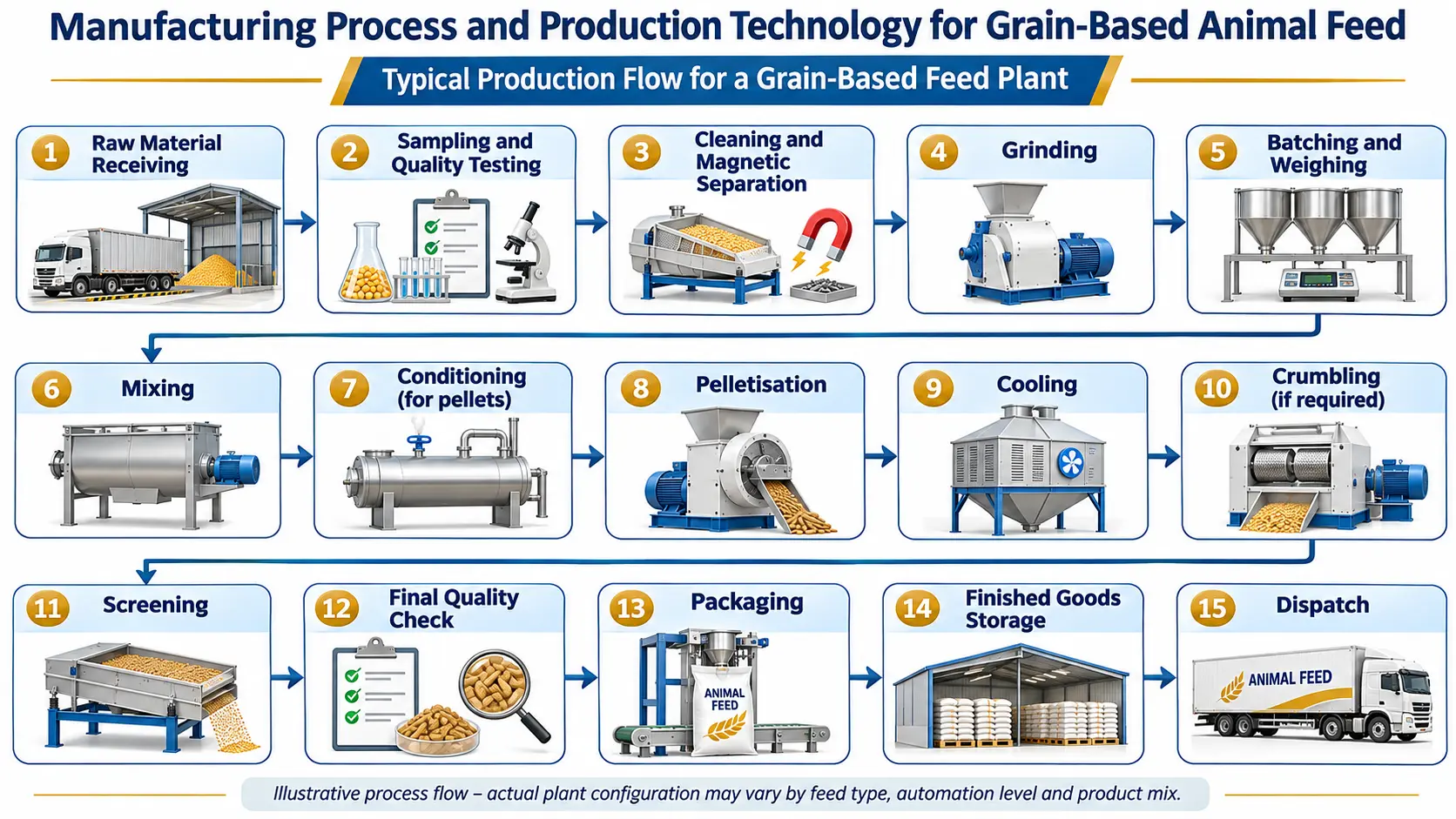
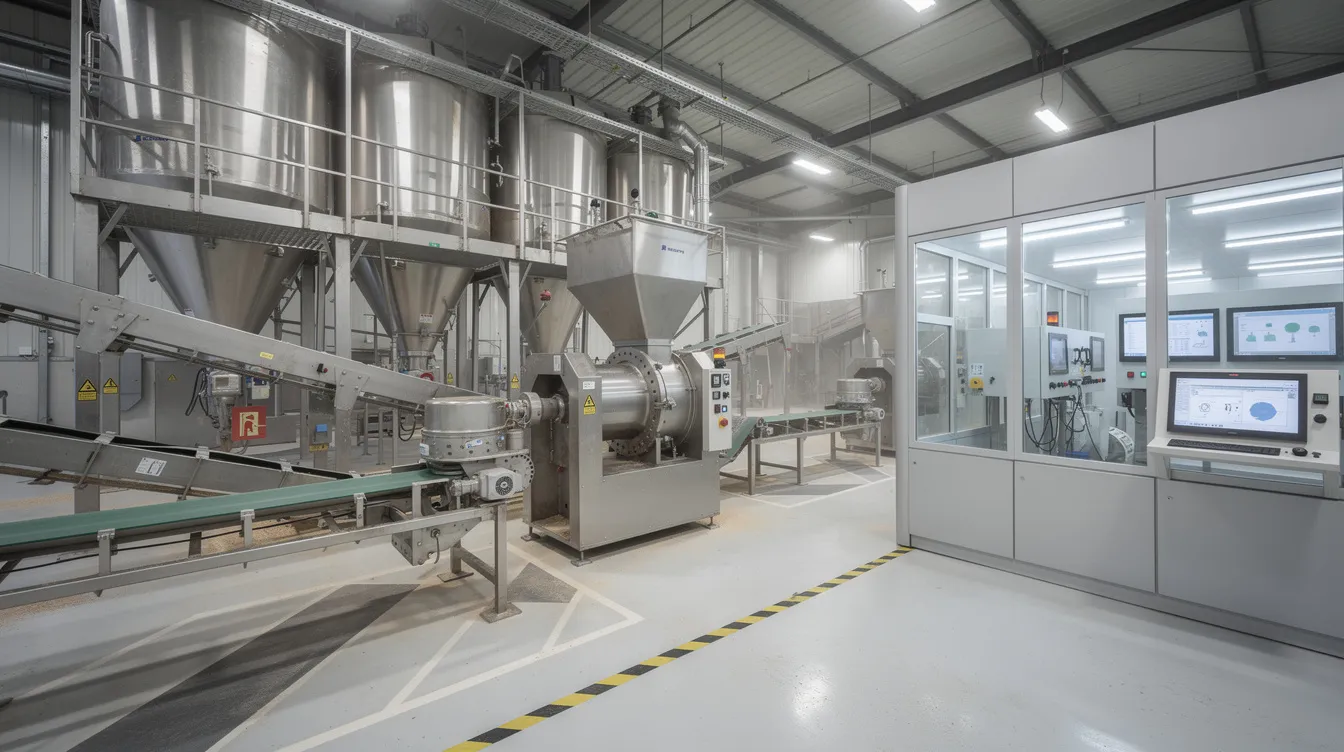
The production flow for a grain-based feed plant follows a logical sequence: Raw Material Receiving → Sampling and Quality Testing → Cleaning and Magnetic Separation → Grinding → Batching and Weighing → Mixing → Conditioning (for pellets) → Pelletisation → Cooling → Crumbling (if required) → Screening → Final Quality Check → Packaging → Finished Goods Storage → Dispatch.
Animal feed manufacturing requires grinding, mixing and pelleting equipment as its core processing backbone. Key technical considerations at each stage include:
- Grinding: Hammer mill screen size determines particle size-finer for poultry feed (chicken feed, broiler growth feed), coarser for cattle feed and dairy cows. Specific power consumption typically ranges from ₹250–₹400 per tonne of feed depending on particle size and plant design.
- Mixing: Uniform mixing time and low coefficient of variation ensure consistent nutritionally balanced feed formulations across every batch.
- Conditioning: Steam parameters (temperature 75–85°C, retention time, moisture addition) directly affect pellet quality, durability and feed efficiency.
- Pelleting: The pellet mill compresses conditioned mash into pellets; die and roller wear are ongoing maintenance costs.
For mash feed, the process is simpler-no pellet mill, conditioner, cooler or crumbler is required. Many plants producing liquid feed or basic concentrations operate as mash-only units. However, pelleted feed generally commands better market acceptance and lower transportation costs per unit of nutrition delivered.
Quality control checkpoints include raw material proximate analysis, in-process moisture and bulk density checks, and finished feed testing for nutritional parameters and microbiological safety. Process configuration varies for specialised products-readers planning aquatic feed or pet food annually should explore the automatic feed pellet manufacturing plant for advanced pelleting and extrusion technology requirements.
Raw Material Cost and Working Capital Requirements
Raw materials account for approximately 80–85% of operating expenses in a grain-based animal feed plant. This single fact dominates every financial discussion about animal feed manufacturing. Raw material costs significantly impact profitability in feed manufacturing, and price volatility in maize, soybean meal and oilcakes can directly impact operational margins.
An illustrative cattle feed formulation (simplified) may look like:
| Ingredient | Approximate % | Indicative Cost (₹/kg, 2025–26) |
|---|---|---|
| Maize | 35–45% | ₹22–28 |
| Wheat bran / rice bran | 15–20% | ₹14–20 |
| Soybean meal / rapeseed meal | 12–18% | ₹38–48 |
| DDGS | 5–10% | ₹18–24 |
| Mineral mixture, vitamins, additives | 3–5% | ₹60–120 |
| Other ingredients | Balance | Varies |
At these indicative levels, raw material cost per tonne of finished cattle feed may range from ₹20,000–₹28,000 depending on formulation and procurement efficiency.
Grain-based feed manufacturing heavily relies on working capital for ingredient procurement and operational expenses. An illustrative working capital assessment for a 5 TPH plant at 75% utilisation:
| Component | Days | Amount (₹ lakh) |
|---|---|---|
| Raw material inventory | 30 | 450–600 |
| Finished goods inventory | 7 | 90–130 |
| Receivables | 21 | 280–380 |
| Cash and operating expenses | – | 30–50 |
| Total current assets | 850–1,160 | |
| Less: Creditors | 15 | 220–300 |
| Working capital gap | 630–860 | |
| Margin money (25%) | 160–215 |
Seasonality in grain procurement in India (kharif maize harvest in October–November, rabi crops in March–April) affects both raw material cost and capital tied up. Many feed plants use a combination of spot purchases, forward contracts and bulk storage in godowns or grain silos to manage supply chain risks. Working capital finance typically involves cash credit limits secured against stock and receivables.
Annual Operating Costs and Cost of Production per Tonne
The objective here is to help promoters estimate production cost per tonne using a structured approach rather than relying on flat industry averages. Raw materials account for 80–85% of operating costs. Utilities represent around 5–10% of total operating expenses. Transportation and packaging costs make up the remaining operating expenses. Operating costs increase due to inflation and market fluctuations, and in the first year, operating costs prominently include utilities and maintenance alongside raw materials.
Illustrative cost of production per tonne for a 5 TPH plant at 75% utilisation:
| Cost Head | ₹ per Tonne |
|---|---|
| Raw materials and additives | 22,000–27,000 |
| Packaging material | 300–500 |
| Direct labour and supervision | 200–400 |
| Power and fuel (electricity, boiler fuel) | 350–600 |
| Repairs and maintenance | 150–300 |
| Quality control and laboratory | 50–100 |
| Factory overheads | 200–400 |
| Administrative and selling expenses | 300–600 |
| Total operating cost (excl. depreciation & interest) | 23,550–29,900 |
EBITDA represents earnings before interest, tax, depreciation and amortisation-the true operating performance metric. EBIT deducts depreciation to reflect asset consumption. Profit before tax further deducts interest, revealing the impact of the financing structure. Actual numbers will vary by region, product mix, raw material procurement efficiency and the operating cost structure of each plant. A plant-specific DPR refines these assumptions with supplier quotations and local cost data.
Revenue Model and Project Economics for a 5 TPH Grain-Based Animal Feed Plant
The following illustrative five-year financial model is presented for a 5 TPH pellet-based animal feed manufacturing plant operating one 8-hour shift per day, with provision for future expansion to double shift.
Key assumptions (clearly illustrative):
- Operating days: 300 per year
- Capacity utilisation: 60% (Year 1), 70% (Year 2), 80% (Year 3), 85% (Year 4), 90% (Year 5)
- Weighted average selling price: ₹30,000/MT (blended across cattle feed, poultry feed, pig feed)
- Raw material cost: ₹24,000/MT in Year 1, escalating at 4% annually
- Fixed operating costs: ₹1.8 crore in Year 1, escalating at 5% annually
- Total project cost: ₹22 crore; Term loan: ₹14 crore at 10.5% for 7 years; Promoter equity: ₹8 crore
| Parameter | Year 1 | Year 2 | Year 3 | Year 4 | Year 5 |
|---|---|---|---|---|---|
| Production (MT) | 7,200 | 8,400 | 9,600 | 10,200 | 10,800 |
| Sales revenue (₹ crore) | 21.60 | 25.20 | 28.80 | 30.60 | 32.40 |
| Variable costs (₹ crore) | 18.00 | 21.42 | 24.96 | 27.08 | 29.24 |
| Fixed operating costs (₹ crore) | 1.80 | 1.89 | 1.98 | 2.08 | 2.18 |
| EBITDA (₹ crore) | 1.80 | 1.89 | 1.86 | 1.44 | 0.98 |
| Depreciation (₹ crore) | 0.95 | 0.95 | 0.95 | 0.95 | 0.95 |
| Interest (₹ crore) | 1.35 | 1.15 | 0.95 | 0.75 | 0.55 |
| Profit before tax (₹ crore) | (0.50) | (0.21) | (0.04) | (0.26) | (0.52) |
Note: The above table demonstrates the severe margin compression when raw material costs escalate faster than selling prices can be adjusted. This scenario deliberately shows the downside risk-it does not represent the only outcome.
Under more favourable conditions where selling prices track input costs (which is the norm in a competitive but rational market), gross profit margins typically range between 15–25%, and net profit margins can reach 5–12% under normal conditions. Some industry projections suggest animal feed production can achieve ROI within 18 months, but this depends heavily on capacity utilisation, procurement efficiency and product positioning. Promoters must model both optimistic and conservative scenarios.
This framework can be customised by Project Report Bank into a plant-specific financial model, with detailed schedules for capacity utilisation, price scenarios and raw material variants.
Funding Pattern, Bank Loan Requirements and Documentation
The typical means of finance structure for an animal feed manufacturing plant in India includes:
| Source | Illustrative % of Project Cost |
|---|---|
| Promoter’s equity (including unsecured loans) | 25–35% |
| Term loan from bank / FI | 55–65% |
| Subsidy / soft loan (where applicable) | 5–15% |
Many entrepreneurs utilise government schemes to lower upfront equity requirements for setting up animal feed plants. Under AHIDF and similar schemes, projects across cost slabs from ₹5 crore to over ₹100 crore are being sanctioned.
Banks typically evaluate:
- Minimum promoter contribution (25–35% of project cost)
- Debt-equity ratio (usually not exceeding 2:1 to 2.5:1)
- DSCR of at least 1.3–1.5x
- Primary charge on fixed assets, collateral where required
Key documents lenders expect include a bankable DPR, CMA data, detailed machinery quotations, civil cost estimates, implementation schedule, promoter profile and KYC. The demand for investor-ready documentation is high among entrepreneurs seeking funding for new projects. A professionally prepared DPR and CMA data improve the quality of credit appraisal discussions and reduce iterative queries from bank officials.
Financial Feasibility, DSCR, IRR, NPV and Break-even Analysis
Profitability alone does not establish project viability. Lenders evaluate cash flow-based metrics and debt-servicing ability for animal feed plant capital investment decisions.
Break-even capacity utilisation – Derived by dividing total fixed costs (including depreciation and interest) by contribution per tonne. For a well-structured 5 TPH plant, break-even utilisation often falls in the range of 40–60%.
DSCR (Debt Service Coverage Ratio) – Computed as cash available for debt service divided by principal plus interest due in each year. Acceptable benchmarks vary by lender and project risk profile.
Project IRR and Equity IRR – Evaluated over a 7–10 year project life. Net present value is calculated using an appropriate discount rate reflecting the weighted average cost of capital.
Payback period – The time required to recover the initial investment from operating cash flows, typically 4–6 years for well-run feed plants.
Return on Capital Employed (ROCE) – Indicates how efficiently the total capital deployed generates operating returns.
Higher volatility in grain prices should be reflected in conservative assumptions. Both accounting profitability and actual free cash flow to equity must be examined before making long-term investment commitments. The global livestock feed production market reached $470 billion in 2023 and is projected to exceed $580 billion by 2028, growing at a CAGR of 3.8%, which underscores the scale of opportunity-but individual project viability depends on local economics, not global aggregates.
Sensitivity Analysis and Project Risk Assessment
Grain-based animal feed manufacturing faces significant volatility in maize and oilseed meal prices, as well as competitive pressure on finished feed prices from India’s largest feed plants and leading animal feed manufacturers. Asia-Pacific is experiencing rapid growth in feed demand due to rising incomes, which supports volume growth but does not eliminate price risk.
A sensitivity analysis should test the base case against:
| Scenario Change | Impact on EBITDA Margin | Impact on DSCR |
|---|---|---|
| Raw material cost +5% | Moderate compression | Falls by 0.15–0.25x |
| Raw material cost +10% | Significant compression | May breach minimum DSCR |
| Selling price –3% | Moderate compression | Falls by 0.10–0.20x |
| Selling price –5% | Severe compression | Likely below comfort level |
| Capacity utilisation –10pp | Reduced absorption of fixed costs | Falls by 0.20–0.30x |
| Power/fuel cost +15% | Minor impact (5–10% of OpEx) | Marginal |
| Interest rate +2pp | Moderate impact on PBT | Falls by 0.10–0.15x |
Key risks and mitigation strategies:
- Demand estimation error – Conduct a thorough market study; avoid overcapacity
- Raw material quality issues – Establish quality protocols and track feed materials from approved suppliers
- Plant downtime – Preventive maintenance schedules, adequate spares inventory
- Working capital shortages – Maintain adequate cash credit limits and buffer stock during peak procurement
- Commissioning delays and cost overruns – Realistic implementation timelines, contingency provision
A properly prepared DPR and risk analysis allows promoters and bankers to evaluate downside scenarios before finalising investment, contributing to animal welfare through better feed quality and improving animal productivity through consistent nutrition.
Land, Utilities, Licences and Regulatory Compliance for Animal Feed Plants
Selecting appropriate land for a feed manufacturing plant requires industrial zoning, connectivity to grain markets and consuming regions, and room for future expansion. Typical land requirements range from 0.5–1 acre for a 1 TPH plant to 3–5 acres for a 10 TPH plant, including raw material yard, production block, warehousing, administration and internal roads.
Utility requirements include:
- Power: 100–200 kVA for 1 TPH; 500–1,000+ kVA for 5–10 TPH plants
- Boiler: Steam generation essential for pelleting; biomass or gas-fired
- Water: Boiler make-up, dust suppression, domestic and laboratory use
- DG set: Essential backup in power-deficit areas
Commercial feed plants in India require adherence to BIS standards such as IS 2052:2009 for cattle feed. Initial costs for licences and registrations can range from ₹1 lakh to ₹2 lakh for animal feed plants, covering factory registration, trade licence and labour law compliance. Pollution control board consent for air emissions (dust, boiler stack) and noise is required in most states. Fire safety NOC and building plan approvals are standard requirements.
FSSAI licensing is typically more relevant for pet food or certain specific feed categories, and requirements differ by state, product composition and labelling. Voluntary certifications such as ISO or HACCP may support branding and tie-ups with leading animal feed manufacturers but are not legally mandatory for every feed plant.
Location Selection and Investment Feasibility in Indian Context
Location strongly affects both CapEx (land and logistics infrastructure) and OpEx (raw material transport, finished feed distribution and transportation costs per tonne). Key site selection criteria include:
- Proximity to maize, wheat and oilseed-growing belts
- Distance from major dairy, poultry and piggery clusters
- Access to highways, railheads and ports
- Power reliability and industrial water supply
- Labour cost, skill availability and local fabrication ecosystem
Typical strategic patterns include: a cattle feed plant near milk cooperatives in high milk-producing states serving dairy cows and buffalo feed demand; a multi-species animal feed plant positioned between grain surplus areas and poultry hubs producing chicken feed and broiler feed; and a feed plant integrated with DDGS or maize processing units for ingredient security and advanced nutrition science application. The animal farming industry thrives where logistics are optimised, and even the United States producing feed in large volumes follows regional clustering to minimise costs.
New Greenfield Plant vs Expansion or Modernisation of Existing Feed Plant
Promoters must evaluate whether a greenfield animal feed manufacturing facility or a brownfield expansion better serves their investment objectives.
Expansion or modernisation typically offers lower incremental CapEx per tonne of additional capacity, faster implementation, and lower market risk where existing brand and distribution infrastructure supports the volumes. Key evaluation points include current bottlenecks in grinding, mixing, pelleting or packing, existing land availability, and opportunity to upgrade automation and enhance animal growth formulations. Extensive production capacities can often be achieved by adding a second pellet line or upgrading batching systems rather than building entirely new infrastructure.
Greenfield investment is favoured when the promoter needs proximity to a new demand cluster, the existing site has physical or regulatory constraints, or a large capacity jump is planned. Akralos Supplies Animal Feeds and Akralos Animal Nutrition are examples of brands that have expanded through both approaches. For detailed evaluation of debottlenecking projects, refer to animal feed mill expansion and modernisation.
When and Why a Detailed Project Report (DPR) Is Necessary
For bank finance above modest ticket sizes and capacities above 1–3 TPH, lenders and investors in India require a professionally prepared DPR. The functional roles of a DPR for a grain-based animal feed manufacturing plant include:
- Validating market demand and appropriate plant capacity
- Finalising process flow, machinery selection and automation level
- Estimating accurate plant setup cost and total project cost
- Determining working capital needs and drawing power
- Preparing realistic 5–10 year financial projections, including stress scenarios
- Assessing DSCR, IRR, net present value, break-even and sensitivity
A generic project report based on templates differs fundamentally from a bankable DPR tailored to specific capacity, selected machinery suppliers, local construction costs and the promoter’s equity capacity. The American Feed Industry Association and other global bodies emphasise that advanced compound feed formulations require project-specific planning rather than one-size-fits-all approaches. Project Report Bank, led by CA Manish Gugliya, prepares DPRs integrating engineering, costing, GST treatment, funding pattern and CMA data aligned with Indian banking practices.
Serious promoters should treat DPR preparation as an investment in risk reduction and better negotiation with both machinery vendors and financiers.
Professional DPR, Financial Feasibility & Project Finance Advisory for Animal Feed Manufacturing Plants
ProjectReportBank.com is a Chartered Accountant-led project advisory platform specialising in manufacturing DPRs, CMA Data and project finance, with over 20 years of professional experience under the leadership of CA Manish Gugliya, FCA, DISA (ICAI).
Key services relevant to grain-based animal feed plant investors include:
- Customised DPRs for capacities of 1, 3, 5, 10 TPH and above
- Capital cost and machinery cost assessment, comparing semi-automatic versus automatic configurations
- Financial modelling with plant-specific cost of production, pricing strategy and profitability projections to achieve higher profit margins
- Working capital assessment, DSCR analysis, IRR and NPV calculations, and sensitivity analysis
- CMA Data preparation and support in structuring bank term loans and working capital limits
Project Report Bank also prepares specialised DPRs for integrated animal feed mills, automatic pellet plants, grain silos and maize-based ingredient units. The firm operates independently, not tied to any machinery supplier, enabling objective comparison of multiple quotations.
Promoters planning an investment in animal feed manufacturing are welcome to share basic project details over WhatsApp or email for an initial professional discussion.
Conclusion: Planning Grain Based Animal Feed Plant Setup Cost & Long-Term Viability
Establishing a grain-based animal feed manufacturing plant is a capital-intensive undertaking where accurate estimation of total plant setup cost-including land, civil construction, machinery, utilities, pre-operative expenses and working capital-determines whether the project proceeds on a sound financial foundation. The global animal feed industry continues to expand, with the livestock feed production market reflecting rising demand for livestock health and animal productivity solutions worldwide.
Correct capacity selection, robust machinery configuration and a disciplined raw material procurement strategy underpin sustainable operating margins in animal feed production. Promoters must maintain adequate working capital and liquidity buffers so that maize and other grain purchases can be timed advantageously without disrupting feed production schedules. Long-term success depends on cash flow and debt-servicing capacity, not merely on projected profit percentages. Sensitivity to raw material and selling price changes, along with higher profit margins achievable through operational efficiency and brand development, must be analysed thoroughly.
Serious entrepreneurs and existing feed manufacturers planning expansion should obtain a professionally prepared, lender-oriented DPR and financial model from Project Report Bank before finalising investment commitments and loan sanctions. Defensible assumptions and transparent financial analysis are far more valuable than optimistic projections when committing capital of this magnitude.
Frequently Asked Questions (FAQs) on Grain-Based Animal Feed Plant Setup Cost
The following FAQs address common promoter queries that complement the detailed analysis presented above.
How long does it usually take to commission a grain-based animal feed plant after financing approval?
For most 3–5 TPH projects, the typical timeline from financing approval to commercial production is 6–10 months, subject to land readiness and statutory clearances. This includes approximately 2–3 months for detailed engineering and final machinery orders, 3–5 months for equipment delivery and installation, and 1–2 months for trial runs and production stabilisation. Larger plants (10 TPH and above) or those involving extensive civil works and waste management systems may take 10–14 months.
Are grain storage silos mandatory, or can a feed plant start with only godowns?
Many small and mid-size feed plants in India operate initially with covered godowns and floor storage for raw material storage. Steel or RCC silos are a strategic add-on rather than a mandatory requirement. Silos improve bulk grain handling, reduce storage losses and support seasonal procurement strategies as volumes grow. Promoters can plan silo installation as a Phase 2 investment once production volumes and procurement patterns stabilise.
Can one plant manufacture both cattle feed and poultry feed without major extra cost?
A well-designed grain-based feed plant can usually switch between cattle feed, poultry feed and even pig feed using the same core machinery. The incremental cost relates more to recipe management, silo or bin allocation for different animal species ingredients, and quality controls (especially avoiding cross-contamination of shrimp feed formulations or specialty feed ingredients) rather than heavy capital expenditure. Careful formulation management ensures each product meets the required nutritional standards.
Is it necessary to start with pelleted feed, or can I begin with mash feed only?
Mash-only plants have lower machinery cost and simpler utility requirements-no pellet mill, smaller or no boiler. However, pelleted livestock feed often commands better market acceptance, improved feed efficiency, lower dust losses and logistics advantages. Many promoters start with mash feed production plus provision for a future pelleting line, adding the pellet press, conditioner, cooler and crumbler when volumes and market demand justify the additional investment. Animal feed serves different segments, and the product form should match market requirements.
How does contract manufacturing for established brands impact project economics?
Long-term toll manufacturing or contract production for leading animal feed manufacturers can help secure base utilisation, improve cash flow visibility and support project bankability. However, margins per tonne are typically lower than own-brand sales. A well-prepared DPR should separately model both own-brand and contract production volumes, distinguishing the contribution margin from each stream. This blended approach supports higher capacity utilisation in early years while the promoter builds distribution and brand recognition in the animal agriculture value chain.