Key Takeaways
- Maize is the dominant energy grain in India’s animal feed industry, with roughly 60% of domestic consumption directed toward poultry and livestock feed formulations. A dedicated maize feed ingredient processing plant-focused on cleaning, grinding and grading raw maize grain into standardised feed-grade products-addresses a distinct and growing industrial demand.
- This article covers the technical setup, production process, machinery, project cost framework, working capital, operating economics, financial projections and feasibility considerations for industrial maize grinding and grading plants in India, across capacity ranges of 2 to 20 TPH and above.
- Raw material cost (maize procurement) typically constitutes 70–80% of total operating expenses; quality risks including mycotoxins and moisture, along with working capital management, drive project viability far more than machinery cost alone.
- This article focuses strictly on maize cleaning, grinding and grading for feed-grade ingredients. It does not cover maize starch manufacturing, bioethanol production, full compound feed mills or human-food flour milling.
- Project Report Bank, led by CA Manish Gugliya, FCA, DISA (ICAI), prepares customised Detailed Project Reports (DPRs), feasibility reports and CMA data for bank finance for maize feed ingredient processing projects across India.
1. Introduction and Industrial Opportunity
Maize (Zea Mays), commonly known as corn, is the principal energy-providing cereal in commercial animal feed across the world. In India, maize grain now competes with rice and wheat as a leading cereal crop, but unlike those two, the majority of its output is consumed not as human food but as a raw material for feed, starch and industrial applications. The demand for maize-based animal feed is increasing globally, and India’s maize processing industry is growing rapidly to keep pace with the expansion of poultry, dairy, aquaculture and organised livestock farming.
A maize feed ingredient processing plant is a facility that receives raw maize, cleans it, removes impurities, grinds or crushes the grain to specified particle sizes, grades the output and packages it for supply to feed manufacturers. This is fundamentally different from an integrated compound feed mill (which blends multiple ingredients into complete rations), a maize starch or wet milling plant (which extracts starch, gluten and oil through wet processing), or a maize flour unit serving the human food market. The distinction matters for project planning, machinery selection, regulatory compliance and financial feasibility.
The commercial rationale is straightforward: as poultry and cattle feed manufacturing shifts from unorganised mixing to quality-controlled formulations requiring consistent supply of graded maize ingredients, there is rising demand for reliable, specification-driven maize meal, grits and cleaned grain. Establishing a dedicated maize feed ingredient processing plant-whether as an independent unit or as backward integration for an existing feed manufacturer-creates value by bridging the gap between farm-level maize and industrial feed production. This maize feed ingredient processing plant project report article guides promoters through every aspect of technical setup, cost estimation, financial projections and bankable DPR preparation in the Indian context.
2. Industrial Maize Feed Ingredient Processing Industry in India
India produced approximately 55.1 million tonnes of maize during 2025–26, cultivated across about 14.41 million hectares, according to government production estimates. The global maize market size was estimated at 1.34 billion tons in 2025 and is projected to reach 1.71 billion tons by 2034. Globally, the USA and China produce 31.38% and 23.28% of global maize respectively, while India’s output positions it among the top producers in both developing and developed economies.
| Parameter | Approximate Figure (2025–26) |
|---|---|
| India maize production | ~55.1 million tonnes |
| Area under cultivation | ~14.41 million hectares |
| Share used for poultry feed | ~47% |
| Share for livestock feed | ~13% |
| Share for starch / industrial use | ~14% |
| Major producing states | Madhya Pradesh, Karnataka, Maharashtra, Bihar, Andhra Pradesh, Telangana |
The maize procurement ecosystem operates through APMC mandis, e-NAM networks, aggregators and Farmer Producer Organisations (FPOs). Contract farming is emerging in southern India for specific yellow maize varieties demanded by feed and industrial buyers. Market analysis identifies target customers including poultry feed manufacturers, cattle feed plants, aqua feed producers, large integrators and traders supplying bulk maize meal and grits.
Regional production and consumption patterns create commercial opportunity. States like Karnataka, Maharashtra and Madhya Pradesh are high production zones, while poultry and livestock feed consumption is concentrated in Andhra Pradesh, Telangana, Tamil Nadu, Punjab, Haryana and West Bengal. The gap between production belts and consumption hubs sustains demand for organised, quality-assured processing with standard particle size and moisture levels-far superior to unprocessed farm-level maize sales.
3. Products Manufactured and Commercial Applications
A maize feed ingredient plant converts raw maize grain into multiple graded and ground products tailored to different feed requirements. The nutritional value of maize as an energy-dense cereal-rich in starch, with moderate protein and oil content-makes it suitable for a wide range of livestock feed formulations including those for cattle, poultry, pigs and ruminants. For broiler diets, optimal maize particle sizes are typically in the range of 600–900 microns; coarser particles benefit dairy and layer birds, while finer grinding suits aqua feed premixes.
Maize fiber, a by-product of corn wet milling, contains hemicellulose, cellulose and residual starch. It supports digestion and gut health in livestock and is used in feed formulations for cattle, poultry and pigs. Maize fiber contributes to economical feed production and is sometimes available as a supplementary ingredient. In a dry grinding plant, screening fines serve a broadly similar role in low-value feed mixes.
| Product Type | Particle Size Range | Key Processing Steps | Target Customers | Main Commercial Uses |
|---|---|---|---|---|
| Cleaned whole feed-grade maize | Whole grain, unground | Cleaning, destoning, grading | Feed mills, integrators | Direct feed mixing, storage |
| Crushed / kibbled maize | 2–5 mm | Cleaning, coarse grinding | Cattle feed plants, traders | Dairy rations, ruminant feed |
| Coarse maize meal | 1–3 mm | Cleaning, grinding, sieving | Cattle, layer poultry | Grower/finisher feed, cattle TMR |
| Fine-ground maize meal | 600–900 µm | Cleaning, fine grinding, sieving | Poultry, aqua feed mills | Starter/grower mash, aqua diets |
| Maize grits / fractions | 2–5 mm | Cleaning, crushing, screening | Feed premix companies | Blended feed, energy component |
| Screening fines / by-products | <300 µm | Collected during sieving | Low-value feed blenders | Economy rations, bran blends |
Custom particle-size specifications and consistent moisture content improve feed efficiency and feed conversion ratio (FCR), which is why institutional buyers pay a premium for graded, specification-compliant maize ingredients over raw, unprocessed grain.
4. Plant Capacity and Production Planning
Installed capacity is measured in tonnes per hour (TPH) of raw maize input, while practical operating capacity depends on operating hours, shift patterns, utilisation rate and yield after cleaning losses. Plant capacity should be based on market demand and raw material availability rather than on theoretical machinery output alone.
A maize processing facility can have a production capacity of 100,000–200,000 MT annually at the higher end, depending on configuration. The following illustrative table shows how annual output scales with TPH:
| Installed Capacity (TPH) | Hours/Day | Days/Year | Theoretical Input (MT/yr) | Utilisation % | Finished Product Output (MT/yr)* |
|---|---|---|---|---|---|
| 2 | 18 | 300 | 10,800 | 75% | ~7,700 |
| 5 | 18 | 300 | 27,000 | 80% | ~20,500 |
| 10 | 18 | 300 | 54,000 | 80% | ~41,000 |
| 20 | 18 | 300 | 108,000 | 85% | ~87,200 |
*After ~1–3% cleaning and ~1–2% dust/shrinkage losses. Figures are illustrative and must be validated in a plant-specific DPR.
Key bottlenecks that often limit capacity include hammer mill throughput, classifier and sifter sizing, packing speed (especially with manual bagging) and availability of raw maize during lean months. The distinction between raw maize input capacity and saleable finished-product output after cleaning, shrinkage and dust removal is critical for accurate production economics.
5. Raw Material Requirements and Procurement Strategy
Maize grain is the primary raw material. Acceptable quality parameters for feed-grade maize include moisture content at or below 14–15%, foreign matter below 1–2%, minimal broken or damaged kernels, no insect infestation and aflatoxin B1 within permissible limits (≤15 µg/kg for cereals). Raw material quality parameters should include moisture content and contamination levels as the first line of defence against downstream quality problems.
Procurement strategies for maize must consider seasonal availability and local market conditions. During Kharif harvest, prices are lower but moisture tends to be higher; lean-season maize is drier but costlier and supply may be interrupted. The Minimum Support Price for maize KMS 2026–27 stands at ₹2,410 per quintal, providing a floor reference for cost estimation.
Critical quality risks include aflatoxins, fumonisins and other mycotoxins exacerbated by humid climates, rain-damaged harvests and poor on-farm drying. Sampling, rapid testing (strip tests, ELISA), traceability, batch segregation and rejection protocols are essential. Storage must target moisture of 12–13% for safe long-term holding, with aeration, fumigation and regular inspection. Typical storage losses may range from 1–3% annually.
Procurement strategy directly affects working capital. Bulk buying during harvest season locks up significant inventory; the trade-off between lower purchase price and higher interest cost on inventory must be modelled carefully. Credit terms from maize suppliers versus credit given to feed manufacturer customers define the cash conversion cycle. These factors feed directly into CMA data preparation and bank working capital appraisal.
6. Maize Feed Ingredient Manufacturing Process – Step by Step
The production process follows a defined flow: Raw Maize Receiving → Sampling & Quality Testing → Pre-Cleaning → Magnetic Separation → Destoning & Grading → Moisture Testing → Grinding / Crushing → Sieving & Particle-Size Classification → Product Grading → Final QC → Weighing & Packaging → Finished-Goods Storage → Dispatch.
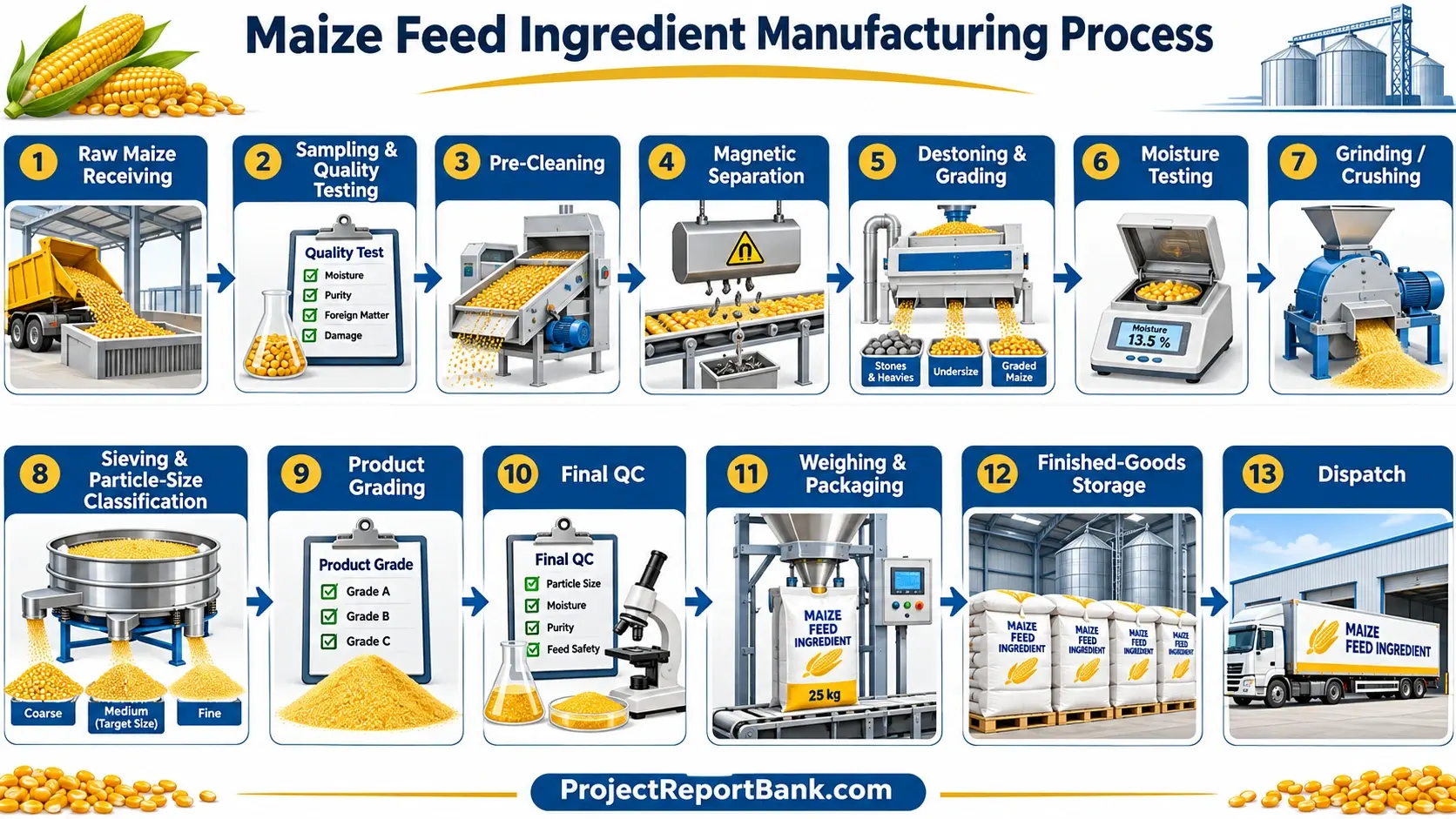
The main stages include:
- Raw maize receiving: Trucks unload into intake pits or hoppers. On-site weighbridge measurement and preliminary visual inspection establish quantity and gross quality.
- Sampling and quality testing: Representative sampling for moisture measurement, visual checks for foreign matter, damaged kernels, insect presence and mycotoxin tests where required. Quality control measures are essential in ensuring feed safety and compliance with nutritional standards.
- Pre-cleaning: Rotary or vibratory pre-cleaners and aspiration systems remove dust, chaff and large debris.
- Magnetic separation: Magnetic separators capture ferrous metals, protecting hammers, rollers and screens downstream.
- Destoning and grading: Destoners remove heavy impurities; grading machines classify kernels by size.
- Moisture testing and conditioning: Online or batch moisture measurement. High-moisture grain is rejected or dried; light conditioning may improve grinding production efficiency.
- Grinding / crushing: Hammer mills are common for coarse and medium grinding; roller mills produce more uniform particle size at potentially lower energy per tonne but higher capital cost. Energy benchmarks for maize grinding are typically 3–6 kWh per tonne of input.
- Particle-size screening: Vibratory sieves or plansifters separate coarse, medium and fine fractions. Oversize particles enter re-grind loops.
- Product grading and blending: Different fractions are blended to achieve target granulometry for specific customer requirements.
- Final quality control: Particle-size analysis, moisture, mycotoxin checks and any microbiological testing per contractual specifications.
- Weighing and packaging: 25–50 kg bags, jumbo bags or bulk loading. Certified weighing scales are essential.
- Storage and dispatch: FIFO practices, proper stack management, truck loading systems.
Trial runs and quality control protocols are necessary before commercial production begins. Aspiration, cyclone collection and bag filters are essential for dust control and safety around grinders and transfer points. Automation level options range from basic semi-automatic plants with manual bagging to higher-end facilities with PLC-based control, SCADA and online particle-size monitoring.
7. Plant and Machinery Requirements
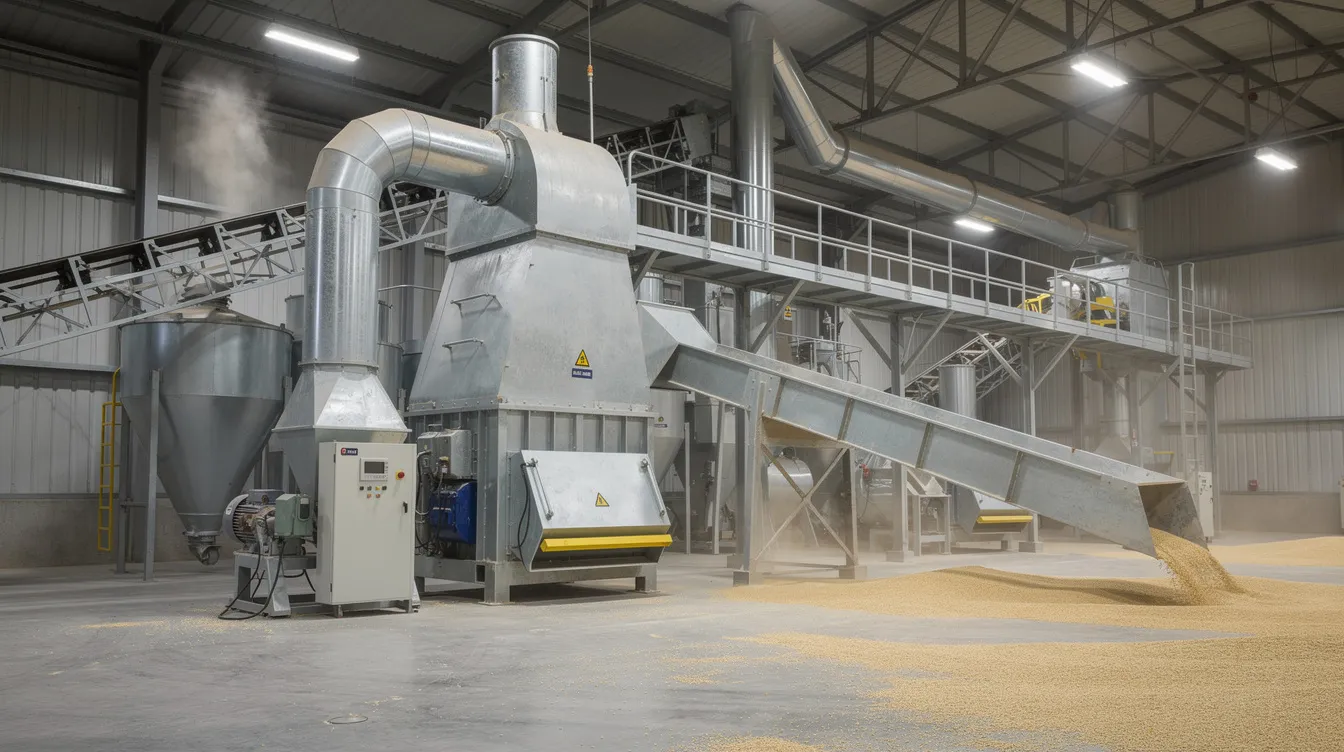
Machinery selection must match desired capacity, product mix and automation level to avoid under- or over-investment. Setting up a maize processing plant requires evaluating technological needs carefully before committing capital.
| Machinery / System | Function | Capacity / Sizing Notes | Key Selection Considerations |
|---|---|---|---|
| Intake hopper, belt/bucket elevators | Raw maize receiving and transfer | Matched to TPH rating | Height, power, safety guards |
| Pre-cleaners, vibratory sieves | Remove foreign matter | Sized for raw maize throughput | Screen change-over, robustness |
| Magnetic separators | Remove ferrous metals | In-line, before grinding | Strength, cleaning access |
| Destoners, grading machines | Remove stones, grade kernels | Throughput matched | Accuracy, grain damage |
| Moisture meters | Inline and portable testing | Continuous or batch | Accuracy, calibration |
| Hammer mills (100–650 HP) | Grinding to specified particle size | 1–10 TPH per unit | Screen size, rotor speed, energy, spares |
| Roller mills | Uniform fine grinding | Higher capital, lower energy/t | Precision, maintenance |
| Vibratory screens / plansifters | Grade meal into fractions | Matched to mill output | Mesh sizes, throughput |
| Dust extraction (cyclones, bag filters) | Dust control, safety | Duct sizing for all transfer points | Spark detection, air volume |
| Finished-product bins/silos | Product storage | Based on output and holding period | Weather protection, discharge |
| Automatic bagging machines | Weighing, filling, sealing | Bags per hour | Accuracy, bag type compatibility |
| Electrical panels, PLC/automation | Control, monitoring | Plant-wide | Redundancy, safety interlocks |
| Lab equipment | Mycotoxin, moisture, sieve analysis | In-house or external tie-up | Testing turnaround time |
Energy efficiency, spare-parts availability and local versus imported machinery choices affect both project cost and long-term maintenance. For context on machinery cost considerations in other milling projects, the approach is similar to that for specialty flour plant machinery.
8. Land, Building, Infrastructure and Utilities
Typical land requirements range from approximately 0.5–1 acre for small 2–5 TPH plants to 2–3 acres for larger 20 TPH+ facilities with silos and truck yards. The feed processing plant’s layout should allow for efficient material movement and workflow from raw maize receiving through processing to finished-goods dispatch.
Plant design must include infrastructure for raw material storage, processing and product dispatch. Key building requirements include a main processing hall, raw maize warehouse or silo yard, finished-goods warehouse, administrative block with QC lab, utility block (DG set, compressors, transformers) and internal roads with truck turning areas.
Utilities required for operation include electricity, water supply and waste management systems. Electrical load depends on machinery configuration; larger hammer mills, screeners and conveyors contribute most of the demand. Backup DG sets are essential where grid reliability is poor. Water requirements are limited mainly to domestic use and occasional cleaning-large process water is not generally required in a dry maize grinding plant. Ventilation and dust-extraction ducting are critical for worker safety and to minimise environmental impact.
Fire and explosion safety aspects include spark detection systems, explosion vents or suppression where appropriate, flameproof electrical fittings in high-dust zones and fire hydrants or extinguishers in line with local safety codes.
9. Maize Grinding and Grading Plant Project Cost in India
Project cost varies significantly with capacity, automation level, building design and land price. Capital cost estimates encompass land, construction, machinery and operational costs, and only vendor quotations and civil estimates at the time of planning can give accurate figures.
| Cost Head | Description |
|---|---|
| Land and site development | Purchase or lease, levelling, boundary |
| Factory building and civil works | Processing hall, warehouses, admin block |
| Plant and machinery | Domestic and/or imported equipment |
| Storage facilities | Silos, warehouses, bins |
| Electrical installation | Cabling, panels, transformer, HT connection |
| Utilities | DG set, compressor, dust collection, fire protection |
| Laboratory and testing equipment | Moisture, mycotoxin, sieve analysis |
| Pre-operative expenses | Consultancy, DPR preparation, interest during construction, trial runs |
| Contingency | Typically 5–10% of above |
| Margin money for working capital | As required by bank |
For smaller plants (2–5 TPH), simpler material handling and bag-based operations keep capital modest. Medium plants (5–10 TPH) require moderate automation and some bulk handling. Larger 20 TPH+ plants need silos, sophisticated dust-control systems and higher-level automation, substantially increasing outlay. Indicative machinery costs in India range from a few lakhs for basic hammer mills to over ₹1 crore for large integrated lines with automation.
Cost heads frequently underestimated by promoters include electrical panels and cabling, fire and safety systems, statutory fees and interest during construction.
10. Working Capital Requirements
Maize processing is inventory-intensive. Maize is harvested seasonally, but sales to feed mills are continuous, creating significant working capital requirements. Key components include raw maize inventory (typically 30–90 days coverage), packaging material, finished-goods stock, trade receivables from feed mill customers (credit periods of 15–45 days), trade payables and cash for operations.
| Working Capital Item | Norm (Days) | Funded By |
|---|---|---|
| Raw maize inventory | 30–90 days | Bank CC + promoter margin |
| Packaging materials | 15–30 days | Bank CC |
| Finished goods | 7–15 days | Bank CC + margin |
| Trade receivables | 15–45 days | Bank CC |
| Less: Trade payables | 15–30 days | Supplier credit |
Seasonal procurement at lower prices requires higher inventory and therefore higher bank limits. Alternatively, staggered purchasing at slightly higher prices reduces inventory carrying cost. These calculations feed directly into CMA data preparation and bank assessment of drawing power. The promoter’s margin money for working capital is typically included in the project cost.
11. Operating Cost and Production Economics
Operating costs for maize processing are 70–80% raw material expenses. Maize accounts for 70–80% of total operating expenses in processing, making procurement price the single most important variable in production economics. Operating costs increase significantly by the fifth year of operation as maintenance, labour and input costs escalate.
| Cost Head | Indicative Share of Total Cost |
|---|---|
| Maize raw material | 70–80% |
| Power and fuel | 3–8% |
| Direct labour and supervision | 3–5% |
| Packaging materials | 2–3% |
| Repairs and maintenance | 1–3% |
| Quality control and lab expenses | <1% |
| Storage and handling losses | 1–3% |
| Administrative and selling expenses | 2–4% |
The relevant financial terminology for readers: gross trading margin is the difference between selling price and raw maize cost per tonne; processing contribution is gross margin minus direct processing and overhead costs; EBITDA margin reflects earnings before interest, tax, depreciation and amortisation. Net profitability accounts for interest and tax. Sensitivity analysis should be conducted in the DPR for changes in power tariffs, labour cost and maintenance spend.
12. Revenue Model, Selling Price and Profitability
Revenue streams include sale of processed maize meals, grits and cleaned grain, possible toll or contract grinding for nearby feed mills and sale of by-products or screenings where quality permits. Maize processing plant gross profit margins range from 20–30% depending on product mix, quality premiums and procurement efficiency.
Selling price is influenced by quality parameters (moisture, mycotoxin levels), particle-size specification and consistency, packaging type (bulk versus bagged), credit terms and delivery conditions. Customers range from spot buyers through traders to annual or seasonal rate-contract holders such as large integrators.
Profitability is highly sensitive to maize procurement price, capacity utilisation (fixed-cost absorption), energy cost and local selling-price competition. Promoters should avoid relying on optimistic margins. Instead, the DPR should provide realistic base, optimistic and conservative scenarios over at least seven years. Financial projections assess ROI and long-term sustainability rather than short-term profit appearance.
13. Financial Projections and Bankable DPR
A Detailed Project Report outlines technical and financial aspects for project stakeholders-lenders, investors and the promoter. Banks and investors expect a structured, bankable DPR with integrated analysis rather than a generic template. Financial projections should cover at least five years to address profitability and cash flow management comprehensively.
The DPR should include sections on executive summary, market analysis and financial projections. Financial models must reflect project-specific assumptions and be based on realistic market analysis. Core components include:
- Project cost estimate and means of finance (promoter equity, term loan, working capital limits)
- Year-wise production and sales projections with product mix and pricing assumptions
- Projected profit and loss statements, balance sheets and cash-flow statements
- Term-loan repayment and interest schedule
- Working capital assessment and CMA data
- DSCR calculation over loan tenure
- Break-even analysis, project IRR, equity IRR and NPV
Banks evaluate adequacy of promoter contribution, DSCR comfort, robustness of assumptions and ability of project cash flows to service debt. A feasibility study assesses local demand and competitor pricing for financial planning. Project Report Bank, under CA Manish Gugliya, prepares customised DPRs with transparent assumptions, sensitivity checks and banker-friendly formats.
14. Financial Feasibility and Investment Appraisal
The financial viability of a project is determined using metrics like ROI, IRR and break-even analysis across alternative capacity options. Practical sensitivity analysis evaluates financial stability under changing operational conditions.
Scenarios to model include lower-than-expected capacity utilisation, increase in maize prices, lower selling-price realisation, higher electricity and logistics costs, delayed receivables and higher interest rates. Each adverse scenario affects gross margin, EBITDA, cash flow available for debt servicing, DSCR and overall project IRR.
| Metric | 5 TPH Plant | 10 TPH Plant | 20 TPH Plant |
|---|---|---|---|
| Relative project cost | Lower | Moderate | Higher |
| Expected mature-year turnover | Lower | Moderate | Higher |
| EBITDA margin sensitivity | Higher risk | Moderate | Better absorption |
| Minimum viable utilisation | Higher % needed | Moderate | Lower % sufficient |
Investment decisions should be based on conservative assumptions. Independent professional review reduces the risk of over-optimistic projections and helps identify the minimum viable scale for the targeted market.
15. Statutory Approvals, Regulatory Compliance and Quality Standards
Regulatory approvals vary based on plant types and processing technologies employed. Exact requirements differ by state, capacity and nature of operations. Typical registrations include business constitution and PAN, UDYAM/MSME registration, GST registration and factory licence.
Environmental compliance involves obtaining licences and following pollution control regulations. State Pollution Control Board consent for air and noise emissions is generally required. Fire NOC, electrical safety approvals and periodic inspections are standard. Waste management practices should focus on reducing environmental impact and adhering to regulations.
Labour-law compliance includes registration under applicable statutes, minimum wages, ESI and PF. Training programs should be developed for staff to ensure operational efficiency and safety compliance, particularly around high-dust areas and heavy machinery.
Weights and measures requirements apply to packaging operations under Legal Metrology. FSSAI licensing may not be mandatory where products are strictly for animal feed, but conditions differ by state and product scope. BIS standards and other quality certifications are often voluntary or customer-driven. Written quality-control SOPs aligned with industry standards and customer specifications are recommended.
16. Industrial Risks and Mitigation
| Risk | Likely Impact | Mitigation |
|---|---|---|
| Maize price volatility | Higher raw material cost, margin squeeze | Multi-state sourcing, harvest-season procurement, forward contracts |
| Mycotoxin contamination | Batch rejection, customer complaints | Rapid testing, traceability, supplier qualification |
| Grain moisture / storage loss | Weight loss, fungal growth, quality degradation | Proper silos, aeration, fumigation, moisture monitoring |
| Dust explosion / fire | Safety hazard, property damage | Spark detection, explosion vents, flameproof fittings |
| Particle-size inconsistency | Customer complaints, rejection | Regular sieve calibration, inline monitoring |
| Machinery breakdowns | Production loss, delayed deliveries | Preventive maintenance, spare-parts inventory |
| Power interruptions | Downtime, DG fuel cost | Backup DG sets, energy-efficient equipment |
| Customer concentration | Revenue risk if large buyer exits | Diversified customer base, contract and spot mix |
| Working capital stress | Inability to procure or operate | Conservative inventory planning, adequate bank limits |
| Regulatory changes | Compliance cost, operational disruption | Monitor policy, maintain statutory hygiene |
Professional DPRs incorporate risk analysis and contingency planning to strengthen the project’s position with banks and investors, as discussed in detail in approaches to dairy project sensitivity and risk analysis.
17. Strategic Location and Industrial Integration Opportunities
Setting up a maize feed processing plant requires proximity to maize-growing regions for cost-effective operations. Plant location directly influences raw maize procurement cost, outward logistics to feed consumers and overall feasibility. Ideal sites offer access to national or state highways, reliable electricity and proximity to poultry or cattle feed clusters.
Integration opportunities include backward integration by existing feed manufacturers setting up captive maize processing, forward integration by maize traders adding value through grinding and grading, and horizontal expansion into other grains and cereals such as broken rice, wheat bran, barley grain and sorghum. Entrepreneurs interested in downstream projects may also explore setting up a separate integrated animal feed mill, industrial cattle feed manufacturing plant or automatic feed pellet manufacturing plant as complementary projects.
18. Why a Professional Project Report Is Essential
Generic project reports typically suffer from outdated cost assumptions, lack of state-specific regulatory context and oversimplified capacity utilisation and working capital assumptions. A comprehensive project report includes a detailed assessment of operational and financial requirements that cannot be addressed by a downloadable template.
A professional maize feed ingredient processing plant project report should include technical configuration specific to selected capacity and product mix, realistic capex with vendor-backed estimates, detailed working capital assessment, multi-year financial projections with assumptions explicitly stated, DSCR and IRR calculations under base and stress scenarios, and thorough risk analysis. Investor-ready documentation includes comprehensive financial analyses and project feasibility assessments that generic reports cannot provide.
Banks and financial institutions place higher confidence in DPRs prepared or reviewed by experienced professionals with project-finance exposure. Project Report Bank focuses on customised, analysis-driven DPRs and feasibility reports, not generic templates.
19. Professional DPR and Financial Feasibility Services by Project Report Bank
CA Manish Gugliya, FCA, DISA (ICAI), is a practising Chartered Accountant with over 20 years of experience in project finance, bank DPRs, CMA data and manufacturing-project feasibility across India. Core advisory services relevant to maize feed ingredient projects include:
- Customised Detailed Project Reports for term loans and investor funding
- Bankable project reports and CMA data for working capital limits
- Detailed financial modelling and sensitivity analysis
- Project cost assessment, means of finance and loan-structuring advice
- DSCR, IRR, NPV, break-even and payback analysis
- Investor-ready DPRs for equity fundraising
- Comparative analysis of capacities (5 vs 10 vs 20 TPH) tailored to the promoter’s market and capital constraints
The team at ProjectReportBank.com prepares banker-friendly projections, ratios and documentation that help serious promoters present a credible case to lenders and investors.
20. Frequently Asked Questions on Maize Feed Ingredient Processing Plant Project Reports
What is the approximate project cost of a maize feed ingredient processing plant in India?
Indicative project cost depends on capacity, building design, land price, automation level and whether silos are included. A 2–3 TPH semi-automatic unit requires a relatively moderate investment, while a fully automated 20 TPH plant with silos involves a significantly higher outlay. For serious planning, promoters should commission a plant-specific cost estimate based on current-year quotations from machinery suppliers and civil contractors, incorporated into a bankable DPR.
Which machinery is essential for an industrial maize grinding and grading plant?
Key equipment includes intake and conveying systems, pre-cleaners, magnetic separators, destoners, grading equipment, hammer or roller mills, vibratory sieves or plansifters, dust-collection systems, product bins, automatic bagging machines, electrical panels and basic laboratory instruments. Exact machinery count and specifications depend on chosen throughput, desired product range and target automation level.
What is the minimum commercially viable capacity for such a plant?
Viability depends more on local market size and sourcing logistics than on a fixed TPH figure. In many Indian industrial contexts, capacities below about 2 TPH may struggle to cover fixed overheads unless integrated with a captive feed mill. Comparing scenarios like 2, 5 and 10 TPH in a feasibility report helps determine the most economical scale.
How are DSCR and project IRR calculated?
DSCR is the ratio of cash available for debt service to the total debt obligations (principal plus interest) due in each year. Project IRR is the discount rate at which the net present value of all project cash flows equals zero. Both are computed from detailed year-wise financial projections and are essential metrics for bank appraisal. The quality of these ratios depends entirely on the quality of the underlying assumptions.
Why is a customised bankable DPR important instead of using a generic project report?
Generic reports ignore state-specific factors, actual land and building costs, local maize and power prices, specific machinery quotations and the promoter’s own equity and collateral position. A customised DPR from Project Report Bank aligns technical design, project cost, means of finance, financial projections and risk analysis with the promoter’s exact capacity, location and financing plan-giving lenders and investors a reliable basis for appraisal rather than a theoretical exercise.
21. Conclusion and Professional Call to Action
India’s maize feed ingredient processing opportunity is commercially significant and growing. With the growth in organised poultry, dairy and aquaculture feed manufacturing, the demand for standardised, quality-controlled maize meal, grits and cleaned grain will continue to expand. A dedicated maize cleaning, grinding and grading plant-whether serving external feed mills or integrated with captive feed manufacturing-addresses a real and measurable market need.
Project viability, however, depends on robust maize procurement strategy, realistic capacity planning, efficient processing, disciplined working capital management and professional financial analysis. The difference between a successful project and a stressed investment often lies not in the machinery but in the accuracy of the project report’s assumptions and the promoter’s understanding of the financial structure.
Serious promoters and businesses should obtain a customised maize feed ingredient processing plant project report-including detailed cost estimates, working capital assessment, DSCR and IRR analysis-before finalising machinery specifications or approaching banks for finance.
CA Manish Gugliya, FCA, DISA (ICAI) Industrial Project Reports | Bank Finance DPR | Financial Feasibility | Project Finance Advisory Website: https://projectreportbank.com/
For enquiries, reach out through the official website contact or WhatsApp channel.