Key Takeaways
- A profitable-looking manufacturing business idea does not automatically attract equity investors; they evaluate risk-adjusted returns, governance, scalability and exit routes before committing capital.
- A strong manufacturing investor pitch deck is built on a customised investor-ready DPR, financial model and feasibility study, not a generic pitch deck template or startup pitch deck template.
- Presenting project cost, means of finance, working capital, project IRR and equity IRR with clear assumptions is what separates a successful pitch from an ignored one.
- The ₹20 crore illustrative example in this article shows how promoter contribution, bank term loans and new equity combine to determine valuation and promoter dilution.
- Project Report Bank and CA Manish Gugliya specialise in preparing investor-ready DPRs, financial projections, business valuation and investor pitch deck documentation for manufacturing projects across India.
How to Pitch a Manufacturing Project to Equity Investors in India
A manufacturing project investor pitch in India looks nothing like a technology startup pitch. A startup founder might secure seed funding on a concept, a team slide and a growth trajectory chart. A manufacturing promoter pitching a ₹20 crore plant must show land, machinery quotations, raw material contracts, power tariff data and a financial model connecting installed capacity to cash flow.
The difference runs deeper than format. Banks focus on collateral, DSCR and repayment security. Equity investors, whether angel investors, HNIs, family offices, venture capitalists or strategic corporate investors, focus on scalability, governance, competitive advantage and exit. A successful pitch must clearly define the business model, translate physical plant constraints into an intelligible company’s story and present a clear investment structure.
India has seen significant government shifts to reward manufacturing through Production-Linked Incentive (PLI) schemes, the Electronics Component Manufacturing Scheme (ECMS) and favourable fiscal policies. The China-plus-one strategy encourages diversification of manufacturing supply chains into India. Fresh investment proposals in manufacturing rose 58.3% year-on-year to ₹17.24 lakh crore in FY 2026. India offers some of the lowest corporate tax rates in Asia for new manufacturing units. India’s demographic dividend provides a cost-competitive, skilled labor force. Local demand growth supports the case for manufacturing projects in India.
These macro conditions create the opportunity. But to raise funding, a promoter needs three things working together: plant-level operational clarity, robust financial projections and a defensible investment and exit structure. The investor pitch deck, investor-ready DPR and detailed business plan are complementary documents. The deck is a concise narrative; the DPR is the evidence.
In my professional experience, the highest-quality manufacturing equity pitches come from promoters who prepare their DPR, financial modelling and valuation analysis before designing a single slide.
What Equity Investors Evaluate Before Investing in Manufacturing Projects
Equity investors run a structured evaluation long before discussing valuation. Here is what they assess:
- Market demand and target market: Domestic demand size, export potential, import substitution opportunities. Investors look for evidence of customer demand and market viability through trade data, industry reports and verifiable growth numbers. Local demand growth and market opportunity must be quantified.
- Promoter profile and team: Manufacturing experience, prior execution record, promoter contribution (typically 15-25% for established promoters, 30%+ for first-time entrants), governance approach and the right team to operate the plant. Industry expertise matters here; a co-founder with plant operations experience adds weight.
- Customer relationships: Letters of intent, trial orders, OEM vendor registrations. Investors prefer pitches that highlight unique value propositions backed by actual customer base engagement.
- Technical capability: Proven technology, quality systems (ISO, BIS), process know-how, consistent yields. Investors assess whether the manufacturing process can deliver at scale.
- Cost competitiveness: Unit economics, raw material sourcing, logistics costs, power tariff. Proximity to key infrastructure reduces logistical challenges for manufacturing operations. These factors concisely define the competitive advantage.
- Financial viability: Profitability projections, break-even, DSCR, project IRR versus equity IRR, debt-equity ratio. A clear financial model helps demonstrate project viability and potential returns. Government policy alignment is essential for attracting investment, including any applicable PLI or state incentive schemes.
- Scalability: Phased capacity additions, modular plant design, product diversification and growth potential across different industries.
- Regulatory and ESG compliance: Pollution control consents, factory licences, labour law compliance. Regulatory compliance is a critical factor influencing investor confidence. Investors are increasingly interested in Environmental, Social, and Governance (ESG) metrics, especially institutional and PE investors.
- Valuation and exit: Realistic pre-money valuation, potential strategic buyers, IPO prospects for larger projects. Investors expect exit clarity within 3-7 years.
| Metric | What It Reveals |
|---|---|
| EBITDA Margin | Operating efficiency and pricing power |
| Project IRR | Return on total capital deployed |
| Equity IRR | Return specifically to equity holders |
| DSCR | Ability to service debt from operating cash flow |
| Asset Turnover | Revenue generation efficiency per rupee of assets |
| Capacity Utilisation Ramp-up | Demand validation and execution capability |
Preparing a Manufacturing Project Before Approaching Investors
Most manufacturing equity approaches fail because promoters pitch before the project is technically and commercially ready. Investors distinguish quickly between a concept and a prepared venture.
Technical feasibility covers process technology selection, plant layout, machinery configuration, utilities (power, water, fuel), automation level and any dependence on imported technology. Machinery delivery timelines can run 24-52 weeks for imports. A project feasibility study formalises these technical assumptions.
Market and competition assessment requires demand-supply gap analysis, competitor capacity data, import volumes (DGFT data), price trends and validation with real industry references. The market size must be quantified.
Plant location and infrastructure selection should consider industrial estate utilities, logistics to ports and highways, power availability, land costs and state incentive regimes. States compete for investment; Maharashtra, for instance, reduced Consent to Establish timelines for Red category projects from 60 to 40 days.
Raw material availability and pricing, including seasonality for agro-based plants, alternate suppliers and price volatility scenarios, must be documented.
Statutory approvals carry real timeline risk. Environmental Clearance for chemical sector projects averages approximately 255 days of delay. Category A projects can take 10-18 months. Promoters should map state-specific approval timelines accurately.
Commercial validation through pilot runs, sample approvals and trial orders with potential customers is essential before seeking large equity funding. This reduces demand ramp-up risk for the investor.
How to Prepare a Manufacturing Project Investor Pitch Deck
A manufacturing business pitch deck should convert the detailed analysis in the DPR into a 12-15 slide investor pitch deck. A pitch deck typically contains 10-20 slides, and investors prefer concise and clear presentations. A compelling story engages investors on a personal level; pitch decks should communicate a clear narrative from start to finish.
Key components include problem, solution and business model. The deck should include a clear problem statement, highlight traction numbers (which are crucial for investor confidence and validate the startup’s market acceptance), and present the “Ask” that specifies the funding amount needed. Real-life scenarios can illustrate your business’s potential effectively. A memorable tagline can enhance investor recall of your pitch.
| Slide | Title | Key Content |
|---|---|---|
| 1 | Title & Company Story | Business name, tagline, value proposition |
| 2 | Problem / Industry Gap | Supply-demand gap, import dependence, quality issues |
| 3 | Business Idea & Product | Product or service overview, specifications, applications |
| 4 | Market & Go to Market Strategy | Market size, target market segments, distribution plan |
| 5 | Manufacturing Process & Plant | Process flow, technology, plant layout |
| 6 | Capacity & Scalability | Installed capacity, phased expansion, growth trajectory |
| 7 | Unit Economics | Cost per unit, contribution margin, break-even |
| 8 | Financial Projections | 5-7 year revenue, EBITDA, PAT, cash flow |
| 9 | Project Cost & Means of Finance | CAPEX breakdown, funding structure |
| 10 | Funding Ask & Equity Structure | Investment amount, valuation, investor ownership |
| 11 | Promoter & Team | Industry expertise, track record, key hires |
| 12 | Risks & Mitigants | Top 6-8 risks with mitigation measures |
| 13 | Milestones & Use of Funds | Deployment schedule, timelines |
| 14 | Competitors & Differentiation | Competitive landscape, moats |
| 15 | Contact | Next steps, contact details |
Your pitch deck should clearly define your business model with operational clarity: simple process flow diagrams, capacity visuals and unit cost breakdowns. Avoid data-room level detail in the main slides. For professional support building a manufacturing deck, consider investor pitch deck services tailored to your sector.
The same core deck can be adapted for angel investors, HNIs, family offices or strategic corporate investors without diluting manufacturing depth. Practice your pitch to ensure clarity and confidence before every meeting.
How to Present Manufacturing Project Cost and Funding Requirements
Manufacturing projects require clear CAPEX and OPEX breakdowns for investor presentations. Investors expect a clear ask for funding in the pitch, and the project cost statement is where that ask becomes credible.
Standard project cost heads include: land, site development, building and civil works, plant and machinery, utilities, electricals, preliminary and pre-operative expenses, interest during construction, contingency and margin for working capital. Contingency provisioning (typically 5-15% of CAPEX) protects against cost overruns.
The means of finance statement should show promoter contribution (equity), bank term loan, external equity and any applicable subsidies. Effective supply chain strategies mitigate risks in manufacturing execution and should be reflected in realistic cost assumptions.
Deciding how much equity capital to raise requires balancing project economics, debt-equity norms (Indian banks typically allow 60-75% debt for manufacturing), and promoter dilution comfort. Over-raising early dilutes promoters unnecessarily; under-raising creates implementation risk.
In my professional experience, well-structured project cost and means-of-finance statements improve both bank finance and equity investor discussions.
How to Demonstrate Manufacturing Project Profitability and Investor Returns
Investors differentiate between project-level profitability and equity investor returns. Financial projections should detail expected returns for investors and outline expected future performance with transparent assumptions.
Revenue build-up should link installed capacity, operating days, capacity utilisation ramp-up (typically starting at 50-60% and reaching 75-85% over 3-5 years), product mix and selling price assumptions. Financial projections need to include realistic assumptions on working capital and break-even analysis.
The cost structure should cover raw material consumption norms, power and fuel, direct labour, consumables, overheads and selling expenses, leading to contribution margin and EBITDA.
For detailed financial modelling, investment return metrics include:
- Project IRR: Return on total capital (debt + equity). Indicative range for manufacturing: 15-25%.
- Equity IRR: Return to equity holders after debt service. Typically 25-35% depending on sector and risk.
- DSCR: CRISIL Ratings treats DSCR below 1x as default risk; lenders require minimum 1.2-1.3x in initial years.
- Payback Period and ROI: Complement IRR by showing capital recovery timeline.
Include financial projections to attract investors’ interest, and always present sensitivity analysis on selling price, raw material cost and capacity utilisation.
How to Present Equity Valuation, Investor Shareholding and Promoter Dilution
Project cost is not equal to valuation. Valuation captures the present value of future cash flows, not just how much money is being spent on the plant.
Core terms: pre-money valuation is what the business is worth before new investment; post-money valuation equals pre-money plus the new money raised; investor shareholding percentage follows from the ratio of new investment to post-money valuation.
Typical valuation approaches for manufacturing businesses include DCF (discounted cash flow), comparable EV/EBITDA multiples (6-12x for mature plants depending on sector and margin) and asset-based cross-checks. For greenfield projects, DCF with conservative ramp-up assumptions is standard. Professional business valuation services ensure defensibility.
Over-aggressive valuation expectations stall discussions. A defensible, slightly conservative valuation attracts more serious investors than an aspirational number detached from financial projections.
Manufacturing Project Investor Pitch Example: ₹20 Crore Project
All numbers below are purely illustrative and do not represent market benchmarks for any specific industry.
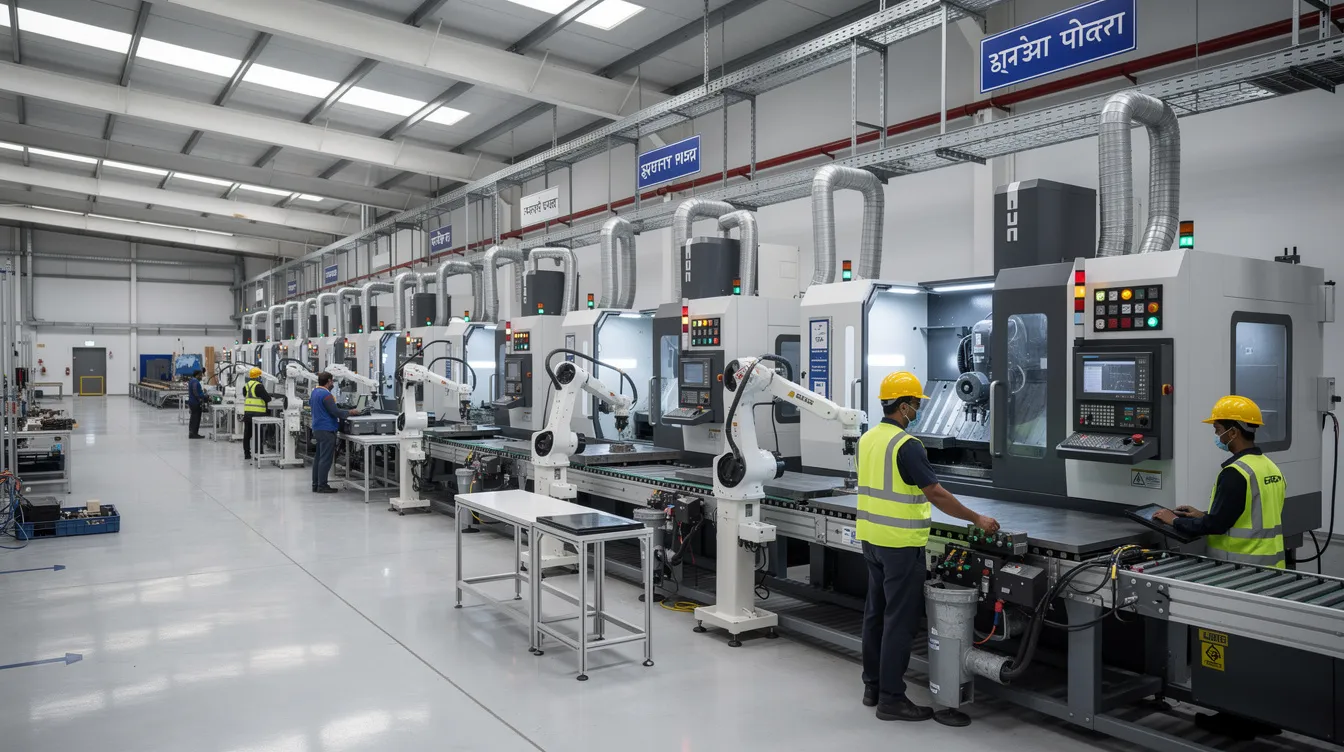
Consider a hypothetical mid-sized engineering components plant with a total project cost of ₹20 crore, targeting domestic OEM customers.
Means of Finance:
| Source | Amount (₹ Crore) | Share |
|---|---|---|
| Promoter Contribution | 5.00 | 25% |
| Bank Term Loan | 9.00 | 45% |
| Outside Equity Investment | 6.00 | 30% |
| Total | 20.00 | 100% |
Valuation Illustration: If pre-money equity valuation is assumed at ₹24 crore and the new equity investment is ₹6 crore, post-money valuation becomes ₹30 crore with indicative investor ownership of 20%.
Investors would expect to see alongside these numbers: revenue potential at 60-70% capacity utilisation, expected EBITDA margin, break-even year and indicative project IRR and equity IRR ranges linked to stated assumptions. DSCR projections influence permissible bank term loan size, which in turn determines how much equity (promoter plus outside investors) is needed.
Initial working capital planning covering inventory, receivables and minimum operating cash must be factored into the funding structure.
How to Explain Manufacturing Project Risks to Equity Investors
Sophisticated equity investors in India expect transparent risk discussion. Hiding or minimising risks damages credibility. Operational risks are a major concern for investors in manufacturing projects.
Implementation risks: Delays in land acquisition, approvals, machinery delivery and civil works. Cost overruns of 10-20% are common without adequate contingency.
Raw material and input price volatility: Commodity cycles, supply disruptions and currency risk for imported inputs. Effective supply chain strategies mitigate risks through long-term contracts or hedging.
Market and sales risk: Weaker-than-expected demand, slower ramp-up, customer concentration. Present downside scenarios in financial projections.
Debt-servicing and liquidity risk: High leverage combined with slower sales strains DSCR and working capital. Equity buffers and conservative debt sizing are essential.
Regulatory, environmental and ESG risks: Tightening pollution norms, compliance requirements and potential capital expenditure for pollution-control upgrades.
Include a concise “Risks and Mitigation” slide in the deck. Governance around deploying investor funds can be strengthened through capital deployment and utilisation controls.
How to Approach HNIs, Family Offices and Strategic Investors
Identifying the right investor profile matters as much as building the pitch. Not every investor category suits every manufacturing project.
HNIs and ultra-HNIs typically invest ₹2-10 crore per deal in mid-market manufacturing plants, expecting board rights and periodic reporting. Family offices bring longer investment horizons and prefer stable, cash-generating manufacturing businesses with strong governance. Strategic corporate investors may invest for capacity assurance, technology access or market expansion, and can influence offtake and exit routes.
Initial contact should use a professional one-page teaser and investor introduction email. Follow a staged approach: teaser, introductory call, NDA, detailed DPR sharing, then deeper due diligence. For broader strategies on getting investor meetings in India, structured outreach outperforms generic email blasts. Prepare thoroughly for the first investor meeting by anticipating questions on assumptions, plant design and downside cases. For sector-specific nuances on approaching HNI and family office investors, relationship-building and trust remain central.
Never approach investors with incomplete documentation.
Documents Required for a Manufacturing Equity Investment Pitch
Investor-ready documentation is crucial for securing funding and financial approvals. Numbers, narrative and legal data must align across all materials. Detailed Project Reports (DPR) are essential for project finance and investor presentations.
Required documents typically include:
- Investor-ready DPR: Technical details, project cost, means of finance, profitability, IRR, DSCR and risk analysis. Use an investor-ready DPR checklist to verify completeness.
- Financial model: Assumption-driven Excel model with revenue build-up, cost sheets, working capital, cash flows, ratios and sensitivity analysis.
- Investor pitch deck: 12-15 slide summary aligned with DPR numbers.
- Promoter and co-founder profiles: Professional bios, track record, shareholding details.
- Historical financials: Last 3-5 years’ audited financials for existing businesses.
- Licences and approvals: Land documents, key approvals, technology agreements.
- Cap table and funding utilisation schedule: Clean shareholding structure and milestone-linked deployment plan.
Common Mistakes Manufacturing Promoters Make When Pitching Investors
From a project finance perspective, these recurring errors stall manufacturing equity discussions:
- Unrealistic projections: Assuming 90%+ capacity utilisation in year one without offtake evidence, or margins exceeding industry benchmarks without explanation.
- Inadequate promoter contribution: Expecting investors to fund 70-80% of the project while the promoter brings minimal skin in the game.
- Underestimating working capital: Focusing only on plant and machinery while ignoring inventory, receivable build-up and operating cash buffers.
- Confusing bankability with investability: A bank DPR focuses on repayment; an investor pitch must also address scalability, exit and equity IRR.
- Overemphasis on subsidies: Pitching state or central subsidies as the core investment case. Investors treat subsidies as upside, not the primary driver.
- Valuation detached from fundamentals: Valuing a new plant purely on project cost or comparing with unrelated startup idea multiples.
- Incomplete documentation: Approaching potential investors with a rough summary and no detailed DPR, model or structured deck.
How CA Manish Gugliya Helps Prepare Investor-Ready Manufacturing Project Proposals
CA Manish Gugliya, FCA, DISA (ICAI), brings over 20 years of professional experience in DPRs, CMA Data, project finance, financial modelling, feasibility studies and investor documentation. Project Report Bank focuses on manufacturing and industrial projects across India, typically in the ₹5 crore to ₹100 crore+ range.
Core services for equity funding include: investor-ready DPR preparation, detailed financial projections, financial modelling, project feasibility studies, business valuation and investor pitch deck creation tailored to manufacturing. Customised analysis using realistic assumptions and industry-specific benchmarks is far more credible than generic templates.
For structured preparation before approaching equity investors, explore investor-ready DPR and fundraising assistance. We do not promise funding or guaranteed valuations; we help promoters become substantially better prepared and more credible in investor discussions.
Frequently Asked Questions
At what stage should I start preparing my manufacturing investor pitch deck and DPR?
Ideally after land identification and preliminary technical feasibility, but before committing to major capital expenditure. Starting early allows the financial model to inform decisions on plant size, machinery selection and funding structure rather than merely documenting decisions already made.
How much promoter contribution do equity investors typically expect in Indian manufacturing projects?
Indian banks and financial institutions often require 15-25% promoter contribution for established promoters and 30%+ for first-time promoters. Equity investors expect promoters to retain 50-80% post-raise in mid-sized manufacturing projects. The exact range depends on sector risk, technology complexity and promoter track record.
Can I raise equity only, without any bank term loan, for a manufacturing project?
Technically possible, but rarely efficient for capital-intensive plants. Bank term loans at 10-12% interest rates lower the overall cost of capital compared to equity investors expecting 25-35% equity IRR. Balanced leverage (55-70% debt, remaining equity) typically produces better returns for all stakeholders while maintaining comfortable DSCR.
What is the difference between a bank DPR and an investor-ready DPR?
A bank DPR emphasises repayment capability, DSCR, collateral and creditworthiness. An investor-ready DPR adds scalability analysis, equity IRR, competitive positioning, valuation basis, exit possibilities, sensitivity analysis and governance framework. The underlying financial data should remain consistent; the emphasis and presentation differ.
Do I need audited financials if my project is a greenfield new company?
If the company is newly incorporated, audited financials will not exist. Investors will instead review the promoter’s personal net worth statement, financials of any existing businesses, bank account statements and provisional accounts. For accelerator programs or early-stage discussions, personal financial credibility of the promoter becomes the primary reference point.
Planning to Raise Equity Funding for Your Manufacturing Project?
If you are planning a new manufacturing plant, capacity expansion or diversification project requiring equity investment, professional preparation makes a measurable difference. Project Report Bank assists with investor-ready DPRs, financial modelling, project feasibility, business valuation and investor pitch deck preparation for manufacturing projects across India.
Reach out via our website or WhatsApp with the following details:
- Project industry and location
- New project or existing business expansion
- Estimated total project cost
- Proposed equity funding requirement
- Current stage (concept, land acquired, approvals, under construction, trial production)
We cannot commit to securing investment, but we can improve the quality, consistency and credibility of your project’s financial and technical presentation for equity investors. Treat investor preparation with the same seriousness as plant design and machinery selection.
About the Author
CA Manish Gugliya, FCA, DISA (ICAI), is a practising Chartered Accountant with over 20 years of professional experience in Detailed Project Reports, financial modelling, CMA Data, project finance, feasibility studies and investor-related financial advisory. Through ProjectReportBank.com, he supports entrepreneurs, MSMEs and industrial project promoters across India in preparing structured, financially sound project and investment documentation for bank finance and equity funding.