Key Takeaways
- Soybean crushing plant investment risks remain high in India despite rising demand for soybean oil and soybean meal, because thin crush margins can turn negative within weeks due to adverse commodity price movements.
- Volatile soybean prices, fluctuating crush spread, and inconsistent capacity utilisation can erode profit margins and DSCR even in a technically sound 500–5,000 TPD plant with modern solvent extraction technology.
- Risk analysis must extend beyond headline profitability and examine raw material procurement strategy, working capital exposure, and the sensitivity of ROI, IRR and equity returns to small changes in crush margin.
- Project Report Bank, led by CA Manish Gugliya, FCA, DISA (ICAI), applies stress-tested DPRs, CMA Data and financial modelling to evaluate soybean crushing projects under adverse price and utilisation scenarios before recommending investment or bank finance structures.
Introduction: Why Technically Successful Soybean Plants Still Fail Financially
Many Indian soybean crushing and solvent extraction plants commissioned after 2010 – including well-equipped 1,000–2,000 TPD units – have experienced cash flow stress, covenant breaches or temporary shutdown despite satisfactory machinery performance and acceptable oil and meal recovery. The soybean processing industry globally is projected to be part of a market reaching USD 286.73 billion by 2034, yet individual plant-level profitability remains far from guaranteed.
Investment outcomes in processing soybeans depend on the interaction between soybean prices, crush margins, demand for meal and soybean oil, power and steam costs, finance charges, and working capital management. A typical large plant requires capital investments of ₹150–₹400 crore including term loan and working capital limits, making systematic risk assessment essential before sanctioning bank finance.
This article provides an analytical, CA-led perspective on soybean crushing plant investment risks for promoters, investors, bankers and project developers. It complements other detailed resources on Project Report Bank and concentrates specifically on risk identification, financial consequences, scenario analysis and mitigation.
Understanding Major Investment Risks in Large Soybean Crushing Plants
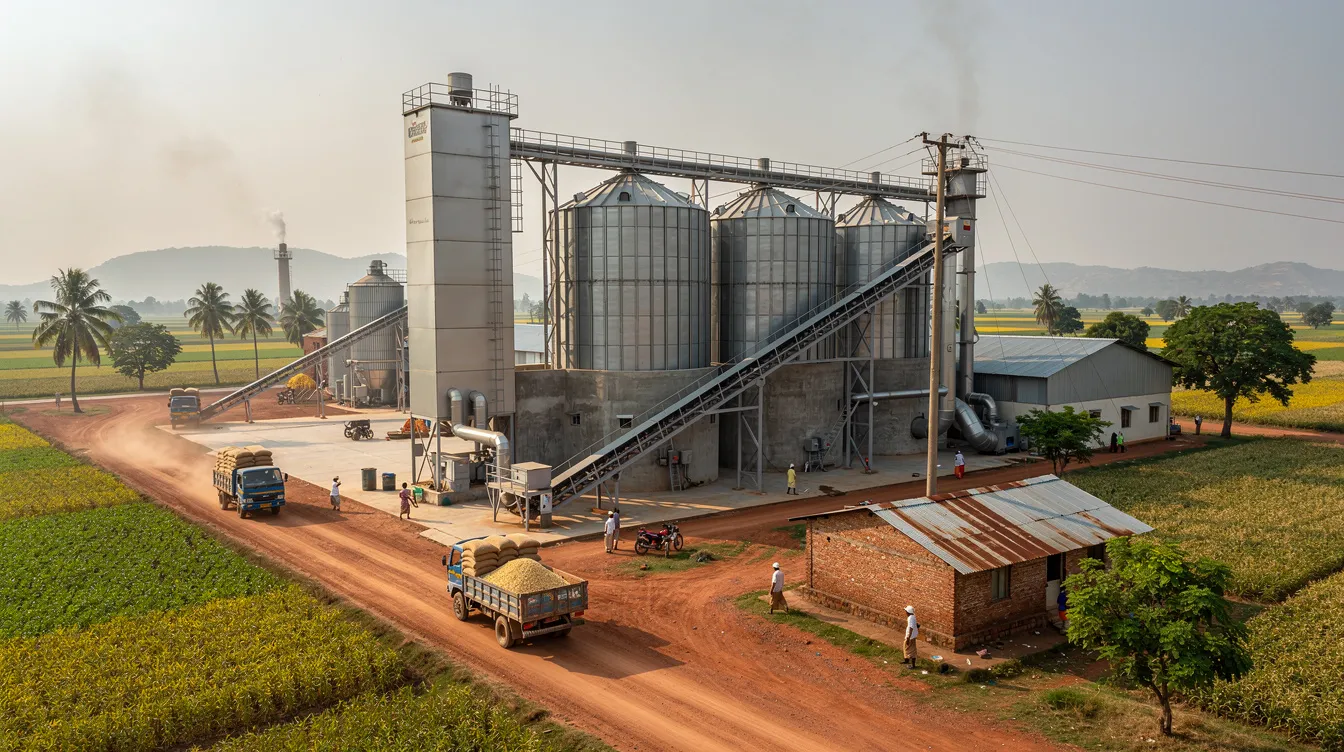
Integrated soybean crushing plants (500–5,000 TPD) typically encompass cleaning, cracking, flaking, cooking, solvent extraction, desolventising-toasting, crude oil refining and meal handling. Establishing such a plant involves significant capital expenditure, and crushing plants require substantial upfront investment in specialised infrastructure where machinery costs represent the largest portion of capital expenditure. For reference, even a small 5 ton/day production line costs about $7,000 to $8,000, and a 20–30 ton/day plant costs around $40,000 for small oil presses – large-scale plants are orders of magnitude more capital-intensive.
The principal risk categories include:
- Market risks: Soybean prices, crush spread, demand for soybean oil and meal, price volatility in energy markets and commodities
- Operating risks: Downtime, energy efficiency, yield losses, operating costs accounting for 85–90% of total expenses
- Financing risks: Interest rate exposure, DSCR deterioration, covenant breaches
- Technical risks: Machinery selection, construction and technology risks affecting capital expenditure and operational performance
- Implementation risks: Time and cost overruns during project execution
For a detailed breakdown of capital cost levels, promoters may refer to our analysis of large-scale soybean crushing plant setup cost, investment and project economics. The sections that follow examine each risk driver with numerical illustrations relevant to bankable DPRs and CMA Data.
Soybean Raw Material Price Volatility and Procurement Risk
Soybean procurement timing, quality and landed cost decisions during the main arrival season (typically October–January in central India) can determine the entire year’s profitability for a soybean processor. Understanding local market conditions is essential for accurate soybean procurement – securing high-quality raw soybeans at commercially viable prices remains the single most important operational decision.
Key risk factors include:
- Seasonal patterns: Harvest-driven price dips (October), lean-season firmness (April–May), crop failure years and monsoon variability. Historical data shows Indian soybean prices have swung from approximately ₹875/quintal (October 2001) to ₹8,361/quintal (August 2021), with unconditional price volatility ranging from 0.08 to 0.15 across different mandis.
- External influences: MSP announcements, export-import policy changes, global supply conditions in Brazil and the US, rupee fluctuations, and soybean futures price movements all influence Indian soybean prices. Crush margins also influence soybean procurement and cash prices at the mandi level.
- Adverse stocking risk: Even a ₹500–₹800 per MT adverse movement across 1 lakh MT of stock can erode several crore of profit. Logistics challenges and transport disruptions can significantly inflate operational costs for soybean processing facilities.
- Procurement cost components: Mandi price, quality-based deductions (moisture, foreign matter), freight from producing regions to plant, storage losses and interest during holding period must all be reflected in DPR assumptions.
Promoters should study our detailed guide on soybean procurement, seasonal inventory and working capital management before finalising stock policies. Aggressive assumptions of uniform low-cost procurement should be replaced with worst-case crop and price scenarios.
Soybean Crush Margins, Crush Spread and Commodity Price Risks
The crush margin (or crush spread) for an Indian processor is the revenue from soybean meal and soybean oil (plus minor by-products) minus soybean cost, expressed per MT of beans crushed. The crush margin is calculated as the value of byproducts minus soybean costs. Soybean meal contributes the largest share to the crush spread in most market conditions. For global context, a typical crush margin is around 53 cents per bushel in the US market, but Indian realisations differ substantially due to local pricing mechanisms and cost structures.
It is essential to distinguish between:
- Gross crush spread: Pure commodity margin (product revenue minus bean cost)
- Contribution margin: After deducting variable processing costs (power, steam, solvents, labour)
- EBITDA: After fixed overheads (salaries, insurance, depreciation)
- Net profit: After interest, depreciation and tax
Crush margin volatility directly impacts the profitability of soybean processing. Effective management of commodity price risk is therefore critical for soybean processing profitability. The financial viability of a soybean crushing project fundamentally hinges on the crush spread.
Illustrative crush-margin calculation (hypothetical, for analysis only):
| Component | Assumption |
|---|---|
| Soybean purchase price | ₹66,000/MT |
| Oil recovery (18%) revenue at ₹1,40,000/MT | ₹25,200/MT |
| Meal recovery (78%) revenue at ₹55,000/MT | ₹42,900/MT |
| Total product revenue | ₹68,100/MT |
| Less: Processing cost | ₹2,500/MT |
| Net crush margin | −₹410/MT |
As FarMart’s September 2026 analysis demonstrated, net crush margin in Indore swung from +₹590/MT to −₹790/MT within a single month. Negative crushing margins can arise from unfavourable price shifts in the soybean market, and sudden price changes can compress or invert crush margins with little warning. Soybean crush margins can fluctuate due to market volatility, making sensitivity analysis across multiple scenarios non-negotiable.
Basis risk – the difference between soybean futures or theoretical board crush and realised plant margins – creates additional gaps in Indian conditions for traders and market participants using futures contracts for hedging. Promoters should review our analysis of soybean oil and meal recovery, yield, losses and profitability to understand how recovery percentages affect realised margins.
Capacity Utilisation, Break-Even Risk and Over-Capacity Exposure
Many plants designed at 1,000, 2,000 or 3,000 TPD operate below 60–70% utilisation due to raw material constraints or weak margins. Overcapacity can lead to reduced utilisation rates among soybean crushing plants, and capacity utilisation significantly impacts the financial viability of soybean crushing operations. CLFMA data showed that Indian soy crushing dropped by approximately 1.77 million MT in April–June 2024, mainly because crush margins were persistently negative. Competitive pressure from other processors can further impact input prices and profitability.
Illustrative utilisation impact for a 1,000 TPD plant (300 operating days):
| Utilisation | Annual Crush (MT) | Fixed Cost/MT (₹) | EBITDA/MT at ₹1,000 margin (₹) | Indicative DSCR Trend |
|---|---|---|---|---|
| 50% | 1,50,000 | 600 | 400 | Below 1.0 |
| 60% | 1,80,000 | 500 | 500 | ~1.0–1.1 |
| 70% | 2,10,000 | 430 | 570 | ~1.15–1.25 |
| 80% | 2,40,000 | 375 | 625 | ~1.30–1.45 |
| 90% | 2,70,000 | 335 | 665 | ~1.45–1.60 |
Note: All figures are illustrative and based on assumed fixed costs of ₹900 lakh/year and base crush margin before fixed costs.
DPRs should test 60–70% utilisation cases, especially in initial years and during weak crush margin cycles. Promoters evaluating right-sizing decisions should review our guide on soybean crushing plant capacity planning: 500–5,000 TPD. Over-sized plants in regions with limited soybean production or heavy competition may struggle to secure sufficient raw soybeans at viable prices, pushing DSCR below acceptable banking norms.
Soybean Oil and Meal Realisation Risks
Revenue depends on both volume and price of soybean oil and soybean meal. Both can move independently of soybean prices, compressing or expanding crush margins. Profitability can decline sharply if soybean prices rise while oil and meal prices fall simultaneously.
Key demand drivers and risk factors include:
- Soybean oil demand: Driven by edible oil consumption (cooking oil demand across India), biodiesel production, and renewable diesel mandates. Government policies heavily influence the demand for soybean oil. Policy shifts can lead to unpredictable changes in soybean oil demand. US soybean oil consumption reached 1.22 million tons in March 2025, of which 658,000 tons went to biofuels. Soybean oil prices globally are supported by biofuel blending mandates, and soybean oil demand is expected to rise due to renewable energy policies. Trade policy changes – including import duty adjustments on competing edible oils – can drastically alter the economics of soybean processing.
- Soybean meal demand: Soybean meal demand increases with population growth and meat consumption, supporting the poultry feed and animal feed sectors. However, Indian meal must compete with exports from Brazil and the US. US soybean crush volumes are forecast to reach 2.49 billion bushels by 2026, expanding global supply. Increased demand for processed foods also supports meal consumption indirectly.
- Quality risk: Oil colour, FFA levels and meal protein percentage can result in discounts, so a technically weak operation may realise lower sales prices than DPR assumptions.
Impact sensitivity: A ₹2/kg drop in soybean oil prices reduces revenue by approximately ₹3,600/MT of soybeans crushed; a ₹1.5/kg decline in meal price reduces revenue by approximately ₹11,700/MT. For a plant crushing 2,40,000 MT/year, the combined yearly revenue loss could exceed ₹35–₹40 crore. Promoters must track related news and policy moves rather than basing long-term projections on one favourable year’s growth.
Working Capital, Inventory and Financing Risks
Large soybean crushing plants typically require working capital limits of ₹40–₹120 crore depending on size and stock policy. Total operational costs are expected to rise due to inflation and market fluctuations, further straining working capital requirements. Operational costs can rise significantly due to inflation, making periodic reassessment of working capital lines essential.
- Seasonal bulk procurement of raw soybeans right after harvest leads to high inventory levels; longer holding periods increase interest cost and price risk. This business venture demands disciplined coordination between procurement, production and sales cycles.
- Drawing power risk: Bank drawing power depends on stock valuation and margin requirements. Price declines can trigger mark-to-market reductions, making part of stock ineligible for drawing power and creating liquidity stress.
- Receivable risk: Sales of soybean meal and soybean oil on credit, debtor ageing and over-reliance on a few key buyers can cause cash flow and DSCR volatility.
- Coordination imperative: Promoters should negotiate realistic working capital lines with adequate buffer, avoid over-trading during thin margins, and coordinate stocking policies with bank covenants. Farmers’ arrival patterns, regional soybean production volumes, and expected demand cycles should all determine inventory norms in the financial model.
Financial Feasibility, ROI, IRR, DSCR and Long-Term Viability Risks
Strong topline turnover – often ₹800–₹1,500 crore per year for large plants – does not guarantee attractive ROI or IRR. Thin margins on large volumes can still result in weak DSCR and inadequate equity returns, leaving the company vulnerable during even a single adverse season.
- Key variables: Soybean procurement price, meal and soybean oil realisations, capacity utilisation, processing cost per MT, interest rate and repayment schedule all flow into project ROI, project IRR, equity IRR, NPV and break-even analysis.
- Leverage risk: Project IRR (return on total capital) differs from equity IRR (leveraged return to promoters after debt servicing). Leverage magnifies downside when margins compress – a ₹300/MT lower crush margin or 10 percentage-point lower utilisation can reduce equity IRR from a projected 18–20% to single digits, and DSCR from 1.4× to below 1.0.
- Optimistic base cases are not adequate for bank finance appraisal. Banks typically require DSCR of at least 1.20–1.25× in the base case, with stress cases still above 1.0.
For a comprehensive financial analysis framework, promoters should study our integrated soybean crushing plant feasibility study, ROI, IRR and sensitivity analysis. Additionally, the preparation of robust CMA Data and DSCR analysis is covered in our guide on soybean oil plant financial projections, CMA Data, DSCR and bank finance.
Investment Risk Matrix, Scenario Analysis and Sensitivity Testing
At Project Report Bank, we build a structured risk matrix and sensitivity model for soybean crushing projects before advising on term loan size and repayment schedule. Conservative sensitivity assumptions – not best-case crush margins – are central to responsible project finance advisory in commodity-processing industries.
Illustrative Financial Sensitivity Table:
| Scenario | EBITDA Impact | Project IRR Impact | Avg. DSCR |
|---|---|---|---|
| Base case | – | ~18% | ~1.40 |
| +5% soybean cost | −15 to −20% | ~14% | ~1.20 |
| −5% oil & meal prices | −20 to −25% | ~12% | ~1.10 |
| Utilisation −10 pp | −18 to −22% | ~13% | ~1.15 |
| Combined downside | −35 to −45% | ~6–8% | <1.0 |
All figures are illustrative and project-specific; actual results depend on plant size, location, financing structure and market conditions.
Banks and investors should never depend solely on a single optimistic projection. Prudent DPRs must highlight how quickly DSCR can fall below 1.20–1.25× if crush margins compress for even one or two seasons. The pricing mechanism for soybeans, oil and meal varies by region, and spreadsheet models must reflect local realities rather than generic global averages.
Technology, Machinery, Operational Efficiency and Technical Risk
While this article focuses on financial risks, technical design and machinery selection directly affect yields, energy consumption and downtime, which in turn influence crush margins and profitability. Operational efficiency is vital for maintaining profitability in soybean crushing plants.
- Process choice: Full solvent extraction gives higher oil yield but requires higher capex and solvent handling capability. Mechanical press plus solvent extraction suits certain capacity ranges. The choice should be guided by expected production volumes and target oil recovery.
- Critical equipment: Reliable preparatory equipment (cleaners, destoners, crackers, flakers), desolventiser-toaster, and energy-efficient boilers determine actual versus theoretical recovery. Suboptimal plant layout and inadequate utilities can reduce realised crush spread below DPR assumptions.
- Operational hazards: Soybean crushing plants face fire and explosion risks due to solvent handling, and environmental compliance adds regulatory pressures to soybean processing facilities.
- Vendor selection: Promoters should review our detailed guide on soybean processing plant machinery, equipment and technology selection before finalising technical offers.
Lenders should seek comfort not only in brand-new equipment but also in realistic uptime assumptions, preventive-maintenance budgets and experienced technical teams.
Risk Mitigation Strategies and Pre-Investment Due Diligence Checklist
Risk cannot be eliminated, but it can be priced, mitigated and structured through disciplined project planning and financial engineering. A comprehensive risk management framework should cover:
Commercial and operational mitigation:
- Diversified procurement across multiple mandis and regions
- Staggered buying instead of single-season stocking
- Quality control at procurement to protect yields
- Conservative crush-margin assumptions in all financial models
Financial and hedging strategies:
- Appropriate mix of term loan and equity with realistic repayment schedules linked to cash generation
- Use of commodity hedging instruments (where available) for soybeans, meal and soybean oil – while recognising that hedging reduces volatility but cannot compensate for structurally unviable projects
- Maintaining adequate working capital liquidity with buffer for margin calls
Pre-investment due diligence checklist:
- Verify long-term soybean availability within economic freight radius
- Assess competing plants and their expanding capacity, crush margins and utilisation
- Cross-check historical price series for soybeans, oil and meal over at least 5–7 years
- Validate technical offers from machinery suppliers against actual plant references
- Test at least 3–4 downside scenarios in the financial model before finalising capacity and finance structure
Engaging a professional DPR and project finance advisory firm ensures that feasibility, sensitivity, ROI, IRR and DSCR analysis are conducted using grounded, India-specific assumptions rather than generic global averages.
How Project Report Bank Supports Soybean Crushing Plant Investors
As a practising Chartered Accountant with more than 20 years of professional experience, I have prepared DPRs, CMA Data and feasibility studies for numerous agro-processing projects including soybean crushing and solvent extraction plants. Our approach at Project Report Bank is to build project-specific assumptions on soybean procurement costs, soybean oil and meal yields, power and steam requirements, and realistic capacity utilisation curves – never relying on generic templates.
Our services for soybean projects include customised Detailed Project Reports, bankable DPRs for term loans, CMA Data for working capital limits, financial modelling with crush-margin sensitivity, DSCR analysis, and advisory on means of finance and promoter contribution. We also prepare investor-ready documentation including cash-flow projections, IRR, equity IRR, NPV, break-even point, payback period and sensitivity analysis tailored to soybean crushing plant investment risks.
Conclusion: Evaluating Soybean Crushing Plant Investment Risks Before Committing Capital
A soybean crushing plant can be a high-turnover business venture, but it remains a thin-margin operation where small adverse movements in soybean prices, crush spread or utilisation can quickly turn profits into losses. The soybean crush is a commodity-driven process, and no amount of technical excellence alone can overcome structurally unfavourable market conditions.
Careful assessment of raw material risks, crush margins, capacity utilisation, working capital exposure, ROI, IRR and DSCR – under multiple scenarios – is critical before finalising any 500–5,000 TPD project in India. Disciplined procurement, conservative financial modelling, realistic operating assumptions and robust risk mitigation measures help preserve liquidity and protect promoters’ equity.
Entrepreneurs, investors and project promoters considering soybean crushing investments are invited to contact CA Manish Gugliya, FCA, DISA (ICAI), at Manish Gugliya & Company, Chartered Accountants, through the Project Report Bank website for customised DPR preparation, CMA Data, feasibility studies, financial projections, investment sensitivity analysis and project finance advisory. WhatsApp is the preferred mode of initial enquiry – serious promoters may share preliminary project details for a focused consultation on soybean crushing plant investment risks.
Frequently Asked Questions on Soybean Crushing Plant Investment Risks
What minimum crush margin should I assume to evaluate a new soybean crushing plant in India?
There is no single safe crush margin level. Promoters should analyse at least three cases: a conservative low-margin scenario, a realistic average based on 5–7 years of historical data, and a best-case scenario. Projections should be stressed at margins 10–20% below historical averages to test whether DSCR remains acceptable. Business plans that appear viable only at unusually high crush margins observed during peak years are inherently fragile. A professionally prepared DPR can benchmark assumed margins against regional historical data for soybeans, soybean oil and meal.
Can hedging with soybean futures fully protect a crushing plant from margin risk?
Futures and options on soybeans, soybean meal and soybean oil can help lock in a board crush margin, but basis risk, liquidity constraints and regulatory factors in India mean hedging is rarely a complete solution. Hedging can reduce market volatility exposure but cannot compensate for projects with poor location, oversized capacity or unrealistic financial leverage. Hedging strategies should be integrated into broader risk management – not treated as a substitute for sound project planning.
How do I choose the right capacity (TPD) for my soybean crushing project?
Start from soybean availability within economic freight radius, local competition, demand for meal and soybean oil, and realistic working capital capability rather than simply installing the largest possible plant. Evaluate multiple capacity options (for example, 500, 1,000 and 2,000 TPD) using IRR, payback period and DSCR comparisons – including downside scenarios for each size. The goal is to determine the capacity at which the project remains financially viable even during weak margin cycles.
What early warning indicators suggest my soybean crushing project is drifting into financial stress?
Practical indicators include persistent negative or very thin crush margins, repeated utilisation below 60–65%, rising creditor days, frequent drawing-power shortfalls, delays in interest or instalment servicing, and increasing dependence on unsecured high-cost borrowings. Promoters and lenders should respond early by revisiting procurement policies, temporarily reducing throughput, restructuring debt where appropriate, and updating financial projections. Timely engagement with a financial advisor and the lending bank can help realign operations before the account trends towards NPA classification.
How many months of soybean inventory should a crushing plant hold?
Optimal inventory depends on regional seasonality, mandi access, storage infrastructure and financing cost. Many plants target a few weeks to a few months of stock, but excessive stocking increases interest cost and price risk. Inventory policies should be decided in conjunction with bank working capital limits, price outlook and hedging possibilities, and tested in cash-flow models under falling-price scenarios.