
Key Takeaways
- Soybean crushing plant land requirements depend on plant capacity (500–5,000 TPD), raw material storage days, utilities infrastructure, and provision for future expansion. Land size for a soybean crushing facility depends directly on processing capacity and integration level.
- Civil construction, utilities, and factory layout together can form 30–45% of total fixed investment (excluding land) in a large soybean crushing and solvent extraction processing plant, making infrastructure planning as important as machinery selection.
- Poor planning of land and layout increases raw material cost, internal handling, labor cost, and safety risk, directly affecting oil extraction margins and meal quality over the long run.
- Bankers and investors look for realistic land records, site development cost, factory layout drawings, and utility assumptions in the DPR and CMA Data before approving project finance.
- Project Report Bank, led by CA Manish Gugliya, helps investors integrate technical land and infrastructure planning into bankable financial projections and project reports for soybean processing plants.
Understanding the Infrastructure Requirements of a Soybean Crushing Plant
A soybean crushing plant is far more than oil extraction machinery housed under a roof. It is a complex processing plant integrating seed handling, cleaning, preparation, extraction, meal processing, oil storage, utilities, and safety systems-each requiring dedicated space, civil works, and utility connections. The processing capacity is typically expressed in metric tonnes processed per day (TPD), and a complete soybean processing plant can process 200 to over 1,000 tons daily depending on its configuration. A soybean crushing facility needs space for raw material storage, processing, and finished goods storage.
Soybean processing includes cleaning, crushing, and oil extraction. The main process blocks are: seed receiving and weighing, pre-cleaning, seed cleaning and grading, cracking, conditioning, flaking, oil extraction, desolventising-toasting, drying and cooling of soybean meal, and crude soybean oil storage. Soybean oil comprises about 20% of the soybean seed, while soybean meal accounts for approximately 80% of the seed, making it a key ingredient in animal feed and poultry feed formulations. Soybean processing can also produce lecithin and biodiesel feedstock, adding to the product range.
The difference between mechanical pressing-only units and large solvent extraction-based plants is significant. Mechanical pressing is suitable for small and medium scale operations (a medium scale plant processes 50 to 100 tons per day), with lower oil extraction efficiency and higher residual oil in the meal. Solvent extraction achieves over 95% oil recovery, producing better meal quality, but demands substantially more land, utilities, and safety infrastructure. Processing technology therefore influences the overall footprint of a soybean facility.
Key infrastructure components that drive land and building requirements include raw material silos or warehouses, intermediate bunkers, finished meal and hull storage, crude oil and miscella tanks, boiler house, cooling towers, power substation, workshop, laboratory, admin block, and truck parking areas. A crushing plant requires dedicated areas for utilities and safety infrastructure.
Infrastructure design directly affects raw material cost, logistics efficiency, labor cost, automation level, production efficiency, and compliance with industry standards and quality control norms. The soybean processing industry is driven by rising demand for plant-based protein, and with the global soybean market projected to reach USD 286.73 billion by 2034, investing in properly planned infrastructure is fundamental to capturing this growth.
Capacity-Wise Land Requirements for Soybean Crushing Plants
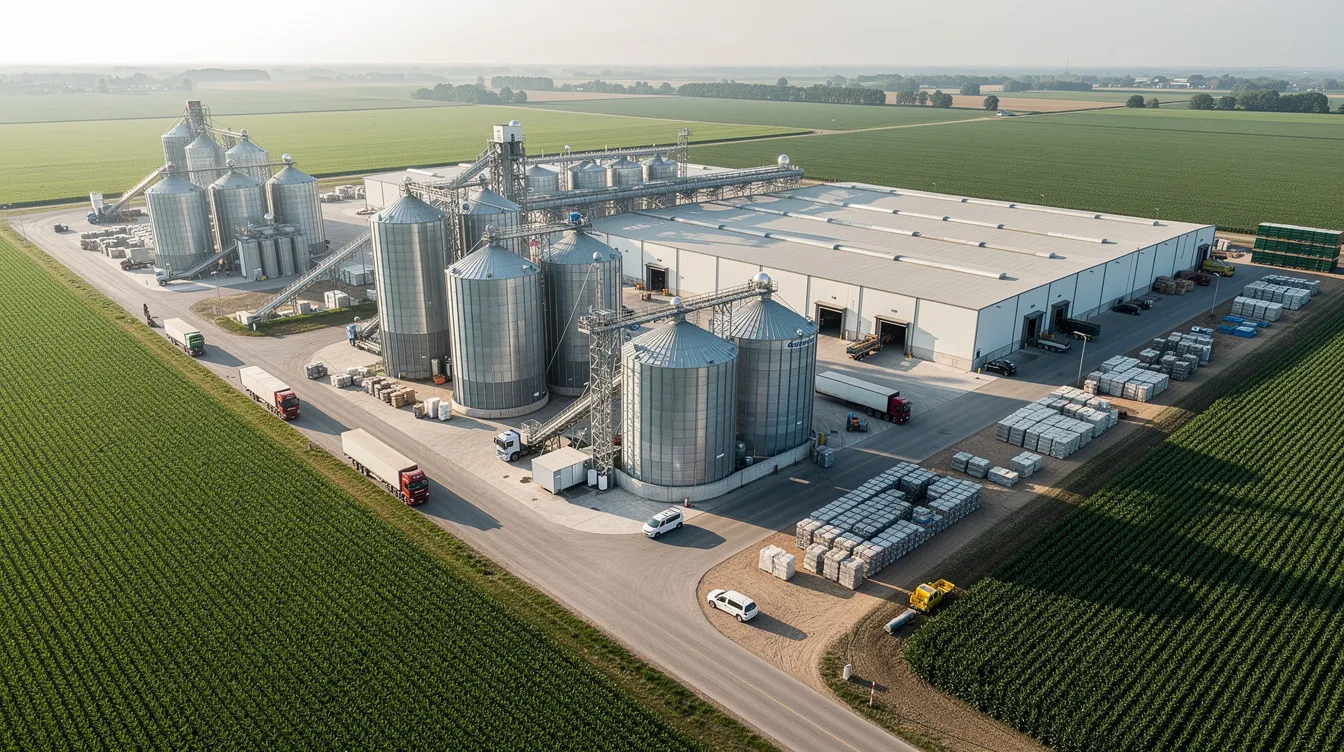
Land requirement for a soybean crushing plant depends mainly on plant capacity (TPD), assumed storage days for seed and meal, extent of integration (crushing only versus crushing plus refining), and provision for future expansion. Land requirements vary based on required storage for soybeans and finished products, and processing facilities that also handle refining and packaging require significantly more land.
The figures below are indicative planning norms used in preliminary DPRs for typical Indian installations. They must be validated by detailed engineering, local development rules, and technology supplier layouts. Future expansion planning typically suggests reserving 20–30% of additional land.
| Plant Capacity (TPD) | Minimum Land (Acres) | Recommended with Expansion (Acres) | Approx. Built-up Area (sq. m) | Raw Material Storage | Meal/Hull/Oil Storage | Utilities, Roads & Greenbelt |
|---|---|---|---|---|---|---|
| 500 | 5–6 | 7–9 | 8,000–12,000 | 15–30 days seed stock | Meal godowns, oil tanks | Boiler, substation, roads, safety buffer |
| 1,000 | 8–10 | 10–14 | 15,000–22,000 | 30–45 days seed stock | Large meal warehouses, oil tank farm | Substantial utility block, internal roads |
| 2,000 | 12–16 | 16–20 | 25,000–35,000 | 30–60 days seed stock | Multiple warehouses, large tank farms | Major internal logistics, fire-water systems |
| 3,000 | 18–22 | 22–28 | 35,000–50,000 | Significant silo-based storage | Extensive storage infrastructure | Captive power, large boiler, water plant |
| 5,000 | 25–35 | 30–40+ | 50,000–70,000+ | Large-capacity silos | Multiple warehouses and tank farms | Major utility campus, environmental block |
Large industrial plants need approximately 5 to 10 acres or more for basic operations, while large plants may require several acres of land beyond that for comfortable operations and expansion. A large scale plant can process over 1,000 tons per day, and at such capacities, storage requirements for raw soybeans impact land needs significantly.
In India’s soybean-growing belts-Madhya Pradesh, Maharashtra, Rajasthan, and Telangana-seasonal procurement and raw material price volatility demand that promoters plan for 30 to 60 days of seed storage to maintain a steady supply, directly increasing land and civil construction requirements. For promoters evaluating how capacity choices affect infrastructure sizing, our detailed guide on soybean crushing plant capacity planning from 500 to 5,000 TPD provides useful context.
The financial implications of getting land area wrong are real. Over-estimating leads to higher upfront land acquisition and site development cost, tying up promoter contribution. Under-estimating creates congestion, higher internal handling cost, constraints on future automation and expansion, and potentially forces the purchase of a second site-a far more expensive outcome in the long run.
Industrial Land Selection and Site Development Requirements
Land selection affects lifetime logistics cost, raw material cost, and working capital for a soybean processing plant. In my experience preparing industrial project reports, I have seen cases where an otherwise well-conceived project struggled because the promoter selected land without evaluating procurement catchment and transport connectivity.
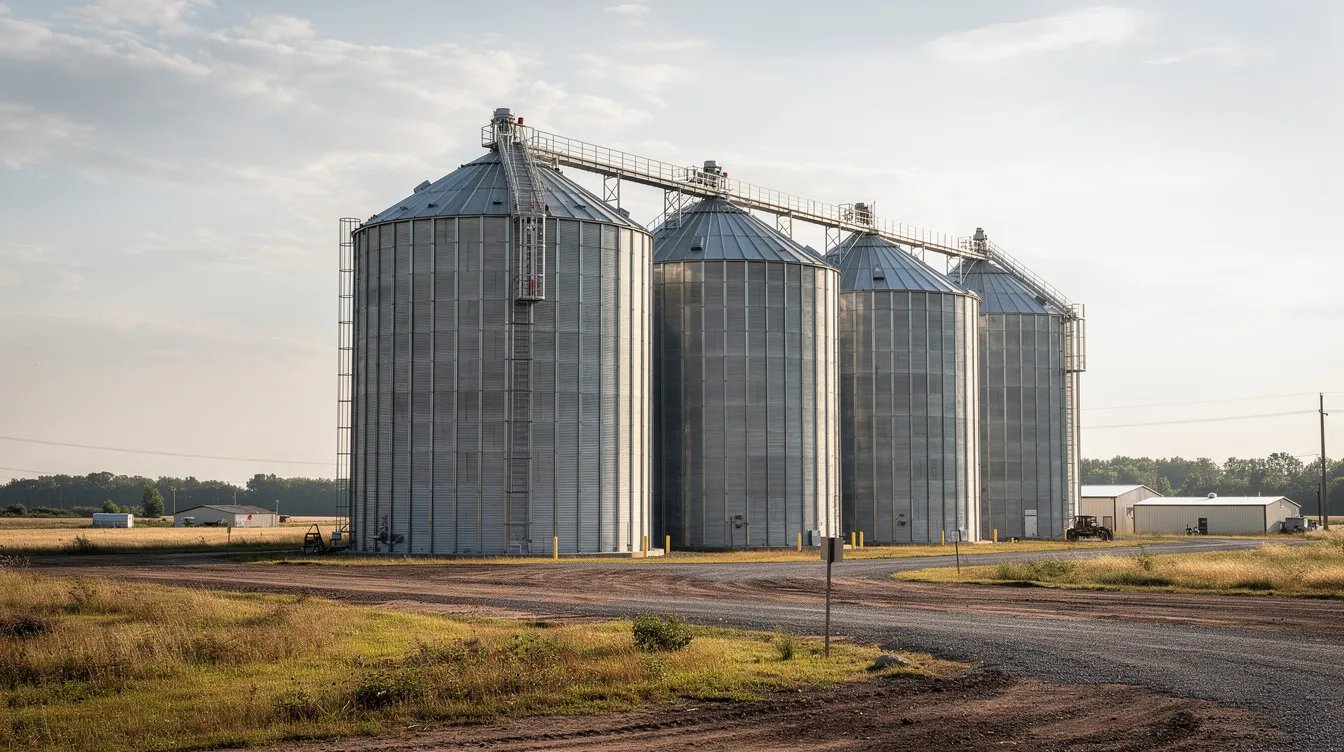
Site selection criteria include proximity to soybean procurement centres and mandis, road and highway connectivity for inbound seed and outbound meal and oil, rail siding availability for bulk movement, and reasonable distance to ports if export of soybean meal or crude oil is planned. Rail and truck logistics are critical for moving raw inputs and finished products in high-volume operations. Several factors influence site suitability, and the main raw material-soybeans-must be sourced within an economically viable radius.
Zoning regulations mandate industrial zones for soybean processing facilities. Promoters must check local Development Plan norms, distance from residential areas, and permissions from the State Pollution Control Board and local authorities. Local government regulations may affect site layout due to pollution control and safety requirements, and environmental compliance impacts land utilization for soybean crushing.
Soil conditions and site topography can affect construction and land selection. Geotechnical aspects are important for heavy silos and equipment foundations: low soil bearing capacity increases foundation cost significantly, while high water tables and flood risk demand additional civil measures.
Practical site-development elements that consume budget and space include: boundary wall, site levelling and filling, internal roads with adequate truck turning radius (minimum 6–8 m wide), storm-water drainage, rainwater harvesting pits, weighbridge location, security gate complex, and greenbelt as per environmental norms. From a DPR and project finance perspective, documented land title, conversion to industrial use, right-of-way for utilities, and estimated land development cost are all scrutinised by banks before sanctioning term loans.
Building and Civil Construction Requirements
A modern soybean crushing and solvent extraction plant requires several distinct building types: seed godowns or silos, preparation building, extraction and desolventising structure, meal storage warehouse, crude oil tank farm, boiler house, compressor house, electrical substation and MCC room, utility buildings, laboratory and quality control area, admin block, and ancillary structures. The spatial allocation of a crushing facility includes areas for administration, utilities, and logistics.
The following indicative built-up area breakdown is for a reference 1,000–2,000 TPD plant:
| Department/Area | Type | Indicative Area (sq. m) |
|---|---|---|
| Seed unloading and receiving shed | Semi-covered | 500–1,200 |
| Raw material warehouse / silos | Enclosed | 3,000–8,000 |
| Seed cleaning and preparation hall | Enclosed | 800–1,500 |
| Extraction and desolventising house | Enclosed (hazard-rated) | 1,500–3,000 |
| Meal storage warehouse | Enclosed | 2,000–5,000 |
| Crude oil / miscella tank farm | Open with dyke walls | 800–1,500 |
| Boiler house and fuel storage | Semi-covered / open | 600–1,200 |
| Electrical substation and MCC | Enclosed | 200–400 |
| Cooling towers and water treatment | Open | 400–800 |
| Laboratory and QC | Enclosed | 100–250 |
| Admin block and staff facilities | Enclosed | 200–500 |
| Internal roads, truck parking, greenbelt | Open | 3,000–6,000 |
Structural considerations include taller RCC or structural steel buildings for preparation and extraction sections to accommodate equipment columns and conveyors, heavy-duty industrial flooring in seed and meal handling areas, and corrosion protection in solvent exposure zones. Equipment quality and process design influence structural specifications. Adequate ventilation, dust-control measures in seed cleaning sections, explosion relief in certain areas, and fire-resistant construction around solvent-handling zones are all essential.
Civil and structural cost can vary widely with location, soil condition, structural loading, and specifications. Investors should obtain preliminary drawings and BOQs from structural consultants for realistic DPR cost estimation. For a comprehensive view of how civil construction integrates with total project investment, refer to our analysis of large-scale soybean crushing plant setup cost and investment.
Soybean Crushing Plant Factory Layout and Material Flow
The ideal soybean crushing plant factory layout follows a logical one-direction flow from seed receipt at the gate to finished meal and oil dispatch, with minimal cross-traffic and backtracking. Technological advancements have improved soybean oil extraction efficiency, but even the best process design loses its advantage if the physical layout introduces unnecessary handling, dust generation, and safety exposure.
The material flow sequence for a solvent extraction plant is:
Seed Receiving & Weighbridge → Seed Unloading & Sampling → Raw Material Storage → Cleaning & Preparation → Cracking & Conditioning → Flaking → Solvent Extraction → Desolventising–Toasting–Drying–Cooling → Meal Storage & Dispatch
Side branches include crude oil handling and miscella treatment, solvent recovery loops, and utility connections (steam, power, cooling water).
Layout principles require segregating the solvent extraction area and tank farm from the boiler house and electrical substation, maintaining safe distances and access roads around high-risk areas, and organising conveyors to minimise transfer points and dust generation. Safety distancing is required between processing and storage areas due to flammable materials.
Truck movement and logistics planning should provide separate entry and exit gates where possible, one-way circulation, adequate truck parking and waiting bays, and a weighbridge placed to avoid traffic bottlenecks. Space planning for maintenance access, future expansion, and additional extraction or preparation lines should be built into the original layout. Factory layout must be coordinated with vendor-specific equipment dimensions and maintenance clearances, as discussed in our guide on soybean processing plant machinery, equipment and technology selection.
Power and Electrical Infrastructure Requirements
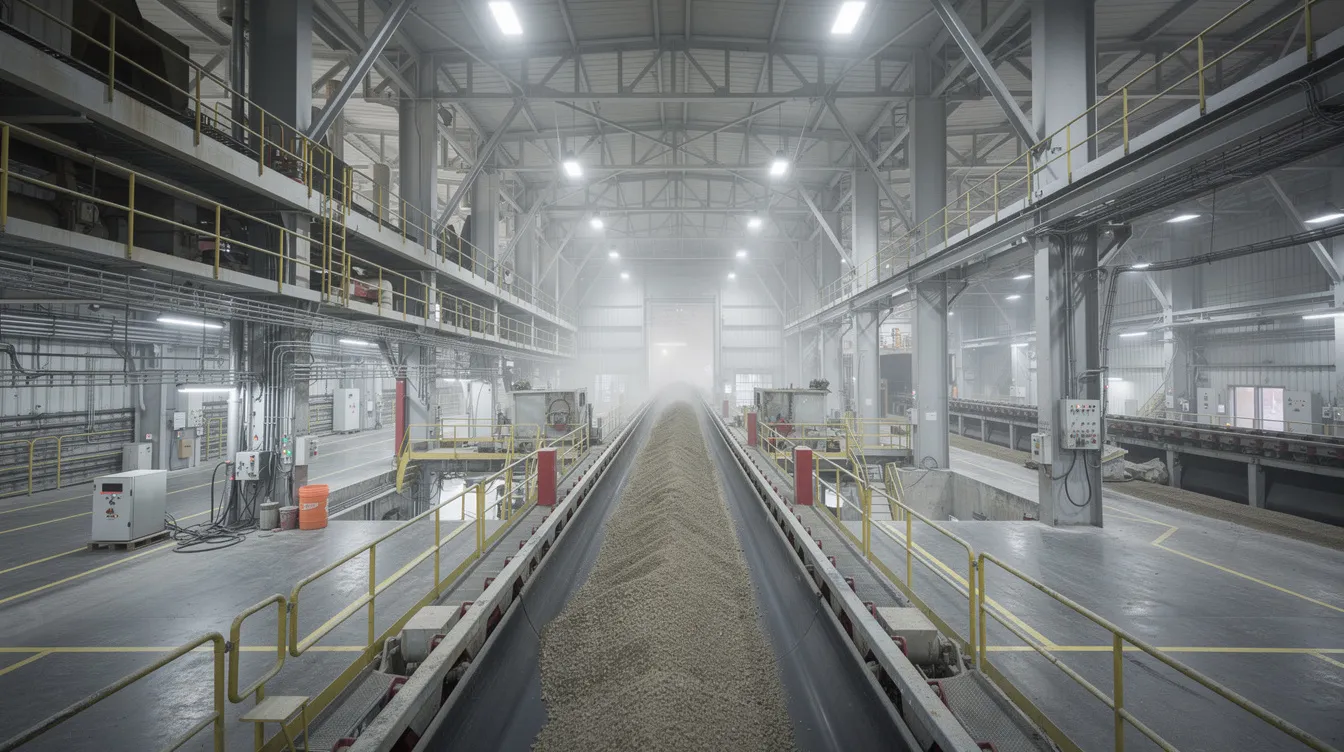
Power requirement in a soybean oil processing plant is driven by large motors in preparation, flaking, extraction, meal grinding, and material handling systems, as well as by utilities like pumps, compressors, cooling towers, and lighting. Adequate access to water and power is essential for soybean processing facilities.
It is important to distinguish between connected load (sum of all motor ratings), maximum demand (kVA actually drawn at peak), and average operating load. For typical Indian soybean processing plants using modern equipment, specific electricity consumption lies between 22–28 kWh per tonne of seed processed. For a 3,000 TPD plant, installed power can reach approximately 9.6 MW.
Typical electrical infrastructure includes 33/11 kV incoming line (depending on local grid), main transformers, HT and LT panels, motor control centres, variable frequency drives for major drives, cable trays, earthing and lightning protection, and emergency DG sets for critical loads such as solvent recovery and safety systems. A higher automation level and digital monitoring raise connected load slightly but can reduce overall labor cost and improve power-factor management and process stability.
From a DPR and finance perspective, electrical CAPEX-transformer, HT yard, internal distribution, cabling, lighting, instrumentation, and control panels-must be itemised separately from process machinery in the project cost schedule.
Steam, Boiler and Thermal Utility Requirements
Steam is one of the largest utility drivers in a soybean processing plant, used for seed conditioning, flaking, solvent evaporation, desolventising-toasting of meal, distillation in miscella treatment, and occasionally for heating crude oil tanks. Operating costs for soybean processing plants are primarily driven by raw materials, accounting for 85–90% of expenses, but fuel for steam generation is the next most significant cost component.
For DPR-level steam balance, typical steam consumption ranges from 180–250 kg per tonne of seed crushed, depending on extraction method, desolventisation design, and condensate recovery efficiency. Boiler selection parameters include required steam pressure and temperature, fuel options (rice husk, briquettes, coal, natural gas), automation level, and stack-height requirements per environmental norms.
Fuel choice and boiler efficiency directly influence per-tonne processing cost, affecting production efficiency and overall soybean oil production economics. In the financial model, these feed directly into DSCR and IRR calculations. Thermal-utility system components-deaerator, condensate recovery, feedwater pumps, boiler water treatment, insulated steam piping, and steam traps-must be properly designed; inadequate design leads to higher fuel consumption and operating expenses.
In a bankable project report, boiler and steam-system CAPEX should be shown separately along with expected specific fuel consumption and annual fuel cost estimates, validated against local fuel availability and price trends.
Water, Cooling and Wastewater Infrastructure
Main water uses in a soybean crushing plant include boiler feedwater, cooling-tower make-up, process water for cleaning and conditioning, domestic water for staff facilities, and greenbelt irrigation. For a 1,000 TPD plant, total water requirement may range from 300–500 KLD (kilo litres per day), while recirculating cooling water through cooling towers operates in closed cycles at much higher volumes.
Water-treatment infrastructure typically includes raw-water storage, sand and carbon filtration, softener or RO for boiler feed depending on raw water quality, and separate potable water treatment. Wastewater types include cooling tower blowdown, boiler blowdown, floor washings, and domestic sewage. Effluent characteristics in a soybean crushing plant are typically manageable with a properly designed ETP and STP, but actual design must be based on vendor and consultant data to reflect the environmental impact accurately.
Storm-water drainage planning is essential, especially in states with heavy monsoon rainfall. Inadequately designed surface drainage can affect raw material storage conditions, building foundations, and overall site operability. From a financial-planning viewpoint, investors should account for borewell or external water-connection cost, reservoir construction, pumping systems, and ETP/STP civil and mechanical cost within infrastructure CAPEX.
Solvent Storage, Fire Safety and Environmental Infrastructure
Large-capacity soybean extraction plants in India commonly use hexane as solvent, which demands specialised storage, ventilation, instrumentation, and fire-safety infrastructure. Hexane consumption (loss) in well-designed plants is typically 1.0–1.8 litres per tonne of seed, but poor sealing or condenser design can increase losses and safety risk significantly.
Key elements of solvent-handling infrastructure include above-ground hexane storage tanks with dyke walls (sized to hold 110–120% of tank capacity), solvent transfer pumps and pipelines, vapour recovery systems, vent condensers, nitrogen blanketing where applicable, and leak-detection systems. Hazardous-area classification affects electrical equipment selection-flameproof motors and intrinsically safe instrumentation are required near extraction, distillation, and tank-farm zones.
Major fire-safety provisions include dedicated fire-water storage and pumps, ring-main with hydrants and monitors, foam connections near solvent tanks, portable and trolley-mounted fire extinguishers, emergency shut-off systems, and safe emergency exits and muster points. Regulatory approvals generally relevant include State Pollution Control Board consent, factory inspectorate clearances, and Petroleum and Explosives Safety Organisation (PESO) approvals for specific solvent and tank installations. Exact requirements depend on capacity and process design.
Fire-safety and environmental systems constitute a visible part of fixed capital investment. Under-budgeting in this area leads to regulatory delays and can affect project bankability and insurance cost.
Soybean Crushing Plant Land, Building and Infrastructure Cost
For medium to large soybean crushing plants, total fixed capital is split between land, site development, civil works, plant and machinery, utilities, and pre-operative expenses. Civil and structural work typically accounts for 20–30% of total machinery and infrastructure cost, while utilities add another 8–12%, bringing combined non-machinery infrastructure to roughly 30–45% of fixed capital excluding land. This represents a major industrial investment.
Land costs vary significantly based on location. Industrial land near cities is generally more expensive, while remote plots may have lower per-acre cost but higher development charges for road, power line extension, and water source. Promoters should budget 10% to 20% of total investment for land and construction. Land costs typically account for 10% to 20% of total soybean processing plant cost, depending on region and market conditions.
Gross profit margins for soybean processing typically range between 10–20%, which means that every rupee saved or wasted on infrastructure directly affects long-term viability. Capitalised interest during construction, pre-operative expenses, design consultancy fees, and statutory charges must be correctly incorporated into total project cost for accurate DSCR and IRR analysis.
Even a well-designed site and building layout must be aligned with expected oil extraction performance-our detailed analysis of soybean oil and meal recovery, processing losses and profitability explains how recovery rates justify infrastructure investment. Investors should obtain at least two sets of civil-cost estimates-one based on standard industrial-shed construction and another reflecting higher specifications-to understand sensitivity of project cost to civil design choices.
Infrastructure Planning for Bank Finance and DPR Preparation
In a bankable Detailed Project Report and CMA Data, land and infrastructure planning is quantified and directly feeds into project cost, means of finance, depreciation, and DSCR analysis. Financial projections assess capital investment, operating costs, and demand outlook-and infrastructure forms a significant portion of all three.
Land details-area, cost per acre, registration charges, and land status-are captured in the fixed-assets schedule and supported by title documents, agreements to sell, or lease deeds. Civil and infrastructure cost estimates are grouped into logical heads and depreciated at different rates as per Income Tax and Companies Act norms, affecting profit and tax projections.
Infrastructure decisions link directly to working capital assessment: raw material storage days determine inventory level and working capital requirement; utilities capacity affects minimum economic running days and thus receivables and payables cycles. Banks typically evaluate reasonableness of land and building cost by comparing project cost per TPD with similar sanctioned projects. Unrealistic estimation often leads to queries, delays, or requirement of additional margin money.
At Project Report Bank, DPRs for soybean crushing projects-including the Soybean Oil Manufacturing Project Report-are prepared with an integrated technical-financial view. Land and layout assumptions are cross-checked with capacity, raw material planning, and utility load to ensure bankability and realistic projections, without claiming any form of engineering certification.
Common Mistakes in Soybean Crushing Plant Layout Planning
Many project promoters focus heavily on machinery quotations while underestimating the impact of land, layout, and utility mistakes on long-term operating cost and overall project viability.
Frequent errors include:
- Choosing plots that are too narrow or irregularly shaped, limiting truck circulation and causing demurrage charges
- Leaving inadequate space for future expansion, forcing expensive relocations later
- Insufficient raw soybean storage, forcing off-season purchase at higher prices and disrupting steady supply
- Inadequate meal and hull storage leading to forced sales at low prices, eroding margins
- Locating solvent extraction too close to boiler house or substation, creating safety compliance problems
- Placing laboratory and quality control facilities far from critical sampling points
- Routing conveyors with multiple unnecessary transfer points that increase dust, spillage, and maintenance cost
- Not budgeting for storm-water drainage, boundary wall, site-security cost, and ETP/STP systems, which later show up as cost overruns
Project promoters should validate conceptual layouts with both process equipment suppliers and local architects before finalising DPR assumptions and approaching banks for term loans. Equipment selection and process design must work together with the physical layout.
Practical Recommendations from CA Manish Gugliya
In my experience over two decades of DPR preparation and project finance advisory for agro-processing plants in India, the most robust projects are those where land, layout, and utilities have been sized with realistic raw material and market assumptions-not optimistic projections designed merely to impress a lender.
My recommendations for promoters planning to invest in this sector:
- Begin with a clear capacity and operating-days model for at least seven years, align this with regional soybean availability and logistics, and only then finalise land area and building footprint. Most well-run soybean processing plants see positive ROI within a few years when infrastructure is properly matched to demand.
- Build in a defined expansion corridor on the original site-space for a second extraction line, a refinery, or additional raw-material silos-even if these are not part of Phase I. This improves long-term ROI and business valuation.
- Integrate technical inputs from EPCC vendors, civil engineers, and internal operations teams with financial modelling. Land development, boiler and power systems, water infrastructure, and fire safety should be evaluated not only for technical adequacy but for impact on project IRR, DSCR, and break-even point.
- Perform sensitivity analysis on land cost, raw material cost, fuel prices, and interest rates during the feasibility stage so that promoters understand how resilient the plan is to volatility in soybean and energy markets.
Professional advisory does not replace engineering design, but it ensures that the project’s financial structure-promoter contribution, term loan, and working capital-matches the actual infrastructure and capacity being created on the ground.
Planning a Soybean Crushing Plant? Get Professional DPR & Project Finance Assistance
Project Report Bank, led by CA Manish Gugliya, FCA, DISA (ICAI), prepares customised, bank-ready Detailed Project Reports, financial projections, CMA Data, and project finance documentation for soybean crushing and solvent extraction plants across India.
Services include project cost and means-of-finance planning, working capital assessment, DSCR and loan-repayment analysis, profitability and cash-flow projections, ROI and IRR analysis, and sensitivity analysis on key variables like raw material cost and capacity utilisation. While engineering layout and safety design remain the responsibility of specialised process and civil consultants, Project Report Bank works closely with such inputs to reflect accurate civil, utility, and machinery assumptions in the financial model and bank proposal.
Serious project promoters, MSMEs, and corporates considering 500–5,000 TPD soybean crushing plants are welcome to contact us through the ProjectReportBank.com website and WhatsApp enquiry facility for a discussion on project feasibility and funding strategy. Early engagement-before land purchase or machinery ordering-often leads to better plant setup decisions, more appropriate plant capacity, optimised automation level, and improved bankability of the overall project.
Frequently Asked Questions
The following questions address practical planning concerns frequently raised by project promoters, bankers, and investors evaluating soybean crushing plant infrastructure in India.
How much land is required for a 500 TPD soybean crushing plant in India?
A standalone 500 TPD mechanical pressing plant with moderate storage may operate on about 2–3 acres, but a 500 TPD solvent extraction plant with proper raw-material and meal storage, utilities, and a future expansion corridor would typically plan around 5–6 acres minimum and 7–9 acres with expansion margin. Medium-scale plants generally require around 2 to 5 acres of land, but at 500 TPD with solvent extraction, the requirement moves toward the higher end. Actual land requirement depends on desired seed-storage days, whether refining is included, local setback norms, and truck-parking provision. These are preliminary planning norms requiring project-specific validation.
How many acres are required for a 1,000 to 2,000 TPD soybean processing plant?
A 1,000 TPD integrated crushing and solvent extraction processing plant may need around 8–10 acres for minimum operations and 10–14 acres with comfortable expansion space. A 2,000 TPD unit may require about 12–18 acres, subject to storage strategy and integration level. For such capacities, it is prudent to block additional contiguous land to allow a future refinery, biomass-based power plant, or extra silos without relocating major utilities. These ranges are indicative; actual requirements depend on plot shape, local norms, and engineering design.
What utilities are typically required for a soybean crushing and solvent extraction plant?
The main utilities include electrical power (grid connection plus DG backup), steam and boiler system, cooling water with cooling towers, process and domestic water supply, compressed air, fire-water system, effluent-treatment and sewage-treatment facilities, and instrument air where automation level is high. Utility capacities are sized based on plant capacity, expected operating hours, oil extraction method, and equipment selection. Soybean oil is the most dominant edible oil in the U.S. market, and in India too, rising global demand for cooking oil and animal feed-grade meal means that efficiently planned utilities directly improve production efficiency and sales margins. Approximately 66% of U.S. soybean oil is consumed by the food industry, and Indian soybean oil processing is increasingly oriented toward both domestic food products and export customers.
Why is a detailed factory layout important for bank finance and DPR approval?
A well-developed factory layout demonstrates to banks that the proposed land area, buildings, and utilities are technically feasible for the stated plant capacity, and that the promoter has realistically assessed project cost and implementation challenges. Layout drawings help lenders verify adequacy of storage, safety distances around solvent areas, truck circulation, and provision for future expansion, reducing perceived project risk and improving chances of timely term-loan sanction. Without a credible layout, the entire DPR loses bankability regardless of how attractive the financial projections appear.
Can a small-scale soybean processing plant be set up on less than one acre?
A small soybean processing plant needs about half an acre, and small-scale plants need approximately 0.5 to 1 acre of land for basic mechanical pressing operations with minimal storage. A small soybean processing plant in this range may cost about 7,00,000 to 8,00,000 at the most basic international level, though Indian costs differ based on local factors. However, once solvent extraction, adequate raw material warehousing, and environmental infrastructure are added, land requirements increase substantially. Hypro soya meal, which has a higher protein content than commercial grade meal, also requires more careful process control and storage conditions, further influencing infrastructure needs. Market segmentation-whether targeting high-protein meal for poultry feed or standard meal for animal feed customers-affects both process design and storage planning. Investors should note that the oil extraction process can yield higher efficiency with advanced technology, but this comes with greater land and utility requirements. For small and medium scale projects, biofuels applications and refining options may also influence facility sizing and purchase decisions. Investors can obtain a customised capacity-wise land and utilities plan as part of a professional DPR and feasibility assignment from Project Report Bank.