
An optical colour sorter for pulses has moved from being a premium upgrade to a practical necessity for Indian dal mills, pulse processors and exporters. This article covers the technology types, machine capacity planning, indicative price ranges in India, pulse-specific sorting requirements, operating cost, financial feasibility and selection criteria that matter for a sound investment decision.
Key Takeaways
- An optical colour sorter for pulses is now essential for dal mills targeting branded retail, institutional supply or export markets. It removes discoloured, defective and foreign grains with consistency that manual sorting cannot match.
- Modern optical sorting technology ranges from CCD monochromatic and RGB full-colour cameras to AI-assisted image recognition and NIR-based systems, each suited to different quality targets and budgets.
- Machine capacities in India typically range from about 0.5 TPH to 10 TPH, with indicative prices from roughly ₹8 lakh to ₹60 lakh or more depending on configuration, technology and brand.
- Correct selection depends on the pulse variety processed, required output capacity, target quality level, compressed air and power availability, and the vendor’s after-sales service support.
- Project Report Bank, led by CA Manish Gugliya, FCA, DISA (ICAI), provides customised DPRs, CMA Data and financial projections to assess ROI and payback before any machinery purchase is finalised.
Introduction – Why Optical Colour Sorting Matters in Pulse Processing
Indian consumers, retail chains and export buyers now expect uniform colour and defect-free pulses. Whether it is toor dal, chana dal, moong dal, urad dal or masoor dal, the visual appearance of the end product directly influences purchase decisions, pricing and buyer confidence. Inconsistent colour, black spots, insect-damaged grains or foreign materials in a packed bag can result in customer complaints, lot rejections and loss of market access.
Optical colour sorting refers to the use of sensors and cameras to detect defects in pulses – discolouration, spots, immature grains, stones and foreign seeds – and to pneumatically eject them from the product stream. This is fundamentally different from cleaning (removing dust, husk, stones) and grading (separating by size or density), which address other categories of quality problems but cannot reliably remove colour defects.
The commercial impact is significant. Optical sorting enhances product quality and consistency significantly, enabling higher sale prices per kg, access to premium and export markets, lower customer complaints and stronger brand reputation. It also improves throughput and reduces labor costs compared to manual hand-picking, where human fatigue, subjective judgement and slower speed make consistent results difficult. Optical sorting reduces waste by eliminating defective pulses before they reach the consumer. Even for MSME dal mills, the investment case for an automatic pulse colour sorter has become increasingly compelling.
This article covers technology types, capacity planning, pulse colour sorter price in India, operating cost analysis, ROI considerations and a practical selection guide.
What Is an Optical Colour Sorter for Pulses?
An optical colour sorter is an automatic sorter machine that inspects each grain using cameras or sensors, compares it against pre-set quality thresholds, and uses compressed-air ejectors to remove defective and discoloured pulses from the accepted product stream. Optical sorters are effective for separating lookalike contaminants from pulses that manual inspection would miss.
The main components include:
- Feed hopper and vibratory feeder – ensures even, continuous feeding and singulation so each grain is presented individually.
- Chute or belt presentation – vertical free-fall chutes or belt systems where grains pass through the camera field of view.
- Cameras and sensors – high-resolution cameras capture images of each pulse from multiple angles. Advanced models utilise 16200 pixel cameras for scanning. These machines can sort based on color, size, and shape.
- LED or full-spectrum illumination – provides stable, uniform light for consistent colour measurement.
- Image-processing system – software (and in advanced models, AI algorithms) that analyses each grain’s optical characteristics and triggers ejection decisions within milliseconds.
- Ejector valves – high-speed air jets that remove defective grains; require clean, dry compressed air.
- Accept and reject outlets – separate collection for good product and rejects.
- Control panel with HMI – touchscreen interface for recipe storage, calibration and diagnostics.
In a typical pulse processing plant, the colour sorter operates on cleaned, graded and often de-husked or polished material – not on raw harvested grain full of impurities. A single machine can often handle multiple commodities (various dals, whole pulses, some grains, sesame seeds) with recipe changes, though capacity and accuracy differ by product. The device requires stable power, dry compressed air and consistent feeding to deliver high accuracy.
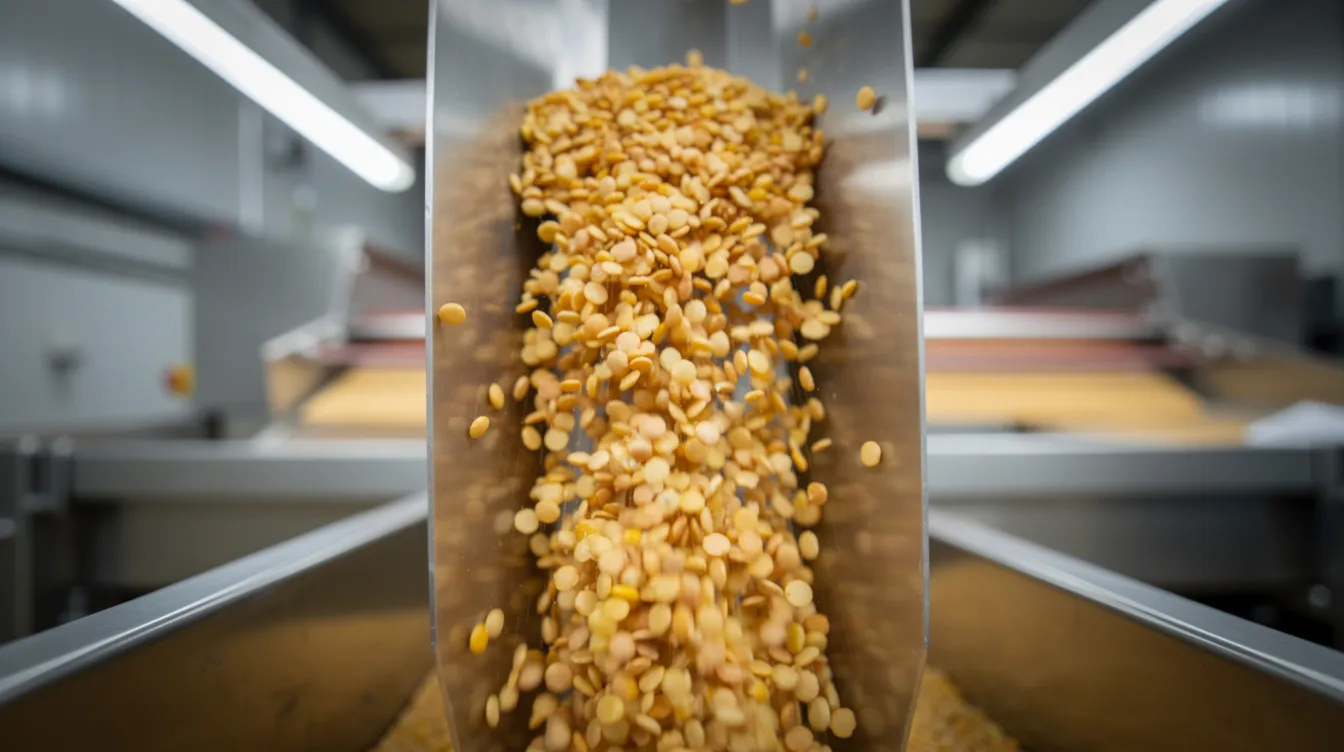
Optical Colour Sorter Working Process
The sorting process occurs through stages including feeding, imaging, processing, and ejection. A typical process sequence is:
- Pre-cleaning – aspirators, de-stoners, magnetic separators remove dust, stones and metallic particles.
- Grading – screens and gravity separators produce uniform-size input for the sorter.
- Controlled feeding – vibratory feeder singulates grains into channels for single-layer flow.
- Free-fall or belt presentation – grains pass through the optical inspection zone.
- Optical inspection – high-resolution imaging inspects pulses at high speeds; cameras capture colour, brightness and sometimes shape data.
- Defect identification – software compares each grain to stored thresholds. Optical sorting can detect defects like discoloration and insect damage in pulses.
- Pneumatic ejection – air jets remove defective grains in milliseconds.
- Accepted product collection – good grains pass forward.
- Quality inspection – accept and reject streams are checked to verify performance.
- Packing – accepted product proceeds to packaging.
Upstream cleaning and grading directly influence sorting performance. If pre-cleaning is inadequate, the colour sorter must deal with excessive contamination, reducing effective capacity and increasing rejection. For details on upstream equipment specifications and costs, refer to the guide on pulse cleaning, grading and sorting machinery cost.
Multiple sorting passes – primary sort plus re-sort of rejects – are commonly used for export-quality output. The number of passes affects both sorting accuracy and overall capacity per hour.
Types of Optical Colour Sorting Technologies
Defect detection capability depends on the type of camera technology used. Understanding the differences between CCD, RGB, AI and NIR is important for selecting the right dal colour sorting machine.
CCD monochromatic / bichromatic sorters use CCD or CMOS sensors to detect basic light/dark contrast and foreign material. These are widely used in standard domestic pulse processing where high-contrast defects dominate. Lower cost but limited in detecting subtle shade differences.
RGB full-colour sorters use red, green and blue channels to identify visible color differences in pulses. High-resolution RGB cameras are better at distinguishing subtle shade variations, off-colour kernels and mixed varieties. Suitable for branded retail and export-grade applications.
AI-assisted image recognition sorters use deep-learning software trained on actual sample sets to recognise complex defect patterns – spots, tip-open, immature grains, insect damage, shape irregularities. They incorporate IoT technology for real-time automated sorting and reduce false rejects. Higher cost but can adapt to regional defect patterns.
NIR-based sorters include near-infrared sensors that detect defects invisible under standard lighting conditions – internal mould, moisture differences, chemical contamination. NIR cameras can detect defects that are invisible under standard lighting. This is typically an optional add-on, not required for all dal mills.
Multi-spectral / hybrid systems combine visible and NIR or other sensors for the highest detection coverage. Designed for high-end export or multi-commodity plants. Highest cost and complexity.
| Technology | Detection Capability | Typical Applications | Advantages | Limitations | Relative Cost |
|---|---|---|---|---|---|
| CCD Mono/Bichromatic | Basic colour contrast, foreign seeds, burnt grains | Domestic loose trade, standard pulses | Simple, low cost, reliable for high-contrast defects | Cannot detect subtle shade; no internal defects | Low–Medium |
| RGB Full-Colour | Shade variation, off-colour, colour impurities | Branded retail, export-grade dals | Better subtle defect detection; multi-commodity flexibility | Higher cost; needs stable lighting and calibration | Medium–High |
| AI Image Recognition | Complex spots, shapes, insect damage; adapts to varieties | Multi-product plants, premium quality | High accuracy; reduces good-grain loss; learns from samples | Requires training; higher cost; operator skill needed | High |
| NIR / Infrared | Internal damage, mould, moisture, hidden foreign material | Export safety-critical; aflatoxin risk crops | Adds detection invisible to RGB; improves food safety | Expensive; complex calibration; usually hybrid add-on | High |
| Multi-Spectral Hybrid | Combined visible + IR + shape/size | Highest export standards; multi-commodity | Best coverage; fewest false negatives | Highest cost; complex maintenance; skilled staff needed | Very High |
Optical color sorters identify defects based on multiple optical characteristics. Not every AI-enabled machine contains NIR hardware. For many Indian MSME pulse processors, a good RGB-based sorter with reliable support may be more practical than an expensive multi-spectral system. Buyers should request demonstration trials with their own pulse samples on different technologies before deciding.
Optical Colour Sorter Capacity and Channel Configuration
Capacity in TPH and channel/chute count are the primary parameters determining actual throughput. A channel or chute is a separate vertical flow path with its own camera view and ejectors. Adding more channels allows higher capacity at similar sorting quality.
These machines can process 1 to 10 tons per hour depending on configuration. Optical sorters can process large volumes of pulses quickly. Typical rated capacities for pulse sorters in India range from about 0.5 TPH to 10 TPH, though these are vendor-rated figures under controlled conditions.
Factors that reduce actual capacity versus rated capacity:
- Higher input contamination levels
- Requirement of multiple sorting passes
- Smaller grain size (moong vs chana, for instance)
- Poor feed uniformity
- Limited compressed-air availability
- Higher target sorting accuracy
Optical sorting technology achieves over 99.9% accuracy under optimal conditions, but real-world performance is usually somewhat lower.
Capacity-Selection Guidance
| Plant Size (Finished Output) | Recommended Sorter Configuration |
|---|---|
| 0.5–1 TPH | 1–2 chute compact machine |
| 2 TPH | 3–5 chute sorter |
| 5 TPH | 7–10 chute sorter |
| 10 TPH | Multi-chute industrial sorter, possibly parallel machines |
Compressed-air requirements typically range from 600–1,500 L/min at 0.6–0.8 MPa air pressure for a two-channel sorter. Electrical power varies from about 3 kW to 10 kW depending on the model and channel count. Vendor test reports using actual pulse samples and live trials are essential before finalising capacity decisions. For reference on machine specifications, vendors like Orange Sorting Machines offer detailed technical data across their range.
Optical Colour Sorter Price in India
Prices for optical sorting machines vary widely by brand, technology, capacity, number of channels, imported versus Indian-built, and level of automation. The figures below are indicative ranges, not vendor quotations.
- Small 0.5–1 TPH sorters: roughly ₹8 lakh to ₹15 lakh
- Medium 2–3 TPH sorters: roughly ₹15 lakh to ₹30 lakh
- Larger 5–10 TPH industrial sorters: roughly ₹30 lakh to ₹60 lakh+ (especially with AI/NIR or imported brands)
Total investment extends beyond the base machine cost:
| Cost Component | Indicative Range (₹ Lakh) |
|---|---|
| Colour sorter machine (2 TPH) | 15–20 |
| Screw compressor with dryer & filters | 3–5 |
| Electrical panel, cabling, earthing | 1–2 |
| Bucket elevator, conveyors | 2–4 |
| Dust extraction / aspiration | 0.5–1 |
| Civil / structural supports | 0.5–1.5 |
| Freight, insurance, installation | 1–2 |
| GST and other taxes | As applicable |
Imported machines may offer advanced features and higher sensor resolution but carry higher prices and spares costs. Reputed Indian manufacturers provide cost-effective customization options with faster local service. Promoters should obtain at least 2–3 competitive quotations with detailed technical specs and negotiate warranty terms, AMCs and response-time commitments.
For comprehensive project budgeting including all equipment, refer to the export-grade pulse cleaning, colour sorting and packing plant DPR.
Pulse-Wise Optical Colour Sorting Applications
Advanced sorting machines can differentiate pulses by size and color. Sorting requirements differ significantly across pulse varieties because of different colour shades, grain size, skin behaviour and typical defects.
| Pulse | Target Colour | Common Defects | Sorting Focus |
|---|---|---|---|
| Toor dal | Lemon-yellow | Black/brown spots, off-shade, insect damage, husk remnants | Colour uniformity; remove spotted kernels |
| Moong dal / whole moong | Bright yellow (split) / green (whole) | Skin patches, immature grains, greenish off-shade | High-resolution cameras; accurate lighting critical |
| Urad dal | White / cream | Chalky grains, foreign seeds, partial husk | Careful threshold setting to avoid excessive good-product rejection |
| Chana dal | Golden yellow | Browns, shrivelled kernels, foreign grains | Important for branded packed products |
| Masoor dal | Orange-red | Shade variation, mottling, fungal stains | Distinguish acceptable natural shade vs serious discolouration |
| Rajma, peas, beans, whole lentils | Varies | Foreign seeds, surface blemishes, discoloured beans, stones | Colour + sometimes shape detection |
For toor dal specifically, optical sorters are particularly useful for improving the appearance and consistency of finished products by removing black-spotted and brownish kernels. For moong dal, the small grain size demands high-resolution scanning and precise channel design. Masoor dal requires careful recipe calibration given natural shade variation – a challenge where export markets demand strict uniformity.
Some plants use the same optical sorter for other commodities like sesame seeds, peanuts, almonds, nuts, corn, maize, wheat, rice, cereals and certain beans during off-season, which can improve the economic justification of the investment.

How to Select the Best Optical Colour Sorter for a Dal Mill
Sorting accuracy is critical when selecting an optical color sorter for pulses. Incorrect selection – over-sized or under-performing – can adversely impact both project cost and plant profitability.
Technical checklist:
- Required finished-product capacity (TPH) and projected utilisation (hours/day, days/year), planned for 3–5 year growth
- Target quality level: domestic loose trade, branded retail or export, and acceptable rejection percentage
- Pulse types handled: single product versus multi-pulse and other grains; typical input contamination
- Camera resolution, RGB vs monochromatic, illumination type; stable light is essential for consistent colour detection
- Ejector valve type, speed, life and spares cost; directly affects good-grain loss
- Air consumption and required air pressure; ensure adequate compressed-air supply
- Power consumption (kW) and impact on operating cost per tonne
Non-technical checklist:
- Vendor reputation and service network in the plant’s state or region
- Availability and pricing of critical spares (nozzles, solenoid valves, cameras, circuit boards)
- Warranty period, AMC availability and typical response time for breakdown calls
- Possibility of remote diagnostics, software upgrades and recipe storage
- Ability to conduct live trials with buyer’s own raw material at the vendor’s demo centre
All these details should be documented for inclusion in the Detailed Project Report and internal investment approval notes.
Optical Colour Sorter Installation and Utility Requirements
The colour sorter is typically placed after grading/polishing and before final packing, at a height compatible with bucket elevators and gravity discharge.
Key requirements:
- Layout: adequate headroom for feed hopper and elevator, safe maintenance platforms, space for opening covers, compliance with safety norms
- Electrical: stable three-phase supply (415V), appropriate cable sizing, earthing, dedicated control panel, voltage stabiliser where needed
- Compressed air: screw compressor of adequate HP, air receiver, filters and dryer, pipelines sized to maintain 0.6–0.8 MPa at the machine, regular condensate drainage
- Dust control: aspiration points around the feeding area to prevent dust accumulation on camera lenses
- Noise and vibration: compressor room segregation, vibration isolation for machine foundation
Optical Colour Sorting Operating Cost per Tonne
Understanding operating cost per tonne is essential before investment, for negotiating job-work rates and evaluating profitability. This technology reduces waste by minimizing false rejects when properly calibrated.
Cost heads:
- Electricity = (machine kW + compressor kW) × hours × tariff ÷ tonnes processed
- Labour = total sorting-related labour cost per day ÷ tonnes per day
- Maintenance = annual spares and AMC cost ÷ annual tonnes
- Rejection loss = (good pulses lost in rejects %) × sale price per kg
Illustrative example (assumptions clearly labelled):
| Parameter | Assumption |
|---|---|
| Machine capacity | 2 TPH |
| Operating hours | 8 hours/day, 300 days/year = 4,800 tonnes/year |
| Machine power | 4 kW |
| Compressor power | 15 kW |
| Electricity tariff | ₹8 per kWh |
| Labour | 2 operators at ₹500/day each |
| Maintenance and spares | ₹1.5 lakh/year |
| Good-product loss in rejects | 1% at ₹80/kg sale price |
| Cost Head | Annual Cost (₹) | Per Tonne (₹) |
|---|---|---|
| Electricity (19 kW × 2,400 hrs × ₹8) | 3,64,800 | ~76 |
| Labour | 3,00,000 | ~63 |
| Maintenance | 1,50,000 | ~31 |
| Rejection loss (10 kg/tonne × ₹80) | 38,40,000 | ~800 |
| Indicative total | – | ~970 |
Rejection loss often dominates operating cost. Better input quality and optimised thresholds can reduce this substantially. Actual cost differs by plant size, local tariff, capacity utilisation and operator skill. Serious investors should get a plant-specific cost analysis through customised financial projections.
Financial Feasibility, ROI and Payback Period
From a financial advisory perspective, an optical colour sorter changes a pulse mill’s economics in three measurable ways: it enables sale in higher price segments (branded packs, supermarkets, export), it reduces manual sorting labour, and it improves consistency – thereby reducing returns, rework and working capital blockage in rejected lots.
A case study from a tur dal mill in Marathwada demonstrated that deploying AI optical sorting plus NIR moisture analysis improved dal recovery from 71% to 79%, doubled export-grade output and reduced energy cost per tonne by 19%.
Illustrative ROI calculation:
| Parameter | Assumed Value |
|---|---|
| Total installed cost (sorter + utilities) | ₹30 lakh |
| Annual processing volume | 5,000 tonnes |
| Incremental realisation (better quality + labour saving) | ₹1.50/kg |
| Incremental operating cost (power, maintenance) | ₹0.40/kg |
| Net incremental benefit per kg | ₹1.10 |
| Annual net benefit | ₹55 lakh |
| Simple payback | Under 1 year (favourable case) |
The actual payback depends on market acceptance, consistent quality improvement and capacity utilisation. When financed through bank term loans, cash flows should be analysed through projected Profit & Loss and Cash Flow statements with DSCR analysis. Project Report Bank can build detailed financial models capturing different scenarios and conduct sensitivity analysis before final investment.
Optical Colour Sorter Integration with Complete Pulse Processing Plants
Optical sorting is often used as a final quality control step in processing lines, positioned after de-husking/splitting and polishing but before packaging. A combination of multiple sorting methods often yields better results for pulse processing.
Key integration considerations:
- Poor performance in upstream pre-cleaners, graders and destoners increases sorting load, reducing colour sorter capacity and raising rejection
- Conveyors and bucket elevators must handle material gently to avoid breakage and dust
- Downstream packing machines must be balanced so the colour sorter does not become a bottleneck
- Feed control through vibratory feeders or surge hoppers at the sorter inlet ensures consistent flow
For readers planning complete processing lines, refer to the integrated multi-pulse cleaning, grading and packing plant project report. Entrepreneurs exploring independent processing on a contract basis may find the pulse cleaning, grading and packing job-work business model relevant.
Common Mistakes When Purchasing Optical Colour Sorters
Frequent errors by first-time buyers include:
- Selecting capacity based only on current production instead of a 3–5 year growth plan
- Buying solely on lowest price without checking service support, spares availability and actual trial results from suppliers
- Underestimating air compressor and air-treatment requirements, leading to poor ejection and frequent breakdowns
- Believing marketing claims of “zero loss” or “100% accuracy” without realistic trial data – pulses color sorters achieve over 99.9% accuracy under ideal conditions, not universally
- Ignoring operator training and recipe management, resulting in high good-grain rejection and error rates
The financial consequences include higher downtime, unexpected capital expenditure, elevated operating cost per tonne and difficulty meeting buyer specifications. A structured techno-commercial evaluation – comparing at least three suppliers, conducting sample-based trials and getting technical specifications reviewed during DPR preparation – reduces these risks substantially.
Role of DPR, CMA Data and Financial Projections in Machinery Investment
A bankable Detailed Project Report is essential when investing in optical colour sorters and related pulse-processing machinery, particularly for bank term loans and MSME projects across industries in India.
A good DPR for a pulse colour sorting project should include a detailed machinery list with estimated costs, plant layout, land and building requirements, utility requirements, project cost estimation including margin money for working capital, and means of finance covering promoter contribution, bank term loan and other sources.
CMA Data and financial projections should cover at least 5–7 years, showing projected production, sales, raw material consumption, power, labour, maintenance, depreciation and loan-repayment schedules, along with DSCR, break-even, ROI and IRR analysis. Financial projections are prepared based on reasonable assumptions and available data – they are not guarantees of performance.
Project Report Bank provides customised DPR preparation, bank finance DPR and loan proposal assistance (starting from around ₹25,000 for typical MSME projects), CMA Data and financial modelling tailored to each client’s pulse-processing project.
CA Manish Gugliya, FCA, DISA (ICAI) Manish Gugliya & Company, Chartered Accountants Ratlam, Madhya Pradesh – Serving Clients Across India Website: https://projectreportbank.com/
Interested entrepreneurs and project promoters can share basic project details via the website or WhatsApp enquiry to discuss scope, fees and timelines for professional advisory services.
Frequently Asked Questions
Below are additional queries entrepreneurs commonly raise about optical colour sorters for pulses.
What is the typical life of an optical colour sorter for pulses?
With proper maintenance, periodic cleaning of cameras and lenses, and timely replacement of ejector nozzles and filters, an optical colour sorter can typically serve for 8–12 years or more in Indian conditions. Life depends on daily working hours, dust control, compressed-air quality and adherence to the manufacturer’s maintenance schedule.
Can one optical colour sorter handle multiple products like pulses, grains and sesame seeds?
Many modern colour sorter machines store multiple recipes and can sort different commodities – various dals, whole pulses, certain grains, sesame seeds and similar seeds – provided chutes and feeding are suitable for each product’s size and flow characteristics. Buyers should confirm product compatibility, changeover time and expected capacity de-rating with the vendor.
How often should an optical colour sorter be calibrated and cleaned?
Routine cleaning of lenses and chutes is usually required daily or per shift, especially in dusty environments. Deeper cleaning and ejector-valve checks may be done weekly or monthly. Many machines offer auto-calibration tools, but operators should still perform manual checks after any major product or lighting change to ensure consistent results.
Do banks in India finance optical colour sorter purchases for MSME dal mills?
Scheduled commercial banks and NBFCs routinely finance colour sorter machines as part of pulse-processing or agro-processing term-loan projects, subject to standard appraisal of project viability and borrower credentials. A well-prepared Bank Finance DPR, CMA Data and realistic financial projections significantly improve clarity for the lender.
How can Project Report Bank help in planning an optical colour sorter investment?
Project Report Bank, under the leadership of CA Manish Gugliya, offers professional services including customised DPR preparation, bank finance DPR and loan proposal support, CMA Data, financial projections, working capital and DSCR analysis for pulse-processing and colour-sorting projects. Entrepreneurs can share basic project details via the website or WhatsApp enquiry to discuss scope and timelines.
Optical Colour Sorter for Pulses