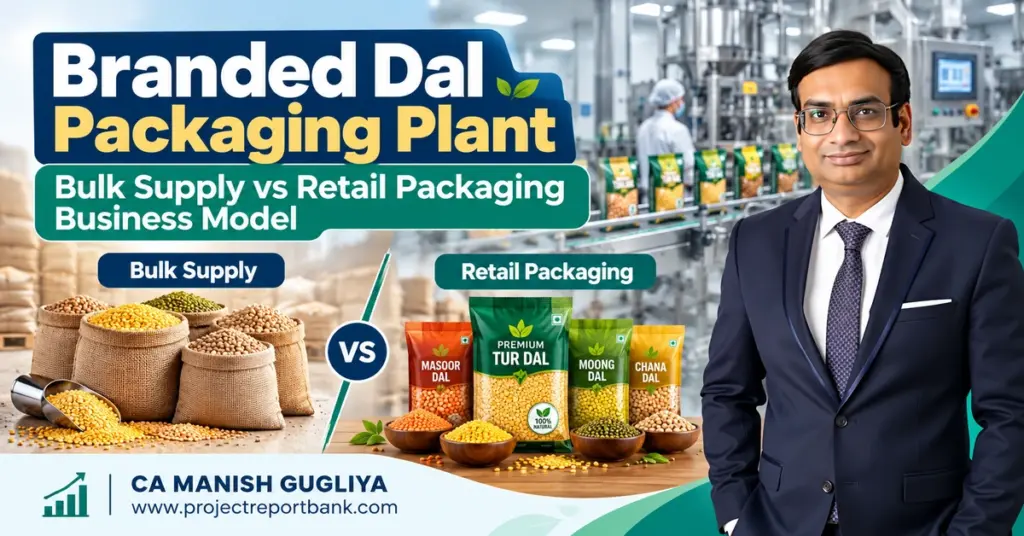
A branded dal packaging plant can create measurable value for entrepreneurs willing to move beyond bulk commodity sales. But the decision between selling processed dal in 25-50 kg bags and retailing it in 500 g or 1 kg consumer pouches involves trade-offs that affect every line of the financial model. This article examines those trade-offs with the rigour of a project finance evaluation.
Key Takeaways
- Bulk dal supply (25-50 kg bags) requires lower capital investment, simpler operations and shorter working capital cycles, but offers limited pricing power and thin margins per kg.
- A branded dal packaging plant selling 500 g to 5 kg retail packs can achieve higher price realisation per kg, but introduces packaging material costs, distributor credit, retailer margins, brand-building expenses and longer cash conversion cycles.
- The best model depends on the promoter’s distribution reach, working capital capacity, branding experience and whether the unit is integrated with a dal mill or operates as a standalone packaging plant.
- This article includes illustrative profitability comparisons, packaging cost per kg tables and guidance on DPR preparation, CMA Data, bank finance and feasibility evaluation for dal packaging projects.
- Readers will also find coverage of FSSAI licensing, Legal Metrology compliance and how Project Report Bank supports entrepreneurs with customised project reports and financial projections.
Introduction – Why Dal Packaging Is Becoming a Separate Business Opportunity
India produces 25% of global pulses and consumes 27% of the world’s supply. The dal mill industry is a major agro-processing sector; India processes 75% of its annual 13.19 million tonnes of pulses through dal mills. Yet in FY2020, only about 5-6% of pulse consumption was in branded, pre-packaged form, with over 90% still sold loose or in bulk.
That gap is narrowing. Consumer preferences for hygiene, consistent grain size and brand trust have risen in urban and semi-urban markets since 2015. Branded packaging accelerates the shift from unorganized to organized retail, and establishing a branded dal packaging facility transforms a commodity into a consumer product. Emerging opportunities in dal milling are driven by growing demand for packaged moong dal, masoor dal, chana dal, tur dal and urad dal across modern trade, e-commerce and institutional channels.
The distinction matters financially. Selling processed dals in 25 kg bags to wholesalers is a different business from selling 1 kg pouches of moong to kirana stores or supermarkets. The retail MRP per kg is higher, but so are costs: printed pouches, packing labour, retailer and distributor margins, marketing, sales returns and GST working capital. A higher selling price is not automatically a higher profit. Net margin depends on contribution per kg after all direct and indirect costs. Branded facilities can introduce product differentiation and innovation within the market, but the economics must hold up under scrutiny.
As a project finance advisor and CA with over 20 years of experience, I focus this analysis on commercial feasibility, cash flows and investment decisions rather than aspirational claims.
Understanding Three Dal Packaging Business Models
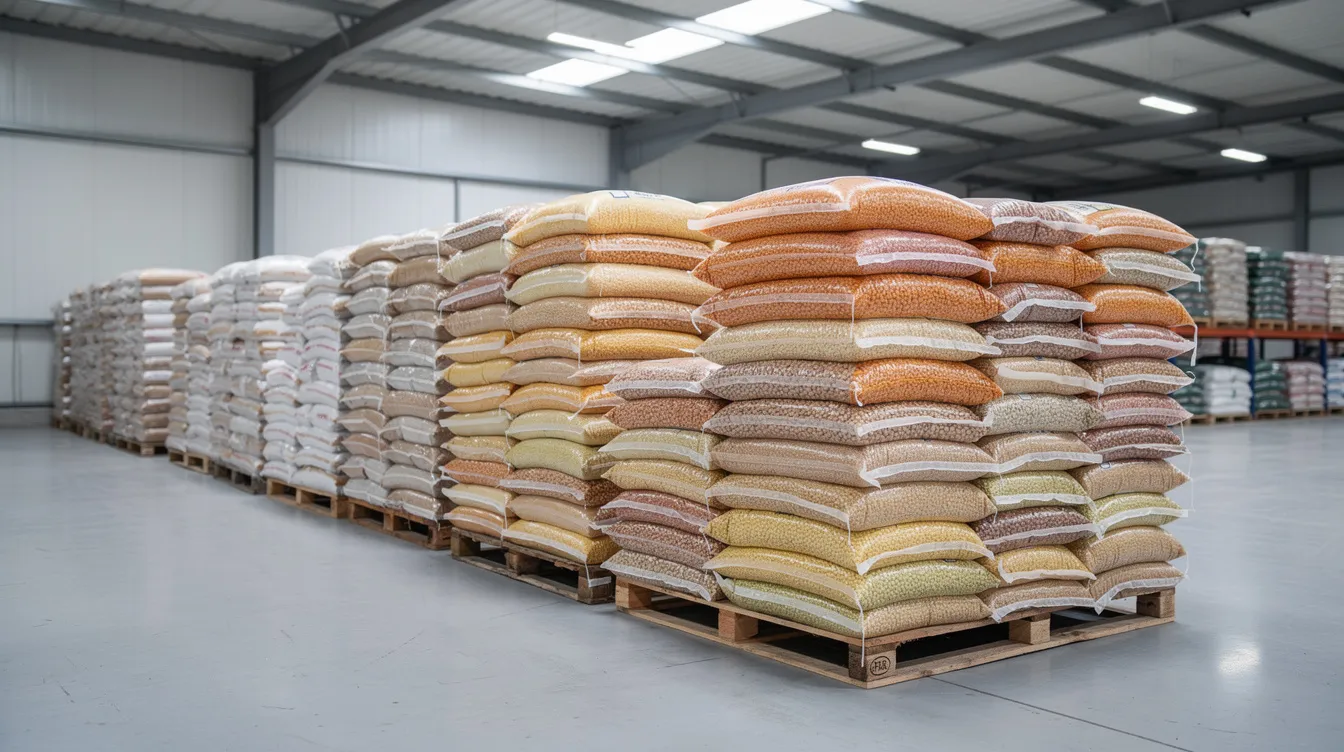
Indian entrepreneurs choosing to enter dal packaging usually evaluate three models: bulk supply, own-brand retail packaging and private label or contract packaging.
Model A: Bulk Dal Supply. The plant sells cleaned, graded dal in 25-50 kg HDPE or PP bags to wholesalers, institutional buyers, hotels, caterers and large retailers’ bulk sections. Advantages include lower packaging cost per kg, faster cash conversion (wholesalers often pay within 7-15 days), and minimal marketing spend. Limitations include thin margins (often ₹10-15 per kg gross on commodity dal), exposure to commodity price swings and limited ability to differentiate. Branded operations can stabilize pricing and supply of pulses, but bulk sellers lack that lever.
Model B: Own-Brand Retail Packaging. The entrepreneur creates a brand, designs packaging, and sells through kirana shops, supermarkets, distributors and online marketplaces. Branded dal can capture value at multiple stages of production, from procurement through processing to distribution. Branding can lead to higher profit margins compared to unbranded products. However, this model demands working capital for multiple SKUs, marketing budgets, distributor credit of 30-60 days and sustained investment in brand-building over 2-3 years before reaching scale.
Model C: Private Label / Contract Packaging. The plant packs dal under third-party brands for a per-kg or per-pouch fee. This offers predictable volumes and lower marketing overhead, but margins are thinner and depend on client retention.
Many practical dal mill businesses run a hybrid approach: 60-70% volume through bulk channels and 30-40% through retail or private-label packaging.
| Parameter | Model A (Bulk) | Model B (Own Brand) | Model C (Private Label) |
|---|---|---|---|
| Upfront Investment | Low | Medium-High | Medium |
| Price Realisation per kg | Low | High | Moderate |
| Gross Margin Range | 8-12% | 15-25% (before marketing) | 10-15% |
| Marketing Spend | Minimal | High | Low |
| Working Capital Intensity | Low | High | Medium |
| Operational Complexity | Low | High | Medium |
| Scalability | Volume-dependent | Brand-dependent | Client-dependent |
Dal Packaging Plant Setup – Standalone vs Integrated Dal Mill
A standalone branded dal packaging plant purchases ready dal from different mills as raw material, while an integrated dal mill operates its own de-husking, splitting and polishing line feeding directly into packaging. Dal milling involves de-husking and splitting pulses; modern dal mills achieve a de-husking efficiency of approximately 95%, and the split pulses yield stands at 80-85% depending on pulse variety. The complete Dal Milling Process & Flow Chart covers these steps in detail. Promoters evaluating integrated projects should study the Dal Mill Recovery Ratio, Yield and Milling Losses to understand how yield affects cost of goods sold.
Standalone packers avoid investment in modernized milling equipment but depend on stable bulk dal suppliers and consistent quality. If a supplier delivers moong dal with high broken percentage or inconsistent moisture, the brand reputation suffers. Multiple reliable suppliers and clear specifications for size, colour and moisture content are non-negotiable.
Plant layout for a pure packaging unit typically needs less space than a full dal mill, but still requires areas for raw material storage, packaging material storage, the packaging line, finished goods and dispatch. The concepts in Dal Mill Land, Building & Plant Layout Requirements apply to the milling side; packaging plants need to plan their own layouts for efficient material flow. A dal mill requires modernized milling equipment for efficiency, and capacity must be planned carefully. Dal Mill Capacity Planning addresses the milling side, while this article focuses on packaging throughput measured in pouches per hour.
Packaging Machinery, Equipment and Automation
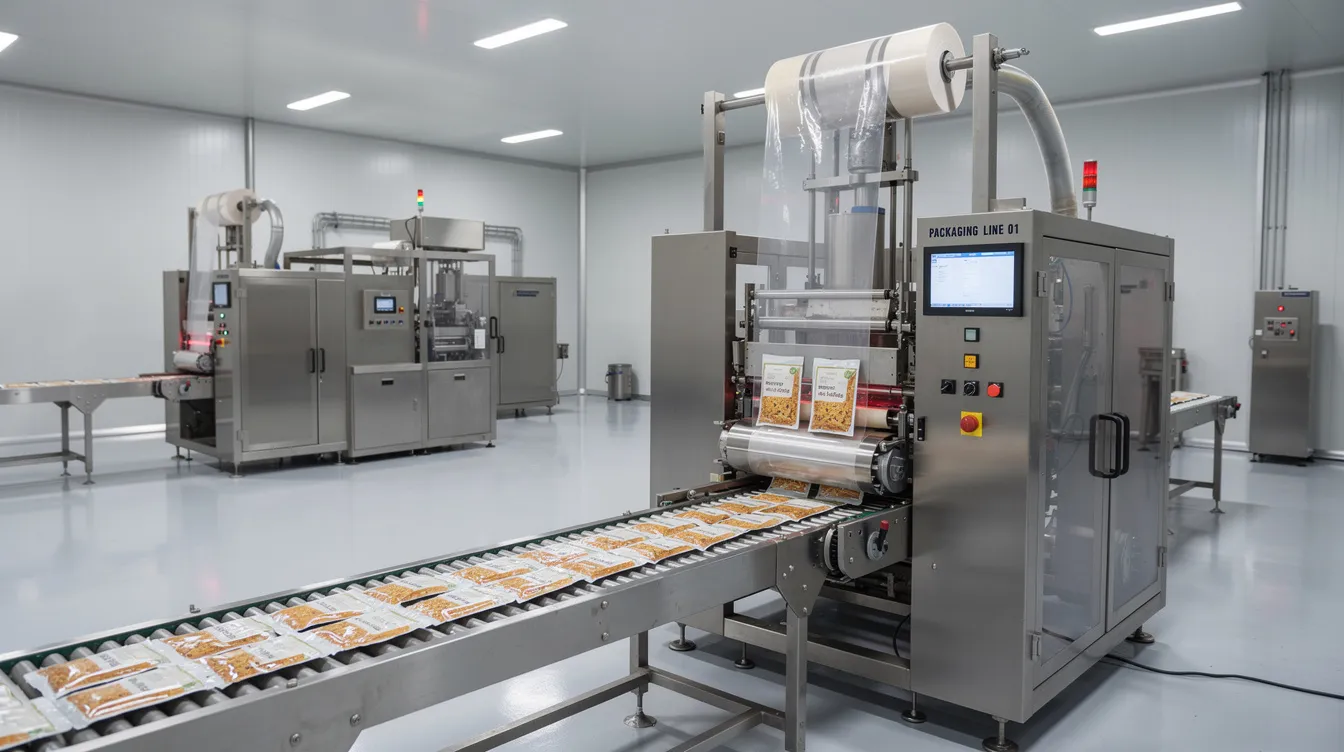
Dal milling technology can be semi automatic or fully automatic; packaging machinery follows a similar spectrum. Technological advancements are boosting the dal milling industry, and automation improves operational efficiency in packaging facilities. Modern automated packaging extends shelf life and preserves quality through consistent sealing, nitrogen flushing and controlled fill weights.
A semi automatic line uses separate electronic weighing scales, manual pouch filling, foot-operated band sealing, manual stitching of 25-50 kg sacks and manual secondary packing. A fully automatic line uses VFFS (Vertical Form Fill Seal) machines that form pouches from roll stock, weigh via multihead weighers, fill, seal and discharge onto conveyors with batch coding. Semi-automatic VFFS machines for 100 g-1 kg pouches cost approximately ₹4.5-7.5 lakh; fully automatic single-head models range from ₹8-15 lakh. Milling automation choices are covered separately in Fully Automatic vs Semi-Automatic Dal Mill.
A practical equipment checklist for a branded dal packaging plant includes: electronic weighing system, FFS or pouch sealing machine, batch coding printer, stitching machine for bulk bags, conveyors, compressor (for pneumatic systems), basic lab equipment for moisture and quality testing, and optional metal detector and checkweigher. Readers wanting detailed Indian machinery options can refer to Dal Mill Colour Sorter, Grading, Polishing & Packaging Machinery.
Bulk Packaging vs Retail Packaging – Packaging Formats and Costs
Bulk formats use 25 kg and 50 kg woven PP or HDPE bags with liners, often stitched closed. Retail formats use laminated pouches (BOPP/CPP/LDPE), with or without zip closure, transparent windows or full-colour printing, in sizes from 500 g to 5 kg. Print quality and pouch thickness directly impact cost and brand perception. Effective packaging design enhances shelf presence and marketing appeal, while proper packaging minimizes wastage and spillage during distribution.
| Pack Size | Approx. Material Cost per Unit | Approx. Cost per kg |
|---|---|---|
| 50 kg bulk bag (woven PP, liner) | ₹40-70 per bag | ₹0.80-1.40 |
| 5 kg printed laminate pouch | ₹20-40 per pouch | ₹4-8 |
| 1 kg printed laminate pouch | ₹6-15 per pouch | ₹6-15 |
| 500 g printed pouch | ₹3-8 per pouch | ₹6-16 |
These are indicative ranges based on trade vendor listings. Actual costs vary by region, print complexity, film micron, order volume and supplier negotiation.
Packaging cost is only one component. Profitability depends on price realisation, trade margins, marketing spend and working capital cost, covered in later sections.
Branded Dal Packaging Plant Investment and Project Cost
Investment for a branded dal packaging plant has two broad components: fixed capital (machinery, building or shed modification, electrical installation, utilities, quality testing equipment) and working capital (raw dal stock, packaging materials, staff costs, marketing, receivables). Fixed capital for plant and machinery in a small scale operation can start at approximately 1.84 lakhs for basic equipment, scaling up with automation and capacity. Starting a dal mill requires approximately 7.96 lakhs in fixed capital; adding a packaging section increases total project cost.
Intangible and pre-operative costs include trademark registration, logo and pouch design artwork, cylinder making for print, consultancy, company registration, trial-run expenses and pre-operative interest. Government schemes can support food processing businesses financially, and funding options include bank loans and government support programs.
For integrated dal mills adding packaging, the total investment is higher but benefits include control over quality, ability to monetise by-products such as husk, chuni and broken dal, and flexibility in product mix covering moong, masoor, chana dal, green gram (Bengal gram), lentils, beans and urad.
Entrepreneurs planning a dal packaging unit can obtain professional support for financial projections, project feasibility assessment and business planning through Bank Finance DPR & Loan Proposal Assistance.
Bulk Supply vs Branded Retail – Detailed Profitability Comparison
Many entrepreneurs switch to branded dal packaging expecting better profits. Actual profitability depends on contribution after trade margins, packaging cost and marketing, not on MRP alone.
Definitions: Gross margin = selling price minus cost of goods (dal + packing). Contribution margin = gross margin minus variable selling expenses. EBITDA = earnings before interest, tax, depreciation and amortisation. Net profit = post interest and tax.
Consider 1,000 kg of moong dal available at ₹120/kg ex-mill cost:
| Component | Bulk (50 kg bags) | Own Brand (1 kg pouches) | Private Label (1 kg pouches) |
|---|---|---|---|
| Realised selling price per kg | ₹130 | ₹170 (after retailer/distributor margins on ₹200 MRP) | ₹145 |
| Dal cost per kg | ₹120 | ₹120 | ₹120 |
| Packaging material per kg | ₹1.00 | ₹10.00 | ₹8.00 |
| Packing labour + electricity per kg | ₹0.50 | ₹2.00 | ₹2.00 |
| Marketing + schemes per kg | ₹0.00 | ₹5.00 | ₹0.50 |
| Credit cost (interest on receivables) per kg | ₹0.30 | ₹2.00 | ₹1.00 |
| Contribution per kg | ₹8.20 | ₹31.00 | ₹13.50 |
| Total contribution for 1,000 kg | ₹8,200 | ₹31,000 | ₹13,500 |
Illustrative example only. Actual numbers vary by region, dal type, season and negotiated terms.
Contribution per kg = Net selling price per kg minus (Dal cost per kg + Packaging cost per kg + Direct variable selling cost per kg). Break-even volume (kg) = Annual fixed costs divided by Contribution per kg.
Bulk supply is more attractive when a dal mill has high throughput, strong institutional buyers, minimal marketing expenses, and the promoter prefers lower complexity and a shorter cash cycle. Branded retail packaging rewards promoters who have strong regional distribution, can control packaging costs through volume, and are prepared to invest 1-3 years in brand-building and retailer relationships. Private label packaging offers modest margins per kg but predictable volumes and lower marketing expenditure because the brand owner handles consumer marketing.
For bank-financed projects, DSCR and long-term sustainability depend on consistent contribution and sales volume rather than occasional high-margin orders. Financial Projections & Financial Modelling Services help promoters prepare realistic appraisals before committing investment.
Working Capital Requirements and Inventory Management
Working capital for a dal packaging plant covers raw dal inventory, packaging materials, finished goods stock, trade receivables and operating expenses. Working capital requirement for a dal mill is about 15.45 lakhs; a branded packaging operation layered on top can push this higher due to multiple SKUs and longer credit cycles.
Bulk dal supply typically involves faster payments (7-15 days from wholesalers). Branded retail distribution means credit to distributors and retailers extending 30-60 days. Stocking complexity rises with multiple SKUs: moong dal, masoor dal, chana dal, urad, tur dal, green gram and spices. Seasonal demand spikes around festivals and wedding seasons require advance procurement, covered in detail in Raw Pulse Procurement, Storage & Seasonal Inventory Planning.
A simple working capital framework: if a plant holds 30 days of dal stock (₹36 lakhs at ₹120/kg for 1 tonne/day), 20 days of packaging material (₹2 lakhs), and has 45 days of receivables (₹23 lakhs based on retail), the total fund requirement before supplier credit can exceed ₹55-60 lakhs. This amount may equal or exceed the initial machinery investment. Preparing bank-standard CMA Data is critical for negotiating adequate cash credit limits and working capital finance; CMA Data Preparation Services for Bank Loans supports this process.
Dal Branding, Market Entry and Distribution Strategy
A branded dal packaging plant’s success depends more on distribution pull than on machinery specs. Quality is mandatory but not sufficient for scale. Branded packaging creates stronger customer loyalty through consistent quality and reliable products, but loyalty must be earned over time.
Brand positioning choices include “everyday value” versus “premium, cleaned and sorted” products. Regional strategies often work better than rushing to pan-India presence; many entrepreneurs start with 2-3 districts using local language packaging and expand based on repeat orders and distributor performance. Distribution channels include traditional wholesalers and kirana stores, modern supermarkets, HoReCa (hotels, restaurants, caterers), B2B institutional buyers and online marketplaces. Each channel has distinct margin expectations, service requirements and credit terms. Private label partnerships with regional chains help a packaging plant achieve capacity utilisation even while the own brand is in early stages.
Marketing costs (consumer offers, in-store visibility, sampling, listing fees for e-commerce) must be built into financial projections. SKU-wise and territory-wise performance monitoring is essential to avoid spreading resources too thin across products that Indian cuisine demands and geographies.
Quality Standards, FSSAI and Packaging Compliance
Food safety practices are critical in processing plants for maintaining quality. Facilities must design for effective moisture control and pest management. Branded packaging increases consumer trust and traceability of products, and quality grading is standardized in branded packaging to meet market demands and international quality standards.
Licensing requirements include obtaining an FSSAI license for food businesses. Most commercial branded dal packaging plants require an appropriate State or Central FSSAI licence depending on scale. Key compliance areas include: clean plant layout, pest control, batch tracing from raw material to finished packs, and documented cleaning schedules.
Packaged commodities must comply with local legal standards and regulations under Legal Metrology (Packaged Commodities) Rules: declaration of net quantity, MRP, packed-on or best-before date, FSSAI licence number, manufacturer or packer details and batch number. Trademark registration is advisable for own brands.
On GST: pre-packaged and labelled pulses attract 5% GST from 18 July 2022 regardless of brand name. Promoters must manage correct HSN classification and ITC on packaging materials. Multi-layer plastic pouch users should track EPR (Extended Producer Responsibility) guidelines and pollution control board requirements.
Financial Projections, Break-Even and Investment Feasibility
Before investing, entrepreneurs should prepare structured financial projections covering at least 5-7 years. The main elements of a dal packaging plant’s financial model include installed packaging capacity, expected capacity utilisation ramp-up, average selling price per kg, variable costs, fixed costs and planned marketing intensity.
Break-even sales (kg) = Total annual fixed costs divided by Contribution per kg. For a small regional branded plant with ₹12 lakhs in annual fixed costs and ₹25/kg contribution, break-even volume is 4,800 kg per year, or about 400 kg per month. This is achievable, but a 10% fall in selling price or a rise in raw dal procurement cost can push the break-even volume up by 30-40%, which materially affects ROI and payback period.
Banks prefer DSCR consistently above 1.3-1.5 over the forecast period. Sensitivity analysis testing price drops, input cost rises and lower utilisation must be part of any credible project report.
Which Business Model Should an Entrepreneur Choose?
There is no universally correct dal packaging business model. Market validation is essential before investing in machinery for new operations.
Existing dal mill owners with strong wholesale relationships and limited branding experience should start with bulk supply or a hybrid model. FMCG entrepreneurs with distribution access, consumer marketing skills and willingness to invest 2-3 years in brand-building suit the own-brand model. Private label or contract packaging works for plants near pulse-producing regions or consumption centres, with quality systems and capacity for multiple clients. New entrepreneurs with limited capital should consider starting small scale, testing demand with semi automatic packaging, and scaling based on actual orders rather than projected volumes.
Role of a Detailed Project Report in Planning a Dal Packaging Business
A detailed project report for a branded dal packaging plant is a core decision-making document. Investors should prepare a detailed project report for funding. A project report includes fixed and working capital requirements, market analysis, technical configuration, manpower plan, implementation schedule and risk analysis. Reports must meet bank standards for approval, covering projected P&L, cash flow, balance sheet, break-even, DSCR, IRR and payback period.
Custom project reports are essential for obtaining bank financing and investor funding. Collateral is often required when borrowing from banks; a well-prepared DPR strengthens the loan proposal. Investing in project planning and feasibility analysis is crucial before execution. The total fixed capital for a dal mill is approximately 7.96 lakhs, but a branded packaging addition changes the investment profile. Loans from banks remain the primary source; government support through schemes like PMFME can provide additional benefit.
Project Report Bank, led by CA Manish Gugliya, prepares customised branded dal packaging plant DPRs based on realistic local assumptions rather than generic templates. The firm offers Bank Finance DPR & Loan Proposal Assistance for entrepreneurs seeking project-specific documentation.

Frequently Asked Questions
Is a branded dal packaging business profitable in India?
Profitability depends on scale, product mix, distribution strength and working capital discipline. Net profit margins for branded dal typically fall in single digits after accounting for trade margins, marketing and credit costs. High sales volume and repeat orders determine overall returns. A project-specific feasibility study is more reliable than blanket profitability claims. India’s food processing industry is large, but the dal segment remains competitive with both branded and unbranded players, including government-backed brands like Bharat Dal, which captured 25% household chana dal market share within four months of launch at ₹60/kg versus competing brands at ₹80/kg.
Can I start a dal packaging business without owning a dal mill?
Yes. Many entrepreneurs operate standalone dal packaging units purchasing moong dal, masoor dal, chana dal and other pulses from established dal mills as raw material. The main sources of supply should be diversified across multiple suppliers to ensure continuous availability and consistent grain quality. However, standalone packers face higher exposure to dal procurement price fluctuations and must negotiate clear specifications for size, colour and moisture with suppliers. Protein, minerals, vitamins and cooking quality depend on the raw material sourced.
What machinery is required for automatic dal packaging?
A fully automatic dal packaging line typically includes a VFFS machine, multihead weigher, batch coding printer, conveyor, and optionally a metal detector and checkweigher. Machines with speed of up to 2,000 pouches per hour cost approximately ₹12-13 lakhs. Semi-automatic setups using manual weighing and band sealers start from ₹1.9-4 lakhs. Capacity, pack size range, frequency of SKU changes, power requirement and budget should drive the choice.
Can a bank provide finance for a dal packaging project?
Banks and NBFCs in India finance branded dal packaging plants as MSME or food processing projects. Key documents required include a Detailed Project Report, KYC and financials of promoters, projected financial statements, CMA Data, machinery quotations, building documents and standard bank application forms. The bank evaluates fixed assets, productivity projections, efficiency of operations, and repayment capacity. The project report serves as the primary document for approval.
What is the packaging cost per kg of dal?
Packaging cost per kg depends on pack format and is one of the largest variable cost differences between bulk and retail models. For a 50 kg bulk bag, material cost is approximately ₹0.80-1.40 per kg. For a 1 kg retail pouch, it ranges from ₹6-15 per kg depending on print quality, film layers and supplier. Retail packing also requires secondary packing (cartons), batch coding ink and handling labour. These costs are the main reason why branded dal at a higher MRP does not always deliver a proportionally higher net margin. The food industry across countries uses similar pouch formats, but Indian pricing reflects local film and oil costs. Manufactured pouches from automated lines reduce per-unit cost through speed, form consistency and lower rejection rates, benefiting the production process and reducing drying and cleaning waste.
Conclusion and Professional Advisory
A branded dal packaging plant can add measurable value for dal millers and traders, but only when grounded in realistic assumptions about price realisation, packaging cost, distribution margins and working capital availability. Bulk dal supply offers simplicity and lower marketing cost but limited pricing power. Branded retail and private label packaging offer higher potential margins at the cost of greater complexity, capital requirement and time to scale. India being the largest producer and consumer of pulses provides the demand foundation, but individual project economics determine viability.
Entrepreneurs should compare all three models using transparent financial calculations for their specific situation, target geography and product mix, rather than copying competitors’ assumptions or relying on vendor brochures.
For promoters, investors and existing dal mill owners planning a branded dal packaging business, Project Report Bank provides customised DPRs, feasibility studies, financial modelling and bank finance advisory. Connect via the official website and WhatsApp channel for a project-specific discussion.
CA Manish Gugliya FCA, DISA (ICAI) www.projectreportbank.com