Key Takeaways
- Scientific pulse conditioning, precise moisture control and correct dehusking settings are the biggest levers to increase saleable dal yield in any dal mill. Effective conditioning can increase recovery rates to 80%–89% compared to 65–75% in poorly managed operations.
- Even a 1–2% improvement in dal recovery can materially improve profitability, cash flow and DSCR for 5–20 TPD dal milling projects in India.
- Conditioning and dehusking requirements differ significantly for Toor, Moong, Urad, Chana and Masoor, so a pulse-wise conditioning strategy is essential for any multi-pulse processing plant.
- Common recovery losses originate from uneven moisture distribution, worn emery surfaces, aggressive roller settings and inadequate tempering rather than from fundamental process limitations.
- Project Report Bank, under CA Manish Gugliya, FCA, DISA (ICAI), specialises in linking technical recovery assumptions with realistic DPRs, financial projections and bank finance proposals for dal milling projects.
Introduction – Why Pulse Conditioning Matters in Dal Milling
The pulse conditioning and dehusking process is the heart of commercial pulse milling and dal milling profitability. Raw pulses like Toor, Moong, Urad, Chana and Masoor cannot be sold as marketable dal without passing through a carefully managed sequence of conditioning, dehusking and splitting. The quality of this sequence determines how much saleable split dal a plant can extract from every tonne of raw material purchased.
Poor conditioning leads to higher broken percentage, incomplete husk removal, multiple reprocessing cycles, extra energy consumption and lower overall dal recovery. Traditional dal mills in India recover only about 65–75% of pulses as dal, whereas modern mills with better conditioning and machinery achieve a recovery of 82–85%. India has about 4000 pulse mills with 10–12 tonnes daily capacity, and the gap between average and best-practice recovery represents an enormous financial opportunity at the national level.
Even a 1–2% improvement in dal recovery can significantly affect margins for a 5–20 TPD dal mill. The additional saleable output directly improves contribution margin, influences working capital requirements, strengthens term loan repayment capacity and supports a healthier DSCR. This article, written from Project Report Bank’s perspective, combines plant-level pulse milling experience with the project finance and DPR insights of CA Manish Gugliya.
Understanding Pulse Conditioning, Dehusking and Splitting
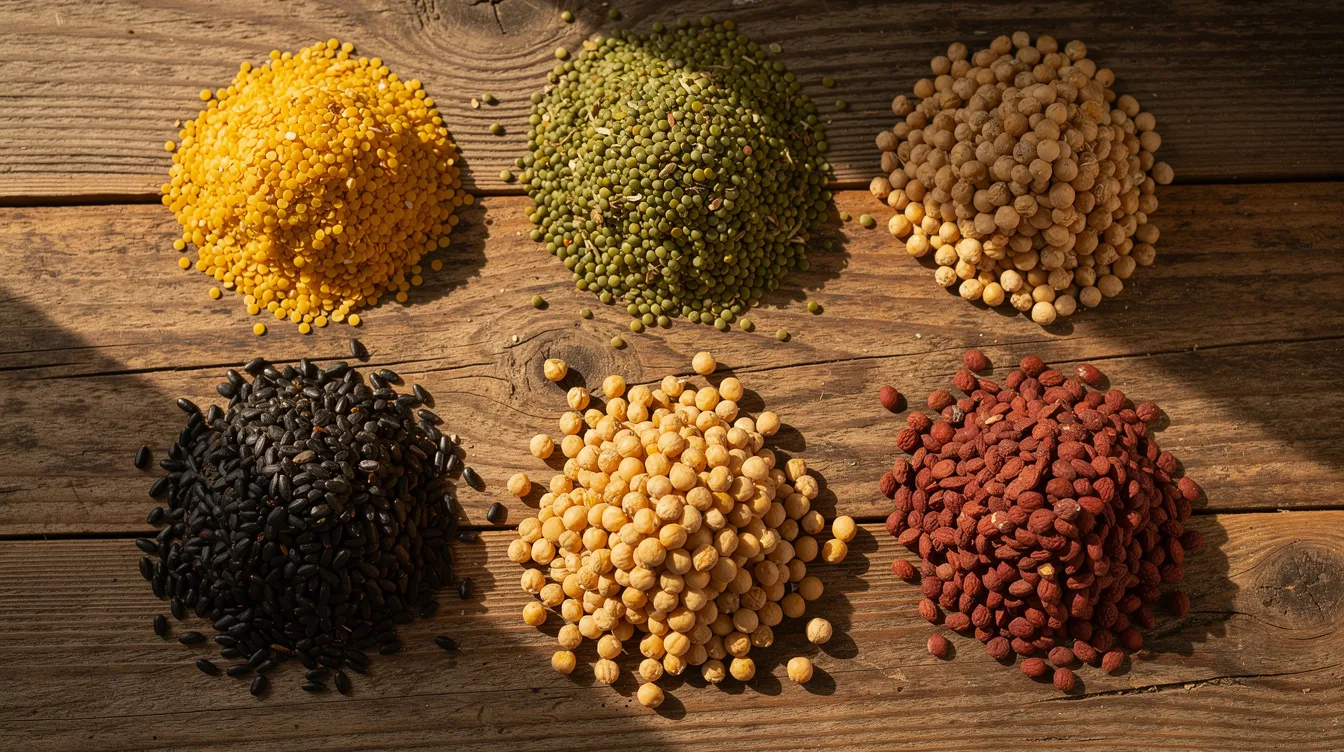
Three core operations define the basic processes in a dal mill: conditioning, dehusking and splitting. Each step serves a distinct purpose, but they are closely interdependent. Failure at any stage cascades into higher losses downstream.
Pulse conditioning is the pre-milling treatment where raw pulses are treated with water, edible oil and mechanical pitting to loosen the bond between the outer husk (seed coat) and the cotyledons. The objective is to weaken this bond without cracking the kernel. Conditioning involves alternate wetting and drying of pulses, and it typically lasts for two to four days depending on the pulse variety and processing technology.
The dal dehusking process in India is primarily emery roller–based or abrasive type. Dehusking uses emery rollers to remove husk from pulses through controlled abrasive force, designed to strip the husk cleanly with minimum brokens and fine powder. Split dal with skin remaining is called chilka, while split dal without skin is called dhuli or mogar. Whole pulses like urad gota are unprocessed seeds that retain the husk.
The pulse splitting process involves gentle breaking of dehusked pulses along the natural crease line into two equal halves, producing clean splits with minimal fines. Dal is primarily made from dehusked split pulses.
| Parameter | Conditioning | Dehusking | Splitting |
|---|---|---|---|
| Objective | Loosen husk from cotyledon | Remove husk with minimum damage | Separate cotyledons into equal halves |
| Main Machines | Pitting rollers, mixing drums, tempering bins | Emery roller dehusker, aspirators | Impact splitters, reciprocating splitters |
| Key Control Parameters | Moisture content, oil dosage, tempering time | Roller speed, clearance, feed rate, emery condition | Impact force, moisture before splitting, feed uniformity |
| Typical Output | Conditioned pulses ready for dehusking | Dehusked whole grains (gota), husk, fines | Split dal, brokens, unsplit gota, powder |
| Common Problems | Uneven moisture, over/under conditioning | Excessive powder, incomplete husk removal | High brokens, unsplit grains, crushed dal |
Complete Pulse Conditioning and Dehusking Process Flow
The whole process of converting raw pulses into finished dehusked and split pulses follows a defined sequence in commercial dal mills. Each stage directly affects final recovery.
Stage-by-stage flow:
- Raw pulse receiving and moisture testing
- Cleaning and grading to remove foreign material and damaged grains
- Destoning to separate stones and heavy impurities
- Size grading to ensure uniform kernel size for consistent processing
- Pitting and surface treatment using an emery roller machine to create scratches in the husk for easier removal
- Oil smearing where applicable (a small quantity of linseed oil or other edible oil)
- Water addition and mixing for moisture adjustment
- Tempering in bins for 8–12 hours or overnight
- Drying to target moisture content of about 10–12%
- Dehusking via emery rollers in multiple passes
- Aspiration to separate husk and dust
- Splitting of dehusked gota into dal
- Separation and reprocessing of unsplit and partially dehusked grains
- Final grading of dal versus brokens versus gota
- Optional polishing to improve visual appeal and market value
- Packaging
The actual sequence and number of passes may change with pulse variety. Bengal gram requires fewer conditioning cycles than pigeon pea. Installed milling technology also dictates the flow. For a broader overview of the overall process, readers may refer to the detailed dal milling process and flow chart.
Simplified flow diagram:
Raw Pulses → Cleaning → Destoning → Grading → Pitting → Oil/Water Conditioning → Tempering → Drying → Dehusking (multiple passes) → Aspiration → Splitting → Grading → Polishing (optional) → Packaging
Unprocessed and partially processed streams are recirculated back to dehusking or splitting stages as needed.
Pulse Conditioning Methods Used in Commercial Dal Mills
Different pulses require different conditioning approaches. Dal mills use combinations of dry, wet, oil and semi-wet conditioning depending on pulse type and market requirements.
Dry conditioning relies on minimal moisture addition. Pitting and repeated operations through mild dehusking rollers gradually narrows the husk attachment. This dry milling method is simpler but typically yields lower recovery, often in the range of 65% to 75%.
Water conditioning involves spraying or mixing raw pulses with controlled quantities of water, usually 2.5–3.5 kg per 100 kg of raw pulses, followed by tempering and partial sun drying. This common processing method is widely used across different pulses.
Oil-assisted conditioning is especially important for difficult pulses like pigeon pea. A small quantity of linseed oil or other edible oil, typically 1.5–2.5 kg per tonne (0.15–0.25%), is applied after pitting. Linseed oil is used during conditioning to enhance appeal and to help in loosening of husk by penetrating between husk and cotyledon. Oil treatment followed by water addition and tempering is a traditional method widely practised in Indian dal mills.
Wet milling processes involve soaking or treating pulses with red earth or water for extended periods. Wet milling can give good colour retention but is heavily weather dependent due to reliance on sun drying, and requires large drying yards.
Mechanical pitting using emery roller machines scratches the husk surface, creating micro-cracks that allow water or oil to penetrate. The clearance between rollers is set wide initially and gradually narrows across successive passes. Pitting creates scratches in the husk for easier removal and is a critical enabler for all conditioning methods.
| Method | Best Suited For | Capital Cost | Process Time | Effect on Dal Recovery | Typical Scale |
|---|---|---|---|---|---|
| Dry milling | Chana, field pea | Low | Short | Moderate (65–75%) | Small to medium |
| Water conditioning | Most pulses | Low–Medium | 2–4 days | Good (72–80%) | All scales |
| Oil + water conditioning | Toor, Arhar, black gram | Medium | 2–4 days | High (75–85%) | Medium to large |
| Wet/semi-wet soaking | Green gram, Urad | Medium | 1–3 days | Good if well managed | Traditional mills |
| Mechanical pitting + any above | All pulse types | Medium | Adds hours | Improves all methods | Medium to large |
Conditioning can involve various methods including water soaking, oil treatment and hydrothermal options. The choice depends on husk characteristics, available infrastructure and target market quality.
Moisture Control and Tempering for Better Dehusking
Moisture content and its uniform distribution between husk and cotyledon is one of the most critical factors in pulse conditioning. Conditioning weakens the bond between the husk and cotyledons, but this happens only when moisture is correctly managed.
Under-conditioned pulses that are too dry tend to shatter under the abrasive force of dehusking rollers, producing more fine powder and brokens. Over-conditioned pulses that are too wet lead to smearing, husk sticking and low dehulling efficiency. Higher moisture content in pulses enhances dehusking efficiency, but only up to a point. Moisture content is adjusted to about 10–12% during conditioning for optimal results.
Tempering is the practice of holding conditioned pulses in bins or bags for a defined period, typically 8–12 hours or overnight, to allow moisture to equilibrate inside the grain before dehusking. For difficult pulses like Toor, the pulses alternate wetting and drying over 2–4 days with repeated tempering cycles to achieve uniform loosening of husk throughout the batch.
Practical issues in moisture control include: variations by incoming lot quality, ambient humidity differences, uneven water addition, inadequate mixing and rushed tempering times.
Moisture monitoring checklist:
- Test moisture at raw pulse receiving using a simple meter
- Add water in controlled, measured quantities and mix thoroughly
- Record tempering start time and target duration for each batch
- Check surface dryness by hand before feeding grains to dehuskers-grains should feel firm and non-sticky
- Verify moisture with a meter after drying and before dehusking
- Adjust tempering duration and drying method based on ambient conditions and pulse variety
Exact moisture percentages and tempering durations vary by pulse variety and technology. The ranges above (10–12% moisture, 8–12 hour tempering) are consistent with established Indian processing literature.
Dal Dehusking Process – Machinery, Operations and Efficiency
The dal mill dehusking and splitting process is where most milling losses and fines tend to originate. Dehusking can produce fine powder if abrasive action is excessive, and traditional dehusking methods can result in higher breakage rates compared to improved systems.
Key dehusking equipment:
- Emery roller dehusker: The primary machine in most Indian dal mills. Pulses pass between an abrasive emery roller and a screen, with the roller machine gradually removing husk through controlled abrasion. The narrowing clearance across multiple passes ensures progressive husk removal.
- Pitting machines: Used before conditioning to create surface scratches on the husk.
- Aspirators and husk separators: Pneumatic systems that remove loosened husk and dust after each dehusking pass.
- Grading sieves and separators: Classify output into dehusked gota, partially dehusked grains and husk/fines.
- Screw conveyor and bucket elevators: Move material between stages.
Feed rate, roller speed, clearance between rollers, emery grit condition, aspiration level and feed moisture all interact to determine dehusking efficiency. For Toor dal, the first pass dehusking rate is typically only about 40–50%; tail pulses must be reprocessed through additional machine passes.
A hand-operated pulse dehusking machine yields 75–80% dal under careful operation. Burr grinders and burr mills can process pulses at 72 kg per hour. However, commercial plants rely on powered emery roller machines for throughput and consistency.
Multiple light dehusking passes instead of a single aggressive operation reduce powder generation. To obtain complete dehusking with minimal damage, operators should avoid overloading and should maintain emery surfaces with periodic replacement or re-coating, alignment checks and lubrication.
Pulse Splitting Process and Broken Dal Reduction
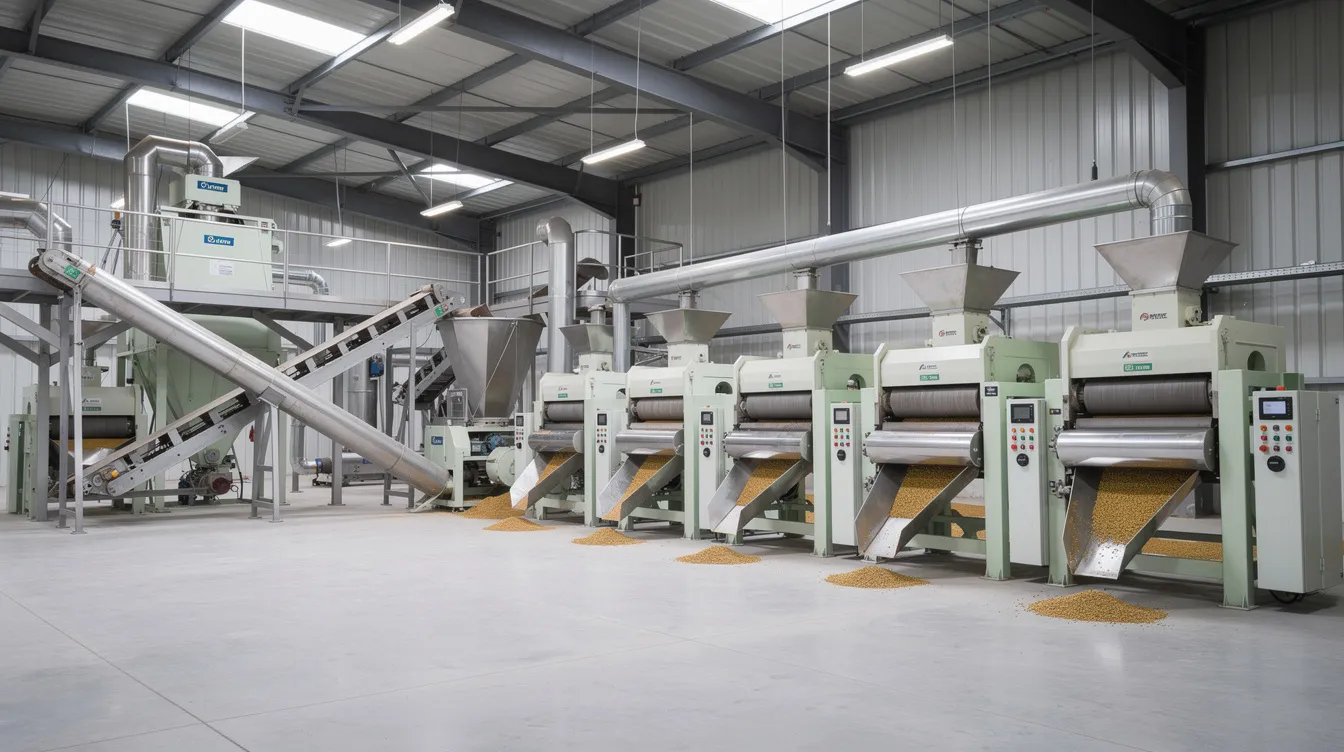
After dehusking, fully or partially dehusked pulses are routed to splitting machines to separate the two cotyledons into two equal halves. This subsequent splitting step determines the proportion of marketable whole splits versus brokens and powder.
Key splitter machines include impact splitters, reciprocating splitters and centrifugal shellers. Centrifugal shellers split pigeon pea at 2100 rpm, delivering controlled impact rather than crushing. The result of repeated operations through aggressive splitters is excessive brokens and powder rather than clean dal.
Causes of unsplit pulses (gota), brokens and excessive powder include incorrect moisture before splitting, mixed grain sizes in the feed, over-speed settings, improper feed distribution and rough material handling across the line.
Practical guidance for reducing broken dal during splitting:
- Ensure moisture is checked before feeding gota to the splitter
- Grade by size so similarly sized kernels receive similar impact
- Adjust splitter speed and impact settings for each pulse variety
- Limit reprocessing cycles to avoid cumulative mechanical damage
- Use belt or bucket elevators rather than screw conveyor where possible to minimise fall damage
- Balance throughput against quality-faster is not always better
Success in reducing broken dal during splitting depends heavily on upstream conditioning quality. A well-conditioned, uniformly moistened grain splits cleanly with minimal force. Proper conditioning helps preserve whole and split kernels during milling and minimises grain breakage during dehusking and splitting.
Pulse-Wise Conditioning and Dehusking Requirements
Each major Indian pulse has distinct husk characteristics and millability. One universal process cannot work for all different pulses. The major variation lies in husk adhesion, gum content and sensitivity to moisture.
Toor/Arhar Dal (pigeon pea): This pulse has a tight husk with high gum content between husk and cotyledon. It requires combined oil plus water conditioning and repeated pitting–conditioning–dehusking cycles. Recovery in well-operated mills reaches 70–75%, but high fines result from over-processing. Detailed planning assumptions for this pulse are covered in the Toor Dal Mill Project Report.
Moong Dal (green gram): Moong has a thin, fragile husk with risk of skin slippage. Over-wetting causes black spot formation and discolouration. Conditioning needs gentle moisture control with minimal oil. Recovery is moderate but colour and appearance are critical for market value.
Urad Dal (black gram): Urad has very strong husk adhesion. The dehusking process requires suitable pitting and semi-wet processes. Products include both whole dehusked urad gota and split urad dal. Processing details are available in the Urad Dal Mill Project Report.
Chana Dal (Bengal gram): This pulse has been extensively studied in pulse milling. It is easier to dehusk, with less gum content. Conditioning options include oil plus water or simple water treatment. Dal yield is among the highest, typically 78–85%. Chana dal is also the base material for besan (gram flour) manufacturing.
Masoor Dal: Masoor has relatively easier dehusking compared to Toor or Urad, but it is colour sensitive. Gentle handling is essential to preserve appearance and market value. Removing the husk improves cooking quality and reduces cooking time for consumers.
| Pulse | Husk Nature | Typical Conditioning | Dehusking Difficulty | Main Concern | Recovery Sensitivity |
|---|---|---|---|---|---|
| Toor/Arhar | Tight, gummy | Oil + water + pitting | High | Fines and powder | Very high |
| Moong | Thin, fragile | Gentle water, minimal oil | Moderate | Colour and skin damage | Moderate |
| Urad | Strong adhesion | Semi-wet, pitting | High | Husk sticking, gota quality | High |
| Chana | Moderate, less gum | Water or oil + water | Low–Moderate | Colour, appearance | Moderate |
| Masoor | Relatively easy | Mild water conditioning | Low | Colour preservation | Low–Moderate |
Pulses grown in different regions and seasons also show variation in husk characteristics, so operators should test and adjust conditioning for each lot of clean pulses received.
How to Improve Dal Recovery Percentage
Dal mill recovery improvement depends on optimising every step from raw pulse procurement to final packing. No single operation in isolation delivers the result. The improvement comes from disciplined control across the entire line.
Raw material quality: Start with grade I pulses of uniform size and low proportion of damaged grains. Systematic cleaning and grading before conditioning reduces downstream problems. Better raw pulses directly support higher dehulling efficiency.
Conditioning improvement: Consistent oil and water dosing, adequate mixing, recorded tempering times, and checking sample grains before feeding to the dehusker are all process-based improvements. Conditioning improves dehusking efficiency and reduces losses. Conditioning and dehusking operations significantly impact the nutritional profile of pulses and dietary fibre content, which also affects market value for health-conscious consumers.
Dehusking optimisation: Controlled feed rate, correct roller clearance, timely replacement of emery, proper aspiration and avoiding overloading are essential. Avoid unnecessary additional passes that generate powder without improving husk removal.
Splitting optimisation: Ensure uniform moisture before splitting, proper size classification, correct impact settings and limited re-circulation of gota.
Material handling: Minimise fall heights, avoid prolonged open storage after conditioning and keep processing areas clean.
Daily/weekly/monthly checklist:
- Daily: moisture testing, visual inspection of dehusker output, recording batch-wise broken percentage and powder levels
- Weekly: emery roller condition check, aspiration system cleaning, splitter calibration review
- Monthly: full machine maintenance, recovery trend analysis, process parameter review
Troubleshooting table:
| Problem | Likely Cause | Corrective Action |
|---|---|---|
| Low overall recovery | Poor conditioning uniformity, wrong moisture | Review water/oil dosage, extend tempering, test moisture before dehusking |
| High powder/fines | Over-dry pulses or worn emery | Check drying method, replace emery, reduce roller speed |
| High unsplit percentage | Insufficient moisture in gota, gentle splitter setting | Condition gota separately before splitting, adjust impact force |
| Inconsistent batch results | Lot-to-lot variation, ambient humidity changes | Test each incoming lot, adjust conditioning per lot, record parameters |
| Husk sticking after dehusking | Over-wet conditioning, insufficient drying | Extend sun drying or mechanical drying, reduce water addition |
| Machine choking/overloading | Excessive feed rate, sticky grains | Reduce feed, ensure surface dryness, check roller clearance |
Understanding Dal Recovery, Broken Percentage and Milling Losses
Clear definitions help operators and investors understand what recovery figures actually mean.
- Total dal recovery % = (Weight of all dal output ÷ Weight of raw pulse input) × 100
- Marketable dal recovery % = (Weight of split + whole dehusked dal ÷ Weight of raw pulse input) × 100
- Broken percentage % = (Weight of broken dal ÷ Weight of total dal output) × 100
- Husk + by-product % = (Weight of husk + powder + fines ÷ Weight of raw pulse input) × 100
Dehusking efficiency is a separate technical measure of husk removal completeness and is not the same as overall dal recovery. It depends on both conditioning quality and machine operation.
Illustrative mass balance for 1,000 kg of raw pulses (Toor dal, commercial mill):
| Output Category | Quantity (kg) | % of Input |
|---|---|---|
| Saleable split dal | 700 | 70.0% |
| Broken dal | 50 | 5.0% |
| Dehusked whole (gota, reprocessed) | 20 | 2.0% |
| Husk | 100 | 10.0% |
| Powder/fines | 50 | 5.0% |
| Moisture and process loss | 80 | 8.0% |
| Total | 1,000 | 100% |
Small changes matter. Reducing fines by just 0.5–1% or converting a portion of brokens into marketable splits can add up to several tonnes of additional milled dal across an entire season. Pulse flour and snack food manufacturers sometimes purchase brokens and fines, but at significantly lower realisations. For deeper calculations, readers may refer to the detailed article on dal mill recovery ratio, yield, broken percentage and losses.
Impact of Recovery Improvement on Dal Mill Profitability
In dal milling projects, improvement in saleable dal recovery is equivalent to increasing production without increasing raw material input. This directly affects contribution margin.
Illustrative comparison for a 10 TPD dal mill:
| Parameter | At 72% Recovery | At 78% Recovery | At 80% Recovery |
|---|---|---|---|
| Raw pulse input (kg/day) | 10,000 | 10,000 | 10,000 |
| Saleable dal output (kg/day) | 7,200 | 7,800 | 8,000 |
| Additional dal vs 72% base (kg/day) | – | 600 | 800 |
| Additional dal per year (300 working days, tonnes) | – | 180 | 240 |
These are illustrative assumptions. Actual recovery depends on pulse variety, conditioning method, machinery and operating practices.
For a 5 TPD plant, the same 6-percentage-point improvement yields 90 additional tonnes per year. For a 20 TPD plant, it yields 360 tonnes. At prevailing dal selling prices, the revenue impact is substantial.
Higher recovery also reduces working capital per quintal of output, improves operating cost efficiency and strengthens both ROI and IRR for the project. The effect on DSCR is particularly important for bank-financed projects, where even a small shortfall in recovery can create repayment stress.
However, aggressive over-processing to chase higher splits may increase energy, labour or maintenance costs and reduce product quality. Economic optimisation must balance yield, cost and quality.
Entrepreneurs planning new dal mills or evaluating capacity expansion should note that Project Report Bank, under CA Manish Gugliya, prepares customised DPRs, financial projections and sensitivity analyses that realistically model recovery assumptions, milling losses, DSCR and bank loan viability for dal mill investors. The analysis covers capacity utilisation, dal mill capacity planning and working capital requirements specific to each pulse type.
Common Problems in Dal Conditioning and Dehusking
Inconsistent conditioning results and fluctuating dal recovery are common complaints in traditional mills and even in some modern operations. Most problems trace back to a few root causes.
| Problem | Probable Cause | Effect on Dal Recovery | Recommended Corrective Action |
|---|---|---|---|
| Incomplete husk removal | Insufficient pitting, poor oil/water penetration, short tempering | Unsplit gota recirculates, reducing throughput and increasing losses | Increase pitting passes, verify oil/water dosage, extend tempering |
| Excessive broken dal | Over-dry grains, narrow roller gap, worn emery | Direct reduction in saleable dal; brokens sell at discount | Check moisture before dehusking, widen gap, replace emery surface |
| High powder/fines generation | Brittle grains, aggressive single operation, high speed | Powder is lowest value output; raises total milling loss | Use multiple light passes, moderate roller speed, maintain target moisture |
| Over-dried grains | Excessive sun drying, uncontrolled mechanical drying | Cotyledons shatter easily, high fines | Monitor drying time, use moisture meters, aim for 10–12% MC |
| Patchy/uneven conditioning | Poor mixing, inconsistent water addition, rushed process | Some grains over-conditioned, others under-conditioned | Use mixing drums, measure water, ensure uniform batch treatment |
| Machine overloading | Excessive feed rate to dehusker | Crushing rather than clean husk removal | Reduce feed rate, use gravity feeders, monitor output quality |
| High unsplit gota after splitting | Gota not separately conditioned, low impact | Gota must be reprocessed, adding cost and time | Condition gota with light moisture before splitting, adjust impact |
Record-keeping is essential. Maintaining batch-wise records of moisture, conditioning time, machine settings and output quality enables operators to diagnose and prevent repetitive issues.
Modern Technology and Automation for Dal Recovery Improvement
Modern dal milling technology can support better process control, but each investment should be assessed for capital cost versus actual recovery benefit, especially for MSME-scale plants.
Useful automation includes online or handheld moisture meters for real-time measurement, programmable conditioning systems with controlled water dosing, level sensors on tempering bins and automated feed rate controllers on dehusking rollers. These tools help standardise the process and reduce dependence on operator judgement alone.
Integrated dehusking lines with synchronised feeders, aspiration and grading reduce manual handling errors. Advanced grading, separation and optical sorting systems help maintain consistent quality, especially for export-grade dehusked pulses.
Real-time data logging of inputs, outputs, power consumption and recovery by batch enables management to monitor yield performance and identify problems early. According to industry case studies, AI-optimised dal mills have improved recovery from approximately 71% to 79% for Toor dal through dynamic moisture control and feed rate adjustment. Digital project financing enhances the recovery of commercially viable pulses by enabling better process decisions.
However, automation does not guarantee higher dal milling efficiency on its own. Success still depends on correct process parameters, skilled operators and regular maintenance. The selection between fully automatic and semi-automatic dal mill layouts affects conditioning and dehusking control and should be evaluated carefully in the project planning stage.
Conditioning and Recovery Planning in a Dal Mill DPR
Bankable Detailed Project Reports for dal mills must explicitly state realistic recovery assumptions for each major pulse rather than using generic percentages. Pulse milling involves cleaning, pitting, oil treatment and conditioning, and each of these steps has a cost and time implication that the DPR should capture.
Key technical–financial linkages that DPRs should address include: raw material quality and price, expected dal recovery ratios, broken and by-product realisations, processing cost per tonne, power and water requirements and chosen milling technology. There are about 4000 pulse mills in India, many operating with traditional methods and sub-optimal recovery. New entrants should benchmark against realistic industry data rather than theoretical maximums.
Capacity planning for a 5, 10 or 20 TPD dal mill must align with expected working days, capacity utilisation ramps, conditioning cycle times and bottlenecks at dehusking or splitting stages. Post harvest technology improvements and the drying method chosen affect both throughput and quality.
Sensitivity analysis on dal recovery is critical. A 1–2% change in recovery can influence annual profit, DSCR and loan repayment capacity. Unrealistic or over-optimistic recovery assumptions may make a project appear profitable on paper but lead to stress in servicing bank finance once the plant starts operating.
Promoters should consider engaging professional advisory for bank finance DPR and loan proposal preparation and project feasibility study services that incorporate realistic milling assumptions.
Practical Recommendations for Dal Mill Entrepreneurs
The following recommendations address both existing dal mill operators and new project promoters.
Low-cost and process-based improvements:
- Invest in a reliable moisture meter and test every incoming lot of raw pulses before conditioning.
- Standardise oil and water dosages per batch and record them. Avoid approximate pouring.
- Enforce minimum tempering times. Do not rush conditioning during peak season.
- Check emery roller condition weekly. Worn surfaces cause excessive powder, and result in repeated operations without improving husk removal.
- Grade pulses by size before conditioning so that clean pulses of similar dimensions receive uniform treatment.
- Record batch-wise recovery, broken percentage and powder levels. Compare trends monthly.
Capital-intensive improvements:
- Upgrade to modern dehusking lines with synchronised feeding, aspiration and separation for plants processing above 10 TPD.
- Install mechanical dryers to reduce dependence on weather dependent sun drying.
- Add optical sorters for high-value or export-oriented dal operations.
- Consider installing an overhead tank for controlled water dosing rather than manual spraying.
Management and process improvements:
- Train operators on the relationship between moisture, machine settings and recovery. Skill matters as much as machinery.
- Pilot process changes on small batches, measure effects on dal recovery percentage and quality, and only then scale up across the full plant.
- Periodically review process economics-recovery, costs, selling prices-with a financial adviser to ensure the dal mill remains competitive and can sustain its debt service.
For entrepreneurs evaluating new pulse dal mill projects, cluster bean and field pea processing or multi-pulse plants, these principles apply with appropriate pulse-wise adjustments. Polishing can improve the visual appeal and market value of the final product and should be considered for premium or branded dal markets. The milling of pulses for different end uses, including pulse flour for the food processing industry or dal for the vegetarian diet market, may require different quality standards.
Frequently Asked Questions on Pulse Conditioning and Dehusking
The following questions address common practical concerns around the pulse conditioning and dehusking process in Indian dal mills.
What is pulse conditioning and why is it critical for dal milling?
Pulse conditioning is the pre-milling step where raw pulses are treated with oil, water and mechanical pitting to loosen portions of the husk without cracking the cotyledon. Correct conditioning makes the husk brittle and easier to remove, reducing energy use, broken dal and fines during the subsequent dehusking and splitting process. Without proper conditioning, even the best pulse dehusking machine or emery roller will struggle to achieve good dehulling efficiency. Conditioning minimises grain breakage during dehusking and is the single most important factor in achieving consistent dal quality.
How does moisture content practically affect dehusking efficiency?
Moisture influences how tightly the husk adheres to the cotyledon and how the grain responds to impact and abrasion inside the dehusker. Grains that are too dry tend to shatter and produce more powder, while too-wet grains may smear, clog machines and leave the husk only partially removed. Operators should routinely check moisture before and after conditioning with simple meters and adjust tempering time and the drying method so that grains feel firm and non-sticky at the surface.
Can one dal mill line handle multiple pulses like Toor, Chana and Masoor?
Many commercial dal mills in India are designed as multi-pulse processing plants, but changeover requires cleaning, adjustment of conditioning method and fine-tuning of dehusking and splitting settings. Recovery and throughput will differ by pulse type, so project reports should include separate assumptions and operating plans for each major pulse. Dedicated conditioning and binning arrangements for sensitive pulses help maintain quality and reduce downtime.
What simple steps can a small dal mill take to reduce broken dal?
Practical low-cost steps include improving grading, avoiding over-drying, using correct feed rate and roller pressure, limiting reprocessing cycles and checking moisture before splitting. Even without major automation, disciplined SOPs and periodic maintenance of emery rollers and screens can substantially reduce avoidable milling losses in traditional mills. Recording batch-wise broken percentage and comparing over time helps identify where loosen portions of the process need attention.
How does dal recovery link to bank finance, DPRs and project feasibility?
Projected dal recovery percentage directly affects expected sales volume, revenue, gross margin and therefore DSCR, which banks examine before sanctioning term loans for dal milling projects. If a DPR assumes unrealistically high recovery or very low milling losses, cash flows may be overestimated, creating repayment stress once the plant starts operating. This document discusses pulse milling from both a technical and financial perspective. Professional DPR preparation and financial modelling by experts like CA Manish Gugliya at Project Report Bank help promoters use realistic recovery assumptions and assess true project viability before investing.
Conclusion – Improving Recovery Through Better Process Control
Sustainable dal recovery improvement comes from disciplined conditioning, correct moisture management, well-maintained machinery and realistic process assumptions. The pulse conditioning and dehusking process is not merely a mechanical operation-it is the financial engine of a dal mill. Every percentage point of additional recovery translates directly into higher saleable output, better margins and stronger debt-servicing capacity.
Entrepreneurs planning new dal mills, integrated multi-pulse processing plants or capacity expansions are welcome to contact CA Manish Gugliya through WhatsApp at Project Report Bank for customised DPR preparation, financial modelling, CMA Data and project finance advisory based on realistic, pulse-wise recovery assumptions.
CA Manish Gugliya FCA, DISA (ICAI) More than 20 years of professional experience in project reports, financial projections, CMA Data, project finance and business advisory. Website: www.projectreportbank.com