Key Takeaways
- The dal milling process converts raw pulses into cleaned, de husked split pulses through a defined sequence of unit operations: cleaning, destoning, grading, conditioning, dehusking, splitting, polishing, sorting and packaging.
- A well-designed process improves recovery, product quality and operational efficiency across tur, moong, urad, chana, masoor and black gram; dal mill plants can recover 70-86% of head pulses depending on pulse type and conditioning method.
- Different dal mill machine configurations (mini dal mill at 0.5-1 TPH vs commercial mill plant at 5-10 TPH) require different levels of process control, automation and capacity planning.
- Material balance, process losses, dal mill recovery percentages and energy consumption are critical inputs in a bankable Detailed Project Report (DPR); over-optimistic recovery assumptions can mislead project economics.
- Project Report Bank, led by CA Manish Gugliya (FCA, DISA), provides professional DPR preparation, feasibility studies and project finance advisory for dal mill business planning across India.
Introduction – Understanding the Dal Milling Process in India
Pulses supply a large share of daily protein intake across Indian households. Tur, chana, moong, urad, masoor and black gram are processed into dal at over 10,000 milling units spread across the country. The dal milling process is a core agro-processing activity, and its design determines finished dal quality, milling recovery, energy use and profitability.
Dal milling differs from flour grinding or generic cereal grains processing in a fundamental way. Flour milling pulverises the entire grain. Dal milling preserves the two cotyledons by removing the outer layer (husk), splitting the grain into two equal halves and grading the product by size and colour. The basic processes include cleaning, grading, dehusking, and splitting, followed by optional polishing and packaging.
Plant scales in India range from a mini dal mill handling 0.5-1 TPH to commercial processing plants rated at 5-10 TPH or higher. As capacity increases, so does the need for mechanical dryers, optical colour sorters, automated packaging and tighter process controls. Process sophistication directly affects finished dal colour, shine, cooking time and overall operational efficiency.
For a promoter planning a dal mill plant, understanding the manufacturing process is not optional. It is the basis for finalising project cost, selecting the right machinery, estimating working capital and preparing a bank finance proposal that a lender can evaluate.
What Is Dal Milling and How Does a Dal Processing Plant Work?
Dal milling is the industrial conversion of raw whole pulses into cleaned, dehusked, split and graded dal suitable for retail sale, institutional supply and export. The primary goal of dal milling is to maximize recovery yield and minimize broken pieces and powder losses. Dal milling involves converting raw pulses into clean split pulses through mechanical and sometimes chemical or thermal treatments.
Key product categories in dal processing:
- Whole pulses: Raw grain with husk intact, as received from farms.
- Dehusked whole pulses (gota): Husk removed but cotyledons not yet split.
- Split pulses (dal): Cotyledons separated into equal halves; the primary market product.
- Broken dal: Smaller fragments produced during splitting; sold at lower value.
- By-products: Husk, powder/fines, cleaning waste; used as cattle feed or fuel.
A dal processing plant typically operates in continuous flow: raw pulse feeding, cleaning, conditioning (where applicable), dehusking, splitting, grading, optional polishing, colour sorting and packing. Raw material factors such as variety (for example, Desi vs Kabuli chana), grain size, hardness and initial moisture directly influence machine settings and process sequence. Modern dal mill plants use conveyors, bucket elevators, screw conveyor systems and PLC-based controls to reduce manual handling and improve consistent quality across shifts.
Dal Mill Process Flow Chart – From Raw Pulses to Finished Dal
The following flow diagram translates the dal milling process into a stepwise sequence suitable for industrial planning and for inclusion as an attachment in a DPR. A clear dal mill process flow chart helps bankers, investors and plant engineers visualise the complete dal mill plant workflow.
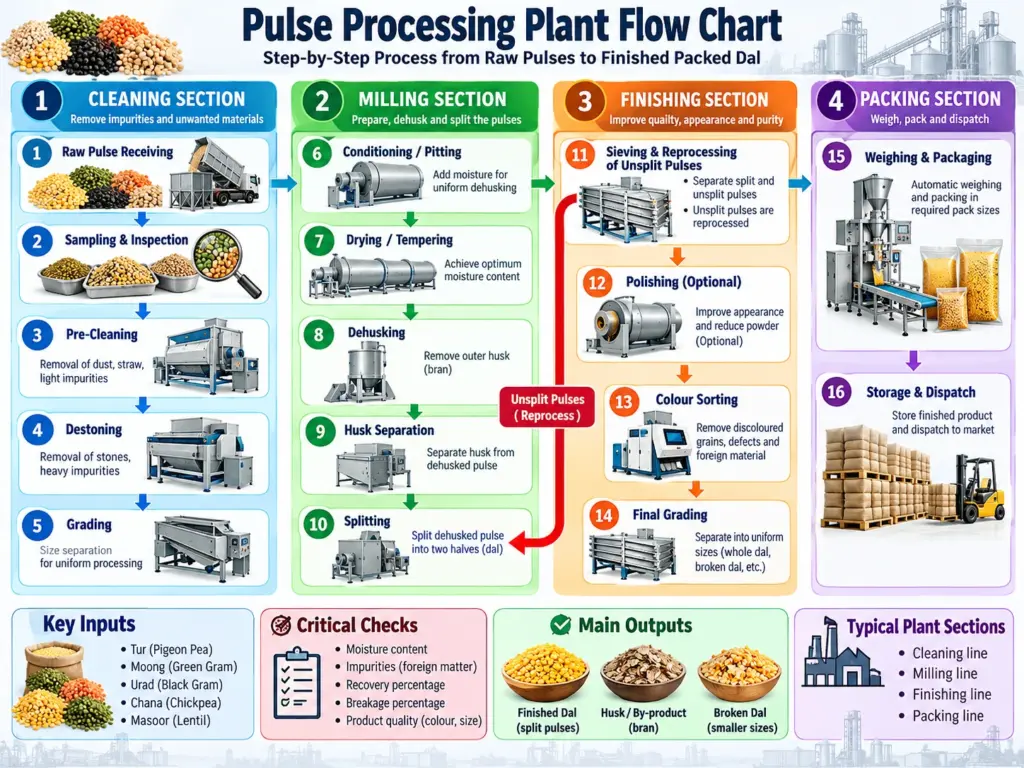
Raw Pulse Receiving → Sampling & Inspection → Pre-Cleaning → Destoning → Grading → Conditioning / Pitting (where applicable) → Tempering / Drying → Dehusking → Husk Separation & Aspiration → Splitting → Sieving & Grading → Reprocessing of Unsplit Pulses → Optional Polishing → Colour Sorting & Final Inspection → Weighing → Packaging → Storage & Dispatch
- The exact sequence and number of passes vary for different pulses (tur, moong, urad, chana, masoor) and for dry milling operation versus conditioned (wet) milling.
- For difficult-to-mill pulses like tur and urad dal, additional conditioning-drying cycles and multiple dehusking passes are common; for chana and masoor, fewer passes typically suffice.
Step-by-Step Dal Milling Manufacturing Process
This section explains the dal milling process step by step, aligned with the practical operation of a commercial dal mill. Each step is covered under a separate subheading, with focus on purpose, machinery, key operating parameters, common problems and impact on yield and quality. The description applies to both medium-scale dal milling units and larger automatic dal mill plants, with variation in automation level.
Step 1 – Raw Pulse Receiving and Inspection
Raw pulses arrive in jute or PP bags (typically 50-100 kg) or in bulk via trucks. They are unloaded, weighed on a platform scale or weighbridge and logged batch-wise with supplier details, lot IDs and arrival date.
Sampling and inspection follow immediately. Operators check moisture percentage using a digital moisture meter, examine foreign matter content, insect damage, discoloured grains and variety purity. FSSAI procurement specifications require maximum moisture of 14% for most split pulses (16% for chana dal) and foreign matter below 1%. Quality raw materials directly impact the final product’s quality; accepting a poor lot means fighting quality problems at every downstream stage.
Good receiving practices and lot-wise quality documentation directly influence process stability. If moisture or impurity levels vary between lots without documentation, the conditioning and dehusking stages cannot be properly adjusted, leading to inconsistent finished dal.
Step 2 – Pre-Cleaning, Destoning and Grading
The dal mill cleaning process uses vibro pre-cleaners, rotary screen cleaners, aspiration channels and magnetic separators in sequence. Cleaning removes impurities from raw pulses using air-screens, magnets, and destoners. The cleaning process separates grains based on size and impurities, isolating oversize debris, light matter (straw, chaff) and metallic contaminants.
Destoning uses a gravity selector (destoner) to separate stones, mud balls and heavier impurities. This step is essential both for food safety and for protecting downstream machinery from abrasive damage.
Grading operations use a vibratory inclined sieve and multi-deck graders to separate oversize, undersize and the main fraction by grain size. Grading sorts cleaned pulses by size to ensure uniform processing in later stages; mixed sizes cause uneven dehusking because smaller grains pass through roller gaps without adequate friction. Common issues at this stage include high dust load slowing throughput, improper air adjustment in aspirators, and overloaded screens reducing separation accuracy.
Step 3 – Pulse Conditioning and Pitting
Conditioning is the controlled application of water and/or edible oil to loosen the bond between husk and cotyledon. Moisture conditioning helps loosen the bond between the husk and the cotyledon to reduce breakage during milling. For tur and chana, a typical process involves adding 2.5-3.5 kg water per 100 kg of pulses, followed by tempering (resting) overnight. For urad and black gram, studies show that oil treatment at 0.4-0.8% by weight combined with drying at approximately 90°C produces dehusking rates around 85.25%.
Linseed oil is used at 1.5 to 2.5 kg per ton of pulses for subsequent oil penetration into scratched or pitted material. Pitting uses an emery roller machine that scratches or cracks the outer husk to facilitate de husking, a traditional practice applied to tur and chana. Clean pulses passing through the pitting machine emerge with micro-cracks that allow oil or moisture to reach the gum layer binding husk to cotyledon.
Conditioning recipes (time, moisture addition, oil dosage) differ for different pulses and must be optimised through plant-specific trials, not copied from another mill. Over-conditioning causes excessive brokens; under-conditioning leaves husk tightly bound, reducing dehusking efficiency and darkening the final dal colour.
Step 4 – Drying and Moisture Control
After conditioning and tempering, conditioned pulses must be dried to the target moisture range before dehusking. Sun drying is still common in smaller mills, typically requiring 2-3 days. Mechanical dryers (recirculating hot-air type) reduce this drying method to 2-3 hours but require fuel or electricity.
Moisture management is crucial before dehusking to prevent high breakage rates in dal milling. Excess moisture can cause clogging and insufficient moisture can lead to brittleness in grains. The target moisture before dehusking is typically 10-12% for most pulses, though exact values vary by variety and technology.
Key operating variables include moisture uniformity across the grain bed, drying time, bed depth and air temperature. Common problems include uneven drying (producing a mix of hard and soft grains in the same batch), condensation in storage bins after drying, and weight loss from excessive drying. Each of these reduces recovery and increases brokens.
Step 5 – Dehusking
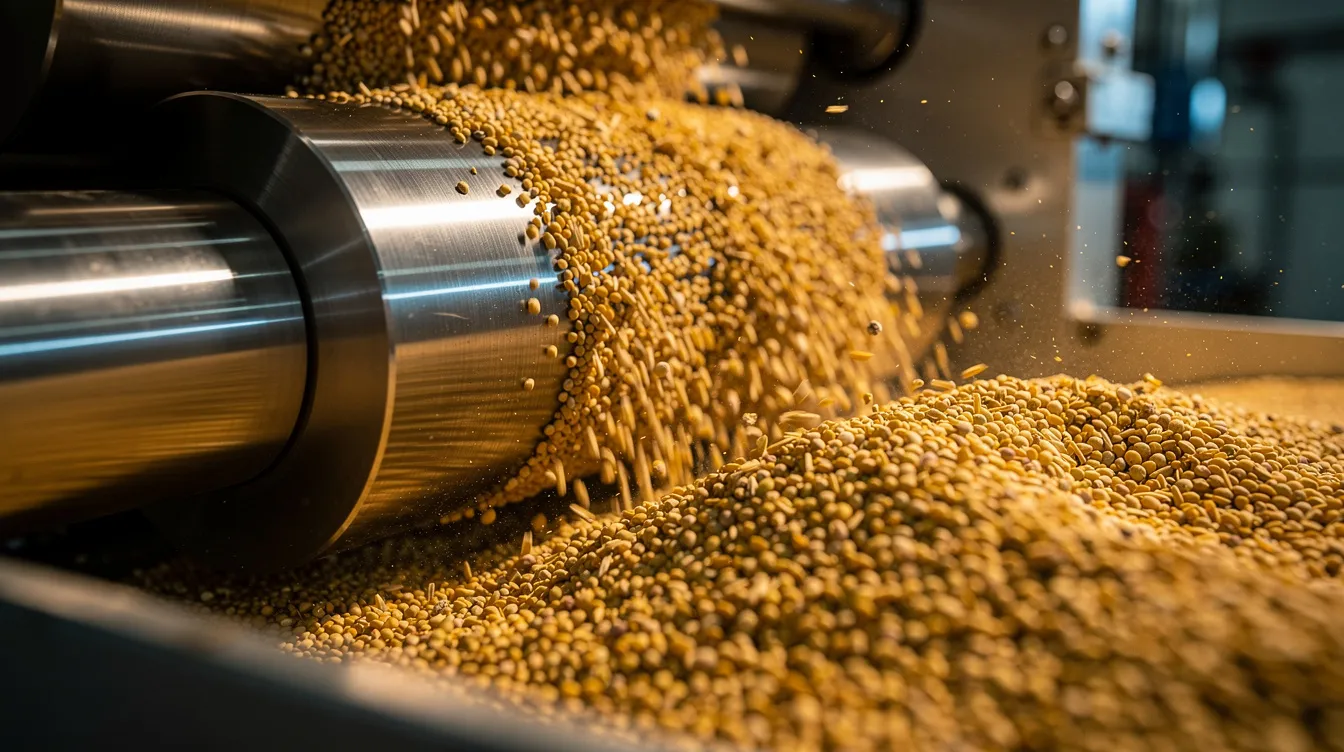
Dehusking is the removal of the outer husk from conditioned grains using abrasive machines, primarily emery roller dehuskers. Dehusking involves removing the outer husk from conditioned grains using abrasive machines. Pulses pass between emery-coated surfaces and perforated cages; friction detaches husk from cotyledons while the perforations allow loosened husk to exit.
De-husking achieves 50-75% efficiency in a single pass. Emery rollers achieve 50-75% de husking in one pass, meaning that difficult pulses like tur and urad require 3 or more passes. Proper machine settings are necessary to effectively remove husks without damaging the cotyledons. Critical adjustments include roller speed, feed rate, clearance between roller and cage, and emery grade (abrasiveness).
Multi-pass milling can enhance recovery and minimize breakage by separating products after each pass. Each pass produces a mixture of dehusked grains, partially dehusked grains, husk and some brokens, which are separated and reprocessed. Symptoms of poor dehusking include a high percentage of husky kernels, burnt grain surfaces due to overheating from excessive friction, and an uncontrolled mix of whole and split grains.
Step 6 – Husk Separation and Aspiration
After each dehusking pass, aspiration systems use airflow to lift and remove light husk and dust from the heavier product stream. Husk separation uses airflow and sieves to separate light husk and fine particles from split dal. Cyclone separators, airlocks and dust collectors handle the separated husk and prevent dust from polluting the mill plant environment.
Husk and fine powder are by-products with commercial value as cattle feed ingredients or boiler fuel; their separate collection affects project revenue streams. Incorrect air settings can either retain husk in the product (contaminating the dal) or carry away valuable small grains with the husk, reducing recovery.
Step 7 – Dal Splitting
Once husk is sufficiently loosened or removed, pulses are split along the natural seam into two cotyledons using under-runner disc shellers or impact-type splitters. The splitting mixture discharged from these machines contains split dal, unsplit kernels (gota), broken pieces and residual husk.
Unsplit conditioned pulses (gota) are separated using vibratory sieves and recycled back through dehusking and splitting stages in a closed loop to maximise recovery. Common problems in dal milling include excessive broken dal and husk remaining on grains; careful adjustment of splitter gap, feed rate and motor driven shaft speed can improve head dal percentage.
Step 8 – Polishing and Finishing
Polishing is an optional step in dal milling that improves surface appearance and storage life of the dal. Polishing enhances the visual appeal using leather, nylon or rubber roll polishers and brushes that smooth the split surface.
Commercial reasons for polishing include perceived quality and higher market prices for shiny tur and chana dal. At the same time, some buyers, especially institutional or export, specify limits on added oil or polishing agents for food safety reasons. Controlling friction and residence time is critical to avoid overheating, colour darkening and nutrient loss during the dal polishing process.
Step 9 – Grading and Colour Sorting
Mechanical size grading uses multi-deck graders and vibratory sieves to separate whole dal (head pulses), broken dal, fine brokens and powder into distinct fractions. Dal undergoes a meticulous quality inspection post-polishing to confirm uniformity.
Automatic optical colour sorters detect and reject discoloured, immature or spotted grains using cameras and ejector valves. Colour sorting improves uniform appearance and reduces contamination; it is becoming standard in modern dal milling lines above 2-3 TPH. Accurate grading enables separate sale of different fractions (head dal at premium, brokens at lower price, powder as feed), directly affecting revenue calculations in project reports.
Step 10 – Weighing, Packaging and Dispatch
Final weighing uses electronic weighers, bagging machines and check-weighers. Milled dal is packed in 25 kg or 50 kg PP woven bags for bulk trade and in 1 kg, 5 kg or 10 kg laminated pouches for the domestic market retail segment.
Batch coding, labelling with FSSAI licence number, net weight, date of packing and traceability records are maintained for each production lot. Good storage practices include palletisation, adequate ventilation, pest control and FIFO (First In First Out) dispatch to preserve quality.
Machinery Used at Different Stages of Dal Processing
Correct selection and balancing of dal mill machine capacities is central to efficient mill plant design. Dal milling machinery includes pre-cleaners, graders, and dryers alongside dehuskers, splitters and sorters. Below is a reference table:
| Processing Stage | Machinery | Main Function |
|---|---|---|
| Pre-cleaning | Vibro cleaner, rotary screen | Removes dust, straw, light foreign matter |
| Destoning | Gravity destoner | Separates stones, mud balls |
| Grading | Vibratory inclined sieve, grader | Separates by grain size |
| Conditioning | Pitting machine, mixing drum | Applies oil/water, scratches husk |
| Drying | Sun yard / mechanical hot-air dryer | Reduces moisture to target level |
| Dehusking | Emery roller machine, abrasive dehusker | Removes husk from cotyledons |
| Aspiration | Aspirator, cyclone separator | Separates husk and dust |
| Splitting | Under-runner disc sheller, impact splitter | Splits grain into two equal halves |
| Polishing | Leather/nylon roll polisher, brush polisher | Smoothens dal surface |
| Colour sorting | Optical colour sorter with ejectors | Rejects discoloured, defective grains |
| Conveying | Bucket elevator, screw conveyor, belt conveyor | Transfers material between stages |
| Packaging | Electronic weigher, bagging machine, sealer | Weighs, packs and seals finished dal |
| Dust control | Dust collector, bag filter | Controls airborne dust in plant |
Auxiliary equipment like storage bins, cam operated link mechanisms in feeders and electric voltage stabilisers integrate the line into a single operational system. For detailed price ranges and configuration options per capacity, refer to the guide on dal mill machinery and equipment cost. Machinery choice must be aligned with intended capacity (TPH), product mix and automation level when preparing a DPR.
Dal Milling Process for Different Pulse Varieties
While the generic dal milling steps are similar, tur, moong, urad, chana and masoor behave differently due to husk adhesion, grain size and internal structure. The dal milling process can utilize both wet and dry methods depending on the type of pulses. The following table summarises major variation points:
| Pulse | Husk Character | Oil/Water Conditioning | Typical Passes | Special Care |
|---|---|---|---|---|
| Tur (pigeon peas / toor dal) | Tight, gum-bound | Required; pulses alternate wetting and drying over 2-4 days | 3+ | Colour sensitive; avoid overheating |
| Moong (mung beans) | Medium adhesion | Minimal to moderate | 2-3 | Green colour retention; breakage sensitive |
| Urad dal (black gram) | Tight | Oil + heat at ~90°C | 3+ | High powder loss risk (~7%) |
| Chana | Medium-tight (Desi); loose (Kabuli) | Oil treatment common | 1-2 (Kabuli), 2-3 (Desi) | Grain legumes with size variation |
| Masoor | Loose, thin husk | Minimal or dry milling | 1-2 | Easy to mill; colour grading important |
In an integrated multi-pulse processing plant, cleaning between batches, preventing cross-contamination and adjusting machine settings for each pulse are operational challenges. A dedicated integrated multi-pulse processing plant project report can help entrepreneurs design multi-product plants with appropriate changeover planning. Separately, promoters focused on single-pulse operations can refer to a tur dal mill project report for variety-specific process and financial benchmarks.
Dry Dal Milling vs Conditioned Dal Milling
In India, both dry milling (minimal pre-treatment) and conditioned milling (with water, oil and tempering) are used depending on pulse type and market requirements.
Dry milling:
- Simpler equipment; lower processing time; lower energy consumption
- Works well for easy-to-mill pulses like masoor and Kabuli chana
- Limitation: lower recovery in tight-husk pulses (e.g., tur UPAS 120 study shows ~71% head dal recovery untreated vs ~75% with water conditioning); more brokens and dull finish
Conditioned milling:
- Higher dehusking efficiency; better appearance for tur and chana; higher head dal recovery
- Requires pitting, oil/water application, tempering (6-12 hours or overnight) and controlled drying
- Limitation: more complex moisture control, longer cycle, additional energy cost, possible food safety scrutiny for oil use
Selection between dry and conditioned milling should be based on target pulses, desired quality, energy cost and local climatic conditions, ideally assessed through a feasibility study before equipment procurement. Neither method is universally superior; efficient performance depends on matching the process to the pulse.
Dal Milling Recovery Percentage, Yield and Processing Losses
Dal recovery percentage is the ratio of finished head dal output to raw pulse input. Dal recovery rates ideally target 75% to 80% to minimize loss into broken pieces and powder. This metric drives profitability assumptions in every DPR.
Main output streams in a typical mass balance:
- Head dal (clean splits meeting grade)
- Broken dal (smaller fragments, sold at lower value)
- Husk (5-15% by weight of raw pulse)
- Powder / fines (feed-grade or waste)
- Cleaning and handling losses (stones, foreign matter, dust)
- Moisture loss or gain (net change through conditioning and drying)
Formulas:
- Dal Recovery (%) = (Head Dal Output / Raw Pulse Input) × 100
- Total By-product (%) = (Brokens + Husk + Powder) / Raw Pulse Input × 100
- Processing Loss (%) = 100 – Dal Recovery (%) – Total By-product (%)
Worked example: 1,000 kg raw tur (dry, conditioned milling)
| Component | Weight (kg) | Percentage |
|---|---|---|
| Cleaning losses (stones, foreign matter) | 30 | 3.0% |
| Head dal (clean splits) | 720 | 72.0% |
| Broken dal | 70 | 7.0% |
| Husk | 130 | 13.0% |
| Powder / fines | 30 | 3.0% |
| Moisture and handling loss | 20 | 2.0% |
| Total | 1,000 | 100% |
These figures are illustrative for conditioned tur milling. Easy-to-mill pulses like chana or masoor may yield 80-85% head dal. Realistic, plant-specific recovery assumptions should be built into financial projections. Over-optimistic numbers (claiming 85% recovery from tur without advanced equipment) can mislead project economics, weaken DSCR and create funding gaps.
Dal Mill Capacity Planning and Production Efficiency
Production capacity of dal mills typically ranges from 1.5 to 10 tons per hour. Capacity is expressed as tonnes per hour (TPH) of raw pulse input; annual capacity combines TPH, operating hours per day (commonly 16 hours for two-shift plants) and operating days per year (280-300).
Bottlenecks often arise in cleaning, drying or colour sorting stages. All machines in the line must be capacity-balanced to avoid idle time; an oversized dehusker paired with an undersized dryer creates a production chokepoint.
Example: A 5 TPH line operating 16 hours/day for 280 days processes 22,400 tonnes of raw pulses annually. At 72% recovery, finished dal output is approximately 16,128 tonnes. Accounting for 5% downtime (maintenance, changeovers), effective output drops to around 15,322 tonnes. Dal mill plants require 6,000 to 15,000+ sq. ft. of area depending on capacity and storage needs.
Factors affecting operational efficiency include planned maintenance schedules, skilled operators, power reliability (energy consumption for dal milling ranges from 100 to 250 kW installed depending on plant size), raw material consistency and automation level. In DPR preparation, capacity utilisation ramp-up (for example 60% in year 1, 70-75% in year 2) should be linked to realistic commissioning and market development timelines. The machines should be energy efficient and require low maintenance to keep operating costs manageable, and the plant operates efficiently only when all line equipment is matched in throughput.
Quality Control, Hygiene and Food Safety in Dal Milling
Dal is a staple food; dal mill plants must comply with FSSAI food safety standards throughout the dal milling process. Quality control parameters in dal milling include raw-material quality, moisture content, and dal recovery. Quality checks are essential at every production stage, and quality control ensures compliance with food safety standards.
Key quality control checks:
- Raw pulse grading against procurement specifications
- Moisture testing before and after conditioning (max 14% for finished product)
- Foreign matter monitoring (FSSAI limit ≤1%)
- Infestation and aflatoxin checks (FSSAI limit ≤30 µg/kg)
- Metal detection before packaging
- Monitoring polishing agents and oil usage where applicable
Hygiene practices include routine cleaning of machines, sieves and storage areas; pest control schedules; and preventing cross-contact with allergens or contaminants. Occupational safety measures cover dust extraction systems, machine guarding, safe electrical panels and lock-out/tag-out during maintenance. High-quality pulses improve market reputation and product quality; quality assurance across the process is what separates a reliable brand from a commodity supplier.
Documentation (batch records, cleaning logs, calibration reports) supports traceability and certifications needed if the plant targets institutional or export buyers. These records also form part of industry standards compliance during bank or investor due diligence.
Common Problems in Dal Milling and Their Solutions
| Problem | Probable Cause | Corrective Action |
|---|---|---|
| Excessive broken dal | Incorrect roller clearance; over-dried grains; high feed rate | Adjust clearance; verify moisture before dehusking; reduce feed rate |
| Low dehusking efficiency | Insufficient conditioning; worn emery rollers; wrong emery grade | Extend tempering time; replace rollers; match grade to pulse type |
| High unsplit percentage | Under-conditioned gota; splitter gap too wide; low roller speed | Re-condition and recycle gota; adjust gap and speed |
| Inconsistent finished dal colour | Uneven drying; overheating during dehusking or polishing | Improve dryer uniformity; reduce residence time on polisher |
| High dust in plant | Damaged aspiration ducting; overloaded cyclone separator | Repair ducting; clean cyclone; maintain dust collector bags |
| Moisture variation in packed dal | Inadequate post-drying tempering; mixing lots of different moisture | Temper before packing; segregate lots by moisture level |
| Erratic packing weights | Worn check-weigher sensors; inconsistent bulk density | Calibrate weigher; standardise product density through grading |
Persistent or complex technical issues should be escalated to equipment suppliers or process consultants. Maintenance schedules must account for precision engineering wear items such as emery rollers, screens and bearings. These represent minimal maintenance costs when replaced proactively, but cause extended downtime if neglected.
How the Dal Milling Process Affects Project Cost and Profitability
Process configuration directly influences capital cost (more machines require more building area and electrical infrastructure), operating costs (power, labour, consumables) and product yield.
- Choice of drying system: sun drying has near-zero fuel cost but requires large open yards and adds 2-3 days of cycle time; mechanical dryers need fuel or electricity but reduce cycle to hours.
- Colour sorting equipment adds capital cost but can improve recovery by rejecting defective grains that would otherwise downgrade the entire lot.
- Level of automation in packaging affects labour cost and weight accuracy.
- Separate by-product handling (husk collection, powder bagging) adds equipment but generates additional revenue.
- Higher recovery and better grading improve average selling price; poor process control increases brokens and reduces realisation, weakening cash flow and DSCR.
A bankable DPR must incorporate realistic assumptions on dal milling recovery, energy consumption, labour requirement, spares and maintenance linked to the chosen process and capacity. Conduct market research to understand target market needs and to determine whether high demand in the domestic market justifies the proposed scale. Initial investment for a dal mill can vary based on capacity, process sophistication and level of automation. A detailed business plan is essential for financial assistance from banks or investors.
For a structured assessment of how technology choices translate into total project investment, promoters can review the guide on dal mill plant setup cost in India. Separately, entrepreneurs exploring adjacent pulses processing or cereal grains projects (such as rice milling or besan manufacturing) can refer to the rice mill project report and besan mill project report for comparative reference.
Obtain necessary licenses and certifications for regulatory compliance before commencing commercial production; these include FSSAI registration, Udyam registration, GST, pollution consent and fire NOC.
Frequently Asked Questions About Dal Milling
This FAQ section addresses common practical doubts entrepreneurs have when planning or operating a dal mill plant. Answers here complement the detailed process descriptions above, focusing on project planning and investor-relevant queries.
What additional utilities are required for a commercial dal mill plant?
Beyond machinery, a commercial dal mill plant requires electrical power (typically 100 to 250 kW installed load depending on capacity), water supply for cleaning and conditioning, compressed air for colour sorters and packing machines, and space for hot-air generators where mechanical dryers are used. Dal milling machinery operates with 100 to 250 kW energy. Promoters should plan transformer capacity based on connected load, arrange diesel generator backup (power reliability varies across Indian locations), and provide basic water storage. These utility requirements influence project cost, site layout and operational expenses.
How long does it typically take to commission a new dal milling plant?
Smaller plants (1-2 TPH) can be commissioned within 4-6 months from order placement, including civil work, machinery installation and trial runs. Larger multi-line plants (5-10 TPH) may take 8-12 months depending on building construction, equipment manufacturing lead times and statutory approvals. Promoters should factor a commissioning and stabilisation period of 1-2 months into financial projections, during which capacity utilisation and recovery will be lower than steady-state levels.
Can an existing grain mill be upgraded into a dal mill plant?
Some infrastructure, such as land, building, power connection, grain cleaning equipment and storage silos, can often be reused. However, specialised dal milling machinery (dehuskers, splitters, polishers, sorters) must be added. Procure machinery that matches production capacity and efficiency requirements of the intended pulse types. A structured techno-economic feasibility assessment is advisable to compare upgrading versus setting up a new dedicated dal mill, especially when bank finance is involved.
What documents are needed for bank finance of a dal mill project?
Banks in India typically require a Detailed Project Report, CMA Data, projected financial statements (profit and loss, balance sheet, cash flow), term loan application, KYC documents of promoters, income-tax records, collateral details, and statutory registrations (Udyam, GST, FSSAI for operations stage). Process assumptions in the DPR (capacity, recovery, operating days, selling prices) must be coherent with the proposed dal milling process and machinery list. For professional support, promoters can explore bank finance DPR and loan proposal assistance or refer to the dal mill project report guide for a broader overview of project planning, costs and subsidies.
How can Project Report Bank support entrepreneurs planning a dal milling unit?
Project Report Bank, led by CA Manish Gugliya, prepares customised DPRs, financial projections, feasibility studies and bank finance documentation specifically aligned to the chosen dal milling process and capacity. Entrepreneurs can discuss integrated multi-pulse plants, expansion of existing dal mills or diversification from trading into processing, with advisory covering project economics, risk analysis, high quality output targets and investor readiness.
Planning a Commercial Dal Milling or Integrated Pulse Processing Plant?
A successful dal milling project requires more than machinery selection. Capacity planning, raw material availability, recovery assumptions, investment budgeting, working capital and financial viability must be evaluated together. CA Manish Gugliya provides professional assistance with Detailed Project Reports, feasibility studies, financial projections, CMA Data preparation and bank finance proposals for industrial projects across India. Smooth operations in project planning begin with a credible process design and defensible financial assumptions.
Visit www.projectreportbank.com to discuss your proposed project.