

Key Takeaways
- An integrated value-added rice products processing plant combines multiple product lines – Poha, puffed rice, rice snacks, packaged rice, fortified and organic variants – under one roof, extracting significantly more value per tonne of paddy than conventional rice milling alone.
- A bankable detailed project report for such a plant must cover project cost, machinery, capacity planning, product mix, working capital, financial projections, DSCR, ROI, IRR, payback period and sensitivity analysis, all built on realistic, internally consistent assumptions.
- Operating costs in rice processing are dominated by raw materials (typically 80–85% of total costs), making procurement strategy, inventory planning and by-product utilization critical to margins and cash flow.
- The global rice market is projected to reach USD 384.74 billion by 2034, and India exported basmati rice worth USD 5.84 billion in FY2023-24, creating substantial domestic and international demand for value-added rice products.
- Project Report Bank and CA Manish Gugliya specialize in preparing customized, bank-ready DPRs, CMA Data and financial models for integrated rice processing plants seeking MSME loans, term loans and investor funding.
Introduction: From Commodity Rice to Integrated Value-Added Rice Products
Rice remains a staple food for over half the world’s population. Yet most Indian rice millers continue selling bulk milled rice at thin margins, missing the growing consumer shift towards packaged rice, ready-to-cook rice products, health foods like fortified and organic rice, and convenience snacks. The rice sector is at an inflection point where value addition – not volume alone – determines profitability.
An integrated value-added rice products processing plant addresses this gap. Instead of operating a single rice milling line, such a facility combines multiple compatible processing lines – Poha (flattened rice), puffed rice (murmura), rice-based snacks, premium packaged rice, fortified rice and even baby food bases – within one coordinated plant. These lines share common raw materials, utilities, warehousing and packaging infrastructure, creating operational efficiencies that standalone units cannot match.
Preparing an integrated value-added rice products processing plant project report is fundamentally different from drafting a simple rice mill project report. The DPR must synchronize plant capacity across multiple lines, model raw material allocation between products (including broken rice and by-products), project revenues from diverse market channels, and demonstrate that the combined operation generates sufficient cash flow to service debt – all while surviving realistic sensitivity scenarios.
This article is written from the perspective of CA Manish Gugliya, a practising Chartered Accountant experienced in developing DPRs, CMA Data and project finance proposals for agro-processing and food processing ventures. The focus here is on commercial viability, project financials, DSCR analysis, profit margins and risk assessment – the elements that ultimately determine whether a project gets financed and whether it succeeds.
Explore the Integrated Value-Added Rice Plant DPR Series
This hub article provides a complete strategic overview of setting up an integrated rice products processing plant. For deeper technical and financial detail, explore the specialized supporting guides in this series: the integrated Poha, puffed rice and rice snacks manufacturing process and line integration guide covers process engineering; the integrated value-added rice plant machinery and equipment cost analysis addresses equipment selection; integrated rice processing plant capacity planning and product mix decisions are explored separately; and land, building and multi-line plant layout for an integrated rice processing plant covers spatial planning.
On the infrastructure side, refer to the guide on utilities, warehousing, packaging and material handling for an integrated rice plant and raw material procurement and inventory planning for an integrated rice plant. Financial planning is covered through the integrated value-added rice plant project cost and means of finance framework, integrated rice products revenue model, market strategy and profitability analysis, rice plant financial projections, working capital and DSCR assessment, and the bank loan, feasibility, ROI, IRR, payback and sensitivity analysis for an integrated rice plant.
What Is an Integrated Value-Added Rice Products Processing Plant?
An integrated value-added rice products processing plant is a multi-product manufacturing facility that processes paddy, milled rice and broken rice into several finished products – each commanding higher market realization than bulk commodity rice. The key word is integration: common raw material streams feed multiple processing lines that share cleaning, grading, storage, utilities and packaging infrastructure.
Consider three models for comparison:
- A conventional rice mill focuses on bulk raw rice or parboiled rice production, selling milled rice, rice bran and rice husk with limited brand value.
- A standalone Poha or puffed rice unit buys rice and processes one product, often lacking scale for infrastructure efficiency.
- An integrated rice products processing plant combines Poha manufacturing, puffed rice manufacturing, rice snacks processing, premium packaged rice lines, and potentially fortified or organic rice – all from common paddy and broken rice inputs.
The advantages of integration include:
- Product diversification across retail, wholesale, institutional and export markets
- Better utilization of plant capacity and infrastructure
- Shared utilities (power, water, steam), warehousing and material handling
- Broader market reach including Indian markets, the Middle East and other international markets
- Higher value realization from broken rice and by-products like rice bran and rice husk
- Risk diversification against single-product price volatility
The challenges are equally real: more complex production planning, higher working-capital requirements, stricter quality control (especially for baby food and fortified rice lines), more demanding inventory and packaging management, and the need for a professionally structured DPR and financial model. An integrated value-added rice products plant must demonstrate both technical feasibility and financial viability to secure bank finance.
Major Products That Can Be Manufactured in an Integrated Rice Plant
The actual product mix should emerge from market demand analysis, raw material availability, plant capacity constraints and target profit margins – all evaluated in the rice processing plant feasibility report and DPR. Starting from a machinery brochure rather than a market assessment is a common and costly mistake.
Poha / Rice Flakes
A flattened rice processing plant produces thick, medium and thin Poha grades. Rice flakes are popular snacks consumed with tea and coffee across India. Branded retail Poha can achieve net margins of 16–22%, substantially above bulk unbranded supply. For detailed process insights, refer to the Poha manufacturing project report and business plan.
Puffed Rice / Murmura
A puffed rice manufacturing plant converts parboiled or dried paddy into murmura through thermal puffing. Gross margins in puffed rice often reach 30–45%. The puffed rice manufacturing plant project report and DPR provides a detailed standalone framework.
Rice Snacks and Extruded Products
Rice-based snacks – extruded chips, flavoured mixtures, coated snacks – represent higher-margin processed foods, but require extruders, fryers or baking ovens, seasoning equipment and significant packaging and branding investment.
Ready-to-Cook and Ready-to-Eat Rice Products
Convenience products like instant Poha mixes, ready-to-eat rice meals and breakfast cereals target urban consumers and modern retail. The instant Poha manufacturing process and production line guide covers this segment in detail.
Premium Packaged Rice, Organic and Fortified Variants
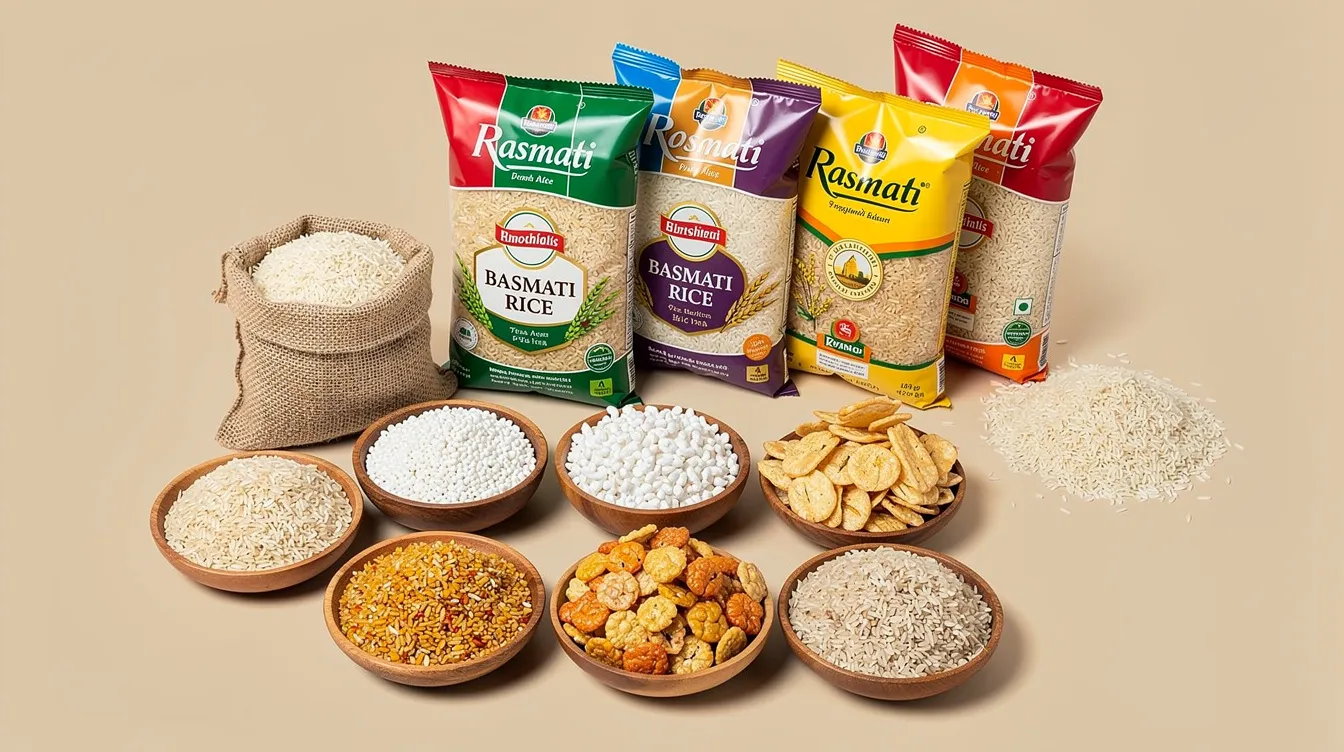
Branded rice – including premium basmati, non-basmati rice, specialty rice varieties, brown rice, organic rice and fortified rice – commands higher realization. Fortified rice is enriched with iron, folic acid and vitamin B12, serving government nutrition programmes and export tenders.
By-Products and Secondary Revenue
By-products like rice bran and rice husk can be profitable if effectively utilized. Rice bran oil is a heart-healthy cooking oil derived from rice processing. Rice flour is widely used in gluten-free food products. Liquid glucose can be produced from broken rice through enzymatic conversion. Rice starch and wheat flour substitutes further expand revenue streams. Even rice husk finds use as fuel, in animal feed production, and in other industrial applications.
Manufacturing Process and Line Integration
An integrated rice products manufacturing plant operates through a coordinated flow: raw material intake (paddy, raw rice, broken rice), cleaning and grading, conditioning or parboiling where applicable, then branching into dedicated lines – flaking for Poha, puffing for murmura, extruding or frying for snacks – followed by seasoning, cooling and final packaging.
Different lines can share common front-end sections (cleaning, destoning, grading, storage) but require separate controlled areas for final processing and seasoning to avoid cross-contamination. Quality control measures must comply with food safety standards like HACCP and FSSAI throughout the facility.
Exact process parameters – temperatures, pressures, residence times – depend on equipment design and supplier guidance. For a comprehensive process and line-integration discussion, manufacturers and consultants should refer to the integrated Poha, puffed rice and rice snacks manufacturing process guide in this series.
Efficient line integration directly influences plant capacity utilization, throughput consistency, power and fuel consumption, packaging logistics, and overall rice processing plant profitability in the DPR.
Machinery and Equipment Requirement
Machinery scope varies significantly with plant capacity, automation level, product mix and packaging style. Major equipment groups include:
- Raw-material handling: conveyors, bucket elevators, hoppers
- Cleaning and grading: destoners, aspirators, sifters, colour sorters
- Poha / rice flakes line: soaking, roasting, flaking rollers, grading screens
- Puffed rice line: puffers (hot-air, steam or pressure type), cooling systems
- Rice snacks line: mixers, extruders, fryers or roasters, seasoning drums
- Drying and conditioning equipment
- Weighing, filling, sealing and coding machinery
- QC and laboratory instruments
Capital investment for a small rice milling unit can start at Rs. 25 lakh, but an integrated value-added plant with multiple product lines requires substantially higher machinery investment. The instant Poha machinery and ready-to-cook rice equipment guide provides equipment-specific detail for Poha and convenience food lines.
Integrated rice processing plant machinery cost depends heavily on whether equipment is indigenous or imported – indigenous machines cost 30–45% less, but imported equipment from brands like Satake or Bühler can deliver 5–8% higher head-rice recovery, which may justify the premium for basmati rice or export-grade processing.
Capacity Planning, Product Mix and Plant Utilization
Rice processing plant capacity planning must be done at the integrated level – harmonizing Poha, puffed rice, snacks and packaged rice lines so that one line does not become a bottleneck while others remain underutilized. Rice processing plants can produce 50,000 to 100,000 MT annually at larger scales, but capacity must match realistic market absorption.
Key capacity planning considerations include:
- Installed versus practical operating capacity (accounting for maintenance, changeovers, seasonal variation)
- Realistic annual capacity utilization build-up – typically 45–55% in Year 1, rising gradually to 75–85% by Year 3 or 4
- Shift patterns (single or double shift) and their impact on labour and power costs
- Packaging mix: small retail pouches versus family packs versus institutional bulk bags
- Export versus domestic allocation and their respective logistics requirements
Over-optimistic capacity utilization assumptions can make the DPR look artificially profitable and will be challenged by experienced bankers evaluating rice processing plant DSCR and loan repayment capacity. For scenario-based planning tools, refer to the detailed guide on integrated rice processing plant capacity planning and product mix.
Land, Building and Multi-Line Plant Layout
An integrated rice products processing plant requires careful spatial planning covering raw-material yard, production block with separate areas for Poha, puffed rice and snacks processing, packaging hall, finished goods warehouse, utility block, QC laboratory, and administrative facilities.
Rice processing plant land and building requirements differ based on scale – a 3 TPH Poha plus 2 TPH puffed rice facility needs substantially less space than a larger plant with additional snacks and ready-to-eat lines. Future expansion corridors should be considered at the design stage.
Layout principles for food processing plants include:
- Unidirectional material flow from raw material receipt to dispatch
- Segregation of dusty and clean processing areas
- Food safety zoning compliant with FSSAI norms
- Adequate height for material handling equipment and conveyors
- Fire exits and emergency access as per local building codes
- Provision for waste management systems and effluent treatment
Prefabricated (PEB) sheds can reduce construction cost and timeline – a 4 TPH unit can be erected in approximately 90–110 days compared to 8–12 months for conventional RCC construction. The land, building and multi-line plant layout for an integrated rice processing plant guide provides more detailed spatial planning guidance.
Utilities, Warehousing, Packaging and Material Handling
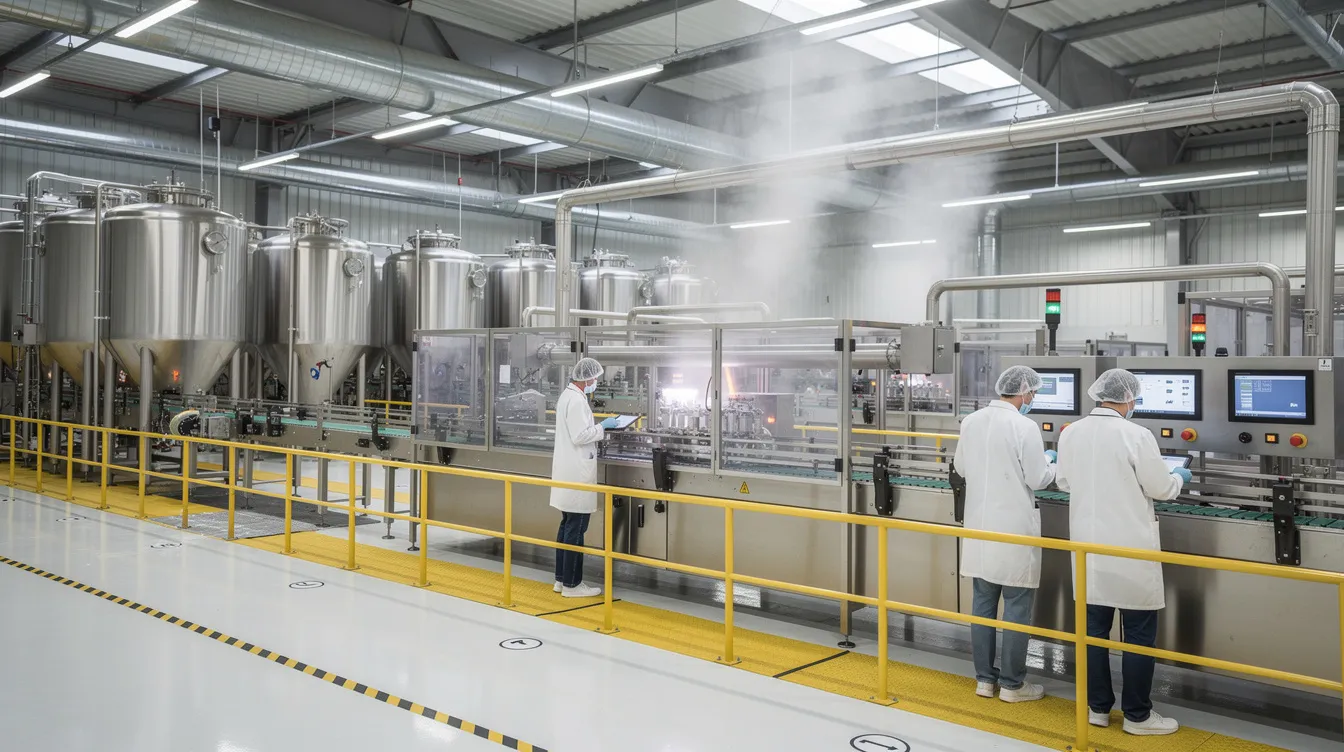
An integrated plant benefits from shared electrical, water, steam and compressed air systems, but these must be sized for simultaneous peak loads from multiple lines. Key utility items include connected power load (transformer, paneling, backup), water supply and treatment, boilers or thermic fluid heaters where thermal processing is involved, air compressors, ventilation, dust control, and basic effluent treatment for food-grade operations.
Warehousing needs span raw paddy and rice storage (silo or bag storage), separate packaging material stores, finished goods warehousing with racking and pallets, and loading bays. If the plant handles sensitive ready-to-eat rice products, cold storage or controlled-atmosphere storage may be required.
An efficient rice plant packaging system and material handling system directly affect packaging cost, labour requirement and product damage – all of which feed into operating margins and DSCR calculations. The supporting guide on utilities, warehousing, packaging and material handling for an integrated rice plant offers deeper cost-allowance guidance for DPR preparation.
Raw Material Procurement, Inventory Planning and Supply Chain
Raw materials for an integrated rice products processing plant include paddy, milled rice, broken rice, specialty basmati rice, organic rice, spices, seasonings, edible oils, micronutrient premixes (for fortified rice), and packaging materials.
Critical procurement considerations include:
- Assessing regional paddy availability in major rice cultivation areas
- Understanding seasonality and harvest cycles (Kharif, Rabi) that drive price volatility
- Deciding whether to mill own paddy or purchase milled rice and broken rice
- Planning procurement cycles and evaluating long-term supply contracts versus spot purchases
- Allocating raw materials between product lines – using broken rice for Poha or snacks, whole grains for premium packaged rice
A project report must analyze seasonal demand and procurement strategies for paddy. Inventory carrying costs – safety stocks, storage losses, quality deterioration, insurance – directly impact the rice plant working capital requirement. Stocking paddy for several months after harvest can tie up substantial funds.
The guide on raw material procurement and inventory planning for an integrated rice plant should be studied in detail before finalizing DPR assumptions. Additionally, the instant Poha raw material, seasoning and product mix guide covers ingredient-level planning for value-added Poha products.
Project Cost Structure of an Integrated Value-Added Rice Products Plant
Rice processing plant setup costs include both capital and operating expenditures. Capital expenditure covers land, machinery and installation costs, while operational costs typically consist of raw materials, utilities and labor. Operating expenses account for 80–85% of total costs in rice processing, with raw material purchase dominating the cost structure.
The main heads of integrated rice processing plant project cost include:
- Land and site development
- Building and civil works (factory, warehouse, packaging area, utilities block)
- Plant and machinery (all processing lines, packaging equipment)
- Electrical installations and utilities infrastructure
- Material handling and storage systems
- QC laboratory equipment
- Furniture, office equipment and IT systems
- Preliminary and pre-operative expenses (professional fees, trial runs, interest during construction)
- Contingency provision
- Margin money for working capital
Actual costs vary widely depending on capacity, technology, product mix, automation level and location. Project Report Bank structures the cost section in each detailed project report with item-wise summaries, clear assumptions, basis of estimation from vendor quotations, and direct linkage to the financing plan. For a more granular component-wise perspective, refer to the integrated value-added rice plant project cost and means of finance framework.
Means of Finance and Funding Structure
Typical funding sources for an integrated rice processing plant include promoter’s equity contribution, internal accruals from existing business operations, unsecured loans from promoters or associates where permitted by lenders, term loans from banks or NBFCs, and sometimes subsidized credit under government schemes.
A rice processing plant loan proposal normally balances:
- Term loan and promoter contribution at a prudent debt-equity ratio (often not exceeding 3:1 for corporates or 4:1 for smaller MSMEs, subject to bank norms)
- Adequate margin money for working capital
- Repayment schedules matched to projected cash flows and DSCR, not just accounting profits
- Moratorium period aligned with project gestation (typically 6–18 months)
India’s Agriculture Infrastructure Fund has supported 92,393 projects with INR 56,334 crore in funding, demonstrating institutional appetite for agro-processing investments. However, ultimate sanction terms depend on each bank’s appraisal, collateral requirements, risk appetite and regulatory guidelines. No DPR can guarantee loan approval.
Revenue Model, Market Strategy and Profit Margins
An integrated rice products revenue model must account for multiple product streams – each with different pricing, margins, distribution channels and competitive dynamics. Customer segments for rice products typically include retail consumers, institutional buyers and export markets.
India’s rice exports reached USD 5.84 billion in FY2023-24 for basmati rice alone, and the India packaged rice market is expected to grow to approximately 20.1 million tonnes by 2033. Market analysis should assess existing competitors, consumer preferences and price trends through an expansive market analysis framework.
Key revenue drivers include:
- Ex-factory selling prices by product and pack size
- Branded versus private-label sales and premium packaging investments
- Domestic versus export allocation (Middle East and other premium markets)
- Institutional channels: government tenders for fortified rice, mid-day meal programmes
- Modern trade, e-commerce and D2C channels for packaged rice and ready-to-cook products
Healthy profit margins for rice processing typically range from 15–25% at gross level. Branded retail products – Poha, snacks, organic rice, branded rice – can achieve higher margins but require greater spending on packaging, distribution and marketing. The puffed rice plant feasibility, ROI, IRR and payback analysis demonstrates how margin assumptions affect overall project viability.
For a deeper playbook, explore the integrated rice products revenue model, market strategy and profitability guide.
Financial Projections, Working Capital & DSCR
Integrated rice plant financial projections should include projected production and sales volumes by product, revenue, raw material cost (paddy, milled rice, broken rice), power and fuel, wages, packaging, selling and administrative expenses, interest, depreciation and tax. Financial projections assess ROI, profitability and sustainability of the venture. They should include profits, losses, cash flow and break-even analysis. Financial models should incorporate the complete product mix and by-product contributions to revenue.
Working capital is particularly critical for integrated rice plants: stocking paddy and rice (often seasonal), packaging materials, finished goods inventory and receivables from distributors, institutional buyers and export customers can collectively absorb substantial funds. The working capital assessment for puffed rice plants illustrates how seasonal procurement cycles drive working-capital needs.
DSCR (Debt Service Coverage Ratio) measures cash available for servicing term loan interest and principal repayment versus the amount actually due in each period. Banks focus heavily on DSCR while appraising rice processing plant loan repayment capacity – most lenders expect DSCR of 1.50 or above. Detailed project reports should highlight profitability and cash flow projections clearly. For modelling frameworks, refer to the rice plant financial projections, working capital and DSCR assessment guide.
Bank Loan, Project Finance and Feasibility Appraisal
Banks evaluate an integrated rice processing plant DPR on multiple dimensions: promoter background and industry expertise, project cost supported by quotations, technical feasibility of the integrated processing line, market potential backed by industry trends and market growth data, conservative capacity utilization assumptions, revenue projections, profitability analysis, DSCR, security and collateral, implementation schedule, and statutory approvals.
A well-structured rice processing plant DPR for bank loan clearly presents:
- Project rationale and location advantages
- Competitive landscape and market reach assessment
- An operational blueprint with implementation schedule and governance structure
- A comprehensive executive summary for quick stakeholder understanding
- Risk-mitigation measures and realistic sensitivity scenarios
- A risk assessment matrix to identify and mitigate potential project risks
A project is truly bankable only when technical, market, financial and managerial feasibility are all satisfactory. The bank loan and project finance guide for puffed rice plants illustrates lender evaluation methods. For expanded coverage, explore the guide on bank loan appraisal, feasibility, ROI, IRR, payback and sensitivity analysis for an integrated rice plant.
While CA Manish Gugliya and Project Report Bank prepare strong professional documentation, final loan approval rests solely with the bank or financial institution based on their internal appraisal and policy.
ROI, IRR, Payback Period and Sensitivity Analysis
Return on Investment (ROI), Internal Rate of Return (IRR) and payback period are standard metrics used by promoters, investors and lenders to judge integrated rice processing plant profitability. ROI measures net profit relative to total capital investment. IRR is the discount rate at which the project’s net present value equals zero. Payback period indicates the years needed to recover the initial investment from net cash flows.
These metrics are only as reliable as the underlying assumptions. Sensitivity analysis helps evaluate financial resilience under varying conditions – this is especially important for a multi-product rice plant where small variations in key parameters can significantly alter outcomes:
- 10% drop in selling prices due to competitive pricing pressure
- 10–15% increase in paddy or raw rice procurement cost
- Delayed capacity stabilization (reaching 80% utilization only by Year 4 instead of Year 3)
- Higher interest rates on floating-rate term loans
- Increased packaging cost for premium packaging or export-compliant labelling
Including 3–4 such scenarios in the DPR demonstrates responsible project planning and strengthens the case with lenders. The puffed rice plant financial projections guide and DSCR and loan repayment capacity analysis for puffed rice projects offer practical illustrations of scenario planning.
Indicative Project Cost Framework
The following table outlines typical project cost heads for an integrated value-added rice products manufacturing plant. No rupee values are provided – actual figures must be determined from quotations and project-specific assumptions.
| Project Cost Component | What It Normally Includes |
|---|---|
| Land & Site Development | Land acquisition, levelling, roads, compound wall, site infrastructure |
| Building & Civil Works | Factory building, warehouse, packaging hall, utilities block, admin and staff facilities |
| Plant & Machinery | All processing lines (Poha, puffed rice, snacks, rice milling), integrated equipment |
| Utilities | Electrical installations, transformer, water supply, boiler/thermal systems, compressed air |
| Packaging Equipment | Filling, weighing, sealing, coding and labelling machines |
| Material Handling | Conveyors, elevators, hoppers, pallets, racking systems |
| QC & Laboratory | Testing instruments, sampling equipment, basic food safety lab setup |
| Pre-operative Expenses | Professional fees, trial runs, interest during construction, establishment costs |
| Contingency | Provision for eligible unforeseen costs (typically 5–10% of fixed assets) |
| Working Capital Margin | Promoter’s contribution towards working capital as required by lender norms |
Project Report Bank incorporates such detailed cost breakdowns into each rice processing plant DPR, linking each head to the proposed means of finance.
Illustrative Product Mix and Application Matrix
This illustrative framework helps promoters and consultants map products to commercial strategy during project planning. It is not a compulsory configuration.
| Product Category | Processing Nature | Commercial Role |
|---|---|---|
| Poha / Rice Flakes | Value-added primary processing | High-volume packaged or bulk product for domestic and export markets |
| Puffed Rice / Murmura | Thermal/value-added processing | Retail, wholesale and snack industry supply |
| Rice Snacks | Further processing (extrusion, frying) | Higher-value branded products with competitive edge |
| Ready-to-Cook Mixes | Convenience food processing | Consumer-focused value addition for modern retail |
| Fortified Rice | Fortification and precision packaging | Government tenders, institutional supply, stable demand segments |
| Premium Basmati / Organic Rice | Cleaning, grading, premium packaging | Premium markets including export to Middle East |
| By-products (Bran, Husk, Broken Rice) | Secondary recovery and utilization | Additional revenue from rice bran oil, animal feed, rice flour |
This matrix helps identify which products are high-volume but moderate-margin versus lower-volume but higher-margin, supporting decisions on capacity allocation and marketing focus.
Typical Contents of an Integrated Rice Processing Plant DPR
A bankable DPR for an integrated value-added rice products processing plant must be structured, data-backed and customized. Detailed project reports cover market analysis and financial requirements comprehensively. The major sections normally include:
- Promoter profile, existing business background and financial statements
- Project concept, objectives and rationale for value addition
- Product descriptions with target markets and quality standards
- Manufacturing process and integrated line description
- Installed plant capacity, phasing and utilization assumptions
- Location, infrastructure and site advantages
- Land, building and layout details
- Machinery list with specifications and vendor quotations
- Utilities, manpower and implementation schedule
- Market assessment including industry trends and competitive landscape
- Detailed project cost and means of finance
- Working capital assessment
- Projected P&L, cash flow and balance sheet (typically 5–7 years)
- DSCR and loan repayment schedule
- Break-even, ROI, IRR and payback analysis
- Sensitivity analysis under multiple scenarios
- Key risks, mitigation strategies and statutory/regulatory considerations
The DPR should be prepared in sync with CMA Data and bank application formats to avoid duplication and inconsistencies. The comprehensive rice mill project report offers a reference framework for rice milling-focused DPRs.
Why Integrated Projects Need Careful Financial Planning
A multi-product facility creates interacting assumptions that cannot be modelled in isolation. Raw material allocation between Poha, puffed rice and snacks lines affects yields and margins differently. Shifting more capacity towards rice snacks may increase profit margins but also requires higher marketing spend and premium packaging costs. Focusing on fortified or organic rice raises selling prices but demands stringent quality assurance and certification investment.
A single integrated financial model – not separate spreadsheets for each product line – is essential to capture these interactions across the plant, particularly for term loan assessment, working-capital finance needs and sensitivity analysis. Machinery selection should follow the finalized product mix rather than precede it. A technically feasible project may still fail financially if working capital is underestimated.
Higher installed capacity does not automatically produce higher profitability. Capacity utilization assumptions should be gradual and commercially defensible. Debt repayment should be evaluated against projected cash generation rather than accounting profit alone.
Key Risks and Mitigation Strategies
Risk identification must be part of any serious rice processing plant feasibility report. Key risks include:
- Raw-material price volatility and procurement concentration in limited geographies
- Overestimation of market growth and stable demand assumptions
- Incorrect product mix leading to unsold inventory
- Underutilized high-cost machinery due to demand shortfalls
- Inadequate working capital leading to capacity underuse
- Quality inconsistency damaging brand reputation
- Regulatory and compliance lapses
Mitigation strategies should include:
- Diversified sourcing across multiple rice cultivation regions
- Conservative capacity utilization and pricing assumptions in project financials
- Phased capacity ramp-up rather than full-scale launch
- Pre-launch market testing of new rice snacks and convenience foods
- Strict process and quality systems including HACCP and FSSAI compliance
- Maintaining liquidity buffers through additional banking lines
Multiple statutory approvals are required before commercial operation – these include food safety registration, pollution control permissions and environmental clearances. Legal metrology compliance is necessary for rice processing plants. Factory-related approvals are essential for operations. The report should incorporate environmental management practices to meet regulatory standards, and environmental standards must be met for waste management systems.
Lenders appreciate DPRs that openly discuss risks with reasoned mitigation, viewing this as responsible management rather than weakness.
Role of CA Manish Gugliya & Project Report Bank
CA Manish Gugliya is a practising Chartered Accountant experienced in preparing detailed project reports, CMA Data, financial projections and bank finance documentation for agro-processing and food processing projects, including integrated rice plants. Services include:
- Preparation and review of integrated rice processing plant DPRs
- Structuring project cost and means of finance proposals
- Developing integrated financial models with projected P&L, cash flow, balance sheet and DSCR
- Preparing CMA Data and term loan proposals aligned with bank formats
- Advising on working-capital assessment and inventory planning
- Conducting ROI, IRR and payback analysis
- Performing sensitivity and scenario analysis for risk evaluation
- Supporting preparation of other project financials and research reports as needed
Project Report Bank operates as a B2B consulting and documentation platform, offering both downloadable templates and customized DPR preparation suited for MSME loans, larger industrial projects and investor-ready documentation. While professional documentation can significantly support a loan proposal or investor discussion, the final decision on sanction, loan amount, interest rate and terms always rests with the respective bank, NBFC or investor as per their policies and credit appraisal.
Conclusion: Building a Bankable Integrated Value-Added Rice Products Project
Integrated value-added rice projects allow promoters to unlock higher value from paddy and broken rice through diversified products – Poha, puffed rice, rice snacks, fortified and organic packaged rice, health foods, breakfast cereals and ready-to-cook items. But the rice industry rewards rigorous planning, not optimism. The competitive landscape demands sound business decisions grounded in realistic market analysis, business requirements assessment and disciplined financial modelling.
A robust integrated value-added rice products processing plant project report must connect plant capacity, layout, machinery selection, product mix, raw material strategy, market positioning, working capital and term loan structure into one coherent financial story – tested against multiple sensitivity scenarios. Promoters, consultants and CAs should treat the DPR as a decision-making tool rather than merely a bank submission, using it to refine strategy on capacity, markets, profit margins, DSCR, ROI, IRR and payback period before committing large capital to what can be a highly profitable project.
For a customized, bank-ready DPR, CMA Data or financial model for an integrated rice processing plant, connect with CA Manish Gugliya through ProjectReportBank.com. Professional documentation built on realistic assumptions and internally consistent projections is the foundation of every successful rice processing venture.
Frequently Asked Questions
What minimum scale makes sense for an integrated value-added rice products plant?
Commercially viable scale depends on location, product mix, target market and competitive dynamics. In practice, integrated plants are usually planned at medium to large scale – combining multiple tonnes per hour of Poha, puffed rice and snacks output – to achieve economies in utilities, warehousing and overheads. The DPR should analyze break-even capacity and economies of scale for the specific configuration rather than relying on arbitrary benchmarks. A plant producing edible grains and value-added products needs sufficient throughput to absorb fixed costs and generate acceptable DSCR.
Can an existing rice mill be upgraded into an integrated value-added rice products facility?
Many existing rice mills can add Poha, puffed rice and rice snacks lines using existing paddy and rice streams, leveraging available infrastructure. However, a fresh DPR should still be prepared covering incremental machinery costs, layout modifications, additional utilities, revised working-capital requirements and updated profitability and DSCR projections under the diversified model. The instant Poha plant capacity, land, layout and utilities guide addresses practical considerations for adding Poha production to existing facilities.
How should promoters factor export opportunities into their DPR?
Export potential – for basmati rice, non-basmati rice, fortified rice and snacks to the Middle East and other international markets – can be attractive but needs documented demand assessment, buyer linkages, packaging and labelling compliance, logistics costs and currency or credit risk analysis. India exported basmati rice worth USD 5.84 billion in FY2023-24, indicating strong global demand. However, the DPR should not assume all additional production will be easily exported without establishing concrete market linkage and understanding the regulatory compliance requirements for export markets.
Is third-party market research necessary before preparing the DPR?
While not always mandatory, credible market data – from research reports, industry associations, local trade feedback and distributor discussions – strengthens the feasibility study, especially for new brands, new geographies or unconventional product mixes. Multinational companies and institutional lenders routinely expect documented evidence of market growth, consumer preferences and competitive positioning. Market analysis referencing the projected global rice market size of USD 384.74 billion by 2034 and domestic consumption patterns adds credibility to the rice processing plant DPR.
How often should financial model assumptions be updated after commissioning?
The original DPR should be treated as a living document. Key assumptions – capacity utilization, selling prices, raw material cost, working-capital cycle, interest rates – should be revisited at least annually, or more frequently in volatile markets. Updated financial projections support internal decision-making, lender reviews and any expansion or diversification planning. Market trends, competitive landscape shifts and changes in government policies on fortified rice procurement or export restrictions can materially affect project economics and require timely model adjustments.