Key Takeaways
- General hospital term loan assessment in India centers on promoter capability, realistic project cost, means of finance, hospital viability, cash flow and DSCR; collateral alone does not drive loan approval.
- Banks link bed capacity, occupancy ramp-up, tariffs, operating costs, working capital and DSCR before sanctioning a hospital loan. Loan applications must demonstrate repayment capacity and financial viability at every stage.
- A strong General Hospital DPR and CMA Data with coherent financial projections, realistic revenue assumptions and defensible numbers improve lender confidence.
- Weak assumptions on project cost, loan amount, promoter contribution, working capital and loan repayment schedule are among the most common reasons hospital loans get reduced or rejected.
A term loan assessment for a hospital evaluates both financial and operational health of the proposed project. Hospitals support $3.3 trillion in economic activity annually worldwide, and over 19 million people are employed by hospitals in the U.S. alone. In India, the healthcare sector is expanding rapidly into Tier-2 and Tier-3 cities, yet many hospitals operate on thin financial margins or face closures when financing is poorly structured. The purpose of this article is to walk you through what banks actually examine when a promoter approaches them for financing a new hospital or expanding an existing one.
Explore General Hospital DPR Guides
Explore our complete series on General & Small Hospital project planning, cost, financial projections, repayment capacity and bank finance.
What Is a General Hospital Term Loan?
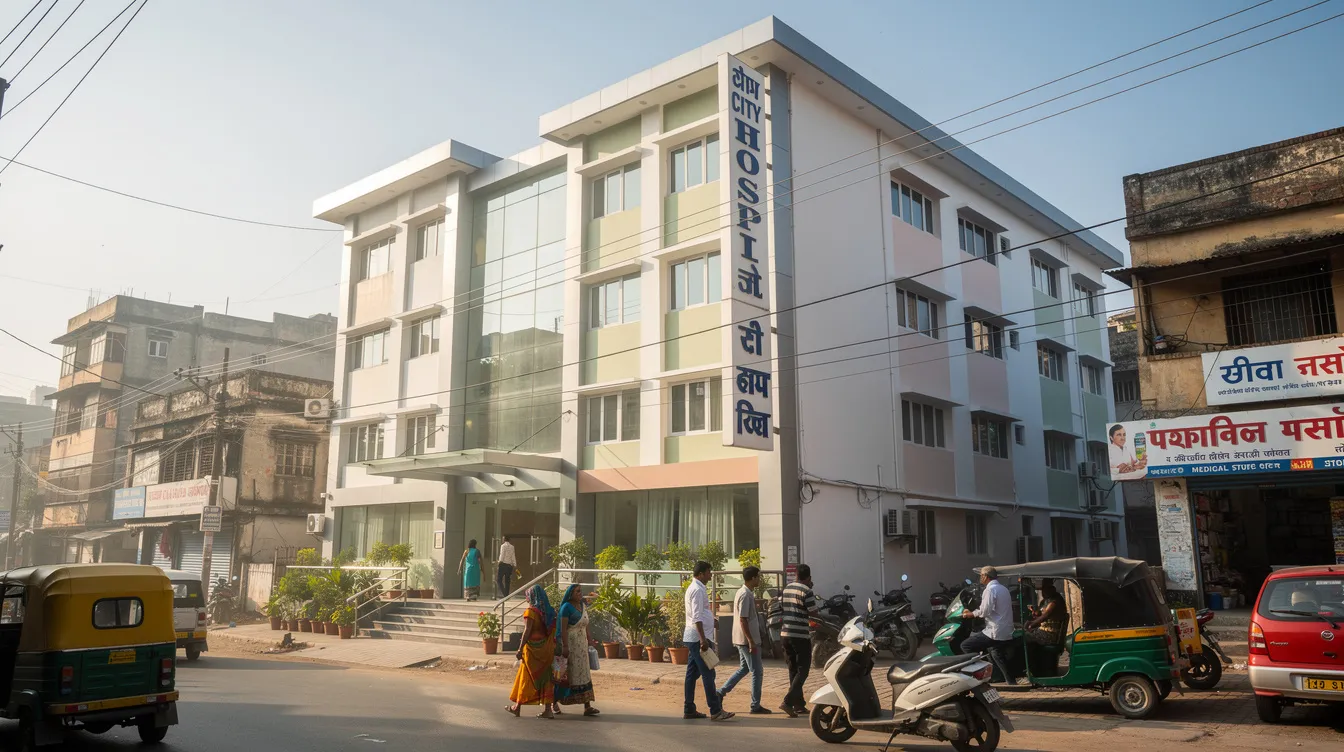
A general hospital term loan is a medium-to-long-term bank loan used to finance fixed assets for a new or expanding 10 to 50 bed hospital. Term loans are repaid in regular installments over tenures that can stretch up to 15 years including a moratorium period. Equipment financing covers purchasing expensive medical equipment such as OT modules, ICU setups, radiology and diagnostic equipment, while the term loan also finances building construction, interiors, furniture, electrical and HVAC systems, fire safety, IT infrastructure and ambulances where applicable.
This is distinct from working capital loans, which help maintain stability during revenue gaps by financing pharmacy inventory, consumables and receivables. Lines of credit provide financial flexibility for day-to-day operational needs. Banks insist on separate assessment for term loan (fixed assets) and working capital (operations) because interest rates, tenure, repayment terms and security structures differ. The moratorium period and repayment tenure are structured around asset life and hospital cash generation, not around the purchase date of a single piece of medical equipment.
How Banks Assess a General Hospital Term Loan Proposal
The general hospital term loan assessment follows an integrated credit appraisal covering multiple dimensions:
| Area | What the Bank Examines |
|---|---|
| Promoter | Professional experience, net worth, credit profile |
| Project | Location, beds, specialties, configuration |
| Cost | Reasonableness, supporting quotations |
| Finance | Promoter contribution and proposed debt |
| Revenue | Occupancy, OPD, procedures, pricing |
| Profitability | Operating margins and sustainability |
| Cash Flow | Cash available for debt servicing |
| DSCR | Loan repayment capacity |
| Working Capital | Operating-cycle funding |
| Security | Primary and collateral required as applicable |
| Risk | Sensitivity to adverse assumptions |
Project feasibility includes assessing the technical viability of hospital projects alongside commercial viability. From a lender’s perspective, a ₹5 to ₹25 crore hospital project does not automatically justify a high loan amount merely because collateral is available. Banks finance repayment capacity.
Promoter Background and Management Capability
Banks assess the promoter before relying on projected numbers. Registered medical practitioners can apply for hospital loans, and many bank schemes require the promoter to hold a requisite qualification (MBBS, MD, MS, DNB) or engage qualified medical professionals on contract. Eligibility often requires at least 2 years of professional experience post-qualification.
Key assessment points include clinical practice history, prior hospital management experience, net worth, income proof, existing borrowings, CIBIL score, banking conduct (bank statements, tax compliance) and Aadhaar card verification. A doctor-promoted hospital where key consultants are also promoters carries lower risk than an investor-promoted model fully dependent on hired doctors. Banks also evaluate management depth: hospital administrator, nursing leadership, billing and procurement systems. Promoters should prepare a crisp profile note and management chart for the DPR.
Hospital Project Concept and Configuration
The hospital project concept drives the entire financial model. Financial and operational assessments must consider local market conditions and competition. A 30-bed general hospital in a Tier-2 city might include 4 ICU beds, 2 modular OTs, 10 general ward beds, 16 semi-private or private rooms, basic radiology, in-house pathological lab, pharmacy and 6 to 8 OPD chambers. Market position and demographics affect a hospital’s financial sustainability.
Banks compare proposed bed mix and tariffs with catchment-area demographics, disease profile, competition and affordability. A 20-bed hospital cannot be projected like a scaled-down 100-bed corporate facility; economies of scale, doctor availability and occupancy ramp-up differ and must be reflected in the DPR. Facilities like physiotherapy centres, dialysis centres, IVF centres and skin clinics within the hospital add revenue diversity but also add cost and complexity that must be justified.
Assessment of Hospital Project Cost
Banks assess project cost estimates in the DPR to avoid funding gaps. Major cost heads include land development, building and civil works (benchmark: ₹3,500 to ₹8,000 per sq ft depending on specification), interiors, medical equipment, diagnostic equipment, furniture, electrical, HVAC, fire safety, medical gas, IT systems, ambulance, preliminary expenses and contingency. A 30-bed hospital typically costs ₹12 to ₹20 crore depending on city and specialty mix.
Banks expect item-wise costs backed by contractor estimates, architect BOQs and vendor quotations. Independent valuation of land and building is common before finalizing the eligible project cost. For a deeper breakdown of cost structuring and funding, refer to the detailed discussion on General Hospital Project Cost & Means of Finance.
Means of Finance and Promoter Contribution
The basic formula: Project Cost = Promoter Contribution + Bank Term Loan + Other Eligible Sources. For a ₹7 crore 30-bed project, promoter contribution might be ₹2 to ₹2.5 crore with the term loan covering the balance. Other sources can include unsecured loans from promoters or relatives (where acceptable), government subsidy or credit-linked scheme benefits, and quasi-equity. Under IOB’s Hospital & Equipment Finance Scheme, margin requirements are 15% for equipment and 25% for building or renovation.
Banks verify source and timing of promoter contribution through bank statements, income-tax returns and sale-deed proceeds. Unsubstantiated cash margins weaken the application process. Higher own contribution generally improves lender confidence and reduces financial stress during early operations.
How Banks Assess Hospital Revenue Projections
Hospital revenue projections determine whether the loan repayment schedule is serviceable. Projected revenue relies on assumptions like occupancy rates and service volumes. Key revenue drivers: bed capacity, category-wise bed mix, realistic occupancy ramp-up, average daily revenue per occupied bed, OPD volumes, surgery counts, ICU utilisation, diagnostics (pathology, radiology), pharmacy margins and emergency services.
A realistic model assumes gradual occupancy build-up: 25 to 35% in the first year for a new 30-bed hospital, moving toward 60 to 70% over 3 to 4 years. Payer mix and revenue diversity (self-pay, insurance or TPA, government schemes like PM-JAY) impact the financial assessment. Banks cross-check tariffs with local competition and doctor strength. For detailed revenue modelling, refer to General Hospital Revenue Model & Financial Projections.
Operating Cost and Profitability Assessment
Rising operational costs strain hospital budgets, and banks scrutinize projected expenses carefully. Major cost heads: doctors’ remuneration, salaries and wages (nurses, technicians, admin, housekeeping, security), medical consumables, pharmacy purchases, pathology and radiology consumables, utilities, maintenance, biomedical waste, marketing, IT/software, insurance and admin overheads. Staff retention and recruitment of medical professionals directly influence hospital performance projections.
Operating margin and EBITDA margin are key profitability metrics for healthcare operations. EBITDA measures operating surplus before depreciation and interest; banks focus on it because accounting profit alone does not establish cash available for loan repayment. Aggressive underestimation of salary costs or consumables to inflate projected profits is a common weakness quickly challenged by experienced credit officers.
Working Capital Assessment for a Hospital
Inadequate working capital planning is a common financial stressor. Even profitable hospitals face cash-flow pressure from pharmacy inventory, lab reagents, delayed insurance or TPA receivables and routine cash expenses. Days Cash on Hand (DCOH) indicates how many days a hospital can operate on available cash; bankers track this closely.
The DPR and CMA Data should show both the term loan for fixed assets and proposed working capital limits. Working capital loans and lines of credit address the gap between incurring expenses and collecting revenue. A 30-bed hospital might need ₹40 to ₹80 lakh of working capital for the first 3 to 6 months. For deeper calculations on the operating cycle, refer to General Hospital Working Capital Requirement.
DSCR: A Key Measure of Repayment Capacity
The Debt Service Coverage Ratio (DSCR) measures cash flow available for debt service. A DSCR of 1.25x to 1.50x is typically desired for healthcare entities by lenders, though exact thresholds vary depending on bank policy, scheme, collateral and risk profile.
Illustrative example (for understanding only): if a 30-bed hospital generates cash accrual of ₹1.20 crore in a year and annual term loan repayment (interest plus principal) is ₹80 lakh, the DSCR is 1.50x. This tells the banker that cash generation covers debt obligation with a 50% buffer.
Banks examine both year-wise DSCR and average DSCR across the loan tenure. Improving DSCR should come from correcting assumptions (occupancy, tariffs, operating efficiency, realistic tenure and moratorium period) rather than artificially inflating revenue. For detailed DSCR analysis, see General Hospital DSCR & Loan Repayment Capacity.
How Banks Examine the Proposed Repayment Schedule
A well-structured loan includes an appropriate repayment schedule matching cash flow patterns. Banks discuss total repayment tenure (7 to 15 years for building-heavy projects), moratorium period covering construction plus initial ramp-up, instalment periodicity and step-up versus equal instalments. Aggressive repayment from year one, with lower monthly payments not aligning to actual cash generation, can push DSCR below acceptable levels and create financial stress. Greater financial flexibility through stepped-up instalments during early years, with gradual increases as occupancy stabilises, often makes the proposal more bankable.
Break-Even Analysis and Capacity Utilisation
Break-even analysis helps bankers understand the minimum occupancy needed to cover fixed and variable costs. Utilization rates indicate operational efficiency, reflecting demand for healthcare services. Many hospitals incur 24×7 fixed costs (nursing, basic doctor coverage, utilities) from day one. For a 20-bed hospital with monthly fixed costs of ₹12 lakh and average contribution of ₹1,500 per occupied bed-day, break-even occupancy works out to roughly 40 to 45%. DSCR strengthens only after break-even is comfortably crossed.
Balance Sheet and Financial Ratio Assessment
Banks review projected debt-equity ratio, current ratio, tangible net worth, fixed-asset coverage and interest coverage ratio. High leverage increases vulnerability during occupancy shortfalls even if collateral is available. The projected balance sheet prepared as part of CMA Data should consistently reflect project cost, means of finance, depreciation, loan outstanding, working capital and net worth without internal contradictions. Ratios should be computed and tabulated year-wise.
Existing Business and Historical Financial Performance
For expansion projects, lenders assess historical and projected financial statements like EBITDA and operating margins from audited financials (last 3 years), GST data, bank statements and existing loan repayment track record. A well-performing existing facility strengthens the case for additional funds. For greenfield hospitals, banks rely more on promoter profile and DPR quality. Clean, segregated banking (avoiding mixed personal and business transactions) is preferred.
Security and Collateral Assessment
Lenders analyze the quality of hospital assets, including real estate and medical technology. Primary security covers hypothecation of medical equipment and mortgage of hospital land and building. Collateral required varies by lender, loan amount and scheme; options include additional property mortgage, personal guarantees and corporate guarantees. The valuation of a hospital’s collateral impacts the lender’s risk assessment; banks arrange independent valuation and legal search reports. Some MSME healthcare schemes may relax collateral norms up to certain maximum loan amounts, but repayment capacity remains non-negotiable.
Statutory and Regulatory Feasibility
Regulatory compliance and accreditation are critical for hospital financing. Banks verify entity registration, local municipal approvals, building plan sanction, fire and safety NOC, biomedical waste tie-up, clinical establishment registration, pharmacy licence and other applicable approvals. Requirements vary depending on state and services offered (nursing homes, diagnostic centres). Delays in mandatory approvals shift the commissioning date, affecting interest during construction and DSCR in early years.
What Banks Expect from a General Hospital DPR
A Detailed Project Report (DPR) evaluates every aspect of a hospital project. Banks require a professionally prepared DPR for loan approval. A bankable DPR includes market feasibility studies and revenue projections, and DPRs must demonstrate loan repayment capacity to improve funding prospects. Loan rejections often stem from inadequate project documentation.
Core components: executive summary, promoter profile, hospital concept and configuration, location and market analysis, implementation schedule, item-wise project cost, means of finance, projected revenue model, operating-cost assumptions, projected P&L, Balance Sheet and Cash Flow, working capital assessment, DSCR and loan repayment schedule, break-even analysis, ratio analysis and sensitivity analysis. A “General Hospital DPR for Bank Loan” or “Hospital Project Report for Bank Loan” must differ from a purely architectural report; internal consistency across all documents and the application form is essential. The DPR should annex quotations for major medical equipment, architect estimates, necessary documents for approvals status and promoter KYC.
Sensitivity Analysis
Cash flow sensitivity analysis helps lenders gauge potential risks in hospital financing. Typical stress scenarios: 10 to 20% lower occupancy, higher salary and consumable costs, increase in interest rates, commissioning delay by 6 months. A 15% revenue drop might reduce DSCR from 1.50x to 1.15x, signalling tight repayment capacity. Promoters should run these scenarios before approaching banks to adjust project size, loan amount, tenure or cost structure.
Common Reasons a Hospital Loan Proposal Becomes Weak
In my experience preparing hospital DPRs and CMA Data, most rejections arise from assumption and documentation weaknesses rather than lack of medical merit. Red flags include:
- Inflated occupancy (90% from month one) without supporting market data
- Underquoted project cost leading to cost overruns
- Insufficient promoter contribution or unclear source of margin money
- Inadequate working capital estimates
- Aggressive loan repayment schedule crushing DSCR in years 1 to 3
- Missing or weak market study
- Inconsistent numbers between DPR, CMA Data and financial projections
- Incomplete medical equipment planning without quotations
- Late payments or poor banking conduct history
Increasing revenue in Excel to achieve a “target DSCR” without justifying patient volumes and tariffs is noticed by experienced bank appraisers. Promoters should avoid late payments on existing borrowings and get their DPR reviewed before submitting to multiple banks.
How to Make a General Hospital Term Loan Proposal More Bankable
A bankable proposal is one where every figure can be logically explained and supported. Practical steps:
- Undertake realistic bed planning (refer to Small Hospital Setup Cost in India for benchmarks)
- Obtain proper quotations for medical equipment to buy medical equipment at validated prices (see Small Hospital Equipment List & Cost in India)
- Use conservative occupancy and tariff assumptions linked to bed capacity, OT capacity, diagnostic equipment utilisation and OPD flow
- Structure means of finance with clear promoter margin, reasonable debt-equity, adequate working capital and moratorium aligned to cash generation
- Have integrated projections (P&L, balance sheet, cash flow, DSCR) reviewed by an experienced finance professional so the CMA Data and DPR tell one coherent story
Illustrative General Hospital Bank Appraisal Example
All figures below are illustrative only, not standard norms.
| Parameter | Illustrative Value |
|---|---|
| Beds | 30 |
| Project Cost | ₹7.00 crore |
| Promoter Contribution | ₹2.50 crore |
| Term Loan | ₹4.50 crore |
| Year 1 Occupancy | 30% |
| Year 4 Occupancy | 65% |
| Year 1 Revenue | ₹1.80 crore |
| Year 4 Revenue | ₹4.20 crore |
| Year 1 DSCR (with moratorium) | 1.10x |
| Year 4 DSCR | 1.55x |
| Average DSCR | 1.40x |
A banker would note tight DSCR in year 1 (acceptable given moratorium), improving trend as occupancy stabilises, and reasonable leverage. Promoter profile and collateral provide additional comfort. Each real project will differ by city, specialty mix and bank policy.
Role of CMA Data and Financial Projections in Hospital Loan Appraisal
In Indian banking practice, CMA Data and detailed financial projections are required documents for hospital term loans beyond certain limits. Key parts: projected P&L, balance sheet, fund-flow and cash-flow statements, working capital requirement and DSCR analysis. A Chartered Accountant may assist in preparation, structuring and reviewing these projections, but they remain estimates subject to bank appraisal, not a certificate of guarantee. An assumption sheet listing all key drivers (bed occupancy, OPD volume, pricing, salary escalations, interest rates) helps bankers quickly review the model.
General Hospital Term Loan Assessment: A Lender’s Overall View
Successful general hospital term loan assessment is about consistency: Promoter capability leads to project concept, which drives project cost, means of finance, revenue and cost structure, cash flow, DSCR and security. Banks mentally check: Is the promoter experienced and financially committed? Is project size appropriate for location? Is the loan amount justified by repayment capacity? Are security, approvals and specific criteria met? Banks secure financing based on repayment capacity, not collateral alone.
A well-prepared, transparent and conservative DPR backed by robust CMA Data gives bankers confidence to take a positive credit view. Promoters who need assistance with General Hospital Project Report or DPR, CMA Data, hospital financial projections, DSCR and repayment analysis, working capital assessment or bank finance documentation can access funds and professional support through ProjectReportBank.com. In India, improving healthcare access through well-financed hospitals requires both clinical vision and disciplined financial planning. SBA loans offer low interest rates for healthcare facilities in applicable jurisdictions, and nonprofit hospitals are eligible for SBA loans under specific criteria.
The key benefits of approaching the process with realistic, defensible assumptions and a detailed business plan are clear: secure funding on attractive interest rates, repayment flexibility aligned to hospital cash flows, and minimal documentation challenges during processing. Whether you run nursing homes, a new hospital or existing units seeking expansion, the application process rewards preparation over optimism. A guarantee fee, processing fees, upfront fee and other charges vary by lender and scheme, but the foundation of every successful hospital loan remains the same: prove that cash generation will service the debt.

FAQs on General Hospital Term Loan Assessment
How do banks assess a hospital term loan proposal in practical terms?
Banks evaluate the promoter’s professional experience and age requirement compliance, hospital concept, realistic project cost, means of finance, revenue and cost assumptions, cash-flow projections, DSCR, security and regulatory feasibility. The assessment covers both financial documents and operational logic. The bank checks whether projected hospital operations can generate enough cash to service interest and repay principal across the loan tenure. Employment of qualified medical professionals and lender-acceptable management arrangements also factor into the decision.
What DSCR is generally considered acceptable for a hospital project?
There is no single universal DSCR. Many lenders prefer an average DSCR above 1.25x to 1.50x with no severely weak early years. Final expectations depend on risk profile, collateral, project size, the specific scheme and internal credit policy. A comfortable DSCR indicates that cash accrual from hospital operations covers debt obligations with a reasonable buffer.
How much promoter contribution is needed for a small general hospital?
Promoter contribution varies by bank, loan quantum, asset mix and promoter strength. Some banks require 15% margin for medical equipment and 25% for building or renovation. The maximum loan amount as a proportion of project cost depends on the lender’s norms and the borrower’s ability to demonstrate credible sources of own funds through bank statements, tax returns and documented savings.
Can a first-time doctor without hospital experience get a general hospital loan?
First-time doctors can obtain hospital loans if the proposal is otherwise strong: solid clinical track record, realistic 10 to 20 bed plan, support from experienced hospital administrators or partners, well-prepared DPR with proper financial solutions, adequate promoter contribution and acceptable collateral and DSCR. Banks may apply more cautious conditions without prior hospital management experience.
Is working capital also financed when banks sanction a hospital term loan?
Many banks assess and sanction working capital limits for pharmacy stock, medical consumables and receivables alongside the term loan, either immediately or after commissioning. Hospitals must clearly present working capital requirement and margin in the DPR and CMA Data. Working capital loans and cash credit facilities serve different purposes from the term loan and require separate documentation and assessment. The required documents for each component may differ based on the lender’s eligibility criteria.
Explore All General Hospital DPR Guides
Continue exploring our complete series on General & Small Hospital project planning, setup cost, equipment, financial projections, repayment capacity and bank finance.