Key Takeaways
The rbi integrated ombudsman scheme for mudra loan complaints gives every small borrower a structured, free way to escalate genuine service failures by banks. Here is what you need to know before reading further:
- Every Mudra borrower must first file a complaint in writing to the bank and wait 30 days before approaching the rbi ombudsman under the Reserve Bank – Integrated Ombudsman Scheme.
- The scheme covers issues like delay, no reply, unfair charges, forced insurance and staff misbehaviour, but does not review purely commercial lending decisions such as loan amount or interest rate.
- Complaints are filed free of cost through the cms portal (https://cms.rbi.org.in), by email or by post to the CRPC, Chandigarh, and are usually decided within around 30–60 days in straightforward cases.
- This article is written by CA Manish Gugliya (FCA) and will guide you step-by-step with checklists, practical examples, timelines, tables and an expert guidance section to improve your chances of resolution.
Introduction: Mudra Loan Problems and the Role of RBI Ombudsman
If you are a shopkeeper, small manufacturer, woman entrepreneur or startup founder who has applied for a Mudra loan, chances are you have faced at least one of these problems: the branch keeps asking for the same documents again and again, your application sits untouched for months, the bank deducts charges nobody explained, or an officer tells you insurance is “compulsory” before your loan can move forward. These are not rare events. With over 52 crore Mudra loan accounts sanctioned across india since the scheme launched, even a small percentage of service failures affects millions of real people.
Many branches refuse to give written replies. They offer verbal excuses, leaving you without proof. Some banks insist on collateral or security even for loans where RBI rules clearly say no collateral is needed. Others quietly reject applications without issuing a written rejection letter, making it impossible for you to escalate or apply elsewhere.
This is where the Reserve Bank – Integrated Ombudsman Scheme, 2021 (RB-IOS 2021) enters the picture. Launched on 12 November 2021, this scheme replaced the older banking ombudsman scheme and two other separate ombudsman schemes. It created a single, free, centralized grievance system for customers of regulated entities, including every bank that offers Mudra loans. Filing a complaint under the scheme is entirely free of cost for borrowers.
Think of RB-IOS as the “second step.” You first exhaust the bank’s own complaint process. If the bank does not respond or its response leaves you dissatisfied, you escalate to the rbi ombudsman. The ombudsman does not sanction loans, increase your limit or change interest rates. It addresses deficiency in service – situations where the bank failed to do what it was supposed to do under RBI rules or its own commitments.
This article is written from the experience of CA Manish Gugliya (FCA), a practising Chartered Accountant with 20+ years in MSME finance, Mudra loans, CMA data and banking compliance. Over the following sections, you will learn exactly how to use the integrated ombudsman scheme correctly, what works and what does not, and how to avoid mistakes that weaken even genuine complaints.

Table of Contents
What is RBI Integrated Ombudsman Scheme?
The Reserve Bank – Integrated Ombudsman Scheme, 2021, was introduced by the reserve bank of india to handle customer complaints against banks and other regulated entities in a simple, free and time-bound manner. The integrated ombudsman scheme uses a “One Nation, One Ombudsman” approach for complaints, removing the confusion of territorial jurisdiction and multiple forms that existed earlier.
Before 2021, there were three separate schemes: the Banking Ombudsman Scheme (2006), the NBFC Ombudsman Scheme (2018) and the Digital Transactions Ombudsman Scheme (2019). RB-IOS merged all three into one framework. One common portal, one set of rules, one complaint form and centralised processing through the CRPC in Chandigarh.
The scheme covers complaints from borrowers of regulated entities including banks and NBFCs. Specifically, it includes scheduled commercial banks, regional rural banks, small finance banks, certain urban co-operative banks with deposits of ₹50 crore or more, eligible NBFCs, payment system participants and credit information companies.
The Integrated Ombudsman Scheme was updated on July 1, 2026, when a revised version (RB-IOS 2026) came into effect. The scheme superseded the previous version from 2021. Complaints filed before that date continue under 2021 rules; new complaints follow the 2026 version.
Main objectives in simple language:
- Protect customers from deficiency in service by financial institutions
- Provide free and fair dispute resolution without needing a lawyer
- Improve discipline in banks and the broader financial system
- Aim for faster resolution of grievances through centralized handling
The ombudsman can order corrective action and limited compensation in suitable cases. But note – it does not act as an appeal authority over every lending decision. It focuses on service quality, not business judgement.
Can Mudra Loan Borrowers File Complaint under RB-IOS?
Yes. Mudra loan applicants and borrowers can use the rbi integrated ombudsman scheme against banks and other regulated entities if there is a deficiency in service connected with their Mudra loan.
Who can complain:
- Individual Mudra borrowers (proprietors, self-employed persons)
- Partners of small firms
- Self-help group members
- Women entrepreneurs and startup founders
- Guarantors affected by the bank’s service deficiency
Even if your Mudra loan is not yet sanctioned – for example, your application was not accepted or has been kept pending without explanation – you can still complain if the bank has not followed fair and transparent procedures after you raised the issue internally.
Quick practical examples:
- Branch refuses to accept your Mudra application without giving a reason in writing.
- Branch promises a Mudra loan but then goes silent for months.
- Bank deducts charges from your Mudra loan account without your consent.
- Bank refuses to give you a copy of the sanction or rejection letter.
Who should not complain through this route:
- Persons whose dispute is purely about the bank’s commercial judgement (loan amount, rate, collateral where permitted)
- Borrowers whose matter is already before a court or tribunal
- Anyone who has not yet approached the bank in writing
Complaints should be filed by the borrower directly. Avoid using advocates to file on your behalf unless the advocate is herself or himself the aggrieved person, as RBI limits complaints routed only through lawyers.
Which Mudra Loan Complaints Can RBI Ombudsman Handle?
Complaints can be based on a deficiency in service provided by financial institutions. In simple terms, this means the bank did not do what it was supposed to do under RBI rules, Mudra guidelines, sanction terms or its own promises – or did it in an unfair, delayed or non-transparent manner.
Examples of common complaints include delayed processing and incorrect fees charged. Here are the major grounds relevant to Mudra borrowers:
Unreasonable delay in processing: A woman running a tailoring unit applies for a Kishor Mudra loan. Despite repeated visits over four months and submitting every requested document, the branch neither sanctions nor rejects. This qualifies as a service deficiency.
No response within 30 days: You write a formal complaint to the bank about your pending application. The bank does not respond within the required time. You now have grounds to approach the ombudsman.
Refusal to accept or acknowledge applications: Some branches verbally refuse to accept Mudra applications without recording anything. This violates RBI expectations on fair treatment during Mudra loan processing.
Misleading or wrong information: A bank officer tells you Mudra loans require a minimum turnover of ₹10 lakh, which is not an official PMMY requirement. Incorrect guidance counts as a service lapse.
Unauthorized or excessive charges: The bank deducts processing fees higher than what was displayed or mentioned in the Key Facts Statement. Learn more about unauthorized fees in Mudra loans.
Forced or tied insurance products: PMMY guidelines clearly state insurance is not mandatory. If a bank tells you credit-life insurance is “compulsory” before sanctioning your Mudra loan, that is a valid complaint ground. Read more on whether banks can force insurance with Mudra loans.
Rude behaviour, harassment or discrimination: Staff misbehaviour or discriminatory treatment is actionable.
Non-compliance with RBI instructions: The ombudsman can address complaints regarding failure to implement RBI instructions, including Master Directions on MSME lending (for example, demanding collateral on loans up to ₹10 lakh where it is prohibited).
No written reasons for rejection: If the bank rejects your application verbally and refuses to explain the Mudra loan rejection in writing, that is a deficiency.
These grounds apply at all stages – pre-sanction, sanction, disbursement and post-sanction – and cover all Mudra categories (Shishu, Kishor, Tarun) provided by banks under the scheme.
Which Complaints RBI Ombudsman Will NOT Accept for Mudra Loans
The rbi ombudsman is not a loan approval authority. It cannot force a bank to sanction a Mudra loan, increase the limit or change interest rates. The ombudsman generally does not replace commercial lending decisions made by banks.
Non-maintainable matters include:
| Examples Generally Accepted | Examples Generally NOT Accepted |
|---|---|
| Bank delays processing for months without explanation | Borrower disagrees with loan amount sanctioned |
| Forced insurance as precondition for Mudra loan | Bank sets interest rate based on internal risk policy |
| Hidden charges not disclosed in Key Facts Statement | Bank rejects loan due to low credit score (valid risk reason) |
| No written rejection letter given | Dispute already pending in a court or tribunal |
| Staff harassment or discriminatory behaviour | Anonymous or fictitious complaints |
| Bank ignores RBI’s MSME lending guidelines | Complaint already decided by ombudsman or appellate authority |
Time-bar rules: Your complaint must be filed within one year of the bank’s final reply, or within one year and 30 days from the date of the original complaint if no reply is received. Under RB-IOS 2026, a tighter 90-day window may apply in certain situations.
Vexatious, abusive or deliberately repetitive complaints will be rejected. Always maintain a professional and factual tone. In complex legal disputes or where a higher monetary claim is involved, you may need to consider civil court or consumer court instead of relying only on RB-IOS.
Before Filing Complaint with RBI: Bank-Level Grievance Steps
The rbi ombudsman only intervenes after initial complaints to the bank have been made. Without this step, your complaint will normally be rejected as premature.
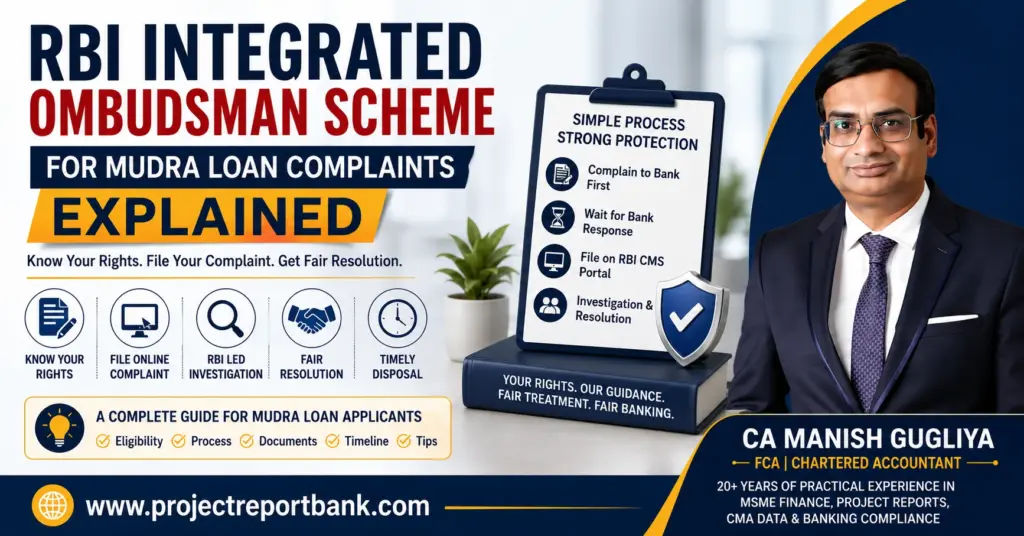
Step 1: File a complaint with your bank first. Write to the branch manager, the bank’s nodal officer, or the principal nodal officer through letter, email or the bank’s online grievance portal. Always request an acknowledgement or ticket number. You can also escalate internally to the general manager of the region if the branch does not act.
Step 2: You must wait 30 days for resolution from the bank. This 30-day clock starts from the date the bank receives your complaint. If the bank replies before 30 days and you find the response unsatisfactory, you can proceed immediately.
Step 3: During this period, keep copies of all emails, SMS, branch visit notes and any written communication. This evidence is critical. Learn how to collect evidence if a bank violates Mudra loan rules.
Step 4: If the bank’s reply brings no satisfaction or there is no reply within 30 days, lodge a complaint with the RBI Ombudsman if unresolved. Use the complaint management system portal, email or post to the Centralised Receipt and Processing Centre (CRPC), Reserve Bank of India, Sector 17, Chandigarh – 160017.
Readiness Checklist Before Approaching RBI
| Item | Status |
|---|---|
| Copy of written complaint to bank | ☐ |
| Date of lodging complaint with bank | ☐ |
| Proof of delivery (email receipt, post acknowledgement) | ☐ |
| Bank’s reply (if any) | ☐ |
| Mudra loan account number and type (Shishu/Kishor/Tarun) | ☐ |
| Supporting documents (charges statement, KFS, SMS) | ☐ |
Documents Required for a Strong Mudra Loan Complaint
The quality of your documents often decides the strength of your complaint. Many Mudra borrowers lose relief simply because they cannot prove what happened at the bank.
Key documents to collect:
- Copy of Mudra loan application
- Acknowledgment or reference number from the bank
- Copy of written complaint to the bank and any reminders you sent
- Bank’s reply letters or emails
- Sanction letter or rejection letter
- Account statements for Mudra loan and linked savings/current account
- Evidence of unauthorized charges or deductions
- Insurance policy documents (if forced insurance is alleged)
- SMS or email communications supporting your case
Identity and relationship documents:
- Aadhaar, PAN, address proof
- Business registration, Udyam registration, shop licence
- Partnership deed (if applicable)
- Guarantor’s consent documents where relevant
Scan or photograph all documents clearly. Arrange them date-wise and name files logically – this makes the online cms portal upload process much smoother, especially if you are using a mobile phone.
Documents Checklist Table
| Document | Why It Is Important | Mandatory / Optional |
|---|---|---|
| Complaint copy to bank | Proves you approached the bank first | Mandatory |
| Bank’s reply | Shows response received or not received | Mandatory (if available) |
| Mudra loan application | Establishes your relationship with the bank | Mandatory |
| Account statements | Shows unauthorized deductions or delays | Mandatory |
| KFS / charge sheet | Proves what charges were disclosed | Optional but very useful |
| Insurance documents | Supports forced insurance claim | Mandatory for insurance complaints |
| SMS/email alerts | Time-stamped evidence trail | Optional but very useful |
Step-by-Step RBI Complaint Process for Mudra Loans
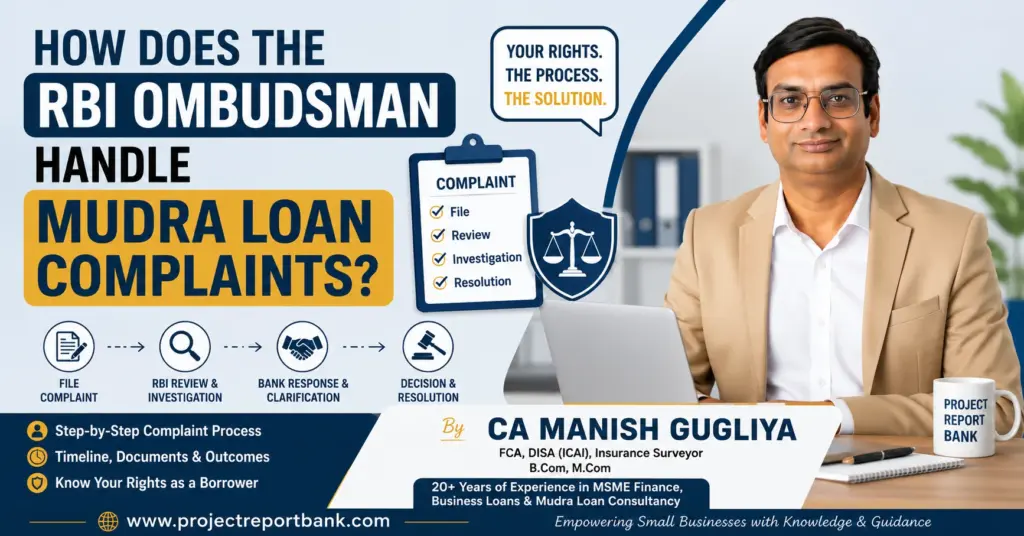
Complaints are processed at a centralized receipt and processing centre. Initial complaint intake is centralized at the CRPC in Chandigarh. Here is the step-by-step process:
Step 1: Visit the RBI CMS portal and select your language. The scheme enables filing complaints in multiple languages – the form is available in hindi and english, and facts can be described in any language.
Step 2: Choose the type of regulated entity (bank, NBFC, etc.).
Step 3: Fill in personal details, account or loan information, and the name of the bank branch.
Step 4: Describe your grievance clearly with precise dates, facts and the specific issue. Avoid emotional paragraphs. Stick to what happened, when, and what relief you want.
Step 5: Upload supporting documents (scanned copies of complaint, bank reply, statements, etc.).
Step 6: Submit and note the complaint reference number. You will need this to track status on the portal later.
Complaints can also be filed online through email or sent by post to: Centralised Receipt and Processing Centre, 4th Floor, Reserve Bank of India, Sector 17, Chandigarh – 160017. The toll free number 14448 can guide you on the process but does not itself register complaints.
What happens after submission:
The complaint is checked for basic eligibility. If maintainable, it is assigned to the concerned ombudsman office. The bank is asked to submit its version. You may be contacted for additional information.
Flowchart: Borrower files on CMS → RBI acknowledges by email/SMS → Bank files reply → Ombudsman examines and may attempt settlement → Decision / Award / Rejection
To understand how to report illegal bank practices in Mudra loans and protect yourself from illegal bank practices, review our detailed internal guides.

RBI Complaint Timeline for Mudra Loan Cases
Timelines operate at two levels: the minimum 30 days the bank gets to resolve your internal complaint, and the time taken by the rbi ombudsman after a valid complaint is filed.
Typical Timeline After Filing with RBI
| Stage | Expected Time |
|---|---|
| Day 0 | File complaint on CMS portal |
| Day 1–3 | Receive acknowledgement (SMS/email) |
| Day 7–10 | Preliminary review / maintainability check |
| Day 15–30 | Bank submits reply and supporting documents |
| Day 30–60 | Discussion, mediation and decision in most simple cases |
Complex matters – especially those involving multiple regulated entities or disputed facts – can take longer. Official timelines are indicative, not guaranteed.
What to do while waiting:
- Keep records updated
- Respond quickly to any RBI queries
- Avoid sending duplicate complaints to multiple authorities
- Continue normal repayment if your loan is already running, to avoid extra complications
- Use your complaint reference number to track status regularly on the rbi website
What Happens After Filing Complaint with RBI Ombudsman?
After you lodge your complaint, a system-generated acknowledgement with a complaint reference number is sent by SMS or email. The complaint is allocated to the concerned ombudsman office under RB-IOS. Regional Consumer Education and Protection Cells handle local oversight where applicable.
The rbi forwards the complaint to the concerned bank or regulated entity and seeks its written version. The bank must respond with supporting documents and justification for its actions.
Modes of handling:
- Clarification stage: The ombudsman may request more details from you.
- Settlement/conciliation: The ombudsman tries to help both sides arrive at a mutually acceptable solution.
- Award or rejection: If settlement is not possible, a reasoned decision is passed.
Possible outcomes:
- Bank agrees to correct its mistake – refund charged fees, issue sanction/rejection letter, close loan without penalty, correct CIBIL reporting
- Partial relief
- Complaint rejected as not maintainable or for lack of evidence
- Complaint closed as resolved on mutual settlement
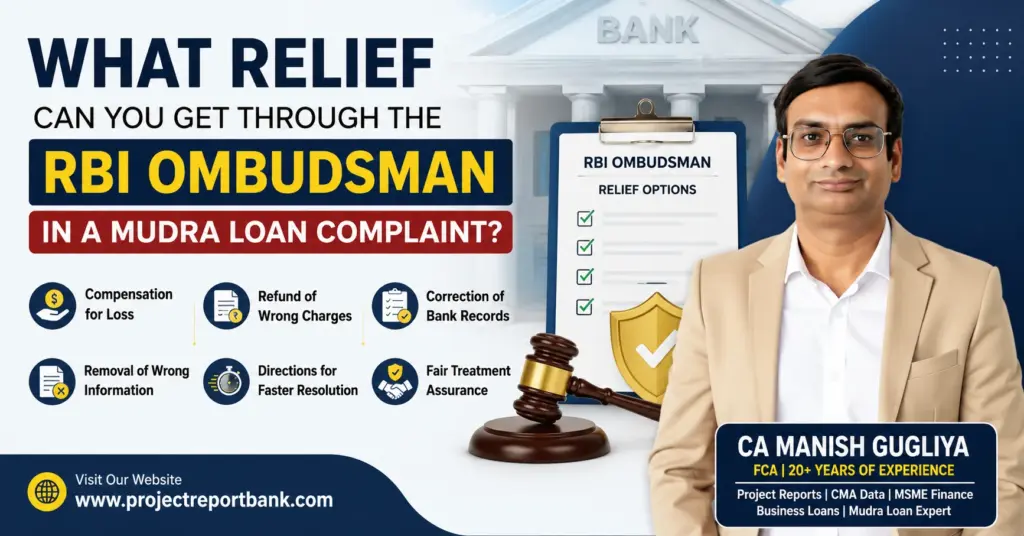
The RBI Ombudsman can award compensation for financial losses and mental anguish. Under RB-IOS 2021, the limit was ₹20 lakh for financial loss and up to ₹1 lakh for mental agony. Under the 2026 version, these limits have been raised to ₹30 lakh and ₹3 lakh respectively.
If you are not satisfied with an Award or certain closures, you can appeal to the Appellate Authority within 30 days. Take professional advice before filing such appeals.
Practical Mudra Loan Complaint Examples
Example 1: Forced Insurance
Ramesh, a vegetable vendor, applied for a Shishu Mudra loan of ₹40,000. The branch officer said the loan would only be processed if Ramesh purchased a ₹3,500 credit-life insurance policy. Ramesh complained in writing; the bank did not reply in 30 days. He filed with the rbi ombudsman citing forced tied product. The ombudsman found the bank violated PMMY guidelines (insurance is optional) and directed a refund of the premium.
Learning: Always get the insurance demand in writing. Evidence of hidden insurance charges in Mudra loans strengthens your case dramatically.
Example 2: Unreasonable Delay
Sunita, a woman entrepreneur running a small food-processing unit, applied for a Kishor Mudra loan. Four months passed with repeated document requests but no sanction or rejection. She wrote to the branch; no response came. She then approached the ombudsman. The bank was directed to either issue a sanction or provide a written rejection with reasons within 15 days.
Learning: Demand your right to timely communication. Track the Mudra loan processing stage timeline to know when delays become unreasonable.
Example 3: Hidden/Unauthorized Charges
Ajay took a Tarun Mudra loan of ₹8 lakh. At disbursement, the bank deducted ₹12,000 as “service charges” not mentioned in the Key Facts Statement. He raised the issue with the bank. The bank’s reply was vague. The ombudsman directed the bank to refund the unauthorized charges.
Learning: Always compare the KFS with actual deductions on your account statement.
Example 4: No Written Rejection Letter
Meena applied for a Mudra loan at her local branch. After two months, the officer verbally told her the loan was rejected. No written rejection was ever given, leaving Meena unable to apply elsewhere or understand the reason. She complained in writing; the bank gave no reply. The ombudsman directed the bank to issue a formal rejection letter with reasons.
Learning: Does the bank have to explain Mudra loan rejection? Yes – you have the right to a written reply.
Example 5: Complaint Rejected (Commercial Decision)
Vikram wanted ₹10 lakh under Tarun but the bank sanctioned only ₹6 lakh based on his income and credit assessment. He complained to the ombudsman demanding the full ₹10 lakh. The complaint was rejected because the loan quantum was a commercial decision within the bank’s risk policy. The ombudsman cannot override valid business judgement.
Learning: Focus your complaint on service failures, not on disagreement with the bank’s credit assessment. Frame issues as deficiency in service, not as demand for higher amounts.
Common Mistakes Mudra Applicants Make While Complaining
Even genuine borrowers lose their case because of avoidable mistakes. Here are the most common errors:
| Mistake | Better Approach |
|---|---|
| Skipping the bank’s formal complaint process | Always write to the bank first and keep proof |
| Filing with RBI before the 30-day bank response period expires | Wait the full 30 days unless the bank has already given a final reply |
| Sending emotional narratives without dates or facts | Write short, precise, date-wise accounts with documents attached |
| Blaming RBI or government instead of the specific bank | Focus only on the specific bank action and the deficiency |
| Submitting incomplete forms on the CMS portal | Fill every field, upload all relevant documents |
| Mixing many unrelated issues in one complaint | File one complaint per issue for clarity |
| Sending duplicate complaints to multiple authorities | One well-prepared complaint is stronger than five scattered ones |
| Using abusive or threatening language | Maintain respect and professionalism throughout |
Complaints routed through agents, commission brokers or unqualified consultants – without the borrower’s clear involvement – often create confusion and may not be taken seriously. Read the bank’s terms and RBI’s basic guidelines before complaining, and keep expectations realistic about what the ombudsman can and cannot do.
Tips to Increase Chances of Resolution (Expert Advice)
Here are 18 practical tips drawn from years of MSME finance advisory experience:
- Always prepare a date-wise timeline of events before writing your complaint.
- Keep the complaint within 2–3 pages. Attach documents separately.
- Quote any key RBI guideline in simple words – do not copy-paste entire circulars.
- Show how the bank’s action caused specific financial loss or hardship.
- Remain polite and factual. Emotional language reduces credibility.
- Respond quickly to any queries from the ombudsman’s office.
- Avoid threatening language or political references – they do not help.
- Continue servicing existing obligations if financially possible; default during complaint weakens your position.
- Refer to RBI’s expectations on fair treatment of MSME borrowers in your complaint.
- Highlight that Mudra loans are meant to be collateral-free up to specified amounts; forced collateral or security can be reported.
- Record cases of forced cross-selling clearly with evidence – watch for warning signs of forced cross-selling by banks.
- Never send original documents. Always send copies and keep originals safe.
- If you send complaint by post, use registered post or speed post for proof of delivery.
- Do not approach the ombudsman for loan sanction or higher amounts – that is not its role.
- Use the cms portal to track status instead of calling repeatedly.
- If the bank gives a partial reply, note what was addressed and what was not; file your RBI complaint only on unresolved points.
- If you have a guarantor, ask about guarantor rights and responsibilities before including guarantor-related issues.
- A well-prepared, honest and documented complaint has a far better chance of success than a long emotional story without proof.
RBI Ombudsman vs Consumer Court for Mudra Loan Disputes
Both forums can handle financial service issues, but they operate under different laws, timelines and powers.
| Aspect | RBI Ombudsman (RB-IOS) | Consumer Court |
|---|---|---|
| Cost | Free of cost | Court fee applicable |
| Time to decide | Usually 30–60 days (simple cases) | Several months to years |
| Need for lawyer | Not required | Usually advisable |
| Procedure | Simple online/postal form | More formal, quasi-judicial |
| Type of relief | Corrective action, limited compensation | Wider compensation, directions |
| Can question commercial decisions? | No | Limited, but broader powers |
| Appeal | Appellate Authority within RBI | District/State/National Commission |
| Best for | Clear service deficiency, moderate claims | High-value disputes, complex legal issues |
Guidance: Start with the rbi ombudsman for clear service deficiency cases. Consider consumer court when the financial loss is very high, the dispute is complex, or ombudsman relief is inadequate. In some cases, you may need both avenues at different stages.

Expert Guidance by CA Manish Gugliya
I have spent over 20 years working closely with MSMEs, Mudra loan applicants and small business owners across india. In my practice, I have seen thousands of Mudra-related disputes – some resolved quickly, many dragged out because the borrower did not know how to present a case properly. Let me share what I have learned about making the rbi integrated ombudsman scheme work for you.
How Professionals Prepare Stronger Complaints
The single biggest difference between a complaint that gets results and one that gets rejected is preparation. When I help a borrower draft a complaint, the first thing I do is request every piece of written communication – every email, SMS, letter, receipt, account statement and branch visit note. Most borrowers are surprised when I tell them that a small SMS from the bank can sometimes be the most powerful proof.
Next, I map events in a clear, precise timeline. This is not a story – it is a factual sequence. Date, what happened, who said what, what document was given or not given. This timeline becomes the backbone of the complaint. The ombudsman’s office reviews hundreds of complaints every week. A clear timeline saves their time and immediately shows merit.
I then connect the facts with the relevant RBI instruction or Mudra guideline. For example, if a bank demanded collateral on a ₹5 lakh Mudra loan, I reference the specific Master Direction on MSME Lending that prohibits this. I do not copy the entire circular – I state the relevant point in one or two simple sentences and note the circular reference for verification. This shows the ombudsman exactly which rule was broken.
Finally, I remove unnecessary emotional content. Frustration is natural when a bank treats you unfairly. But in a formal complaint, emotional language clouds the core issue. The complaint should read like a clean, professional report – not a personal letter.
Why Written Communication Matters So Much
In my experience, the number one reason good complaints fail is lack of written proof. Banks know this. That is why many branches prefer to give verbal responses. They avoid leaving a paper trail.
My advice to every Mudra applicant: from the very first day you approach a bank, communicate in writing. If you visit the branch, follow up with a short email summarising what was discussed. If the bank makes a verbal promise, write back saying “As discussed on [date], you confirmed that my Mudra loan will be processed within [time]. Please confirm.” This creates a record.
Always ask for an acknowledgement of every letter or application you submit. If the bank refuses, send it by registered post – the receipt is your proof of delivery. Preserve every SMS and email alert from the bank. These are time-stamped and can be powerful assets in your complaint.
Practical Strategies from Advisory Work
Before filing with the ombudsman, I always check whether the complaint is maintainable under RB-IOS. Is it about service deficiency or about a business decision? Has the bank been given 30 days to respond? Has the borrower filed within the allowable time window? A complaint that fails on maintainability never reaches the merits stage, no matter how genuine.
I also help borrowers choose the correct forum. Not every issue belongs at the ombudsman’s door. Some matters are better suited for consumer court or even a simple escalation to the bank’s principal nodal officer or the general manager at the zonal office. Picking the right forum at the right time saves weeks of effort.
Avoiding Unnecessary Disputes
Part of good financial discipline is knowing when not to fight. Minor misunderstandings – a small processing delay, a request for one additional document – can often be resolved with a calm conversation at the branch. Not every inconvenience is a deficiency in service.
Being transparent with the bank about your financial information, maintaining regular repayments where feasible and building a positive track record all improve your standing. Banks treat borrowers with good repayment history very differently from those with defaults. Even if you are pursuing a legitimate complaint, continue your EMI payments if the loan is already running. A default during the complaint process complicates everything.
Maintaining Professional Communication
I always tell my clients: treat bank officials with respect, even when you strongly disagree. Polite, professional communication improves your chances at both the bank stage and the ombudsman stage. The ombudsman values complainants who present facts calmly and let the evidence speak.
If bank staff behaves rudely, note the date, time and nature of the interaction, and include it in your complaint. But do not respond in kind. Your job is to escalate through proper channels – not to win an argument at the branch counter.
When Expert Help Becomes Useful
Most simple complaints – a delayed application, an unauthorized charge, a missing rejection letter – can be handled by the borrower directly using the guidance in this article. But certain situations demand professional help:
- Complex documentation involving multiple accounts or transactions
- Repeated rejections without clear or consistent reasons
- Large disputed charges that significantly impact your business
- CIBIL reporting disputes where your credit score is damaged
- Situations where you feel overwhelmed by forms, portals and technical language
In these cases, a qualified professional can prepare a precise issue-note, verify maintainability, draft the complaint in the correct format and manage communication with both the bank and the ombudsman’s office.
My recommendation: Focus your energy on running and growing your business. If the complaint process feels overwhelming, seek professional guidance for preparing Mudra project reports, CMA data, documentation and complaint strategy. A properly prepared case not only improves your chances of resolution but also saves you valuable time and stress that your business cannot afford.
Frequently Asked Questions on RBI Integrated Ombudsman Scheme for Mudra Loans
The following FAQs cover common doubts not fully addressed in the sections above.
Can a rejected Mudra applicant file with RBI Ombudsman without any bank reply?
No. You must first lodge a written complaint with the bank and wait 30 days. If the bank does not reply or gives an unsatisfactory reply, only then can you approach the ombudsman. Filing without this step will likely result in your complaint being rejected as premature.
Can a guarantor file a complaint under RB-IOS?
Yes. If a guarantor is directly affected by the bank’s deficiency in service – for example, the bank wrongly reports the guarantor’s credit information or harasses the guarantor without following RBI norms – the guarantor can file a complaint. Learn more about guarantor liability in Mudra loans.
Can I file the complaint in my local language?
Yes. The scheme enables filing complaints in multiple languages. The online form on the cms portal supports hindi and english, and the grievance description can be written in any language. Physical complaints sent by post or email can also be in any language.
Will filing a complaint affect my credit score or future relationship with the bank?
Filing a legitimate complaint through the ombudsman does not negatively affect your credit score. Your CIBIL or credit bureau record is based on your repayment behaviour, not on complaints. However, maintaining professional communication throughout the process helps preserve your banking relationship.
Can the RBI Ombudsman force the bank to sanction my Mudra loan?
No. The ombudsman cannot force a bank to sanction, increase or modify a loan if the bank’s decision is a valid commercial judgement based on its internal risk assessment. The ombudsman addresses service deficiency – not lending decisions. If the bank failed to follow proper procedures (no written rejection, unexplained delay, violation of RBI guidelines), those issues can be addressed. But the final credit decision remains with the bank.
Is there a toll free number to get help with the complaint process?
Yes. You can call the toll free number 14448 for guidance on how to file your complaint and understand the process. However, this helpline does not register complaints on your behalf – you must use the cms portal, email or post for formal filing.
What if I already filed the same complaint in consumer court?
If the same matter is already pending before a court, tribunal or arbitrator, the ombudsman will not accept your complaint. You must choose one forum. In some cases, you can approach consumer court after the ombudsman process is complete if you are not satisfied with the outcome.
How do I track my complaint after filing?
Use the complaint reference number provided at the time of filing. Visit the rbi website or the CMS portal and use the “Track a Complaint” feature to check progress. You can also withdraw a complaint at any stage through this portal.
Conclusion
Mudra loans are a powerful tool for small businesses across india. But problems with banks – delay, hidden charges, forced insurance, rude behaviour – remain common. The RBI’s Integrated Ombudsman Scheme provides a structured, free and time-bound way to address genuine service deficiencies after your bank has failed to resolve them internally.
Success depends on following the right sequence: internal bank complaint, a 30-day waiting period, and then a well-documented complaint to the rbi ombudsman focused on deficiency in service – not simply disagreement over commercial decisions.
Be informed. Be organised. Be professional. Correct use of the scheme not only helps you as an individual entrepreneur but also sends a clear signal to banks that Mudra borrowers know their rights.
When in doubt, consulting a qualified professional can save you time, stress and money – especially when your main focus should remain on running and growing your business.
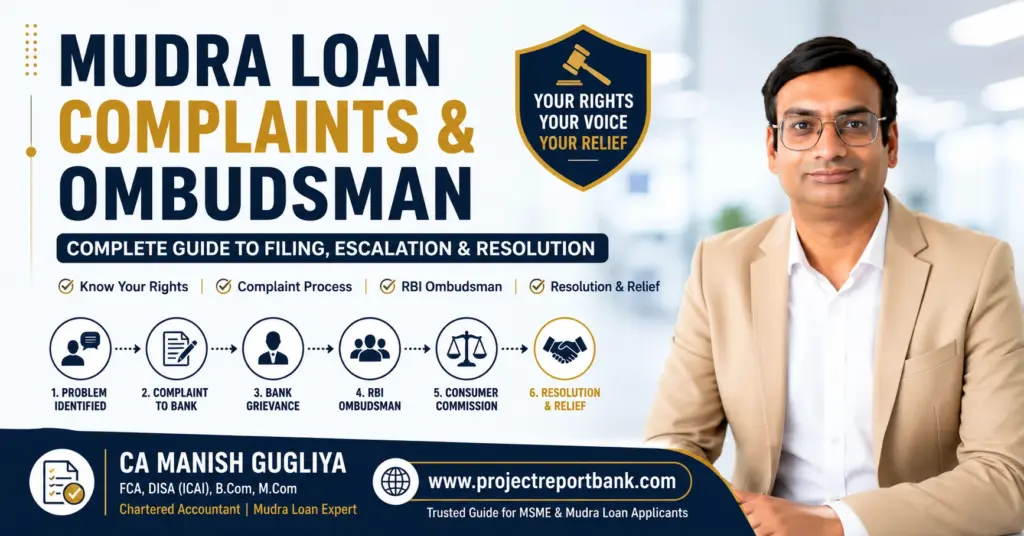
- Mudra Loan Complaints & Ombudsman: Complete Guide to Filing, Escalation & Resolution
- Can a Bank Blacklist You for Filing a Mudra Loan Complaint?
- Can a Mudra Loan Complaint Affect Future Loan Approval?
- Common Mistakes That Lead to Mudra Loan Complaint Failure
- RBI Ombudsman Mudra Loan Relief: Practical Guide for Small Borrowers
- Can the RBI Ombudsman Reject Your Mudra Loan Complaint? Reasons Explained
- Consumer Commission vs RBI Ombudsman: Which Is Better for Mudra Loan Disputes?
- Bank Grievance Redressal System for Mudra Loans: Complete Guide
- RBI Ombudsman Mudra Loan Complaint – Detailed Guide by CA Manish Gugliya