Key Takeaways
- The RBI Ombudsman can reject Mudra loan complaints under the Integrated Ombudsman Scheme, 2021 if basic eligibility conditions are not met. This article explains every major rejection reason in simple language.
- Many Mudra loan complaints are rejected because borrowers do not first complain in writing to the bank, or they file after the time limit – usually one year from the bank’s reply or 13 months from the incident.
- Complaints outside the Reserve Bank of India jurisdiction, against non-regulated entities, without evidence, or already pending in court are treated as “not maintainable.”
- This guide covers step-by-step what RBI Ombudsman accepts, what it rejects, how to avoid rejection, documents required, appeal options, and a full Mudra case study.
Introduction: Why Mudra Loan Complaints Get Rejected So Often
I am CA Manish Gugliya (FCA), and in my 20+ years of working with MSME finance and Mudra loan consultancy, I have seen thousands of borrowers approach the RBI Ombudsman only to have their complaint rejected. The reason is almost always the same – the basic rules of the Integrated Ombudsman Scheme were not followed.
Mudra loans, under the Pradhan Mantri Mudra Yojana (PMMY) launched in 2015, offer up to ₹10 lakh to micro and small businesses across three categories: Shishu (up to ₹50,000), Kishor (₹50,001 to ₹5 lakh), and Tarun (₹5,00,001 to ₹10 lakh). When banks delay, overcharge, or refuse these loans without reason, borrowers naturally look for an independent authority. The RBI Ombudsman is that authority.
But here is the reality: when the RBI Ombudsman rejects a Mudra loan complaint, it does not always mean the borrower is wrong. It often means the complaint was filed in the wrong way, at the wrong time, or against the wrong party. The Reserve Bank of India’s Integrated Ombudsman Scheme, 2021, replaced the older banking ombudsman scheme and now covers banks, non banking financial companies, and certain payment system operators – all called regulated entities.
This article will show you: (1) when the RBI Ombudsman can reject a Mudra loan complaint, (2) how to prepare a valid complaint, and (3) what options exist after rejection. Filing a complaint is free under the RBI Ombudsman Scheme, so let us make sure yours does not get wasted.

Table of Contents
Can RBI Ombudsman Reject Your Mudra Loan Complaint?
Yes. The RBI Ombudsman has full legal power under the Integrated Ombudsman Scheme, 2021 to reject or close Mudra loan complaints at the preliminary stage if they do not meet eligibility conditions.
When a complaint is “not maintainable,” it means it does not fit the rules of the ombudsman scheme, so it cannot be examined on merits. If you check your status on the CMS portal, you may see phrases like “Rejected” or “Non-maintainable” with a reason code referencing a specific clause.
The legal base is the Reserve Bank – Integrated Ombudsman Scheme, 2021, notified on 12 November 2021. It covers all regulated entities like scheduled commercial banks, certain NBFCs with assets above ₹100 crore, credit information companies, and payment system operators. In summary proceedings, the Ombudsman analyzes evidence based on banking laws and guidelines to decide each case.
The banking ombudsman – now part of the integrated ombudsman – is not a general court. It is limited to deficiency in service by entities regulated by the Reserve Bank of India, including delays, overcharges, or mishandling in Mudra loan sanction, disbursement, or account handling. It operates under the consumer education and protection department of RBI.
To be eligible, your complaint must meet these conditions:
- You first approached the concerned regulated entity (the bank) in writing
- Your complaint is within time limits
- The matter is not already pending in court
- Your complaint is about a service failure covered under the scheme
Common Reasons RBI Ombudsman Rejects Mudra Loan Complaints
Most rejections of Mudra loan complaints fall into standard categories listed in Clause 10 of the Integrated Ombudsman Scheme. The RBI Ombudsman may reject a complaint based on specific administrative and procedural grounds, and complaints can be rejected for non-maintainability at any stage.
In FY 2024-25, total complaints under the scheme reached approximately 13.34 lakh, with 29.25% related to loans and advances – the category that includes Mudra loans. A significant portion of these customer complaints were closed as non-maintainable. Knowing these grounds in advance helps you prepare a strong Mudra loan grievance that is more likely to be admitted.

Complaint Filed Before Approaching the Bank
Under the Integrated Ombudsman Scheme, the borrower must first file a complaint in writing to the bank’s branch and nodal officer and wait up to 30 days for a reply. Complaints can be rejected if the complainant did not approach the bank first in writing. The grievance redress process starts at the bank level, not at the ombudsman office.
Example: In April 2025, a borrower in Jaipur directly files on CMS about Mudra loan rejection without ever emailing or writing to the bank. RBI marks the complaint “Premature” and rejects it.
The correct flow is: branch or customer care → bank grievance redressal system → RBI Ombudsman.
Solution: Send a written complaint to the bank via email or letter. Keep the acknowledgement or ticket number. Approach the ombudsman only if no satisfactory reply comes within 30 days.
Complaint Filed After Limitation Period
Complaints must be filed within one year of the incident – specifically, within one year from the bank’s final reply. If the bank did not reply at all, you have 13 months (one year + 30 days) from the date you wrote to the bank.
Example: A Mudra loan was wrongly rejected on 15 January 2023. The bank replied on 1 February 2023. But the borrower approaches RBI Ombudsman in March 2025. This is time-barred and will be rejected.
Count your dates carefully. If there are multiple letters, use the bank’s final response date. Delays in collecting documents submitted to the bank do not normally stop the limitation clock, so file within time even if some papers are still being arranged.
Complaint Outside RBI Jurisdiction
The RBI Ombudsman only handles disputes involving entities regulated by the Reserve Bank. Complaints must relate to services provided by RBI-regulated entities. Disputes with private moneylenders, NGOs, unregistered fintech apps, or government subsidy decisions fall outside its regulatory purview.
Example: A borrower complains that the District Industries Centre refused a Mudra subsidy, or a state government department delayed a caste certificate. RBI Ombudsman rejects this as “outside jurisdiction.” Similarly, matters like an employer employee dispute or pure commercial disagreements between business partners are not covered.
Solution: Check whether the opposite party is listed as a regulated entity on the RBI website. If not, consider other remedies like a Consumer Commission or civil court.
Matter Already Pending in Court or Other Forum
Complaints can be dismissed if a parallel legal proceeding is already pending on the same issue. This prevents duplication. Additionally, complaints cannot be filed for issues already decided by courts.
Example: A trader has already filed a Consumer Commission case in 2024 about wrongful Mudra loan recall and then files again with RBI Ombudsman. The ombudsman rejects citing the ongoing court matter.
If the court case covers a different aspect (say, a property dispute) and your ombudsman complaint is purely about bank service deficiency, explain this clearly. After legal advice, choose one main forum and continue there.
Complaint Lacks Evidence or Clear Facts
Vague or emotional complaints – “bank is cheating me” – without supporting documents are difficult for RBI Ombudsman to admit. Complaints may be dismissed if judged as lacking sufficient cause or being frivolous. Complaints lacking sufficient evidence may be rejected outright.
Example: A borrower claims bank staff demanded a bribe for sanctioning a ₹5 lakh Mudra loan but provides no emails, messages, or witness names. RBI may treat it as unsubstantiated. Also, documents requiring complex evidence may not be suitable for summary proceedings before the ombudsman.
Solution: Attach sanction letters, rejection emails, bank statements, application receipts, sms alerts screenshots, and written communication. Write facts in a timeline format with dates and amounts so the ombudsman can easily understand the deficiency.
Anonymous or Incomplete Complaint
Complaints not directly addressed to the Ombudsman from an identified person may be considered non-actionable. Under the scheme, every complaint must carry the complainant’s name, contact details, and relationship with the account. An anonymous filing is rejected outright.
Example: A person files on CMS only as “Concerned Citizen” without account number or KYC details, alleging large-scale Mudra fraud in a branch. RBI may treat this as information but not a maintainable complaint.
Whistle-blower concerns about systemic fraud should go to appropriate RBI departments or the bank’s vigilance cell, not the ombudsman channel. However, authorized representatives can file complaints on behalf of consumers – an authorised representative like a family member or advocate can submit the complaint with proper authorization.
Fill all mandatory fields: name, address, e mail, phone, account number, bank branch, and complaint number from bank’s internal system.
Wrong Bank or Branch Selected
Sometimes borrowers select the wrong regulated entity in the CMS dropdown – for example, choosing SBI instead of SBI Cards, or selecting a correspondent bank instead of the actual Mudra lending bank. This leads to delays or closure.
Example: A Mudra loan was taken from a regional rural bank in 2023, but the complaint is filed against the sponsor bank. The ombudsman may mark it as mis-directed.
Solution: Verify details from your passbook, sanction letter, or Mudra loan agreement. Correctly choose bank name, branch, city, and product type when filing online. Include accurate transaction details in every field.
Complaint Against Non-Covered Entity (DSA/Agent/Consultant)
Complaints purely against Direct Selling Agents, external recovery agents, or private consultants – who are not RBI-regulated in their personal capacity – may be rejected if no deficiency is alleged against the bank itself.
Example: A borrower paid ₹15,000 to a local agent who promised to get a Mudra loan sanctioned but disappeared. RBI Ombudsman cannot order that agent to refund because he is not a regulated entity. The bank’s deposit size or type is irrelevant here – the issue is about an unregulated person.
If the bank allowed or supported illegal behaviour by its agent (like abusive recovery calls), the complaint must focus on bank responsibility. Otherwise, consider a police complaint, consumer forum, or civil suit against the private agent.
No Deficiency in Banking Service Found
A complaint is maintainable only if it involves a deficiency in service by the bank. If the bank followed RBI and government guidelines, the complaint may be rejected even if the borrower is unhappy.
The Ombudsman cannot interfere with a bank’s commercial judgment or commercial decision. Banks are not required to sanction every Mudra loan.
Example: A borrower’s 2024 Mudra application is declined due to a very low credit score and existing NPA. RBI Ombudsman holds this as a commercial decision, not a deficiency in service.
The ombudsman checks whether the bank evaluated the application fairly, transparently, and within a reasonable time. Focus your complaint on clear violations – delay beyond normal timelines, wrong interest charges, or mis-calculation of eligibility – rather than simply “I wanted a loan but bank refused.”
Complaint Already Settled or Withdrawn
If the bank has already resolved the Mudra issue and documented settlement, the RBI Ombudsman may close the complaint as “settled” and not pass further directions.
Example: During 2025, a bank reverses a wrongful Mudra processing fee and issues an apology before the ombudsman hearing date. The complaint is then closed as resolved.
If you voluntarily signed a “full and final settlement” with the bank, the ombudsman may treat that as closure unless there is clear evidence of coercion. Think carefully before signing any settlement letter if you still plan to pursue the matter before RBI Ombudsman or Consumer Commission later.
Complaints RBI Ombudsman Usually Accepts in Mudra Loan Matters
Once basic eligibility is satisfied, the RBI Ombudsman generally admits customer complaints involving deficiency in service as defined in the Integrated Ombudsman Scheme. Typical Mudra loan issues that get accepted include:
- Unreasonable delay in processing (e.g., Shishu loan application pending for 60+ days without response)
- Non-communication of rejection reasons
- Wrong interest rate or charges (e.g., Kishor loan charged higher than RBI guidelines)
- Mis-selling of insurance along with Mudra loan
- Unauthorized auto-debits from borrower’s account
- Refusal to provide loan account statement
- Wrongful closure or NPA classification without notice
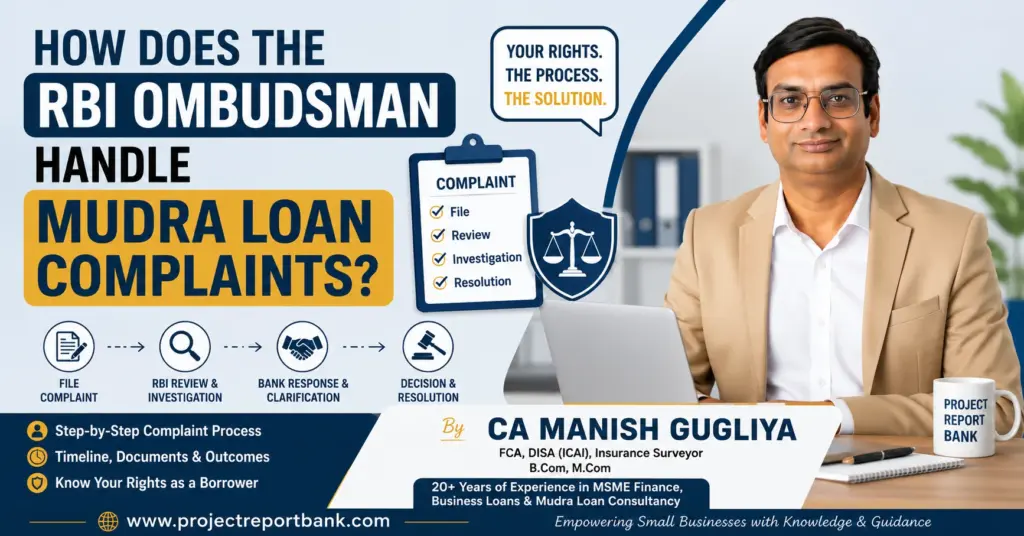
For a detailed understanding of how RBI Ombudsman handles Mudra loan complaints, including the step-by-step process after admission, you can refer to our separate guide.
Acceptance does not guarantee full relief or loan sanction. It ensures an impartial examination of the bank’s conduct under RBI and Mudra guidelines. The Ombudsman may award financial compensation or dismiss the complaint based on evidence.
How to Avoid Rejection of Your RBI Mudra Loan Complaint
Here is a practical checklist to file a complaint that survives initial scrutiny:
- Always complain first to the bank’s branch and nodal officer in writing
- Wait at least 30 days for a reply, or obtain the final reply before escalating
- File within the 1-year (from bank reply) or 13-month (from date of incident if no reply) limitation period
- Confirm the bank is an RBI-regulated entity
- Select the exact bank and branch in the CMS portal – complaints can be filed online at cms.rbi.org.in
- Complaints can also be submitted via email to cpc@rbi.org.in, or in physical mode by post to the centralised receipt and processing centre
- Keep copies of Mudra loan application, sanction/rejection letter, rate of interest sheet, repayment schedule, emails, SMS, complaint receipts, and any internal grievance reference number
- Write the complaint in simple, chronological order with dates and amounts
- Clearly state what relief you request – loan sanction, refund of excess charges, correction of CIBIL reporting, or written apology
- Use polite, factual language – professional presentation avoids dismissal for being frivolous or vexatious
- You can also reach RBI’s contact centre via their toll free number for guidance before filing
- The complaint can be submitted in regional languages if preferred
- Consult a professional like a CA for complex or high-value Mudra disputes
For a broader understanding of who can file an RBI Ombudsman complaint for Mudra loans, including the role of an authorised representative, refer to our related guide. The entire process is cost free for the aggrieved person.
Documents Required Before Filing an RBI Ombudsman Mudra Complaint
Keeping documents ready speeds up the process and reduces the risk of rejection. The receipt and processing centre reviews your filing against what you attach. Here is a ready reference:
| Document | Why It Is Needed |
|---|---|
| Identity proof (Aadhaar / PAN) | Verifies identity of complainant |
| Mudra loan application form or application number | Proves you applied for the loan |
| Sanction / rejection letter with date | Shows bank’s decision and timeline |
| Loan account statement | Shows disbursement, charges, EMI history |
| Correspondence with bank (emails, letters, SMS) | Proves you raised the grievance first |
| Bank’s final reply to grievance | Establishes the complaint is not premature |
| Internal complaint reference number | Confirms the bank’s grievance redress process was used |
| CIBIL report (if credit-score error is alleged) | Supports claim of wrong reporting |
| Proof of security offered / invoices submitted | Relevant for disbursement or usage disputes |
Scanned copies or clear mobile photos (PDF/JPEG) can be uploaded on the CMS portal. Use meaningful file names like “Mudra-Sanction-Letter-15-06-2024.pdf” so the ombudsman office can easily review them.
What Happens After RBI Ombudsman Rejects Your Mudra Loan Complaint?
Rejection is not always the end. The outcome depends on whether your complaint was rejected for a technical defect or on merits.
You will typically receive a closure communication via CMS portal status update and an email or SMS intimation, sometimes with a PDF order stating the specific clause of the scheme under which it was rejected. You can track your complaint status using the RBI CMS portal anytime with your complaint number and reference number.
There is an important difference:
- Technical rejection (premature, time-barred, outside jurisdiction): You may correct the defect and file a fresh complaint if limitation still permits.
- Rejection after detailed examination (no deficiency found): This is more like a final decision and harder to overturn without new evidence.
After rejection, your options include: re-filing a fresh complaint with missing documents, approaching the bank again with clarifications, or considering Consumer Commission vs RBI Ombudsman for suitable cases. Read the rejection reason carefully and, where required, seek professional help.
Can You Appeal Against the RBI Ombudsman’s Decision in a Mudra Case?
Under the Integrated Ombudsman Scheme, an appeal can be made to the appellate authority in RBI – usually the executive director in charge of the consumer education and protection department – against certain types of orders. The appellate authority functions as a quasi judicial authority reviewing the ombudsman’s decision.
The typical time window is 30 days from the date of the ombudsman’s decision. Appeals are generally possible where there is an award, partial relief, or rejection on merits. Pure technical non-maintainable closures may have limited scope for appeal but can sometimes be corrected through a fresh complaint if time allows.
Documents needed for appeal:
- Copy of ombudsman order
- Earlier complaint and all documents submitted
- Bank’s replies
- A clear note explaining why you believe the decision is wrong
There is a monetary limit on compensation the ombudsman can provide, and a complaint can be rejected if it seeks compensation beyond the Ombudsman’s authority. Even after appeal, borrowers retain independent rights to approach a Consumer Commission or civil court. The ombudsman approach is an additional remedy, not the only one. An advocate can represent you in these alternative forums.
Practical Mudra Loan Case Study: From Rejection to Successful Re-Filing
Meet Meena, a women entrepreneur from Bhopal who applied for a ₹3 lakh Mudra Kishor loan in 2024.

Step 1 – The Mistake: Meena’s bank delayed her Mudra application for 2 months without any written response. Frustrated, she directly filed a complaint on the CMS portal without first using the bank grievance redressal system. The ombudsman rejected her complaint as “premature” under Clause 10 – she had not approached the bank in writing first.
Step 2 – The Correction: After reading this guide, Meena sent a formal written complaint to the bank branch manager and the nodal officer via email, clearly stating her Mudra application number, date, and the 60-day delay. She kept the email receipt. After 30 days with no bank reply, she collected all her documents – application form, bank correspondence, identity proof – and re-filed a detailed RBI Ombudsman complaint, this time selecting the correct bank name and branch.
Step 3 – The Result: The RBI Ombudsman admitted the complaint, sought the bank’s reply, and after examination, directed the bank to process Meena’s Mudra application within 15 days or issue a reasoned rejection letter and correct the delay-related deficiency.
The first complaint failed due to process mistakes. The second succeeded because it followed the Integrated Ombudsman Scheme rules and presented clear evidence. The sector she operates in did not matter – what mattered was procedure.
Common Mistakes Borrowers Make While Filing RBI Mudra Complaints
Here is a quick “Do / Don’t” checklist:
| Don’t | Do |
|---|---|
| Skip the bank’s internal grievance process | File a written complaint to bank first and wait 30 days |
| File without documents | Attach all relevant proof with your online submission |
| Mix multiple unrelated issues in one complaint | File separate complaints for separate issues |
| Use abusive or threatening language | Be polite, factual, and professional |
| Hide material facts (like being NPA) | Disclose full facts in good faith |
| Demand unrealistic relief (waive entire principal) | Request reasonable, specific relief |
| Ignore the limitation period | Track dates carefully and file on time |
| Select wrong bank name in CMS | Verify from passbook or sanction letter |
| Make anonymous or third-party complaints without authorization | Use your real name or proper authorised representative |
| File multiple complaints for same issue in quick succession | File once with complete information |
Avoiding these mistakes directly reduces the chance of the RBI Ombudsman rejecting your Mudra loan complaint. If your complaint is about financial loss caused by the bank, make sure you quantify it clearly.
Expert Advice from CA Manish Gugliya Before You File an RBI Mudra Complaint
In my 20+ years of working with MSME customers and Mudra loan consultancy, I have found that most issues can be resolved if handled carefully from the start. Here are my practical recommendations:
- Prepare a proper project report for your Mudra loan application – this reduces the chance of rejection at the bank level itself
- Understand the bank’s eligibility norms before applying – credit score, business vintage, address proof requirements
- Maintain all communication in writing – every request, every response, every payment receipt
- Act within time limits – both the bank’s internal grievance timelines and the ombudsman’s one-year window
- Use RBI Ombudsman as a last escalation step, not the first – resolve customer complaints at branch level whenever possible
- Know when to get professional help – complex cases involving NPA classification, large Mudra loans near ₹10 lakh, or earlier rejections marked as “not maintainable” benefit from expert guidance
- Choose the right forum – for some disputes, a Consumer Commission may offer better remedies than the ombudsman
For deeper understanding, explore our guides on RBI Ombudsman complaints for Mudra loans and the complete bank grievance redressal system.
A well-prepared, honest borrower who submits proper paperwork stands a strong chance of getting fair treatment from both the bank and the RBI Ombudsman. The process is designed to help customers in India – use it wisely.
Frequently Asked Questions (FAQ) on RBI Ombudsman Rejecting Mudra Loan Complaints
Here are additional clarifications on common borrower questions.
Can the RBI Ombudsman reject my Mudra complaint without giving me a hearing?
Yes. For clearly non-maintainable matters – time-barred, premature, outside jurisdiction, or anonymous – the Integrated Ombudsman Scheme allows rejection at a preliminary stage based on documents alone, though the order usually states the reason. In many Mudra cases where facts are disputed, the ombudsman will seek the bank’s reply and may offer a chance for a written or virtual hearing before passing a final order. The ombudsman scheme is designed for summary proceedings, so elaborate oral hearings like in civil courts are rare.
Can I file both a Consumer Commission case and RBI Ombudsman complaint for the same Mudra issue?
If a case is already pending before a Consumer Commission, the RBI Ombudsman will usually refuse to entertain the same matter to avoid duplication. Choose one main forum after understanding the pros and cons. For strategic guidance, you can read our comparison of Consumer Commission vs RBI Ombudsman for Mudra loan disputes.
Is a legal notice from an advocate compulsory before going to RBI Ombudsman?
No. The ombudsman scheme does not make a lawyer’s notice mandatory. What is mandatory is a written complaint to the bank and either an unsatisfactory reply or no reply within 30 days. Borrowers may still use a lawyer or CA to draft a better complaint if the matter is complex, but any person can file a complaint without legal representation.
Will complaining to the RBI Ombudsman affect my CIBIL score or relationship with the bank?
Filing a genuine, well-documented complaint does not directly lower your CIBIL score. However, existing overdues or NPAs will still reflect in bank reporting. RBI encourages banks not to retaliate against complainants, and any such behaviour can itself be raised as a service deficiency. Stay professional with bank officials throughout the process.
Can I get compensation for mental harassment if my Mudra loan complaint is upheld?
The Integrated Ombudsman Scheme allows the RBI Ombudsman to provide compensation for loss of time, expenses, and harassment, but the amount is subject to a monetary limit set by the scheme and depends entirely on case facts. Focus first on correcting the core issue – sanction, delay, wrong charges – and then request reasonable compensation with justification. Very large amounts like in civil suits are not typical in ombudsman proceedings.
Conclusion: Use RBI Ombudsman Wisely for Mudra Loan Disputes
The RBI Ombudsman is a powerful, cost free mechanism for Mudra borrowers – but it will reject complaints that do not follow the Integrated Ombudsman Scheme rules or do not show a real deficiency in service.
To improve your chances: (1) first use the bank’s internal grievance system, (2) stay within timelines, (3) collect solid documents, and (4) file a clear, factual complaint. The RBI Complaint Management System is used to track or submit grievances – use it properly and your complaint will be taken seriously.
Do not let a preventable technical mistake become the reason your valid Mudra complaint gets rejected. Understand the eligibility, avoid common mistakes, and seek professional guidance where needed. An informed borrower is always a stronger borrower.
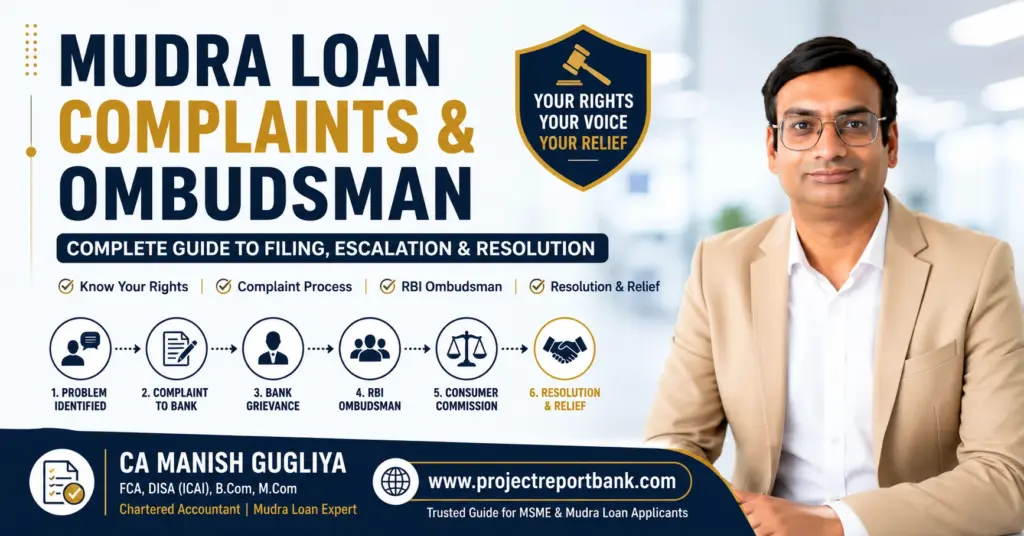
- Mudra Loan Complaints & Ombudsman: Complete Guide to Filing, Escalation & Resolution

- Can a Bank Blacklist You for Filing a Mudra Loan Complaint?
- Can a Mudra Loan Complaint Affect Future Loan Approval?
- Common Mistakes That Lead to Mudra Loan Complaint Failure
- RBI Ombudsman Mudra Loan Relief: Practical Guide for Small Borrowers
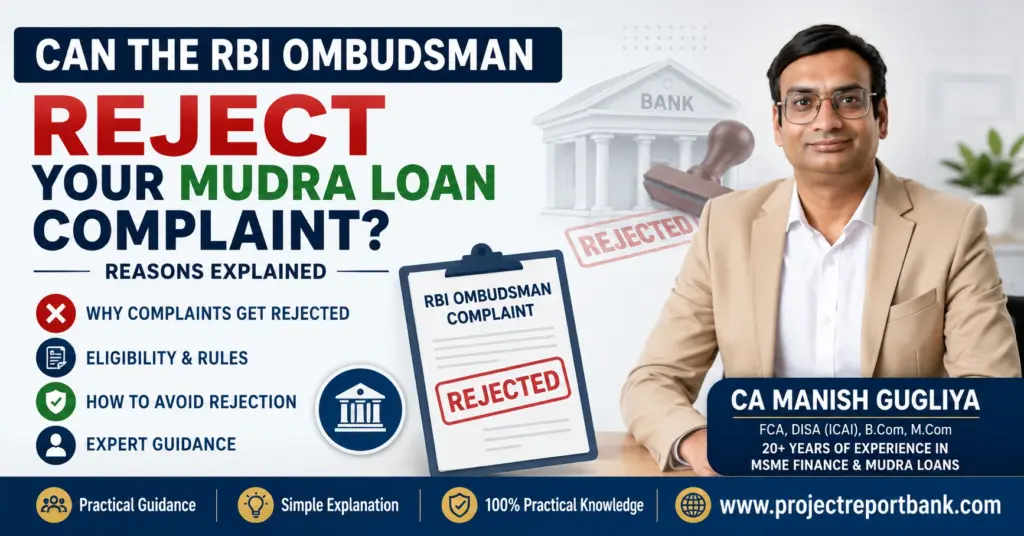
- Can the RBI Ombudsman Reject Your Mudra Loan Complaint? Reasons Explained
- Consumer Commission vs RBI Ombudsman: Which Is Better for Mudra Loan Disputes?
- Bank Grievance Redressal System for Mudra Loans: Complete Guide
- RBI Ombudsman Mudra Loan Complaint – Detailed Guide by CA Manish Gugliya