Key Takeaways
Here are the quick answers about filing an RBI Ombudsman Mudra loan complaint, so you know what to expect before reading the full guide.
- The RBI Integrated Ombudsman handles only complaints showing deficiency in service by banks and other regulated entities. It does not overrule business decisions like a pure loan rejection based on credit assessment.
- A Mudra loan borrower must first file a complaint with the bank and wait up to 30 days for a response. Only after this can you file a complaint on RBI’s complaint management system portal for non adherence to RBI or PMMY guidelines.
- After filing on CMS, the complaint moves through fixed stages: registration, bank reply, borrower rebuttal, investigation, settlement attempt, and then decision or closure.
- Strong supporting documents – emails, rejection letters, sanction letters, account statements, screenshots, call records – and clear facts greatly improve the chances of a favourable outcome from the banking ombudsman.
Introduction: Why Mudra Loan Borrowers Turn to the RBI Ombudsman
In my 20+ years of helping MSMEs with finance and banking issues, I have seen countless small business owners struggle with banks over their Mudra loan applications. The problems repeat themselves: branches demand unnecessary documents, force borrowers to buy insurance, delay disbursal for months, or reject applications without giving written reasons – even when the borrower meets every eligibility criterion.
Common Mudra loan disputes include repeated document demands, non adherence to Reserve Bank of India guidelines, pressure to add a guarantor when collateral is not required, and outright rejection without explanation. These situations leave borrowers feeling helpless.
The reserve bank’s Integrated Ombudsman enters the picture only after the bank’s internal grievance process fails or the bank does not respond within 30 days. You must file a formal complaint with your lender before approaching the RBI Ombudsman.
This article explains how the RBI Ombudsman handles Mudra loan complaints – step by step, based on real MSME financing experience. Whether you are preparing to file a complaint or have already filed one, this guide from ProjectReportBank covers the entire process.

Table of Contents
Understanding the RBI Integrated Ombudsman Scheme for Mudra Loans
From 12 November 2021, RBI merged its earlier ombudsman schemes into the Reserve Bank – Integrated Ombudsman Scheme, 2021, creating a single “One Nation One Ombudsman” framework. This scheme was further updated in 2026.
Here is what you need to know:
- A banking ombudsman is an independent authority set up by the RBI. It resolves customer complaints against banks and ensures accountability in banking services.
- The scheme covers deficiency in service – not commercial lending decisions made in good faith.
Which regulated entities are covered for Mudra loan issues?
- Public sector banks
- Private banks
- Small finance banks
- Regional rural banks
- Scheduled commercial banks
- Eligible NBFCs participating in PMMY
Mudra loans are offered by commercial banks, regional rural banks, small finance banks, or NBFCs. Mudra loans can be up to ₹10,00,000, split into categories: Shishu loans are up to ₹50,000, Kishore loans range from ₹50,001 to ₹5,00,000, and Tarun loans range from ₹5,00,001 to ₹10,00,000.
The key difference: a bank’s own grievance redressal cell (branch manager, regional office, nodal officer) is the first step. The external RBI Ombudsman comes only after the bank has been approached and has either not responded or given an unsatisfactory reply.
Complaints to the Ombudsman can be filed online or submitted via email or post. You can file complaints online at the RBI’s CMS portal (cms.rbi.org.in), email crpc@rbi.org.in, or send a physical letter to the Centralised Receipt and Processing Centre in Chandigarh.
Can Every Mudra Loan Complaint Go to the RBI Ombudsman?
No. Not every Mudra loan issue can be taken to RBI. Only cases showing service deficiency or non adherence to guidelines are usually maintainable. The RBI Ombudsman does not usually interfere with a lender’s commercial decisions unless RBI rules are violated. The RB-IOS covers deficiencies in service for Mudra loans – not disputes about business feasibility.
However, complaints can be filed if banks deny Mudra loans under circumstances where the process was unfair or guidelines were ignored.
Eligible Mudra loan complaints include:
- Unreasonable delay in sanction or disbursal beyond a reasonable period
- Charging wrong interest rates or hidden fees
- Non-issue of sanction or rejection letter in writing
- Mis-selling of insurance or forced bundling of products
- Rude behaviour or harassment by branch staff
- Clear violation of PMMY or RBI circulars
Not eligible or normally rejected:
- Bank’s commercial decision to reject a proposal based on internal credit policy
- Demand for a higher loan amount than permitted under Mudra categories
- Disputes purely about business feasibility or viability
| Eligible Mudra Loan Complaints | Not Eligible / Normally Rejected |
|---|---|
| Branch keeps you waiting 3 months with no written answer | Bank refuses loan due to low credit score but gives written reasons |
| Bank charges fees not in its published schedule | Borrower wants ₹15 lakh but Tarun limit is ₹10 lakh |
| Forced insurance purchase as a condition for Mudra loan | Bank declines after proper appraisal and communicates clearly |
| No rejection letter despite repeated request | Dispute over whether the business plan is viable |
Mixed cases are common. The Ombudsman may examine whether the bank followed fair procedure even if it cannot force a loan sanction. Each RBI complaint against a bank is dealt with case by case, considering many factors.
Step-by-Step Journey: From Bank Complaint to RBI Ombudsman Decision
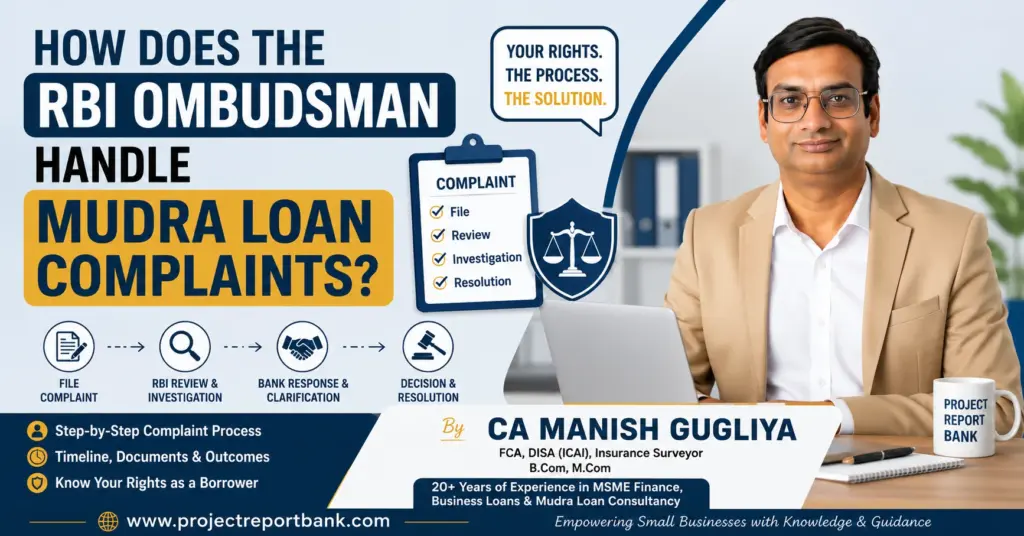
The journey of a Mudra loan grievance runs in stages. Here is the complete flow borrowers can follow:
- Borrower files written complaint with bank → Keep the acknowledgement and complaint reference numbers.
- Wait up to 30 days → The bank must provide a satisfactory response in this window.
- If unresolved, file a complaint on RBI CMS portal → Within one year of the bank’s reply (or one year + 30 days if no reply). Complaints must be filed within one year of the incident.
- CMS registration and screening → CRPC checks if the complaint is maintainable.
- Allocation to the appropriate Ombudsman office → Jurisdiction-neutral assignment.
- Notice sent to the regulated entity (bank) → Bank is asked to reply with records.
- Bank submits its reply and documents submitted → Uploaded on CMS.
- Borrower’s rebuttal or comments → You respond to the bank’s explanation.
- Settlement or mediation attempt → The Ombudsman may facilitate a settlement or issue a binding decision regarding complaints.
- Final decision or closure → Complaint upheld, rejected, or resolved.

Each step has its own internal timelines, but RBI does not promise a fixed number of days for every case. Serious non adherence cases – for example, ignoring clear RBI circulars on Mudra loans – may get closer scrutiny. Simple documentation disputes are often resolved faster through mediation.
What Happens After You File an RBI Ombudsman Mudra Loan Complaint?
Once the complaint is registered on the RBI CMS portal or received by CRPC, the process is system-driven. Every complaint gets a unique reference number for tracking.
Here are the 10 stages explained simply:
- Stage 1 – Registration: Your complaint gets a CMS number.
- Stage 2 – Acknowledgement: You receive confirmation via email or SMS.
- Stage 3 – Assignment: The complaint is routed to the specific RBI Ombudsman office.
- Stage 4 – Notice to bank: The bank receives a formal communication asking for its reply.
- Stage 5 – Bank reply: The bank uploads its response and documents.
- Stage 6 – Borrower rebuttal: You can submit additional facts or counter the bank’s explanation.
- Stage 7 – Evidence examination: RBI reviews records against circulars and PMMY guidelines.
- Stage 8 – Settlement attempt: Conciliation between both sides is attempted.
- Stage 9 – Decision: The Ombudsman may uphold, partly uphold, or reject the complaint – or close it on settlement.
- Stage 10 – Intimation: Both parties are informed. Appeal rights exist in eligible cases.
Sometimes complaints are closed early at the scrutiny stage – for example, if you never approached the bank first, filed beyond the time limit, or raised a matter outside the scheme’s scope.
Physical hearings are rare in Mudra loan cases. Most communication happens through the CMS portal, email, or phone. Check your email and CMS account regularly – non-response to queries may weaken your case or lead to closure.
How the RBI Ombudsman Investigates Mudra Loan Service Deficiencies
RBI does not act on emotions alone. It checks documents, bank records, and applicable guidelines before deciding if the complaint is justified.
In Mudra cases, deficiency in service usually means: failure to follow PMMY norms, delay without proper reason, non adherence to written terms, charging beyond what was agreed, or conduct that amounts to harassment.
The Ombudsman may examine:
- Bank’s internal loan appraisal note and branch recommendations
- Credit score reports and risk flags
- Sanction or rejection letter and its reasoning
- Email communication between borrower and bank
- Relevant RBI circulars and PMMY operational guidelines
For example, in a case similar to Sri Santosh Roy vs IDBI Bank, a borrower fulfilled eligibility, incurred costs, and the bank promised sanction but later refused – the consumer commission found deficiency of service. In contrast, where a borrower’s own documents were incomplete and the bank gave clear written reasons for rejection, the complaint was rejected.
The Ombudsman will not redo the bank’s full credit appraisal. It checks if the procedure and communication were transparent, timely, and within RBI norms.
Documents and Evidence You Should Keep Ready for an RBI Mudra Loan Complaint
Documentation is often the key difference between a strong complaint and a weak one, especially in small-ticket Mudra loans where many discussions happen verbally.
| Document / Evidence | Why It Helps |
|---|---|
| Loan application form | Proves you applied and met eligibility |
| Bank acknowledgement / receipt | Shows date of application and proof of submission |
| Sanction or rejection letter | Core evidence of bank’s decision |
| Email exchanges with bank | Establishes communication record |
| SMS or WhatsApp chats | Captures informal promises or threats |
| Call log screenshots | Shows frequency and date of follow-ups |
| Account statement | Proves fee deductions or loan credit |
| Hypothecation or security documents | Relevant if collateral was wrongly demanded |
| Guarantor details | Important if guarantor was forced unfairly |
| Identity and address proof | Basic KYC for complaint filing |
Upload scanned copies or clear photos on the CMS portal. Name your files clearly – for example, “Rejection-letter-15-March-2026.pdf.”
Keep a simple timeline document summarising key dates – application date, bank complaint, follow-ups, RBI CMS filing – and upload it as a single PDF. This helps the Ombudsman quickly understand the sequence.
Possible Outcomes of an RBI Ombudsman Mudra Loan Complaint
Outcomes vary. RBI does not guarantee that every borrower will get a Mudra loan sanctioned, but it can ensure fair treatment and correction of genuine service failures.
- Complaint upheld: The Ombudsman finds deficiency and directs the bank to correct it, refund charges, pay compensation, or issue proper written reasons.
- Partly upheld: Some relief is granted but not all demands.
- Rejected: Due to non-maintainability, lack of evidence, or the matter being purely a commercial decision.
- Settled: Resolved by mutual agreement during the process.
- Closed: For procedural reasons like withdrawal or duplication.
There is no upper limit on the disputed Mudra loan amount. But the compensation the Ombudsman can order has caps – for example, up to ₹3 lakh for harassment and mental agony under the latest scheme as the authority may deem fit based on circumstances.
RBI cannot force a bank to give fresh Mudra limits in every case. But it can ask the bank to review the claim again if the original decision seems inconsistent with rules. An appeal to the Appellate Authority at RBI Central Office may be available within 30 days of the decision.
Typical Timeline and Stages for an RBI Ombudsman Mudra Loan Complaint
No rigid deadlines are promised for every complaint. But Mudra loan cases usually move through predictable time windows if parties respond promptly.
| Stage | Approximate Time |
|---|---|
| Registration and acknowledgement | 1–3 working days |
| Bank’s reply | 15–30 days |
| Borrower rebuttal | 7–15 days after seeing bank’s reply |
| Investigation and settlement attempts | A few weeks to a few months |
| Final decision and communication | Depends on case complexity |
Add the initial 30-day wait (after filing with the bank) to your total expected resolution time. Consumers can contact a toll-free helpline (14448) for assistance with grievance redressal and to track status. Delays often occur when borrowers do not upload proper documents or do not respond to clarifications on CMS.
Why Many RBI Ombudsman Mudra Loan Complaints Fail – and How to Avoid That
A large number of complaints get rejected or closed because of basic mistakes – not because RBI is against borrowers. Here are common failure reasons:
- Approaching RBI before complaining to the bank – Always exhaust the bank’s internal remedy first.
- Filing after the time limit – File within one year of the bank’s response or the date the bank fails to respond.
- No evidence attached – Without proof, the Ombudsman cannot act. Keep every record.
- Demanding “RBI must force the bank to sanction my loan” – The Ombudsman checks service, not credit decisions.
- Wrong category on CMS – Select the correct complaint type carefully.
- Emotional language without facts – Write clear facts with dates and amounts.
- Duplicate complaints – Filing the same complaint multiple times does not help; it may get rejected.
- Complaining against a non-regulated entity – Check if your lender is covered under the scheme.
- Misunderstanding guarantor liability – Know your contractual obligations before filing.
Write a short, factual narrative. Clear facts are more powerful than long, unclear allegations.
Expert Tips from CA Manish Gugliya for Strong Mudra Loan Complaints
These tips come from over 20 years of handling Mudra, MSME finance, and banking grievance cases.
- File a written complaint with the bank first. Insist on a registered acknowledgement with a date stamp.
- Attach RBI or PMMY circular references only when you fully understand them.
- Structure your CMS complaint in three parts – facts, what the bank did wrong, and what relief you seek.
- Avoid exaggeration. Stick to dates, amounts, and what actually happened.
- Upload clear PDF evidence with descriptive file names.
- Do not threaten bank staff – it weakens your position.
- Make sure your KYC, financials, and project report are realistic and complete.
- Keep guarantors informed about complaint status and their rights.
- For complex disputes, consider professional help in drafting – a well-framed complaint makes a huge difference.
- Regularly check CMS and your email for updates. Non-response is treated as lack of interest.
I have seen cases where a borrower’s well-prepared complaint – with a clean timeline, clear evidence, and a reasonable request – led to refund of wrongly charged fees and a written apology from the branch. Preparation matters more than volume.
For deeper guidance, refer to the RBI Ombudsman for Mudra Loan Complaints guide on ProjectReportBank.
Conclusion and Call to Action for Mudra Loan Borrowers
The RBI Ombudsman for Mudra loan complaints is a powerful but limited remedy. It focuses on service deficiency and non adherence to guidelines – not on guaranteeing Mudra financing for every borrower. The banking ombudsman ensures accountability in banking services, and that commitment to fair conduct benefits every customer in the sector.
First use the bank’s internal grievance system. Maintain proper documents. Then use the RBI CMS portal only when justified. Study related topics like who can file an RBI Ombudsman complaint for a Mudra loan, guarantor rights, and hypothecation to strengthen your understanding before filing online.
Need expert guidance with your Mudra loan issue, project report, CMA data, or RBI complaint documentation? CA Manish Gugliya and the team at ProjectReportBank help MSMEs prepare strong financial documentation and understand the correct grievance redressal process. Visit www.projectreportbank.com to explore practical guides and professional assistance.

Frequently Asked Questions about RBI Ombudsman Mudra Loan Complaints
These FAQs cover additional questions borrowers commonly ask but which are not fully addressed in the main article above.
Can I hire a Chartered Accountant or lawyer to help me with an RBI Ombudsman Mudra loan complaint?
Yes. You are free to take help from a CA, consultant, or advocate to prepare your documents and draft the complaint. However, communication with the RBI Ombudsman usually happens directly through the borrower’s CMS login, email, or phone. In rare, complex cases, the Ombudsman may allow an authorised representative to join discussions, but this is not required for most Mudra loan disputes. Professional help is especially useful when project reports, CMA data, or technical finance points need clear explanation in writing.
What if the bank offers me a settlement after I file my RBI Ombudsman complaint?
Banks often become more responsive after an RBI CMS complaint is registered. They may offer written apologies, refunds, or corrected terms. If you are satisfied with the offer and confirm settlement in writing on CMS, the complaint is normally closed as “settled.” You cannot usually pursue the same matter again. Verify that all agreed actions – like refund of charges or issuance of a sanction letter – are actually completed before you formally agree to closure.
Can I edit or correct details in my RBI CMS Mudra loan complaint after submitting it?
Once submitted, the core complaint form cannot usually be rewritten. However, you can upload additional documents and written clarifications as attachments or replies to queries raised on the CMS platform. Clearly mark such uploads as “Correction / additional facts” so the Ombudsman understands the context. Double-check all facts, dates, accounts, and bank branch details before your first submission to reduce the need for later corrections.
Does the RBI Ombudsman also cover Mudra loans given through NBFCs or Micro Finance Institutions?
The scheme covers only those NBFCs and entities that are specifically regulated by the Reserve Bank of India and notified under the Integrated Ombudsman framework. Check whether your lender is an RBI-regulated entity before filing. If your lender is not covered, your remedy may lie with other government regulators or consumer forums rather than the RBI Ombudsman. The lender’s website or RBI’s official list of covered entities can help you confirm this.
Can a group of borrowers or a partnership firm file a joint RBI Ombudsman Mudra loan complaint?
Complaints can be filed by individuals, proprietors, partnership firms, companies, or other eligible enterprises that are the actual customer of the bank for that Mudra loan facility. For joint or group loans, mention all borrowers’ names, but one authorised person can act as the main contact. Attach proof of authority – such as a partnership authorisation letter or board resolution – so the Ombudsman recognises the complainant’s standing and can process the complaint without delay. This feedback loop ensures your complaint is not rejected on a technicality.
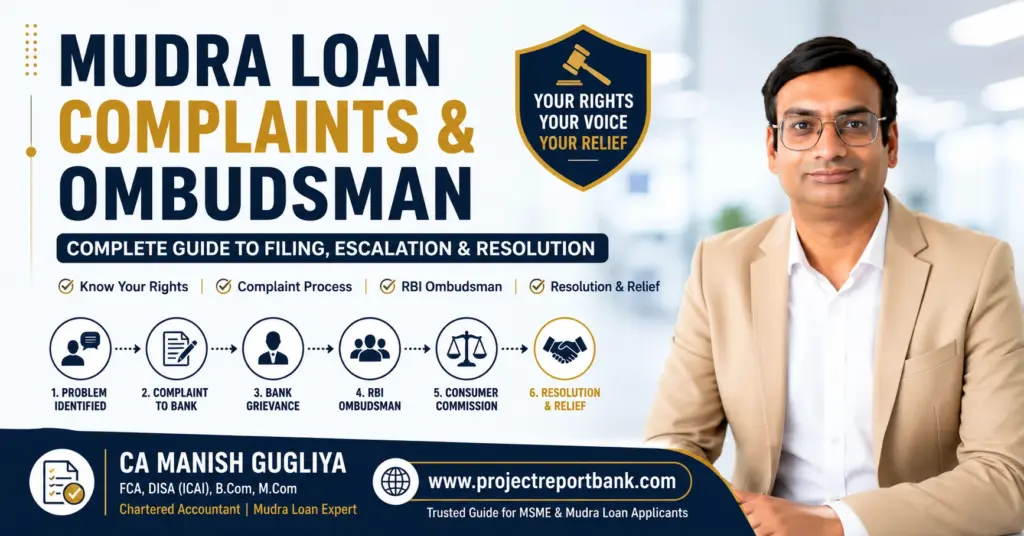
- Mudra Loan Complaints & Ombudsman: Complete Guide to Filing, Escalation & Resolution

- Can a Bank Blacklist You for Filing a Mudra Loan Complaint?
- Can a Mudra Loan Complaint Affect Future Loan Approval?
- Common Mistakes That Lead to Mudra Loan Complaint Failure
- RBI Ombudsman Mudra Loan Relief: Practical Guide for Small Borrowers
- Can the RBI Ombudsman Reject Your Mudra Loan Complaint? Reasons Explained
- Consumer Commission vs RBI Ombudsman: Which Is Better for Mudra Loan Disputes?
- Bank Grievance Redressal System for Mudra Loans: Complete Guide
- RBI Ombudsman Mudra Loan Complaint – Detailed Guide by CA Manish Gugliya