Key Takeaways
- A Mudra loan guarantor is legally liable to repay the outstanding amount if the borrower defaults, often to the same extent as the primary borrower under the guarantee agreement.
- In Mudra Tarun loans (₹5 lakh–₹10 lakh) and higher-risk categories, banks commonly ask for a personal guarantor whose own personal assets and CIBIL score can be at risk on default.
- Banks are allowed to recover the entire outstanding balance – principal, interest, penal interest, and some recovery expenses – directly from the guarantor, depending on the signed guarantee deed.
- Guarantor liability starts only after borrower defaults on EMI payments, but once triggered, it is serious, legally enforceable, and can lead to legal notices, civil court proceedings, and long-term credit damage.
- Anyone agreeing to become a Mudra loan guarantor should read the documents carefully, understand the legal consequences, and seek expert advice before signing.
Introduction: Why Mudra Loan Guarantor Liability Matters
In my 20+ years as a Chartered Accountant advising small enterprises and MSME borrowers, I have seen this story repeat itself dozens of times. A shopkeeper or a small business owner approaches his elder brother, a friend, or a relative and says, “Just sign here as my guarantor. It is only a formality. The bank needs a name. You will never have to pay anything.” The relative signs. Two years later, the business fails, the borrower stops paying, and the guarantor receives a legal demand notice from the bank asking for ₹8 lakh – principal plus interest plus penalties.
Let me explain this in plain terms. A loan guarantor is a person who gives a written promise to the bank: “If the main borrower does not repay, I will pay.” It sounds simple. But that one signature can change your financial life.
Under the Pradhan Mantri MUDRA Yojana, which was launched on 8th April 2015, institutional credit is provided to micro and small businesses through categories like Shishu (up to ₹50,000 for startups and vendors), Kishore (₹50,000 to ₹5 lakh for business growth), Tarun (₹5 lakh to ₹10 lakh for established businesses), and the newer Tarun Plus (₹10 lakh to ₹20 lakh for expanded businesses). These are collateral free loans for micro and small businesses, meaning borrowers often do not have to provide collateral or security. But collateral free does not mean liability free – for the borrower or the guarantor.
Many people in India sign guarantee forms casually without reading a single line. They believe that because the Mudra loan scheme is a government scheme, nothing serious will happen. That is a dangerous myth. Banks have full legal right to recover public money from either the borrower or the guarantor. A default can affect the guarantor’s CIBIL score, block future home loans or a personal loan, and in extreme cases put savings and property at risk.
This article will answer clearly: when does Mudra loan guarantor liability start, is the guarantor equally liable, what happens after default, what are the options like one time settlement, and how a guarantor can protect themselves before signing.

Table of Contents
What Does Being a Mudra Loan Guarantor Mean?
In everyday banking practice, a guarantee is a written promise given to the bank. If the Mudra borrower fails to pay EMIs and the loan account falls into default, the guarantor will pay the dues – including interest, charges, and sometimes recovery costs.
Why do banks ask for guarantors in some Mudra loans? It comes down to risk. For higher ticket sizes – especially a Tarun loan of ₹5–₹10 lakh – or where the borrower has a weak credit history, thin CIBIL score, or no formal income proof, lenders want extra comfort. Having a guarantor increases loan approval chances and may even result in lower interest rates being offered. The Credit Guarantee Fund for Micro Units backs Shishu and Kishor loans, but for Tarun and above, banks often rely on personal guarantees to manage lending risk.
The most common type in Mudra is a personal guarantor – usually a family member, friend, or business associate with regular income. A corporate guarantor is rare for very small enterprises.
Practical example: A small manufacturing unit in Jaipur takes a Tarun Mudra loan of ₹7 lakh in 2023. The business owner asks his elder brother, who is salaried, to sign as personal guarantor. The bank accepts because the brother has a stable salary and a good CIBIL report. The bank now relies on the brother’s income as a safety net if business loans like this one go bad.
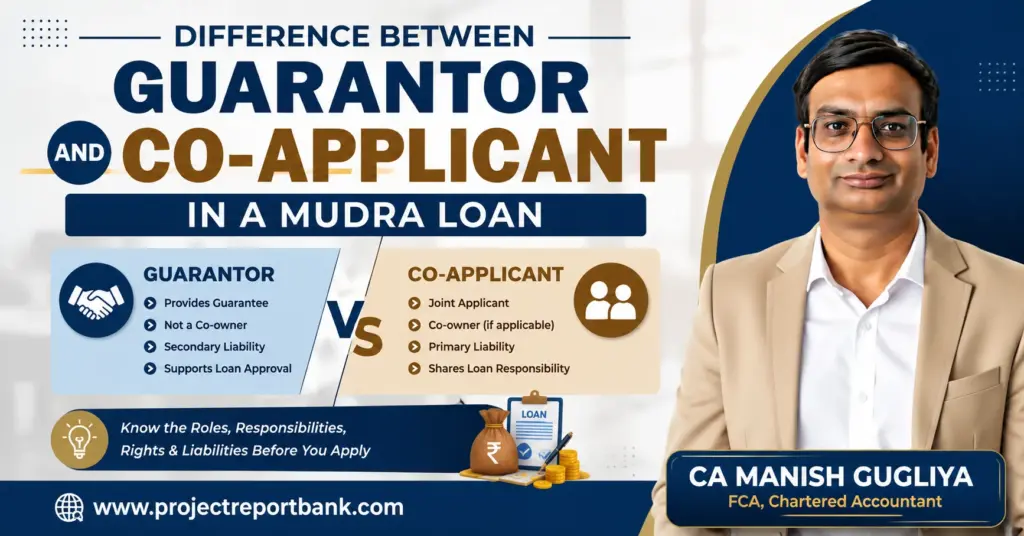
It is important to understand the difference between a guarantor and a co-applicant. A guarantor is only called upon when the borrower defaults; a co-applicant is jointly responsible from day one. You can learn more about this distinction in our guide on Guarantor vs Co-applicant in a Mudra Loan.
Eligibility to become a guarantor depends on age, citizenship, income, and credit score. For a deeper look, read Who Can Become a Guarantor for a Mudra Loan?.
Always ask the bank for a copy of the guarantee agreement, sanction letter, and key terms before signing. These documents required from you define the exact scope of your liability.
When Does a Mudra Loan Guarantor Become Liable?
Guarantor liability does not start on the day of loan approval or disbursement. It starts when the borrower fails to honour repayment as per the sanctioned schedule.
Here is the typical default timeline for Mudra loans:
| Stage | What Happens |
|---|---|
| EMI due date passes | Borrower misses payment |
| 1–30 days overdue | Bank sends reminder SMS, phone calls, emails |
| 31–60 days overdue | Stronger follow-up, written reminders |
| 61–90 days overdue | Branch-level escalation, formal communication |
| 90+ days overdue | A MUDRA loan becomes a Non-Performing Asset (non performing asset) after 90 days of default |
| NPA declared | Bank issues loan recall notice demanding full repayment |
| Post-recall | Guarantor receives formal demand notice |
| Further escalation | Field visits, recovery agents, legal action |
Under the guarantee agreement and general principles of the Indian Contract Act, once due amounts remain unpaid, the bank has the right to proceed against borrower, guarantor, or both – without waiting for the borrower’s assets to be exhausted first.
Even for small Shishu or Kishore loans where guarantors are normally not taken, if a bank has taken a guarantor, the same default timeline and liability logic applies.
My advice: Treat any written notice from the bank – whether SMS, email, or registered post – very seriously. Respond in writing or visit the branch. Ignoring a notice does not make the debt disappear; it only makes things worse.
Is the Mudra Loan Guarantor Equally Liable as the Borrower?
Here is the part that shocks most guarantors. In legal terms, the liability of a guarantor is “co-extensive” with the borrower. This means the bank can demand from the guarantor exactly what it can demand from the borrower.
Guarantors are legally obligated under Section 128 of the Indian Contract Act, 1872. In plain language, once the borrower defaults and dues are not cleared, the bank can treat the guarantor almost like the borrower for recovery purposes.
What this means in practice:
- The bank can choose to recover first from the borrower
- The bank can recover first from the guarantor
- Or the bank can recover partly from both the borrower and guarantor at the same time
| Factor | Borrower | Guarantor |
|---|---|---|
| EMI payment responsibility | Primary | Only if borrower fails |
| Impact on CIBIL score | Direct and immediate | Yes, on default or NPA |
| Exposure to legal action | Full | Full (co-extensive) |
| Control over use of Mudra funds | Complete | None |
| Ability to negotiate with bank | Direct | Must coordinate with borrower |
A common and dangerous misunderstanding: signing as “guarantor” is not the same as signing as a simple “witness.” A witness only confirms that a signature took place. A guarantor’s liability is contractual and enforceable in a civil court.
A guarantor’s credit score may drop severely if the Mudra loan turns NPA and remains unpaid. A MUDRA loan default severely impacts your CIBIL score. This can restrict future personal loans, car loans, or even credit cards for the guarantor. Guarantors may struggle to obtain their own loans due to existing guarantee obligations.
Real example from court records: In Punjab National Bank vs Azad Singh (2025), a Mudra loan of ₹4 lakh went into default. The bank filed a recovery suit listing both borrower and guarantor as defendants, claiming approximately ₹7 lakh including interest and penalties. Both faced identical legal pressure.
Can the Bank Recover the Entire Mudra Loan Amount from the Guarantor?
Yes. If the guarantee agreement states joint and several liability – which is standard for Mudra and MSME business loans – the bank can legally demand the entire outstanding amount from the guarantor.
What is normally recoverable:
- Principal outstanding under the Mudra loan
- Normal interest up to the date of default
- Penal interest or default interest rate charges where applicable
- Reasonable legal costs and recovery expenses as per bank policy
Consider this example: a ₹6 lakh Mudra Tarun loan disbursed in 2022. If EMI payments stop after one year, the outstanding after 12–18 months could include unpaid principal, accumulated interest for the overdue period, and penalties – pushing the total well beyond ₹6 lakh before the bank even issues a recall notice.
Mudra being collateral free does not limit the loan amount the bank can claim. Banks can freeze or deduct funds from the guarantor’s accounts to settle the borrower’s debt if they fail to pay. Via legal processes and court orders, salary, bank accounts, or other attachable assets of the guarantor may be targeted.
In some cases, banks may be open to a negotiated one time settlement (OTS) with either the borrower or the guarantor, especially after the account becomes NPA and has been overdue for a long time. However, OTS still affects CIBIL as “settled” rather than “closed.”
Important: Before committing to any repayment plan or OTS, get a full loan statement, calculation of interest and charges, and written break-up of dues from the bank. Every bank has internal OTS guidelines, and guarantors should not assume the bank must accept any low offer. Carefully weigh your options and seek professional help if amounts are large.
What Happens After the Borrower Defaults on a Mudra Loan?
Here is the step-by-step recovery process that typically unfolds:
- EMI missed – Borrower fails to pay on the due date
- Bank sends reminders – Phone calls, SMS, emails from branch or call centre
- Written reminders – Formal letters sent to borrower’s registered address
- 90 days pass – NPA classification – The loan account is classified as non performing asset per Reserve Bank norms
- Loan recall notice – Bank demands full repayment of all outstanding dues from borrower
- Guarantor receives demand notice – Bank formally contacts guarantor demanding payment
- Field visits and recovery agents – Recovery agents may harass borrowers after a MUDRA loan default, though RBI’s Fair Practices Code requires them to behave politely, visit only at reasonable times, and not disturb family members who are not borrowers or guarantors
- Legal proceedings – Defaulting on a MUDRA loan can lead to civil recovery suits. Banks can also initiate recovery actions under Section 138 for bounced checks. Depending on the amount and bank policy, the bank may approach Debt Recovery Tribunal
- Settlement discussions – At various points, there may be opportunities for restructuring, rescheduling EMIs, or negotiating a settlement

The guarantor’s details – name, PAN, address, and CIBIL relationship to the account – are already with the bank from the sanction stage. Once the borrower defaults, contacting the guarantor is a normal part of the recovery process.
Delay increases interest, penalties, and weakens bargaining power. I always advise guarantors to document all communication with the bank: dates of calls, copies of emails and notices, and where possible, follow up conversations with a short written confirmation.
Rights of a Mudra Loan Guarantor During Recovery
While guarantors carry heavy liability, they also have certain rights that they should actively use during recovery.
- Right to information: A guarantor can request copies of the sanction letter, loan agreement, guarantee deed, and an updated statement of account showing principal, interest, and charges outstanding as on a specific date.
- Right to receive notices: Guarantors should be served important legal notices. If no communication was received before drastic action, this can be raised while negotiating or defending in legal proceedings.
- Right to clarification: Guarantors can request face-to-face meetings with branch officials or higher authorities to understand the bank’s expectations and possible solutions.
- Right to legal remedies: Consulting a lawyer or Chartered Accountant, responding to legal notices in writing, and raising genuine disputes like incorrect calculation of interest or charges are all within the guarantor’s rights.
- Right to updated contact: Keep your contact information updated with the bank to ensure you receive all communications on time.
For a deeper understanding, read our detailed guide on Rights and Responsibilities of a Mudra Loan Guarantor.
Situations Where a Mudra Loan Guarantor May Face Serious Financial Risk
Some situations carry especially high risk for guarantors:
- Large Tarun loans close to ₹10 lakh where the borrower’s business shuts down due to market conditions or health issues, leaving no income source for EMI payments
- Multiple guarantees – when the same person has signed as guarantor for multiple Mudra or MSME loans for different relatives or friends, creating a chain of contingent liabilities
- Death or insolvency of borrower – even if the borrower dies or becomes bankrupt, the guarantee can still be enforced by the bank against the guarantor
- Long-pending NPAs – mounting interest and penal charges can turn a small overdue into a large outstanding amount over just a few years
Guarantors can face financial strain and limited financial flexibility when such cases arise. Aggressive recovery or legal action can lead to attachment of salary, bank accounts, or in some cases property, depending on the court’s order.
⚠️ Warning: Think twice before becoming a guarantor if: (1) the borrower has unstable or seasonal income, (2) you already have high EMIs of your own, (3) the borrower has poor credit history or poor financial discipline, or (4) you are planning to apply for your own home loans or education loan soon. The negative impact on your own finances can be severe.
If you are already facing such serious risk, do not keep silent. Engage early with the bank and consider restructuring, part payment, or professional negotiation of a settlement to contain the damage.
Common Myths About Mudra Loan Guarantor Liability
Many guarantors sign based on hearsay from friends or bank staff without checking what is actually written in the guarantee documents. Here are the most common myths:
| Myth | Reality |
|---|---|
| “I only signed as a witness, so I am safe” | If the document you signed is a guarantee deed, you are a guarantor – not a witness. Check the document title and clauses |
| “My liability ends after loan approval” | Liability continues until the Mudra loan is fully repaid or the bank formally releases the guarantor in writing |
| “The bank can recover only 50% from me” | Unless the guarantee deed caps your liability, the bank can recover the full outstanding amount from you |
| “Collateral free means the bank cannot touch my assets” | Collateral free means the borrower does not pledge assets upfront. But after default, the bank can seek court orders to attach the guarantor’s assets |
| “Family members cannot face legal action” | If a family member signed as guarantor, they are fully liable. Family members who become guarantors face the same legal consequences as anyone else |
| “Mudra loans are small, nothing big will happen” | Even a ₹3–₹5 lakh default can cause long-term CIBIL damage and stressful recovery |
| “If I just sign as guarantor, my CIBIL will not be affected” | A guarantor’s credit score can be negatively affected by defaults. The Mudra account appears in your CIBIL report, and serious default or settlement can harm your cibil score for years |
| “The government will pay through guarantee schemes” | Government guarantee funds like CGTMSE protect the bank’s loss, not the guarantor’s liability. The bank can still recover from you |
Always verify every verbal assurance – even from staff – with written clauses in the loan and guarantee documents before relying on it.
Can a Mudra Loan Guarantor Refuse to Pay?
Once a valid guarantee deed is signed and the bank has disbursed the Mudra loan on its basis, the guarantor cannot simply refuse to pay by saying “it was not my loan.” A loan guarantor must repay if the borrower defaults – that is the entire purpose of the guarantee.
Consequences of refusing after a formal demand:
- Continued legal notices and escalation
- Potential civil court suit against guarantor
- Adverse remarks on cibil report, dragging down credit score
- Increased interest and legal costs making the final amount even larger
In rare situations, guarantors can raise legal defences – for example, if the signature was forged, or the guarantee terms were materially altered without consent. But such cases require specific legal advice and evidence.
Banks generally prefer amicable solutions like restructuring or negotiated settlement instead of lengthy litigation, especially for modest Mudra loans. A guarantor can talk to the bank about paying in instalments, combining resources with the borrower, or exploring OTS if the account is already NPA.
Disclaimer: This article provides general information. Guarantors facing actual recovery notices should consult the lending bank and, where needed, a qualified legal professional before deciding their response.
Can the Mudra Loan Guarantor Recover Money from the Borrower Later?
When a guarantor pays on behalf of the borrower, they generally get a “right of recovery” against the borrower. In simple terms, you can ask the borrower to reimburse you for the amount you paid to the bank to clear the borrower’s debt.
Here is how it works in practice:
- Pay the bank and take written confirmation and receipts
- Ask the borrower to sign an acknowledgement of the debt owed back to you
- If the borrower refuses to refund, you can file a civil case
Under general legal principles of indemnity and surety, the guarantor can pursue legal recovery. But courts look at documents and evidence, and the process can be long and costly.
Practical challenge: The borrower might be unable to pay, may have moved away, or may already be under heavy financial difficulties, making actual recovery very hard even if legally allowed.
Before paying large amounts to the bank, have a frank discussion with the borrower and record any repayment plan in writing. Keep all receipts, bank statements showing payments, and written communication – this paperwork will be essential if you later pursue legal recovery.
Can a Guarantor Protect Himself Before Signing a Mudra Loan Guarantee?
The best protection comes before signing, not after default. Once the guarantee is given, your options are limited and mostly defensive.
Pre-signing checklist:
- [ ] Understand the exact Mudra product – Shishu, Kishore, Tarun, or Tarun Plus
- [ ] Read the guarantee deed line by line
- [ ] Check whether liability is joint and several
- [ ] Confirm whether the guarantee covers only this one Mudra loan or future top-ups and enhancements
- [ ] Verify the borrower’s existing loans and repayment track record
- [ ] Check the borrower’s CIBIL score yourself if possible
- [ ] Ask the bank: what is the maximum amount of liability?
- [ ] Ask: what happens if the borrower dies?
- [ ] Ask: under what conditions can the guarantor be released?
- [ ] Keep copies of every document – sanction letter, loan agreement, guarantee deed, KYC papers
For a full list of Mudra Loan Guarantor Documents, check our detailed resource.
If you are not comfortable with the borrower’s financial discipline or business idea, or if your own future loan plans (home loan, children’s education) might be affected, politely decline. Saying “no” is sometimes the most responsible support you can offer.
What If a Mudra Loan Guarantor Wants to Withdraw?
A guarantor cannot usually withdraw unilaterally after the Mudra loan has been sanctioned and disbursed. The guarantee is a binding contract that supports the bank’s existing exposure.
Before sanction: A proposed guarantor can say no, and the bank may either reject the application or ask the borrower to find a new guarantor.
After disbursement: Release is much more difficult. It may be possible only in limited situations:
- Full repayment of the existing loan
- Substitution with another acceptable guarantor (with bank and borrower consent)
- Conversion of the loan with fresh documentation
Even when a new guarantor is approved, the bank will execute fresh guarantee deeds and only then issue a formal release letter. Until such written release, the old guarantor should assume they are still liable.
For in-depth guidance, read What Happens If a Mudra Loan Guarantor Withdraws? and Can You Change the Guarantor After Mudra Loan Sanction?.
Legal rights and bank policies vary across institutions, so any guarantor considering withdrawal should discuss directly with the concerned bank branch.

Practical Tips Before Agreeing to Become a Mudra Loan Guarantor
From my 20+ years of MSME finance experience, here are the tips I give every person who is being asked to sign as guarantor:
- Never sign blank forms – insist that every field is filled before you sign
- Read the draft sanction letter and guarantee deed before the disbursement date
- Confirm the exact Mudra category and loan amount (Shishu, Kishore, Tarun)
- Understand the EMI amount, interest rate, and tenure
- Ask the borrower for projected cash flow of the business
- Check the borrower’s existing term loans and outstanding liabilities
- Verify the borrower’s CIBIL score – ask to see the report
- Avoid becoming a guarantor if you plan to apply for a home loan in the next 2–3 years
- Ensure your spouse knows you are signing as guarantor
- Avoid multiple guarantee commitments – the cumulative responsibility is high
- Prefer written communication with the bank over verbal promises
- Honestly assess: can you afford to pay the EMIs from your own income if things go wrong?
- Confirm whether life insurance cover exists on the borrower
- Ask the bank to explain legal consequences and the repayment schedule in simple terms
- Understand the effect on your own credit and future borrowing capacity
- Maintain a personal file – physical or digital – with all signed Mudra and guarantee documents
- Keep notes from discussions with bank officers
- Save copies of any SMS or email confirming key terms
- Do not make decisions under emotional pressure at the branch counter – take the documents home and review overnight
- If the business idea sounds weak or the borrower has poor financial discipline, decline politely
Saying “no” to a guarantee request from a close friend or relative is difficult. But it is sometimes the wisest financial decision you can make.
Expert Guidance by CA Manish Gugliya
I am CA Manish Gugliya (FCA), and I have spent over 20 years advising MSMEs on project reports, CMA data, and Mudra and SME loans across sectors like trading, manufacturing, and services.
I have seen guarantors come to me after receiving legal notices – stressed, confused, and angry. In one case, a retired schoolteacher had signed as guarantor for her nephew’s Tarun Mudra loan. When the nephew’s shop closed, the bank started demanding ₹6.5 lakh from her. She had no idea her pension could be at risk. In another, a salaried employee signed two guarantee deeds for two friends – both defaulted within a year, and his own home loan application was rejected because of the contingent liability on his credit report.
Every single one of these situations could have been prevented with just a few clicks of effort – reading the guarantee deed, checking the borrower’s financials, and understanding the security they were putting on the line.
At Project Report Bank, we focus on educating small entrepreneurs and prospective guarantors with clear, practical content on Mudra eligibility, guarantor roles, legal consequences of default, and settlement options. My strong belief is that every borrower and guarantor should fully understand what they sign – not rely on verbal explanations at the branch.
Mudra loans play a crucial role in India’s MSME growth story and offer real benefits to small businesses. But guarantor liability is serious, and informed decision-making is the best protection.
Conclusion
A Mudra loan guarantor takes on full legal and financial responsibility to repay the bank if the borrower fails. This duty continues until the loan is cleared or the bank formally releases the guarantor in writing.
Mudra loan guarantor liability can include the entire outstanding principal, interest, penalties, and some recovery costs. Defaults can badly damage the guarantor’s credit score and borrowing capacity for several years – restricting even basic products like credit cards.
While solutions like restructuring and one time settlement exist, they are last-resort options and still carry long-term credit consequences. Prevention is always better than cure.
Think carefully. Ask tough questions. Seek professional advice before signing as a Mudra loan guarantor – especially for Tarun loans or when your own financial plans are at stake.
Remember: Being a guarantor is almost like taking the loan yourself, so treat the decision with the same seriousness.
FAQs on Mudra Loan Guarantor Liability
These FAQs cover additional specific doubts that small business owners and guarantors frequently ask after understanding the basics of Mudra loan guarantor liability.
Does acting as a Mudra loan guarantor affect my CIBIL score even if EMIs are paid on time?
The Mudra loan usually appears in the guarantor’s credit report as a guaranteed account. This may reduce future loan eligibility because banks see it as a potential liability, even if the borrower is making timely repayment. Actual negative impact on the CIBIL score generally happens only if the Mudra loan becomes overdue, NPA, or is settled. But the exposure still counts in eligibility calculations when you apply for your own loans.
Can I be a guarantor for more than one Mudra or personal loan at the same time?
Technically, banks may allow a person to be guarantor for multiple loans. However, each new guarantee increases your total contingent liability and can reduce your chances of getting your own personal loan or home loan approved. As a thumb rule, avoid being guarantor on more than one large Mudra or personal loan at a time, especially if your own income is modest or you have existing EMI commitments.
What happens to guarantor liability if the Mudra loan is closed through a one time settlement (OTS)?
Once the bank accepts an OTS, receives the agreed amount, and issues a No Dues Certificate or closure letter, the guarantor’s liability for that specific Mudra loan account normally ends. However, credit bureaus may still show the account as “settled” instead of “closed,” which can negatively affect both the borrower’s and guarantor’s CIBIL scores for a few years even after the liability ends.
Can family members who are not guarantors or co-borrowers be forced to pay the Mudra loan?
The bank can only proceed directly against persons who have signed as borrower, co-borrower, or guarantor. Relatives who have not signed loan or guarantee documents are not automatically liable. While recovery agents sometimes pressure family members informally through phone calls or visits, such behaviour is not supported by law or RBI guidelines. Families can complain to the bank or banking ombudsman if they face harassment.
Is my salary or property at risk if I am only a guarantor and not the main Mudra borrower?
If the bank obtains a court decree or recovery certificate against both borrower and guarantor, it can seek attachment of the guarantor’s salary, bank accounts, or other attachable property, up to the amount of dues. This is exactly why banks prefer salaried or financially strong people as guarantors – and why you must think carefully before allowing your future salary or property to stand behind someone else’s Mudra loan.
- Mudra Loan Guarantor & Security Issues: Complete Guide for Borrowers (2026)


- What Is the Liability of a Mudra Loan Guarantor in Case of Default?

- What Happens If Your Mudra Loan Guarantor Withdraws?

- Can You Change the Guarantor After Mudra Loan Sanction?

- Understanding Hypothecation in Mudra Loans

- Rights and Responsibilities of a Mudra Loan Guarantor – Complete Legal Guide for Borrowers & Guarantors
- What Documents Are Required from a Mudra Loan Guarantor? Complete Checklist

- Guarantor vs Co-applicant in Mudra Loan: Which Option is Right for Your Business?
- Can Family Members Be Guarantors for a Mudra Loan?