Key Takeaways
- Mudra loans under Pradhan Mantri Mudra Yojana (PMMY) are collateral free loans, but many banks still ask for a guarantor – especially for Kishore and Tarun category loans above ₹2–3 lakh.
- Common mudra loan guarantor documents include Aadhaar card, PAN card, recent address proof, passport size photographs, and income proof like salary slips, bank statements, or Income Tax Returns.
- A total of three document categories are typically needed from guarantors: identity proof, address proof, and financial or income documents.
- Document requirements are not identical across every bank or financial institution. They depend on the lending institution’s internal policy, the loan amount, and the guarantor’s risk profile.
- Well-prepared, consistent KYC and income documents from the guarantor can speed up Mudra loan sanction and help avoid rejection or repeated bank visits.
Introduction: Why Mudra Loan Guarantor Documents Matter (2026 Perspective)
I am CA Manish Gugliya (FCA), and over the past 20+ years, I have helped hundreds of small business owners navigate MSME finance, project reports, CMA data, and Mudra loan consultancy through ProjectReportBank.com.
One question that comes up almost every week is: “What documents does my guarantor need to bring to the bank?”
Here is some quick context. The Pradhan Mantri Mudra Yojana (PMMY) – often called Mantri Mudra Yojana PMMY – was launched in April 2015 to support micro enterprises and non-farm income generating activities. Under this scheme, the maximum loan amount is ₹20 lakh, and loans are collateral free, meaning borrowers do not need to pledge assets or offer property as security. The scheme supports non-corporate and non-farm businesses, and eligible borrowers include individuals and partnerships or any other legal entity running a small business.
Mudra loans are categorized into Shishu, Kishore, Tarun, and Tarun Plus based on business growth stages. Shishu loans offer up to ₹50,000 for new businesses. Kishore loans range from ₹50,001 to ₹5 lakh for growing businesses. Tarun loans provide ₹5 lakh to ₹10 lakh for established businesses. And Tarun Plus loans range from ₹10 lakh to ₹20 lakh for repeat borrowers who have successfully repaid previous loans.
Now, a guarantor is not always required for Mudra loans. But in real banking practice – especially at public sector banks, regional rural banks, and even some small finance banks – branches often insist on a guarantor for larger amounts. And that is where the confusion starts. Different branches ask for different papers.
In this guide, you will learn exactly when guarantor documents are needed, what the complete document checklist looks like, which identity and address proofs are accepted, the role of PAN and Aadhaar, when income proof is asked, how family member guarantor cases work, common rejection reasons, and preparation tips. For the borrower’s own complete Mudra Loan document checklist, I have a separate detailed guide.
Everything in this article is based on practical banking observations across nationalised banks, cooperative banks, non banking financial companies, and micro finance institutions up to 2026 – not just theoretical scheme rules.

Table of Contents
Why Do Banks Ask Documents from a Mudra Loan Guarantor?
PMMY loans are collateral free, but that does not mean banks face zero risk. The role of a guarantor is to provide assurance regarding loan repayment if the borrower defaults. Guarantor documentation is how the bank makes that assurance real and enforceable.
Here is why each piece matters:
- Identity verification: Banks must confirm the guarantor is a real, identifiable person – not a fake or benami entry. KYC documents like Aadhaar, PAN, and photographs satisfy RBI KYC norms.
- Financial credibility: Income proof, bank statements, and ITRs help the branch judge whether the guarantor can realistically support repayment if the business faces difficulty.
- Fraud prevention: Verifying documents prevents impersonation, forged guarantees, or pressure on elderly or illiterate relatives to sign without understanding their liability.
- Regulatory compliance: Anti-money laundering rules and internal credit policies require documented proof for every guarantor, similar to borrowers.
- Risk assessment: Consider a Tarun loan of ₹8 lakh. A salaried guarantor earning ₹50,000 per month with clear bank statements gives the branch far more comfort than an unemployed guarantor with no income proof. The documents tell that story.
Myth: Because Mudra is collateral free, banks cannot ask for guarantor documents. Fact: Collateral free means no property as security. Banks can still require a personal guarantor and their supporting documents based on internal policy. There are no collateral security requirements, but personal guarantees are a different matter. Read more about collateral rules under Mudra Loans.
Is Every Mudra Loan Applicant Required to Submit Guarantor Documents?
There is no single national rule that forces every Mudra borrower to bring a guarantor. Banks assess a borrower’s credit profile before deciding whether a guarantor is needed. Requirements vary by bank, loan category, and risk profile.
When guarantor is usually NOT required:
| Situation | Why |
|---|---|
| Shishu category loans up to ₹50,000 | Minimal risk; shishu loans require minimal documentation like ID proof and photographs |
| Existing account holder with good track record | Bank already knows the customer’s repayment capacity |
| Strong CIBIL score and clear credit history | Low perceived risk |
| Small OD or working capital facility against deposits | Built-in security |
When guarantor is usually required:
| Situation | Why |
|---|---|
| Kishore and Tarun loans above ₹2–3 lakh | Higher loan amount increases bank risk |
| First-time borrowers with thin banking history | No track record to rely on |
| New businesses without financials or sales achieved | No proof of economic viability yet |
| Weak income proof or high-risk sectors | Bank needs extra comfort |
Different banks follow different internal credit policies. For example, IDBI Bank’s product page explicitly states “No third party guarantee requirement” for its Mudra product. Meanwhile, DNS Bank’s Mudra loan checklist includes “guarantor details” among the documents to submit. Even within the same bank, two branches may handle things differently.
If you are unsure whether your branch will ask for a guarantor, read the detailed discussion on is a guarantor mandatory for a Mudra Loan? or learn whether a bank can reject a Mudra Loan without a guarantor.
Complete Mudra Loan Guarantor Document Checklist
This is the core practical checklist. You can save it on your phone or print it before visiting the bank. Keep in mind that actual requirements can vary slightly by lender and state, but most banks in 2025–2026 follow a similar broad pattern for guarantor documentation under PMMY loans.
If a guarantor is needed, they must provide identity and address proof at minimum. For larger amounts, financial documents join the list. Here is the detailed table:
| Document | Mandatory? | Purpose | Remarks |
|---|---|---|---|
| Aadhaar Card | Generally mandatory | Identity + address + e-KYC | Keep mobile linked for OTP verification |
| PAN Card | Strongly expected (Kishore/Tarun) | Tax identity, credit bureau check | Form 60 may work for very small loans |
| Passport | Optional alternative | Strong ID + address proof | Useful if Aadhaar has issues |
| Voter ID | Optional alternative | Identity proof | Common in rural/semi-urban areas |
| Driving Licence | Optional alternative | Identity proof | Must be unexpired |
| Electricity / Water / Gas Bill | Often required | Recent address proof | Not older than 2–3 months |
| Rent agreement or rental agreement | Where applicable | Address confirmation | Stamped/registered preferred |
| Property tax receipt | Where applicable | Address and asset proof | Some banks accept as address proof |
| Bank statements (3–6 months) | Required for Kishore/Tarun | Income and cash flow assessment | Clear, printed, with correct name |
| Salary Slips (3 months) | If guarantor is salaried | Income proof | With company letterhead |
| Form 16 / Employment Letter | If guarantor is salaried | Confirms stable employment | Strengthens guarantee |
| Income Tax Returns (2–3 years) | Required for Tarun/Tarun Plus | Income verification | Filed, not just computed |
| Business Financials (P&L, Balance Sheet) | If guarantor owns business | Income and net worth | CA-certified preferred |
| GST Returns | If guarantor is GST-registered | Business turnover proof | Last 6–12 months |
| Passport Size Photographs (2–4) | Mandatory | KYC file | Recent, clear photos |
| Specimen Signature / Cancelled Cheque | Usually required | Signature verification | Matches guarantee form |
| Relationship Proof | When family member is guarantor | Confirms genuine relationship | Marriage cert, birth cert, ration card |
| Net Worth Statement | For larger loans | Guarantor’s financial strength | Self-certified or CA-certified |
| Pension Documents | If guarantor is retired | Income proof | PPO, pension account passbook |
Originals are usually needed for verification at the branch, but banks keep only self-attested photocopies. Always carry one extra set.

Identity Proof Accepted by Banks for a Mudra Loan Guarantor
Identity proof establishes “who” the guarantor is. It must be officially issued by a government authority, as per RBI KYC norms. Proof of identity and residence is needed for all loan categories. Borrowers and guarantors both must provide identity proof such as PAN card or Aadhaar.
Here is a quick comparison:
| ID Document | Used as ID? | Used as Address Proof Too? | Common Practical Issues |
|---|---|---|---|
| Aadhaar Card | Yes | Yes | Old address, blurred photo, unlinked mobile |
| PAN Card | Yes | No | Name spelling variations, no photo match |
| Passport | Yes | Yes | Expired, costly to renew, rural unavailability |
| Driving Licence | Yes | Sometimes | Expired licence, signature mismatch |
| Voter ID | Yes | Sometimes | Old photo, address not updated after shifting |
Most banks prefer Aadhaar + PAN as the primary combination because Aadhaar supports e-KYC (instant online verification) and PAN links to the credit bureau and tax records. If your guarantor has both updated and consistent, you are in good shape.
Address Proof Accepted by Banks for a Mudra Loan Guarantor
Banks insist on correct address proof so they can send legal notices, loan recall letters, and other communication if the borrower defaults. Address proof can include utility bills or a property tax receipt.
Here is what most branches accept:
- Aadhaar Card – most common, but if the guarantor has shifted residence and not updated Aadhaar, the bank may reject it as address proof.
- Utility bills – electricity bill, water bill, piped gas bill, or post-paid telephone bill. Must be not older than 2–3 months.
- Bank passbook or bank statement with printed address – accepted in many PSU banks, especially in rural branches.
- Rental agreement or rent agreement – accepted in urban areas if properly stamped or registered. Some branches also ask for the landlord’s ID proof and NOC.
- Passport and Driving Licence – serve as dual-purpose documents (ID plus address), but expiry or mismatch with current residence causes delays.
Practical tip: Ensure name and address are consistent across all documents. If your guarantor recently moved, update Aadhaar first. Avoid submitting very old ration cards or non-standard proofs unless the branch specifically agrees.
Is PAN Card Mandatory for a Mudra Loan Guarantor?
There is no single PMMY rule publicly stating “PAN is always compulsory for every guarantor.” But in practice, most banks strongly prefer or insist on PAN, especially for larger ticket loans.
Here is how it works in reality:
- For shishu loans or very small amounts, some rural branches may proceed without PAN if the guarantor’s income is below taxable limits. They may record a written declaration instead.
- For a kishore mudra loan or Tarun category loan – particularly above ₹1–2 lakh – branches generally expect PAN of both borrower and guarantor. Financial and income documents may be required for larger Mudra loans, and PAN is the gateway to verifying those.
- Where PAN is not available, some banks accept Form 60/61, but acceptance depends entirely on the bank’s latest policy. This can change over time.
Example: A guarantor who is a homemaker without PAN may face difficulty. Some banks accept her with adequate family income proof, while others insist she first obtain PAN. Since e-PAN allotment is quick and free online (as of 2026), it is better to apply for PAN before visiting the bank.
Do not rely on internet rumours. Always confirm with the specific branch. For context on why branches ask for extra papers, see can banks keep asking for additional documents?
Is Aadhaar Mandatory for a Mudra Loan Guarantor?
Aadhaar has become the most common identity proof for both borrowers and guarantors because it supports online e-KYC verification. In many public sector banks and private banks, Aadhaar is treated as “practically mandatory” because their internal systems, PMMY portal interface, and risk processes are designed around Aadhaar-based KYC.
Here is how e-KYC works: the bank staff enters the Aadhaar number, does OTP or biometric verification, and the system fetches KYC data instantly. This speeds up Mudra loan guarantor verification significantly.
Some banks allow offline KYC where Aadhaar is used only as a physical document (photocopy) along with manual verification. If Aadhaar is genuinely not available, the guarantor should inform the branch early. Some banks may allow an alternate KYC route using passport or voter ID, but the decision may get delayed.
Important: Make sure the guarantor’s Aadhaar details – especially mobile number and address – are updated well before the mudra loan application form is filed. OTP problems and address mismatches are among the most common causes of delay.
Always carry a self-attested photocopy plus the original for physical verification at the branch.
Do Banks Ask Income Proof from the Mudra Loan Guarantor?
Unlike simple KYC, income proof from the guarantor is not mandated by PMMY guidelines. But it is commonly taken by banks as part of internal credit appraisal, especially for kishore tarun category loans. The logic is simple: if the guarantor’s income is not known, the guarantee is only on paper. Income proof helps the branch judge repayment capacity.
For salaried guarantors:
- Last 3 months’ salary slips
- Last 6 months’ salary account bank statement
- Form 16 or employment letter
- Stable salary in a government or reputed private job strengthens the guarantee significantly
For self-employed or business-owner guarantors:
- Last 2–3 years’ Income Tax Returns (Tarun loans require last two years’ financial statements)
- GST returns where applicable
- Last 6–12 months’ current account statement
- CA-certified balance sheet and profit & loss account
- Business proof like UDYAM registration or shop & establishment licence
For pensioners:
- Pension payment order (PPO)
- Pension bank account statement
- Any additional income streams like rent or interest shown via bank statement
For very small shishu loans, some branches may accept guarantors without detailed income proof. But this is becoming less common as banks tighten risk processes. Kishore loans need bank statements and a business plan from the borrower, and similar financial diligence often extends to the guarantor.
Disclose all legal income sources honestly. Hiding loans or credit card dues does not work – these are visible in credit bureau reports, and inconsistencies lead to rejection.
Documents Required if a Family Member Becomes Guarantor
In Indian practice, most Mudra loan guarantors are close family members – parents, spouse, siblings, or adult children. This makes communication easier but can create emotional pressure.
The base KYC documents are the same as for any other guarantor: Aadhaar, PAN, photographs, address proof, and relevant income proof.
Banks may additionally ask for relationship proof to confirm the guarantor is genuinely related and not a paid third party. Possible relationship documents include:
- Ration card showing family names together
- Marriage certificate (for spouse)
- Birth certificate (for parent-child link)
- School leaving certificate showing father’s name
- Aadhaar family update printout where available
Practical combinations:
- Father as guarantor for son’s Kishore Mudra loan → ration card + Aadhaar of both
- Wife as guarantor for husband’s Tarun loan → marriage certificate + Aadhaar
If the guarantor is a homemaker or senior citizen with limited income, the bank may either reject the guarantee or ask for an additional financially strong guarantor. This is normal risk practice, not harassment.
Discuss guarantee implications openly with family. The bank will treat the guarantor as legally responsible even if the business fails due to market reasons. For a detailed list of who can become a Mudra Loan guarantor or whether family members can become Mudra Loan guarantors, refer to the linked articles.

Additional Documents Banks May Request from Guarantors
Beyond standard KYC and income proofs, banks sometimes ask for extra documents. The loan amount may necessitate additional documentation depending on the bank. This is part of risk control, not harassment.
Common additional requests include:
- Property documents: Copy of property tax receipt, sale deed, or 7/12 extract when the guarantor’s house or shop is shown as part of their net worth. This does not automatically convert the property into collateral under PMMY.
- Employment proofs: Appointment letter, job ID card, or HR certificate for private sector salaried guarantors.
- Pension documents: Pension sanction letter or PPO for retired employees acting as guarantors.
- Business documents: GST registration, UDYAM registration, shop & establishment licence, partnership deed copies, or company Memorandum & Articles of Association. Documentation needed for Mudra loans includes business existence proof, and this can extend to guarantors who own businesses.
- Net worth or liability statement: Some banks ask guarantors to fill a simple format showing assets and liabilities, sometimes certified by a Chartered Accountant.
These are assessment documents, not security. For the difference between assessment and actual security in a Mudra Loan, read the linked guide.
Common Reasons Banks Reject Guarantor Documents
Many Mudra loan delays come not from weak projects but from small KYC and documentation issues. Applicants must not be defaulters to any bank, and this check extends to guarantors too. Here are the most common rejection reasons:
| Reason | Example from Banking Practice | How to Fix Before Applying |
|---|---|---|
| Name mismatch | “Rajesh Kumar” on Aadhaar, “Rajesh Kr.” on PAN | Update documents to match |
| Expired documents | Driving licence expired 2 years ago | Renew before bank visit |
| Address mismatch | Application says Mumbai, Aadhaar says village address | Update Aadhaar or bring recent utility bill |
| Poor photocopies | Barcode or MRZ cut off, blurred photo | Use clear, full-page copies |
| Missing PAN | Bank policy requires PAN for Kishore/Tarun | Apply for e-PAN online (free) |
| Signature mismatch | Signature on form differs from specimen on Aadhaar/cheque | Practice consistent signature |
| Incomplete KYC | Only one ID proof submitted, bank needs two | Carry multiple ID options |
| Missing income proof | Tarun loan but guarantor has no ITR or bank statement | Prepare financial documents in advance |
| Illegible documents | Faded old ration card, unclear handwriting | Get fresh copies or alternate documents |
| Guarantor is a defaulter | Guarantor has unpaid loans in credit bureau records | Choose a different guarantor |
Tips to Prepare Guarantor Documents Before Visiting the Bank
Use this as a quick checklist before your bank visit:
- Confirm with the specific branch (call or visit) the exact guarantor document list for your loan category and loan amount
- Collect all KYC documents – originals and 2–3 self-attested photocopies – in one folder
- Download the latest bank statement (PDF) covering the required months; check that name and address are correct
- For business-owner guarantors, prepare ITR acknowledgements, GST returns, UDYAM certificate, and a simple net worth summary
- Review all documents for spelling consistency across Aadhaar, PAN, and bank records
- If corrections are needed (Aadhaar update, PAN name change), initiate them well before filing the Mudra loan application form
- Keep a written list of every document handed to the bank to avoid confusion during follow-ups
- You can apply for Mudra loans online or offline. Online applications can be submitted via mudra.org.in or bank websites. Offline applications require visiting a lending institution branch. An application number is generated after submission for tracking. The application process requires ID proof and address proof from both borrower and guarantor.
Mistakes Borrowers Commonly Make with Mudra Loan Guarantor Documents
Many rejections or delays are completely avoidable. They relate to misunderstanding guarantor requirements rather than weak projects or low CIBIL scores.
Common mistakes include:
- Assuming guarantor is never needed because Mudra is collateral free – collateral free does not mean guarantee-free
- Bringing a guarantor without PAN or Aadhaar when the bank clearly needs both
- Ignoring income proof despite a higher loan amount in the kishore tarun range
- Choosing a relative who is already over-leveraged or has poor credit history, causing the bank to reject both guarantor and loan
- Signing blank forms or guarantee documents without reading – always ask the manager to explain in simple language
- Giving partly updated information (changed address in the application but no update on Aadhaar or bank records)
- Relying on agents or hearsay for the document list instead of confirming directly with the bank branch
Expert tip from CA Manish Gugliya: Spend 10–15 minutes doing a pre-visit document check with a CA or experienced consultant, especially for Kishore and Tarun loans. This small step saves days of running back and forth.
Frequently Asked Questions on Mudra Loan Guarantor Documents
These are direct, short answers to common queries borrowers and guarantors ask in day-to-day practice, based on 20+ years of MSME finance experience.
Does every guarantor need a PAN card? Not always, but for Kishore and Tarun loans, most banks expect PAN. For very small Shishu amounts, some branches accept Form 60 instead. Get e-PAN online to be safe.
Is Aadhaar compulsory for guarantors in Mudra loans? Practically yes, in most banks. Aadhaar supports e-KYC and speeds up verification. If unavailable, inform the branch early and carry alternative ID like passport or voter ID.
Can digital KYC or video KYC be used for guarantors? Some banks accept DigiLocker copies and online KYC for borrowers, but for guarantors, physical verification of originals is still commonly required at branch level.
Do banks keep original guarantor documents? No. Banks verify originals at the branch but retain only self-attested photocopies. Always carry originals and copies both.
Are income proofs mandatory for all guarantors? Not for every case. For shishu category loans or very small amounts, income proof may be skipped. For kishore and tarun loans, most branches will ask for salary slips, ITR, or bank statements.
Can pensioners become Mudra loan guarantors? Yes, if they have regular pension income. Banks typically ask for PPO, pension account passbook, and sometimes additional income proof.
Can an unemployed person be accepted as guarantor? It depends on the bank. An unemployed person with no income source is usually rejected as guarantor. Some branches may accept if the person owns property or has investments, but this is rare.
Can one person act as guarantor for multiple Mudra loans? There is no legal bar, but banks check the guarantor’s total exposure. If the guarantor already has covering loans or other outstanding guarantees, the branch may decline.
How long does guarantor document verification take? Typically 2–7 working days, depending on the bank’s internal process and whether any document issues arise.
What if the guarantor has no ITR? For salaried guarantors, Form 16 and salary slips may suffice. For self-employed without ITR, banks may decline the guarantee or ask for alternate income evidence like bank statements.
What if address proof is outdated? Get it updated before applying. An electricity bill older than 3 months or an Aadhaar with a wrong address will likely be rejected.
Can the bank ask for additional documents even after file submission? Yes. Internal audit or credit committees can raise queries. This is normal. Read more about can banks keep asking for additional documents.
Are guarantor document requirements different for Shishu, Kishore, and Tarun loans? Yes. Shishu usually needs minimal guarantor documentation (if any). Kishore and Tarun need stronger KYC and income proof. Tarun Plus loans are available only to those who have successfully repaid previous Tarun loans, so documentation requirements are the most rigorous. Applicants must be aged between 18 to 65 years for all categories.
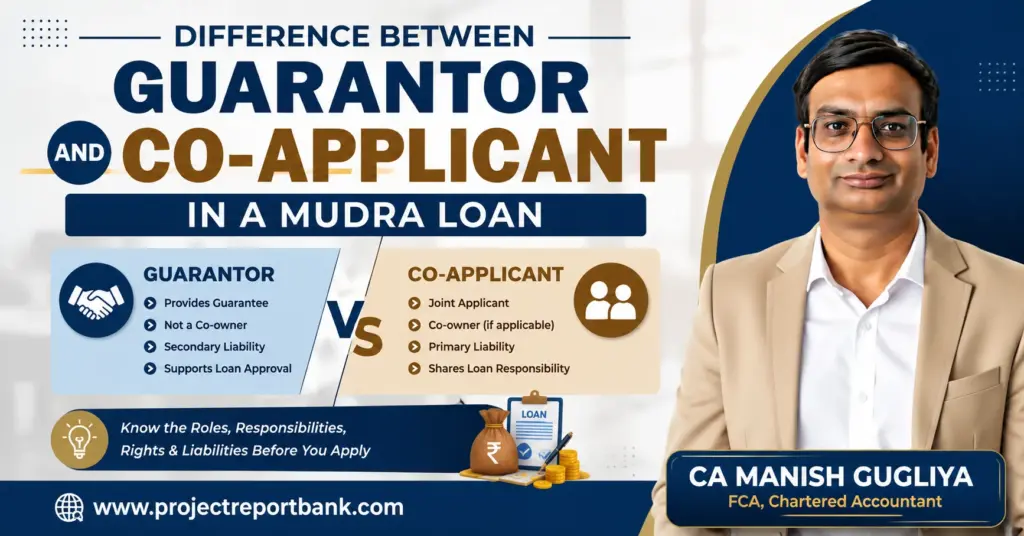
What is the difference between a guarantor and a co-applicant? A co-applicant shares the loan liability from day one and often has equal rights to the loan amount. A guarantor steps in only if the borrower defaults. Document requirements overlap but are not identical.
Can I check my pm mudra loan eligibility or mudra loan eligibility online? Yes. Some loan applications can be submitted via official online portals. You can apply for a mudra loan online through bank websites or mudra.org.in, or apply for a mudra loan offline by visiting the branch. The complete MSME Mudra Loan guide covers eligibility in detail.
Conclusion: Use Strong Guarantor Documents to Speed Up Your Mudra Loan
Good guarantor documentation – clear KYC, correct address, reasonable income proof – directly increases the chances of faster Mudra loan approval and fewer bank objections.
While PMMY is a collateral free scheme designed to bring financial assistance and financial inclusion to micro enterprises and small businesses, in practical 2025–2026 banking many lenders still rely on guarantors as a credit comfort. This is especially true for Kishore and Tarun loans above ₹1–2 lakh, and for first-time borrowers in sectors like food processing, food service units, small manufacturing units, repair shops, and service sector units where cash flow may be irregular.
Treat your guarantor’s paperwork as seriously as your own. Check consistency. Keep documents updated. Prepare all papers before meeting the branch manager. And remember – document requirements differ across member lending institutions, non banking finance company branches, public sector banks, regional rural banks, and micro finance institutions. Do not argue using “internet lists.” Use them as guidance and confirm the final requirements with your specific bank branch.
The Pradhan Mantri Mudra Yojana is designed to support income generating activities and bring eligible borrowers into the formal credit system. Mudra serves as a refinance agency channelling funds through its member lending institutions. Mudra loan interest rates are set by individual lenders, typically ranging from 8% to 12% per annum, and rates depend on the borrower’s credit profile and loan category. The Reserve Bank of India guidelines influence interest rate determination. Micro-loans under PMMY are backed by the Credit Guarantee Fund for Micro Units development, giving banks additional comfort.
With the right business plan, a realistic repayment schedule, and strong guarantor documents, business loans under PMMY – whether for working capital or a term loan – can be powerful tools for business growth. The mudra loan limit of ₹20 lakh with flexible repayment terms, reasonable repayment period, and low processing fee makes this scheme one of the best options for existing businesses and new ventures alike.
I encourage you to prepare a bank-ready project report alongside your guarantor documents. A good project report showing economic viability, expected sales achieved, and business operations plan – combined with complete guarantor KYC – gives the credit officer everything needed to say “yes.”
Additional Short FAQ (Quick Doubts Not Covered Above)
Can NRIs act as guarantors for Mudra loans?
Most PMMY loans are for Indian residents, and banks generally prefer resident guarantors. An NRI guarantor creates enforcement challenges. Actual policy depends on bank rules and the legal entity structure of the business.
Can a guarantor withdraw their guarantee after loan sanction?
Once the loan is disbursed, removing a guarantor is extremely difficult. It usually requires full loan closure or bank-approved substitution with a new guarantor who meets all KYC and income criteria.
Does the guarantor’s CIBIL score matter even if documents are perfect?
Yes. Banks check the guarantor’s credit history through bureau reports. A weak CIBIL score – from previous loans that were delayed or defaulted – can lead to rejection despite complete paperwork. An eligible borrower needs a clean guarantor too.
Are digital lockers like DigiLocker accepted for guarantor documents?
Many banks now accept DigiLocker copies as valid other documents for initial processing. However, physical verification of originals may still be required at branch level, especially for guarantor KYC under Mudra loans.
- Mudra Loan Guarantor & Security Issues: Complete Guide for Borrowers (2026)


- What Is the Liability of a Mudra Loan Guarantor in Case of Default?
- What Happens If Your Mudra Loan Guarantor Withdraws?

- Can You Change the Guarantor After Mudra Loan Sanction?
- Understanding Hypothecation in Mudra Loans
- Rights and Responsibilities of a Mudra Loan Guarantor – Complete Legal Guide for Borrowers & Guarantors
- What Documents Are Required from a Mudra Loan Guarantor? Complete Checklist
- Guarantor vs Co-applicant in Mudra Loan: Which Option is Right for Your Business?
- Can Family Members Be Guarantors for a Mudra Loan?