Key Takeaways
- Under PMMY guidelines, every borrower is not required to provide a guarantor. Mudra loans are designed to be collateral free, and rejection solely because of “no guarantor” goes against the spirit of the scheme.
- Banks can still reject a mudra loan application if overall risk is high – weak income proof, poor credit score, doubtful business plan, or documentation gaps. In such cases, the real reason is risk, not just the absence of a guarantor.
- If a bank manager at any bank branch (Canara Bank, SBI, or any other) insists on a guarantor without clear justification, the borrower should politely ask for written reasons and a copy of the relevant bank policy.
- Applicants can strengthen their mudra loan application by improving documentation – proper project report, bank statements, income proof, Udyam registration – and can also complain or approach another financial institution if they face unfair rejection.
Introduction: Why Guarantor Confusion Happens in Mudra Loans
Many small business owners across India – street vendors, shopkeepers, women entrepreneurs running tailoring or food service units – walk into a bank branch in 2025–26 and hear the same thing: “Bring a guarantor first, otherwise your Mudra loan will not pass.” This informal statement, often spoken casually at the counter, creates real fear and confusion for people who genuinely need financial assistance to grow their business.
So what exactly is a Mudra loan? It is a government-backed, collateral free business loan available under the Pradhan Mantri Mudra Yojana (PMMY) for non-farm micro units and small enterprises. The mudra scheme covers loan categories like Shishu loan (up to ₹50,000 for startups), Kishore loans (₹50,000 to ₹5 lakh for growth), Tarun loan (₹5 lakh to ₹10 lakh for established businesses), and Tarun Plus (₹10 lakh to ₹20 lakh for expanded businesses). Eligible borrowers include individuals and various business entities. These loans are available through public sector banks, private sector banks, regional rural banks, small finance banks, non banking financial companies, and micro finance institutions. Applicants must be aged between 18 to 65 years, and Mudra loans are available for non-farm businesses only.
Can a bank reject a Mudra loan only because you don’t have a guarantor? This article gives you a clear, practical, experience-based answer.
This guide is written from the perspective of a practicing Chartered Accountant – CA Manish Gugliya – who has seen hundreds of mudra loan applications in real branches and knows what actually happens at the counter. Rules from PMMY and the reserve bank, and actual branch practice, sometimes differ. This article helps you understand both – along with your rights and remedies.

Table of Contents
Understanding the Purpose of a Guarantor in Bank Loans
Before answering the main question, you need to understand what a guarantor really means in banking language.
A guarantor is a person who gives a legal promise to the bank: “If the borrower does not repay the loan, I will repay it.” This is not a casual favour. It is a binding agreement. If the business owner defaults, the bank can legally recover money from the guarantor’s income or assets.
Why do banks ask for guarantors? Simple – it reduces their risk. A guarantor provides extra income backup, extra assets the bank can fall back on, and extra moral pressure on the borrower to repay on time. For example, imagine a shopkeeper running a small kirana store takes a ₹2 lakh Mudra loan. The bank asks his salaried cousin to stand as guarantor. Now, if the shopkeeper misses monthly instalments, the bank feels safer because someone with a regular salary is also on the hook.
Being a guarantor does not give any ownership in the business. The guarantor carries only repayment responsibility if default happens – nothing more.
This concept of guarantor applies to many types of loans – housing loan, car loan, any business loan. But the mudra scheme under PMMY has its own special policy on security. And that policy must be respected by every lending bank.
Guarantor vs Collateral in Mudra Loans: Don’t Mix Them Up
Many applicants think guarantor and collateral are the same thing. They are not. These are two very different types of security.
Collateral is a physical asset – house, land, fixed deposit, gold, machinery – that the bank can legally sell if the borrower does not repay. A guarantor, on the other hand, is a human promise backed by a person’s financial standing. One is a property charge; the other is a personal liability.
Under PMMY guidelines, no collateral is required for Mudra loans. The Credit Guarantee Fund for Micro Units (CGFMU) was set up specifically so that banks do not insist on collateral or third party guarantee for loans up to ₹20 lakh. Banks like Bank of Maharashtra publicly list “Collateral: NIL” as a standard feature of their Mudra products.
Even though collateral is generally prohibited, some banks still ask for guarantors as extra comfort. Legally and ethically, this must be justified by genuine risk in the specific case – it should not be applied as a blanket rule for all applicants. For deeper understanding of collateral rules under Mudra loans, you can refer to our detailed guide.
Can a Bank Legally Reject a Mudra Loan Only Because You Don’t Have a Guarantor?
Here is the direct answer: Mudra loans under PMMY are designed to be collateral free and third party guarantee free. Banks should not reject a loan application just because the applicant cannot bring a guarantor. Decisions should be based on overall eligibility criteria and risk assessment.
The PMMY principle is clear – pmmy loans up to the prescribed Mudra limit should be available to viable non-farm micro and small businesses without insisting on collateral or third party guarantee as a strict condition. The Credit Guarantee Fund for Micro Units helps manage risk for Mudra loans by covering the bank against defaults, reducing the need for external security. Banks assess based on overall credit risk and project viability when considering loan applications. Assessment of income and cash flow is crucial for loan approval – not the presence or absence of a guarantor.
Each bank – including Canara Bank, SBI, and others – still has internal credit policy and eligibility criteria approved by their Board. These policies guide when a bank may ask for additional comfort like a guarantor, based on repayment capacity, credit history, and risk grading. Banks evaluate personal and business credit profiles in loan applications without a guarantor.
A bank has full right to reject a mudra loan application if overall risk is high: weak income proof, poor credit history, non-viable business, manipulated bank statements, or serious documentation gaps. Inadequate repayment capacity can lead to loan application rejection. But there is a critical difference:
- “Your income is insufficient, and we need extra comfort such as a guarantor, but you don’t have one” – this is a risk-based decision.
- “Our branch policy is: no guarantor, no Mudra loan for anyone” – this is against the spirit of PMMY and can be challenged.
If a branch openly says the second version, request written policy or a circular reference. If refused, consider complaint mechanisms described later in this article.
Situations Where Banks May Raise Concerns and Talk About a Guarantor
From a banker’s perspective, some cases are genuinely high-risk. In such situations, they may either reject or ask for a guarantor as additional comfort.
Typical risk situations include: very new business with no past sales achieved, no proper project report, highly seasonal or unstable income, or an applicant unable to explain the business model clearly to the bank manager. A satisfactory credit track record is necessary for eligibility, and without it, bankers get nervous.
Document-related weaknesses also trigger guarantor demands. Missing income proof, a cash-only business with no bank trail, missing address proof for the business premises, or a serious mismatch between the mudra loan application form and actual activity – all of these raise red flags. Banks may reject Mudra loans due to low CIBIL scores. Incomplete documentation can lead to immediate rejection of applications. Documentation discrepancies may stall or cause rejection of loan applications.
Poor credit history – previous defaults, overdue credit cards, written-off previous loans in CIBIL – makes banks very cautious. Reasons for loan rejections can include poor credit history and non-viability of the proposed business. A lack of a clear business plan can result in loan rejection. Banks may reject applications if the business is unregistered.
The risky nature of certain businesses (speculative trading, banned activities, or activities outside PMMY scope) can lead to rejection for policy reasons, not because of guarantor issues.
In all these examples, the real reason is risk and eligibility. The “no guarantor” part is only a side topic. This distinction matters if you later decide to complain or apply at another bank.
Difference Between Loan Rejection and Asking for Extra Comfort
In practice, there are two different stages: first, the banker feels the application is weak and asks for stronger support; second, the banker formally rejects. Many borrowers mix these up and assume the worst too early.
“Asking for extra comfort” can include many things besides a guarantor: additional income proof, a more detailed project report, proper CMA data, updated bank statements, GST returns, a shop rent agreement, or confirmation of existing debt through a liability statement. A bank may require documentation for their internal credit assessment even if no guarantor is needed.
A professional like a Chartered Accountant can help prepare a realistic project report and cash flow statement to address banker doubts. This often removes the need for a guarantor in borderline cases.
True loan rejection under bank rules must be recorded with reasons in the system. If the customer asks, the branch should share the general reason – insufficient income, low credit score, non-viable project – not simply “no guarantor.”
My advice: politely ask the bank manager whether the request for a guarantor is mandatory policy or just a suggestion to strengthen the file, and whether the application can still be considered without it if other documents are improved.
Why Many Applicants Are Told: “First Arrange a Guarantor”
Real-world branch practice is often driven by pressure, habits, and fear of defaults – not just by written PMMY circulars.
Some branch managers tell staff to “play safe” and push for guarantors on almost every Mudra loan above a certain amount, especially after a few NPAs in the branch. High default rates at banks tighten internal loan approval criteria. According to the Niti Aayog impact assessment of PMMY (2024), many MLIs feel that lack of collateral increases security risk and therefore effectively treat guarantee-free loans as riskier.
Misunderstanding of rules also plays a role. Newer staff may copy old practices from other schemes and believe “collateral free” only means no property – but a guarantor is always allowed or even compulsory. This is incorrect.
In some cases, the guarantor demand is used to filter applicants: the bank manager knows many casual applicants will drop out if a guarantor is demanded, reducing the file load. This is not in the spirit of financial inclusion.
Staff sometimes give half-truths like “head office has ordered guarantor in all Mudra loans” without showing any circular. This leaves small borrowers – truck operators, food processors, repair shops, machine operators – confused and scared. If you face this, our guide on your rights when banks create problems in Mudra loans covers the issue in depth.

What to Do If the Bank Says “Bring a Guarantor or We Will Reject the Mudra Loan”
Do not panic or argue. Follow a calm, step-by-step process to protect your rights and also respect the bank’s genuine concerns.
Step 1: Ask clear questions. Request the officer or bank manager to explain why a guarantor is needed in your specific case. Is it an income issue? A credit score concern? A business risk? Is this from bank policy or only their personal comfort? Understanding the real reason helps you respond correctly.
Step 2: Request written reasons. If they refuse to accept your mudra loan application without a guarantor, politely ask for a written note or email mentioning “application not accepted/processed because…” This is your right under customer service guidelines.
Step 3: Offer to improve documents. Show readiness to submit a better project report, income proof (ITR, CA-certified statement), bank statements for 6-12 months, rent agreement, GST registration, Udyam certificate, photographs of shop, stock, and machinery, property tax receipt, and other documents that demonstrate business viability.
Step 4: Meet a higher authority. If the front-desk staff is rigid, request a brief meeting with the Branch Manager or, in larger branches, the Chief Manager. Present your business plan clearly in simple language. Carry your complete file.
Step 5: Use escalation channels. If you still feel the rejection is unfair and based solely on the lack of a guarantor, mention that you may file an online complaint through the bank’s grievance portal. If needed later, you can approach the RBI Integrated Ombudsman Scheme. Details of this escalation process are covered in a later section below.
Can You Apply for a Mudra Loan at Another Bank If One Bank Demands a Guarantor?
Yes, you can usually approach another bank or Member Lending Institution under PMMY. But act strategically, not emotionally.
Each bank has its own risk appetite. One Canara Bank branch may be strict, while a nearby regional rural bank or small finance bank may be more open to lending under Mudra to the same profile. Mudra loans can be applied online or offline, giving you flexibility.
Before going to another bank, correct earlier weaknesses: complete your documents, prepare a stronger project report, clearly explain cash flow projections, properly fill the mudra application form, and be specific about the loan amount and loan required for business purposes.
Avoid making multiple simultaneous loan applications to many banks at once. This creates multiple inquiries in your CIBIL report and makes bankers doubt your seriousness. Loans under the PMMY are intended to be accessible and facilitate credit for micro and small businesses – but that does not mean applying everywhere at once.
Start with the same bank where you have your savings or current account (they already see your bank statements and transaction history). If that doesn’t work, explore other participants such as non banking financial companies or micro finance institutions, especially for smaller ticket amounts like a shishu loan.
How to Strengthen Your Mudra Loan Application Without a Guarantor
The best way to avoid a guarantor demand is to make your mudra loan application so strong that the bank feels comfortable even without extra support.
Here are the key strengthening elements:
- A clear, simple project report showing exactly what the loan will be used for – machinery, stock, working capital, shop renovation. If possible, get it prepared or reviewed by a CA. Include realistic sales projections and expense estimates for economic viability.
- Proper CMA data for Kishore and Tarun loan categories, showing projected revenue, expenses, and cash flow over the repayment period.
- Income proof: recent ITRs if available, or a CA-certified income statement. Even small shopkeepers can show evidence through UPI credits and banked cash receipts. Documents required include ID proof (Aadhaar, voter’s id card, PAN) and business registration.
- Business identity and continuity: GST registration where applicable, Udyam Registration (micro units development and refinance agency portal), trade licence, shop and establishment registration, or local authority licence for small manufacturing units, food service units, or service sector units.
- Supporting documents: rental agreement or ownership proof of shop, invoices from suppliers, photographs of the business place and business assets, address proof, utility bills, and any evidence that you have successfully repaid previous loans – demonstrating a repayment culture.
If you have been covering loans on time in the past, highlight that in your loan proposal. A track record of timely repayment matters more than a guarantor in most banks’ eyes.
For practical templates and detailed guidance, ProjectReportBank offers ready-made project report resources and guides on whether banks can demand collateral for Mudra loans.

Common Myths About Guarantors in Mudra Loans
Many myths spread through agents, neighbours, and even some bank staff. Clearing these helps applicants argue politely but confidently.
| Myth | Reality |
|---|---|
| Every Mudra loan needs a guarantor | Not true. PMMY guidelines do not mandate a guarantor for all applicants. |
| No guarantor means automatic rejection | False. Most banks evaluate overall risk, not just guarantor availability. |
| Banks must approve every Mudra loan without any security | Also false. Banks can reject for genuine risk reasons. |
| A strong guarantor fixes everything | Not always. If the core business plan or documents are weak, even a guarantor may not save the application. |
| Only people with property can get Mudra loans | Wrong. Mudra loans are collateral free by design. |
| Good documentation and repayment capacity matter more than a guarantor | True in the vast majority of cases. |
These myths are dangerous because they either scare away genuine borrowers who think they must have a rich relative as guarantor, or they make people overconfident, thinking the scheme guarantee forces the bank to lend regardless of risk. Neither is true.
Practical Case Study: Mudra Loan Approved Without Any Guarantor
A real-life type story makes the rules easier to understand for first-time entrepreneurs and small business owners.
Consider Sunita, a 32-year-old woman running a small tailoring unit in Jaipur. She wanted a ₹3.5 lakh Kishore Mudra loan from a public sector bank to buy two new sewing machines and raw material. On her first visit, she carried only her Aadhaar card and a rough idea of what she needed. The bank manager casually said, “Bring a guarantor, then we will see.” Sunita went home discouraged.
After speaking with a CA consultant, she prepared properly. She got a clear project report showing her monthly income, expenses, and expected growth. She gathered 12 months of bank statements showing regular UPI deposits from customers. She obtained Udyam registration, a rent agreement for her shop, and photographs of her existing machines and finished garments. She prepared a simple income statement and a term loan repayment schedule.
She returned to the same bank branch and requested the bank manager to reconsider. This time, with proper documents showing solid repayment capacity and business viability, the bank internally re-assessed her profile. The mudra loan approved was ₹3 lakh – slightly less than requested – with a manageable repayment period. No guarantor was required. Loan disbursement typically occurs within 7-10 working days, and Sunita received her funds on time.
The learning: strong documentation plus polite insistence on rights can turn an informal “guarantor condition” into a fair mudra loan approval without any guarantor.
Expert Tips from CA Manish Gugliya to Avoid Unfair Guarantor Demands
From 20+ years of preparing project reports and handling Mudra and MSME business financing cases across multiple banks, here are my practical tips:
Always carry a complete file on your very first visit to the bank branch. This includes ID proof, address proof, business registration, bank statements, and a basic project report. First impressions matter – an incomplete file invites unnecessary demands.
Fill the mudra loan application form neatly and accurately. Mismatches between what you write and what documents show will raise doubts instantly. Do not overstate your income. Banks cross-check, and inflated numbers destroy trust.
Match the requested loan amount with actual business need. Asking for ₹10 lakh when your business clearly needs ₹3 lakh makes bankers suspicious. Show realistic need through your loan proposal.
Maintain at least six months of banked business transactions before applying. If you run a cash-heavy business – a food stall, a repair shop – start depositing daily collections through UPI or bank deposits. This builds a trail.
Avoid agents who promise “guaranteed Mudra loan” for a fee. No agent can guarantee loan approval. Choose bank branches that are active in MSME lending – some branches handle more Mudra files and are more familiar with the process.
Keep all communication polite and, wherever possible, written. If the bank manager gives oral reasons, follow up with a brief written note summarising what was discussed. This protects you later.
Do not rush to arrange a weak guarantor just to satisfy informal demands. A guarantor with poor finances adds no value and may even hurt your file.
Use official portals like Udyam Registration and UdyamiMitra for application guidance. Read simple guides on collateral rules under Mudra loans so you can quote core PMMY principles when discussing with bankers.
There is no shortcut replacement for a genuine, viable small business and clean financial behaviour. Even the best guarantor cannot permanently hide a bad project.
Escalation and Complaint Process If Your Mudra Loan Is Unfairly Rejected
Complaints should be used only after reasonable discussion with the branch. But they are an important right if the bank behaves wrongly – for example, refusing even to accept a mudra loan application without a guarantor.
Step 1: Obtain rejection reason. Request a simple written note or email from the branch mentioning the reason for rejection. This becomes key evidence if you later file a complaint. Most banks are required to provide this under customer service norms.
Step 2: Use the bank’s internal grievance system. Every bank – Canara Bank, SBI, Bank of Baroda, any public or private sector bank – has an online “Customer Grievance / Complaint” portal and a Nodal Officer. File your complaint mentioning the bank branch name, date of visit, and exactly what was said about the guarantor requirement.
Step 3: Escalate to higher levels. If there is no reply or an unsatisfactory reply within 30 days, you can approach the RBI Integrated Ombudsman Scheme through the official portal. Mention that the issue relates to PMMY / Mudra loan handling and that you believe the rejection was based solely on the absence of a guarantor, not on genuine credit risk.
Keep your complaint fact-based and respectful. Focus on unfair practice – “the branch refuses to accept any Mudra loan application without a guarantor” – rather than personal attacks on staff.
Where possible, consult a CA or knowledgeable advisor before filing a formal complaint. Make sure your documents are genuinely in order so that authorities take the issue seriously.

Frequently Asked Questions About Mudra Loans and Guarantors
Below are answers to common, specific doubts that readers often have beyond what is covered in the main article above.
Is a guarantor compulsory for every Mudra loan under PMMY?
No. PMMY guidelines aim for collateral free loans, and there is no universal rule that every Mudra loan must have a guarantor. A bank may ask for one only in specific higher-risk cases as per its internal policy. For smaller amounts like a shishu loan, most banks process applications without a guarantor if documents and repayment capacity look satisfactory. The Credit Guarantee Fund for Micro Units was created precisely to remove the need for third-party guarantees.
Does the required loan amount decide whether the bank will ask for a guarantor?
Loan amount is an important factor but not the only one. For higher Kishore and Tarun loan amounts – for example above ₹5 lakh – some banks are more likely to seek extra comfort like a guarantor after assessing business viability and credit profile. But even for larger amounts, a well-documented and profitable existing business can often obtain mudra loan approval without a guarantor. Conversely, a risky small loan for a completely new venture may still trigger a guarantor request. Each loan category carries its own risk assessment approach.
If my CIBIL score is low, will providing a guarantor automatically ensure Mudra loan approval?
A guarantor is not a magic solution for bad credit. Banks look at both the borrower’s track record and the guarantor’s financial strength. Serious past defaults may still lead to rejection even with a strong guarantor. Improving your own credit behaviour – clearing overdues, regularising accounts – and providing honest explanations often matters more than just adding a guarantor name on paper. A business owner should focus on rebuilding credit while also strengthening the overall application.
Can the bank convert my spouse or family member into a co-applicant instead of a guarantor?
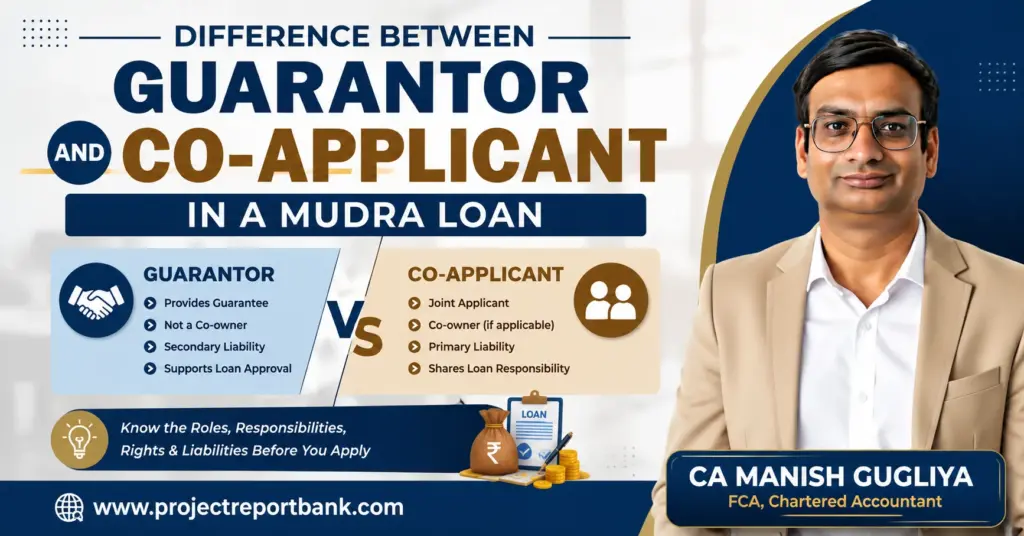
Yes, this happens. A co-applicant is a joint borrower in the Mudra loan – usually someone actively involved in the business. A guarantor only provides a backup promise of repayment. Banks sometimes prefer co-applicant status when a spouse is actively running the business alongside the primary applicant. But before agreeing, understand the legal responsibility clearly: both co-applicant and guarantor can be fully liable if the loan is not repaid. The implications differ, and you should read the terms carefully.
Can the bank add a guarantor condition after issuing a Mudra loan sanction letter?
Normally, key terms like the guarantor requirement should be clear at the sanction stage itself. Adding new conditions later without discussion is poor practice and can be challenged. If such a situation arises, politely ask the branch to explain the change in writing. If not satisfied, you may consider complaint routes or re-negotiation as described in the escalation section of this article. Always keep copies of your original sanction letter and all communications.
Conclusion: Focus on Strong Applications, Not Just Guarantors
Mudra loans exist to help small businesses grow without the burden of collateral. They are a form of financial assistance designed for business purposes – from street vendors and food processors to small manufacturing units and repair shops. The absence of a guarantor alone should not normally close the door for a genuine, well-prepared applicant. You can apply online or visit any participating bank to explore your options.
The core message is simple: banks must judge mudra loan applications based on business viability, repayment capacity, and documentation quality. A guarantor may enter the picture in some high-risk cases, but it should never be treated as a blanket entry ticket that every single business owner must arrange.
Focus your energy on improving your project report, arranging solid income proof, maintaining clean banking habits, and registering your business properly. If you face an unfair demand, use your rights respectfully – ask for written reasons, meet the bank manager, and escalate complaints only when genuinely necessary.
If you are planning to apply for a Mudra loan without a guarantor, start by organising your documents today. Refer to our related guides on collateral rules, guarantor issues, and project report preparation for step-by-step help. A strong application speaks louder than any guarantor ever can.
- Mudra Loan Guarantor & Security Issues: Complete Guide for Borrowers (2026)


- What Is the Liability of a Mudra Loan Guarantor in Case of Default?
- What Happens If Your Mudra Loan Guarantor Withdraws?

- Can You Change the Guarantor After Mudra Loan Sanction?
- Understanding Hypothecation in Mudra Loans

- Rights and Responsibilities of a Mudra Loan Guarantor – Complete Legal Guide for Borrowers & Guarantors
- What Documents Are Required from a Mudra Loan Guarantor? Complete Checklist

- Guarantor vs Co-applicant in Mudra Loan: Which Option is Right for Your Business?
- Can Family Members Be Guarantors for a Mudra Loan?