Introduction
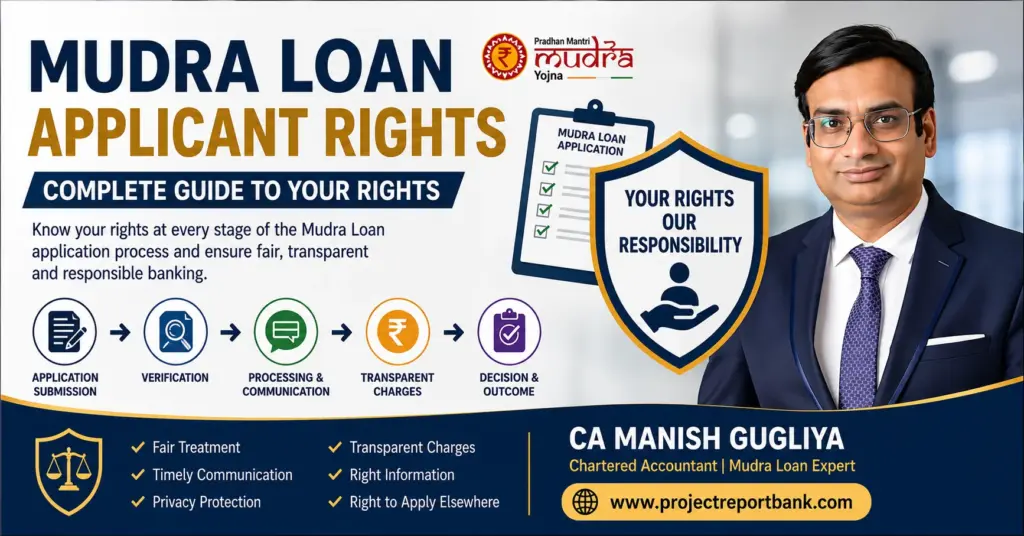
Many entrepreneurs applying for a Mudra Loan spend considerable time understanding eligibility criteria, required documents, and business financing, but very few are aware of their rights as loan applicants. This lack of awareness often leads to unnecessary delays, confusion, repeated document requests, hidden charges, poor communication, and even unfair treatment during the loan application process. Understanding your rights is just as important as meeting the eligibility requirements because it helps you interact with the bank with greater confidence and clarity.
It is important to remember that your rights begin the moment you decide to apply for a Mudra Loan—not only after the loan is sanctioned. From submitting your application and receiving an acknowledgement to fair evaluation, transparent communication, protection of your personal information, and receiving accurate guidance from the bank, applicants are entitled to fair and professional treatment throughout the entire loan journey. Knowing these rights helps ensure that the application process remains transparent, accountable, and customer-focused.
Banks and financial institutions offering Mudra Loans are expected to conduct the application process in line with the Pradhan Mantri Mudra Yojana (PMMY) framework and applicable Reserve Bank of India (RBI) guidelines on customer service, fair banking practices, transparency, grievance handling, and responsible lending. While banks have the responsibility to assess the creditworthiness and viability of every application, they are also expected to treat applicants fairly, communicate clearly, and avoid practices that are inconsistent with regulatory expectations.
Awareness of your rights can significantly reduce unnecessary delays, misunderstandings, and avoidable disputes during the application process. Whether it involves obtaining an application acknowledgement, questioning unnecessary document requests, understanding processing charges, protecting your privacy, or knowing the reasons behind an application decision, informed applicants are better equipped to safeguard their interests and complete the loan process more smoothly.
This comprehensive guide serves as the central resource for Mudra Loan Applicant Rights. It provides an overview of every important right available to applicants and connects you to detailed articles covering each topic in depth. By exploring this guide and the linked resources, you will gain a clear understanding of your rights, the responsibilities of banks, and the practical steps you can take to ensure a fair, transparent, and hassle-free Mudra Loan application experience.
What You Will Learn in This Guide
This guide explains the most important rights available to Mudra Loan applicants at different stages of the application process. Select any topic below to read the complete guide.
Â
Why Every Mudra Loan Applicant Should Know Their Rights
Many entrepreneurs focus on meeting the eligibility criteria for a Mudra Loan but often overlook an equally important aspect—their rights as loan applicants. It is a common misconception that once an application is submitted, the bank has complete authority over the entire process. While banks are responsible for evaluating loan applications, they must also process them in a fair, transparent, and customer-focused manner. Understanding these rights helps applicants communicate confidently with the bank and ensures a smoother borrowing experience.
Banks Have Responsibilities Along with Lending Authority
Banks play an important role in assessing the viability of every Mudra Loan application, verifying documents, evaluating repayment capacity, and ensuring compliance with applicable lending norms. However, this authority is accompanied by responsibilities. Applicants have the right to expect professional conduct, transparent communication, and a fair assessment of their applications. The loan process should not create unnecessary obstacles or confusion for genuine applicants.
Transparency Builds Trust in the Loan Process
Transparency is one of the most important principles of responsible banking. Applicants should clearly understand the application procedure, documentation requirements, processing timelines, applicable charges, and important decisions taken during loan processing. When banks communicate openly and provide accurate information, applicants can prepare better, avoid unnecessary delays, and complete the application process with greater confidence.
Fair Treatment Is the Right of Every Applicant
Every Mudra Loan application should be assessed on its own merits rather than on assumptions or personal bias. Banks are expected to evaluate applications based on eligibility, business viability, financial position, documentation, and applicable lending norms. Fair treatment helps create confidence among entrepreneurs and ensures that every applicant receives an equal opportunity to obtain institutional finance.
Accountability Improves Customer Confidence
Applicants should be able to rely on banks to follow proper procedures throughout the application process. Accountability means maintaining accurate records, communicating important developments, requesting only relevant information, and handling applications responsibly. When banks remain accountable for their actions, applicants experience greater confidence in the overall lending system.
Customer Protection Is an Important Banking Principle
During the Mudra Loan application process, banks receive sensitive personal, financial, and business information from applicants. They are expected to handle this information responsibly and maintain appropriate confidentiality. Customer protection also involves providing accurate information, avoiding misleading practices, and ensuring that applicants are treated professionally throughout the loan journey.
RBI Promotes Fair Banking Practices
The Reserve Bank of India (RBI) has established broad principles that encourage banks to maintain transparency, fairness, responsible lending, effective grievance handling, and high standards of customer service. Although banks retain the discretion to approve or reject applications based on their credit assessment, they are expected to conduct the entire process in accordance with these regulatory expectations and fair banking practices.
PMMY Was Introduced to Support Entrepreneurs
The Pradhan Mantri Mudra Yojana (PMMY) was launched to improve access to institutional finance for micro and small businesses across India. The scheme is designed to promote entrepreneurship by encouraging banks to provide credit through a transparent, structured, and customer-friendly process. Understanding the purpose of PMMY helps applicants appreciate that the objective of the scheme is not only to evaluate risk but also to facilitate responsible business financing.
Awareness of Your Rights Leads to Better Outcomes
Applicants who understand their rights are generally better prepared throughout the loan process. They maintain proper records, ask informed questions, seek clarification whenever required, and communicate more effectively with the bank. This awareness reduces misunderstandings, minimizes unnecessary delays, and helps applicants identify and respond appropriately to situations where fair banking practices may not have been followed.
Mudra Loan Application Journey and Your Rights at Every Stage
Understanding Every Stage of the Mudra Loan Application Journey
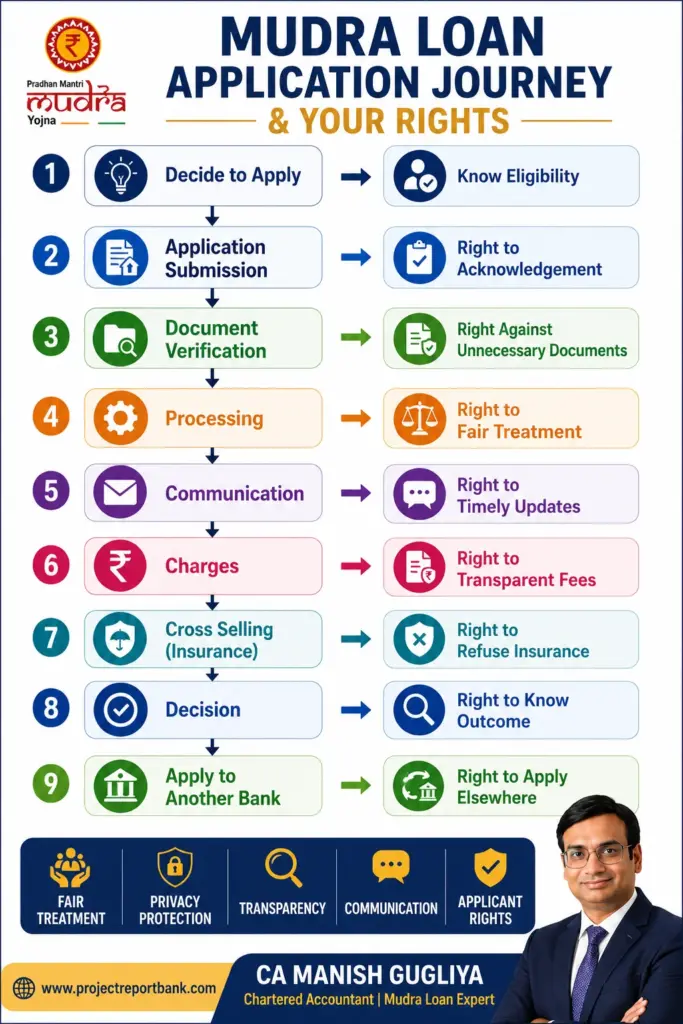
The infographic above outlines the complete Mudra Loan application journey and highlights the important rights available to applicants at every stage. While banks are responsible for assessing the creditworthiness and viability of each application, applicants also have rights that promote transparency, fairness, and responsible banking practices. Below is a brief explanation of each stage.
1. Decide to Apply
The first step is understanding whether your business and financing requirement are suitable for a Mudra Loan. Before applying, review the eligibility conditions, determine the appropriate loan category, prepare your business plan, and collect the required documents. Proper preparation reduces the chances of delays and improves the quality of your application.
2. Application Submission
Once your application is ready, submit the prescribed application form along with all required supporting documents. At this stage, you should receive an acknowledgement confirming that the bank has accepted your application for processing. This acknowledgement serves as an important record for future follow-up.
3. Document Verification
The bank verifies your identity, business details, financial information, and supporting documents to ensure the application is complete. Applicants should provide genuine and relevant documents, while banks should request only those documents that are reasonably required for processing the loan.
4. Processing
During processing, the bank evaluates your eligibility, business viability, repayment capacity, and overall credit profile. Every application should be assessed fairly and objectively based on its merits, without arbitrary or discriminatory treatment.
5. Communication
Applicants should remain informed about the progress of their loan application. If additional information or clarification is required, the bank should communicate the requirements in a timely and clear manner. Regular communication helps applicants respond promptly and keeps the application moving smoothly.
6. Charges
Before paying any fee, applicants should clearly understand the applicable processing charges and other legitimate costs associated with the loan. Transparent disclosure of charges helps applicants make informed financial decisions and avoids unnecessary confusion.
7. Cross-Selling (Insurance)
Banks may inform applicants about optional insurance or financial products, but such products should not be presented as compulsory unless specifically required under applicable rules. Applicants should understand the purpose and cost of any additional product before deciding whether to purchase it.
8. Decision
After completing the assessment, the bank communicates its decision regarding the loan application. Whether the application is approved or not, applicants should understand the outcome and, where appropriate, seek clarification regarding the next steps or any issues identified during the assessment.
9. Apply to Another Bank
If the application is not approved or if the applicant decides to explore other financing options, it may be possible to approach another eligible bank or financial institution, subject to applicable rules and circumstances. Before reapplying, applicants should review their previous application, correct any deficiencies, and submit a stronger proposal.
Understanding each stage of the Mudra Loan application process enables applicants to prepare better, communicate effectively with the bank, maintain proper documentation, and navigate the lending journey with greater confidence. Awareness of these stages also helps applicants recognize their rights and responsibilities throughout the application process.
Â
Complete Mudra Loan Applicant Rights Library
Understanding your rights as a Mudra Loan applicant becomes easier when each right is explained separately with practical examples and detailed guidance. This library brings together every important applicant right covered in this cluster, helping you understand what you can reasonably expect from the bank throughout the loan application process. Whether you want to know about acknowledgements, fair treatment, transparent charges, privacy, communication, or your options after rejection, the guides below provide comprehensive information to help you navigate the Mudra Loan process with confidence.
Right to Receive an Acknowledgement After Submitting Your Mudra Loan Application
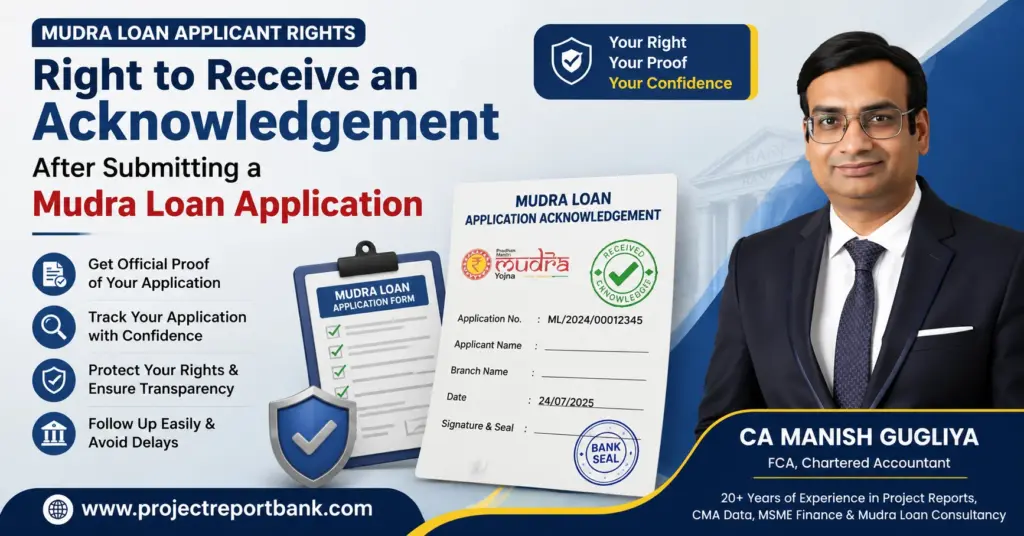
Receiving an acknowledgement after submitting your Mudra Loan application is one of the most important safeguards for every applicant. It confirms that the bank has officially accepted your application and creates a record containing the application date and reference details. This acknowledgement becomes useful when tracking your application, following up with the bank, or resolving disputes regarding submission dates.
Applicants who submit applications without obtaining an acknowledgement may find it difficult to prove when the application was filed or monitor its progress. Therefore, every applicant should ensure that proper proof of submission is obtained before leaving the branch or completing the online application process.
Who should read this guide? Anyone preparing to submit a new Mudra Loan application or waiting for confirmation that their application has been accepted for processing.
👉 Read the Complete Guide:
https://projectreportbank.com/mudra-loan-application-acknowledgement-rights/
Your Right to Fair and Non-Discriminatory Treatment During Mudra Loan Processing
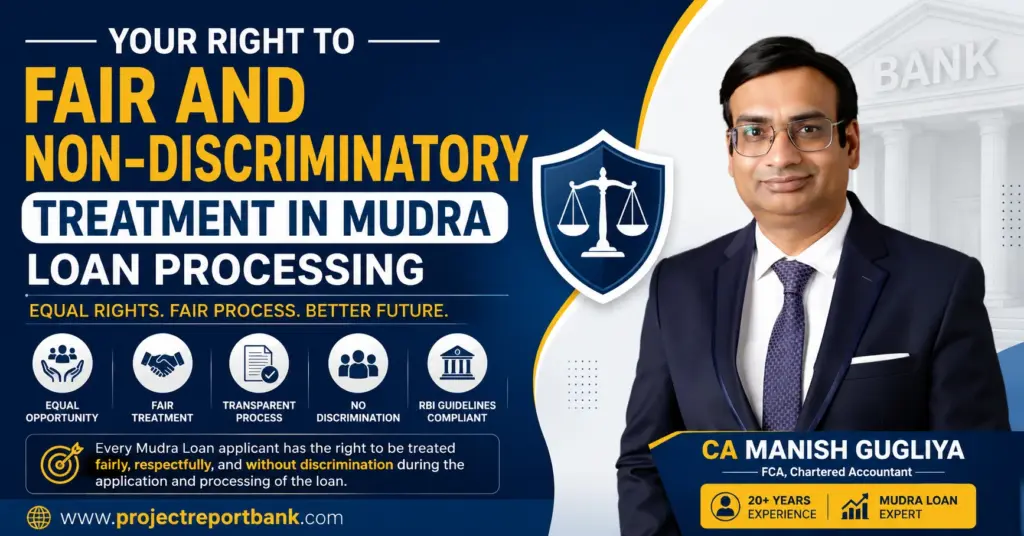
Every eligible applicant deserves to have their Mudra Loan application evaluated fairly and objectively. Banks should assess applications based on business viability, eligibility, documentation, and financial capability rather than personal assumptions or irrelevant considerations. A transparent assessment process builds confidence in the banking system and promotes equal access to institutional finance.
Fair treatment also includes respectful communication, professional conduct, and consistent application of lending policies. Applicants should feel confident that their application is being reviewed using established procedures and objective criteria.
👉 Read the Detailed Guide:
https://projectreportbank.com/fair-treatment-mudra-loan-processing/
Can a Bank Ask for Documents Not Required Under Mudra Loan?
Banks verify documents to assess eligibility and business details, but applicants often wonder whether additional document requests are always justified. Understanding which documents are generally required and when further information may reasonably be requested helps applicants respond appropriately without unnecessary confusion.
Knowing your rights regarding documentation can also help reduce delays and ensure that your application progresses smoothly while maintaining proper compliance with lending requirements.
👉 Read the Complete Guide:
https://projectreportbank.com/can-bank-ask-extra-documents-mudra-loan/
Right to Transparent Loan Processing Charges and Fees
Applicants should clearly understand any legitimate charges associated with their Mudra Loan application before making a payment. Transparency regarding processing fees and related costs enables borrowers to make informed financial decisions and prevents misunderstandings during the loan process.
Understanding applicable charges also helps applicants distinguish between official fees and charges that may require further clarification.
👉 Read the Complete Guide:
https://projectreportbank.com/mudra-loan-processing-charges/
Can a Bank Force You to Buy Insurance or Other Products with a Mudra Loan?
During loan processing, banks may inform applicants about insurance or other financial products. Applicants should understand whether such products are optional or mandatory under the applicable terms and conditions. Awareness of your rights helps you make informed decisions without feeling pressured to purchase products that may not suit your requirements.
Knowing the difference between optional cross-selling and genuine loan requirements helps applicants protect their interests throughout the borrowing process.
👉 Read the Complete Guide:
https://projectreportbank.com/can-bank-force-insurance-with-mudra-loan/
Right to Timely Communication During Mudra Loan Processing
Regular communication plays an important role in ensuring a smooth Mudra Loan application process. Applicants should remain informed about important updates, additional document requirements, verification activities, and significant developments affecting their application.
Timely communication allows applicants to respond quickly, reduce unnecessary delays, and maintain better coordination with the bank throughout the processing stage.
👉 Read the Complete Guide:
https://projectreportbank.com/mudra-loan-timely-communication-rights/
Privacy Rights of Mudra Loan Applicants
Applying for a Mudra Loan requires applicants to share personal, financial, and business information with the bank. Such information should be handled responsibly and with appropriate confidentiality. Understanding privacy rights helps applicants know how their information should be collected, stored, used, and protected during the loan process.
Maintaining confidence in the security of personal information is an essential part of responsible banking practices.
👉 Read the Complete Guide:
https://projectreportbank.com/privacy-rights-of-mudra-loan-applicants/
Right to Receive Correct Information from the Bank
Applicants depend on banks for accurate guidance regarding eligibility, documentation, loan procedures, timelines, and applicable conditions. Receiving complete and correct information enables applicants to prepare their applications properly and avoid unnecessary mistakes.
Clear communication from the bank helps applicants make informed decisions throughout the application journey.
👉 Read the Complete Guide:
https://projectreportbank.com/mudra-loan-applicant-rights-bank-information/
Does the Bank Have to Explain Why Your Mudra Loan Was Rejected?
A Mudra Loan application may be declined for various reasons, including documentation issues, financial assessment, business viability, or eligibility concerns. Understanding whether and how banks communicate the reasons behind a rejection helps applicants identify areas for improvement before considering another application.
Knowing the possible reasons behind a decision allows applicants to strengthen future applications and reduce the likelihood of repeated issues.
👉 Read the Complete Guide:
https://projectreportbank.com/does-bank-have-to-explain-mudra-loan-rejection/
Can You Apply to Another Bank While One Application Is Pending?
Applicants sometimes consider approaching another bank if their application is taking longer than expected or if they wish to explore other financing options. Before doing so, it is important to understand the practical considerations, possible implications, and appropriate approach when multiple applications are involved.
Having a clear understanding of your available options helps you make better decisions while pursuing business finance.
👉 Read the Complete Guide:
https://projectreportbank.com/can-you-apply-to-another-bank-for-a-pending-mudra-loan/
Quick Comparison of Important Applicant Rights
The table below provides a quick overview of common situations faced by Mudra Loan applicants, the corresponding applicant rights, and why those rights matter during the loan process.
| Applicant Situation | Your Right | Why It Matters |
|---|---|---|
| Application submitted | Right to acknowledgement | Helps you confirm submission and track the application status. |
| Bank requests documents | Right to reasonable document requests | Prevents unnecessary demands, confusion, and avoidable delays. |
| Application under processing | Right to fair treatment | Supports equal opportunity and an objective assessment. |
| Charges or fees requested | Right to transparent charges | Helps you understand costs and avoid unexplained or hidden fees. |
| Insurance or another product offered | Right against forced cross-selling | Allows you to make an informed choice without undue pressure. |
| No update from the bank | Right to timely communication | Reduces uncertainty and helps you respond to requirements promptly. |
| Guidance required from the bank | Right to correct information | Enables better preparation and informed financial decisions. |
| Personal or business data submitted | Right to privacy and data protection | Helps protect sensitive personal, financial, and business information. |
| Loan application rejected | Right to know the rejection reason | Helps you identify weaknesses and improve a future application. |
| Application remains pending | Right to explore another bank where permitted | Provides alternative financing opportunities when appropriate. |
Common Mistakes Applicants Make Without Knowing Their Rights
Many Mudra Loan applicants unknowingly create problems for themselves simply because they are unaware of their rights. Avoiding the following common mistakes can help reduce delays, improve communication with the bank, and make the loan application process smoother.
❌ Never Ask for an Acknowledgement
Some applicants submit their Mudra Loan application without obtaining an acknowledgement receipt. Without proof of submission, it becomes difficult to track the application or establish when it was submitted. Always request an acknowledgement to maintain a proper record and facilitate future follow-up.
❌ Accept Unnecessary Document Requests
Applicants sometimes provide every document requested without understanding whether it is genuinely required. While banks may seek additional information in certain cases, you should understand the reason behind repeated or unusual document requests and maintain copies of everything you submit.
❌ Buy Insurance Under Pressure
Many applicants believe purchasing insurance or other financial products is compulsory for obtaining a Mudra Loan. Before accepting any additional product, understand its purpose, benefits, and whether it is optional or specifically required under the applicable lending terms.
❌ Never Ask About the Processing Timeline
Applicants often wait silently for weeks without requesting updates on their application status. Regular and polite follow-up helps you understand the current stage of processing, respond quickly to additional requirements, and reduce unnecessary uncertainty during the application journey.
❌ Ignore Privacy of Personal Information
A Mudra Loan application contains important personal, financial, and business information. Applicants should keep copies of submitted documents, share information only through official channels, and understand how sensitive data is handled throughout the loan application process.
❌ Never Seek the Reason for Rejection
When a loan application is not approved, many applicants immediately abandon the process instead of identifying the underlying issues. Understanding the possible reasons behind the decision helps you strengthen future applications and avoid repeating the same mistakes.
❌ Believe Every Statement Without Verification
Applicants occasionally rely on verbal information without confirming important details related to documentation, timelines, charges, or eligibility. Whenever possible, verify significant information through official communication, written instructions, or the bank's published guidance before making important decisions.
❌ Pay Charges Without Understanding Them
Some applicants pay processing fees or other charges without asking what they are for. Before making any payment, understand the nature of the charge, request clarification where necessary, and keep all payment receipts for your records.
Practical Tips to Protect Your Rights During Mudra Loan Processing
Understanding your rights is only the first step. Following practical habits throughout the Mudra Loan application process can help you avoid unnecessary delays, communicate effectively with the bank, and protect your interests. Use this checklist to stay organized and make informed decisions from application submission to the final loan decision.
Keep Copies of Every Document
Always retain photocopies or scanned copies of your application form, KYC documents, project report, bank statements, and every document submitted to the bank. This helps resolve disputes and makes future verification much easier.
Ask Questions Politely
If any requirement is unclear, politely ask the bank for clarification. You also have the right to receive accurate information regarding eligibility, documentation, and the loan process. Learn more about your right to receive correct information from the bank →
Maintain Written Communication
Whenever possible, communicate through emails, letters, or written acknowledgements instead of relying solely on verbal discussions. Written records are valuable if you need to follow up or clarify any issue later.
Read Every Document Carefully
Before signing any application form, declaration, or consent letter, read every document carefully. Ensure all information is accurate and understand every condition before giving your approval.
Verify Charges Before Making Payment
Always ask the bank to explain processing fees or any other charges before making payment. Understanding applicable charges helps you avoid confusion and unnecessary expenses. Read the complete guide on transparent Mudra Loan processing charges →
Keep Your Application Acknowledgement Safe
Never leave the bank without obtaining and preserving your application acknowledgement. It serves as proof of submission and helps you track your application throughout the processing stage. Know why the acknowledgement receipt is important →
Request Regular Status Updates
Do not hesitate to request updates regarding your application. Regular communication helps you respond promptly to additional requirements and reduces unnecessary uncertainty. Read about your right to timely communication →
Preserve Emails and Official Messages
Keep copies of emails, SMS alerts, WhatsApp messages, and written correspondence related to your Mudra Loan application. These records can be useful during future follow-ups or if any dispute arises.
Understand Insurance Before Agreeing
If insurance or any additional financial product is offered, understand whether it is optional or required. Never feel pressured to purchase products without knowing their purpose and benefits. Read whether banks can force insurance with a Mudra Loan →
Keep the Rejection Letter or Communication
If your Mudra Loan application is rejected, preserve the rejection letter or official communication. Understanding the reasons behind the decision will help you improve your application before reapplying. Learn whether the bank should explain the rejection reason →
Applicant Rights vs Bank Responsibilities
A successful Mudra Loan process depends on both applicants and banks fulfilling their respective responsibilities. While applicants have specific rights that promote transparency and fairness, banks are expected to follow responsible lending practices and communicate clearly throughout the application process. The table below summarizes these important rights and corresponding bank responsibilities.
| Applicant Rights | Bank Responsibilities |
|---|---|
| Right to Fair Treatment | Evaluate every eligible application fairly, objectively, and without discrimination. |
| Right to Privacy | Protect applicants' personal, financial, and business information from unauthorized disclosure. |
| Right to Correct Information | Provide accurate guidance regarding eligibility, documentation, procedures, and applicable terms. |
| Right to Timely Communication | Keep applicants informed about the status of their application and any additional requirements. |
| Right to Transparent Charges | Clearly disclose applicable processing charges, fees, and other official costs before collection. |
| Right to Reasonable Documentation | Request only relevant documents necessary for assessing eligibility and processing the application. |
| Right to Receive an Acknowledgement | Accept the application, issue an acknowledgement, and maintain proper submission records. |
| Right to Know the Loan Outcome | Communicate the application decision and provide appropriate information regarding the outcome. |
When Should You Escalate a Mudra Loan Issue?
Most Mudra Loan applications are processed smoothly when applicants submit complete documentation and maintain regular communication with the bank. However, there may be situations where an issue remains unresolved despite reasonable follow-up. In such cases, applicants should first attempt to resolve the matter directly with the concerned branch. If the problem continues, they may consider using the bank’s official grievance redressal process before pursuing any higher level of escalation.
The following situations commonly indicate that an issue may require escalation.
No Acknowledgement Issued After Application Submission
After submitting your Mudra Loan application, you should receive an acknowledgement or other proof of submission. If the bank accepts your application but does not issue any acknowledgement despite your request, follow up with the branch and request written confirmation.
Related Guide:
👉 Right to Receive an Acknowledgement After Submitting Your Mudra Loan Application
Repeated Requests for Unnecessary Documents
Banks may occasionally ask for additional documents to complete their assessment. However, if you are repeatedly asked for documents without a clear explanation or are asked to submit information that appears unrelated to your application, politely seek clarification and request the reason for the additional requirements.
Related Guide:
👉 Can a Bank Ask for Documents Not Required Under Mudra Loan?
Unexplained Delays in Processing
Some processing delays can occur due to verification, document deficiencies, or internal procedures. However, if your application remains pending for an unusually long period and you receive no meaningful updates despite repeated follow-ups, it is reasonable to request a written status update through the bank’s official communication channels.
Related Guide:
👉 Right to Timely Communication During Mudra Loan Processing
Pressure to Purchase Insurance or Other Products
Banks may introduce applicants to insurance or other financial products, but applicants should clearly understand whether such products are optional or mandatory under the applicable loan terms. If you feel pressured to purchase additional products without proper explanation, request clarification before making any decision.
Related Guide:
👉 Can a Bank Force You to Buy Insurance or Other Products with a Mudra Loan?
Hidden or Unexplained Processing Charges
Before paying any processing fee or service charge, ask the bank to explain its purpose. If charges are unclear or not properly explained, seek clarification and request a receipt for every payment made.
Related Guide:
👉 Right to Transparent Loan Processing Charges and Fees
Unprofessional or Discourteous Behaviour
Applicants should expect courteous and professional communication throughout the loan process. If you experience repeated unprofessional behaviour, inappropriate language, or conduct that prevents fair communication, document the incidents and raise the matter through the appropriate grievance channel within the bank.
Related Guide:
👉 Your Right to Fair and Non-Discriminatory Treatment
Concerns About Privacy of Your Information
Mudra Loan applications require applicants to provide sensitive personal, financial, and business information. If you have concerns about how your information is being handled or shared, raise the issue with the branch and request clarification regarding the handling of your data.
Related Guide:
👉 Privacy Rights of Mudra Loan Applicants
No Communication Despite Repeated Follow-up
If you have contacted the branch multiple times through appropriate channels but continue to receive no meaningful response, maintain a record of your follow-up attempts before using the bank’s formal complaint mechanism.
Related Guide:
👉 Right to Timely Communication During Mudra Loan Processing
Rejection Without Any Explanation
A bank may decline a Mudra Loan application based on its assessment and applicable lending policies. Where reasons are expected to be communicated, applicants should request an explanation so they can understand the decision and improve future applications where appropriate.
Related Guide:
👉 Does the Bank Have to Explain Why Your Mudra Loan Was Rejected?
Best Practices Before Escalating a Mudra Loan Issue
Before escalating any concern, take reasonable steps to resolve the matter through the branch and maintain proper documentation. Good record-keeping makes it easier to explain the issue clearly if further review becomes necessary.
Follow this checklist before escalating:
âś” Keep copies of your Mudra Loan application and all supporting documents.
âś” Preserve the application acknowledgement and payment receipts.
âś” Save emails, SMS messages, letters, and other written communications.
âś” Record the dates of branch visits and follow-up discussions.
âś” Request written clarification wherever possible instead of relying only on verbal conversations.
âś” Note the names or designations of officials you communicate with, where appropriate.
âś” Use the bank’s official grievance redressal process and allow reasonable time for a response before considering any further escalation.
By maintaining organised records, communicating professionally, and following the bank’s established grievance process, applicants can often resolve concerns efficiently while protecting their rights throughout the Mudra Loan application journey.
Expert Guidance from CA Manish Gugliya
Over the years of working with entrepreneurs, startups, and MSMEs, I have observed that many Mudra Loan applications face avoidable challenges not because the business idea is weak, but because the application process is not handled systematically. The following practical suggestions can help applicants prepare stronger applications while protecting their rights throughout the loan journey.
Understand Your Rights Before Applying
Many applicants are unaware of their rights during the Mudra Loan process. Knowing your rights regarding acknowledgement, fair treatment, transparent charges, privacy, and timely communication helps you interact with the bank more confidently and reduces the chances of unnecessary misunderstandings.
Submit Complete and Accurate Documentation
Incomplete or inconsistent documentation is one of the most common reasons for delays. Ensure that your KYC documents, business proofs, financial records, and supporting information are accurate, up-to-date, and consistent across all documents before submitting your application.
Prepare a Professional Project Report
A well-prepared Project Report is much more than a formality. It explains your business model, funding requirements, projected income, expenses, profitability, and repayment capacity in a structured manner. A realistic project report enables the bank to understand your business proposal more effectively and supports a smoother credit assessment.
Maintain Proper Records
Keep copies of every document submitted to the bank, including your application form, acknowledgement receipt, payment receipts, emails, and other written communications. Proper record-keeping makes future follow-ups easier and helps resolve any confusion that may arise during processing.
Communicate Professionally
Maintain polite and respectful communication with bank officials throughout the application process. If additional documents or clarifications are requested, respond promptly and seek written clarification whenever necessary. Professional communication often helps resolve issues more efficiently.
Verify Information Before Taking Action
If you receive information regarding eligibility, documentation requirements, charges, or timelines, verify it through official bank communication whenever possible. Making decisions based on confirmed information helps avoid unnecessary mistakes and delays.
Address Issues at an Early Stage
If you experience repeated delays, unexplained document requests, or communication gaps, raise your concerns with the branch promptly instead of waiting until the issue becomes more complicated. Early resolution is usually more effective than delayed escalation.
Treat the Application as a Professional Business Proposal
A Mudra Loan application should not be viewed as merely filling out forms. Present your business professionally by providing realistic financial projections, complete documentation, and clear explanations of your business activity. A systematic and transparent approach benefits both the applicant and the lending institution.
Final Advice
A successful Mudra Loan application is built on three foundations: complete documentation, awareness of your rights, and professional communication. When applicants prepare carefully, maintain proper records, understand the process, and present a realistic business proposal supported by a quality Project Report, they significantly improve both the efficiency of the application process and their overall preparedness for bank evaluation.
Frequently Asked Questions
The following frequently asked questions address some of the most common concerns that entrepreneurs and business owners have regarding their rights during the Mudra Loan application process. Understanding these answers can help you communicate more effectively with the bank, prepare a stronger application, and avoid common mistakes.
What are the rights of a Mudra Loan applicant?
A Mudra Loan applicant has several important rights during the application process, including the right to fair treatment, proper acknowledgement of the application, transparent information about charges, timely communication, privacy of personal information, and professional handling of the application. Being aware of these rights helps applicants navigate the loan process more confidently.
Is a bank required to issue an acknowledgement after receiving my Mudra Loan application?
Applicants should request an acknowledgement or proof of submission whenever they submit a Mudra Loan application. An acknowledgement serves as evidence that the application has been received and helps applicants track its progress during processing.
Can a bank ask for additional documents during Mudra Loan processing?
Yes. Banks may request additional documents when they are necessary to verify eligibility, business details, or financial information. If additional documents are requested, applicants may politely seek clarification regarding their purpose to ensure the request is relevant to the loan assessment.
Can a bank force me to buy insurance with a Mudra Loan?
Applicants should understand whether any insurance or financial product offered during the loan process is optional or required under the applicable terms. Before purchasing any additional product, carefully understand its purpose, cost, and conditions.
Are processing charges mandatory for every Mudra Loan?
Processing charges depend on the applicable policies, loan category, and lending institution. Before making any payment, applicants should ask the bank to explain the nature of every charge and obtain an official receipt for the payment.
Does the bank have to explain why my Mudra Loan application was rejected?
Banks assess Mudra Loan applications based on multiple factors, including eligibility, documentation, business viability, and internal credit assessment. Where reasons are expected to be communicated, applicants should request clarification so they can better understand the decision and improve future applications.
Can I apply to another bank while my Mudra Loan application is pending?
Whether another application is appropriate depends on the circumstances and the policies of the concerned banks. Before submitting multiple applications, applicants should understand the possible implications and make an informed decision.
How should my personal information be protected during the application process?
Your personal, financial, and business information should be handled responsibly by the bank. Applicants should also protect their own records by submitting documents only through official channels and keeping copies of everything they provide.
What should I do if the bank is not responding to my application?
Start by following up politely with the branch and requesting a status update. Keep records of your communication and use the bank’s official grievance redressal process if meaningful responses are not received within a reasonable period.
Can I refuse unnecessary products offered by the bank?
If products such as insurance or other financial services are offered, applicants should first understand whether they are optional or specifically required under the applicable loan terms. Make decisions only after understanding all relevant information.
What documents should I keep after applying for a Mudra Loan?
Applicants should safely preserve the application acknowledgement, completed application form, KYC documents, project report, payment receipts, emails, letters, SMS messages, and any other communication exchanged with the bank during the application process.
Where can I complain if my rights are ignored?
Applicants should first raise the issue with the concerned branch and follow the bank’s official grievance redressal mechanism. If the matter remains unresolved after following the prescribed process, applicants may consider the appropriate escalation channels available under applicable banking grievance procedures.
Does every Mudra Loan applicant have the same rights?
Yes. Every applicant should be treated fairly and professionally throughout the application process. While the final lending decision depends on eligibility and credit assessment, the principles of transparency, respectful communication, and responsible handling of applications apply to all applicants.
Can I request important communication from the bank in writing?
Yes. Wherever practical, applicants may request important information, document requirements, application updates, or other significant communications in writing. Maintaining written records helps reduce misunderstandings and provides useful documentation for future reference.
How do applicant rights improve Mudra Loan approval readiness?
Awareness of applicant rights encourages better preparation, organized documentation, timely follow-up, informed decision-making, and professional communication with the bank. When combined with a complete application and a well-prepared Project Report, these practices help applicants present a stronger and more organized loan proposal.
Conclusion
Understanding your rights as a Mudra Loan applicant is just as important as meeting the eligibility criteria or submitting the required documents. Awareness of these rights helps you navigate the loan application process with greater confidence, improves communication with the bank, and enables you to make informed decisions at every stage. Keep the following key takeaways in mind:
Every Applicant Has Important Rights
Every Mudra Loan applicant has important rights throughout the application process—from submitting the application and receiving an acknowledgement to document verification, loan processing, communication, and the final loan decision. Being aware of these rights promotes transparency and accountability.
Rights Awareness Helps Avoid Common Problems
Understanding your rights can help you avoid many common issues, including:
Unnecessary processing delays
Hidden or unexplained charges
Unfair or discriminatory treatment
Forced insurance or cross-selling
Repeated requests for unnecessary documents
Poor communication and lack of timely updates
Maintain Proper Records Throughout the Process
Good record-keeping is an essential part of protecting your interests. Always:
Keep copies of all submitted documents.
Preserve your application acknowledgement.
Save payment receipts, emails, SMS messages, and written correspondence.
Maintain a record of important discussions and follow-ups with the bank.
Professional Communication Makes a Difference
Communicate politely and professionally with bank officials, respond promptly to genuine requests, and seek written clarification whenever necessary. Clear and respectful communication often helps resolve issues quickly and keeps the application process moving smoothly.
A Strong Application Improves Overall Readiness
Rights awareness should be combined with complete documentation, accurate information, and a well-prepared Project Report. A systematic and organized application helps the bank evaluate your proposal more efficiently and demonstrates your preparedness as a borrower.
Explore the Complete Applicant Rights Library
This Mudra Loan Applicant Rights library has been created to help entrepreneurs, startups, and MSMEs understand every important applicant right in detail. Explore the individual guides linked throughout this page to gain deeper insights, strengthen your application, protect your rights, and confidently navigate every stage of your Mudra Loan journey.
Mudra Loan Applicant Rights: Complete Guide to Your Rights During the Loan Application Process
Introduction Many entrepreneurs applying for a Mudra Loan spend considerable time understanding eligibility criteria, required documents, and business financing, but very few are aware of their rights as loan applicants. This lack of awareness often leads to unnecessary delays, confusion, repeated document requests, hidden charges, poor communication, and even unfair treatment during the loan application […]

Does the Bank Have to Explain Why Your Mudra Loan Was Rejected?
Key Takeaways Most Mudra loan applicants never receive a clear explanation when their application is turned down. If you have faced a mudra loan rejection recently, here is what you need to know before your next step. Introduction: Why Mudra Loan Rejections Feel So Unfair Every week, thousands of first-time applicants walk out of their […]
Right to Receive an Acknowledgement After Submitting a Mudra Loan Application
Key Takeaways Every Mudra loan applicant should ask for a written or digital acknowledgement slip the moment their application is submitted. This slip is the first official proof that the bank or financial institution has accepted your application under Pradhan Mantri Mudra Yojana (PMMY) and is the foundation for everything that follows-tracking, follow-up, and grievance […]
Your Right to Fair and Non-Discriminatory Treatment in Mudra Loan Processing
Every year, lakhs of small business owners walk into bank branches hoping to secure a Mudra Loan that could change their lives. Some walk out with sanctioned funds and fresh energy. Others walk out confused, frustrated, or worse – feeling that they never got a fair chance. If you have ever wondered whether banks can […]

Can Bank Ask for Extra Documents in Mudra Loan? (Practical Guide by a CA)
Many first-time entrepreneurs assume that banks can ask for any document they want when you apply for a Mudra Loan. Others believe the opposite-that the bank must accept only Aadhaar and PAN and nothing else. Both assumptions are wrong. The reality sits somewhere in the middle. PMMY guidelines lay down a broad framework, but every […]

Mudra Loan Processing Charges: Your Right to Transparent Fees Under PMMY
Most first-time entrepreneurs spend weeks preparing their business plan, gathering documents, and worrying about whether the bank will approve their loan. But very few pause to ask a basic question: what will the bank charge me for processing this loan? Processing charges on a Mudra loan may seem like a small detail, but they directly […]

Can a Bank Force You to Buy Insurance with a Mudra Loan?
Key Takeaways Introduction: Why Mudra Loan Applicants Are Pushed to Buy Insurance I am CA Manish Gugliya, and over the past 20+ years of helping MSME owners with business loans, project reports, and CMA data, I have seen one complaint more than any other at bank branches: forced cross-selling during Mudra Loan processing. Pradhan Mantri […]
Right to Timely Communication During Mudra Loan Processing
Key Takeaways Introduction: Why Timely Communication Matters in Mudra Loan Processing Imagine Sunita, a woman entrepreneur running a small tailoring unit in a semi-urban town. She applied for a Mudra loan at her local bank branch, submitted every document the staff asked for, and then waited. One week passed. Then two. Then a month. No […]
Mudra Loan Privacy Rights: How Banks Should Handle Your Information
Key Takeaways Introduction When you apply for a Mudra loan, you hand over some of the most sensitive information you own. Aadhaar card, PAN, bank statement copies, income tax returns, a project report detailing your business plan, and photographs – all of it goes into the bank’s file. Mudra Yojana, launched on April 8, 2015, […]