Key Takeaways
- Most Mudra loan complaints fail not because the customer is wrong, but because of weak evidence, missed timelines, and procedural gaps.
- Written proof – applications, rejection letters, emails, SMS, WhatsApp chats, branch visit records – matters far more than verbal promises from the bank manager.
- You must first file a proper written complaint with the bank and wait 30 days before approaching the RBI Integrated Ombudsman. Skipping this step usually leads to instant rejection.
- A clear timeline, proper documents, and realistic expectations are the three pillars of a successful Mudra loan complaint.
Introduction: Why Genuine Mudra Loan Complaints Still Fail
I am CA Manish Gugliya, and over 20+ years of MSME consulting, I have watched strong cases collapse because of avoidable technical mistakes. Not weak facts – weak preparation.
Many small business owners and first-time borrowers face real problems with Mudra loans. The bank manager refuses to accept the mudra loan application, says “scheme is closed,” forces insurance, or delays the decision for months. These are genuine grievances. Yet the complaint gets rejected by the banking ombudsman or dies inside the bank’s grievance cell.
This article is not about why banks reject loans. It is about why your complaint about that rejection fails – and how to fix that. You will learn what makes a complaint strong, the specific mistakes that destroy your case, and practical checklists to follow. Mudra loans offer up to ₹20 lakh without collateral under this government backed scheme, and the mudra loan application process is free and direct through banks. Your complaint process should be equally well-prepared.

Table of Contents
What Makes a Mudra Loan Complaint Successful?
The banking ombudsman and senior bank authorities decide based on documents, timelines, and facts – not sympathy. Complaints requiring evidence of procedural lapses tend to be more successful. The Banking Ombudsman resolves customer complaints against banks, so your job is to make the case easy to decide in your favour.
- Complete facts: Clearly state bank name, branch, date of mudra loan application, amount, scheme category (Shishu/Kishore/Tarun), and what exactly went wrong.
- Evidence: Attach the written application copy, acknowledgement with reference number, emails, SMS, WhatsApp chats, rejection letters, and branch visit notes.
- Timelines: Under RBI Integrated Ombudsman Scheme norms, first complain to the bank. Complaints can be escalated if unresolved within 30 days. Then file with the Ombudsman within the prescribed period.
- Written communication: Polite, clear, factual letters carry more weight than verbal fights at the branch counter. Applicants must clearly state their grievances and provide timelines for issues.
- Realistic expectations: The Ombudsman can direct the bank to reconsider your application, remove unfair charges, or provide written reasons. It cannot force the bank to sanction a mudra loan beyond its internal credit policy.
Why Many Mudra Loan Complaints Fail Despite Genuine Issues
Most failures come from process and documentation gaps, not because the applicant is lying. Not exhausting a bank’s internal grievance process can weaken complaints right from the start.
- Incomplete story: Complaints that only say “bank not giving mudra loan” without dates, amounts, or branch details are difficult to act upon. Many complaints are unsuccessful due to incomplete evidence or lack of specific details.
- Emotional narratives: Applicants write long accusations of corruption or political bias without any proof, which weakens credibility.
- No documentation: Many applicants do not keep copies of the application, project report, or rejection letter. It becomes one person’s word against the bank.
- Procedural errors: Going directly to the Ombudsman before filing with the bank, or not using proper complaint forms.
- Poor follow-up: One email or one visit is assumed enough, with no reminders or complaint reference numbers tracked. Using unauthorized agents for complaints can compromise their credibility further.
Mistake 1: Skipping a Proper Written Complaint to the Bank
Under the RBI Integrated Ombudsman Scheme, you must first give the bank a fair chance to resolve your issue. Failing to allow banks enough time to review grievances can weaken the complaint’s validity.
- The mistake: Complaining verbally to the bank manager, arguing at the branch, or sending informal messages – but never filing a formal written complaint to the bank’s grievance redressal system.
- Why it happens: Fear of upsetting the branch, trust in verbal assurance (“kal ho jayega”), or simply not knowing about the bank’s nodal officer and grievance portal.
- How it looks to the Ombudsman: Without a dated written complaint, the case is treated as “premature.” The complaint gets rejected before anyone reads the actual grievance. The Banking Ombudsman ensures accountability in the banking system, but only after you have followed proper steps.
Example: A Kirana shop owner in Jaipur visited his branch for 4 months seeking a ₹5 lakh Kishore mudra loan. He had no email, no written complaint, no acknowledgement. When he went to the Ombudsman, the case was closed as “not first approached the bank.”
How to avoid: Send an email to the bank’s customer care with subject “Complaint regarding Mudra loan application dated DD-MM-YYYY.” Or submit a written letter and take a stamped acknowledgment copy. This also creates the mandatory 30-day waiting period record.
Mistake 2: No Documentary Evidence of Mudra Loan Application or Rejection
No documents, no case. This is almost always true in banking disputes.
- The mistake: Filing complaints without attaching the mudra loan application form, rejection communication, or even proof of visiting the branch. Incomplete or incorrect documentation leads to immediate rejection of grievances.
- Why it happens: Many applicants fill the form at the branch and leave the original there, never asking for a photocopy. Documentation includes PAN, Aadhaar, and business proof – but applicants often do not preserve their own copies.
- How banks respond: Most banks will say “customer never applied” or “loan was processed as per policy” unless there is a paper trail.
Example: A small manufacturer in Indore applied for a ₹10 lakh Tarun mudra loan in 2024 but kept no application copy. When complaining later, he could not prove the date or amount, weakening his entire case.
How to avoid: Always get a photocopy or scan of the filled application. Keep SMS or email acknowledgement. Request rejection reasons in writing under rbi guidelines. Screenshots of UdyamiMitra portal status and bank statements showing processing fee debits also work as evidence.
Mistake 3: Filing the Complaint Too Late and Ignoring RBI Timelines
Many genuine disputes are rejected purely because they are filed after the permitted time limit. Complaints must be filed within one year of the incident.
- The mistake: Waiting months or years after the rejection, then filing with the Ombudsman well beyond the permissible window.
- RBI timelines in plain words: First file with the bank. If no satisfactory response within 30 days, file with the Ombudsman. You can file complaints online at RBI’s complaint management system portal. Do this within the allowed period – ideally within one year from the bank’s final reply.
- Why applicants delay: Fear of spoiling relations with the bank manager, hope that the branch will “somehow” approve the loan later, or simple lack of information.
Example: A borrower at a regional rural banks branch had his mudra loan rejected in 2023 but waited until 2026 to complain. The Ombudsman declined due to delay – records were archived, staff had changed.
How to avoid: Maintain a simple timeline sheet with all dates. Mark calendar reminders. If confused about the deadline, take professional help.
Mistake 4: Emotional Allegations, Abusive Language, and Contradictory Stories
Anger is natural when a bank fails to process applications fairly or misguides about current account requirements. But written complaints must remain calm and factual.
- The mistake: Using abusive language against branch managers, making unverified corruption allegations, or changing the story across different complaints.
- How the Ombudsman views it: Authorities ignore emotional parts and focus on verifiable facts. Abusive or threatening language can lead to complaint rejection.
Example: A street vendor in 2025 alleged “every officer is corrupt” without proof and gave three different versions of events, causing the Ombudsman to distrust the entire complaint.
How to avoid: Write in short paragraphs. List dates sequentially. Avoid personal attacks. Get a trusted person or CA to review the draft before submission.
Mistake 5: Incomplete or Poorly Drafted Ombudsman Complaint (Form, Category, and Uploads)
RBI’s complaint management system has simplified filing, but many applicants still make technical mistakes.
- The mistake: Choosing the wrong complaint category (e.g., “ATM” instead of “loans and advances”), leaving mandatory fields blank, or uploading blurred documents. Non adherence to technical instructions – file size limits, allowed formats – also causes problems.
- Why it happens: Lack of comfort with online forms, filling in a hurry from mobile phones, or getting help from cyber café operators unfamiliar with banking matters.
How to avoid: Prepare all documents in a separate folder first. Write a one-page chronological note. Fill the CMS form carefully on a computer. Double-check loan type, branch name, dates, and contact details. Read about reasons the Ombudsman may reject a Mudra loan complaint before filing.
Mistake 6: Depending Only on Verbal Assurances and Not Preserving Digital Evidence
In modern banking, even a simple SMS can strongly support a mudra loan complaint if preserved correctly.
- The mistake: Relying only on “manager ne bola tha” without saving any messages. Deleting bank SMS or not backing up WhatsApp chats with timelines or reasons from bank staff. Follow up every week after submitting your mudra loan application – but also document each follow-up.
- How to avoid: Create a “Bank” folder on your phone for screenshots. Back up WhatsApp to cloud. Export important chats to email. Photos of acknowledgement slips and branch notice boards also help.
Combining digital evidence with formal written complaints creates a strong, credible case.
Mistake 7: Asking for Relief Beyond the Powers of the Banking Ombudsman
Many strong complaints fail because applicants demand relief the Ombudsman cannot legally grant.
- The mistake: Asking the Ombudsman to guarantee mudra loan approval, order a specific bank to approve a certain amount, punish individual officers criminally, or award huge compensation. Complaints about loan denial can be invalid if the activity falls outside PMMY parameters entirely.
- How to avoid: Request reasonable relief – written reasons for rejection, re-examination of the mudra loan application, adherence to RBI timelines, or refund of wrongly charged fees. Read about RBI Ombudsman relief available for Mudra loan complaints and understand the difference between Consumer Commission vs RBI Ombudsman for Mudra loan disputes.
Mistake 8: Weak Chronology, Missing Project Report, and Business Proof
For Kishore and Tarun Mudra loans especially, the strength of your business story matters during complaint evaluation.
- The mistake: No date-wise chronology, no business plan or project report, no proof of a running business. Unrealistic project reports can lead to loan applications being rejected. Lack of a clear business plan can lead to rejection even before the complaint stage.
- Business proof matters: You must register your business on the Udyam portal for credibility. Weak operational proof such as lacking Udyam Registration can affect loan eligibility. Banks may reject applications if the business is unregistered.
How to avoid: Prepare a basic project report (even 2–3 pages) before applying and preserve it. Maintain a chronology note with all dates. According to the NITI Aayog PMMY assessment, lack of documentation and business proof remain top rejection reasons across lenders.

Comparison Table: Common Mudra Complaint Mistakes and Better Approaches
Here is a quick summary of major mistakes and their fixes:
| Mistake | Consequence | Better Approach |
|---|---|---|
| No written complaint to bank | Ombudsman rejects as premature | Email or letter with dated acknowledgement |
| No proof of mudra loan application | Bank denies you ever applied | Keep photocopy, scan, and reference number |
| Delayed complaint filing | Time-barred rejection | File within prescribed period, track all dates |
| Abusive or emotional language | Complaint dismissed as vexatious | Stick to facts, dates, and polite tone |
| Wrong category on CMS portal | Case gets misrouted or rejected | Select “Loans and Advances” carefully |
| Incomplete document uploads | Ombudsman asks for more, causing delay | Prepare all files in a folder before filing |
| Relying on verbal assurances only | No evidence to support your claim | Save SMS, WhatsApp, and email records |
| Demanding impossible relief | Partial or full rejection | Ask for lawful corrective action only |
Documents Checklist for a Strong Mudra Loan Complaint
Based on real banking experience, keep these ready:
- Application documents: Copy of filled mudra loan application with date and amount, project report or CMA data, KYC documents (PAN, Aadhaar), business proof (Udyam registration, GST certificate, shop licence), current account statement for last 6–12 months.
- Complaint records: Copy of written complaint to branch or grievance cell, complaint reference numbers, bank’s written replies, reminder letters and emails, internal escalation numbers.
- Digital evidence: SMS from bank, emails about the loan, screenshots of UdyamiMitra portal, WhatsApp chats (exported to PDF), photos of branch notices.
- Decision documents: Rejection letter, sanction letter (if partial), processing fee receipts, any security or insurance proposals forced by the bank, CIBIL report if credit history was cited. A CIBIL score above 650 is preferred for mudra loan approval. A CIBIL score below 650 may result in application denial, and in many cases, a CIBIL score below 650 can result in outright rejection.
- Timeline sheet: One page summarising key dates – application, follow-up, complaint, bank reply, Ombudsman filing. Keep both physical and scanned copies.
Ideal Complaint Timeline: From Mudra Loan Application to RBI Ombudsman
Following this logical sequence improves credibility and avoids technical rejections:
- Submit mudra loan application to the bank and keep acknowledgment with date.
- Wait for reasonable processing time. Send a polite reminder after 7–10 working days.
- If the bank rejects or delays beyond normal period, send a formal written complaint to the branch manager and bank grievance cell.
- After 30 days without a satisfactory response, escalate to the bank’s Nodal Officer with all previous documents attached.
- If still unresolved, file complaint on the RBI CMS portal under the correct category within the allowed time limit.
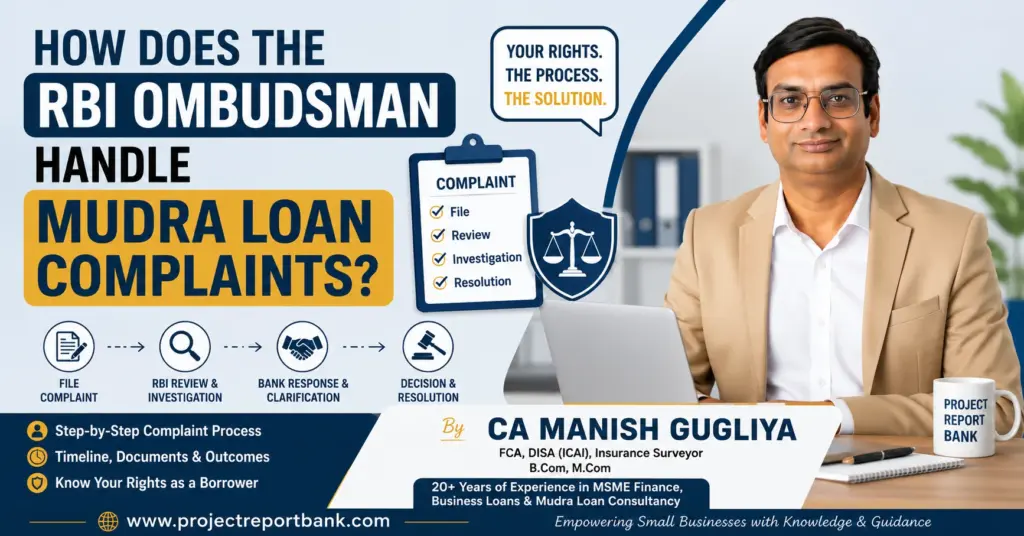
Every step should have a date and documentary proof. Small business owners should maintain a simple notebook or Excel sheet with all dates, reference numbers, and brief notes. Read more about how the RBI Ombudsman handles Mudra loan complaints for a detailed understanding.
Red Flags That Can Instantly Damage Your Mudra Loan Complaint
Some actions can cause complaint failure and create risk for you:
- Fabricated documents: Altering bank statements, fake invoices, or forged rejection letters can lead to criminal cases instead of relief.
- Exaggerated claims: Asking for money or compensation far exceeding actual loss reduces credibility. Applying as an individual instead of a business entity causes confusion at every stage.
- Inconsistent statements: Different versions of dates, amounts, or reasons across branch complaint and Ombudsman filing make decision-makers doubt everything. Grievances often fail due to mismatched KYC details and inconsistent income declarations.
- Hidden facts: Concealing previous loan defaults, existing mudra loans, or prior settlements. Only one active Mudra loan is allowed per PAN number, and banks can easily verify this. Filing complaints with active credit defaults is discouraged due to high credit risk.
- Generic copied templates: Pasting complaint formats from the internet without adjusting to your real facts leads to contradictions.
Stay fully honest, accurate, and transparent. The Ombudsman and banks work with detailed records and can check inconsistencies quickly.
Expert Tips from CA Manish Gugliya for a Successful Mudra Loan Complaint
These tips come from 20+ years of MSME and Mudra loan consulting experience:
- Always write your complaint in simple English or local language with clear dates and amounts.
- Attach a brief project report and business proof even if the dispute is about rejection – it shows business viability and seriousness.
- Use subject lines like “Non-sanction of Mudra loan despite eligibility – Branch XYZ – Application dated DD-MM-YYYY.”
- Avoid caste, religion, or political references. Stick to banking facts.
- If the bank insists on opening an unnecessary current account or buying insurance as a condition for mudra loan, record this in writing with date.
- Send all important communication by email for a time-stamped record.
- Name uploaded files clearly – e.g., “Mudra_Application_15-03-2026.pdf.”
- Do not file the same complaint against the same bank multiple times with different versions. Consolidate everything into one strong complaint.
- A poor credit history can significantly influence loan application outcomes – address it honestly in your complaint if relevant.
- If English writing is difficult, draft in Hindi or regional language. Clarity matters more than language.
- Banks across India – private sector banks, regional rural banks, and small finance banks – all process applications under Mudra. Know which type your lender is.
- Preserve every SMS, even automated ones from the bank. They establish the communication chain.
- If your loan amount is above ₹5 lakh, consider professional help for drafting. Losses from a failed complaint on a Tarun category loan are significant.
- Never accept delay without recording it. Every week without a response should generate a written reminder from you.
- Before filing, confirm your repayment capacity and credit history are correctly reflected. Check your CIBIL report yourself.
Frequently Asked Questions (FAQs) About Mudra Loan Complaint Failure
These FAQs address doubts not fully covered in the sections above.
Can the RBI Ombudsman reject my Mudra loan complaint even if I am right?
Yes. Complaints can be rejected if they are time-barred, filed without first approaching the bank, lack documents, involve already settled matters, or ask for relief beyond Ombudsman powers. Even a morally valid grievance needs procedural correctness to succeed. Read more about who can file an RBI Ombudsman complaint for a Mudra loan to understand eligibility clearly.
What if the bank manager never gives me a written rejection of my Mudra loan?
Send an email or registered letter to the branch and the bank’s centralized grievance cell, specifically asking for written reasons for rejection. Attach that correspondence to your Ombudsman complaint. This shows the bank avoided written communication – which itself becomes evidence of non adherence to fair practices under the consumer protection act framework.
Can WhatsApp chats and SMS really be used as evidence?
While primary reliance is on formal documents, in practice, clear screenshots of WhatsApp chats and official SMS showing sender, date, and content are accepted as supporting evidence. They are especially useful when they match other records and show what the bank staff committed to or refused.
Should I go to Consumer Commission or RBI Ombudsman for my Mudra loan dispute?
The Ombudsman route is faster, simpler, and free for banking service deficiency issues. Consumer Commission under the consumer protection act may handle higher compensation and broader unfair trade practices but takes more time and often needs legal help. Choose based on your dispute’s nature and the amount of money involved.
Can I submit new documents after filing the Ombudsman complaint?
Yes. You can usually send additional documents or clarifications when the Ombudsman office or bank requests them. Cooperate fully and promptly. However, your initial complaint should be as complete as possible – submitting a weak complaint and hoping to fix it later is a risky strategy.
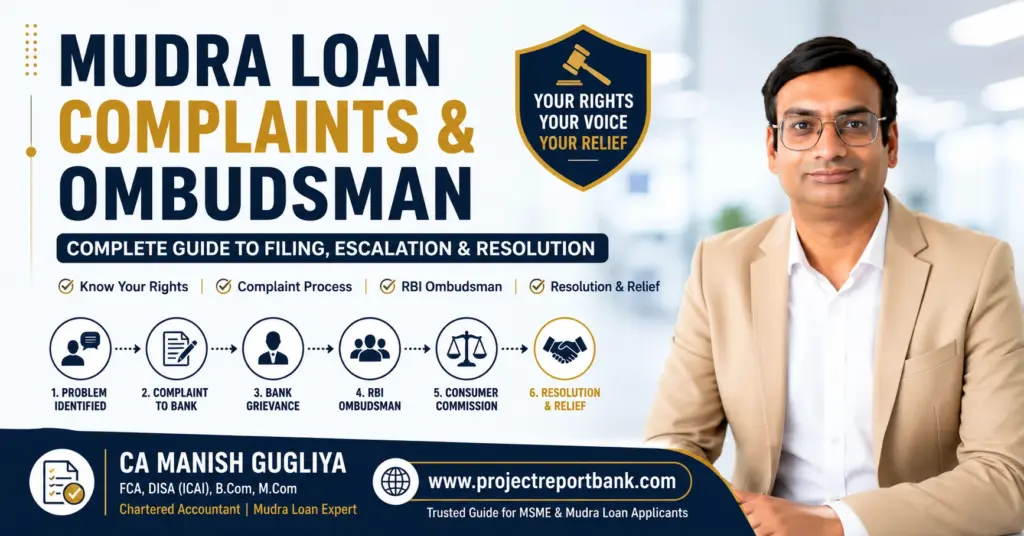
- Mudra Loan Complaints & Ombudsman: Complete Guide to Filing, Escalation & Resolution

- Can a Bank Blacklist You for Filing a Mudra Loan Complaint?
- Can a Mudra Loan Complaint Affect Future Loan Approval?
- Common Mistakes That Lead to Mudra Loan Complaint Failure
- RBI Ombudsman Mudra Loan Relief: Practical Guide for Small Borrowers
- Can the RBI Ombudsman Reject Your Mudra Loan Complaint? Reasons Explained
- Consumer Commission vs RBI Ombudsman: Which Is Better for Mudra Loan Disputes?
- Bank Grievance Redressal System for Mudra Loans: Complete Guide
- RBI Ombudsman Mudra Loan Complaint – Detailed Guide by CA Manish Gugliya