Key Takeaways
A bank in India cannot legally blacklist you only because you filed a genuine mudra loan complaint, whether at the branch, head office, or Reserve Bank of India Ombudsman. Here are the core facts you need to know before reading further.
- A bank cannot legally blacklist an individual for filing a grievance or complaint. Punitive blacklisting for raising a grievance violates regulatory standards under RBI rules.
- Complaint records, CIBIL reports, and fraud databases are three separate things. Credit Information Companies track financial track records, not customer complaints. Only loan repayment performance and fraud-related issues affect your future loan eligibility.
- Using the official banking grievance redressal system for Mudra loans is your legal right. There is no government registry that brands a customer a blacklist candidate for filing complaints.
- Future mudra loan approvals depend on your repayment capacity, business viability, and documentation quality, not on whether you once filed a complaint.
- This article is written from the perspective of CA Manish Gugliya (FCA), with 20+ years of experience in bank finance, project reports, CMA data, and Mudra loan consultancy through ProjectReportBank.com.
Introduction: Fear of Blacklisting After a Mudra Loan Complaint
Many mudra loan applicants in 2026 are afraid to complain against a bank manager or branch. They worry that one complaint will destroy their future banking relationship forever.
Consider a small shopkeeper in Jaipur whose mudra loan application sat untouched at the branch for 45 days. Mudra loan disbursement should occur within 7 to 10 working days per PMMY norms, and realistic disbursement time is 15 to 30 working days in 2026 even with procedural delays. Yet this shopkeeper waited much longer. He wanted to complain but feared “the bank will put my name on some list.”
Or think about a first-time entrepreneur in Lucknow whose bank manager wrongly told her “the mudra scheme is closed; come back next year.” Banks may claim the Mudra scheme is closed illegally, because PMMY is an ongoing government initiative and branches cannot shut it down at will. She knew this was wrong but stayed silent, worried that raising her voice would get her “blacklisted.”

These fears come from a real power imbalance between borrowers and banks. Stories shared on WhatsApp groups and YouTube videos mix up CIBIL reporting, internal bank notes, and actual “blacklists” into a single terrifying idea. People hear one bad experience from someone and assume all banks operate on a secret revenge system.
The main question is direct: can a bank legally blacklist a customer only because the customer filed a mudra loan complaint for unfair rejection, harassment, or delay?
This post covers the legal position under RBI rules, the difference between complaint history and default history, how future Mudra loans and other business loans are actually assessed, and how to protect yourself if you suspect bank retaliation.
By the end of this guide, you will know what Indian banks can and cannot legally do after you file a complaint about your Mudra loan.
Table of Contents
What Does “Blacklisting” Actually Mean in Banking?
The word “blacklist” is commonly used by borrowers, but Indian banks and the reserve bank use more precise terms: “wilful defaulter list,” “fraud account,” “high-risk customer,” and “adverse CIBIL history.”
There is no official “Mudra loan complaint blacklist” in any RBI circular or Pradhan Mantri Mudra Yojana guideline. Complaints are classified under “deficiency in service” in RBI’s framework, not under defaults or frauds.
Here are five distinct concepts that borrowers often confuse:
Complaint history inside the bank. Every bank maintains an internal CRM or grievance system where your complaint is registered with a ticket number. This is an internal record for customer service tracking. It is not shared with CIBIL or other lenders.
Loan repayment history within that bank. This tracks your EMI payments, overdue amounts, restructuring, write-offs. This data directly affects your relationship with that bank and is reported to credit bureaus.
Credit bureau records (CIBIL, Experian, CRIF). These show all your loans across all banks and lenders, with repayment performance. CIBIL report generation can take 3 to 5 days during loan processing when a bank pulls your report.
Fraud, wilful default, and caution lists. These are shared within the banking system under strict RBI Master Direction rules. Under the 2024 Master Direction on Wilful Defaulters, classification requires a minimum ₹25 lakh outstanding, NPA status, an Identification Committee, a Review Committee, and show cause notices. Filing a complaint does not trigger any of these.
Internal risk notes or remarks. A branch may write informal notes about a customer’s nature or behaviour. These stay inside the bank and are not governed by the same strict rules as credit bureau data. Unjustified internal flagging could impede future credit processing, but it is not the same as a CIBIL entry.
| Type of Record | Who Maintains It? | Reason It Is Created | Can It Be Created Only for Filing a Complaint? |
|---|---|---|---|
| Complaint ticket | Bank’s internal CRM | Customer emails nodal officer about delay | No; it tracks service issues, not defaults |
| CIBIL report entry | Credit bureau (CIBIL, Experian) | Bank reports 3-month overdue on Mudra loan EMI | No; requires actual payment default data |
| Wilful defaulter classification | Bank + RBI | Borrower with ₹25 lakh+ NPA intentionally refuses to repay | No; requires investigation, committee, show cause notice |
| Fraud database entry | Bank + RBI | Borrower submitted forged documents | No; requires proven fraud with evidence |
| Internal risk remark | Branch/regional office | Officer writes “difficult customer” in file notes | Should not be; if done punitively, it is unfair banking practice |
Only default and fraud related items can reach CIBIL or fraud databases. Negative reporting to credit bureaus requires legitimate default data; malicious reporting is legally actionable under Indian law.
Can a Bank Legally Blacklist You for Filing a Mudra Loan Complaint?
Under current RBI regulations and Indian law, a bank cannot classify you as a defaulter, fraudster, or blacklist entry only because you filed a genuine Mudra loan complaint.
The Reserve Bank of India mandates a robust grievance redressal mechanism for customers. RBI’s Internal Ombudsman Directions (2023) require every scheduled commercial bank to have an Internal Ombudsman who reviews complaint outcomes before they reach the RBI. The RBI Integrated Ombudsman Scheme provides an official channel to escalate complaints about loan delays, misbehaviour, or non-observance of RBI guidelines.
Any deliberate retaliation, such as wrongly marking an account as “non-cooperative,” delaying account closure, or rejecting all new loan applications solely because of a complaint, can itself be treated as unfair banking practice and reported to the RBI Ombudsman.
Here are practical examples from real consulting experience:
A trader in Pune complained because the branch refused to accept his Mudra loan form, saying the scheme was closed. He escalated to the regional office. Within three weeks, another branch of the same bank sanctioned his Kishore Mudra loan based on his business plan and 14 months of bank statements.
A woman entrepreneur in Bhopal filed an RBI Ombudsman complaint about misbehaviour by the bank manager during her loan verification. The bank received instructions to provide an apology and process applications fairly. Her CIBIL score remained unchanged because she was repaying her existing shishu loan on time.
While individual bank staff may feel uncomfortable with complaints, the bank as a regulated institution has to follow RBI rules. Files cannot be marked as “fraud” or “wilful default” without solid evidence and proper process. A bank can restrict an account only based on documented financial defaults or non-compliance with regulations, not on complaint filing.
At ProjectReportBank.com, we regularly assist clients who have already complained against banks. They still receive new Mudra loans and business loans when they meet eligibility norms with strong project reports and clean repayment records.
When Can Future Loans Actually Be Affected (Genuine Reasons)
While a complaint itself cannot be the legal reason to deny future Mudra loans, there are several genuine risk-based reasons why a bank might reject a loan application later. These are credit appraisal decisions, not punishment.
Common genuine reasons for rejection:
- Past defaults or overdue EMIs on any Mudra loan or other loan product. High default rates lead banks to tighten approval criteria across the board.
- Low CIBIL score (below 650, for example) due to late payments, written-off loans, or high credit card utilisation.
- Use of fake documents or misdeclaration of business turnover, GST returns, or income-tax details in earlier applications.
- Classification as “fraud account” or “wilful defaulter” under RBI guidelines after a proper investigation with committee review and show cause notice.
- Very high existing liabilities compared to income. One active Mudra loan per PAN number is allowed under PMMY norms, so having an undisclosed active loan is itself a problem.
- Poor business viability as per project report, CMA data, or field inspection findings.
- Non-cooperation with bank officials during verification or repeated refusal to provide required KYC or financial documents.
- Internal credit committee approval may delay disbursement by weeks when a file raises legitimate questions about repayment capacity.
When a bank rejects a future Mudra loan or MSME term loan based on these factors, it is called credit appraisal. It is allowed in law. It is not revenge for complaining.
Always ask for written reasons for rejection and preserve email or SMS evidence. This way you can clearly see whether the reasons relate to risk factors or appear like retaliation.
Professional help with project reports and financial ratios matters far more than whether you once filed a complaint. Strong numbers speak louder than old grievances.
Does Filing a Complaint Affect Your CIBIL Score or Credit Report?
Filing a Mudra loan complaint, whether to the branch, bank head office, or RBI Ombudsman, does not get reported to CIBIL, Experian, Equifax, or any other credit bureau. Credit Information Companies track financial track records, not customer complaints.
Banks and NBFCs periodically send data about sanctioned loans, outstanding amounts, EMI performance, write-offs, and settlements to credit bureaus. They do not send data about service complaints, email disputes, or discussions with a bank manager. The CIBIL dispute resolution process exists only for correcting inaccurate loan performance data, not for complaint tracking.
If you complain about rude behaviour of the branch manager but keep paying your existing EMIs on time, your CIBIL score will usually remain stable or even improve over time.
If you stop repaying your Mudra loan EMIs as “revenge” against the bank, your complaint will not hurt your score, but the missed payments definitely will.
The common rumour that “RBI complaint will spoil your CIBIL” is a myth. RBI Ombudsman deals with service issues, not credit scoring. The two systems operate independently.
Check your latest CIBIL report 30 to 60 days after any loan dispute resolution to confirm that only actual repayment behaviour is reflected there. CIBIL report generation can take 3 to 5 days when a lender pulls your report, so minor delays in reflection are normal.
Can the Same Bank Reject Your Future Mudra Loan After a Complaint?
Practically, the same bank where you filed a complaint might be stricter when evaluating your next mudra loan application. But it still must base its decision on documented credit factors, not on personal dislike.
Fresh assessment for a new Mudra loan or enhancement works like this:
- Bank reviews your latest ITR, GST returns, and bank statements.
- Branch checks existing loans and CIBIL score.
- Business plan or project report is evaluated for repayment capacity.
- Field visit may be done to confirm business activity and collateral or security (though Mudra loans are collateral-free, banks verify the business exists).
- Kishore loans require at least 12 months of business history, so the bank checks that too.
The bank can legally reject if these factors are weak. Large cash deposits without proper bills, negative profit in the last two financial years, or no clear use of funds in the project report are all valid reasons.
Rejection becomes suspicious when:
- No written reason is given, even after repeated request.
- Reasons are vague like “management decision” without any financial explanation.
- The bank manager verbally refers to your old complaint as the reason.
- An incorrect NIC code can delay Mudra loan applications, but if the bank itself refuses to help you correct it after your complaint, that raises questions.
In such cases:
- Ask for written reasons for rejection.
- Apply at another branch or bank under PMMY. You are free to do this.
- Consider escalating again through the bank grievance redressal system or RBI Ombudsman, using the unfair rejection as an additional ground.
Signs That a Bank May Be Retaliating After Your Mudra Loan Complaint
Most banks follow rules, but occasionally individual officers may informally “punish” complaining customers through delays or extra hurdles. Here are the warning signs to watch for.
- Unusual, repeated delays in logging or acknowledging a new Mudra loan application while other customers are processed on time. Branches may respond defensively to customer complaints, causing administrative delays that feel intentional.
- Demands for documents far beyond the bank’s own published Mudra loan checklist, without proper justification. If a branch asks for paperwork you have never seen on the official requirement list, that is a red flag.
- Sudden rudeness, refusal to talk, or instructions like “go to another bank, we won’t give you any loan now” without any assessment of your financials.
- Rejection letters that mention unrelated or false reasons, or internally contradict each other.
- Staff informally saying things like “you complained against us, now nobody here will pass your file.” This kind of verbal statement, if witnessed or recorded, is strong evidence of retaliation.
One or two issues alone may not prove retaliation. Patterns over time and comparison with how similar customers are treated matter more.
Preserve evidence carefully: date of every visit, names of staff you spoke with, copies of email and communication, stamped application receipts, and screenshots of any online status for your Mudra loan application.

If you see these warning signs, learn the correct escalation ladder from ProjectReportBank.com’s guide on how the RBI Ombudsman handles Mudra loan complaints.
What Should You Do If You Suspect Bank Retaliation?
Here is a step-by-step action guide in simple English. Follow each step in order.
Step 1: Stay calm. Do not argue or shout at branch staff. Emotional reactions can later be misused against you, and they do not help your case. This is always the first step.
Step 2: Ensure all future communication is in writing. Use emails, complaint forms on the bank website, SMS, or letters with branch acknowledgement. Verbal promises mean nothing unless you can prove them.
Step 3: Ask politely for written reasons for any Mudra loan rejection or delay beyond 15 working days. Mention that you need it for your records. Banks are required to address grievances through their internal escalation process within standard timelines.
Step 4: Escalate within the bank hierarchy. Start with the branch manager (if not involved in the original issue), then the regional office, then the bank’s nodal officer for customer grievances. Follow the bank’s published grievance redressal process step by step.
Step 5: Customers can escalate grievances to the RBI if a bank fails to respond in 30 days. File an online complaint under the RBI Integrated Ombudsman Scheme. The process is free and does not require a lawyer. The Integrated Ombudsman Scheme 2026, effective from July 1, 2026, provides shorter resolution timelines and higher compensation.
Step 6: In serious cases of discrimination or financial loss, victimization by a bank allows for legal action in Consumer Disputes Redressal Forums. You can explore filing a case before the Consumer Commission, especially where there is clear deficiency in service.
Step 7: Throughout the process, keep servicing any existing Mudra loans or other EMIs on time. Never stop payments to “teach the bank a lesson.” Your CIBIL is your insurance product for future credit access. Do not damage it.
Each escalation should be supported by documents, date references, and copies of prior communications to demonstrate that you are reasonable and the bank is not.
If you feel stuck between repeated rejections and fear of further complaints, seek professional help from CA Manish Gugliya through ProjectReportBank.com.
Borrower Rights After Filing a Mudra Loan Complaint
Filing a complaint does not cancel your basic rights as a banking customer. Under RBI and consumer protection principles in India, your rights remain intact and banks must still treat you fairly.
- Right to fair treatment: Bank cannot harass, insult, or threaten you because you complained.
- Right to non-discrimination: Bank decisions must be based on financial criteria, not personal revenge.
- Right to information: You can ask for the status of your mudra loan application and written reasons for rejection at any time.
- Right to written replies: Complaints must receive written responses within defined timelines mandated by RBI.
- Right to escalate: You can escalate to higher authorities and RBI Ombudsman if not satisfied with the bank’s response.
- Right to privacy: Complaint details and financial data must be kept confidential and not misused.
- Right to dignity: Staff must speak respectfully and avoid humiliating language during any interaction, whether at the branch or during a field visit.
Raising issues regarding delayed processing reinforces accountability under the Pradhan Mantri Mudra Yojana framework. Enforcing these rights usually requires using formal channels, not verbal arguments in the branch.
ProjectReportBank.com has detailed guides on RBI Ombudsman relief in Mudra loan complaints and on the difference between Consumer Commission and RBI Ombudsman for readers who want to understand which forum applies to their situation.
Common Myths About Mudra Loan Complaint “Blacklisting”
Many rumours about bank blacklisting after a complaint spread through social media, but most are incorrect and create unnecessary fear among genuine Mudra loan applicants.
| Myth | Reality |
|---|---|
| “If I complain to RBI, all banks will block my Mudra loan application forever.” | Complaints do not go into CIBIL or any PMMY central registry. Future loans depend on repayment record and financial strength, not complaint history. |
| “The bank manager can mark me as fraud just because I complained.” | Fraud classification requires proven evidence of forged documents, fund diversion, or misrepresentation, plus formal investigation. A complaint is not fraud. |
| “RBI Ombudsman complaint will automatically lower my CIBIL score.” | RBI Ombudsman handles service deficiency issues. CIBIL score is based on loan repayment data, not on service complaints. |
| “After one complaint, every future loan in that bank must be rejected.” | The bank must assess each application on its own merits: income, business plan, CIBIL, documents. Blanket rejection for all future applications would be unfair banking practice. |
| “PSU banks share a secret blacklist of complainants.” | Banks share fraud and wilful defaulter data as required by RBI, not complaint data. There is no secret complainant registry. |
| “Private banks will never touch a customer who has complained against any bank.” | Private lenders run their own credit assessment. They typically see your CIBIL and loan history, not your complaint history with other banks. |
| “Complaining is dangerous and you should just stay quiet.” | Silence allows unfair practices to continue. Official complaint channels exist precisely to hold banks accountable. If anything, correct use of grievance systems usually improves service quality. |
Base your decisions on official information and expert advice, not on anonymous social media stories.
Practical Examples: Complaints, Defaults, and Future Mudra Loans
These examples illustrate what actually controls future loan approvals. Names and details are changed, but situations are based on real consulting experience.
Example 1: Complaint with good repayment
A small manufacturing unit owner in Nagpur complained in 2024 because the branch refused to accept his Kishore Mudra loan application. He escalated to the bank’s nodal officer, who confirmed the mudra scheme was open. The original branch was instructed to process applications properly. Meanwhile, the borrower approached another PSU bank with a strong project report prepared by a CA. That bank approved his loan within 20 working days. His complaint history at the first bank did not appear anywhere in the second bank’s assessment. Account linking delays can extend the disbursement timeline, but his loan was disbursed on schedule because his documents were complete.
Example 2: Default without any complaint
A trader in Indore never complained about anything. He simply stopped paying EMIs on his Tarun Mudra loan after his business slowed down. Within 90 days, his account was classified NPA. His CIBIL score dropped below 600. When he tried to apply at three different banks for a new business loan, all of them rejected his application based on his CIBIL history. No complaint was involved. Repayment behaviour, not complaint behaviour, controlled the outcome.
Example 3: Complaint mixed with fraud
A borrower in Delhi made false GST returns and fake invoices to increase his loan eligibility. When the bank’s verification team questioned his documents, he filed multiple complaints accusing the bank of harassment. Investigation revealed the fraud. He was reported to fraud databases and faced strict legal action. His complaint did not protect him from fraud consequences, and it did not cause the fraud classification either. The fraud was the problem; the complaint was irrelevant to the outcome.

Example 4: Woman entrepreneur files Ombudsman complaint
A woman running a boutique in Pune filed an RBI Ombudsman complaint about a bank manager’s harassment during her shishu loan process. The Ombudsman instructed the bank to provide a written apology and resolution. Her existing loan remained in good standing. Six months later, she applied for expansion finance at the same bank with updated financials and a revised project report. The loan was approved because her business numbers were strong and her repayment record was clean.
Documents to Preserve When You File a Mudra Loan Complaint
Proper documentation is your best protection against unfair treatment. Well-organised paperwork also impresses bank management and the RBI Ombudsman. Here is a checklist:
- Copy of original Mudra loan application form with the bank’s date stamp or online submission acknowledgement
- Photocopies or scanned images of all KYC documents, income proofs, PAN card, and project report submitted
- Written complaint letters, emails, or screenshots of online complaint forms with registered reference numbers
- Bank’s written replies, SMS updates, and any promise made in writing about timelines or conditions
- Meeting notes you prepared after branch discussions, including date, time, and names of officers spoken to
- CIBIL reports taken before and after the dispute, to show that any later change is linked to repayment, not to the complaint
- Any other evidence like ATM slips, passbook entries, or call recordings (where legally permitted) supporting your version
- Login credentials and screenshots from the bank’s portal if your application status is visible online
Store these documents safely in both physical and digital form. Arrange them by date so you can easily present a clear story to higher authorities or your consultant at any time.
Expert Tips from CA Manish Gugliya on Safe Complaints and Future Loan Planning
These tips come from 20+ years of working with banks on Mudra loans, MSME term loans, and project finance. They are meant to help borrowers complain confidently without harming their genuine loan prospects.
- Always separate your anger from your actions. Write complaints calmly, not emotionally. Stick to facts, date references, and specific details of what went wrong.
- Never threaten bank staff with “media” or “political connections” in writing. It usually backfires and shifts attention from your legitimate grievance.
- Keep repayment discipline perfect, even during disputes. Your CIBIL stays strong only when you continue to repay on time.
- Use clear facts and date references in your complaint rather than long personal stories or comments about the bank manager’s character.
- If a complaint is discovered to be intentionally false, it can have legal consequences. Never exaggerate or fabricate. Stick to what actually happened.
- Prefer email or written letters over phone calls. Written proof is the easiest form of evidence to present later.
- If one branch relationship is badly damaged, consider opening your main account at another bank before your next mudra loan application. A fresh start sometimes works better than fighting the same people.
- Get a professional project report and CMA data prepared before reapplying. Strong numbers speak louder than old complaints. This is where knowing your financials makes all the difference.
- Do not pay any unofficial “speed money” or agent fees to prevent retaliation. This itself is risky and illegal.
- Consultants charging fees for Mudra loans are often scams. Mudra loan applications are free through official channels. No consultant can guarantee Mudra loan approval. Be careful who you trust.
- Fraudsters use Mudra logos to create fake documents to collect fees from unsuspecting borrowers. Victims pay fees for non-existent Mudra loans. Always apply through the bank’s official website or branch.
- Use official grievance channels and RBI Ombudsman instead of social media attacks, which can complicate matters and reduce your credibility.
- Before submitting your next application, verify that your NIC code is correct. An incorrect NIC code can delay Mudra loan applications by weeks.
- Account linking delays can extend the disbursement timeline. Make sure your savings or current account at the lending bank is active and properly linked to your Aadhaar and PAN.
- If you plan to apply for insurance linked products or additional security features with your Mudra loan, clarify those requirements early so they do not become excuses for delay later.
- Study the related guides on ProjectReportBank.com, such as how the RBI Ombudsman handles Mudra loan complaints and how complaints can affect future loan approval, for a complete understanding of your rights and options.

Frequently Asked Questions (FAQ)
These FAQs cover additional practical doubts that are not fully answered in the main sections above. Each question focuses on what Mudra loan borrowers actually worry about when they consider filing a complaint.
If I complain about a rejected Mudra loan, can I apply at another bank immediately?
Yes. You are free to approach another bank or NBFC participating in PMMY immediately after a rejection. The new lender will mainly look at your income, business strength, CIBIL score, and project report. They will not see your complaint history at the previous bank. The easiest way to start is to walk into the nearest participating branch with your documents ready. Remember, one active Mudra loan per PAN number is allowed, so if you have no active Mudra loan, any participating bank can accept your application.
Will other banks know that I complained against my previous bank?
No. Banks do not share a “complaint list” among themselves. What other lenders typically see through CIBIL and other credit bureau reports is only your loan and repayment history. Your complaint records remain within the original bank’s internal system and the RBI Ombudsman portal. They are not visible as a “blacklist” to other banks or lenders.
Can the bank close my existing savings or current account because of my complaint?
Banks can close accounts only as per their terms and RBI KYC/AML rules, for example, in cases of suspected money laundering or long inactivity. Closing an account purely because a customer filed a complaint would be a clear unfair practice and strong ground for RBI Ombudsman action. If this happens to you, file a fresh complaint immediately with documented evidence.
Is it safe to complain while my Mudra loan application is still under process?
If delays or misconduct are serious, it is legally safe to complain even while the application is running. Advise taking the first step of internal escalation (branch manager, then regional office) before going directly to RBI. Maintain polite, factual communication at every step. Good documentation of the delay itself strengthens your complaint rather than weakening your application.
Should I hire a lawyer before filing an RBI Ombudsman complaint for a Mudra loan issue?
The RBI Ombudsman process is designed for ordinary customers and does not require a lawyer. You can file directly through the RBI’s online portal or through email. Many people handle it themselves. If you want guidance on organising your documents, presenting facts clearly, and understanding what the Ombudsman can and cannot do, you may seek informal help from professionals like CA Manish Gugliya or through ProjectReportBank.com’s guides on common mistakes in Mudra loan complaint filing.
Conclusion: Complaints, Rights, and Your Future Mudra Loan Journey
Filing a genuine Mudra loan complaint is a protected right under Indian banking regulations. No bank in India can legally blacklist you just for complaining. Future loan approvals depend on financial discipline, truthful documentation, strong project reports, and your credit history, not on whether you once filed a grievance.
Three things matter most going forward: keep repaying existing loans on time so your CIBIL remains strong, keep all complaint communication in writing so you have evidence if needed, and focus on improving your business records and project report for the next loan rather than fearing hidden retaliation.
If you need personalised help with Mudra loan applications, project reports, CMA data, understanding RBI Ombudsman procedures, or planning future business finance after a complaint, contact CA Manish Gugliya through ProjectReportBank.com. With responsible preparation and the right professional guidance, genuine borrowers have nothing to fear from any bank when they know their rights and follow proper processes.
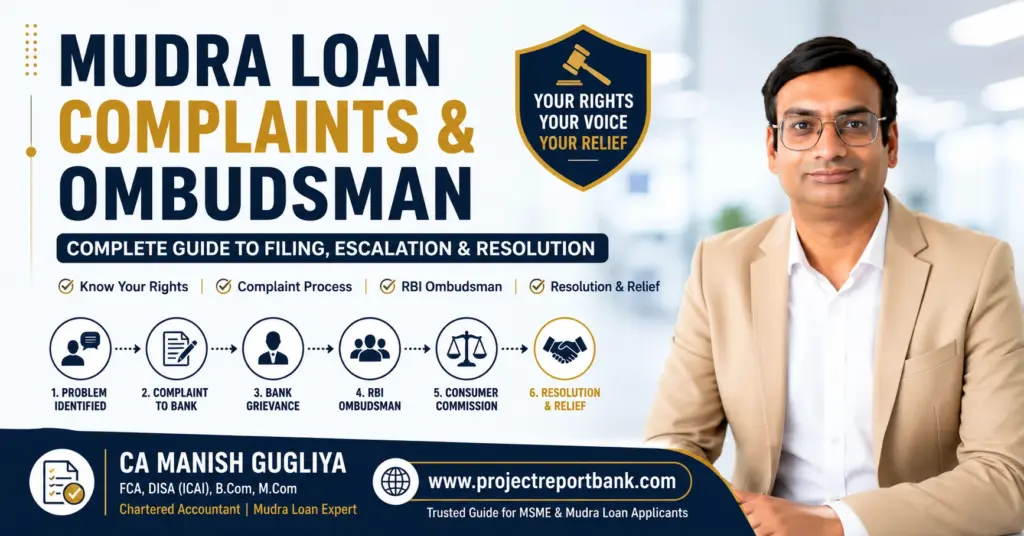
- Mudra Loan Complaints & Ombudsman: Complete Guide to Filing, Escalation & Resolution

- Can a Bank Blacklist You for Filing a Mudra Loan Complaint?

- Can a Mudra Loan Complaint Affect Future Loan Approval?

- Common Mistakes That Lead to Mudra Loan Complaint Failure
- RBI Ombudsman Mudra Loan Relief: Practical Guide for Small Borrowers
- Can the RBI Ombudsman Reject Your Mudra Loan Complaint? Reasons Explained

- Consumer Commission vs RBI Ombudsman: Which Is Better for Mudra Loan Disputes?
- Bank Grievance Redressal System for Mudra Loans: Complete Guide

- RBI Ombudsman Mudra Loan Complaint – Detailed Guide by CA Manish Gugliya