Key Takeaways
- The bank grievance redressal system for Mudra Loans is a multi-tiered framework governed by the Reserve Bank of India that every borrower must use before approaching the RBI Integrated Ombudsman.
- Most Mudra Loan complaints – delay, rude behaviour, forced insurance, wrong rejection – can be solved quickly with a written complaint, a stamped acknowledgement, and proper documentation.
- Banks must follow RBI’s Integrated Ombudsman Scheme, 2021, appoint a principal nodal officer, display grievance details in every branch, and reply within fixed timelines.
- This guide is written from the perspective of CA Manish Gugliya (FCA), using 20+ years of experience in MSME finance to give practical, step-by-step help for resolving Mudra Loan disputes.
Introduction: Why Mudra Loan Complaints Arise and How This Guide Helps
Imagine you run a small tailoring shop. You applied for a Shishu Mudra Loan three months ago. The branch keeps asking for new documents every visit. No one gives you a clear answer. You don’t know whom to complain to – or how. Weeks pass, and frustration builds.
This is common across India. CPGRAMS data from 2024 shows that delay in processing, rejection without reasons, and discrepancies in loan repayment topped Mudra Loan grievances – with Uttar Pradesh, Maharashtra, and Madhya Pradesh accounting for roughly 34.8% of complaints at SBI alone.
Mudra Loans (Shishu up to ₹50,000, Kishor up to ₹5 lakh, Tarun up to ₹10 lakh) are sanctioned and disbursed by Member Lending Institutions, which include commercial banks and microfinance institutions. The Micro Units Development and Refinance Agency serves as a refinancing institution – it does not lend directly. Complaints are natural when lakhs of loans flow through thousands of branches.
Before going to the RBI banking ombudsman, every borrower must first use the bank’s own grievance redressal mechanism. Knowing the correct bank complaint procedure saves time, reduces tension, and builds a stronger case if escalation becomes necessary.
In this guide, you will learn the complaint hierarchy, timelines, documents required, a sample complaint format, your rights as a borrower, and exactly when to move beyond the bank.
Table of Contents
Quick Answer: What Is the Bank Grievance Redressal System for Mudra Loans?
Quick Answer: The bank grievance redressal system for Mudra Loans is the internal process inside each bank to receive, record, and resolve Mudra Loan complaints before the borrower approaches the RBI Ombudsman. The hierarchy runs from the branch grievance officer → regional or zonal office → bank’s nodal officer / principal nodal officer → RBI Integrated Ombudsman. This system is mandatory under RBI rules and applies to all Mudra Loans – whether given by public sector banks, private banks, small finance banks, RRBs, or NBFCs acting as member lending institutions. The grievance redressal process is similar for all banks, not just those handling Mudra Loans. MUDRA does not use third-party agents for loan processing – complaints go directly to the lending bank.
What Is a Bank Grievance Redressal System and Why Do Banks Need It?
A bank grievance redressal system is the bank’s in-house arrangement for receiving, tracking, and resolving complaints – without the customer needing to visit a court or file with RBI first.
RBI has instructed all banks to:
- Create an internal grievance mechanism and publish contact details for escalation
- Appoint nodal officers and a principal nodal officer at the head office
- Display grievance information in every branch and on their website
- Submit complaint statistics to RBI annually
The main objectives are simple:
- Protect customers from unfair treatment
- Give quick, transparent decisions on complaints
- Reduce disputes reaching the banking ombudsman or courts
Under the Integrated Ombudsman Scheme established in 2021, RBI expects borrowers to first exhaust the bank’s internal system. Only if the bank fails or delays beyond 30 days can the complaint be escalated. Complaints can be lodged via multiple channels including email, the bank’s website, or in writing at the branch – but a written complaint with acknowledgement is always the strongest.
Common Mudra Loan Complaints Handled by Bank Grievance Cells
Most Mudra Loan issues are operational or behavioural and can be resolved at branch or regional levels if the customer complains properly. Common complaints include:
- Delay in accepting applications or repeated demand for unnecessary documents
- Rude behaviour, harassment, or staff demanding bribes – reported frequently on Mudra Bank support platforms
- Asking for collateral or guarantors in Shishu/Kishor cases meant to be collateral-free
- Arbitrary loan denial without a written rejection and explicit reasons
- Forced bundling of hidden insurance charges in Mudra Loans or cross-selling by banks during Mudra Loans
- Wrong interest rate, overcharged processing fees, or non-passing of government subvention
Post-sanction complaints are equally common:
- Delay in disbursement or disbursing less than sanctioned amount
- Wrong EMI deductions, ECS bounce charges wrongly levied, or incorrect credit bureau reporting
- Refusal to issue loan account statement or account details
Complaints can also cover guarantor security issues and misuse of guarantor documents. Even wrong SMS alerts or mis-communication on due dates are valid grievances.
Bank Grievance Redressal Hierarchy for Mudra Loans (Branch to Principal Nodal Officer)
Every bank follows a 3–4 level hierarchy. Simple disputes get solved at branch level; complex or policy-level issues move higher. Here is a practical breakdown:
| Level | Authority | When to Approach | Expected Resolution Time |
|---|---|---|---|
| 1 | Branch Manager / Branch Grievance Officer | First point – delay in application, rude staff, wrong information | 7 working days |
| 2 | Regional / Zonal Nodal Officer | Branch has not responded or reply is not satisfactory | 15 working days |
| 3 | Principal Nodal Officer (Head Office) | Regional office failed; need final written decision from bank | 30 days from original complaint |
| 4 | RBI Integrated Ombudsman | Bank gave no reply in 30 days, or final reply is clearly unfair | As per ombudsman scheme timelines |
The principal nodal officer must acknowledge grievances within five days of receipt. Grievances are expected to be resolved within three weeks at branch/regional levels. Customers can escalate unresolved complaints to Regional Nodal Officers if the branch does not act. If the bank does not resolve complaints within 30 days, it can be escalated to the RBI Ombudsman for Mudra Loan complaints.

Step-by-Step Mudra Loan Complaint Process Inside the Bank
Here is exactly what to do from Day 1 of the dispute:
Step 1: Visit the branch where the loan was processed. Meet the Branch Manager. Explain your Mudra Loan issue calmly. Give a short written complaint – on paper or the bank’s standard form. Always ask for a stamped acknowledgement with date and reference number. A unique Grievance ID is generated after complaint submission – note it down carefully.
Step 2: Keep evidence. Photocopy your complaint, take photographs of the branch notice board (especially if grievance details are not displayed), save email screenshots, SMS alerts, and any rejection letters.
Step 3: Wait 7–15 days for the branch response. Follow up politely by visit or email, always referring to the same complaint number to avoid duplication. You can also track grievances by entering the Grievance ID on the bank’s website.
Step 4: If no reply or an unsatisfactory reply is received within the promised time, send an escalation to the Regional Nodal Officer by email or letter. Attach copies of earlier complaints and acknowledgements. Complaints can also be registered through digital platforms like JanSamarth.
Step 5: If still unresolved, write to the bank’s principal nodal officer at the head office. Use the subject line: “Grievance regarding Mudra Loan – Escalation to Principal Nodal Officer.” Request a final written decision with clear reasons.
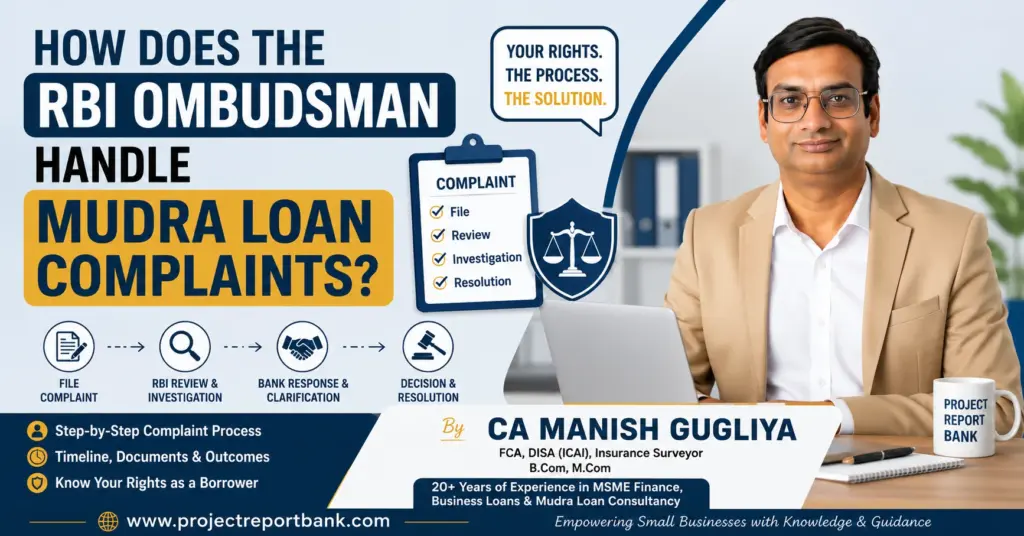
Step 6: If 30 days have passed since your first complaint, or the bank’s reply is clearly unfair, customers can approach the Integrated Ombudsman after one month. Complaints can be processed via the RBI Complaint Management System. Learn more about how RBI Ombudsman handles Mudra Loan complaints and who can file an RBI Ombudsman complaint for Mudra Loan.
Documents Required and Expected Resolution Timelines
Proper documentation is your strongest tool. Incomplete papers are the biggest reason for delay in complaint resolution. Keep this checklist ready:
- Mudra Loan application copy with date stamp
- Sanction letter or rejection letter (if any)
- Copy of project report submitted to the bank
- Collateral or hypothecation documents if applicable
- Bank passbook, account statement, EMI schedule
- All emails, SMS, and letters from the bank
- Identity and address proof (Aadhaar, PAN)
- Business proof (Udyam registration, GST, shop licence)
- Any proof of harassment (WhatsApp chats, written notes with names and dates)
Borrowers should keep records of all loan documents and correspondence from the very first day. Every complaint letter should mention your loan account number, branch name, mobile number, date of issue, and a clear timeline – for example, “Application submitted on 10 April 2026, reminder on 25 April, no reply till date.”
Grievances must be acknowledged within five days of receipt. You can reopen a closed complaint within 30 days if you are not satisfied with the resolution.
Rights of Mudra Borrowers, Practical Tips, and Common Mistakes
Many borrowers – especially first-time entrepreneurs – accept wrong decisions because they do not know their rights.
Your key rights:
- Right to file a free complaint at any level
- Right to acknowledgement with a unique Grievance ID for tracking
- Right to a written reply with reasons for any decision
- Right to escalate to higher levels without penalty
- Right to see the bank’s published service charges and policies
- Right to approach the banking ombudsman after exhausting internal process
- Protection under consumer protection act provisions for banking services
Practical tips for faster resolution:
- Always use polite, fact-based writing – keep emotions out
- Number your points; attach a clear timeline of events
- Send copies, never originals
- Follow up through email to create a written trail
- Mention if your business is time-sensitive (seasonal stock, tender deadline)
- Do not file multiple new complaints for the same matter – refer to your original Grievance ID
- If the case involves large Tarun loans with guarantor and security complications, consider guidance from a Chartered Accountant familiar with MSME finance
Mistakes to avoid:
- Only complaining verbally (no proof exists)
- Threatening or abusing staff (weakens your case)
- Posting on social media before filing a formal complaint (the ombudsman scheme requires proof of internal complaint first)
- Waiting months before raising the issue
- Making inconsistent statements across complaint letters
Sample Complaint Format, Escalation Beyond the Bank, and Key FAQs
Below is a ready-to-use complaint format, guidance on when to escalate, and answers to common queries.
Sample Complaint Letter:
To: The Branch Manager, [Bank Name], [Branch & Area]
Subject: Complaint Regarding Mudra Loan – [Shishu/Kishor/Tarun]
Respected Sir/Madam,
I, [Your Name], holder of Mudra Loan account number [XXXX], located at [your address], applied for a [Shishu/Kishor/Tarun] loan of ₹[amount] on [date]. My contact details are: email [your email], mobile [your mobile number].
Despite submitting all required information and documents, I have faced the following issue: [describe clearly – delay in sanction, forced insurance, rejection without written reasons, etc.].
I request you to kindly resolve this matter within 7 working days. Please send your reply in writing to my address or email.
I reserve my right to approach the Principal Nodal Officer and the RBI Integrated Ombudsman if this query remains unresolved.
Yours sincerely, [Name, Date, Signature]
When to escalate beyond the bank:
- No reply within 30 days of lodged complaint
- Repeated vague replies without resolution
- Clear violation of RBI guidelines (demanding collateral for Shishu loans, not giving rejection reasons)
- Harassment or threats by recovery staff
- Wrongful credit bureau reporting despite timely EMIs
The Banking Ombudsman resolves customer complaints in India as an independent, external authority. The ombudsman scheme covers various banking services and grievances – not just loans. The Reserve Bank of India oversees the Banking Ombudsman scheme. Complaints can be lodged via email or through the RBI’s online portal – no fee, no lawyer needed. The complainant simply needs proof that the bank’s internal process was exhausted or that 30 days have passed.

FAQ 1: Can I use the grievance redressal system if my Mudra Loan was never sanctioned?
Yes. The system covers pre-sanction issues – delay in accepting your application, repeated document demands, or rejection without written reasons. Mention your application date, any acknowledgement received, and the lack of communication as your main grievance. Complaints can be submitted through the bank’s website or lodged in writing at the branch where you applied.
FAQ 2: Can a Mudra Loan guarantor file a complaint with the bank?
Absolutely. Guarantors and co-borrowers can use the bank grievance redressal system if they are affected – for example, if they are threatened for recovery or their security documents are mishandled. Attach proof of your guarantor status from the loan agreement. For deeper guidance, visit our articles on guarantor rights and guarantor security issues.
FAQ 3: Will complaining spoil my relationship with the branch?
RBI expects banks to treat complaints as constructive feedback, not as personal attacks. Polite, fact-based complaints do not harm future relationships. If a bank discriminates or harasses you because you lodged a complaint, that itself becomes a separate valid grievance. Stay respectful, solution-oriented, and always keep a written record of every interaction.
FAQ 4: Is social media an effective way to resolve Mudra Loan issues?
Tweeting or posting may attract attention, but it is not a substitute for the formal bank grievance redressal process. The RBI Integrated Ombudsman will normally not entertain a case unless you have first filed a proper written complaint with the bank and obtained an acknowledgement. Use social media only after you have a formal complaint on record – never as your first or only approach.
FAQ 5: Do I need a lawyer to approach the RBI Integrated Ombudsman for a Mudra Loan dispute?
No. The ombudsman process is powered by a system designed for ordinary customers. You do not need a lawyer. However, borrowers may take help from a CA or consultant to organise documents and facts clearly. The complaint can be filed online, by mail, or by post without any fee under the Integrated Ombudsman Scheme. Simply visit the RBI’s complaint portal or send your complaint to the nearest ombudsman office.
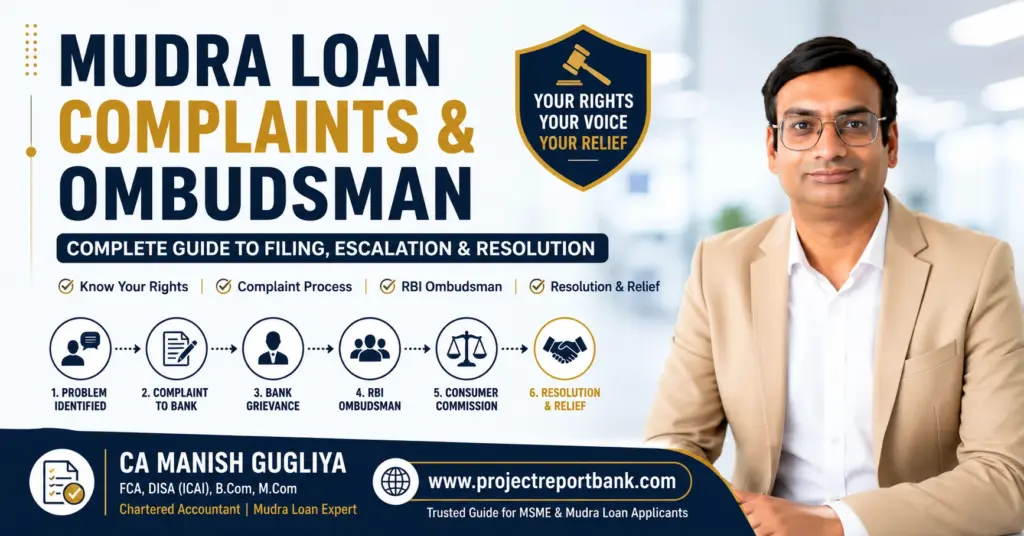
- Mudra Loan Complaints & Ombudsman: Complete Guide to Filing, Escalation & Resolution

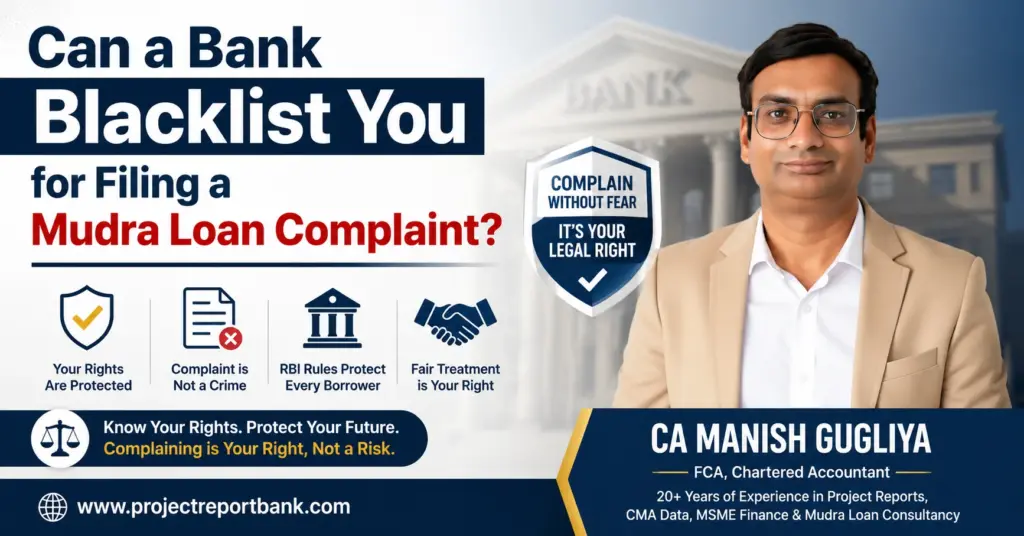
- Can a Bank Blacklist You for Filing a Mudra Loan Complaint?
- Can a Mudra Loan Complaint Affect Future Loan Approval?

- Common Mistakes That Lead to Mudra Loan Complaint Failure
- RBI Ombudsman Mudra Loan Relief: Practical Guide for Small Borrowers
- Can the RBI Ombudsman Reject Your Mudra Loan Complaint? Reasons Explained
- Consumer Commission vs RBI Ombudsman: Which Is Better for Mudra Loan Disputes?
- Bank Grievance Redressal System for Mudra Loans: Complete Guide
- RBI Ombudsman Mudra Loan Complaint – Detailed Guide by CA Manish Gugliya