Key Takeaways
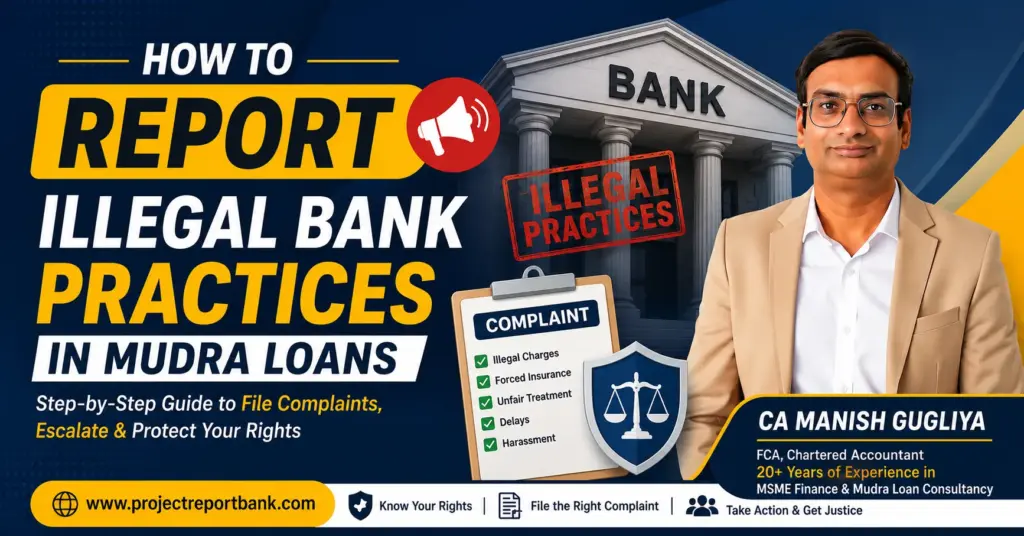
- Any mudra loan applicant can report illegal bank practices by starting at the branch level and escalating step by step to regional office, head office, and finally the Reserve Bank of India’s banking ombudsman.
- Complaints must always be in writing, fact-based, and supported by documents like application acknowledgement receipts, emails, fee slips, and SMS messages.
- The complaint route normally runs: Branch Manager → Regional/Zonal Office → Bank Head Office or online portal → RBI Integrated Ombudsman Scheme.
- Polite, documented follow-up works far better than angry verbal fights. Proper reporting helps protect future mudra loan borrowers across India as well.
Introduction: Why Reporting Matters in Mudra Loans
Many entrepreneurs applying for a mudra loan in 2026 face illegal practices – refusal to accept applications, forced insurance, or demands for cash payments – but most do not know how to report illegal bank practices in Mudra loans. Silence only allows the same behaviour to continue.
This article focuses entirely on the reporting and complaint process. If you want to understand every type of illegality in detail, refer to this separate guide on protecting yourself from illegal practices.
As CA Manish Gugliya (FCA) with 20+ years in MSME and Mudra finance, I am sharing practical, bank-side experience on complaint filing and escalation. Reporting is important because it stops repeat harassment and creates records that regulators and bank head offices can act upon. One critical note: complaints must be based on facts, dates, and documents – not guesses. False allegations can backfire.
Also be aware that fraudulent loan approval letters are circulating using the name of Pradhan Mantri Mudra Yojana. MUDRA does not provide direct loans to individuals. Mudra loans are issued through banks, NBFCs, and MFIs, not agents. If anyone contacts you claiming otherwise, that is a scam.
Table of Contents
What Counts as an Illegal Bank Practice? (Brief Overview)
This is a quick overview so you can recognise when to use the complaint process. For deeper study, visit the detailed cluster pages linked below.
Common suspected illegal practices in mudra loans include:
- Refusing to accept a mudra loan application or saying the scheme is closed without written proof.
- Demanding unauthorized fees like “file opening fees” or speed money beyond the official schedule of charges.
- Forcing insurance, credit cards, or demat accounts as a condition for loan approval.
- Asking for collateral or third-party guarantee in violation of PMMY norms.
- Deliberate, unexplained delays in processing despite complete documents.
- Repeatedly requesting the same documents to discourage the applicant.
- Staff misbehaviour such as insults, threats, or bribery demands.
- Fraudsters using fake Mudra documents to cheat borrowers, or scammers impersonating Mudra officials to solicit payments.
Not every disagreement is illegal. Sometimes a bank’s internal credit policy or genuine risk concerns justify a decision. Focus your complaint only on clear violations of RBI or PMMY rules.
When Should You Report a Bank in a Mudra Loan Case?
Do not rush to higher authorities on day one. Try to resolve issues at the branch first. But do not stay silent if the problem continues.
Start the complaint process when:
- The bank manager refuses to accept your mudra application form or refuses to give an application acknowledgement number.
- You are asked to pay cash above printed processing fee amounts. Remember, legitimate Mudra loans do not require any processing fees, and mudra loan applications are free. Any request for payment for a loan approval letter may indicate a scam. Victims often pay processing fees for non-existent Mudra loans.
- Staff harass you with remarks like “people like you never repay” or threaten to blacklist you.
- Written requests or emails are ignored beyond 7–10 working days.
- The branch demands collateral or security where PMMY rules say none is needed, especially for Shishu loans.
- You are forced to buy an insurance policy or other product to move your file.
- Banks must provide written rejection reasons for loan applications. If your application is rejected without written reasons, that is a valid trigger.
Before reporting, write down exact dates, names of staff, and what was said. This makes your complaint credible.

Documents You Should Collect Before Filing a Complaint
In banking, documents win over emotions. Without evidence, even the reserve bank may close your complaint as “not proved.” When reporting fraud, individuals should preserve evidence related to the case.
| Document | Why It Matters |
|---|---|
| Mudra loan application acknowledgement / reference number | Proves you applied; helps track your case |
| Copy of filled mudra application form | Shows requested amount, date, business details |
| Written refusal or rejection letter from branch | Provides official reason for denial or delay |
| Emails exchanged with branch or regional office | Shows you tried to resolve the matter peacefully |
| SMS messages from the bank | Time-stamped evidence of communication |
| WhatsApp chats or screenshots | Record instructions, promises, or demands |
| Payment receipts, bank statements, processing fee slips | Prove charges taken, including illegal ones |
| Identity proof and PAN copy | Confirm you are the right applicant |
| Written representations to the branch | Show your attempts before escalating |
| Branch visit diary | Note visit date, person met, and discussion summary |
| Witness details (name, mobile number, relation) | Support your version if misbehaviour occurred |
Always attach only self-attested photocopies. Never send original Aadhaar, PAN, or property paperwork by post.
Step-by-Step Process to Report Illegal Bank Practices
The process works like a ladder. Start at the branch and climb up only if the lower step fails. Banks and the reserve bank prefer internal mechanisms are tried first.
Step 1: Speak with the Branch Manager
Visit the branch and ask for a face-to-face meeting with the bank manager or mudra loan officer. Calmly explain the issue and request a resolution based on RBI/PMMY rules. Note the date, time, and outcome in your branch visit diary.
Step 2: Submit a Written Complaint
Write a 1–2 page complaint addressed to the Branch Manager. Attach copies of key documents. Clearly request specific relief – accept my application, refund illegal fee, provide written rejection reasons. Submit by email, in person, or via registered post.
Step 3: Obtain Acknowledgement
Insist on an inward number or stamped copy. If the branch refuses, send the complaint by speed post and use postal tracking as proof of submission.
Step 4: Approach the Regional or Zonal Office
Wait 7–15 days. If no response or an unsatisfactory one, escalate to the regional office. Find contact details on the bank’s website. Attach earlier complaint and acknowledgement.
Step 5: Use the Bank’s Official Grievance Portal
Complaints can be lodged via the bank’s website or in branch. Almost all major banks have online complaint forms. Select the loan category, fill in details, upload documents, and save the complaint reference number. A unique Grievance ID is generated after submitting a complaint. You can track your grievance status using the Grievance ID.
Step 6: Escalate to Higher Authorities
Individuals can escalate complaints to the RBI if banks fail to address issues within 30 days. File a complaint with the RBI Banking Ombudsman for unresolved issues. The Reserve Bank of India provides a complaint management system for unresolved grievances. Attach all previous complaints and replies. The Ombudsman will not entertain cases where internal bank channels were not tried first.
Step 7: Maintain Complaint Records
Create a folder – physical or digital – with all letters, emails, and receipts. Use clear file names like “SBI_Mudra_Complaint_Branch_15-08-2026.pdf” so you can track everything easily.
Step 8: Follow Up Professionally
Follow up every 7–10 working days by email or phone using complaint reference numbers. Stay polite and factual. Abusive language can weaken your case.
Where Can You Report Illegal Bank Practices?
The correct authority depends on the issue, its scale, and whether you have used internal bank routes.
| Authority | Suitable For | Complaint Method | Expected Response |
|---|---|---|---|
| Branch Manager | First-level issues: refusal to accept application, illegal fee demand | Written letter or email | 7–15 days |
| Regional / Zonal Office | Branch ignores complaint or supports illegal practice | Email, speed post, bank form | 15–30 days |
| Bank Head Office / Corporate Care | Serious misconduct or pattern issues | Central grievance portal, email | System-generated complaint ID |
| RBI Banking Ombudsman | Unresolved complaints older than 30 days, clear RBI/PMMY violations | Online via CMS portal, email, physical form | Free resolution and Awards |
| Government portals (CPGRAMS, PMO) | Extreme or repeated cases, large-scale scheme misuse | Online submission | Varies |
| National Cyber Crime / Police | Criminal fraud, fake approvals, KYC misuse | Online or in person | Investigation-based |
Individuals alleging fraud related to Mudra loans should contact national cyber crime authorities. Call 1800 209 000 to report Mudra loan fraud. Complaints can also be lodged via email or social media. Consumers should report misleading or fraudulent communications to PIB Fact Check. Timelines mentioned are from practical experience and may vary.
Information Every Complaint Should Include
Use this checklist when drafting complaints to any authority:
- Full name and father’s name as per Aadhaar or PAN
- Contact details: postal address, mobile number, email ID
- Type of loan (Shishu / Kishore / Tarun) and requested amount
- Name of bank, branch, complete address with city and PIN
- Loan application number or reference ID
- Key dates: date of application, date of visit, date of illegal demand
- Names and designations of staff involved (bank manager, loan officer)
- Clear description of events in time order, in plain language
- List of documents attached
- Exact relief you seek (e.g., “accept my mudra loan application,” “refund ₹2,000 taken as illegal charges,” “provide written rejection reasons”)
- A statement that the information is true and you will cooperate in any investigation
Type the complaint if possible, but neat handwritten letters are also accepted.
Sample Complaint Format for Mudra Loan Issues
Here is a simple, non-legalistic format you can adapt:
From: [Your Name], [Address], [Mobile Number], [Email]
To: The Branch Manager, [Bank Name], [Branch Address]
Date: [DD/MM/YYYY]
Subject: Complaint regarding illegal bank practices in Mudra loan (PMMY) – Application No. [XXXXX]
Sir/Madam,
I, [Your Name], running a [type of business] at [location], applied for a [Shishu/Kishore/Tarun] Mudra loan of ₹[amount] at your branch on [date]. My application reference number is [XXXXX].
On [date], [describe what happened – e.g., “your loan officer demanded ₹3,000 as file opening charges” or “my application was refused without any written reason”]. I believe this is against [mention specific RBI/PMMY guideline if known].
I request you to [state relief – accept my application / refund illegal charges / provide written rejection reasons] within 15 days.
I am willing to cooperate fully in any inquiry. Please provide a written reply at the earliest.
Yours faithfully, [Signature] [Name]
Encl: Copies of application acknowledgement, SMS dated [date], fee receipt dated [date], etc.
This format works for branch, head office, or RBI Ombudsman complaints with minor adjustments.
Mistakes People Make While Reporting Illegal Practices
In my CA practice, I often see genuine cases fail because of how the complaint is made, not because the borrower is wrong.
- Using angry, abusive, or emotional language instead of clear facts and dates
- Making only verbal complaints with no written letter or email
- Waiting many months before complaining, so staff transfers and memory gaps weaken the case
- Not attaching basic proof like application acknowledgement or fee receipts
- Sending original documents instead of self-attested photocopies
- Filing multiple overlapping complaints without keeping track of reference numbers
- Posting allegations on social media before filing an official complaint – this creates noise but rarely leads to formal resolution
- Using words like “fraud” or “corruption” without supporting evidence; prefer “I believe this is against RBI/PMMY guidelines because…”
A short, well-structured, fact-based complaint is always stronger than a long emotional narrative.
What Happens After You File a Complaint?
The exact steps differ by bank, but the broad process is similar:
- Complaint registration: The bank system creates a ticket number and sends SMS or email confirmation. You can track your grievance status using the unique Grievance ID.
- Preliminary scrutiny: The grievance cell checks whether details and documents are complete. They may contact you for clarifications.
- Investigation: The bank reviews CBS records, staff statements, and your documents.
- Branch interaction: The grievance team asks the branch manager to explain or justify their actions.
- Corrective actions: If valid, the bank may refund fees, process your loan, issue an apology, or warn staff.
- Partial relief: Sometimes the bank admits a mistake but still refuses the loan on credit grounds. The Ombudsman ensures fair process but generally cannot force loan sanction.
- Escalation: If unsatisfied or no reply within 30 days, escalate to the RBI Ombudsman. Use your right to timely communication.
Expert Advice from CA Manish Gugliya
From handling hundreds of MSME and Mudra loan cases over two decades:
- Keep every slip – application acknowledgements, post receipts, even small branch visit notes become crucial later.
- Never hand over original property papers unless you receive a formal sanction letter.
- When you quote RBI or PMMY guidelines, attach a printout from official sources. For interpretation help, see common misinterpretations of guidelines.
- If English is a barrier, draft in your local language first and get help translating. Never delay the complaint for language reasons.
- Stay polite and professional. Many branch managers soften their stand when they see you are organised.
- Do not threaten staff with media or politics. Calmly mention you know the official grievance process.
- Consider help from a Chartered Accountant for drafting, but never pay anyone a success-based fee for getting a loan approved.
- If multiple borrowers at the same branch face the same problem, group complaints can be more powerful.
Frequently Asked Questions
Can I complain online about illegal Mudra loan practices?
Yes. Almost all major banks have online grievance forms on their website where you can login and lodge a complaint. Additionally, the RBI’s Integrated Ombudsman Scheme portal allows online complaints once internal remedies are exhausted. You can also click on the bank’s customer services section and select the loans category to file your grievance.
Is an email to the bank enough as a formal complaint?
Email to the official branch or customer care ID is valid if acknowledged. But combining email with a physical letter sent via registered post gives stronger proof of submission. Always save the sent email and any auto-reply you receive.
What if the bank threatens me for complaining?
Record details of threats, preserve messages, and consider a police or cyber crime complaint if threats are serious. Inform higher bank authorities and the banking ombudsman with proof. Genuine complaints do not give banks any right to intimidate you under the consumer protection act.
Will complaining affect my future loan chances?
From my experience, genuine, well-documented complaints do not reduce your creditworthiness. Banks evaluate repayment history and financials – not whether you exercised your legal rights. No bank can officially penalise you for using the mandated grievance process.
How long should I wait before escalating to the RBI Ombudsman?
Generally, wait 30 days from the date of your first written complaint. If no reply comes, or you are not satisfied with the resolution, you may then approach the Ombudsman with complete papers. Running to the Ombudsman without trying the bank’s internal system first usually results in your complaint being closed as not maintainable.
Conclusion
Reporting illegal bank practices in Mudra loans is not only your right – it is your responsibility as a borrower. A clear, written, documented complaint following the proper hierarchy is far more effective than shouting at the counter.
Start from the branch and move step by step. Keep strong evidence. Focus on facts and RBI/PMMY rules, not personal attacks. Every well-filed complaint helps improve the government scheme for small entrepreneurs across India.
Take action today: understand your rights before applying, maintain copies of everything from the first mudra loan application, and act calmly whenever you sense an illegal practice. Structured reporting – not silence – is what makes the Mudra scheme work as intended.
- Mudra Loan Illegal Bank Practices: Complete Guide to Identify, Prevent & Report Unfair Banking Practices


- Can Banks Change Mudra Loan Terms Without Informing the Applicant?
- Red Flags That Indicate Unfair Bank Practices in Mudra Loans: Warning Signs Every Applicant Should Know

- What Evidence Should You Collect If a Bank Violates Mudra Loan Rules?
- How to Report Illegal Bank Practices in Mudra Loans
- How to Protect Yourself from Illegal Bank Practices in Mudra Loans
- How to Identify Illegal Bank Practices During the Mudra Loan Process
- Is It Legal for Banks to Delay Mudra Loan Processing Without Reason?
- Are Banks Allowed to Charge Unauthorized Fees for Mudra Loans? Complete Guide by CA Manish Gugliya