Key Takeaways
This article answers whether RBI circulars are legally binding for Mudra Loans and what that means for you as a borrower.
- Most RBI directions issued under the Reserve Bank of India Act, 1934 and the Banking Regulation Act, 1949 are legally binding on regulated banks, including for Mudra Loans. Some advisory communications, however, serve only as guidance.
- PMMY (Pradhan Mantri Mudra Yojana) guidelines are scheme-level rules issued by the government of india through MUDRA Ltd. Banks implementing the scheme must also follow RBI’s regulatory framework alongside these guidelines.
- Borrowers can rely on relevant RBI circulars and PMMY guidelines when applying for Mudra Loans and when raising complaints about unfair treatment, hidden charges, collateral demands, or unexplained delays.
- RBI circulars and Master Directions are binding on financial institutions, and compliance with RBI regulations is mandatory for all lending institutions offering Mudra loans.
- This article is written from the perspective of CA Manish Gugliya (FCA) with 20+ years of experience in MSME finance. It includes step-by-step remedies if banks do not follow applicable directions, plus links to related guides on ProjectReportBank.com.
Introduction: Why RBI Circulars Matter for Mudra Loan Borrowers
Imagine you walk into a bank branch to apply for a Mudra Loan. The officer mentions “RBI circulars” and “PMMY guidelines” as reasons for certain conditions. You nod along, but you are unsure whether these rules actually protect you or just protect the bank.
This confusion is common. Mudra Loans, launched under the Pradhan Mantri MUDRA Yojana on 8 April 2015, have become a lifeline for micro and small enterprises across india. These loans of upto rs 10 lakh are categorised into three categories: Shishu, Kishore, and Tarun. RBI circulars guide the implementation of Mudra loans by setting norms on priority sector lending, fair practices, and borrower protection.
But are RBI circulars legally binding for Mudra Loans, or can banks treat them as optional suggestions? The answer is not a simple yes or no.
I, CA Manish Gugliya (FCA), with 20+ years of experience in MSME finance, project reports, CMA data, and Mudra Loan consultancy, will explain this in simple, non-legal language. You will learn the legal basis of RBI’s powers, the types of RBI documents, how banks are supervised, practical examples of what happens at branches, and what to do if something goes wrong.

Table of Contents
What Are RBI Circulars and Related Documents?
The reserve bank of india communicates with banks through several types of formal documents. In everyday conversation, bankers call most of them “RBI circulars,” but legally, these documents differ in important ways.
- RBI Circular: An instruction or clarification sent to regulated entities-banks, NBFCs, and other financial institutions-about how to implement specific rules or policy changes. For example, a circular clarifying how advances granted to micro enterprises under priority sector lending should be classified.
- RBI Master Circular: A consolidated document that compiles all important instructions on a particular subject into one updated reference. Master Circulars consolidate RBI instructions meant to protect borrower rights and ensure uniform practices across branches.
- RBI Master Direction: A newer format that replaced many master circulars. A master direction forms a single, continuously updated rulebook on a subject. The Master Direction on Priority Sector Lending – Targets and Classification (last updated in 2025) is directly relevant for Mudra Loans and was issued under Sections 21 and 35A of the Banking Regulation Act.
- RBI Notification: A formal document used when RBI issues or amends regulations under statutory authority, often published in the Official Gazette. These can change key conditions for how banks handle lending operations.
- RBI Advisory / Guidance / FAQs: Communications that clarify understanding or promote good practices, but may not always carry the same binding force as directions issued under specific sections of law.
- RBI Instructions or Letters: Targeted communications to specific banks during inspections or for particular compliance issues.
The critical dot to connect: the legal force of any document depends on which statutory power it cites, the language it uses (“shall” vs “may”), and whether it is directed at all banks or just specific ones.
Why Does RBI Issue Circulars for Banks and Mudra Loans?
RBI is India’s central bank and primary banking regulator. It uses circulars and directions to keep all india financial institutions aligned and disciplined. Here is why these communications exist:
- Banking discipline and financial stability: Circulars ensure that commercial banks, regional rural banks, cooperative banks, and small finance banks follow uniform norms in areas like Mudra Loans and priority sector lending.
- Consumer and borrower protection: RBI circulars provide protections such as fair treatment and transparency to borrowers. They prescribe rules on interest rate disclosure, charges, and grievance redressal that directly benefit Mudra customers.
- Uniform implementation: Without circulars, individual bank interpretations could vary across branches and states, creating unequal treatment.
- Transparency and accountability: Circulars put RBI’s expectations on record-accessible on the rbi website-so that compliance can be verified during inspections and audits.
- Risk management: Circulars guide banks on credit appraisal, documentation, NPA recognition, and reporting norms for accounts including those of micro and small enterprises engaged in manufacturing or services.
- Mudra and PMMY integration: RBI circulars integrate PMMY lending into overall priority sector lending targets and clarify how Mudra Loans should be classified, reported, and monitored for the financial health of the sector.
Legal Basis: What Gives RBI the Authority to Issue Binding Directions?
Understanding the legal basis helps you know why RBI circulars are not just bureaucratic paperwork. Two laws matter most:
Reserve Bank of India Act, 1934: This Act created RBI and gives it power to regulate the monetary system, currency, credit, and certain aspects of banking. It is the foundation of RBI’s authority over india’s banking system.
Banking Regulation Act, 1949: This law governs how banks are licensed, regulated, supervised, and controlled. Two sections are especially important:
- Section 21: Empowers RBI to determine policy for advances granted by banking companies, including the purposes, amounts, margins, and interest rates. Banks are bound to follow these directions on advances.
- Section 35A: Gives RBI power to issue directions to banking companies when satisfied it is necessary in the public interest or to protect depositors. Banks “shall be bound to comply” with such directions.
When a circular or master direction expressly cites these sections, it normally carries statutory force. RBI circulars issue regulatory instructions under the Banking Regulation Act, 1949, making them far more than recommendations.
By contrast, general advisories, faqs, or press releases may guide interpretation but might not be enforceable in the same way. For a Mudra borrower, the key idea is: RBI is not just advising banks-in many cases it is exercising formal regulatory powers under these Acts.
Are RBI Circulars Legally Binding for Mudra Loans?
The direct answer: RBI circulars and directions issued under statutory authority are generally binding on regulated banks, including in relation to Mudra Loans, unless the document itself indicates it is purely advisory.
The binding nature depends on three things:
- Source law cited: Directions under Sections 21 or 35A of the Banking Regulation Act carry mandatory force.
- Wording: “Shall,” “must,” and “bound to comply” indicate mandatory compliance. “May,” “advisable,” or “recommended” suggest guidance.
- Type of document: Master Directions and formal notifications are typically binding. Advisories and press releases are informational.
The Supreme Court confirmed this principle in Central Bank of India v. Ravindra (2002), holding that directions issued by RBI under Sections 21A or 35A have statutory force and are binding on banks. Compliance with RBI regulations is mandatory for all lending institutions offering Mudra loans.
For Mudra Loans specifically, banks must comply with RBI’s priority sector lending framework, fair practices code, and customer service instructions while implementing PMMY scheme rules. Lenders must comply with RBI guidelines on interest rates and asset classification. RBI also implements caps on interest rates for loans refinanced through MUDRA.
While borrowers are not directly regulated by RBI, they can rely on applicable RBI circulars when arguing that a bank has not followed mandated norms.
| RBI Document | Purpose | Typical Nature | Impact on Mudra Loans |
|---|---|---|---|
| Master Direction (e.g., Priority Sector Lending) | Comprehensive rules on lending targets and classification | Generally mandatory for all scheduled commercial banks | Defines how Mudra Loans are classified as priority sector and reported |
| Circular/Notification under BR Act | Implement or clarify binding regulatory requirements | Usually binding, subject to wording | Can mandate specific treatment of small-ticket loans and borrower protections |
| Advisory/FAQ | Clarify interpretation and promote good practice | Guidance; binding force may be weaker | Helps understand how banks should treat Mudra applicants but may not always be enforceable alone |
| Press Release | Communicate policy stance to public | Informational | Useful context but not a standalone legal basis for complaints |
In disputes, regulators and courts do examine whether a bank followed relevant RBI directions applicable at that date.

Difference Between RBI Circulars and PMMY Guidelines
Mudra borrowers often hear both terms and assume they are the same. They are not.
| Aspect | RBI Circulars/Directions | PMMY Guidelines |
|---|---|---|
| Issuing Authority | Reserve Bank of India | Government of India / MUDRA Ltd. (ministry of Finance) |
| Primary Objective | Regulation and supervision of banks | Implementation of PMMY scheme |
| Covers | Banking norms, priority sector lending, fair practices, currency and credit policy | Product structure (Shishu/Kishore/Tarun), eligible borrowers, loan amount limits |
| Legal Basis | RBI Act, 1934; Banking Regulation Act, 1949 | Administrative scheme rules and government decisions |
| Applicability | All regulated banks, sometimes NBFCs/MFIs | Member Lending Institutions (MLIs) participating in PMMY |
| Impact on Borrowers | Rights on transparency, charges, grievance redressal | Eligibility for Mudra Loan and scheme-specific benefits |
RBI focuses on banking regulations, prudential norms, and consumer protection. PMMY guidelines focus on scheme design, eligible activities, loan limits, and operational processes. Both apply simultaneously when a bank offers Mudra products.
In practice, banks must respect both sets of instructions. ProjectReportBank.com has a separate guide on mandatory RBI & PMMY guidelines for banks for deeper detail.
Are PMMY Guidelines Also Mandatory for Banks?
The PMMY framework was launched in april 2015 to support non-farm, non-corporate micro and small enterprises through three categories of loans. Member Lending Institutions (MLIs)-commercial banks, regional rural banks, co operative banks, small finance banks, MFIs, and NBFCs-participate voluntarily but, once enrolled, agree to follow PMMY scheme conditions.
PMMY guidelines are not a statute like an Act passed by Parliament. However, they are binding on participating banks within the scheme and contract framework, especially where linked to refinance eligibility, reporting obligations, and government monitoring.
Banks cannot ignore RBI rules in the name of PMMY, and equally should not ignore PMMY conditions for loans they market as Mudra. A separate article on ProjectReportBank.com explores the consequences of ignoring RBI and PMMY guidelines in more detail.
For borrowers, PMMY guidelines are practically important and can be referred to when discussing entitlements with bank officials, though formal enforceability may depend on specific circumstances and the loan agreement terms.
How RBI Circulars Affect Mudra Loan Applicants in Daily Practice
This is where legal theory meets your experience at the branch counter.
- Documentation: RBI norms on KYC, simplified documentation for small-ticket MSME loans, and acceptance of alternative income proofs shape what banks can ask from you. Fair lending practices require banks to provide copies of loan agreements to borrowers.
- Processing timelines: Some RBI customer service instructions require acknowledgment of applications and time-bound disposal. These should apply to Mudra applications too.
- Transparency: RBI’s fair practices code requires banks to disclose interest rates, services charges, and penalty interest clearly before sanction, preventing hidden charges. Lenders must comply with RBI guidelines on interest rates and asset classification for all advances.
- Collateral: Lenders cannot demand collateral for micro-loans under specified limits. PMMY’s general stance is that Mudra Loans up to a certain threshold should be granted without collateral. See the guide on collateral rules under Mudra Loan for specifics.
- Cross-selling: RBI circulars discourage forcing unrelated products like insurance bundles or a credit card as conditions for granting a loan. If a bank insists you buy insurance to get a Shishu loan, that is a red flag.
- Complaint handling: RBI’s grievance redressal framework structures how complaints at branch and higher levels should be handled.
If a staff member cites an unusual condition, politely ask for the circular number or internal bank policy reference, and keep written records.
Can Banks Ignore RBI Circulars? Regulatory Expectations and Reality
In principle, regulated banks are not supposed to ignore binding RBI directions. Mandatory compliance leads to penalties and audits from the RBI for violating directives. But in practice, implementation can sometimes be imperfect at the branch level.
Banks have internal compliance departments that interpret RBI instructions and issue internal circulars. Staff training on updated norms-especially for development schemes like Mudra-can lag behind, particularly in smaller branches.
RBI conducts periodic inspections, off-site monitoring, and reporting reviews that can detect non-compliance with circulars and Master Directions. For serious or repeated violations, RBI may record observations in inspection reports, restrict business activities, impose monetary penalties, or direct the bank to refund excess charges. This has happened in the past for various regulatory breaches.
Individual borrowers will not usually see supervisory processes directly, but the existence of these mechanisms reinforces the expectation that banks should follow applicable circulars. When issues arise at the branch level, escalation within the bank often resolves them. Read more about what happens when banks ignore RBI directions.
Practical Examples: 10 Realistic Situations Faced by Mudra Borrowers
Here are 10 scenario-based explanations covering situations, applicable principles, correct practices, and suggested borrower actions.
1. Forced Insurance: You are told a specific insurance policy is compulsory for a Shishu loan. RBI’s fair practices guidelines prohibit forcing unrelated products. Ask for written proof of compulsion. If absent, escalate.
2. Unnecessary Collateral: A Kishore applicant is asked for residential property mortgage. PMMY and RBI norms generally indicate collateral-free loans up to the specified limit. Refer to the Mudra Loan collateral guidelines and request written justification.
3. No Acknowledgement: You submit a complete application but receive no receipt. RBI customer service instructions require acknowledgment. Insist on a written receipt or email confirmation.
4. Excess Documentation: A micro enterprise with a small turnover is asked for multiple years of audited financials. RBI and PMMY emphasize simplified processes for small units. Provide what you have and escalate excessive demands.
5. Hidden Processing Fees: Charges are deducted from your loan amount without prior written disclosure. RBI rules require upfront display of charges. Ask for a schedule of charges communicated before sanction.
6. Delay Without Reason: A Shishu loan stays pending for months with no communication. RBI expects time-bound disposal. Send written reminders and meet the Branch Manager, recording all dates.
7. Non-Transparent Rejection: The bank rejects your application verbally without reasons. RBI guidance says reasons should be communicated upon request. Ask for a written rejection letter.
8. Ignoring PMMY Branding: The bank offers a regular business loan, refusing to classify it as Mudra even though it fits PMMY criteria. Ask the bank to clarify in writing why your loan is not classified under PMMY.
9. Unfair Treatment: Two similar applicants receive different treatment due to informal relationships rather than credit criteria. RBI principles of non-discrimination apply. Keep records and use the grievance system if needed.
10. Misuse of Credit History: A first-time borrower with minor past delays is told they are permanently ineligible. RBI’s guidance supports responsible use of credit information. Ask for written reasons and explore corrective steps rather than accepting a blanket refusal.

What Should Borrowers Do if a Bank Does Not Follow Applicable RBI or PMMY Directions?
Borrower recourse depends on the loan agreement and applicable statutory law. Here is a structured process to follow:
Step 1 – Clarify at the Branch: Discuss politely with the dealing officer. Ask for the specific RBI circular or internal bank policy they are following. Note dates and names.
Step 2 – Meet the Branch Manager: Summarize the problem in writing and request a written explanation. Carry copies of relevant RBI or PMMY references-printouts from resources like the mandatory Mudra Loan guidelines page can help.
Step 3 – Written Complaint: Submit a formal complaint (letter, email, or online form) to the bank’s grievance cell, mentioning your account or application number, dates, and the specific instruction you believe is being ignored.
Step 4 – Escalate to Regional/Zonal Office: If no response comes within the bank’s stated timeline (often around 30 days or a maximum period defined in their charter), approach the higher office with copies of earlier correspondence.
Step 5 – Formal Grievance Mechanisms: Borrowers can challenge unfair lender practices using RBI grievance mechanisms. RBI’s Integrated Ombudsman Scheme allows escalation after exhausting the bank’s internal process.
Step 6 – Preserve Evidence: Keep copies of application forms, acknowledgements, sanction or rejection letters, emails, and any reference to RBI or PMMY guidelines.
Step 7 – Follow Up Professionally: Follow up periodically with a professional tone. Avoid emotional or threatening language, which can weaken your position.
The process flow in brief: application → branch discussion → branch manager → written complaint → regional office → ombudsman (if needed).
Common Myths About RBI Circulars and PMMY Guidelines
Many borrowers and even some bank staff misunderstand the force of RBI circulars. ProjectReportBank.com has a dedicated article on common myths about RBI & PMMY guidelines, but here are the key misconceptions:
| Myth | Reality |
|---|---|
| “RBI circulars are only suggestions; banks can follow them or not.” | Many circulars, especially those citing Sections 21 or 35A of the Banking Regulation Act, are binding directions for regulated banks. |
| “Only public sector banks must follow RBI and PMMY guidelines.” | All regulated banks-including private, small finance, and cooperative banks-must follow relevant RBI directions. PMMY rules apply to all participating MLIs. |
| “PMMY guidelines have no value because they are not an Act.” | While not a statute, PMMY guidelines govern how Mudra Loans should be offered by scheme participants and are important in practice. |
| “Borrowers cannot rely on RBI circulars while complaining.” | Borrowers can and should cite relevant RBI and PMMY instructions when raising grievances. |
| “RBI never penalizes banks for non-compliance.” | RBI has imposed monetary penalties and other supervisory actions for violations of its directions. |
Always verify any claim like “RBI has issued a change in the rule” by checking the rbi website or trusted resources rather than relying on hearsay. You can search by subject, date, or circular number and confirm whether a document was accessed in its current or updated form, or has been superseded. Check updates from jan, june, or jul as applicable, since RBI issues revisions throughout the year.
Rights Every Mudra Loan Borrower Should Know
Here is a checklist of rights drawn from RBI’s customer service, fair practices, and priority sector lending framework, combined with PMMY scheme norms:
- Right to Fair Treatment: No discrimination based on gender, caste, region, or informal connections. Similar cases should be assessed on similar credit criteria.
- Right to Transparency: Interest rates, processing fees, insurance charges, and all other costs must be communicated clearly in writing before disbursement.
- Right to Acknowledgement and Time-Bound Processing: Applications should be acknowledged and decided within a reasonable timeframe. Delayed decisions without communication are discouraged under RBI norms.
- Right to Written Sanction/Rejection: You can ask for written sanction terms and, if rejected, a written reason-important for future applications.
- Right Against Forced Cross-Selling: Banks may suggest products, but should not make unrelated products a condition for granting Mudra Loans.
- Right to Privacy: Personal and financial information should only be used for legitimate banking purposes.
- Right to Grievance Redressal: Every bank must have a defined grievance mechanism with displayed contact details for escalation.
Maintain your own file of documents and communications-it is the strongest way to enforce these rights in practice.
Expert Tips from CA Manish Gugliya for Mudra Loan Applicants
These 10 tips come from more than two decades of working with MSME finance, project reports, and Mudra Loan cases across multiple banks and states.
- Always obtain a written acknowledgment for your application, whether via stamped copy, email, or reference number.
- Keep a file with copies of KYC, your project report, CMA data (if applicable), quotations, bank forms, and any SMS or email from the bank.
- Before visiting the branch, review key RBI and PMMY points on ProjectReportBank.com, such as the page on RBI & PMMY guidelines for banks, so you can speak confidently.
- Understand that some RBI communications are binding directions and others are guidance. Focus on those clearly related to customer rights, disclosure, and priority sector lending.
- Prepare a simple project report and cash-flow statement even if not asked. This improves your credibility and helps the bank justify sanctioning the loan. Most loans have a repayment schedule spanning up to five years or as defined in the facility terms.
- If a staff member cites an “RBI rule” for an unusual demand, politely ask for the circular number or internal reference.
- Escalate step by step-officer, Branch Manager, regional office-keeping your communication brief, factual, and respectful.
- Avoid applying at many banks simultaneously without disclosure. It creates confusion and can raise concerns in credit bureaus about your accounts.
- After sanction, read the sanction letter carefully-check interest rate (fixed or floating), charges, repayment schedule, and any conditions precedent.
- If you feel stuck, consider professional help for documentation or dispute framing. Do not give up on the Mudra Loan opportunity-the scheme was created to help small enterprises grow during every phase of development.

Key Takeaways and Summary
- RBI circulars and directions issued under the RBI Act and Banking Regulation Act are generally legally binding on regulated banks, shaping how Mudra Loans must be handled.
- RBI’s regulatory circulars and PMMY’s scheme guidelines come from different authorities and cover different aspects of Mudra lending-both are important.
- Banks, as part of India’s financial institutions, must align Mudra implementation with RBI’s broader framework for priority sector lending, MSME finance, and fair practices. Targets for priority sector lending are set as a percentage of Adjusted Net Bank Credit.
- Borrowers can rely on relevant RBI and PMMY documents when raising concerns about collateral, processing delays, hidden charges, forced cross-selling, or unfair rejection.
- Documentation, polite escalation, and formal grievance channels-including the ombudsman route-are your strongest tools.
- ProjectReportBank.com offers in-depth guides on related topics. Understanding these rules helps first-time entrepreneurs deal with banks more confidently.
Frequently Asked Questions
These FAQs cover additional doubts not fully addressed above, focusing on verification of circulars, court use, and coverage of different bank types. Each question is answered in a way that helps borrowers take practical action.
How can I verify whether an RBI circular shown by the bank is genuine and current?
Visit RBI’s official website and navigate to the “Notifications” or “Master Directions” sections. You can search by date, subject, or circular number to confirm whether the document is authentic and has not been superseded by a later direction. This is the most reliable way to verify-do not rely solely on what is communicated verbally.
Are cooperative banks and small finance banks also required to follow RBI circulars for Mudra Loans?
Most urban co operative banks and small finance banks are regulated by RBI and must follow applicable directions, including those affecting priority sector and Mudra-type loans. However, some cooperative institutions may also be subject to state-level regulations. Check whether the specific institution is on RBI’s list of regulated entities.
Can courts consider RBI circulars in disputes between borrowers and banks?
Courts in India often look at relevant RBI directions and circulars to understand regulatory expectations, especially in consumer or banking disputes. In landmark cases, courts have treated statutory RBI directions as binding. However, final decisions depend on the facts and applicable law in each case.
Do RBI circulars apply directly to borrowers, or only to banks?
RBI primarily regulates banks, not individual borrowers. Circulars are directed at banks. However, borrowers are indirectly affected and can use these circulars to provide support for their position in complaints or negotiations-citing the specific circular, its date, and its requirements.
Where can I find simplified explanations of important RBI and PMMY rules for Mudra Loans?
While RBI’s website carries the original documents, platforms like ProjectReportBank.com provide simplified guides on topics such as mandatory Mudra guidelines, misconceptions about PMMY guidelines, and RBI collateral norms to help non-experts understand their rights without wading through dense legal language.
- RBI & PMMY Guidelines for Mudra Loans – Complete Guide to Bank Rules, Applicant Rights & Compliance

- RBI & PMMY Guidelines for Women Entrepreneurs Applying for Mudra Loans

- Common Misinterpretations of RBI & PMMY Guidelines That Lead to Mudra Loan Problems
- What Happens If a Bank Violates RBI or PMMY Guidelines?
- RBI & PMMY Guidelines on Mudra Loan Complaint and Grievance Redressal (2026)

- RBI Guidelines for Mudra Loan Applicants: Documentation, Eligibility & Bank Duties


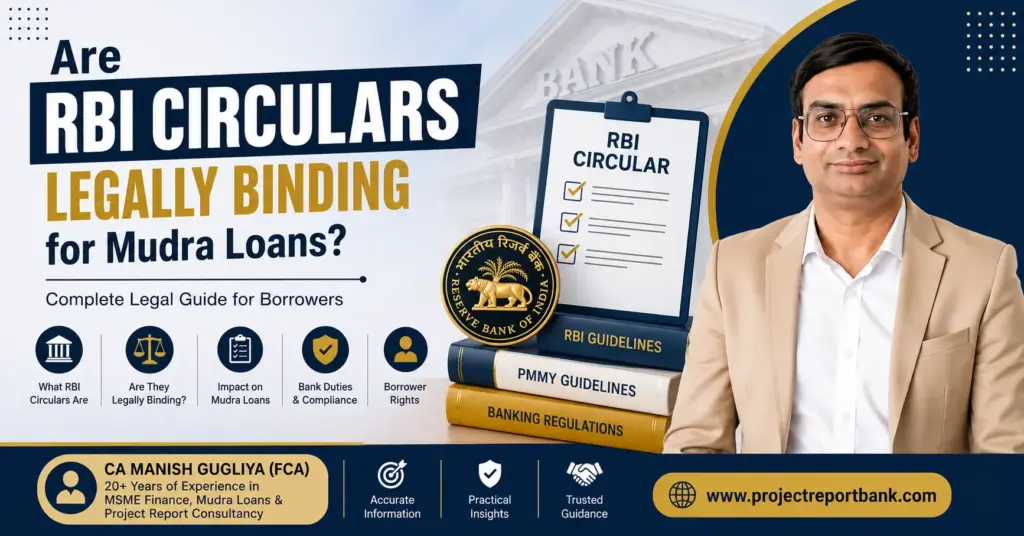
- Are RBI Circulars Legally Binding for Mudra Loans? Complete Legal Guide for Borrowers
- Mandatory RBI & PMMY Guidelines for Mudra Loans: Practical Compliance Guide for Applicants and Banks
- Mudra Loan Collateral Rules: RBI & PMMY Guidelines (Practical Outline)