The Reserve Bank of India (RBI) regulates India’s banking system by issuing guidelines, circulars, and regulatory directions that banks and financial institutions are expected to follow. These guidelines promote fair lending practices, transparency, responsible banking, and customer protection. While RBI does not directly sanction Mudra Loans, its regulatory framework influences how participating banks process applications, communicate with borrowers, and handle grievances.
What is PMMY?
The Pradhan Mantri Mudra Yojana (PMMY) is a flagship Government of India initiative that provides financial support to micro and small businesses through Shishu, Kishore, and Tarun loan categories. The scheme establishes eligibility criteria, loan objectives, implementation procedures, and operational guidelines. Scheduled Commercial Banks, Regional Rural Banks (RRBs), Small Finance Banks (SFBs), Cooperative Banks, NBFCs, and MFIs participate in the scheme while evaluating loan applications according to applicable banking regulations and their internal credit assessment policies.
Why Should Mudra Loan Applicants Understand These Guidelines?
Understanding RBI and PMMY guidelines helps applicants prepare complete loan applications, submit the correct documents, know their rights during the loan process, and avoid common misconceptions. It also enables borrowers to distinguish between genuine regulatory requirements and individual bank procedures, making it easier to address concerns through the appropriate grievance channels when necessary.
Why Must Banks Follow RBI & PMMY Guidelines?
Banks are expected to process Mudra Loan applications in accordance with applicable RBI regulations, PMMY operational guidelines, and their approved internal credit policies. Compliance promotes transparency, consistency, fair customer treatment, proper documentation, responsible lending, and an effective complaint-handling mechanism, ultimately strengthening confidence in the banking system.
What You Will Learn in This Guide
This page serves as the central knowledge hub for the RBI & PMMY Guidelines for Mudra Loans. It explains the roles of RBI and PMMY, mandatory bank responsibilities, applicant rights, collateral rules, legal status of RBI circulars, complaint procedures, common myths, and links to 10 detailed articles that explore each topic in depth. Whether you are planning to apply for a Mudra Loan or want to understand how banks implement these guidelines, this guide will help you navigate the process with greater confidence and clarity.
📌 In This Guide
Table of Contents
Explore RBI & PMMY Guidelines for Mudra Loans
Select the guide that matches your question or concern.
Understanding RBI & PMMY Guidelines
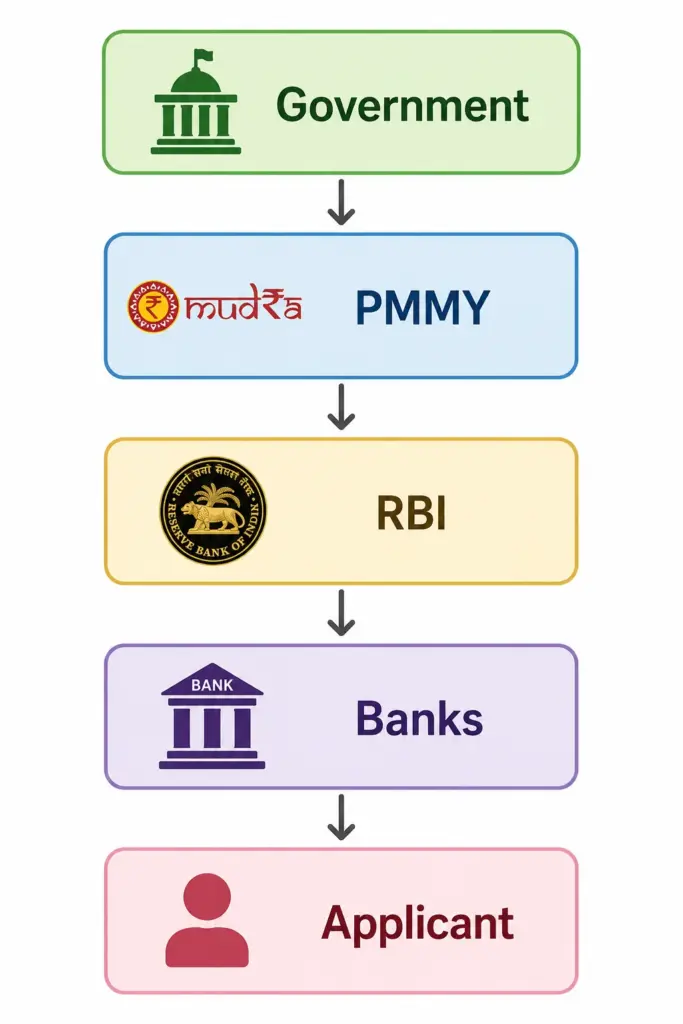
Before applying for a Mudra Loan, it is important to understand the roles of the Reserve Bank of India (RBI), Pradhan Mantri Mudra Yojana (PMMY), SIDBI, and the lending bank. Although these names are often used together, each performs a different function in the Mudra Loan ecosystem.
Knowing these differences helps applicants understand who creates the rules, who implements the scheme, and who actually approves or rejects the loan application.
RBI – Banking Regulator
The Reserve Bank of India (RBI) is India’s central banking regulator. It issues banking regulations, customer service directions, and supervisory guidelines that regulated banks are expected to follow.
RBI’s Key Role
Regulates banks and financial institutions.
Issues banking guidelines and circulars.
Promotes fair banking practices.
Protects customer interests.
Does not approve individual Mudra Loan applications.
PMMY – Scheme Framework
The Pradhan Mantri Mudra Yojana (PMMY) is a Government of India scheme that supports micro and small businesses by providing access to institutional finance.
PMMY’s Key Role
Defines the Mudra Loan scheme.
Specifies Shishu, Kishore, and Tarun loan categories.
Provides operational guidelines.
Promotes financial inclusion and entrepreneurship.
SIDBI – Scheme Implementation Support
SIDBI (Small Industries Development Bank of India) plays an important role in supporting the implementation of the MUDRA ecosystem and strengthening MSME financing.
SIDBI’s Key Role
Supports implementation of the MUDRA ecosystem.
Works with participating lending institutions.
Promotes MSME financing.
Does not normally sanction individual Mudra Loan applications.
Lending Bank – Loan Processing Authority
The lending bank or financial institution is the organization that directly handles your Mudra Loan application.
Bank’s Key Role
Accepts the loan application.
Verifies documents.
Assesses eligibility and business viability.
Conducts credit appraisal.
Sanctions or rejects the loan.
Disburses the approved loan.
Quick Comparison
| Authority | Primary Role | What It Does |
|---|---|---|
| RBI | Banking Regulator | Issues banking regulations, customer protection directions, and supervises regulated banks. |
| PMMY | Scheme Framework | Defines Mudra Loan objectives, eligibility, loan categories, and operational guidelines. |
| SIDBI | Implementation Support | Supports the MUDRA ecosystem and participating lending institutions. |
| Lending Bank | Loan Processing | Evaluates applications, verifies documents, sanctions or rejects loans, and disburses funds. |
At a Glance
RBI → Regulates the banking system
PMMY → Provides the Mudra Loan scheme framework
SIDBI → Supports implementation of the MUDRA ecosystem
Lending Bank → Processes and decides your Mudra Loan application
Understanding the distinct roles of RBI, PMMY, SIDBI, and lending banks helps applicants navigate the Mudra Loan process with greater clarity. While RBI regulates the banking system and PMMY provides the scheme framework, the lending bank is responsible for evaluating each application and making the final lending decision based on applicable regulations, PMMY guidelines, and its internal credit policies.
Why RBI & PMMY Guidelines Matter
The RBI & PMMY Guidelines form the foundation of the Mudra Loan ecosystem. They help create a transparent and structured lending process by defining the responsibilities of banks, protecting applicant interests, and promoting responsible lending practices. Whether you are a first-time entrepreneur, an existing business owner, or a financial institution, understanding these guidelines helps ensure that the Mudra Loan process is fair, consistent, and compliant with the scheme’s objectives.
For Mudra Loan Applicants
Understanding RBI & PMMY Guidelines enables applicants to submit complete applications, know their rights, and avoid common misconceptions during the loan process. It also helps borrowers understand the difference between mandatory banking requirements and a bank’s internal credit assessment.
Benefits for Applicants
- Understand the Mudra Loan process.
- Know your rights and responsibilities.
- Avoid common application mistakes.
- Learn the proper complaint mechanism.
- Prepare better documentation.
For Banks
Participating banks are expected to process Mudra Loan applications in accordance with applicable RBI regulations, PMMY operational guidelines, and their internal credit policies. Proper compliance promotes transparency, consistency, and customer confidence.
Benefits for Banks
- Fair and transparent loan processing.
- Consistent implementation of guidelines.
- Better customer service.
- Strong regulatory compliance.
- Responsible lending practices.
For Women Entrepreneurs
PMMY encourages financial inclusion by supporting women-led enterprises. Understanding applicable guidelines helps women entrepreneurs prepare stronger applications, access available benefits, and approach the lending process with greater confidence.
Why It Matters
- Better understanding of available opportunities.
- Improved application preparation.
- Awareness of applicable scheme provisions.
- Increased confidence during loan processing.
For MSMEs
Mudra Loans are designed to strengthen India’s micro and small business sector. RBI and PMMY Guidelines promote responsible lending, improve access to institutional finance, and support sustainable business growth.
Benefits for MSMEs
- Easier access to formal finance.
- Improved financial discipline.
- Better compliance with banking requirements.
- Support for business expansion.
For Startups
Many first-time entrepreneurs apply for Mudra Loans without understanding the scheme’s requirements. Learning the guidelines helps startups prepare realistic project reports, complete documentation, and improve overall application quality.
Benefits for Startups
- Better business planning.
- Correct documentation.
- Improved loan readiness.
- Reduced application errors.
For Existing Businesses
Existing businesses can also benefit from understanding RBI & PMMY Guidelines when seeking funds for expansion, modernization, or working capital. Proper knowledge helps businesses communicate effectively with banks and submit stronger loan proposals.
Benefits for Existing Businesses
- Expansion planning.
- Working capital support.
- Better financial documentation.
- Improved interaction with banks.
📚 Related RBI & PMMY Guidelines Resources
Explore these detailed guides to better understand specific RBI & PMMY Guidelines applicable to Mudra Loans.
RBI & PMMY GUIDELINES JOURNEY
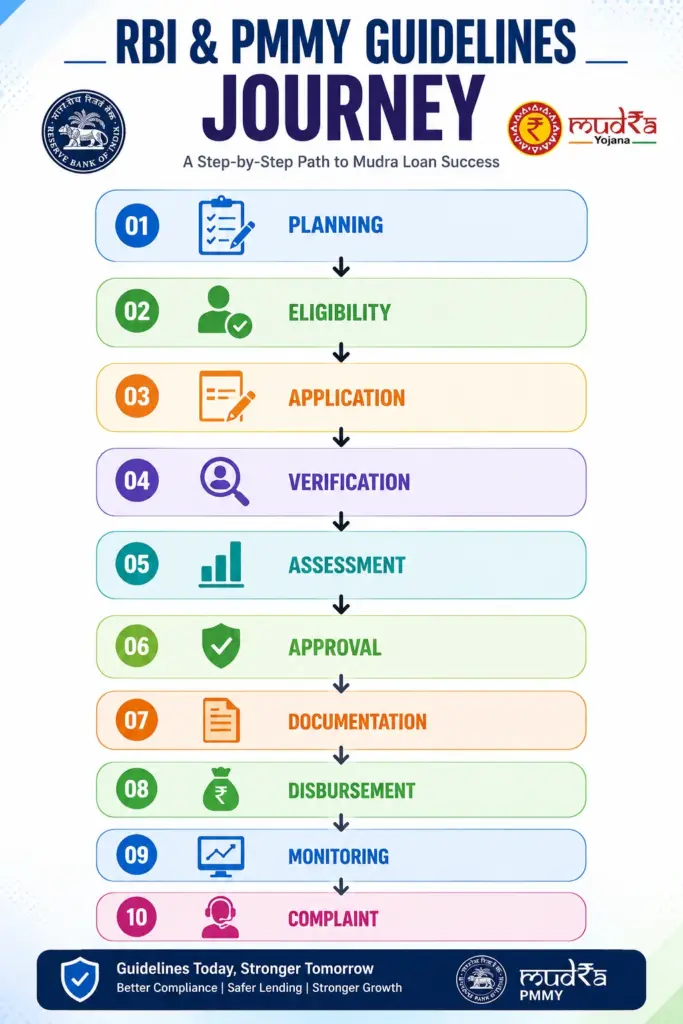
Understanding the complete RBI & PMMY Guidelines Journey helps applicants know what happens at every stage of the Mudra Loan process. From planning your business idea to loan disbursement and complaint resolution, each step has a specific purpose and requires proper preparation. The infographic below provides a simple visual overview of the complete journey, making it easier for entrepreneurs, MSMEs, startups, and existing businesses to understand how banks process Mudra Loan applications under the applicable RBI and PMMY framework.
The infographic below illustrates the complete RBI & PMMY Guidelines Journey in a simple step-by-step format.
Read According to Your Situation
Select the issue that best matches your situation to access the most relevant RBI and PMMY Guidelines for Mudra Loans.
I want to know whether collateral is compulsory
My bank is not following RBI Guidelines
Can banks ignore RBI Guidelines?
Are RBI Circulars legally binding?
What are the benefits for women entrepreneurs?
What is the complaint process?
What are the common Mudra Loan myths?
What are the bank's responsibilities?
Complete RBI & PMMY Guidelines Library
Explore detailed guides covering the RBI framework, bank compliance, applicant protection, collateral rules, complaint procedures, women entrepreneurs, and common Mudra Loan misconceptions.
Understanding the RBI & PMMY Framework
Mandatory RBI & PMMY Guidelines for Banks
This guide explains which RBI regulations and PMMY provisions banks are generally expected to follow while processing Mudra Loan applications. It helps applicants distinguish between mandatory regulatory requirements, scheme-related instructions, and a bank’s internal credit policy. Readers can understand the broader standards relating to fair processing, documentation, communication, collateral, assessment, and grievance handling. The article is useful for applicants who want to know whether a bank’s request or decision is based on an official guideline or an internal lending requirement.
Legal Status of RBI Circulars
RBI circulars, directions, master directions, and regulatory instructions may carry different levels of legal and operational importance. This guide explains how RBI instructions affect regulated banks and how borrowers should interpret them in the context of Mudra Loans. It also clarifies that an RBI circular does not automatically guarantee loan approval because banks must still assess eligibility, repayment capacity, business viability, documentation, and credit risk. The article helps readers understand when an RBI instruction can be relied upon and when professional clarification may be required.
Common Misinterpretations of RBI & PMMY Guidelines
Many Mudra Loan problems arise because applicants misunderstand RBI and PMMY guidelines. Some borrowers believe that every eligible applicant must receive a loan, that banks cannot request additional information, or that collateral-free automatically means risk-free approval. This guide explains such common misunderstandings in simple language. It separates regulatory expectations from practical lending decisions and shows why documentation, repayment capacity, business feasibility, credit history, and internal bank policies remain important. The article can help applicants avoid unrealistic expectations and prepare a more informed loan proposal.
RBI & PMMY Mudra Loan Myths
This guide addresses widespread myths about Mudra Loans and RBI guidelines. It examines beliefs such as guaranteed approval, compulsory sanction for every eligible business, complete prohibition on additional documents, and the assumption that collateral-free lending means no evaluation. Each myth is explained with a practical banking perspective so applicants can understand how lenders assess risk. The guide is especially helpful for first-time borrowers who may rely on incomplete information from social media, agents, or informal sources while preparing their Mudra Loan application.
Bank Compliance and Responsibilities
Bank Responsibilities Under RBI & PMMY Guidelines
Banks play a central role in accepting, verifying, assessing, sanctioning, rejecting, and disbursing Mudra Loans. This guide explains their responsibilities regarding transparent processing, proper communication, document verification, fair treatment, customer service, and grievance handling. It also explains the limits of these responsibilities because banks must protect depositors’ funds and conduct an independent credit appraisal. Applicants can use this guide to understand what they may reasonably expect from a branch and which matters remain subject to the bank’s lending judgment.
What Happens If a Bank Violates RBI or PMMY Guidelines?
This guide explains the steps an applicant may consider when a bank appears to disregard applicable RBI instructions or PMMY-related procedures. It covers the importance of collecting written evidence, approaching the branch manager, using the bank’s grievance system, escalating to the nodal officer, and exploring the RBI Integrated Ombudsman mechanism where applicable. It also highlights that disagreement with a credit decision does not automatically prove a regulatory violation. Applicants should first identify the exact instruction allegedly breached before filing a formal complaint.
Can Banks Ignore RBI & PMMY Guidelines?
Banks cannot casually disregard binding RBI directions or applicable scheme instructions. However, borrowers must understand the difference between a regulatory obligation and a bank’s independent commercial decision. This guide explains situations where banks must comply with regulatory standards and situations where they retain discretion, such as evaluating business viability, repayment capacity, credit history, cash flow, and internal risk limits. It helps applicants identify whether their concern involves non-compliance, poor service, insufficient communication, or a genuine credit-based rejection.
Mudra Loan Applicant Protection
Collateral Rules Under Mudra Loan
Mudra Loans are commonly associated with collateral-free lending, but applicants often misunderstand what this means in practice. This guide explains the difference between primary security, collateral security, personal guarantees, hypothecation of business assets, and applicable credit guarantee arrangements. It also discusses situations where applicants may be incorrectly asked for additional security and how they can seek written clarification. The guide helps borrowers ask the right questions without assuming that every form of security or documentation is prohibited under the scheme.
RBI & PMMY Complaint Guidelines
Applicants should follow a structured grievance process when facing unreasonable delays, unexplained charges, non-communication, improper conduct, or suspected non-compliance. This guide explains how to prepare a complaint, what evidence to attach, and how to escalate the matter from the branch to the bank’s grievance authority. It also discusses the possible role of the RBI Integrated Ombudsman Scheme. The article helps applicants avoid vague allegations and instead present a clear, fact-based complaint supported by dates, acknowledgements, emails, and relevant documents.
RBI & PMMY Guidelines for Women Entrepreneurs
Women entrepreneurs can use Mudra Loans for eligible micro-enterprise activities, subject to normal lending assessment. This guide explains the scheme framework, application preparation, documentation, business ownership, financial projections, and common issues faced by women-led enterprises. It also clarifies that promotional preference or policy encouragement does not guarantee approval. A strong application should demonstrate genuine ownership, business feasibility, repayment ability, and proper use of funds. The article is useful for women starting a new venture or expanding an existing business.
Quick Comparison Tables
Use these tables to quickly understand the difference between RBI and PMMY guidelines, applicant rights, bank responsibilities, collateral rules, complaint levels, and important types of regulatory instructions.
1. Mandatory vs Advisory Guidelines
| Basis | Mandatory Guidelines | Advisory Guidelines |
|---|---|---|
| Meaning | Instructions that regulated banks are expected to comply with where applicable. | Recommendations or good-practice guidance intended to improve implementation. |
| Compliance | Non-compliance may result in regulatory, supervisory, or grievance-related consequences. | Banks may adapt the guidance according to their systems, risk policies, and operational requirements. |
| Examples | Binding RBI directions, KYC requirements, fair-practice obligations, and applicable grievance rules. | Suggested timelines, awareness measures, customer-service improvements, and implementation guidance. |
| Effect on Approval | Compliance is necessary, but it does not guarantee loan approval. | Advisory guidance does not create an automatic right to sanction. |
Read more: Mandatory RBI & PMMY Guidelines for Banks
2. Applicant Rights vs Bank Responsibilities
| Area | Applicant Rights | Bank Responsibilities |
|---|---|---|
| Application | To submit an application and receive proper acknowledgement where applicable. | To receive, record, and process the application according to applicable procedures. |
| Information | To receive clear information about documents, charges, and important loan conditions. | To communicate material requirements and terms transparently. |
| Fair Treatment | To receive fair and non-discriminatory treatment. | To assess applications objectively and consistently. |
| Privacy | To expect reasonable protection of personal and financial information. | To handle customer data under applicable privacy, confidentiality, and KYC requirements. |
| Decision | To receive appropriate communication regarding the application outcome. | To approve or reject the proposal after proper credit assessment. |
| Complaint | To raise a grievance against service deficiencies or suspected non-compliance. | To provide an accessible grievance-redressal mechanism. |
Read more: Bank Responsibilities Under RBI & PMMY Guidelines
3. RBI vs PMMY
| Basis | RBI | PMMY |
|---|---|---|
| Full Form | Reserve Bank of India | Pradhan Mantri Mudra Yojana |
| Primary Role | Regulates and supervises banks and other regulated financial institutions. | Provides the broad scheme framework for eligible micro-enterprise lending. |
| Main Focus | Banking regulation, customer protection, KYC, fair practices, and financial stability. | Access to institutional finance for eligible micro and small business activities. |
| Loan Sanction | RBI does not directly sanction individual Mudra Loans. | PMMY provides the scheme structure but does not itself guarantee approval. |
| Actual Decision-Maker | The lending bank applies RBI rules while conducting its assessment. | The participating lending institution assesses and decides the application. |
4. Mudra Loan Complaint Levels
| Level | Where to Complain | Suitable Issues | Recommended Evidence |
|---|---|---|---|
| Level 1 | Branch Manager | Delay, missing acknowledgement, unclear document requests, or communication problems. | Application copy, acknowledgement, emails, messages, and document list. |
| Level 2 | Bank Grievance Cell or Regional Office | No response from branch, repeated delay, service deficiency, or unresolved conduct issues. | Copy of branch complaint, complaint number, dates, and supporting documents. |
| Level 3 | Principal Nodal Officer | Serious or unresolved grievances after internal escalation. | Full complaint history and proof of prior escalation. |
| Level 4 | RBI Integrated Ombudsman, where applicable | Eligible complaints involving deficiency in banking service after following the bank’s grievance process. | Bank’s final response or proof that the prescribed response period has expired. |
| Level 5 | Other legal or regulatory remedy | Matters outside the Ombudsman’s scope or requiring legal adjudication. | Complete documentary record and professional legal advice. |
5. Collateral Rules
| Type of Security | Meaning | Typical Position | Applicant Action |
|---|---|---|---|
| Primary Security | Assets purchased or created using the loan amount. | The bank may create a charge or hypothecation over financed assets. | Check the sanction terms and asset details carefully. |
| Collateral Security | Additional property or asset offered beyond the financed business assets. | Mudra Loans are generally promoted as collateral-free, subject to applicable scheme and bank rules. | Ask the bank to clarify the legal and policy basis for any collateral demand. |
| Personal Guarantee | A personal undertaking by the borrower or another permitted person. | Treatment may depend on the borrower’s constitution, facility type, and bank policy. | Review the guarantee clause before signing. |
| Credit Guarantee Cover | A guarantee mechanism that may reduce the lender’s credit risk. | Availability depends on eligibility and the applicable guarantee framework. | Do not assume coverage automatically; seek clarification from the bank. |
| Co-applicant or Guarantor | Another person added to strengthen repayment support or documentation. | May depend on constitution, risk profile, ownership, and internal credit policy. | Ask whether the requirement is mandatory under policy or case-specific. |
Read more: Collateral Rules Under Mudra Loan
6. Important Types of RBI Circulars and Instructions
| Instruction Type | Purpose | Typical Importance | Applicant Use |
|---|---|---|---|
| Master Directions | Consolidate binding regulatory instructions on a particular subject. | High regulatory importance for institutions covered by the direction. | Useful for understanding applicable banking obligations. |
| Master Circulars | Bring together important instructions issued on a subject. | Important reference, subject to later amendments or replacement. | Check the latest version and applicable date. |
| Circulars | Communicate specific regulatory changes, clarifications, or instructions. | Depends on wording, scope, issuing authority, and applicability. | Identify whether the circular applies to the concerned lender and issue. |
| Notifications | Formally notify rules, amendments, or regulatory provisions. | May have statutory or formal regulatory significance. | Useful where legal applicability is disputed. |
| FAQs and Clarifications | Explain how existing instructions should be understood or implemented. | Interpretative support rather than a substitute for the original rule. | Helpful for resolving common misunderstandings. |
| Press Releases or Public Statements | Inform the public about policy decisions, developments, or regulatory actions. | Informative, but the underlying direction or notification should be checked. | Use as background information, not as the only legal basis. |
Read more: Are RBI Circulars Legally Binding for Mudra Loans?
How to Verify Whether Your Bank Is Following RBI & PMMY Guidelines
Use this checklist to review whether your Mudra Loan application is being handled transparently, fairly, and through a proper banking process. One missing item does not always prove a violation, but repeated gaps may justify written clarification or a formal complaint.
Acknowledgement Received
You have received an application number, receipt, email, SMS, or another record confirming submission.
Documents Accepted and Recorded
The bank has accepted your documents or clearly informed you about missing, expired, or additional requirements.
No Unnecessary Collateral Demand
Any request for property, guarantee, or additional security has been properly explained and supported by applicable policy.
Proper Communication
The branch provides clear information about pending documents, verification, assessment, and the current application stage.
Transparent Charges
Processing fees, documentation costs, insurance charges, and other expenses are disclosed before collection.
Fair Processing
Your application is assessed on eligibility, business viability, repayment capacity, documentation, and credit risk.
Complaint Channel Available
The bank provides details of its grievance cell, regional authority, nodal officer, or other escalation channel.
Timely Updates
You receive reasonable updates when the application is pending due to verification, clarification, or internal assessment.
Proper Documentation
Important requests, declarations, sanction conditions, charges, and borrower obligations are documented properly.
Written Decision
The sanction, rejection, return, or closure of the application is appropriately communicated and recorded.
How to Read Your Checklist Result
Related RBI & PMMY Compliance Guides
What to Do If RBI & PMMY Guidelines Are Not Followed
If you believe that your bank has not followed an applicable RBI direction, PMMY guideline, or proper banking procedure, raise the issue step by step. Start at the branch level and move to the next authority only when your complaint remains unresolved or you do not receive an appropriate response.
Identify the Problem
Clearly identify the delay, improper collateral demand, unexplained charge, communication failure, documentation dispute, or suspected guideline violation.
Approach the Concerned Branch Officer
Ask the officer handling your Mudra Loan application for clarification. Record the date of discussion and request the pending requirements or reasons in writing.
Submit a Written Complaint to the Branch Manager
If the officer does not resolve the issue, submit a dated written complaint to the Branch Manager and obtain an acknowledgement or complaint reference number.
Escalate the Matter to the Regional Office
Send the complaint to the bank’s Regional Office when the branch does not respond, provides an incomplete response, or fails to resolve the issue.
Approach the Bank’s Grievance Cell
File a formal complaint through the bank’s grievance portal, customer care system, nodal officer, or Principal Nodal Officer, as applicable.
File a Complaint Under the RBI Ombudsman Framework
Where the complaint is eligible, approach the RBI Integrated Ombudsman after first complaining to the bank and completing the required internal grievance process.
Consider an Appropriate Legal Remedy
Where the matter is outside the Ombudsman’s scope or remains unresolved, obtain professional advice regarding the appropriate consumer, civil, regulatory, or other legal remedy.
Keep These Documents Ready Before Escalation
Related Complaint and Compliance Guides
Practical Guidance from CA Manish Gugliya
Understanding RBI and PMMY Guidelines is important, but successful Mudra Loan processing also depends on practical preparation, proper documentation, realistic financial planning, and disciplined communication with the bank. The following recommendations can help applicants protect their rights while presenting a stronger and more credible loan proposal.
Advice Based on Practical Banking Experience
According to CA Manish Gugliya, applicants should not treat RBI or PMMY Guidelines as a shortcut to approval. These guidelines establish a regulatory and scheme framework, while the bank must still examine the applicant’s business, repayment capacity, documents, credit conduct, proposed use of funds, and overall risk. A well-prepared application usually produces better results than an application based only on arguments about eligibility or applicant rights.
Understand That Eligibility Is Not Approval
Meeting the basic PMMY eligibility conditions allows you to apply, but it does not compel the bank to sanction the loan. The lender will separately examine your business viability, repayment ability, banking conduct, credit history, experience, and proposed use of funds. Prepare the proposal to satisfy the bank’s credit assessment rather than relying only on scheme eligibility.
Submit a Complete Application in One Set
Arrange the application form, KYC records, business proof, bank statements, quotations, licences, registrations, financial information, and project report in a logical order. A complete file reduces repeated document requests and makes verification easier. Keep an identical copy of everything submitted so that you can respond accurately during follow-up.
Always Obtain an Acknowledgement
Request an application receipt, reference number, email confirmation, system-generated acknowledgement, or stamped copy. RBI guidance for MSME lending has emphasised acknowledgement of loan applications by banks. An acknowledgement helps establish the submission date and creates a reliable record for future follow-up or grievance escalation. :contentReference[oaicite:0]{index=0}
Keep Financial Projections Realistic
Avoid exaggerated sales, profit, or cash-flow estimates merely to justify a higher loan amount. The projections should be supported by market conditions, production capacity, expected expenses, working-capital requirements, and reasonable repayment assumptions. Unrealistic figures can weaken the credibility of the entire proposal and raise concerns during credit appraisal.
Clearly Explain the Use of Loan Funds
State exactly how much is required for machinery, equipment, stock, renovation, working capital, or other eligible business purposes. The amount requested should match quotations, project costs, and expected business needs. Vague descriptions such as “business expansion” without a cost breakdown may lead to additional questions or a lower sanctioned amount.
Ask for the Basis of Any Collateral Demand
MUDRA states that loans under PMMY are collateral-free under the applicable framework. However, applicants should distinguish collateral security from a charge over assets financed through the loan. When a branch asks for property or additional security, request a written explanation of whether the demand relates to scheme rules, loan structure, or internal policy. :contentReference[oaicite:1]{index=1}
Communicate in Writing Wherever Possible
Important document requests, clarifications, follow-ups, and complaints should be recorded through email, letters, the bank’s portal, or acknowledged submissions. Verbal discussions are useful, but they are difficult to prove later. Written communication reduces misunderstandings and helps both the applicant and the bank maintain a clear processing history.
Disclose Existing Liabilities Honestly
Do not hide existing loans, overdue accounts, guarantees, credit-card obligations, business liabilities, or earlier loan applications. Banks can verify many of these details through credit reports and account statements. A transparent explanation of an old issue is generally more credible than a mismatch discovered during verification.
Maintain Clean Banking Conduct
Avoid frequent cheque returns, unexplained cash deposits, irregular transfers, persistent low balances, overdue instalments, and transactions inconsistent with your declared business. Banks often review account conduct to understand financial discipline. A stable and explainable banking pattern supports the reliability of your repayment projections.
Prepare for Business Verification
Ensure that the business address, activity, machinery, stock, employees, licences, invoices, and projected operations are consistent with the application. For a new business, be ready to explain the proposed location, supplier arrangements, customer demand, implementation plan, and your relevant experience. Inconsistencies discovered during inspection may delay or weaken the proposal.
Do Not Pay Unauthorised Agents
Avoid anyone promising guaranteed approval, special access to bank officials, or sanction without proper assessment. Pay only disclosed and authorised charges through traceable banking channels and obtain receipts. Professional assistance may help with documentation or project-report preparation, but no consultant can lawfully guarantee a bank’s credit decision.
Review All Charges Before Signing
Ask for details of the interest rate, processing fee, documentation expenses, insurance premium, guarantee-related charges, penal charges, and other costs. Read the sanction letter carefully and compare it with what was verbally discussed. Never sign blank forms, incomplete declarations, or documents you do not understand.
Ask for a Copy of Executed Loan Documents
After sanction and documentation, keep copies of the sanction letter, loan agreement, repayment schedule, security documents, insurance records, and important declarations. RBI’s fair-practice guidance has stated that borrowers should be furnished a copy of the loan agreement together with the enclosures referred to in it. :contentReference[oaicite:2]{index=2}
Escalate Complaints in the Correct Order
Begin with the concerned officer and Branch Manager, followed by the bank’s grievance authority or nodal officer. The RBI Ombudsman route generally becomes available when the regulated entity rejects the complaint, provides an unsatisfactory response, or does not reply within 30 days, subject to the complaint’s eligibility. :contentReference[oaicite:3]{index=3}
Separate Service Complaints from Credit Decisions
A complaint may be justified where there is unreasonable delay, improper conduct, undisclosed charges, missing communication, or failure to follow an applicable process. However, a genuine commercial decision based on weak repayment capacity, unsuitable loan structure, poor credit history, or an unviable proposal is different. Identify the exact nature of the problem before alleging a guideline violation.
The Most Important Practical Principle
Do not approach the Mudra Loan process as a dispute between the applicant and the bank. Approach it as a credit proposal that must be supported with evidence. Know your rights, but also demonstrate your responsibilities through truthful disclosures, complete documentation, realistic projections, proper banking conduct, and timely responses. This balanced approach is more effective than relying only on complaints, circulars, or verbal assurances.
Recommended Guides for Further Reading
Frequently Asked Questions
Find clear answers to frequently asked questions about RBI and PMMY Guidelines, Mudra Loan processing, bank responsibilities, collateral rules, complaints and applicant rights.
01 What are RBI & PMMY Guidelines for Mudra Loans?
RBI Guidelines regulate how banks should conduct lending activities, while PMMY (Pradhan Mantri Mudra Yojana) Guidelines define the operational framework of Mudra Loans. Together, they help ensure transparent and fair loan processing.
02 Are RBI Guidelines mandatory for all banks offering Mudra Loans?
Banks are expected to comply with applicable RBI regulations and PMMY operational guidelines. However, every loan application is still subject to the bank's independent credit appraisal and internal lending policy.
03 Do RBI Guidelines guarantee Mudra Loan approval?
No. RBI Guidelines promote fair and transparent processing but do not guarantee loan sanction. Approval depends on eligibility, business viability, repayment capacity, documentation and the bank's credit assessment.
04 Are Mudra Loans always collateral-free?
Under the PMMY framework, Mudra Loans are generally collateral-free. However, applicants should understand the difference between collateral security, primary security and other documentation requirements.
05 Can a bank reject a Mudra Loan application?
Yes. A bank may reject an application if it finds issues relating to creditworthiness, business viability, documentation, repayment capacity or other legitimate lending considerations.
06 Can a bank ask for additional documents?
Yes. If additional documents are reasonably required for verification, regulatory compliance or credit assessment, the bank may request them.
07 Is the bank required to acknowledge my Mudra Loan application?
Banks are generally expected to provide an acknowledgement or application reference so that applicants can track the processing of their application.
08 How long does Mudra Loan processing usually take?
There is no single RBI timeline applicable to every case. Processing time depends on documentation, verification, business type, loan amount and the bank's internal procedures.
09 Can a bank charge processing fees on Mudra Loans?
Applicable charges depend on the loan category, bank policy and prevailing RBI or PMMY instructions. Applicants should request a clear written explanation of all charges before accepting the loan.
10 What should I do if the bank does not respond?
First contact the concerned branch and Branch Manager. You may then approach the Regional Office or use the bank's official grievance mechanism before considering escalation to the RBI Integrated Ombudsman, where applicable.
11 Can I complain directly to the RBI?
Generally, applicants should first complete the bank's internal grievance process before approaching the RBI Integrated Ombudsman, subject to the eligibility and maintainability of the complaint.
12 Can RBI force a bank to approve my Mudra Loan?
No. RBI regulates banking practices but does not normally direct a bank to sanction an individual commercial loan. The lending decision remains subject to the bank's credit assessment.
13 Are RBI Circulars legally binding?
Many RBI circulars issued under statutory or regulatory powers are binding on regulated entities. Their precise applicability depends on the subject, wording and scope of the particular circular.
14 Can banks ignore PMMY Guidelines?
Banks are expected to follow applicable PMMY operational guidelines while continuing to exercise independent credit judgment during loan appraisal.
15 What if a bank asks for collateral under a Mudra Loan?
Ask the bank for a written explanation and clarify whether the requirement relates to collateral security, primary security, hypothecation of financed assets or another part of the lending arrangement.
16 Are women entrepreneurs eligible for special consideration?
Women entrepreneurs may apply under PMMY like other eligible applicants. Some banks or institutions may also offer promotional schemes, concessions or support programmes for eligible women-owned businesses.
17 What documents are usually required for a Mudra Loan?
Typical documents include identity proof, address proof, business proof, quotations, bank statements, financial information and a project report. Requirements depend on the business, loan category and bank assessment.
18 What is the difference between RBI Guidelines and PMMY Guidelines?
RBI Guidelines regulate banking operations and lending conduct generally, whereas PMMY Guidelines relate more specifically to the implementation and operation of the Mudra Loan scheme.
19 Can I challenge an unfair loan processing decision?
If you believe that proper procedures were not followed, you may seek written clarification, submit a formal complaint and use the bank's grievance mechanism before exploring further remedies.
20 Where can I read the complete RBI & PMMY Guidelines library?
You can explore the complete collection of RBI and PMMY guideline articles, complaint procedures, collateral rules, applicant rights and bank responsibilities on ProjectReportBank .
Conclusion
Understanding the distinction between RBI Guidelines and PMMY Guidelines is essential for every Mudra Loan applicant. While the Reserve Bank of India (RBI) establishes the regulatory framework governing banks and lending practices, Pradhan Mantri Mudra Yojana (PMMY) provides the operational framework for implementing the Mudra Loan scheme. Banks are responsible for applying these guidelines while conducting their own independent credit appraisal and complying with applicable regulations.
For borrowers, awareness is just as important. Knowing your rights and responsibilities helps you prepare accurate documentation, communicate effectively with the bank, understand the loan process, and address concerns through the appropriate grievance channels when necessary. At the same time, applicants should remember that compliance with guidelines does not automatically guarantee loan approval, as each application is evaluated on its own merits.
This guide serves as the starting point for understanding RBI and PMMY Guidelines. If you need more detailed information on specific topics—such as collateral rules, bank responsibilities, applicant rights, complaint procedures, processing timelines, RBI circulars, or common misconceptions—explore the related articles throughout this cluster. Together, these guides provide a comprehensive knowledge base to help you navigate every stage of the Mudra Loan process with greater confidence and clarity.
-
RBI & PMMY Guidelines for Mudra Loans – Complete Guide to Bank Rules, Applicant Rights & Compliance
-
RBI & PMMY Guidelines for Women Entrepreneurs Applying for Mudra Loans
-
Common Misinterpretations of RBI & PMMY Guidelines That Lead to Mudra Loan Problems
-
What Happens If a Bank Violates RBI or PMMY Guidelines?
-
RBI & PMMY Guidelines on Mudra Loan Complaint and Grievance Redressal (2026)
-
RBI Guidelines for Mudra Loan Applicants: Documentation, Eligibility & Bank Duties
-
Are RBI Circulars Legally Binding for Mudra Loans? Complete Legal Guide for Borrowers
-
Mandatory RBI & PMMY Guidelines for Mudra Loans: Practical Compliance Guide for Applicants and Banks
-
Mudra Loan Collateral Rules: RBI & PMMY Guidelines (Practical Outline)
-
Can Banks Deviate from RBI & PMMY Guidelines for Mudra Loans?