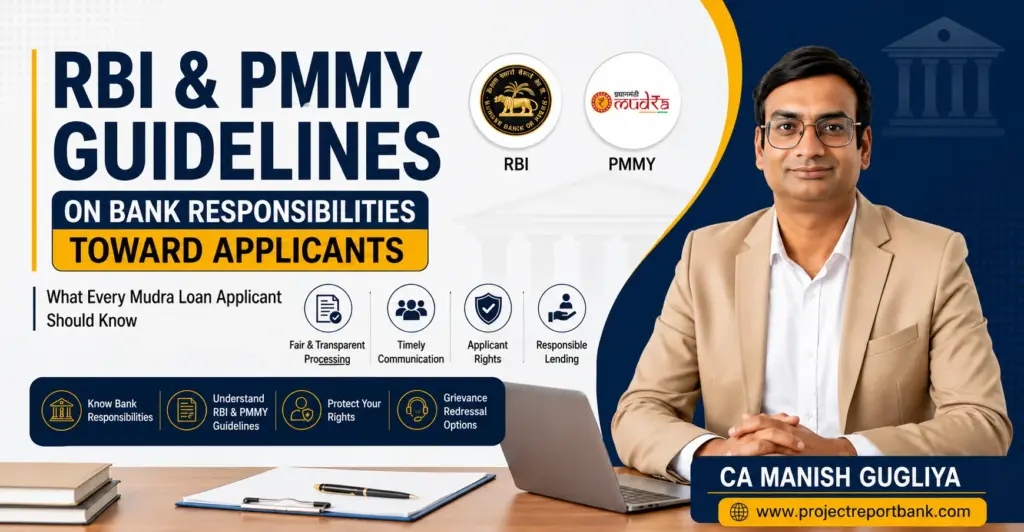
If you are planning to apply for a Mudra loan, knowing what banks owe you under RBI and PMMY rules is just as important as preparing your documents. This guide breaks down documentation, eligibility criteria, bank duties, and your rights as an applicant in plain, practical language.
Key Takeaways
- Mudra loans are collateral-free business loans upto rs 10 lakh under the Pradhan Mantri Mudra Yojana, available to non corporate, non-farm micro enterprises engaged in manufacturing, trading, or services.
- RBI regulates lending institutions and sets broad lending rules for mudra loans, requiring banks to treat every applicant fairly, acknowledge applications, and process them within a reasonable time.
- Applicants must provide standard KYC, business proof, and financial documents (like last 6 months’ bank statements), but banks cannot demand unlimited or irrelevant papers beyond RBI and PMMY norms.
- You have the right to know the applicable interest rate and charges, get reasons for rejection in writing, and escalate complaints through the bank or financial institution’s grievance system and the RBI Ombudsman.

Table of Contents
Overview of RBI Guidelines for Mudra Loan Applicants
RBI guidelines for mudra loan applicants refer to the combined framework of RBI Master Directions on customer service, the Fair Practices Code for lenders, and PMMY operational guidelines issued after the mudra scheme launched on April 8, 2015. Together, these rules tell banks how to receive, process, and decide on loan applications from small enterprises seeking financial assistance.
PMMY covers collateral-free funding for non-farm, non-corporate micro and small enterprises. MUDRA stands for Micro Units Development and Refinance Agency, and it acts as a refinance agency supporting commercial banks, small finance banks, NBFCs, and MFIs that lend under the scheme. Under these guidelines, banks must ensure transparency in the interest rate, avoid hidden charges, provide acknowledgement of applications, and give reasoned decisions whether they approve or reject.
RBI does not dictate every single document a bank can ask for. Instead, it sets broad standards around KYC, due diligence, and fair practices. Document preparation is essential for compliance with lender requirements for Mudra loans. This article covers:
- Documentation requirements and what banks can or cannot demand
- Eligibility criteria for individual borrowers and legal entity applicants
- Core bank responsibilities under RBI Fair Practices Code and PMMY
- Your rights and practical recourse if guidelines are ignored
Understanding Pradhan Mantri Mudra Yojana (PMMY) & Loan Categories
The Pradhan Mantri Mudra Yojana is a government of India scheme that provides loans up to ₹10 lakh for small enterprises through banks, NBFCs, and MFIs. Since launch, approximately 52.07 crore Mudra accounts have been sanctioned with total sanctions crossing ₹33.19 lakh crore.
The scheme supports eligible borrowers in non-farm income-generating activities including trading, manufacturing, services, food processing, transport, and allied sectors. Pure agriculture (crop cultivation) is excluded, but activities like dairy, poultry, and cold storage qualify. Loans are intended for income-generating activities in manufacturing, trading, or services. Every beneficiary micro unit must use the loan amount strictly for business purposes, whether working capital, purchasing capital assets, or shop setup.
Mudra loans are divided into four categories: Shishu, Kishor, Tarun, and Tarun Plus:
- Shishu loans offer up to ₹50,000 for startups and new entrepreneurs
- Kishore loans range from ₹50,000 to ₹5 lakh for the next phase of growth
- Tarun loans provide ₹5 lakh to ₹10 lakh for established businesses
- Tarun Plus loans range from ₹10 lakh to ₹20 lakh for those who have successfully repaid previous loans under Tarun
Collateral-free loans up to ₹20 lakh are available for micro and small enterprises through the Tarun Plus extension, though core PMMY coverage under government reporting is officially up to ₹10 lakh. The repayment period for Mudra term loans can extend up to 84 months. These are business loans, not personal loans. Misuse of funds can affect future eligibility and your credit relationship with the bank.
Eligibility Criteria for Mudra Loan Applicants
RBI provides broad eligibility norms around KYC, customer due diligence, and credit discipline. PMMY operational guidelines then define who can apply. The eligibility criteria are assessed based on business viability and repayment capacity, not personal bias.
Eligible profiles include:
- Shopkeepers, street vendors, and service providers
- Small manufacturers and repair shops
- Transport operators and food processing units
- Micro enterprises engaged in allied agricultural activities (cold storage, agri-logistics)
- Any other legal entity or enterprise in non-farm services
Agricultural income-generating businesses focused on crop cultivation are not eligible. Applicants must be aged between 18 to 65 years with Indian residency and valid KYC documents. Both new and existing micro units can apply. For existing businesses, banks typically look at 6–12 months of business continuity and bank statements to judge cash flow and repayment capacity.
Eligible applicants must not be defaulters to any bank or financial institution. A satisfactory credit track record helps, and banks check CIBIL or credit bureau history where available. However, RBI discourages mechanical rejection based solely on credit scores, especially for first-time entrepreneurs under financial inclusion goals. An applicant’s educational qualification or lack thereof should not be a barrier if the borrower demonstrates necessary skills and knowledge of the proposed activity.
While RBI does not fix a uniform minimum income level, banks use internal credit policies. Always ask your chosen branch clearly which specific criteria apply to your case.

Documents Required Under RBI & PMMY Norms
RBI’s KYC Master Direction and PMMY guidelines together drive the documentation list. Banks may add a few risk-based items but cannot ask for unlimited or irrelevant other documents.
Identity proof (any one): Aadhaar card, PAN card, Voter ID, Passport, or Driving License. You need a valid photo identity proof to apply.
Address proof (any one): A current address proof is required. This can be a recent utility bill, property tax receipt, or valid rent agreement. Ownership proof of residence or office may also be requested.
Business documents:
- Business registration certificate (GST, Shop & Establishment, Udyam Registration)
- Partnership deed or other legal entity proof
- Business licence or proof of business continuity (6–12 months where applicable)
Financial documents:
- A bank statement from the last six months is necessary
- Latest Income Tax Return serves as proof of income (especially for Kishore and Tarun categories)
- Simple projected income statement or business plan with cost estimates
- Quotations for machinery or capital assets being purchased
You must submit a loan application form with your documents. Applicants can submit a project report that outlines the income-generating activity for loan consideration.
For shishu loans, RBI discourages heavy documentation. Banks can rely on KYC, simple business proof, and local verification instead of full audited financials. If a bank asks for items like audited balance sheets for a ₹30,000 loan, you are within your rights to politely ask whether that requirement is standard under PMMY scheme guidelines.
RBI & PMMY Guidelines on Bank Responsibilities Toward Applicants
RBI issues a Fair Practices Code for lenders, customer service guidelines, and circulars covering loans under priority sector lending. All of these apply when a loan is extended under the mudra scheme. PMMY operational guidelines from the government and micro units development refinance agency (MUDRA Ltd) define additional process expectations.
Core bank responsibilities include:
- Accepting and acknowledging every complete application with a receipt or reference point number
- Providing standard application forms with clear details on processing charges
- Explaining eligibility criteria and required documentation upfront
- Charging a transparent interest rate and disclosing all fees before sanction
- Processing applications within a reasonable, communicated time
- Giving written reasons if the application is rejected
Interest rates for Mudra loans are determined by the internal guidelines of the lending institution, not fixed by RBI. However, RBI mandates that loans up to ₹10 lakh are collateral-free for micro-enterprises. No bank can demand collateral or a guarantor for covering loans within this limit.
Banks must not discriminate on grounds of gender, caste, religion, or region. They must protect applicant privacy. Staff cannot share your form details with outsiders. You can also apply online through the JanSamarth portal to access easy access digital processing. MUDRA loans are available from banks, NBFCs, and MFIs, and you need to submit a loan application form and identity proof to start the process.
Banks should display basic PMMY information, contact points, and grievance details in branches. You can request copies of relevant RBI and PMMY guidelines as a reference point for your own knowledge.
Interest Rate, Charges & Timely Processing Standards
RBI has deregulated interest rates on most advances, including Mudra loans. But each bank must adopt a transparent, board-approved interest rate policy, typically linked to EBLR or MCLR plus a spread based on risk grade and category.
- The interest rate is generally competitive compared to unsecured business loans because of credit guarantee support (like CGFMU) available to banks
- All processing charges, documentation charges, and fees must be disclosed upfront
- Many banks waive or cap processing fees for Shishu loans, and no subsidy on interest comes directly from RBI
- Assets created from the loan remain with the borrower as long as repayment is on track
For timely disposal, RBI customer service guidelines expect small loan applications to be processed within 7–15 working days depending on loan amount and completeness. Approval for MUDRA loans can take a few days if documents are complete. Note down your date of application, keep your acknowledgement slip, and follow up politely if the bank crosses its own timeline without communication.
Applicant Rights, Grievance Redressal & Practical Recourse
RBI guidelines for mudra loan applicants create clear rights: to information, to fairness, and to complaint escalation when banks ignore mandatory norms.
Your key rights:
- Right to submit an application and receive an acknowledgement slip or number
- Right to know the applicable interest rate and all charges before sanction
- Right to fair eligibility assessment without personal bias
- Right to written reasons for rejection
- Right to privacy of your personal and business details
Grievance redressal path:
- Speak with the Bank Branch Manager first
- Escalate to the bank’s regional or nodal officer for PMMY
- If no satisfactory reply within 30 days, file a complaint with the RBI Integrated Ombudsman (via CMS portal, email, or letter)
Keep copies of every form, acknowledgement, SMS, email, and written response from the bank. These records are critical when escalating. For deeper understanding, explore related guides on mandatory RBI and PMMY guidelines and applicant rights at banks.

Frequently Asked Questions (FAQ)
These FAQs address practical doubts not fully covered above.
Can a bank refuse to accept my Mudra loan application form?
Under RBI fair treatment norms and PMMY guidelines, branches are expected to accept and register all complete applications. Outright refusal without a valid, documented reason can be challenged through the bank’s internal grievance mechanism and, if needed, the RBI Ombudsman. Finance should never be denied arbitrarily to eligible entrepreneurs.
Are Mudra loan interest rates the same in every bank?
No. Rates vary because RBI has deregulated pricing. Each bank sets rates based on its own approved policy. However, every bank must disclose the effective annual rate and all charges upfront before you sign. Compare at least two or three lenders before you commit.
Does RBI fix a standard document list for Mudra loans?
RBI defines KYC and due diligence principles but not a single national checklist. PMMY and each bank’s internal credit policy determine the exact list. The list should remain simple and proportionate to the loan size. If you feel a bank is demanding proof beyond what is reasonable, ask for the specific guideline or circular that requires it.
What can I do if the bank delays my Mudra loan without giving any update?
First, send a written reminder to the branch. If there is no response, escalate to the regional office. If still unresolved after 30 days, file a complaint with the RBI Integrated Ombudsman, attaching your acknowledgement slip and timeline details. Availed or not, you deserve transparent communication.
Is there any subsidy or interest subvention directly from RBI on Mudra loans?
RBI does not provide direct subsidy on Mudra loans. Some government schemes or credit guarantee mechanisms (like CGFMU) support banks by reducing their risk, but the borrower pays normal interest as per sanction terms. Unless a specific linked subsidy scheme clearly applies to your case, do not expect a separate interest subvention.
- RBI & PMMY Guidelines for Mudra Loans – Complete Guide to Bank Rules, Applicant Rights & Compliance

- RBI & PMMY Guidelines for Women Entrepreneurs Applying for Mudra Loans

- Common Misinterpretations of RBI & PMMY Guidelines That Lead to Mudra Loan Problems
- What Happens If a Bank Violates RBI or PMMY Guidelines?
- RBI & PMMY Guidelines on Mudra Loan Complaint and Grievance Redressal (2026)

- RBI Guidelines for Mudra Loan Applicants: Documentation, Eligibility & Bank Duties


- Are RBI Circulars Legally Binding for Mudra Loans? Complete Legal Guide for Borrowers
- Mandatory RBI & PMMY Guidelines for Mudra Loans: Practical Compliance Guide for Applicants and Banks
- Mudra Loan Collateral Rules: RBI & PMMY Guidelines (Practical Outline)