Key Takeaways
- There is no separate mudra loan for women entrepreneurs. PMMY is gender-neutral, but the scheme strongly encourages lending to women-owned micro units, and many banks offer internal concessions.
- RBI does not provide direct subsidy or guarantee lower interest rates for women. It issues broad prudential and customer-protection rules that all financial institutions must follow.
- Women applicants must meet standard eligibility criteria, submit complete documents required by the bank, and present a realistic business plan or project report.
- Collateral-free credit is available up to Rs. 10 lakh under Mudra, backed by the Credit Guarantee Fund for Micro Units (CGFMU).
- This article is written from the perspective and practical experience of CA Manish Gugliya (FCA), focusing on real bank-level processes and applicant rights.
Introduction: Why Mudra Loan Matters for Women Entrepreneurs
India is home to over 8 million women entrepreneurs, and women-led MSMEs account for approximately 20% of all MSMEs in the country. Women-led businesses contribute significantly to India’s GDP, yet access to formal credit has historically remained a challenge. This is where the Pradhan Mantri Mudra Yojana (PMMY) steps in as a game-changer for financial inclusion.
Over 6.48 crore mudra loans have been disbursed in India to date, with cumulative sanctions exceeding ₹33 lakh crore in collateral-free lending. Remarkably, around 68% of all beneficiaries have been women. These numbers show how central women are to the mudra scheme’s mission.
In this article, I explain the RBI and PMMY guidelines specifically relevant to women applicants-covering eligibility criteria, rights, bank duties, and practical tips to improve approval chances. As on 2024–25, there is no separate RBI circular that gives automatic interest subsidy only for women under Mudra; most benefits come from the PMMY framework and each bank’s own credit policy. I am CA Manish Gugliya (FCA), with over 20 years of hands-on experience in MSME finance, CMA data preparation, and mudra loan project reports.

Table of Contents
Understanding PMMY & Mudra Loan Scheme for Women
Pradhan Mantri Mudra Yojana (PMMY) was launched in April 2015 by the Government of India to provide institutional credit to non corporate, non-farm micro enterprises. It operates through MUDRA (Micro Units Development and Refinance Agency), which acts as a refinance agency supporting lending institutions.
The mudra scheme categorizes loans into Shishu, Kishore, Tarun, and Tarun Plus based on the business stage and funding needs:
| Loan Category | Loan Amount Range |
|---|---|
| Shishu | Up to ₹50,000 |
| Kishor | ₹50,001 to ₹5,00,000 |
| Tarun | ₹5,00,001 to ₹10,00,000 |
| Tarun Plus | ₹10,00,001 to ₹20,00,000 |
Shishu loans offer up to Rs. 50,000 and suit budding entrepreneurs starting a home-based food processing unit or a small tailoring service. Kishor loans range from Rs. 50,001 to Rs. 5,00,000, fitting a growing beauty salon or trading shop. Tarun loans provide funding from Rs. 5,00,001 to Rs. 10,00,000 for established small enterprises. Tarun Plus loans extend from Rs. 10,00,001 to Rs. 20,00,000 for borrowers who have already repaid a Tarun loan. The Pradhan Mantri Mudra Yojana offers loans up to ₹20 lakh for micro-enterprises through this newest category.
Mudra loans support non-corporate small businesses across sectors. Women can apply for loans to support various sectors including manufacturing, trading, and services, as well as transport and allied agriculture activities like dairy or poultry. Direct crop farming is not covered.
Loan applications can be submitted through banks or NBFCs. Eligible lending institutions include public sector banks, private sector banks, regional rural banks, co operative banks, small finance banks, non banking financial companies, and microfinance institutions. Over 60–70% of PMMY accounts nationally are held by women borrowers, confirming how central they are to this scheme’s design.
While this article focuses on women entrepreneurs, the legal framework of PMMY is gender-neutral. Banks are encouraged, not compelled, to prioritise women-but the numbers speak for themselves.
Do RBI Guidelines Give Special Benefits to Women Under Mudra?
The Reserve Bank of India is the regulator of commercial banks, non banking financial companies, and other financial institutions. It is not a direct lender, subsidy provider, or project sanctioning authority under PMMY.
Here is what RBI actually does for mudra loans and MSME finance:
- Issues priority sector lending norms that classify MSME credit as a target category, incentivising banks to lend under Mudra
- Sets customer service guidelines, fair-practice codes, and KYC/AML rules applicable to every business loan
- Mandates that banks provide collateral-free loans up to ₹20 lakh for MSE units under its Master Direction on MSME lending
- Enforces grievance-redress mechanisms through the Banking Ombudsman scheme
There is no dedicated “RBI mudra loan for women” product. RBI does not mandate lower interest rates or guaranteed subsidy simply because the applicant is a woman. Any concessions women receive-slightly lower interest rates, relaxed margin, or reduced processing fees-arise from PMMY operational guidelines, individual bank policies, or state-level schemes. To understand how binding these regulatory directions are, you may find it useful to read about whether RBI circulars are legally binding for Mudra loans.
RBI’s real protection for women is indirect: enforcing non-discrimination, fair treatment, transparency of charges, and grievance-redress norms that apply equally to all borrowers.
PMMY Operational Rules & Eligibility Criteria for Women Applicants
In practice, a woman applying for a mudra loan must satisfy three layers: RBI guidelines, the PMMY operational framework, and the lending institution’s internal credit policy. Understanding all three matters.
Core eligibility criteria applicable to women:
- Indian citizen, typically aged 18–65 years
- Operating or planning a non-farm, income-generating activity
- Business constitution can be individual proprietorship, partnership firms, limited liability partnerships, or company-eligibility includes individuals, partnerships, and small businesses
- Maximum loan amount under standard Mudra is ₹10 lakh; mudra loans range from Rs. 50,000 to Rs. 10 lakh across three categories of shishu kishor and tarun
- Women must not have defaulted on any bank loans to be eligible for mudra loans
Ownership and control: For a business to qualify as women-led, banks generally expect the woman to hold majority shareholding, be named in registration or licence documents, and demonstrate capital contribution. Ownership proof such as registration certificates or partnership deeds is essential.
New vs. existing businesses: Aspiring entrepreneurs starting fresh face more scrutiny-banks may ask for detailed cash flow projections and viability assessment. For existing businesses, evaluation focuses on past turnover, profitability, and bank statements.
Documents required for Mudra loan application:
- Identity proof: aadhaar card, pan card
- Address proof: utility bills, voter ID, or passport
- Business registration, trade licence, or Udyam Registration
- Basic business plan or project report with cost estimates
- Quotations for machinery or equipment
- Last 6 months of bank statements
- ITRs (if applicable for existing businesses)
- Other documents as requested by the specific bank
Documents required include identity proof and a business plan at minimum. Before applying, women should self-check: Is the loan amount justified by actual business needs? Can monthly repayment be met from projected business cash flows?
For Kishor and Tarun loans, a professionally prepared project report with CMA data strengthens the loan application significantly and matches standard bank appraisal formats.

Key Features & Realistic Benefits of Mudra Loan for Women Entrepreneurs
PMMY and the mudra loan scheme do not promise universal subsidies to women. What they offer are concrete structural advantages that make formal financial support accessible to women-owned micro businesses.
Key features relevant to women:
- No collateral is needed for loans up to Rs. 10 lakh, backed by CGFMU guarantee where applicable
- Loan processing typically incurs no fees for shishu loans, making easy access possible for first-time borrowers
- Flexible repayment terms, usually up to 5 years depending on the loan category
- Working capital requirements can be met through Mudra card or CC/OD facility
- Interest rates are market-linked, determined by the lending institution-not fixed by RBI or PMMY
Women can access loans up to Rs. 10 lakh under the Mudra scheme, enabling easy eligibility for micro businesses across sectors. Mudra loans promote financial inclusion for women entrepreneurs by providing a pathway from informal borrowing to institutional credit, helping them build a formal credit history.
The broader economic development benefits are significant. Mudra loans help create job opportunities in local communities, support economic growth through micro enterprises, and promote gender equality in entrepreneurship. Women-led businesses contribute to financial stability at the household and community level.
For a deeper exploration of specific advantages, you can read about top benefits of Mudra loan for women entrepreneurs.
Any lower interest rates or extra relaxations depend on each bank’s internal policy or state-level women entrepreneurship schemes. Always confirm exact terms with your chosen bank branch before finalising.
Rights of Women Mudra Applicants & Responsibilities of Banks
RBI’s customer service guidelines and PMMY operational instructions together create a framework for fair treatment and transparency for women seeking financial assistance through a business loan under Mudra.
Key rights of women applicants:
- Right to submit a loan application and receive proper written acknowledgement
- Right to fair and non-discriminatory appraisal regardless of gender, caste, or religion
- Right to be clearly informed about interest rates, all charges, and repayment terms before sanction
- Right to privacy of personal and business information
- Right to know broad reasons for rejection-applicants can ask the branch to explain which eligibility criteria were not met. Read more on whether banks must explain Mudra loan rejection
Bank responsibilities:
- Follow mandatory RBI and PMMY guidelines in letter and spirit
- Avoid unnecessary delays in processing
- Ask only for relevant documents rather than excessive paperwork
- Not force cross-selling of insurance or bundled products as a condition for sanction-learn more about whether banks can force insurance with Mudra loan
- Charge only permitted processing fees
If a woman applicant faces unfair treatment, the grievance pathway is: branch manager → regional office or nodal officer → Banking Ombudsman under RBI’s Integrated Ombudsman Scheme. A woman applicant can insist on written acknowledgement and calmly but firmly track her application status.
Common Mistakes Women Entrepreneurs Should Avoid in Mudra Loan Application
Many otherwise viable women-run businesses get delayed or rejected because of avoidable errors in planning, documentation, or communication.
Planning and estimation mistakes:
- Applying without a basic business plan or even rough cost estimates
- Under-estimating or over-estimating the required loan amount relative to actual business needs
- Not understanding EMI burden and repayment capacity from projected business cash flows
- Mixing personal household expenses with projected business financials
Documentation errors:
- Incomplete KYC-mismatched names across aadhaar card, pan card, and bank account
- Missing trade licences, GST registration, or Udyam Registration where applicable
- Not updating address proof or other documents across records
Banking behaviour issues:
- Frequent cheque returns or bounces
- Cash-only dealings with no verifiable bank trail
- Multiple small loans already running without proper disclosure to the new bank
Misconception-based mistakes:
- Assuming the loan is guaranteed simply because it is a government scheme
- Expecting a grant or subsidy that does not actually exist for their category
- Believing that collateral can never be asked in any scenario (above ₹10 lakh, banks may ask)
For more clarity on widespread misconceptions, refer to common RBI & PMMY Mudra loan myths.
How Women Can Improve Their Mudra Loan Approval Chances
While final sanction rests with the bank, women can significantly improve their chances by proper preparation and disciplined financial behaviour.
Preparation steps:
- Draft a simple but realistic project report covering cost estimates, expected monthly sales, profit margins, and how the loan amount will be used
- Align the requested maximum loan with actual business aspirations and funding needs-do not inflate or deflate figures
- Prepare a clear repayment plan showing how business income will cover EMIs
Improving financial profile:
- Maintain a clean savings or current bank account with regular digital transactions
- Avoid cheque bounces and pay existing EMIs on time
- Check your basic credit score through free services before applying
Document readiness:
- Organise a complete set in advance: KYC, address proof, photographs, registrations, quotations, and bank statements
- For larger Kishor and Tarun loans, consider consulting a CA or finance professional for detailed CMA data, projected balance sheets, and DSCR analysis
After applying:
- Follow up politely with the bank and respond quickly to queries
- If rejected, request specific feedback on which criteria were not met, address the deficiencies, and re-apply-either at the same bank or a different one

Common Myths About Mudra Loan for Women Entrepreneurs
Several misconceptions prevent women from approaching banks confidently. Here is a fact-check:
| Myth | Reality |
|---|---|
| Mudra loan is a grant that never has to be repaid | Mudra loans are regular credit facilities with defined interest rates and repayment terms. Full repayment is required. |
| All women automatically get lower interest rates | Interest rates are set by each lending institution based on risk, amount, and policy-not mandated lower by RBI for women. |
| RBI directly approves Mudra loan applications | RBI is the regulator, not a lender. Banks, NBFCs, and MFIs sanction loans. |
| Collateral can never be asked under any Mudra loan | No collateral is needed up to ₹10 lakh. Above that (Tarun Plus), banks may ask depending on policy. |
| Once you apply, the bank is bound to sanction | Banks assess eligibility, creditworthiness, and project viability. Sanction is not automatic. |
| No documents are needed for shishu category loans | Even shishu loans require basic KYC and a simple business description. The following documents are always needed at minimum. |
| Mudra and Stand-Up India are the same scheme | These are different programmes with different eligibility criteria-Stand-Up India covers loans between ₹10 lakh and ₹1 crore for SC/ST/women entrepreneurs. |
Frequently Asked Questions (FAQs) on Mudra Loan for Women
These questions address practical issues from a first-time woman borrower’s perspective.
Is there any separate Mudra loan scheme only for women?
No. The mudra yojana is a single scheme under mantri mudra yojana PMMY applicable to all eligible micro units regardless of gender. However, PMMY guidelines encourage banks to prioritise women borrowers, and many banks offer internal concessions such as reduced processing fees or slightly lower margins for women-owned businesses.
Can a housewife with no prior business experience apply under PMMY?
Yes, provided she has a concrete business idea with a viable plan. Banks evaluate the business proposal, not the applicant’s employment history. A housewife planning to start a food processing unit or boutique can apply, but she must demonstrate how the business will generate enough income to repay the loan. A simple project report helps significantly.
If my Mudra loan was rejected once, can I try another bank?
Absolutely. Rejection by one bank does not bar you from applying elsewhere. Different banks and non banking financial companies have varying internal credit policies. Ask the rejecting bank for specific reasons, address those gaps, and approach another lending institution with a stronger application.
Can two women partners jointly take one Mudra loan for a single business?
Yes. Partnership firms and limited liability partnerships are eligible under PMMY. The loan application would be in the name of the firm, with both partners as co-borrowers. The bank will assess the combined creditworthiness and the project’s viability. Ensure the partnership deed clearly establishes ownership proof and roles.
Can I combine a Mudra loan with a state-level women entrepreneurship scheme?
In many cases, yes. Several state governments run interest subvention or grant programmes for women that can dovetail with Mudra credit. However, you cannot use two schemes to fund the exact same expenditure twice. Check with your bank branch and the relevant state agency to understand how schemes can complement each other for your economic empowerment.
Conclusion & Expert Note from CA Manish Gugliya
Mudra loan for women entrepreneurs is a powerful tool under PMMY for promote entrepreneurship and economic development at the grassroots level. But success depends on understanding RBI and PMMY rules, preparing a sound business plan, and asserting your rights with the bank.
RBI ensures fair banking practices across all financial institutions. PMMY focuses on financial inclusion and encourages lending to women-owned micro businesses. Individual banks ultimately decide sanction, interest rates, and loan amount based on their credit policy. Women should see Mudra not as a one-time subsidy, but as an entry gate into the formal credit system-helping them scale up over time to larger MSME finance options and fulfil their business aspirations.
Expert Note: In my 20+ years of working with small businesses and preparing project reports, I have seen that most genuine proposals from women entrepreneurs can be successfully funded when backed by proper documentation and realistic projections. The gap between a good idea and a bankable project is often just a well-prepared CMA statement and a clear cash flow plan. Do not hesitate to seek professional guidance-it can make the difference between rejection and sanction.
Disclaimer: RBI and PMMY guidelines, interest rate norms, and bank policies are updated periodically. Readers should verify the latest official circulars on financialservices.gov.in or consult their bank or financial advisor before making any financial decisions.
- RBI & PMMY Guidelines for Mudra Loans – Complete Guide to Bank Rules, Applicant Rights & Compliance


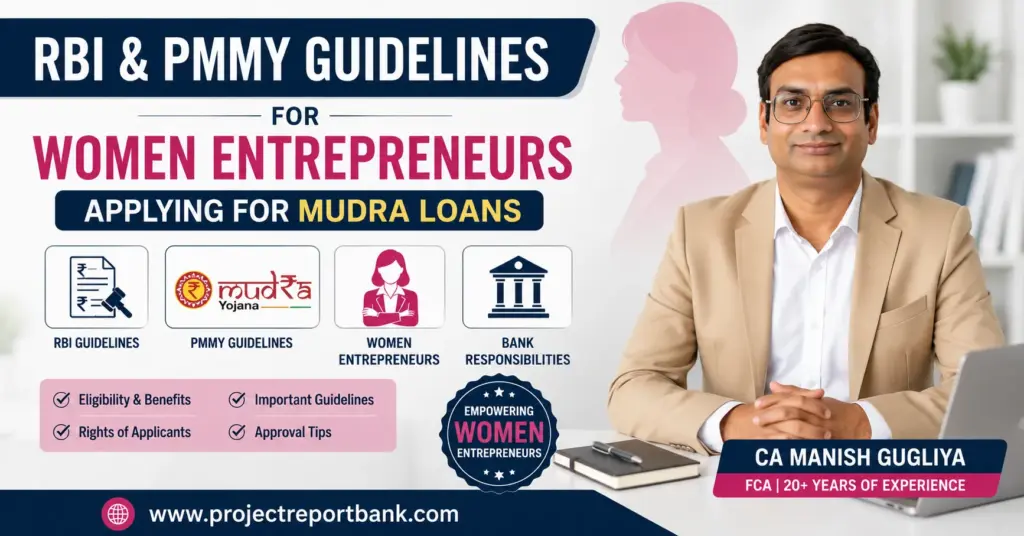
- RBI & PMMY Guidelines for Women Entrepreneurs Applying for Mudra Loans
- Common Misinterpretations of RBI & PMMY Guidelines That Lead to Mudra Loan Problems

- What Happens If a Bank Violates RBI or PMMY Guidelines?

- RBI & PMMY Guidelines on Mudra Loan Complaint and Grievance Redressal (2026)

- RBI Guidelines for Mudra Loan Applicants: Documentation, Eligibility & Bank Duties


- Are RBI Circulars Legally Binding for Mudra Loans? Complete Legal Guide for Borrowers
- Mandatory RBI & PMMY Guidelines for Mudra Loans: Practical Compliance Guide for Applicants and Banks

- Mudra Loan Collateral Rules: RBI & PMMY Guidelines (Practical Outline)