Key Takeaways
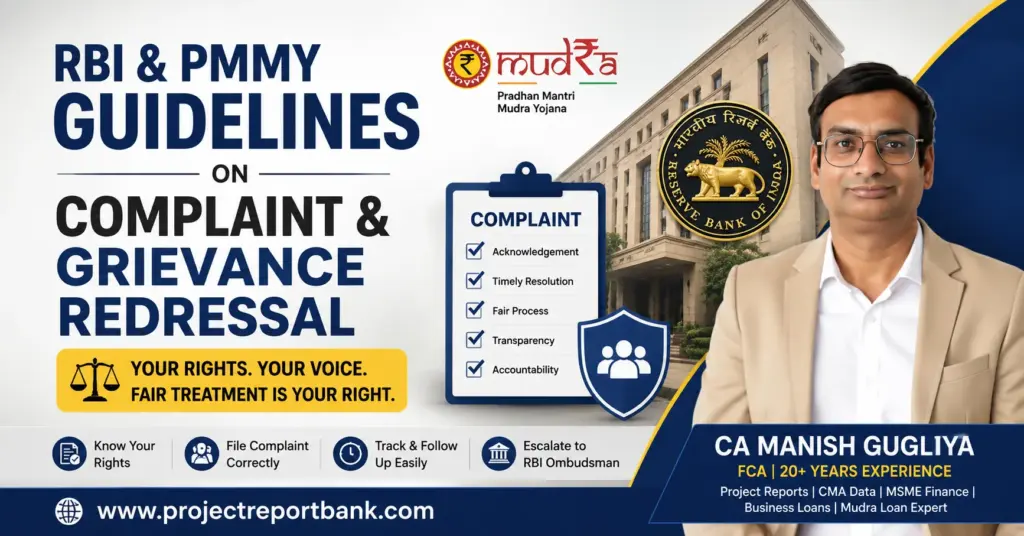
- Every mudra loan applicant has the right to file a written complaint at the bank branch where the application was submitted, and the bank must acknowledge it with a reference number and date.
- Guidelines for addressing complaints involve a multi-level approach: Branch Manager → Regional/Zonal Office → Nodal Officer → Principal Nodal Officer → RBI Integrated Ombudsman.
- Customers can appeal to the Reserve Bank of India Ombudsman if complaints are unresolved within 30 days from the date of the first written complaint.
- Written complaints supported by proper evidence – acknowledgement slips, SMS records, emails, rejection letters – are far stronger than verbal follow-ups and are essential for success at every escalation stage.
- This guide covers the complete step-by-step mudra loan complaint and grievance redressal guidelines, practical examples, common mistakes and expert tips from an MSME finance perspective.
Introduction: Why Mudra Loan Complaints Need a Clear Process
I am CA Manish Gugliya (FCA), and over the past 20+ years of working with MSME finance, project reports and mudra loan consultancy, I have seen hundreds of genuine entrepreneurs struggle – not because their business idea was weak, but because the bank simply did not respond, asked for irrelevant documents, or rejected their application without giving any written reason.
Pradhan Mantri Mudra Yojana (PMMY) was launched in April 2015 by the Government of India to support micro, small and non-farm income generation activities. The scheme covers three categories of mudra loans – Shishu (up to ₹50,000), Kishore (₹50,001 to ₹5,00,000) and Tarun (₹5,00,001 to ₹10,00,000). The maximum loan amount under PMMY is ₹10,00,000. These are collateral-free, low processing fee loans designed for street vendors, women entrepreneurs, startups and small enterprises across India.
Yet mudra loan grievances frequently include delays in processing applications and lack of transparency. RBI’s Master Circular on Customer Service in Banks (2015), updated through the January 27, 2021 circular on “Strengthening of Grievance Redress Mechanism in Banks”, together with PMMY guidelines, require every bank to maintain a proper grievance redressal mechanism.
This guide focuses specifically on mudra loan complaint and grievance redressal guidelines – not general business loans – with emphasis on practical bank-counter realities. It is tailored for first-time borrowers and links naturally to related ProjectReportBank resources on complaint timelines and escalation, evidence checklists and appeal letters in later sections.
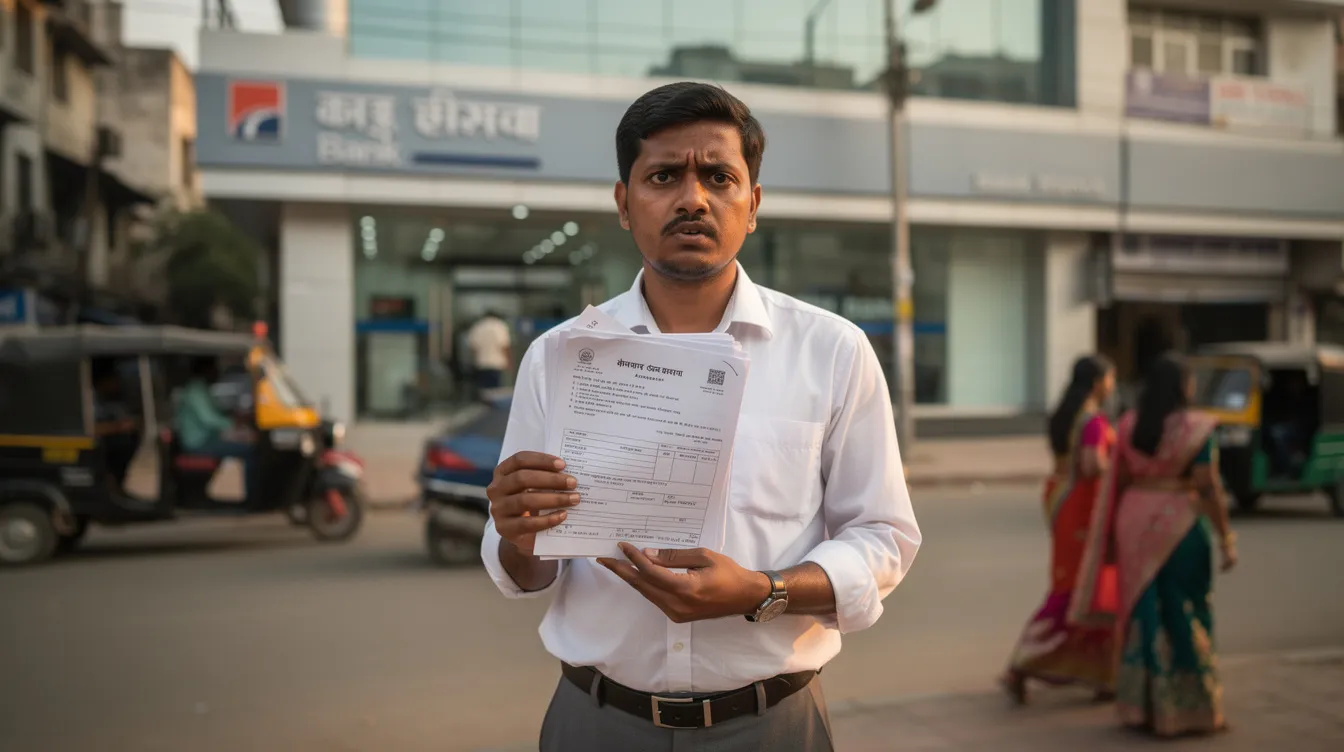
Table of Contents
Why Complaint & Grievance Redressal Matters Under PMMY
Since 2015, PMMY has aimed at financial inclusion by channelling credit to non-corporate, non-farm enterprises through member lending institutions – commercial banks, NBFCs and MFIs. Mudra operates as a refinancing agency and does not lend directly to borrowers, which means the complaint must go to the specific bank, NBFC or microfinance institution that processed the loan. A strong grievance mechanism ensures this chain actually works for the borrower.
- Financial inclusion: Without proper complaint handling, borrowers in rural and semi-urban areas can be effectively excluded from the mudra yojana even when they are eligible on paper.
- Customer protection: RBI and PMMY expect banks to protect small borrowers from unfair practices such as pressure-selling insurance, demanding collateral or security for Shishu and Kishore loans when not permitted, or asking irrelevant extra documents.
- Transparency: Clear reasons for delay or rejection, written communication of decisions and visibility of complaint contacts create trust and reduce confusion for every applicant.
- Fair treatment and non-discrimination: All eligible applicants – women entrepreneurs, SC/ST borrowers, first-generation entrepreneurs – must get equal opportunity. Discrimination based on gender, caste or location is a valid ground of complaint.
- Accountability: RBI’s 2021 circular links poor complaint handling to potential financial cost-recovery and supervisory action for banks, so handling mudra loan complaints is not optional for any bank anymore.
The sections below convert these principles into practical steps, tables and escalation paths that any borrower can follow.
RBI Guidelines on Customer Complaint Handling for Mudra Loans
RBI does not issue a separate grievance circular exclusively for mudra loans. However, its general customer services directions and grievance framework fully apply to PMMY and all mudra loan categories – Shishu, Kishore and Tarun.
Here is what RBI mandates and what it means for you:
- Complaint register at branch: Every branch must keep a physical or electronic complaint register and make complaint forms easily available at the counter. You can submit your mudra loan complaint in writing using a form or email.
- Acknowledgement: The bank must issue a written or electronic acknowledgement with date, complaint number and brief subject. Insist on this every single time. Some grievances can be resolved within three working days where the issue is straightforward, but you still need proof.
- Complaint tracking: You should receive a unique reference number. Many banks allow tracking through their website, SMS or email. Users can expect a response to their complaints promptly once registered.
- Time-bound resolution: Banks are expected to resolve most complaints within 30 days. After this period, you can escalate to the RBI Integrated Ombudsman portal if you are unsatisfied.
- Display of grievance contacts: Branches must prominently display details of the Branch Manager, Regional Office complaint cell, nodal officers, Principal Nodal Officer and the RBI Ombudsman on notice boards and on the bank’s website.
- Nodal Officer and Principal Nodal Officer: These officers supervise complaint resolution within the bank. If the branch and regional office fail to respond, you escalate to them. Contact details for grievance redressal are provided on the portal and the bank’s website.
- Website disclosures: Banks must publish grievance redressal policies, turnaround times, escalation matrix and Integrated Ombudsman information on their official website, which mudra loan borrowers can check before visiting.
These processes arise from the RBI Master Circular on Customer Service (2015) and the 2021 strengthening circular – together forming the legal backbone of complaint handling for every bank in India.
PMMY Expectations for Handling Borrower Complaints
PMMY, as the scheme behind mudra loans, expects banks and MFIs to treat applicants with fairness and dignity and to align their internal processes with RBI customer service standards. Complaints should be directed to the specific bank, NBFC, or microfinance institution that processed the loan.
- Fair treatment and equal opportunity: PMMY guidelines emphasise assessing each application on its merit and business viability – not on personal bias, caste, gender or location. Unfair treatment is a valid ground of complaint.
- Transparency in loan amount and categories: Banks should clearly inform applicants whether their case falls under Shishu, Kishore or Tarun and what documents are required for each category.
- Non-discrimination and inclusion: Women, minority and SC/ST borrowers should not be discouraged or delayed because they are first-time entrepreneurs. Employment creation and income generation are core purposes of the scheme.
- Proper communication: Banks should provide written sanction or rejection letters, clearly mention reasons, and maintain regular communication through SMS, calls or emails.
- No arbitrary rejection: Rejection must be based on objective criteria like repayment capacity, KYC issues or negative CIBIL records – not vague comments such as “policy doesn’t allow.” Borrowers have the right to request written reasons.
- Record keeping: PMMY expects banks to maintain proper records of applications, sanctions, rejections and complaints so that higher authorities and RBI can review them later.
For deeper understanding, you can explore guides on fair treatment in Mudra loan processing and Mudra loan applicant rights on ProjectReportBank.
Types of Mudra Loan Complaints (With Practical Examples)
Mudra loan complaints usually fall into common categories. The table below helps you quickly identify your issue and understand when it typically arises.
| Type of Mudra Loan Complaint | Typical Example / When It Happens |
|---|---|
| Processing delay | Shishu loan pending for more than 15–30 working days without any update despite repeated follow-ups |
| Rejection without reason | Application under PMMY marked “rejected” but no written explanation provided by the branch |
| Demand for extra documents | Bank insisting on documents not normally required (like property papers for a purely unsecured Shishu loan) |
| Illegal collateral or guarantee demand | Branch asking for collateral for loans up to ₹10 lakh where PMMY norms prohibit it |
| Pressure to buy insurance | Bank linking mudra loan sanctioning to compulsory purchase of life insurance or mutual funds |
| Staff misbehaviour | Disrespectful language, insults or harassment during branch visits |
| No acknowledgement or tracking number | Branch refusing to accept written complaint or not providing a reference number |
| Wrong information about PMMY | Staff telling applicants that “Mudra Yojana is closed” or “only existing customers can apply” |
| Problems after disbursement | Excess deduction of charges, wrong EMI schedule, or non-issuance of repayment schedule |
For related guides, see ProjectReportBank’s resources on complaint evidence and documents and claiming compensation for processing delay.

Step-by-Step Mudra Loan Complaint Process (From Branch to RBI Ombudsman)
The standard grievance process includes contacting the lending institution first, then escalating within the bank, and finally approaching the RBI Ombudsman if needed. Following this structured ladder with documents at each stage gives far better results than jumping directly to RBI.
Step 1: Raise Written Complaint at Branch Level
Submit a written complaint addressed to the Branch Manager of the bank where the mudra loan was applied. Clearly mention your name, loan application number, loan amount requested, date of application and the exact issue. Borrowers should clearly state the issue and resolution sought in their complaints.
Obtain a stamped acknowledgement or written receipt with a complaint number. Preserve copies of everything. You can also refer to ProjectReportBank’s Mudra loan complaint appeal letter template for guidance.
Step 2: Escalate to Regional Office / Zonal Office
If the branch does not respond within 7–10 working days for acknowledgement or 30 days for resolution, write to the bank’s regional or zonal office grievance cell with copies of all earlier communication. Customers can escalate grievances to the Regional/Zonal Manager if issues are not resolved at the branch level. Contact details are usually available on the bank’s website and branch notice boards.
Step 3: Approach the Bank’s Nodal Officer
RBI requires every bank to appoint a Nodal Officer for customer complaints. If a complaint is not resolved satisfactorily, it should be escalated to the bank’s Grievance Redressal Officer. Find their email or postal address from the bank’s website and include a chronology of events, copies of earlier replies, and the specific relief you are seeking.
Step 4: Write to the Principal Nodal Officer (PNO)
The Principal Nodal Officer is the highest internal authority for grievance redressal before approaching RBI. Your complaint to PNO should be detailed but polite, with clear evidence and timelines. Normally, give the bank up to 30 days in total from the first complaint before moving to RBI, unless there is extremely serious misconduct.
Step 5: File Complaint Under RBI Integrated Ombudsman Scheme
Mudra loan grievances can be registered online or through email via RBI’s Complaint Management System. Once the bank has either rejected your complaint, given an unsatisfactory reply, or failed to respond within 30 days, you can file a complaint through the RBI portal. The Ombudsman process is free of cost and can be filed online, by email or by post. Upload copies of all communications with the bank.
Complaints can also be registered through the Government’s Public Grievance Portal where applicable.
Practical tip: Maintain a separate file or digital folder of every SMS, email, letter and acknowledgement from day one. This makes every escalation stage – especially the Ombudsman stage – significantly stronger.
Documents Required While Filing a Mudra Loan Complaint
Strong documentary evidence often decides whether a complaint succeeds or fails, particularly at higher levels like the Principal Nodal Officer or RBI Ombudsman. Borrowers should maintain documentation and keep records of their applications and communications.
Here is your checklist:
- Copy of original mudra loan application form or online application reference number, indicating category (Shishu, Kishore or Tarun) and the loan amount requested
- Acknowledgement slip or receipt issued by the bank at the time of submission and at the time of each complaint, showing date and seal
- All written communication from the bank – sanction letters, rejection letters, queries for additional information, emails, SMS alerts
- Copies of KYC documents, project report, quotations, bank statements and any other business documents submitted to support the request
- Screenshots or printouts of WhatsApp messages, emails or online tracking pages showing follow-ups, commitments or misleading information from branch officials
- Any audio or written records of misbehaviour (if lawfully obtained – check privacy and legality before using)
- A well-structured written complaint letter summarising facts in chronological order with dates, attaching a list of enclosures
The same set of documents will be re-used at each higher stage. Keep them organised and backed up – whether digitally or in a physical folder. Saving organised records from day one is the single most important habit for any mudra loan applicant.
Common Mistakes Mudra Borrowers Make While Complaining
Many genuine complaints fail not because the borrower is wrong, but because of procedural mistakes that weaken the case. Here are the most common ones based on what I have seen over years of practice:
- Relying only on verbal complaints: Repeatedly visiting the branch and arguing verbally without ever giving a written application leaves no official record for escalation.
- Not asking for acknowledgement: Submitting complaint letters without getting a stamped copy or complaint number makes it very hard to prove timelines later.
- Waiting too long: Borrowers often wait for many months hoping for sanction. RBI usually expects complaints to be escalated if not resolved in about 30 days.
- Emotional or abusive language: Angry letters harm credibility. Complaints should be factual, date-wise and polite while firmly asserting rights.
- Incomplete documents: Sending complaints without attaching basic evidence (loan application number, dates, copies of earlier replies) leads to unnecessary back-and-forth.
- Skipping intermediate levels: Approaching the Ombudsman directly without first giving the bank 30 days and following its internal process can cause rejection as “premature.”
- Not reading PMMY and RBI guidelines: At least go through simple guides – such as those on ProjectReportBank covering top mistakes in Mudra loan appeals – so you focus on real violations rather than raising issues that are actually as per the rules.
Correcting these mistakes alone often significantly improves the outcome.

What RBI Expects Banks To Do in Mudra Loan Complaints
RBI does not micro-manage every mudra file, but it sets clear expectations on how banks must behave whenever any customer raises a grievance. Complaints must be handled with courtesy and efficiency, aiming for resolution within specified timelines.
| RBI Expectation | Good Bank Practice | Poor Practice |
|---|---|---|
| Acknowledge complaints promptly | Gives reference number same day | Refuses to accept complaint or says “come later” |
| Provide clear reasons for rejection | Written letter explaining CIBIL issues or viability concerns | Oral statement that “policy doesn’t allow” with no details |
| Avoid unnecessary documents | Asks only PMMY-prescribed documents | Demands property collateral papers for Shishu loan |
| No forced bundling of products | Offers insurance as optional | Makes insurance mandatory for sanctioning |
| Time-bound decision | Decides within internal TAT (15–30 days) | Keeps file pending indefinitely without updates |
| Respectful behaviour | Explains calmly and guides alternatives | Insults or discourages small borrowers |
| Escalation information | Clearly displays Nodal Officer contacts and roles | Hides or denies escalation details |
| Proper record keeping | Maintains complaint logs and uses them for improvements | Loses letters or denies receipt later |
| Cooperation with Ombudsman | Submits documents quickly and implements awards | Delays responses, forcing RBI to intervene |
| Digital complaint channels | Accepts complaints via email and online form | Only accepts walk-in complaints at counter |
| SMS/email updates | Sends status updates at each processing stage | No communication until borrower visits again |
| Compensation where applicable | Credits compensation for undue delay per bank policy | Ignores compensation entitlement entirely |
When Can You Approach RBI Integrated Ombudsman for Mudra Loans?
The RBI Integrated Ombudsman Scheme covers complaints against banks, NBFCs and other regulated entities, including matters related to PMMY and mudra loans.
- Preconditions: You must first complain to the bank and either receive an unsatisfactory reply or no reply within 30 days from the date of the first complaint before approaching the Ombudsman.
- Valid grounds: Typical mudra-related issues include refusal to accept application, non-adherence to RBI or PMMY guidelines, delay without reason, unfair charges, denial of acknowledgement, or mis-selling of products linked to the loan.
- Filing method: Complaints can be lodged online through RBI’s CMS portal, by email or physical post. Include personal details, bank details, facts of the case, copies of all letters and what relief is sought. Contact details for the Ombudsman are available on the portal.
- What the Ombudsman can do: The Ombudsman can order corrective action, refund of charges, compensation in some cases, or direct the bank to reconsider the application. However, it cannot force sanction of every mudra loan if eligibility or viability factors genuinely do not support it.
- Free and time-bound: The service is completely free for borrowers and follows defined timelines for acknowledgement and decision – giving small enterprises a powerful yet accessible remedy.
Practical Examples of Mudra Loan Complaints and Resolutions
Real-world situations show how the same guidelines work in daily banking. Here are anonymised case studies based on common patterns I have encountered:
Case 1 – Shishu loan pending without acknowledgement: A small vendor applied for ₹40,000 and waited over 30 days without any status update. After submitting a written complaint at the branch, escalating to the Regional Office with copies, and warning of Ombudsman involvement, the bank processed and sanctioned the loan within one week.
Case 2 – Bank refusing to accept Mudra application: A startup owner was told at the counter that “Mudra scheme is closed in this area.” Using PMMY references and a formal letter to the Branch Manager and then the Nodal Officer, the applicant forced the bank to accept and properly assess the application based on business merit.
Case 3 – Illegal collateral demand for Kishore loan: A borrower who had applied for ₹3 lakh was asked to provide property papers. The borrower cited collateral rules under Mudra loan and filed a written complaint. After reaching the Principal Nodal Officer, the collateral condition was withdrawn and the loan was processed.
Case 4 – Forced insurance with Tarun loan: An applicant was told insurance purchase was mandatory for a ₹8 lakh Tarun loan. The complainant refused, escalated to the bank and then to RBI Ombudsman. The unwanted insurance was refunded and the mudra loan continued without the condition. More on this at ProjectReportBank’s guide on whether banks can force insurance with Mudra loans.
Case 5 – Rejection without reason: A female entrepreneur’s application was rejected with a vague “business not viable” remark. After insisting on a written rejection letter, she discovered CIBIL issues. She cleared them, reapplied with a stronger project report, and succeeded – avoiding unnecessary Ombudsman escalation entirely.
Case 6 – Staff misbehaviour: A borrower in Delhi reported rude and dismissive behaviour by a bank officer. A written complaint to the Branch Manager, followed by post to the Nodal Officer with specific dates and a summary of the incident, resulted in an apology and reassignment of the case to a different officer.
Case 7 – Wrong EMI schedule after disbursement: After receiving a Tarun loan, a borrower noticed the EMI was higher than agreed. A written query to the branch, backed by the sanction letter showing different terms, got the EMI schedule corrected within two weeks.
ProjectReportBank provides templates and checklists to help borrowers prepare similarly strong cases.
Expert Advice by CA Manish Gugliya for Mudra Loan Complainants
Drawing from over two decades of handling MSME and mudra loan files, here are my 10 practical recommendations:
- Always apply for your mudra loan with a clear project report and a complete documents checklist. This reduces chances of rejection and future disputes.
- Convert every important conversation into a brief written summary sent by email or WhatsApp to the branch, creating a dated communication trail.
- Never leave the branch without at least one document bearing the bank’s seal when you submit a complaint. This is crucial for Ombudsman stages.
- Keep your language polite but firm. Focus on facts, RBI and PMMY norms and timelines rather than emotional appeals alone.
- If you are unsure of the correct process, consult a knowledgeable CA, MSME advisor or a detailed online guide rather than depending only on informal advice.
- Where financial loss occurs due to delays – for example, a lost business order because the mudra loan was not disbursed in time – collect proof so you can claim compensation based on the bank’s policy.
- Use internal escalation channels fully before going to RBI Ombudsman. A well-drafted escalation letter often works faster than a prematurely filed external complaint.
- Regularly check your CIBIL and other credit reports before applying, so that surprises and related complaints are minimised.
- Maintain a chronological log of events – dates of visit, names of officers met, summary of what was said – as this becomes powerful evidence.
- Treat grievance redressal as part of professional business management. Plan it calmly, document it properly, and avoid reacting in haste. Many factors determine success, and preparation is the most important one.
Frequently Asked Questions on Mudra Loan Complaint & Grievance Redressal
Can I complain if the bank refuses to accept my Mudra loan application?
Yes, you can and should complain in writing to the Branch Manager if counter staff refuses to accept your PMMY application without valid reason. Grievance processes typically involve escalating issues through the branch manager and regional authorities before involving the RBI. If the bank still does not follow guidelines, escalate to the Nodal Officer and finally the RBI Ombudsman.
Is it compulsory for the bank to give a written reason for Mudra loan rejection?
RBI customer service guidelines expect banks to give clear reasons for rejection. PMMY borrowers have the right to ask for written reasons so they can correct issues (such as CIBIL problems or weak eligibility) or challenge unfair decisions through the grievance mechanism. A variety of reasons may apply, but the bank must communicate them.
Does filing a complaint improve my chances of Mudra loan approval?
Filing a complaint cannot force a bank to sanction an unviable loan. However, it can ensure your case is considered fairly, within timelines, without illegal conditions and with proper communication. Many delays and procedural rejections are resolved once a formal complaint is made and the case reaches senior officers who take action.
Is there any fee for filing a complaint with the RBI Integrated Ombudsman?
The Ombudsman process is completely free for borrowers. However, you should first exhaust the bank’s internal grievance redressal system and keep all documentation ready before approaching RBI. Complaints can be filed via a form or email on the RBI CMS portal.
Can I file a Mudra loan complaint online instead of visiting the branch?
Yes. Many banks allow complaints through their websites, email addresses or toll-free numbers. The RBI CMS portal also accepts online complaints against banks. Still, preserve screenshots and acknowledgements just like physical receipts for proof. For tracking your Mudra loan complaint status, both digital and physical records serve important purposes.
- RBI & PMMY Guidelines for Mudra Loans – Complete Guide to Bank Rules, Applicant Rights & Compliance

- RBI & PMMY Guidelines for Women Entrepreneurs Applying for Mudra Loans

- Common Misinterpretations of RBI & PMMY Guidelines That Lead to Mudra Loan Problems
- What Happens If a Bank Violates RBI or PMMY Guidelines?
- RBI & PMMY Guidelines on Mudra Loan Complaint and Grievance Redressal (2026)
- RBI Guidelines for Mudra Loan Applicants: Documentation, Eligibility & Bank Duties

- Are RBI Circulars Legally Binding for Mudra Loans? Complete Legal Guide for Borrowers
- Mandatory RBI & PMMY Guidelines for Mudra Loans: Practical Compliance Guide for Applicants and Banks
- Mudra Loan Collateral Rules: RBI & PMMY Guidelines (Practical Outline)