Key Takeaways
- Wait up to 30 days after your written branch complaint before approaching the RBI Integrated Ombudsman, unless the bank issues a final written reply earlier.
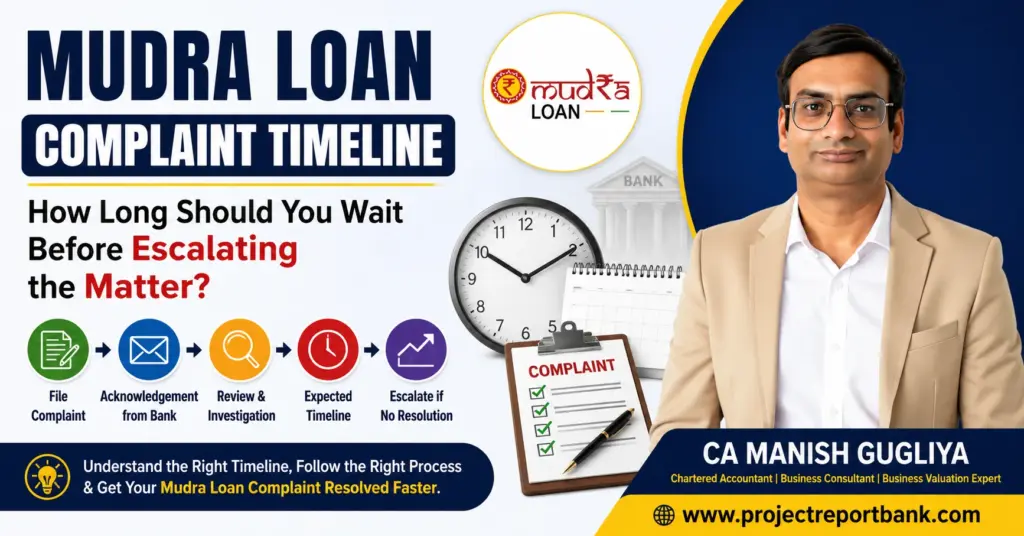
- Follow the correct escalation sequence: Branch Manager → Regional Office → Nodal Officer → RBI Ombudsman. Skipping steps usually results in your complaint being marked premature.
- Every escalation requires proper written records – complaint number, emails, SMS, copies of loan application and required documents.
- Escalating too early or without evidence (no written complaint, no acknowledgement) delays resolution instead of speeding it up.
- This guide is based on the practical experience of CA Manish Gugliya, drawing from 20+ years of handling real MSME and Mudra loan grievance cases.
Understanding Mudra Loan Complaint Timeline & Why It Matters
The Mudra loan scheme, launched on April 8, 2015, under Pradhan Mantri Mudra Yojana (PMMY), provides financial assistance of up to ₹10 lakhs through member lending institutions – banks, NBFCs, and MFIs. Mudra loans are categorized into Shishu (up to ₹50,000 for new businesses), Kishore (₹50,000 to ₹5 lakhs), and Tarun (₹5 lakhs to ₹10 lakhs), with loan amounts ranging from ₹50,000 to ₹20 lakhs for eligible categories. Interest rates range from 10% to 20% – Shishu loans carry interest rates between 10% to 12%, Kishore loans have interest rates starting from 16%, and Tarun loans range from 14% to 17%, all determined by the lending institution. Eligible borrowers include individuals and partnership firms, and applicants must not be defaulters to any bank.
The mudra loan complaint timeline refers to the specific number of days you should wait at each level before escalating. In my practice, I regularly see Mudra loan applications pending for 30–45 days without any status update, rejections without written reasons, branches refusing to accept applications, or branches insisting on unnecessary products like compulsory insurance or a new current account. Complaints can be registered through member lending institutions, and understanding the grievance redressal sequence – branch → regional office → nodal officer → RBI Ombudsman – prevents frustration and premature rejections. Escalating too soon, say within 3–4 days, usually results in the complaint being closed as premature.

Table of Contents
Common Mudra Loan Complaint Situations & When the Timeline Starts
The complaint timeline starts from the date you raise a written complaint with the bank – not from a casual visit or phone enquiry. Mudra loans can be applied online or offline, and the application is normally processed within 7 to 10 days, after which an application number is generated. Individuals may need relevant skills for the proposed activity, and ITR is mandatory for loans above ₹2 lakhs. Here are common complaint situations I encounter:
- Branch not accepting the application – clock starts when you submit a written complaint about refusal
- Application pending beyond 7–15 working days with no update despite submitting all documents
- Rejection without written reason – escalation clock starts from the date you request written reasons
- Delay in document verification even after submitting ID proof, address proof, passport-size photos, business proof, bank statements, and project report
- Delay in sanction after positive field verification
- Delay in disbursement after signing the loan agreement – waiting beyond 15 days post-sanction is unreasonable
- Forced cross-selling – insurance, current accounts, or other documents demanded without justification
- Repeated demand for fresh documents without clear reasons
- No response after filing a written or online complaint (Mudra loan complaint pending status)
PMMY guidelines and RBI norms expect banks to dispose of small loan applications within 2–3 weeks – use this as your benchmark when judging delay.
Standard Mudra Loan Complaint Resolution Timeline Inside the Bank
Most banks follow a stepwise internal grievance redressal policy. Initial complaints should be filed at the bank branch level, and the lender must acknowledge a complaint promptly after receipt. Complaints are registered in a Customer Grievance Register. Complaints regarding a Mudra loan should be resolved within 21 working days, though timelines may vary from 21 to 90 days based on complexity. Simple grievances are often resolved within three working days. Lenders have up to 30 days to investigate and resolve a complaint.
| Stage | Responsible Authority | Normal Time | What You Should Do |
|---|---|---|---|
| Acknowledgement | Branch / Customer Care | 2–3 working days | Obtain complaint number in writing |
| Branch Review | Branch Manager | 7–15 working days | Follow up politely by Day 10; attach any missing documents |
| Internal Escalation | Regional / Circle Office | Day 15–25 | Ask if the matter has been forwarded; send written reminder |
| Final Response | Nodal / Principal Nodal Officer | By Day 30 | If unresolved, prepare for RBI Ombudsman complaint |
For complex cases involving CIBIL errors or fraud concerns, banks may take longer but must communicate the status in writing.
How Long to Wait Before Escalating Each Level of a Mudra Loan Complaint
After Branch Complaint: File a written complaint on Day 0 via email, letter, or the bank’s online form. Users can fill a form or contact via email. Wait 7–10 days before your first follow-up. Send a written reminder around Day 15. If no satisfactory reply by Day 20–25, prepare to write to the Regional Office with copies of all earlier communication.
After Regional Office Complaint: Send a detailed email with copies of the original complaint and acknowledgement. Wait 10–15 days for a response. If still unresolved by Day 30 from your first complaint, escalate to the bank’s Nodal Officer or Principal Nodal Officer.
Before Approaching Nodal Officer: By this stage, you should have a complete complaint file. Complaints can be sent to the Mudra Grievance Redressal Officer via email or letter. Allow 7–10 days after writing to the Nodal Officer – this is the final internal authority.
Before Filing RBI Ombudsman Complaint: If unresolved after 30 days, complaints can be escalated to the RBI Integrated Ombudsman. A complaint can be escalated if there is no satisfactory response from the lender. Complaints can also be escalated to higher authorities if not resolved at the branch level. Mudra loan complaints can be addressed through customer care numbers, and the grievance redressal process is outlined on the official portal.
Approaching other government authorities like District Industries Centre is useful only after following the main banking and RBI grievance chain.
Documents & Evidence to Keep Ready Before Escalation (And Mistakes that Cause Delays)
Strong documentation is the difference between fast Mudra loan complaint resolution and a complaint remaining pending. Documentation is required for filing complaints regarding Mudra loans. Applicants must submit ID proof and address proof along with other documents. Keep these ready:
- Copy of your Mudra loan application form (Shishu / Kishore / Tarun) submitted to the financial institution
- Acknowledgement with date and reference number
- Proof of all required documents submitted – PAN, Aadhaar, Udyam, project report, bank statements, GST returns
- Written complaint with complaint number or screenshot
- All emails and SMS from the bank
- Notes of branch visits with dates and officer names
- Call logs or audio records, if legally recorded
For a detailed checklist, refer to this guide on Mudra loan complaint evidence documents.
Mistakes that cause delays:
- Complaining verbally without written record
- Not taking complaint acknowledgement or number
- Submitting incomplete KYC or business documents, then blaming the bank
- Using angry or emotional language instead of factual details and dates
- Filing multiple complaints on different portals simultaneously, creating confusion
- Changing facts while escalating, making the case look weak
- Ignoring bank emails asking for clarifications within a time limit
A well-organised complaint diary greatly strengthens your case before the Nodal Officer and RBI Ombudsman.
Practical Follow-Up Strategy, Case Example & Expert Tips from CA Manish Gugliya
Step-by-Step Follow-Up Schedule
- Day 1: Submit complete application with required documents; obtain acknowledgement with application number
- Day 3–5: Check status with the dealing officer; confirm file is logged in the system
- Day 7: If no progress, email the Branch Manager with application details
- Day 15: Send a reminder referencing RBI norms on processing small loan files
- Day 20–25: If still pending or rejected without proper reason, write to Regional Office
- Day 30: If no satisfactory outcome, file with the bank’s Nodal Officer or RBI Integrated Ombudsman

Case Study
A proprietor running small manufacturing units in Madhya Pradesh applied for a ₹6 lakh Mudra Tarun term loan in January. The branch kept the application pending for 22 days. On Day 23, the borrower filed a written complaint by email with the Branch Manager. By Day 30, after no response, he escalated to the Regional Office with all documents attached. The Regional Office intervened, and the loan was sanctioned by Day 37. The applicant did everything right – proper documents, calm follow-ups, and a clear escalation trail covering service sectors and commercial purposes relevant to his business serving truck operators, repair shops, shopkeepers, and artisans in his area.
Expert Tips
- Always communicate in writing and retain copies – this is non-negotiable
- Keep a chronological complaint diary with dates and actions
- Attach supporting documents each time you escalate so the new officer understands the full picture quickly
- Avoid threatening language or political pressure; stick to RBI guidelines and facts
- Never give original documents to middlemen claiming to “get Mudra loans cleared faster”
- If your case involves CIBIL errors or project report doubts, get professional help before escalating
- Connect with the bank’s published nodal officer email and mobile number for direct access to the right authority
Following this systematic approach significantly improves the chance of getting a fair decision. The scheme benefits millions of micro enterprises, including those in trading, manufacturing, poultry, and other categories across India – and every applicant deserves a transparent process.

Frequently Asked Questions on Mudra Loan Complaint Timeline
These questions address common doubts that remain even after understanding the main Mudra loan complaint process.
Can I directly complain to RBI Ombudsman without contacting the bank?
No. RBI expects you to first file your complaint with the bank and wait up to 30 days for a response. Only if the bank does not reply or gives an unsatisfactory response can you approach the RBI Ombudsman. Filing directly without this step will likely result in your complaint being returned as premature. You must have permission to escalate by completing the bank-level process first.
Does the complaint timeline change if my Mudra loan is for a startup versus an existing business?
The grievance timeline remains the same regardless of the nature of your business. However, verification steps may differ – a startup without business experience may face additional field checks, while an existing business with a proven track record and server of financial records may move through faster. The complaint escalation process and waiting periods stay identical.
Will filing multiple complaints on different portals speed up my Mudra loan grievance?
No. Duplicating complaints across email, portal, and written letter simultaneously creates confusion in tracking and can actually slow things down. Maintain one main complaint with a single complaint number, follow up consistently on that, and escalate step by step with proper details and a clear form of communication.
Is it useful to tag government portals or social media while my complaint is pending?
Tagging government helplines or social media may draw attention to your case, but it cannot replace the formal complaint and escalation process established by RBI and the bank. Use it as a supplementary step after you have followed the official grievance chain – not as a substitute.
How can I track my Mudra loan complaint effectively?
Use your complaint number to check status on the bank’s complaint portal. If you have escalated to RBI, track it through the RBI CMS portal. Maintain a personal tracking sheet with the date of each complaint, the authority contacted, the response received, and the next step planned. This simple practice gives you complete control over the Mudra loan complaint timeline.
- Roller Flour Mill Setup Cost in India: Professional Investment & Project Cost Guide


- Poha, Puffed Rice & Value-Added Rice Products Project Report & Processing Opportunities

- Integrated Value-Added Rice Products Processing Plant Project Report & DPR

- Integrated Rice Plant Bank Loan, Feasibility, ROI, IRR, Payback & Sensitivity Analysis

- Integrated Rice Processing Plant Financial Projections, Working Capital & DSCR

- Integrated Rice Products Revenue Model, Market Strategy & Profitability

- Integrated Value-Added Rice Plant Project Cost & Means of Finance

- Raw Material Procurement & Inventory Planning for Integrated Value-Added Rice Plant

- Common Utilities, Warehousing, Packaging & Material Handling for Integrated Rice Plant