Key Takeaways
- Most Mudra loan problems stem from misunderstanding RBI and PMMY guidelines, not from banks deliberately breaking rules.
- RBI issues binding Master Directions on MSME lending (consolidated up to 11 June 2024), PMMY provides scheme-level operational guidelines, and each bank still applies its own board-approved credit policy on top.
- Loans up to 10 lakh to eligible micro and small enterprises are collateral-free as per RBI MSME directions, but this does not mean automatic sanction or zero documentation.
- Applicants frequently confuse social-media “Mudra loan rules” with actual RBI circulars, leading to arguments at branches and avoidable rejections.
- This article is written from the perspective of CA Manish Gugliya (ProjectReportBank.com), with 20+ years of MSME finance experience, offering practical, example-based clarifications of Mudra Loan RBI Guidelines.
Introduction: Why Mudra Loan RBI Guidelines Are Frequently Misunderstood
Crores of entrepreneurs across India have heard about Pradhan Mantri Mudra Yojana since its launch on April 8, 2015. Yet only a tiny fraction have actually read the RBI MSME Master Directions or official PMMY guidelines. MUDRA, which stands for Micro Units Development and Refinance Agency, operates as a refinance agency under SIDBI, while Mudra loans are disbursed through banks, non banking financial companies, and micro finance institutions (MFIs).
“Mudra Loan RBI Guidelines” is not a single document. It is a combination of RBI Master Directions on MSME lending, PMMY operational rules from the Government of India, and each bank’s internal credit policy. Mudra loans are divided into four categories based on growth stage: Shishu loans offer up to ₹50,000 for startups, Kishore loans range from ₹50,000 to 5 lakh for growth, Tarun loans provide 5 lakh to 10 lakh for established businesses, and Tarun Plus loans range from 10 lakh to 20 lakh for expanded businesses.
This article focuses on common misinterpretations that cause delays, rejections, and unnecessary complaints rather than repeating scheme features. Throughout, references are made to RBI provisions like the collateral-free norm, 14-working-day decision timelines, and composite loan limits, explained in practical terms. It also addresses confusion about interest rate expectations, documents required including identity proof and address proof, and eligibility of allied activities under the Mudra scheme.

Table of Contents
Why Misunderstanding RBI & PMMY Guidelines Creates Mudra Loan Problems
Here is what most applicants miss: there are distinct layers governing every Mudra loan, and mixing them up creates problems.
- RBI Directions (like the 2017 MSME Master Direction) are binding on banks. They cover priority sector classification, collateral norms up to 10 lakh, timelines, and rehabilitation frameworks. Mudra loans qualify under RBI’s Priority Sector Lending framework. Changes in lending caps are also regulated by the Reserve Bank of India.
- PMMY Guidelines are operational scheme rules from the government and DFS covering loan categories, eligible activities in manufacturing, trading, and service sectors, and refinancing support through MUDRA.
- Bank Internal Policy decides minimum CIBIL thresholds, DSCR norms, documentation beyond basic KYC, and risk-based interest rate pricing. Partnership firms, sole proprietors, and other entities all face bank-specific appraisal.
- Branch-Level Discretion means a Branch Manager may approve a Kishore loan directly but send a Tarun proposal to a higher authority. Two branches of the same bank may handle similar cases differently.
When applicants treat WhatsApp forwards or local agents’ advice as “RBI rules” and argue at branches on that basis, it leads to frustration, avoidable complaints, and delayed sanctions. The following section corrects the most frequent myths one by one.
15 Common Misinterpretations of RBI & PMMY Guidelines
Each myth below follows a simple structure: what people think, what the rules actually say, a practical example, and what you should do instead.
Banks Must Approve Every Mudra Loan
Many believe that under Pradhan Mantri Mudra Yojana, every eligible applicant has a guaranteed right to funds up to 10 lakh or 20 lakh. RBI and PMMY guidelines require fair access, but banks retain full authority to assess repayment capacity and reject proposals that are not financially viable. Eligible businesses include small producers and service providers, but eligibility alone does not equal approval.
A startup with no prior experience and no clear cash flow projection can be lawfully refused even within the Shishu limit. Focus on building a realistic project report and proper documentation rather than arguing that the Mudra Yojana means guaranteed sanction.
Every Rejection Violates RBI Guidelines
Applicants often assume any Mudra loan rejection means the bank violated RBI rules and can be “forced” to sanction through a complaint. RBI circulars mandate fair treatment and timely decisions but do not prohibit rejection of applications that fail credit norms.
If a borrower has multiple existing NPAs or overdue credit card dues, declining the proposal is consistent with prudential norms. Before alleging violation, ask for written reasons for rejection and compare them with actual guidelines.
No Collateral Means Automatic Approval
RBI’s MSME Master Direction mandates that banks cannot accept collateral security for loans up to 10 lakh to eligible micro and small enterprises. The scheme offers collateral-free loans to small businesses. However, “collateral-free” only removes third-party security requirements. Banks can still rely on primary security like equipment financed, hypothecation of stock, personal guarantee, and full credit appraisal.
A trader applying for an ₹8 lakh Kishore loan may be refused because of low income or unstable business, despite no collateral being demanded. Collateral and sanction are separate issues. Understand collateral rules under Mudra loan clearly.
Banks Cannot Ask Any Additional Documents
Some borrowers believe only Aadhaar card and PAN suffice. PMMY provides a standard application form and basic KYC norms, but RBI allows banks to seek additional documents for credit assessment. You need identity proof, address proof, business proof documents, financial statements, and a passport-sized photograph to apply. Banks may also request bank statement records, GST returns, Udyam registration, utility bills, or a rent agreement.
Prepare a complete document set in advance. Banks can ask extra documents for Mudra loan legally under their board-approved policies.
Every Business Qualifies Under PMMY
Not every income activity is covered. PMMY covers non-farm small businesses in manufacturing, trading, and services, including many allied activities like dairy, poultry, and food processing. Agricultural income-generating businesses focused on pure cultivation are not eligible. Mudra loans are available for non-farm small businesses only. Applicants must be aged between 18 to 65 years.
A farmer seeking a loan for seeds is generally not covered, but the same person applying for a dairy unit or agro-equipment workshop may qualify. Students above 18 years can also apply for Mudra loans for eligible activities. Verify your activity’s eligibility before applying.
A Project Report Guarantees Sanction
Many agents sell standard project reports promising that once prepared, the bank is “bound” to sanction. A project report is one input. Banks test assumptions, cross-check sales estimates, and examine the applicant’s track record.
Two applicants with similar project reports for a ₹7 lakh loan can get different outcomes, one approved due to stable income history and one rejected due to cheque bounces. Treat the project report as a planning tool, not a guarantee.
PMMY Guidelines Override Bank Credit Policy
PMMY guidelines work together with RBI Directions. They do not cancel prudent credit norms. Banks remain responsible for asset quality and must apply board-approved policies for Mudra loans just as for other MSME sector loans. Tarun Plus is available only after repaying Tarun loans, a scheme rule, but within that rule, banks still assess risk independently.
Respect the distinction between scheme eligibility and bank-specific appraisal. Negotiate professionally rather than insisting PMMY rules override everything.
All Branches Interpret RBI Circulars Identically
Applicants get conflicting messages from different branches and assume differences are violations. While RBI Directions and PMMY guidelines are uniform, each bank interprets them through internal circulars. One branch may comfortably fund a small dairy unit up to 5 lakh while another prefers trading or service loans, both operating within RBI’s broad MSME framework.
If you face rigid interpretation, seek clarification at another branch or consult mandatory RBI and PMMY guidelines for banks.
A Good CIBIL Score Guarantees Approval
Social media often claims that a CIBIL score above 750 makes banks “bound to approve.” CIBIL is one factor. Banks also assess income stability, existing liabilities, sector risk, and account conduct.
An applicant with a 780 score but unrealistic sales projections or heavy existing EMIs may still be declined because projected cash flow does not support the additional loan amount. See CIBIL as a gate opener, not a guarantee.
RBI Fixes Loan Processing Time in Every Situation
RBI advises banks to dispose of MSME loan applications up to ₹25 lakh within 14 working days from receipt of a complete file. Mudra loans are collateral-free and can be approved quickly, sometimes within a few days for clean cases. But incomplete documentation legitimately extends the timeline.
An applicant who submits only KYC without quotations, business proof, or bank statement records will face repeated follow-ups. Submit a complete file in one go and ask for an acknowledgement with date to invoke timeline protections.
Every Complaint Goes Directly to RBI
The grievance hierarchy requires going first to the branch, then the bank’s nodal officer, then the internal grievance cell, and only then to the RBI’s Integrated Ombudsman. RBI does not act as a first-level complaint cell.
A complaint about forced insurance or unclear processing fee can often be resolved within the bank’s own system. Document interactions in writing and escalate step by step.
Banks Cannot Verify Business Information
Banks are fully allowed and expected to conduct pre-sanction visits, tele-verification, and document checks. If a field visit reveals a residential address with no actual stock or signage for a ₹5 lakh Kishore loan, the bank can justifiably raise queries or reject.
Cooperate transparently with verification. Maintain proper invoices, business registration, and visible operations.
RBI Guidelines Prevent Banks from Assessing Repayment Capacity
RBI’s MSME directions explicitly promote sound credit culture. Banks must examine projected income, existing EMIs, and seasonality of cash flow. The repayment period for Mudra loans can extend up to 84 months, but repayment must still be demonstrably viable.
Even a street vendor seeking ₹1.5 lakh working capital may be asked about daily sales and household expenses. Prepare simple income and expense estimates.
Every Guideline Is Mandatory Without Interpretation
People read one line from an RBI circular and treat it as rigid. There is a difference between mandatory directions (no collateral up to 10 lakh for eligible MSMEs) and broad guidance (simplified procedures for small ticket loans) that allow operational judgment.
Read full paragraphs, not isolated sentences. Consult authentic sources on whether RBI circulars are legally binding.
Every Branch Manager Follows the Same Approval Process
If a friend’s 5 lakh loan was sanctioned in three days at one branch, it does not mean every branch follows the same steps. A semi-urban branch may process Shishu loans quickly but send Tarun or Tarun Plus proposals (10 lakh to 20 lakh) to a central processing centre with additional stages.
Ask your branch politely about its workflow and expected timelines at the start.

Difference Between RBI Directions, PMMY Guidelines and Bank Internal Policies
Understanding this three-layer structure is critical for interpreting Mudra Loan RBI Guidelines correctly.
- Eligibility: RBI classifies MSMEs per the MSMED Act and Udyam. PMMY specifies non-farm activities and categories. Bank policy may add CIBIL thresholds and turnover requirements.
- Collateral: RBI mandates no collateral up to 10 lakh for eligible micro and small enterprises. PMMY aims for collateral-free access. Banks may still ask for personal guarantee or primary security.
- Interest Rate: RBI does not fix a single flat Mudra interest rate. MUDRA loan interest rates start from 7.25% per annum and vary based on the bank and loan category. MUDRA loans are usually cheaper than traditional business loans. Banks set rates via board-approved policies linked to external benchmarks or MCLR.
- Timelines: RBI advises 14 working days for complete applications up to ₹25 lakh. PMMY relies on RBI compliance. Banks may have internal stages adding time.
- Documentation: RBI requires basic KYC. PMMY adds a standard application. Banks request other documents like ITRs, GST, and Udyam based on risk assessment.
- Grievance: RBI mandates written rejection reasons and tracking systems. PMMY expects transparency. Banks follow Fair Practice Code with varying formats.
You can apply for a Mudra loan through banks and non banking financial companies, and you can even apply online in many cases. Loans under MUDRA can range from ₹50,000 to 20 lakh for eligible borrowers.
Real Situations Where Misinterpretation Causes Mudra Loan Problems
Here are typical case patterns from MSME lending practice.
- Unnecessary rejection argument: An applicant with good CIBIL argued that a Tarun loan up to 10 lakh “cannot be rejected.” The bank had declined due to weak projected turnover. After preparing a revised, realistic cash flow projection, the loan was reconsidered.
- Document confusion: A borrower submitted only Aadhaar and PAN. The bank rightly asked for shop establishment proof, GST registration, and rent agreement. The applicant accused the bank of harassment, causing delay.
- Collateral correction: A bank branch unofficially hinted at collateral for a ₹7 lakh loan. The applicant cited RBI’s collateral-free rule properly and got the request withdrawn without confrontation.
- Processing delay: Incomplete file submission pushed a ₹5 lakh Kishore loan past 14 working days. Written follow-up with acknowledgement receipt helped resolve it.
- Insurance confusion: One applicant thought insurance was always compulsory; another believed it was always illegal. The reality is that banks can recommend insurance but cannot force specific products unfairly.
More than 68% of PMMY accounts are held by women entrepreneurs, and with over 53.85 crore accounts and ₹35.13 lakh crore sanctioned as of June 2025, many problems are preventable through proper understanding.
How Applicants Should Verify RBI & PMMY Guidelines Before Believing Advice
Genuine Mudra Loan RBI Guidelines are publicly available and free.
- Access RBI Master Directions on MSME lending from the official RBI website and check the last updated date.
- Cross-check PMMY guidelines on official portals like mudra.org.in describing Pradhan Mantri Mudra Yojana eligibility and categories.
- Rely on written communication from banks: acknowledgement slips, sanction letters, rejection letters with reasons.
- Use expert resources like ProjectReportBank.com’s coverage of bank responsibilities as a bridge between regulatory language and practical understanding.
- Before escalating, re-read the relevant section to confirm what you are claiming as a “right” is actually written in the guideline.
Checklist Before Arguing That a Bank Violated RBI Guidelines
Follow these steps before filing a complaint:
- Confirm your business is eligible under PMMY (non-farm, micro/small, including permitted allied activities).
- Verify the loan amount and category match your requirement (Shishu, Kishore, Tarun, or Tarun Plus up to 20 lakh).
- Check whether you submitted all documents required per the bank’s checklist.
- Confirm you have an acknowledgement with date; the timeline starts when the file is complete.
- Determine whether the issue is about collateral (clear RBI rule up to 10 lakh), interest rate (bank policy), or risk-based rejection.
- Document every discussion in writing before making a formal complaint.
Common Mistakes Applicants Should Avoid
- Treating Mudra as a subsidy: The scheme primarily facilitates credit access without providing subsidies. It is a business loan with interest rates and EMIs, not free government funds.
- Under-disclosing existing loans: Hiding credit card or personal loan dues causes CIBIL mismatches and trust issues. Disclose fully at application stage.
- Submitting incomplete documentation: Missing address proof, business registration, quotations, or Udyam registration leads to repeated branch visits. Prepare everything once.
- Requesting maximum amount without justification: Asking for 10 lakh or 20 lakh when your business can only absorb 3 lakh raises risk concerns. Keep the loan amount realistic.
- Arguing with half-understood RBI circulars: Respectful, fact-based discussion supported by printed guidelines works far better than emotional confrontation.
Expert Advice from CA Manish Gugliya on Using RBI & PMMY Guidelines Effectively
As a practising CA working with MSME and Mudra loans for over two decades, here is what I recommend:
- Always distinguish three layers in your mind: RBI Directions, PMMY guidelines, and bank-specific policy. Phrase your questions to bankers accordingly.
- Prepare a simple but complete project report with realistic sales, costs, interest rate assumptions, and EMI calculations. Professional help significantly reduces rejections caused by weak documentation.
- Maintain a neat file with all key papers: KYC, photographs, address proof, business registration, Udyam, past ITRs, bank statement records, quotations, and licenses.
- Never rely solely on WhatsApp forwards for “Mudra loan rules.” Cross-check with RBI circulars and official PMMY portals.
- Mudra Yojana, properly understood, is a powerful tool for micro-entrepreneurs. Clarity about guidelines often converts a “difficult” loan into a smooth approval.

Conclusion: Mudra Loan Guidelines Explained in Practice
Most Mudra loan problems arise not because RBI PMMY guidelines are ignored, but because both applicants and sometimes front-line employees misunderstand where the guideline ends and bank policy begins.
Mudra Loan RBI Guidelines protect borrowers by mandating collateral-free lending up to 10 lakh for eligible MSMEs, encouraging timely decisions, and ensuring fair treatment. But they do not remove credit appraisal or guarantee sanction. Approval for Mudra loans may take a few days for straightforward cases, and Mudra loans support activities in manufacturing, trading, and services across the industry spectrum.
Treat RBI circulars, PMMY scheme documents, and written bank communication as your primary tools. When entrepreneurs prepare well, avoid myths, and respect genuine guidelines, Pradhan Mantri Mudra Yojana truly supports sustainable development and growth of micro and small businesses across India.
Frequently Asked Questions on Mudra Loan RBI Guidelines
What are Mudra Loan RBI Guidelines in simple terms?
“Mudra Loan RBI Guidelines” mainly refers to how RBI’s Master Directions on MSME lending apply to Mudra loans, covering collateral-free norms up to 10 lakh, fair processing, priority sector classification, and decision timelines. PMMY guidelines separately define scheme structure including Shishu, Kishore, Tarun, and Tarun Plus categories and eligibility. There is no single RBI document titled “Mudra Guidelines.” Mudra loans operate within the broader MSME lending framework prescribed by RBI and the operational rules issued for Pradhan Mantri Mudra Yojana by the ministry of finance.
Does RBI specify a fixed interest rate for all Mudra loans?
RBI does not fix one uniform interest rate. MUDRA loan interest rates start from 7.25% per annum, but interest rates vary based on the bank and loan category. Each bank sets rates through board-approved policies linked to external benchmarks or MCLR, plus a risk premium. For the same ticket size, rates can differ between financial institutions and even between customers within the same bank. Mudra loans are usually cheaper than traditional business loans, but always compare offers from multiple lenders before deciding.
Can I apply for a Mudra loan in another bank if one bank delays or rejects?
RBI and PMMY guidelines do not prevent applicants from approaching another bank, NBFC, or micro finance institutions MFIs if the first bank delays excessively or rejects, provided you disclose earlier attempts honestly. Many borrowers improve their project report and obtain better documentation before approaching a second lender. Mudra loans are available through banks, NBFCs, and MFIs across India, giving you multiple options.
Are banks allowed to charge processing fees and insist on insurance for Mudra loans?
Processing fees are nil for Shishu and Kishor loans. For higher Mudra amounts, banks may charge reasonable fees as per internal policy, and RBI requires all charges to be transparent and non-excessive. Banks can recommend insurance covers like asset insurance or credit life but cannot force specific products unfairly. Applicants should be informed of costs and given freedom of choice. Keep all fee receipts and ask for a written breakdown if charges seem unclear.
How can I check if an RBI circular or PMMY rule quoted by someone is genuine?
Search the circular number or key phrase on the official RBI website (rbi.org.in). Open only RBI or government domain links. Check the date and whether it has been superseded by later Master Directions. Cross-check summaries from agents or social media with original documents. Expert resources can complement official texts but should never substitute them. Require funds of effort upfront to verify saves significant trouble later.
- RBI & PMMY Guidelines for Mudra Loans – Complete Guide to Bank Rules, Applicant Rights & Compliance

- RBI & PMMY Guidelines for Women Entrepreneurs Applying for Mudra Loans

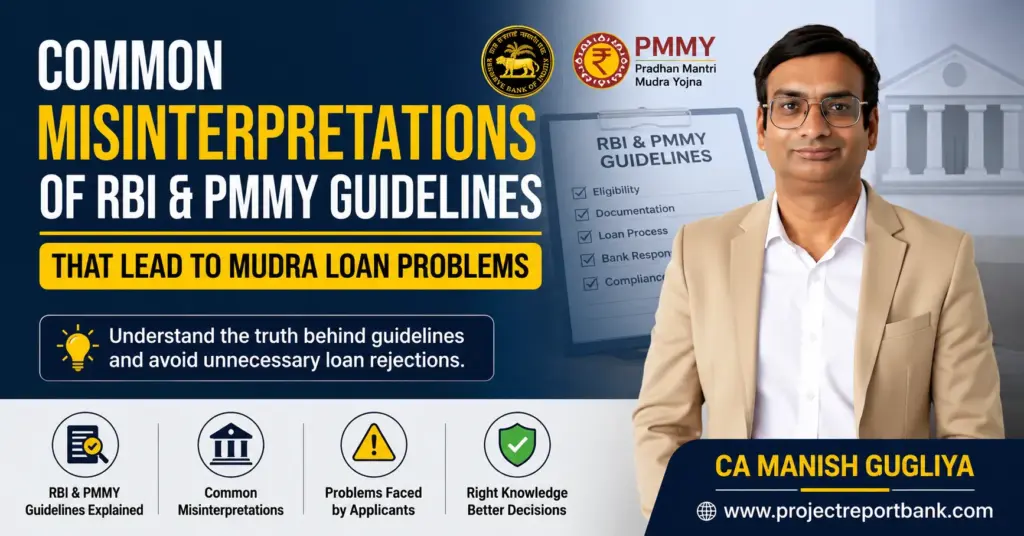
- Common Misinterpretations of RBI & PMMY Guidelines That Lead to Mudra Loan Problems
- What Happens If a Bank Violates RBI or PMMY Guidelines?
- RBI & PMMY Guidelines on Mudra Loan Complaint and Grievance Redressal (2026)

- RBI Guidelines for Mudra Loan Applicants: Documentation, Eligibility & Bank Duties


- Are RBI Circulars Legally Binding for Mudra Loans? Complete Legal Guide for Borrowers
- Mandatory RBI & PMMY Guidelines for Mudra Loans: Practical Compliance Guide for Applicants and Banks
- Mudra Loan Collateral Rules: RBI & PMMY Guidelines (Practical Outline)