Key Takeaways
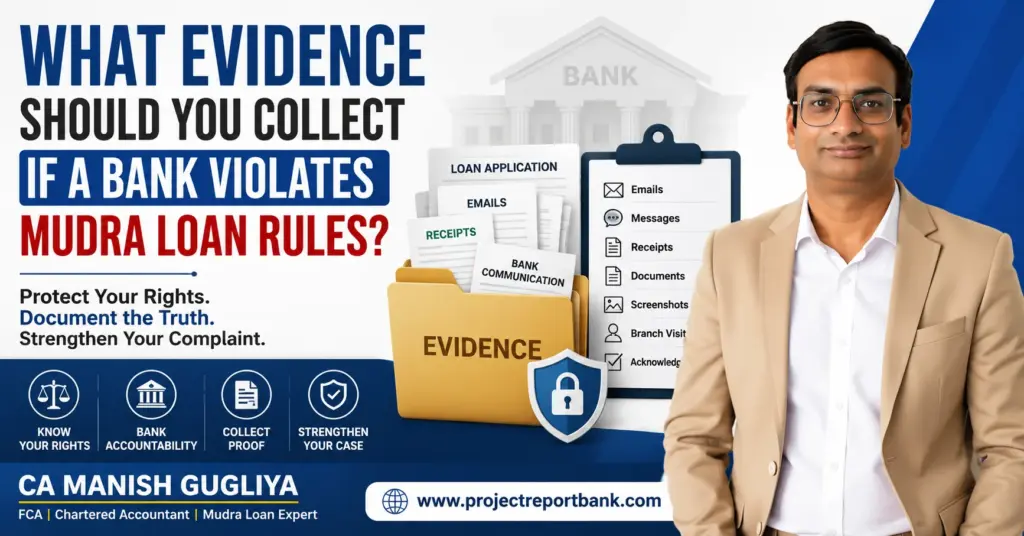
- Evidence for Mudra loan rule violation means written, time-stamped records such as application acknowledgements, emails, SMS alerts, fee receipts, and sanction or rejection letters – not verbal promises.
- Verbal assurances about Pradhan Mantri Mudra Yojana – like “no collateral needed,” “no processing fee,” or “same-day sanction” – carry almost no weight unless converted into written proof.
- Strong evidence is needed at every escalation stage: Branch Manager, Bank Nodal Officer, RBI’s Integrated Ombudsman, or consumer and legal forums.
- The most important items to preserve from day one include your mudra loan application copy, acknowledgement slip, project report or CMA data, all bank communications, and every piece of paperwork the bank sought or required, with dates.
Introduction: Why Evidence for Mudra Loan Rule Violation Is So Important
Most mudra loan applicants – especially those applying under the Shishu or Kishore categories – only realise the importance of evidence after they have already faced delay, rejection, or unfair conditions. By then, critical documents are missing, SMS messages have been deleted, and verbal promises have evaporated.
In practical terms, a Mudra loan rule violation can look like many things: a bank refusing to accept your application without any written note, staff insisting on collateral or a guarantor for a loan up to Rs 10 lakh, forcing insurance as a condition, charging unauthorized fees, or not giving written rejection reasons. In 2024, many callers to our office reported that branches delayed Pradhan Mantri Mudra Yojana applications for more than 30 days without any written reply. Some were even asked to engage middlemen who demanded upfront payment – which itself violates MUDRA loan policies. Violations of Pradhan Mantri Mudra Yojana rules also involve misuse of funds, and mudra loan frauds exploit the scheme’s popularity to cheat unsuspecting individuals.
Not every negative experience is illegal. Banks have limited discretion. But a borrower must meet eligibility requirements to obtain MUDRA loans, and applicants must be ready with proper evidence if they feel RBI or PMMY guidelines are ignored. For context, Mudra Yojana offers loans up to Rs. 20 lakhs. Eligible borrowers include individuals and partnership firms. Shishu loans cover amounts up to Rs. 50,000, Kishore loans range from Rs. 50,000 to Rs. 5 lakhs, and Tarun loans range from Rs. 5 lakhs to Rs. 10 lakhs.
This article is written from my perspective as CA Manish Gugliya (FCA), with 20+ years of experience in project reports, MSME finance, and Mudra loan consultancy. Without documents and time-stamped proof against the bank, even strong complaints before the Banking Ombudsman or RBI portal may fail. Investigations into MUDRA loans are conducted by police and the Central Bureau of Investigation when fraud is suspected, making proper documentation even more important for genuine applicants.
If you also want to understand what constitutes illegal bank practices in mudra loans, you can refer to the guide on reporting illegal bank practices.

Table of Contents
Why Evidence Matters in Mudra Loan Disputes
In any dispute, the burden of proof usually falls on the applicant. The bank will rely on its internal records and notes. To counter that, you need your own written evidence.
Emails, SMS alerts, acknowledgement slips, and sanction letters are far stronger than verbal statements because they carry time-stamps and signatures that prove exactly when something happened. Loan funds must be used solely for authorized business activities, and if a bank claims otherwise, only your own records can establish the truth. Lack of adequate pre-sanction credit appraisals may result in loan fraud, and the Reserve Bank of India monitors credit appraisals in MUDRA loans – but proving a bank skipped due process requires your factual evidence paired with copies of relevant RBI and PMMY circulars.
Strong banking complaint evidence helps at every level: first complaint to Branch Manager, escalation to Regional Office or Nodal Officer, and filing a structured grievance under the RBI Integrated Ombudsman Scheme. There is a difference between service quality issues (rude behaviour, no response) and possible rule violations (forced collateral, unauthorized fees). For service issues, evidence is useful. For rule violations, evidence is critical.
Those who want to first understand common misconduct patterns can read about how to protect yourself from illegal bank practices in Mudra loans.
Evidence does not guarantee loan approval or compensation. But it substantially improves the chances of a fair review and corrective action.
Situations Where You Should Start Collecting Evidence
Evidence collection should ideally start from the first enquiry about a mudra loan, not only after a dispute appears. The moment any of the following situations begins, start preserving every message and receipt as potential Mudra loan violation evidence.
| Situation | Evidence Needed | Why It Matters |
|---|---|---|
| Bank refuses to accept application | Email or note recording refusal with date, name of officer | Proves attempt to apply; bank cannot deny receipt |
| Staff demands collateral or guarantor for Shishu/Kishore (MUDRA loans are mandated to be collateral-free) | Written demand letter/email, screenshot of any form requiring collateral | Shows violation of collateral-free norms under Mudra |
| Forced bundling of insurance or credit card | Insurance receipt, policy copy, sanction letter mentioning insurance condition | Proves forced product; supports complaint of unauthorized charges |
| Unauthorized processing fee charged (especially when Shishu has nil fee) | Fee receipt with amount and date | Detects illegal charges; engaging middlemen or paying a processing fee violates MUDRA loan policies |
| Repeated requests for same documents required without progress | Written or printed request lists with dates | Highlights harassment or deliberate delay |
| Delay beyond PMMY timelines (loan applications for amounts up to Rs. 5 lakh must be processed in 2 weeks) | Application acknowledgement, follow-up emails, SMS status updates | Proves delay with exact dates |
| Rejection without written reasons | Request email, any verbal notes; demand for written explanation | Without reasons, complaint cannot be evaluated |
| Staff misbehaviour, discriminatory or misleading information | Branch visit diary, follow-up email, WhatsApp screenshots | Supports complaint about unprofessional behaviour |
| Submitting fake documents during the application (by agents or others) | Copies of actual vs forged documents, police complaint if applicable | Submitting fake documents during the application is considered a violation |
| Misrepresenting applicant’s defaulter status during loan applications | Credit report (CIBIL), bank statement, any document showing true status | Misrepresenting applicant’s defaulter status during loan applications violates rules |
| Fictitious business activity or availing a loan for a non-existent business | Business registration, trade licence, GST returns, proof of actual operations | Fictitious business activity can indicate potential loan fraud |
| Transferring loan funds from business accounts to personal accounts | Bank statement showing fund movement | This is a violation; misutilization of funds is when loan funds are used for personal purposes |
Essential Evidence Every Mudra Applicant Should Preserve
This is the core section: a checklist of concrete evidence items every applicant should maintain from day one, even if the application seems smooth. These evidence types apply across all Mudra categories – Shishu, Kishore, Tarun, and Tarun Plus – and for all lenders including public sector banks, private banks, small finance banks, RRBs, NBFCs, and MFIs under Pradhan Mantri Mudra Yojana.
Many of these items overlap with the normal documents required for a mudra loan (identity proof, address proof, business proof, project report, bank statements). But here, the focus is on using them as proof against bank misconduct. Evidence of a violation also includes forged supporting documents – so preserving your genuine originals is essential.
Application acknowledgement receipt
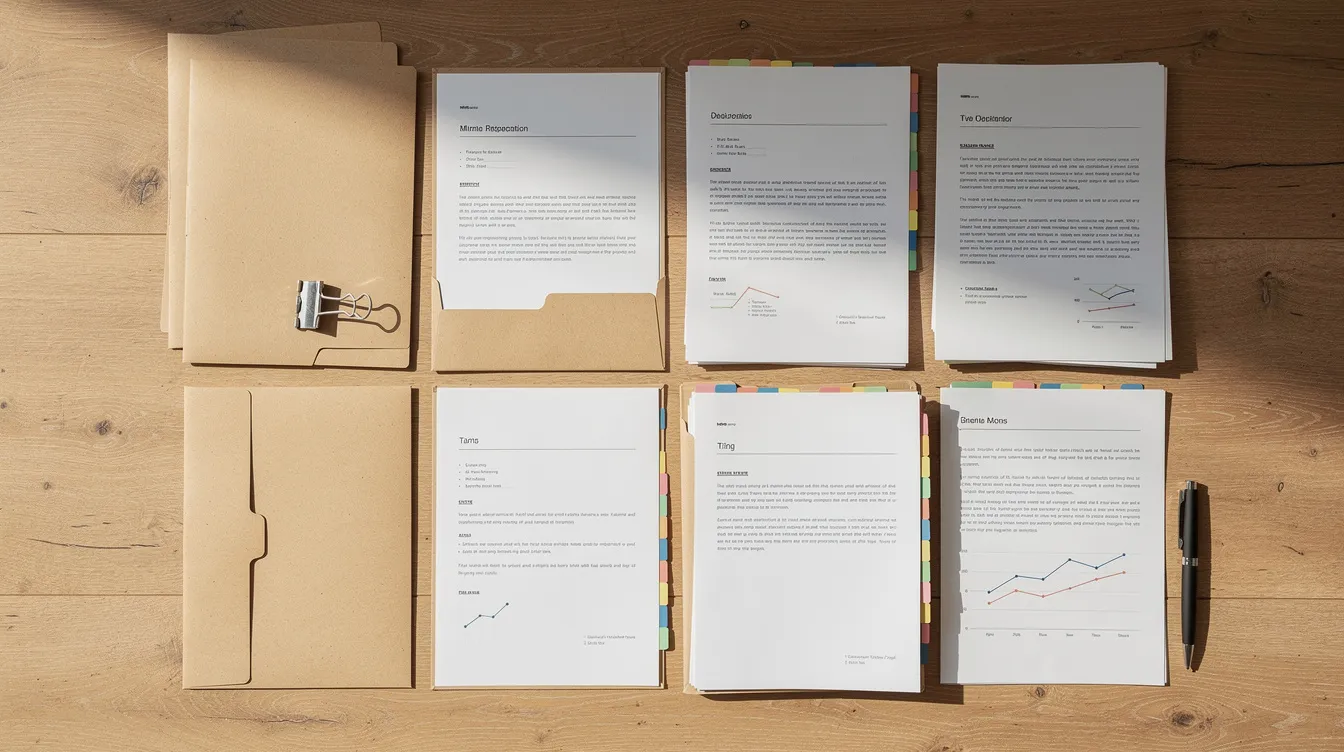
An acknowledgement slip is a stamped copy or system-generated receipt showing date, application number, loan type (Mudra), and branch name. This is one of the most powerful Mudra loan complaint documents because it proves that the bank actually received your application on a specific date. In delay disputes, this slip becomes the starting point for calculating how long the processing took. If a bank refuses to issue one, send an email stating that your application was submitted on a particular date, and keep that email as indirect evidence.
Loan application copy
Always keep a photocopy or scanned copy of the filled-in mudra loan application with your signature and date, plus all supporting sheets you attached. This helps prove what information and documents were submitted at the time. If the bank later claims “no application was received” or “data was incomplete,” your copy counters that. Where online portals are used, download PDF copies or click and take clear screenshots of the confirmation page before you select any next step.
Project Report
A project report details your business model, investment needed, working capital, projected sales and profits, and machinery requirements – covering manufacturing, trading, and service sectors. A properly prepared report, stamped as received by the bank or attached via email, proves your proposal was serious and economically viable. If the bank rejects the application saying “project not viable,” this report is necessary for any reviewer – including the Ombudsman – to examine whether that remark was reasonable.
CMA Data (if submitted)
CMA data includes financial statements, ratio analysis, fund flow, and projections. It is more common in higher-ticket Kishore and Tarun loans or where an existing business seeks enhancement. If CMA data was prepared and submitted, keep both the soft copy and the bank-received copy. In advanced complaints or legal proceedings, CMA data can support the argument that the business was financially sound and the bank’s rejection or unfair conditions were not justified by numbers alone.
Bank emails
Email communication is one of the best forms of bank misconduct evidence because it is time-stamped and retrievable. Always try to write short, polite emails summarising meetings, clarifying which documents were submitted, and asking for written reasons for any rejection or additional conditions. Store all replies – including automated responses – in a separate Mudra loan email folder.
SMS notifications
Many banks send SMS updates on application number, status, document requirements, and disbursement. These are valid evidence for RBI complaint and Ombudsman cases. Do not delete any Mudra-related SMS. Take periodic screenshots and back them up. Even a simple message like “application received” or “loan rejected” with a date and time can strongly support your timeline.
WhatsApp messages
Many branch officials informally use WhatsApp for sending document lists or quick updates. These are still usable as indirect evidence. Do not delete chats. Preserve original messages and take date-stamped screenshots. However, more formal documents – emails, letters, receipts – usually carry higher evidentiary value than WhatsApp alone.
Branch visit records
Maintain a simple diary or digital note where you record every branch visit: date, time, name of the officer met, and a one-line summary of the discussion. Such contemporaneous notes help reconstruct events when filing a detailed grievance, especially when verbal promises were made. After major discussions, send a follow-up email summarising what was said, thereby converting verbal points into written evidence.
Document submission receipts
Whenever the bank takes original KYC or other papers for verification – identity proof like passport, address proof such as utility bills, ownership documents, business registration – insist on a simple “received” note, system checklist, or at least a stamped photocopy. These receipts prove that the documents required were already submitted. If no receipt is issued, an immediate email listing the documents handed over on that date is the next best option.
Processing fee receipts
Any loan amount collected from you – processing fee, inspection charges, documentation charges, or insurance premium – must always be supported by a proper receipt with tax details where applicable. For many Mudra loan categories, processing charges are nil or capped as per PMMY guidelines. Receipts help detect unauthorized fees and support complaints. Victims pay fees for non-existent Mudra loans when scammers impersonate banks, so always verify that fees go to the actual lending institution.
Bank account statements
Keep updated savings or current account statements – usually covering the last six months to twelve months – that were submitted with the mudra application. In some disputes, these statements can show that the applicant had regular transactions, income credits, or business turnover supporting eligibility, contradicting vague claims of “weak profile.” Post-sanction statements can also verify whether the disbursed loan, EMIs, and charges match repayment terms promised in the sanction letter.
Sanction letter
The sanction letter is the bank’s formal approval document. It mentions the sanctioned loan amount, interest rates, tenure, security (if any), guarantees, insurance, and all conditions. If the bank later imposes extra conditions not mentioned earlier, the original sanction letter becomes crucial proof. Keep both physical and scanned copies. Cross-check that the loan is clearly marked as Mudra/PMMY with the correct category.
Rejection letter
Politely insist on a written rejection letter or email specifying at least a broad reason – poor CIBIL score, insufficient income proof, or high existing debts. Under RBI and PMMY communications, banks are expected to provide reasons. Without this document, higher authorities cannot examine whether the rejection was arbitrary. If the bank refuses, send an email recording the verbal reasons staff gave, and keep it as evidence. Evidence of identity fraud for obtaining loans can also indicate a violation, so genuine applicants must have their own documents in order.
Additional document requests
Every time the bank asks for fresh documents – new address proof, alternate ID, revised project report, guarantor details, GST returns – save the written request or email. Repetitive or unreasonable document demands can be challenged only if there is a clear record of how many times and on what dates the bank asked for extra papers. These records are especially useful in complaints about deliberate delay.
Complaint acknowledgement numbers
Whenever a complaint is filed – at the branch, through the bank’s website, toll-free number, or RBI CMS portal – an acknowledgement number or ticket ID is generated. Write these down and preserve them. They are the primary references for tracking your grievance and proving that you tried internal remedies before escalating. Save screenshots of complaint pages and auto-reply emails in your evidence folder.
Response letters from bank
All reply letters or emails from the branch, Regional Office, or Nodal Officer must be kept carefully. They show the bank’s official stand at each stage. These responses help identify contradictions – for example, the branch says “documents incomplete” while the regional office says “poor CIBIL” – which may support a stronger Ombudsman case. When escalation reaches RBI Integrated Ombudsman or consumer forum, these letters are attached as annexures.
Can Verbal Conversations Be Used as Evidence?
Verbal conversations alone are weak evidence in Mudra loan disputes. But they are still important and can be converted into partial proof through good practices.
After each meeting or phone call, maintain brief personal notes capturing the date, time, officer’s name, and key points discussed. Then send a short follow-up email like: “As discussed today in your cabin, you informed me that collateral is compulsory for my Rs 5 lakh Mudra loan. Please confirm this in writing.” This gently converts oral statements into a written trail.
Call logs and duration from your mobile can support a timeline, but actual call recording rules depend on applicable local law. Consult a legal professional before relying on recorded conversations.
For strong evidence for RBI complaint or Ombudsman complaint, written materials – emails, letters, SMS, documents – always carry more weight than memory-based narration. Collusion involving bank officials may result in improper loan approvals, and proving such matters requires documented, verifiable details rather than verbal claims.
How to Organize Your Evidence Properly
Even the best documents lose power if they are scattered and not easily presentable to authorities.
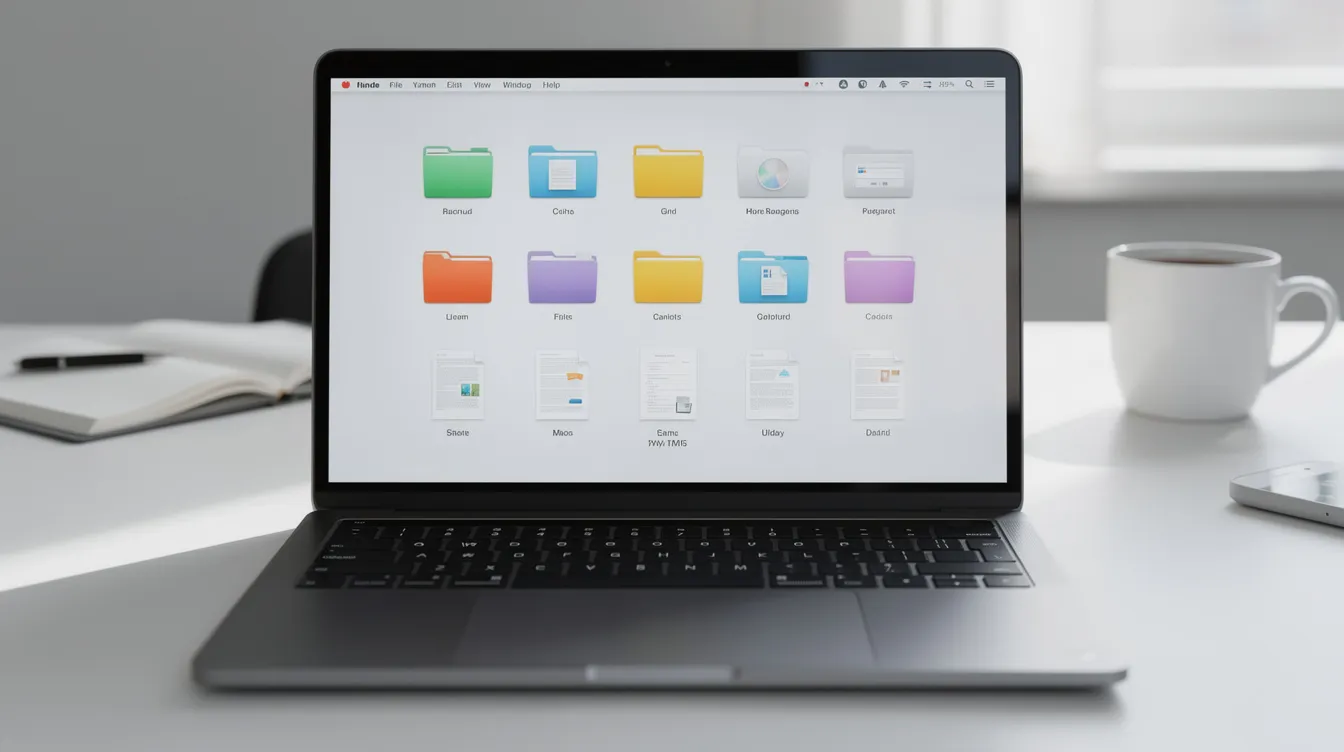
- Create a main digital folder named something like “Mudra Loan – [Bank Name] – [Year]” with subfolders for application, communication, fees, and complaints.
- Scan all key papers – application, acknowledgement, identity proof, address proof, residence proof, project report, sanction letter, receipts – using a mobile scanner app into searchable PDFs.
- Arrange everything in chronological order.
- Use a simple naming convention: “2024-06-15_Application_Acknowledgement.pdf” to make timelines clear.
- Maintain at least one cloud backup (Google Drive, OneDrive) plus one offline backup (pen drive).
- Before approaching higher forums, prepare a concise “index of documents” listing each piece of evidence with a short description.
A neatly organised evidence set reflects seriousness and often leads to better, quicker consideration of the complaint.
Evidence Required for Different Types of Complaints
Not every authority requires the same volume of documents. Here is what is typically helpful at each level:
| Complaint Type | Key Evidence Required |
|---|---|
| Branch Manager | Application copy, acknowledgement slip, project report, brief summary of issues, relevant SMS/emails |
| Regional Office / Bank Nodal Officer | Full timeline of all emails, letters, complaint numbers, bank’s responses, fee receipts |
| RBI Integrated Ombudsman | All earlier complaint acknowledgements, written replies from bank, sanction/rejection letters, fee receipts, supporting RBI/PMMY circular extracts |
| Consumer Forum / Legal Proceedings | All of the above plus affidavits, expert opinions on project viability, certified copies, and possibly bank records obtained through formal processes |
Understanding whether banks can ignore RBI PMMY guidelines and what the mandatory responsibilities under PMMY are will help you select the right circulars to attach.
Mistakes That Weaken Your Mudra Loan Complaint
Even genuine grievances become weak when basic documentation mistakes are made:
- Relying only on verbal discussions with no follow-up email or note.
- Deleting SMS or WhatsApp chats to free phone storage.
- Failing to take an acknowledgement receipt for the application.
- Not saving receipts for processing fee or insurance.
- Misplacing rejection letters or not demanding them at all.
- Writing emotional, lengthy complaints without hard proof – dates, copies, screenshots. Concise complaints backed by clear evidence are more effective.
- Altering documents or editing screenshots. Any tampering can seriously damage credibility and may have legal consequences.
- Waiting too long. Start preserving evidence from the first visit, not after you feel cheated.
Best Practices While Dealing with Banks
These simple habits prevent disputes and automatically create strong records for any future complaint:
- Always ask the bank to communicate key decisions in writing – especially conditions about collateral, guarantor, insurance, or non-sanction reasons.
- Request stamped acknowledgements whenever you submit forms or important documents. Immediately scan or photograph those slips.
- Send polite follow-up emails after important meetings, summarising what was discussed.
- Maintain calm and professionalism. Rude behaviour or arguments distract from the core issue.
- Learn the basics of RBI/PMMY rules – such as collateral norms, timely communication rights, and processing timelines – so you can recognise a true violation worth escalating.
- Know the scheme categories and their funding limits based on your stage of business, whether micro units in manufacturing, trading, or other service sectors in India.
- Understand that apply and fill processes on digital portals should also be screenshotted at each step for continuity of your records.

Expert Advice from CA Manish Gugliya
In my 20+ years of working with MSME finance, project reports, CMA data, and Mudra loan advisory, I have seen one pattern repeatedly: applicants who maintained proper records resolved their issues faster than those who relied on repeated branch visits and verbal arguments.
In one case, a small manufacturing unit owner in Rajasthan was forced to buy insurance worth Rs 12,000 as a condition for a Kishore loan. Because he had kept the insurance receipt, the sanction letter (which did not mention insurance), and a follow-up email, his complaint to the bank’s Nodal Officer was resolved within three weeks – the insurance amount was refunded. In another instance, a trading business owner’s Tarun loan was delayed for over two months. His dated acknowledgement slip and email trail helped the RBI Ombudsman take notice and seek the bank’s response.
I must clarify the limits: evidence improves chances of fair review but does not guarantee approval, reversal, or monetary compensation in every case. Also remember that loans may be targeted for fraudulent schemes through fake approval letters, and fraudulent loan approval letters are circulated online – so verify every communication carefully.
Just as a good project report is essential at the time of applying, a good evidence file is essential if you ever need to prove a Mudra loan rule violation later.
Frequently Asked Questions
Can WhatsApp messages with bank staff be used as evidence for Mudra loan complaints?
Yes, WhatsApp messages with date-stamps can support your complaint. However, they work best as supplementary evidence alongside formal emails, letters, and receipts. Preserve original chats without editing.
Are SMS alerts from the bank valid proof of application status?
Absolutely. System-generated SMS notifications with date, time, and application references are accepted as valid evidence by the RBI Ombudsman and other authorities. Never delete them.
Should I record calls with bank officials about my Mudra loan?
Call recording laws vary by state and applicable regulations in India. Call logs (showing date, time, duration) are generally safe to use. For actual recordings, consult a legal professional before relying on them.
Can emails alone prove bank misconduct in PMMY cases?
Emails are among the strongest forms of evidence because they are time-stamped and retrievable. A clear email trail – documenting submissions, requests for reasons, and bank responses – can form the backbone of a complaint.
What if my bank refuses to give written reasons for rejecting my Mudra loan?
Send a polite email recording what you were told verbally and request written confirmation. Keep a copy. This indirect evidence helps when escalating. Under RBI guidelines, banks are expected to indicate reasons for rejection.
How long should I keep my Mudra loan documents and evidence?
Keep all documents for at least three years after loan closure or final resolution of any dispute. For ongoing or unresolved cases, preserve everything until the matter is fully settled.
Is a project report useful as evidence if the loan is rejected?
Yes. If the bank rejects citing “project not viable,” your professionally prepared project report allows any reviewer to examine whether that assessment was reasonable.
Can I still complain to RBI if I have very little evidence?
You can file a complaint, but its effectiveness depends on what you can prove. Even a few key documents – application acknowledgement, email trail, fee receipts – can make a meaningful difference.
Which 3-4 documents are most important if I cannot collect everything?
Application acknowledgement receipt, email communication with the bank, processing fee or insurance receipts (if any were charged), and the rejection or sanction letter. These four form the minimum evidence base.
What should I preserve even after my Mudra loan is sanctioned and disbursed?
Keep the sanction letter, repayment schedule, all EMI receipts, bank statement showing disbursement, and any communication about changes in interest rates or conditions. These help if post-sanction disputes arise about charges or terms.
Do fraudsters really use Mudra Ltd.’s logo to create fake documents?
Yes. Fraudsters use Mudra Ltd.’s logo to create fake documents and even use the Prime Minister’s image in scams. They circulate fake approval letters online. If you receive any message asking for upfront fees for a “pre-approved” mudra loan, it is a scam. Mudra does not sanction loans directly.
Can CCTV footage of branch visits help in serious disputes?
In rare, serious cases, branch CCTV footage may be relevant. However, obtaining it requires formal requests and is typically available only through legal or regulatory processes. Your own dated visit notes and follow-up emails are more practical and within your control.
Can evidence help if the bank keeps asking for new documents without deciding?
Yes. A clear record of every document request – with dates – is powerful evidence of deliberate delay or harassment. It helps establish that the bank violated processing timelines.
What if I suspect someone used my identity to avail a fraudulent Mudra loan?
Evidence of identity fraud for obtaining loans can indicate a violation. File a police complaint immediately. Collect copies of the forged application and documents if possible. Report to the bank and RBI. Availing a loan for a non-existent business is a violation, and investigations are handled by police and CBI.
Conclusion
In mudra loan disputes, the difference between a weak complaint and a strong, evidence-backed case is almost always the quality of documentation maintained by the applicant. Whether it is a simple delay, an unauthorized charge, or a serious fraud, proper records make your complaint credible and actionable.
Start collecting and organising evidence – application copies, acknowledgements, project reports, emails, SMS, fee receipts – from the very first interaction with the bank. Do not wait for a dispute to arise.
Review your current records today. Fill any gaps. Follow the best practices shared in this article. Systematic documentation is fully under your control and is your strongest tool for ensuring fair treatment under Pradhan Mantri Mudra Yojana.
- Mudra Loan Illegal Bank Practices: Complete Guide to Identify, Prevent & Report Unfair Banking Practices


- Can Banks Change Mudra Loan Terms Without Informing the Applicant?
- Red Flags That Indicate Unfair Bank Practices in Mudra Loans: Warning Signs Every Applicant Should Know

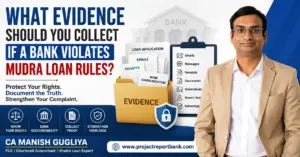
- What Evidence Should You Collect If a Bank Violates Mudra Loan Rules?
- How to Report Illegal Bank Practices in Mudra Loans
- How to Protect Yourself from Illegal Bank Practices in Mudra Loans
- How to Identify Illegal Bank Practices During the Mudra Loan Process
- Is It Legal for Banks to Delay Mudra Loan Processing Without Reason?
- Are Banks Allowed to Charge Unauthorized Fees for Mudra Loans? Complete Guide by CA Manish Gugliya