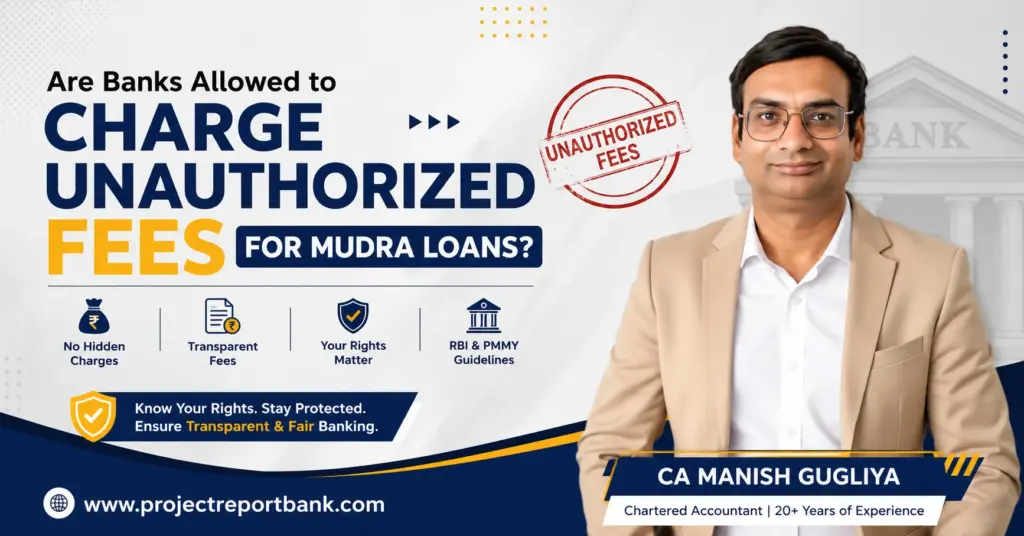
Key Takeaways
- Pradhan Mantri Mudra Yojana (PMMY) loans are not “completely free,” but every charge must be clearly disclosed in writing by the bank or financial institution before you pay anything.
- Unauthorized fees for mudra loans – such as cash demands without receipt, “speed money,” compulsory consultancy, or forced product purchases – are major red flags indicating a scam or misconduct.
- RBI and PMMY expect full transparency: written sanction letters, proper receipts for every rupee, and a clear schedule of charges displayed at every branch.
- Genuine charges like processing fee, stamp duty, and documentation cost will always appear in your sanction letter and loan agreement. If a fee is not written there, question it.
- This guide is written by CA Manish Gugliya (FCA) for ProjectReportBank.com, based on 20+ years of practical experience in MSME finance and Mudra Loan consultancy.
Introduction: Why Mudra Loan Applicants Get Confused About Fees
Imagine this: a shopkeeper in 2024 applies for a ₹2 lakh Mudra Loan at a nearby branch. Just before the file moves forward, someone at the bank asks for ₹3,000 in cash as a “file charge.” No receipt. No written mention. The shopkeeper is confused – is this normal?
This is more common than you think.
The scheme was launched on 8th April 2015 by the Prime Minister under pradhan mantri mudra yojana to provide financial assistance to micro enterprises in non-farm sectors. MUDRA – which mudra stands for Micro Units Development and refinance agency – does not lend directly to individual borrowers. Instead, loans are available through various financial institutions like banks, NBFCs, and small finance banks. Mudra Yojana offers loans up to ₹20 lakh for businesses, with no collateral required for loans up to ₹10 lakh under PMMY.
Some fees are officially allowed. Many are not. This article helps you tell the difference – so you protect your money, your business, and your rights.
Here is what we will cover: what unauthorized fees actually mean, which charges banks can legally collect, which ones are suspicious, how RBI and PMMY protect you, 10 real-world situations you may face, how to verify charges, and what to do if something feels wrong.

Table of Contents
What Are Unauthorized Fees in a Mudra Loan?
An unauthorized fee is any money linked to a Mudra Loan that is not written in the bank’s official rules, your sanction letter, or the published schedule of charges.
These can take many forms:
- Cash taken without a receipt
- Money sent to someone’s personal account or UPI ID
- An extra “service fee” not in any bank document
- Forced purchase of a product as a condition for loan approval
- Amounts silently deducted from the loan amount at disbursal without prior disclosure
Even if a bank staff member says “this is compulsory,” if there is no written bank circular or entry in your sanction letter, it may be unauthorized.
Unauthorized fees for mudra loans are a major red flag indicating a scam. Scammers use fake approval letters and websites to demand unauthorized fees. Fraudsters run lookalike web domains pretending to represent the Mudra Yojana. Any communication containing spelling or grammatical errors is likely fraudulent.
| Authorized Fees | Unauthorized Fees | |
|---|---|---|
| Source | Written in sanction letter, bank policy | Verbal demand, no documentation |
| Payment Mode | Bank counter, cheque, digital to bank account | Cash, personal UPI, private account |
| Receipt | Official bank receipt or challan issued | No receipt, or informal slip |
| Examples | Processing fee, stamp duty, documentation | “Speed money,” file movement charge, forced consultancy |
What Charges Can Banks Legally Collect on Mudra Loans?
There is no single fixed fee list for all lenders. Each bank, NBFC, or small finance banks branch has its own product policy within the RBI framework. Here is what can be legitimate:
Processing fee: Many banks offer Mudra loans with nil or low processing fees. Processing charges for Shishu loans are often waived by banks. For Kishore and Tarun loans, some banks may charge a small percentage as per their board-approved policy. Upfront fees may be charged by banks for Mudra loans only if clearly disclosed. You can read more about this in the guide on Mudra Loan processing charges.
Documentation charges: Nominal fees for loan agreement papers, stamping, and file preparation. Must appear in the sanction letter.
Stamp duty and government charges: These are statutory – paid to government as per State laws. Not bank income. Always ask for a government receipt or invoice, including any property tax receipt where applicable.
Insurance: Credit life or asset insurance can be offered. It should be optional, transparent, and with a separate policy document. Read more about forced insurance with Mudra Loan.
Third-party charges: For larger Tarun or Tarun Plus loans, valuation, inspection, or legal opinion charges may apply if actually used and billed with proof.
Late payment penalty: If you miss an EMI, a penalty may apply – but it must be pre-disclosed in the loan agreement.
Interest rates for Mudra loans are determined by Member Lending Institutions, not by a central government order.
Loans under PMMY are divided into four categories:
- Shishu loans cover amounts up to ₹50,000
- Kishore loans range from ₹50,001 to ₹5 lakh
- Tarun loans range from ₹5 lakh to ₹10 lakh
- Tarun Plus loans cover amounts from ₹10 lakh to ₹20 lakh (for borrowers who have successfully repaid previous loans)
No collateral is required for loans up to ₹10 lakhs under PMMY. For more, see Can banks demand collateral for Mudra Loans?
| Charge | Official? | Receipt Required? | Applicant Should Verify? |
|---|---|---|---|
| Processing fee | Yes, if in sanction letter | Yes | Check percentage, compare with bank website |
| Documentation charges | Yes, if disclosed | Yes | Must appear in agreement |
| Stamp duty | Yes (government charge) | Yes (govt receipt) | Confirm with State rates |
| Insurance premium | Yes, if voluntary and explained | Yes (policy document) | Confirm it is optional |
| Inspection/valuation | Yes, for larger loans if used | Yes (third-party invoice) | Ask for break-up before paying |
| Late payment penalty | Yes, if pre-disclosed | Yes | Confirm rate in loan document |
| “File charge” in cash | No | N/A | Refuse immediately |
Which Charges May Be Considered Unauthorized in Mudra Loans?
PMMY itself never appoints agents or middlemen. No individuals or agents are authorized to collect fees to arrange a Mudra loan. Genuine MUDRA loans do not involve agents or intermediaries. MUDRA acts as a refinancing institution and does not lend directly to individuals.
Here are charges you should treat as suspicious:
- “Speed money” to pass the file faster – no bank policy supports this
- Cash “approval fee” or “signature fee” for the manager
- Compulsory consultancy charges where the bank forces you to use a specific consultant for your project report, with a fixed fee, as a condition for sanction
- “File movement” or “token” charges taken in cash without any bank receipt
- Forced cross-selling – being told your loan will only pass if you buy insurance, a mutual fund, or a policy from the bank
- Hidden documentation or inspection fees added after sanction that were never mentioned before
Never pay upfront fees for loan processing as real banks do not request such payments. Official bank channels do not ask for upfront fees for loan approvals. The demand for any upfront fee for a Mudra loan is a scam.
Warning signs to watch for:
- Payment asked in cash only, no receipt
- Payment to a personal UPI ID or private bank account
- Instruction to “not mention this to anyone”
- Fear-based statements like “otherwise your loan will be rejected”
- Terms are only verbal, nothing in writing
Reports have confirmed that fake letters promising ₹5 lakh Mudra loans in exchange for just ₹2,550 “processing fee” are outright fraud.

RBI and PMMY Expectations on Transparency and Fair Charges
Both the Reserve Bank of India and the mantri mudra yojana pmmy framework focus on fair treatment and full transparency for small borrowers.
The Reserve Bank of India mandates that all loan-related charges must be disclosed upfront. Banks must display key charges on their notice boards and websites. Sanction letters and loan documents must clearly list all applicable charges – not just verbally.
RBI’s Fair Practices Code expects banks to disclose all fees upfront, issue receipts for every payment, avoid mis-selling, and communicate in simple language. For a deeper understanding, read about mandatory RBI & PMMY guidelines for banks.
Since PMMY loans target micro and small units with low financial literacy, unreasonable or surprise charges go against the very spirit of this flagship scheme. If banks violate these norms, systemic violations can be escalated. The related topic Can banks ignore RBI & PMMY guidelines? covers this in detail.
The good news: if you follow the steps in this guide, most fee issues get resolved at branch or bank grievance level without complex litigation.
Common Situations Faced by Mudra Loan Applicants (With Practical Responses)
Below are 10 real-world situations from Mudra Loan processing. Each covers why it happens, whether it is appropriate, and what you should do.
Bank asks for cash without receipt
A staff member asks for ₹2,000–₹5,000 in cash “to open the file” for a Shishu or Kishore loan. Any payment without an official bank receipt or entry in your account is highly suspicious and should be refused. Tell the bank you will pay only through the official counter and only after seeing written charge details in the sanction letter.
Asked to pay compulsory consultancy fee
Some branches insist you use a fixed consultant for your project report or CMA data and demand a fixed fee as a condition for sanction. While professional help is useful, it should be the borrower’s free choice. If this fee does not appear in any bank circular or schedule of charges, treat it as potentially unauthorized.
Told that approval requires “extra payment”
Staff or agents hint that “head office will not pass the loan unless you pay something extra.” Mudra Loan appraisal should be assessed based on eligibility, documents required, and viability – not side payments. Request a written reason for any delay or rejection instead of agreeing to pay unofficial money.
Hidden inspection or valuation charges
The bank suddenly deducts a lump sum at disbursal as “inspection/valuation” without prior mention. While inspection for bigger loans can be legitimate, it must be communicated before sanction and supported by invoices. Ask for a written break-up confirming these are as per bank policy.
Insurance added without clear consent
Some borrowers find an insurance premium bundled into the loan amount without being asked. Cross-selling must be transparent and not compulsory. Ask for the policy copy, premium amount, and your right to choose or refuse before agreeing.
Processing fee not explained in advance
A borrower learns about a 1% processing fee only on the day of disbursal. Processing fee, if any, should be mentioned at application stage and confirmed in the sanction letter. Sudden surprises are not good practice.
Asked to buy investment or insurance products
Staff say “you must buy this SIP or policy, otherwise your loan may be delayed.” Linking unrelated products to loan approval is against fair banking spirit, especially for small pmmy loans borrowers. Firmly but politely separate the two discussions and record in writing if you feel forced.
Unofficial demand from individual employee
One specific employee demands personal benefit, while the official sanction letter shows no extra fee. This is personal misconduct, not bank policy. Escalate to the branch manager with a written complaint.
Extra charges added after sanction
New charges appear at the documentation stage that were never in the original sanction letter. Key charges should not change after sanction without written revision and your consent. Ask for a revised sanction letter if any new official fee is genuinely required.
Applicant signs documents without reading
In a hurry, many applicants sign multiple papers without checking fee clauses, interest rates, or liability statement details. This can lead to genuine but unexpected charges that may not qualify as “unauthorized” because they were in the agreement. Always take 10–15 minutes to read key documents. Ask for help from a trusted person if needed.

How to Verify Whether a Mudra Loan Charge Is Genuine
Follow this step-by-step checklist before paying any fee:
- Ask for the written schedule of charges for mudra loans (Shishu, Kishore, Tarun) at your branch or on the bank’s website.
- Check your sanction letter for a clear list of all fees: processing, documentation, stamp duty, insurance, inspection, and late payment penalties.
- Confirm every rupee you are asked to pay appears in that letter or in an official bank circular. If it does not, treat it as suspicious.
- Pay only through bank counter, cheque, or digital modes to the bank’s official account. Never pay to a personal UPI ID or in unrecorded cash.
- Collect and safely keep all receipts, challans, and policy documents. These are your proof if you later dispute any fee.
Borrowers should apply for Mudra loans through authorized banks and financial institutions only.
| Action | Why Important | What to Keep |
|---|---|---|
| Ask for written fee schedule | Confirms official charges | Screenshot or printed copy |
| Read sanction letter carefully | Lists all applicable fees | Signed copy of sanction letter |
| Pay only via official bank modes | Creates traceable record | Bank receipt / digital confirmation |
| Collect every receipt | Proof against disputes | Receipts, challans, invoices |
| Verify with branch manager | Final authority at branch level | Written confirmation or email |
What Should You Do If You Suspect Unauthorized Fees?
Many fee issues get sorted once the borrower calmly asks the right questions and insists on written clarity. For unauthorized fees, borrowers should request a written explanation from lenders.
Step 1: Politely ask the staff to show where the fee is written – in the sanction letter, circular, or bank website. Note their reply.
Step 2: Refuse to pay any amount in cash without receipt. Offer to pay only at the counter against a system-generated receipt if the fee is proven genuine.
Step 3: If doubt remains, meet the branch manager with a simple written note explaining the demand and asking for clarification.
Step 4: If not resolved, write to the bank’s regional office or grievance cell. Attach copies of other documents and a clear description of events.
Step 5: For serious or repeated issues, explore higher complaint channels. Learn more in What happens if a bank violates RBI or PMMY guidelines?
Escalation flowchart:
Doubt about Fee → Ask for Written Proof → Escalate to Branch Manager → File Written Complaint with Bank Grievance Cell → Consider External Channels (Ombudsman/RBI CMS)
Common Mistakes Mudra Loan Applicants Should Avoid
| Mistake | Better Practice |
|---|---|
| Paying cash without receipt | Pay only at bank counter with official receipt |
| Believing verbal promises about fees | Ask for everything in writing |
| Signing blank or unread forms | Read every page, especially fee and interest details |
| Ignoring fee details in sanction letter | Compare sanction letter with bank’s published charges |
| Trusting unregistered agents for “sure approval” | Deal directly with authorized bank channels |
| Not keeping copies of required documents | Photocopy or photograph every document you sign |
| Not asking about address proof or identity or other documents | Confirm exactly what documents required before visiting |
Over-reliance on middlemen who claim “sure approval” and charge heavy “service money” for simple tasks like filling forms is a costly trap. Applicants must not be defaulters to any bank – maintain a satisfactory credit track record and your application process will be smoother.
Careful reading, written communication, and dealing directly with the bank are your best protections. For more, read about fair treatment during Mudra Loan processing and common misunderstandings about RBI & PMMY guidelines.
Expert Advice from CA Manish Gugliya (FCA)
In my 20+ years of working with MSME finance and Mudra Loan cases across different banks, I have seen how even small unauthorized fees can seriously hurt a micro borrower’s cash flow. A ₹2,000 hidden charge on a ₹50,000 Shishu loan is 4% of the loan amount – that is real money for a small entrepreneur.
Here are my core principles:
- Always ask questions. No question is too small when your money is at stake.
- Never feel shy to seek written clarification. A good bank welcomes informed borrowers.
- Never pay unofficial fees. If it is not in your sanction letter, it is not your obligation.
- Keep copies of every communication and document. This includes your voter’s id card copy, address proof, educational qualification documents, and every receipt the bank gives you.
- Understand your rights. Even as a small customer, you have strong Mudra Loan applicant rights.
Whether you are in manufacturing, trading, services, or any proposed activity covered under PMMY – if you possess the necessary skills and knowledge to undertake your business, no one should stand between you and your rightful funding by demanding unofficial money.
At ProjectReportBank.com, we help entrepreneurs prepare proper project reports and understand the application process and required documents without any connection to bank staff or unofficial payments. We are your knowledge partner – nothing more, nothing less.

Frequently Asked Questions (Mudra Loan Fees & Transparency)
Are Mudra Loans completely free of cost?
- Small shishu loans often have no processing fee, but other legal forms of charges like stamp duty, documentation, and optional insurance may still apply.
- “No hidden cost” means all charges must be shared in writing – not that the loan is always 100% free.
- Businesses must be engaged in non-farm income-generating activities. Agricultural businesses are not eligible for Mudra loans.
- Mudra loans are available for non-farm income generating activities in nature across manufacturing, trading, and services.
Do all banks charge the same Mudra Loan interest rate and fees?
- No. Interest rates and official fees depend on each bank’s policy within RBI rules, the borrower’s credit profile, and the loan category.
- Eligible borrowers include individuals and partnership firms, as well as non corporate and other legal forms of micro enterprises.
- It is advised that borrowers compare offers from 2–3 banks or financial institution options including small finance banks before finalising. Each lender’s details on applicable charges and interest may differ.
What if I already paid an unofficial fee for my Mudra Loan?
- First, collect any proof available: bank messages, WhatsApp chats, witnesses, and payment slips.
- Write a calm, factual complaint to the branch manager explaining that payment was taken without receipt or sanction letter entry.
- If unresolved, escalate to the bank’s grievance cell or higher. The ministry overseeing the scheme and the government expect that every rupee is accounted for.
Can I refuse to buy insurance or other products with my Mudra Loan?
- Banks can suggest insurance or security products, but it should not be a hidden condition for loan approval.
- Ask whether the product is compulsory as per any written rule. If not, you can politely decline or choose another insurer.
- No one can force you to buy assets or investments to get your loan sanctioned. Benefits of the scheme should not be conditional on purchasing unrelated products.
Where can I get help understanding documents required and charges before applying?
- You can study PMMY details on official portals. The Department of Financial Services annual report has comprehensive data – as of January 2025, over 51.41 crore mudra loans have been sanctioned worth approximately ₹32.36 lakh crore, with about 68% going to women entrepreneurs.
- At stage of application, understanding your project report, CMA data, and what documents like identity proof, address proof, and a liability statement are needed can reduce delays.
- ProjectReportBank.com covers everything from documents required to the application process – helping you expand your business with proper preparation, so no one can misuse your lack of knowledge to demand extra money. The subsidy and credit aspects of the scheme are covered in detail across our guides for every eligible applicant seeking to availed this government flagship scheme and undertake their proposed activity in India.
Conclusion
Mudra Loans under Pradhan Mantri Mudra Yojana are designed to help micro and small businesses grow. But as a borrower, you must stay alert about fees.
Not every charge is illegal. Genuine charges will always be disclosed in writing, supported by receipts, and aligned with bank and RBI guidelines. Any charge that fails these simple tests deserves your questions.
Never pay unofficial money. Never pay without a receipt. Read your documents carefully. Use the formal complaint route if something feels wrong.
Explore more Mudra Loan guides on ProjectReportBank.com – including guides on extra documents for Mudra Loan, processing charges, and applicant rights – to protect your business and your money.
About the Author: CA Manish Gugliya (FCA) is a Chartered Accountant with over 20 years of practical experience in Project Reports, CMA Data, MSME Finance, Business Loans, and Mudra Loan consultancy. Through ProjectReportBank.com, he helps entrepreneurs understand loan procedures, interest rate structures, application processes, required documents, and banking practices with practical, experience-based guidance – protecting micro borrowers from confusion and unofficial fee demands.
- Mudra Loan Illegal Bank Practices: Complete Guide to Identify, Prevent & Report Unfair Banking Practices


- Can Banks Change Mudra Loan Terms Without Informing the Applicant?
- Red Flags That Indicate Unfair Bank Practices in Mudra Loans: Warning Signs Every Applicant Should Know

- What Evidence Should You Collect If a Bank Violates Mudra Loan Rules?
- How to Report Illegal Bank Practices in Mudra Loans
- How to Protect Yourself from Illegal Bank Practices in Mudra Loans
- How to Identify Illegal Bank Practices During the Mudra Loan Process
- Is It Legal for Banks to Delay Mudra Loan Processing Without Reason?
- Are Banks Allowed to Charge Unauthorized Fees for Mudra Loans? Complete Guide by CA Manish Gugliya