
Introduction
Getting a Mudra Loan should be a transparent and fair process, but many applicants face unexpected challenges during their loan journey. Some banks or officials may ask for unnecessary documents, demand unauthorized charges, insist on collateral where it may not be applicable, delay applications without proper reasons, or even change loan terms without informing the applicant. While banks have the right to assess loan eligibility and credit risk, every action must follow RBI regulations and Pradhan Mantri Mudra Yojana (PMMY) operational guidelines. Understanding the difference between a legitimate banking procedure and an illegal banking practice is the first step toward protecting your rights.
Why Do Some Mudra Loan Applicants Face Unfair Treatment?
Not every loan rejection or delay is illegal. Banks are allowed to verify documents, evaluate business viability, assess repayment capacity, and conduct due diligence before approving a loan. However, problems arise when applicants experience actions that go beyond these legitimate procedures, such as hidden charges, unjustified delays, misleading information, or behaviour that violates established banking norms. Recognizing these situations helps applicants respond appropriately instead of assuming every banking decision is either completely fair or completely unlawful.
Legal Banking Procedures vs. Illegal Bank Practices
A lawful banking procedure is based on transparent rules, proper documentation, and objective credit assessment. In contrast, an illegal or unfair banking practice may involve actions that lack transparency, ignore applicable guidelines, or place unreasonable demands on the applicant. Knowing this distinction helps borrowers understand when they should cooperate with the bank and when they should seek clarification, raise a grievance, or escalate the matter through the appropriate channels.
How RBI & PMMY Guidelines Help Protect Applicants
The Reserve Bank of India (RBI) issues regulatory directions for banks, while PMMY guidelines provide the operational framework for Mudra Loans. Together, these guidelines promote fair lending practices, transparency, proper communication, and responsible customer service. Although these guidelines do not guarantee loan approval, they help ensure that applicants are treated fairly and consistently throughout the loan process.
Your Complete Learning Library on Illegal Bank Practices
This cluster page serves as your complete learning hub for understanding Mudra Loan Illegal Bank Practices. It brings together detailed guides on identifying unfair practices, recognizing warning signs, dealing with unauthorized fees, understanding collateral rules, handling unreasonable delays, collecting evidence, reporting violations, protecting your rights, and responding to unprofessional behaviour by bank officials. Whether you are applying for a new Mudra Loan or facing issues with an existing application, this library will help you understand your rights and navigate the process with greater confidence.
Find the Right Guide for Your Mudra Loan Bank Problem
Select the issue you are facing to read the relevant detailed guide on illegal, unfair, or unprofessional bank practices related to Mudra Loans.
What You’ll Learn About Mudra Loan Illegal Bank Practices
This guide will help you understand how to identify unfair banking conduct, protect your rights, preserve evidence, and take appropriate action when a bank does not follow applicable Mudra Loan procedures.
How to Identify Illegal Practices
Learn how to distinguish normal banking procedures from unfair, misleading, or potentially improper practices.
When a Bank Crosses Legal Limits
Understand when a bank’s conduct may go beyond reasonable verification, internal policy, or permitted lending procedures.
Which Charges May Be Unauthorized
Identify hidden, unexplained, unofficial, or improperly disclosed charges connected with a Mudra Loan application.
What Evidence You Should Keep
Know which documents, receipts, messages, emails, letters, and records may support your complaint or escalation.
How to File a Complaint
Follow a practical escalation process through the branch, grievance officer, nodal officer, and other appropriate complaint channels.
How to Protect Yourself
Use simple preventive steps before, during, and after the application process to reduce the risk of unfair treatment.
Your Rights Under RBI and PMMY Guidelines
Understand the role of RBI regulations and PMMY operational guidelines in promoting transparent, fair, and responsible lending practices.
Understanding Illegal Bank Practices in Mudra Loans
Many Mudra Loan applicants assume that every loan rejection, document request, or processing delay is an example of unfair treatment. In reality, banks are expected to conduct credit appraisal, verify business details, assess repayment capacity, and follow internal lending procedures before approving any loan. These are legitimate banking activities. However, when a bank acts without transparency, makes unreasonable demands, or does not follow applicable regulations and established procedures, applicants may encounter practices that are considered unfair or inappropriate. Understanding this distinction helps borrowers make informed decisions and take the right action whenever necessary.
What Are Illegal Bank Practices in Mudra Loans?
Illegal or unfair bank practices are actions that go beyond normal banking procedures and may violate applicable banking regulations, PMMY operational guidelines, or principles of fair customer service. Such practices can create unnecessary obstacles for applicants and reduce transparency in the lending process.
Examples may include:
Demanding unauthorized or unexplained charges.
Changing loan terms without informing the applicant.
Requesting collateral where it may not be applicable.
Causing unreasonable delays without proper communication.
Providing misleading information about eligibility or documentation.
Displaying unprofessional or discriminatory behaviour during the loan process.
It is important to note that every complaint must be assessed based on the specific facts and circumstances of the case.
Banking Policy vs. Bank Misconduct
Applicants often confuse a bank’s internal lending policy with misconduct. A bank is permitted to follow its approved credit appraisal process, assess business viability, verify documents, and decide whether an applicant satisfies its lending criteria. These actions are part of responsible lending and should not automatically be viewed as unfair.
Bank misconduct, however, occurs when officials fail to follow proper procedures, communicate inaccurately, demand unofficial payments, ignore applicable rules, or treat applicants unfairly. Understanding this difference prevents unnecessary disputes and helps borrowers identify situations that genuinely require clarification or escalation.
| Legitimate Banking Policy | Potential Bank Misconduct |
|---|---|
| Credit appraisal | Hidden or unauthorized charges |
| Business verification | Unreasonable processing delays without communication |
| Document verification | Changing loan conditions without notice |
| Risk assessment | Misleading or incorrect information |
| Eligibility evaluation | Unprofessional or discriminatory behaviour |
Genuine Loan Rejection vs. Illegal Conduct
Receiving a Mudra Loan rejection does not automatically mean the bank has acted improperly. A bank may decline an application because the business is financially weak, documentation is incomplete, repayment capacity is inadequate, eligibility conditions are not met, or the overall credit assessment indicates a higher lending risk.
Illegal conduct is different. It involves actions unrelated to genuine credit assessment, such as demanding unofficial payments, imposing unauthorized conditions, or failing to provide transparent communication during the application process. Applicants should evaluate whether the issue relates to a legitimate lending decision or to the manner in which the process has been handled.
Common Misconceptions Among Mudra Loan Applicants
Many applicants misunderstand how the Mudra Loan process works, which often leads to unnecessary confusion or complaints. Clearing these misconceptions helps borrowers approach the application process more confidently.
Misconception 1: Every Mudra Loan application must be approved.
No. Every application is subject to independent credit appraisal, document verification, business assessment, and the bank’s lending policy.
Misconception 2: Every processing delay is illegal.
Not necessarily. Delays caused by verification, document deficiencies, or additional credit assessment may be reasonable. Only unexplained or excessive delays may raise concerns.
Misconception 3: Every additional document request is unfair.
Banks may request additional information if it is reasonably required to assess the application. Such requests should be relevant and properly explained.
Misconception 4: Every disagreement with the bank is misconduct.
Differences in lending decisions do not automatically amount to illegal behaviour. Applicants should distinguish between a legitimate credit decision and an improper banking practice.
Misconception 5: RBI or PMMY guidelines guarantee loan approval.
No. These guidelines promote transparency, fair procedures, and responsible lending, but they do not guarantee that every applicant will receive a Mudra Loan.
Why Understanding This Difference Is Important
Knowing the difference between a legitimate banking procedure and an illegal bank practice helps applicants respond appropriately at every stage of the Mudra Loan process. Instead of assuming that every difficulty is unfair, borrowers can identify genuine issues, maintain proper records, communicate effectively with the bank, and pursue the appropriate grievance mechanism when necessary. This understanding not only protects applicants’ rights but also contributes to a more transparent and informed borrowing experience.
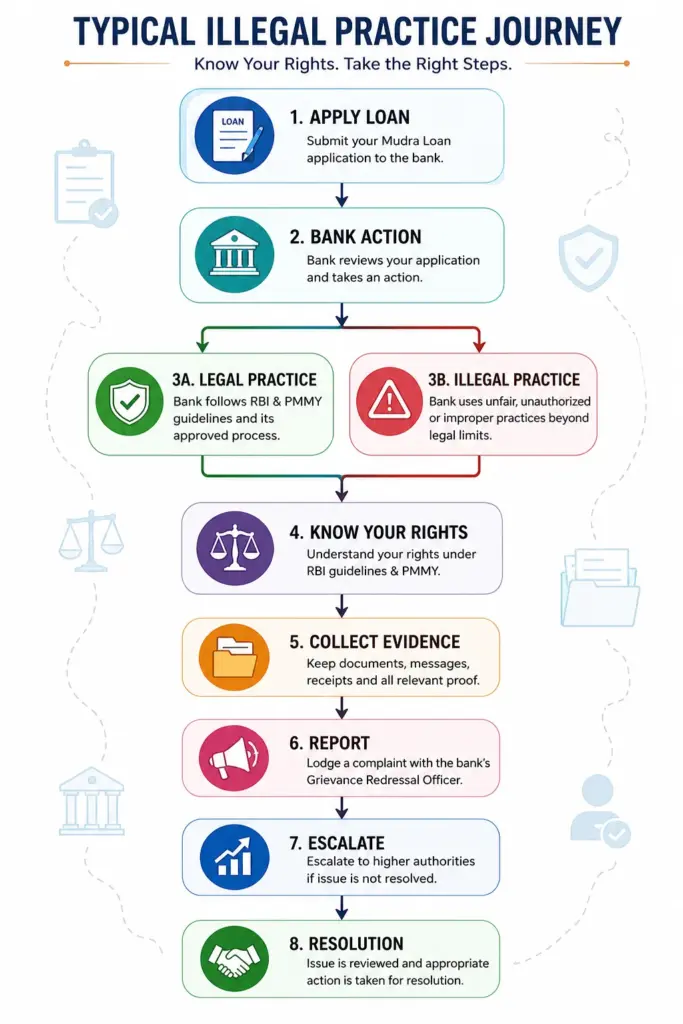
Understanding the Typical Illegal Practice Journey
Every Mudra Loan application follows a series of steps, beginning with loan submission and ending with approval or rejection. In most cases, banks follow transparent procedures for document verification, credit assessment, and eligibility evaluation. However, if an applicant encounters unfair treatment, unauthorized demands, unexplained delays, or improper conduct during the process, it is important to respond systematically rather than emotionally. The infographic below illustrates the typical journey of a Mudra Loan applicant, showing how to distinguish between legitimate banking practices and potential illegal practices, understand your rights, collect supporting evidence, report the issue through appropriate channels, escalate the complaint if necessary, and work towards a fair resolution. Following these steps can help applicants protect their rights while ensuring that their concerns are addressed through the proper grievance mechanism.
Most Common Illegal Bank Practices in Mudra Loans
Not every delay, document request, or loan rejection is illegal. However, some banking actions may become unfair when they involve hidden charges, unreasonable demands, poor communication, unauthorized conditions, or improper conduct. Explore the guides below to understand the most common problem areas and the appropriate steps you can take.
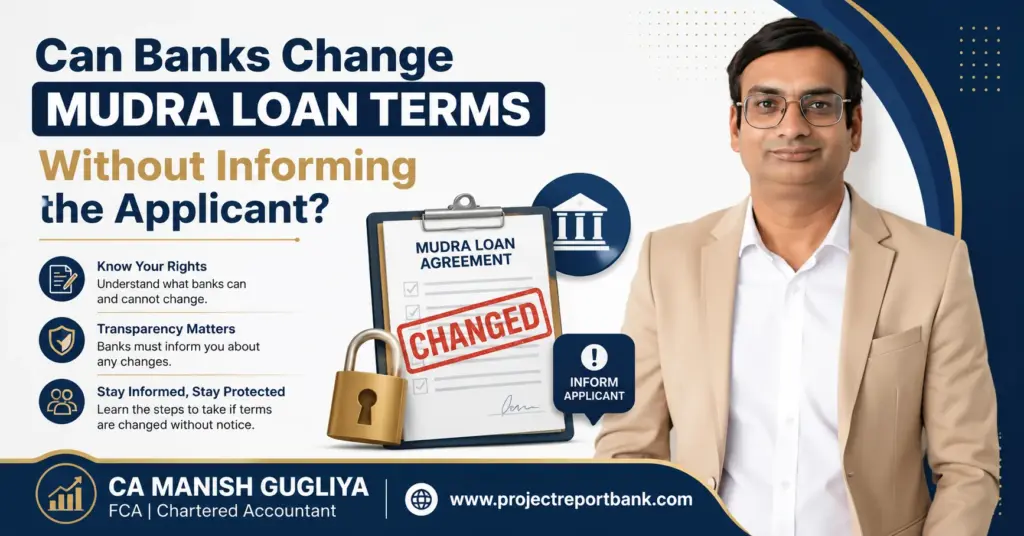
Bank Changes Mudra Loan Terms Without Notice
A bank may revise certain conditions during appraisal when supported by credit assessment or policy. However, applicants should be clearly informed before accepting revised interest rates, repayment terms, sanctioned amounts, charges, or other important conditions. Unexpected changes without proper explanation can create confusion and financial risk. This guide explains how to review the original communication, request written clarification, compare revised terms, and raise a grievance where necessary.
Read More →Warning Signs of Unfair Banking Practices
Early warning signs may include verbal-only instructions, refusal to provide receipts, pressure to purchase unrelated products, repeated demands without written clarification, misleading statements, or unexplained changes in the application process. One red flag does not automatically prove misconduct, but several warning signs should not be ignored. This guide helps applicants recognise questionable conduct, verify the bank’s position, maintain proper records, and decide when a formal complaint may be appropriate.
Read More →Unauthorized or Unexplained Mudra Loan Charges
Applicants should understand every fee connected with their Mudra Loan application. A charge may raise concern when it is unofficial, not properly disclosed, unsupported by a receipt, or collected through a personal account. Applicants should never assume that every fee is illegal, because some legitimate processing or service charges may apply. This guide explains how to verify charges, request a fee breakdown, preserve payment evidence, refuse unofficial demands, and report suspected unauthorized collections.
Read More →Improper Demand for Collateral or Security
Mudra Loan applicants may become concerned when a bank asks them to provide property, fixed deposits, or other security. Before treating such a request as improper, the applicant should confirm the loan structure, applicable scheme conditions, and whether the bank is referring to collateral or another form of support. This guide explains how to seek written clarification, understand the distinction between collateral and guarantee arrangements, and challenge unreasonable security demands through the appropriate channel.
Read More →Unprofessional Behaviour by Bank Officials
Rude communication, dismissive responses, humiliation, repeated refusal to explain requirements, or inappropriate pressure can make the Mudra Loan process difficult for applicants. A difference of opinion is not automatically misconduct, but applicants are entitled to respectful, transparent, and professional communication. This guide explains how to remain calm, record important interactions, request written responses, approach the branch manager or grievance officer, and escalate serious instances of unprofessional behaviour.
Read More →Unreasonable or Unexplained Processing Delay
A Mudra Loan application may take time because the bank must verify documents, examine credit history, assess business viability, and complete internal approvals. Such delays are not automatically illegal. Concern may arise when the application remains pending without updates, documents are repeatedly requested without explanation, or officials refuse to communicate its status. This guide helps applicants distinguish normal processing time from an unreasonable delay and follow up through written reminders and grievance channels.
Read More →How to Identify Illegal Bank Practices
Not every loan delay, rejection, or document request is illegal. The concern arises when a bank demands unofficial payments, changes terms without notice, gives misleading information, or refuses to explain its actions in writing.
To understand the warning signs and distinguish normal banking procedures from unfair conduct, read our detailed guide:
👉How to Identify Illegal Bank Practices During the Mudra Loan Process
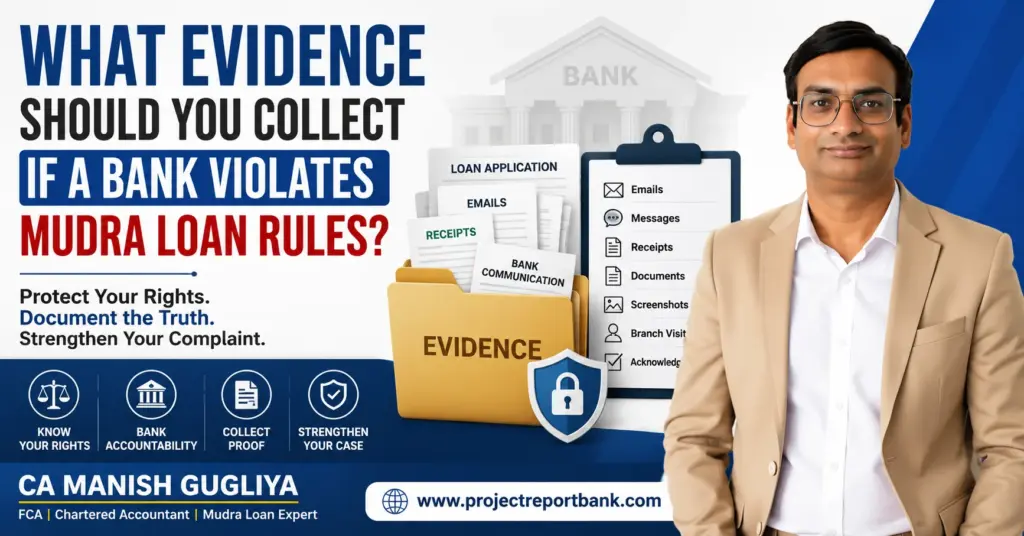
What Evidence Should You Collect?
If you believe a bank has acted unfairly during the Mudra Loan process, collecting proper evidence is essential before filing a complaint. Keep copies of all emails, SMS messages, WhatsApp chats, loan application receipts, fee payment receipts, bank letters, and any written communication received from the bank. Where legally permissible and relevant, CCTV footage or witness statements may also help support your case. Maintaining a complete record of these documents makes it easier to explain the issue and seek appropriate resolution through the bank’s grievance process.
To learn what evidence is most useful and how to organize it effectively, read our detailed guide:
👉 What Evidence Should You Collect If a Bank Violates Mudra Loan Rules?
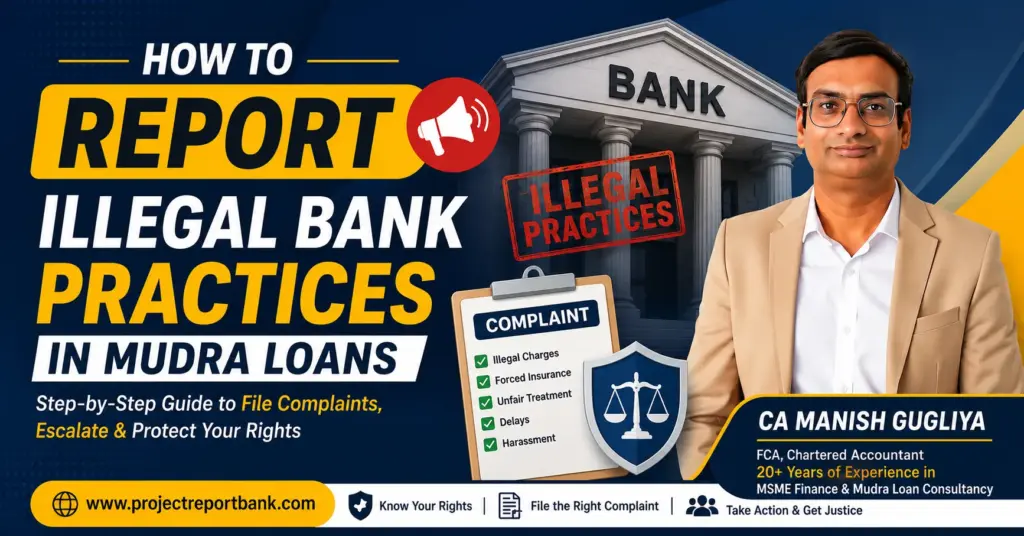
How to Report Illegal Bank Practices
If you suspect unfair or improper conduct during the Mudra Loan process, follow the appropriate grievance escalation process instead of immediately pursuing legal action. Start by seeking clarification from the bank and escalate the matter only if it remains unresolved.
Reporting Hierarchy
🏦 Bank Branch
↓
🏢 Regional Office
↓
👤 Bank Nodal Officer
↓
📋 Bank Grievance Redressal Cell
↓
⚖️ RBI Integrated Ombudsman
(if applicable)
↓
🏛️ Legal Remedy
(if required)
Escalating your complaint step by step, along with supporting documents and written evidence, improves the chances of a timely and effective resolution.
For a detailed explanation of each reporting stage, complaint procedure, and best practices, read our complete guide:
How to Protect Yourself Before Applying
Preventing problems is always easier than resolving them later. Before applying for a Mudra Loan, carefully understand the eligibility criteria, keep all required documents ready, submit information accurately, insist on official receipts for every payment, preserve all written communication, and avoid relying on verbal assurances. Being informed and maintaining proper records can help you identify and address potential issues at an early stage.
For practical tips and preventive measures, read our detailed guide:
👉 How to Protect Yourself from Illegal Bank Practices in Mudra Loans
Decision Flow: Which Guide Should You Read?
Facing a Problem?
│
▼
Is it related to a Fee?
│
┌─────────┴─────────┐
│ │
Yes No
│ │
▼ ▼
Unauthorized Fee Guide Is it about Collateral?
│
┌─────────┴─────────┐
│ │
Yes No
│ │
▼ ▼
Collateral Guide Is it a Delay?
│
┌─────────┴─────────┐
│ │
Yes No
│ │
▼ ▼
Processing Delay Guide Is it Staff Behaviour?
│
┌─────────┴─────────┐
│ │
Yes No
│ │
▼ ▼
Unprofessional Behaviour Guide
│
▼
Need to File a Complaint?
│
▼
Complaint & Reporting Guide
Related Guides
Unauthorized Fee Guide: https://projectreportbank.com/unauthorized-fees-mudra-loans/
Collateral Guide: https://projectreportbank.com/demand-collateral-for-mudra-loan/
Processing Delay Guide: https://projectreportbank.com/banks-delay-mudra-loan-processing-legally/
Unprofessional Behaviour Guide: https://projectreportbank.com/mudra-loan-bank-unprofessional-behaviour/
Complaint & Reporting Guide: https://projectreportbank.com/report-illegal-bank-practices-mudra-loans/
Which Guide Should You Read?
Use this decision matrix to find the most relevant guide for the Mudra Loan problem you are facing.
| If your problem is... | Read this guide |
|---|---|
| Terms changed | Terms Changed Without Notice |
| Extra charges | Unauthorized Fees |
| Illegal collateral demand | Demand Collateral |
| Staff behaviour | Unprofessional Behaviour |
| Processing delay | Processing Delay |
| Unsure whether the practice is illegal | Identify Illegal Practices |
| Need proof or supporting documents | Evidence Guide |
| Want to file a complaint | Report Illegal Practices |
| Want to prevent problems | Protect Yourself |
| Want to identify warning signs | Red Flags Guide |
Common Illegal Practices at Different Loan Stages
Illegal or unfair practices can occur at any stage of the Mudra Loan journey—from the time you make an enquiry until after the loan is disbursed. While many banking procedures are legitimate and part of the normal credit appraisal process, applicants should remain alert to actions such as unauthorized charges, unexplained delays, sudden changes in loan terms, improper collateral demands, or unprofessional behaviour.
The stage-wise navigation below helps you quickly identify the most relevant guide based on where you are in the Mudra Loan process. Simply locate your current stage and explore the recommended articles for detailed guidance.
| Loan Stage | Common Issues | Recommended Guide |
|---|---|---|
| Before Application |
• Unauthorized charges • Warning signs of unfair practices • How to protect yourself |
Unauthorized Fees Red Flags Guide Protect Yourself |
| During Verification |
• Unprofessional behaviour • Unsure whether practices are legal |
Unprofessional Behaviour Identify Illegal Practices |
| During Sanction |
• Terms changed without notice • Illegal collateral demand |
Terms Changed Without Notice Demand Collateral |
| During Documentation |
• Extra charges • Need evidence |
Unauthorized Fees Evidence Guide |
| During Disbursement |
• Processing delay • Terms changed before release |
Processing Delay Terms Changed Without Notice |
| After Disbursement |
• Need to complain • Collect evidence • Future protection |
Report Illegal Practices Evidence Guide Protect Yourself |
Expert Advice by CA Manish Gugliya
With over 20 years of practical experience in MSME finance, project reports, and Mudra Loans, I have found that most disputes can be avoided through proper documentation, clear communication, and awareness of your rights. If you face any issue during the Mudra Loan process, follow these practical recommendations before taking further action.
Stay Calm
Remain professional and avoid unnecessary arguments. A calm approach helps resolve issues more effectively.
Keep Everything in Writing
Request written communication whenever possible and preserve emails, SMS, WhatsApp messages, and official letters.
Never Pay Unofficial Charges
Only make payments through official banking channels and always insist on a proper receipt.
Understand RBI & PMMY Rules
Knowing the applicable guidelines helps you identify whether a bank's action is a normal procedure or requires clarification.
Preserve Every Document
Maintain copies of your application, acknowledgements, fee receipts, bank letters, and all supporting documents.
Escalate Systematically
Follow the proper grievance hierarchy—from the branch level to higher authorities—before considering legal remedies.
The strongest protection for every Mudra Loan applicant is proper documentation, written communication, and awareness of banking procedures. Before assuming misconduct, seek clarification, preserve evidence, and follow the appropriate grievance process step by step.
Mudra Loan Illegal Bank Practices: Complete Guide to Identify, Prevent & Report Unfair Banking Practices
Introduction Getting a Mudra Loan should be a transparent and fair process, but many applicants face unexpected challenges during their loan journey. Some banks or officials may ask for unnecessary documents, demand unauthorized charges, insist on collateral where it may not be applicable, delay applications without proper reasons, or even change loan terms without informing […]
Can Banks Change Mudra Loan Terms Without Informing the Applicant?
Key Takeaways Generally, a bank cannot silently change final Mudra Loan terms after you have accepted and signed the loan agreement. Any change should be communicated in writing and usually needs your consent. Introduction: Why Mudra Loan Applicants Get Confused About Changing Terms I am CA Manish Gugliya (FCA), and in over 20 years of […]

Red Flags That Indicate Unfair Bank Practices in Mudra Loans: Warning Signs Every Applicant Should Know
Key Takeaways Most banks follow proper rules when processing Mudra loan applications. But some behaviours during the process can signal unfair bank practices that every applicant should recognize early. Introduction: Mudra Loans, Bank Behaviour, and Why Warning Signs Matter Mudra loans fall into categories called Shishu (up to ₹50,000), Kishore (up to ₹5 lakh), and […]
What Evidence Should You Collect If a Bank Violates Mudra Loan Rules?
Key Takeaways Introduction: Why Evidence for Mudra Loan Rule Violation Is So Important Most mudra loan applicants – especially those applying under the Shishu or Kishore categories – only realise the importance of evidence after they have already faced delay, rejection, or unfair conditions. By then, critical documents are missing, SMS messages have been deleted, […]
How to Report Illegal Bank Practices in Mudra Loans
Key Takeaways Introduction: Why Reporting Matters in Mudra Loans Many entrepreneurs applying for a mudra loan in 2026 face illegal practices – refusal to accept applications, forced insurance, or demands for cash payments – but most do not know how to report illegal bank practices in Mudra loans. Silence only allows the same behaviour to […]

How to Protect Yourself from Illegal Bank Practices in Mudra Loans
Key Takeaways This is a quick safety summary for every Mudra loan applicant. Read these points before you visit any branch. Introduction: Why Applicant Awareness Is Your First Protection Most first-time entrepreneurs in India do not fully understand how to protect yourself from illegal bank practices in Mudra loans. They walk into branches without knowing […]
Mudra Loan Bank Misconduct: What To Do When a Bank Behaves Unprofessionally
Key Takeaways Introduction: Mudra Loan Bank Misconduct and Why It Matters Mudra loan bank misconduct is something a growing number of small business owners, micro entrepreneurs, shopkeepers, and startups face every year across India. It can range from a bank manager refusing to accept your application without reason, to staff humiliating you publicly, to being […]
How to Identify Illegal Bank Practices During the Mudra Loan Process
Key Takeaways Introduction: Why Understanding Illegal Bank Practices in Mudra Loans Matters A mudra loan under PMMY offers collateral-free credit up to ₹10 lakh for micro and small business owners across three categories – Shishu (up to ₹50,000), Kishore (₹50,001–₹5 lakh), and Tarun (₹5,00,001–₹10 lakh). For many first-time entrepreneurs, this scheme is often the first […]
Is It Legal for Banks to Delay Mudra Loan Processing Without Reason?
Key Takeaways Banks can evaluate and even reject a mudra loan application, but they should not keep it pending for weeks or months without any communication or reason. Here is what every borrower should know before and after they apply for a mudra loan. Introduction: Mudra Loan Processing Delay in 2026 Many applicants across India […]

Frequently Asked Questions (FAQs)
1. What is an illegal bank practice in Mudra Loans?
An illegal bank practice refers to conduct that is inconsistent with applicable laws, regulations, or fair banking procedures, such as demanding unauthorized payments, providing misleading information, or engaging in unfair treatment during the loan process.
2. Can a bank demand collateral for a Mudra Loan?
Whether collateral may be required depends on the applicable scheme guidelines and the nature of the loan. Applicants should always ask the bank for written clarification regarding any security requirement.
3. Can banks charge hidden or unauthorized fees?
Banks should clearly disclose applicable charges. If you are asked to pay an unexplained fee or a payment without an official receipt, seek clarification before making the payment.
4. Can a bank delay Mudra Loan processing indefinitely?
Banks may require time for verification and appraisal, but applicants can request updates and written clarification if there is an unusually long delay without explanation.
5. How do I identify unfair treatment by a bank?
Warning signs may include unofficial payment demands, repeated unexplained delays, refusal to provide written communication, or sudden changes in loan terms without proper explanation.
6. Can I file a complaint with the RBI?
Depending on the circumstances and applicable grievance procedures, eligible complaints may be escalated through the RBI’s Integrated Ombudsman mechanism after following the bank’s internal grievance process.
7. What evidence should I preserve?
Keep copies of emails, SMS, WhatsApp messages, application acknowledgements, fee receipts, bank letters, and other relevant documents that support your concern.
8. What if a bank changes loan terms after approval?
Request a written explanation from the bank and carefully compare the revised terms with the original communication before accepting any changes.
9. Is rude behaviour by bank staff against banking norms?
Banks are expected to maintain professional communication with customers. If you experience inappropriate behaviour, document the incident and report it through the appropriate grievance channel.
10. Can I receive compensation for bank misconduct?
Compensation depends on the facts of each case and the outcome of the applicable grievance or legal process. It is not automatic.
11. Can I refuse to pay unauthorized charges?
If you believe a payment request is unofficial or unexplained, ask for a written justification and an official receipt before making any payment.
12. Who regulates banks offering Mudra Loans?
Banks operate under applicable banking regulations, while Mudra Loans are implemented under the PMMY framework with relevant regulatory oversight.
13. Does PMMY protect Mudra Loan applicants?
PMMY provides the operational framework for Mudra Loans, while applicants also benefit from applicable banking regulations and grievance mechanisms.
14. Can private banks violate PMMY guidelines?
All participating banks are expected to follow applicable regulations and scheme guidelines while conducting their lending operations.
15. Is written proof necessary before filing a complaint?
Written evidence strengthens your complaint and helps the bank or grievance authority understand the issue more effectively.
16. What is the complaint escalation process?
Applicants should generally begin with the branch, then escalate to higher bank authorities before approaching external grievance mechanisms where applicable.
17. Can WhatsApp chats be used as evidence?
Relevant WhatsApp conversations may help support your case when combined with other documents and written records.
18. Can I escalate my complaint beyond the branch?
Yes. If your issue remains unresolved, you may approach the Regional Office, Nodal Officer, or the bank’s grievance redressal mechanism.
19. What should I do if the branch refuses to accept my complaint?
Submit your complaint through the bank’s official grievance channels and retain proof of submission for future reference.
20. Which guide should I read first?
If you are unsure whether the bank’s action is appropriate, start with the guide on How to Identify Illegal Bank Practices before exploring topic-specific articles.
21. Should I rely only on verbal communication from the bank?
No. Wherever possible, request written confirmation of important instructions, conditions, or decisions related to your loan application.
22. Is every Mudra Loan rejection an illegal bank practice?
No. A loan may be rejected for legitimate commercial or credit appraisal reasons. A rejection alone does not indicate unfair or illegal conduct.
23. How can I protect myself during the Mudra Loan process?
Keep complete records, understand the applicable rules, avoid unofficial payments, and communicate with the bank through documented channels whenever possible.
24. What should I do before taking legal action?
First seek clarification from the bank, preserve all supporting evidence, and follow the bank’s grievance escalation process before considering legal remedies.
25. Where can I find detailed guidance on different illegal bank practices?
This cluster page links to dedicated guides covering unauthorized fees, collateral demands, processing delays, evidence collection, complaint procedures, warning signs, and applicant protection, allowing you to explore the topic most relevant to your situation.
Conclusion
Understanding your rights is one of the best ways to navigate the Mudra Loan process with confidence. While banks are responsible for conducting proper credit appraisal and verification, applicants should also be aware of fair banking practices, maintain complete documentation, and seek clarification whenever something appears unclear or inconsistent. Being informed helps you distinguish between legitimate banking procedures and situations that may require further attention.
If you are applying for a Mudra Loan or facing any issue during the application process, take time to learn about your rights, the applicable banking guidelines, and the available grievance mechanisms before taking any further action.
To explore a broader collection of resources, visit our Mudra Loan Rights & Bank Problems pillar page, where you’ll find comprehensive guidance on applicant rights, RBI & PMMY guidelines, illegal bank practices, complaint procedures, documentation issues, and practical solutions for common Mudra Loan problems.
You can also browse the complete Mudra Loan Illegal Bank Practices library to access detailed articles on unauthorized fees, collateral demands, processing delays, unprofessional behaviour, evidence collection, complaint procedures, warning signs, and preventive measures. Together, these guides will help you make informed decisions and deal with banking issues in a structured and confident manner.