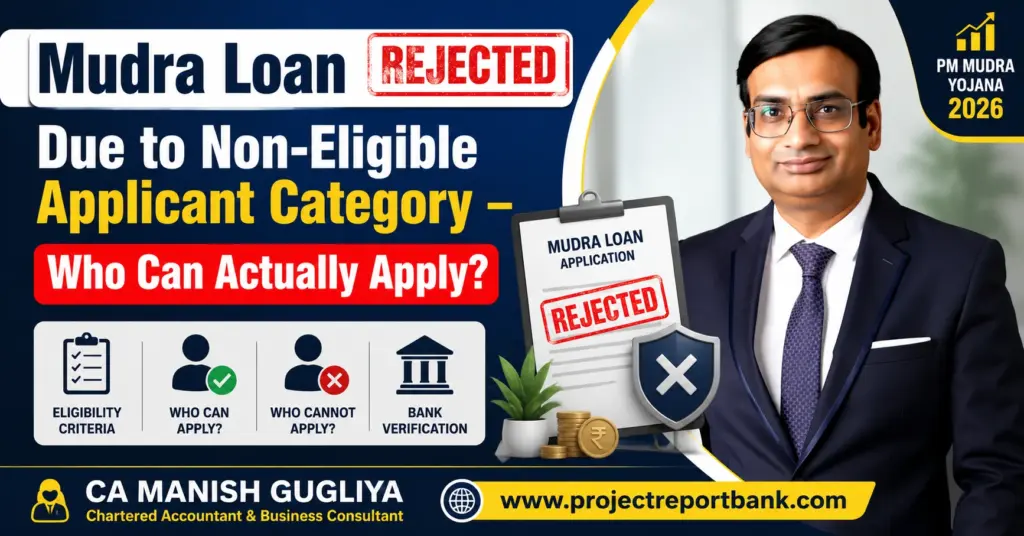
Key Takeaways
- Only micro and small non-farm businesses (manufacturing, trading, services) are eligible under Pradhan Mantri Mudra Yojana. No collateral is required for loans up to ₹10 lakh.
- Eligible entities include individuals, sole proprietors, partnership firms, LLPs, and private limited companies – but only with a genuine business purpose.
- Banks reject applications where the purpose is personal (marriage, education, home renovation, medical expenses) or there is no real business activity, even if documents are complete.
- Applicants must be Indian citizens aged 18 to 65 years with clean credit history and no past loan defaults.
- Loan categories include Shishu (up to ₹50,000), Kishor (up to ₹5 lakh), Tarun (up to ₹10 lakh), and Tarun Plus (up to ₹20 lakh for repeat borrowers).
Introduction – Why Your Mudra Loan Was Rejected Despite “Full Documents”
A 30-year-old salaried professional from Indore submitted his Aadhaar card, PAN, salary slips, and bank statements for a Mudra loan to cover wedding expenses. Every document was in order. The bank rejected him as “non-eligible applicant category.”
Why? Because under PM Mudra Yojana, banks first check whether the applicant and loan purpose fall within the eligible category. Documents, CIBIL, and project reports come later. Many people treat mudra loans as easy personal funding, but these are strictly a business loan product designed for small businesses and self-employed entrepreneurs.
As CA Manish Gugliya with over 20 years advising MSMEs, I wrote this article to help you determine whether you actually qualify – before you waste time and money on an ineligible application.
What Is Applicant Eligibility under Pradhan Mantri Mudra Yojana (PMMY)?
PMMY was launched on 8th April 2015 to provide collateral-free financial assistance to micro units through banks, non banking financial companies, micro finance institutions, and small finance banks. Here, mudra stands for Micro Units Development and Refinance Agency – a refinance agency under the Government of India.
The mudra scheme integrates micro-units into the formal credit system with a clear loan limit structure:
- Shishu category: shishu loans offer up to ₹50,000 for startups
- Kishor category: Kishore loans range from ₹50,001 to ₹5 lakh for expansion
- Tarun category: Tarun loans provide ₹5 lakh to ₹10 lakh for established businesses
- Tarun Plus: loans range from ₹10 lakh to ₹20 lakh for expanded businesses with prior repayment history
There is no processing fee, the interest rate is competitive, repayment tenure is up to 5 years, and no security or collateral is needed. Mudra loans are available for individuals and MSMEs.
Applicant eligibility means who is allowed to be the borrower. Business eligibility means which activities qualify (non-farm income-generating activities like trading, manufacturing, and services). Both must be satisfied. Banks use PMMY guidelines plus internal policy, so treatment can vary slightly across financial institutions.
Table of Contents
Who Can Actually Apply for a Mudra Loan? (Eligible Applicant Categories)
If you searched “mudra loan applicant eligibility,” here is your direct answer. The following categories are eligible when engaged in micro or small non-farm business that can require funds:
- Individual entrepreneurs: tailors, electricians, plumbers, mobile repairers, tutors
- Proprietorship firms: kirana shops, salons, photocopy centres, cyber cafés, coaching classes, home-based food units
- Partnership firms and LLPs: small manufacturing, trading, or service enterprises
- Private Limited Companies and OPCs: micro or small enterprises needing working capital or equipment loans within the loan amount cap
- Small manufacturers: garment stitching, plastic items, fabrication, LED assembly
- Service businesses: diagnostic labs, repair workshops, coaching centres
- Trading businesses: wholesale and retail shops looking to expand or manage working capital
- Transport operators: purchasing commercial vehicles (auto, taxi, tempo) for business use
Special categories encouraged under mudra yojana include women entrepreneurs, SC/ST/OBC and minority entrepreneurs, rural entrepreneurs, and young first-time business owners pursuing growth in small enterprises. Proof of eligibility for SC/ST/OBC categories may be required by some branches.
Practical examples: A housewife starting tiffin services from home fits under shishu category. A student opening a mobile repair shop can qualify under kishor category with a viable business plan demonstrating the income-generating potential. A partnership firm opening a hardware shop is a straightforward eligible applicant for trading credit needs.
Who Cannot Apply for Mudra Loan and Why Banks Call Them “Non-Eligible Applicant Category”
Mudra loans are strictly for income-generating non-farm activities. The following applicant types are not eligible:
- Salaried employees seeking funds for personal purposes – marriage, education, vacation, credit card repayment, home renovation
- Individuals with no business and no concrete plan – just vague intent to “start something”
- Pure agriculture/farm cultivation – businesses related to agriculture are not eligible for mudra loans (though agri-support like equipment repair shops may qualify)
- Speculative activities – intraday stock trading, crypto, commodity speculation, money lending
- Fake business proposals – showing borrowed shop documents or bogus invoices to convert a personal need into a business loan
- Front applicants – people applying in their name for someone else’s business
Applicants must not have any past loan defaults. Banks record such rejections as “non-eligible activity” and may suggest alternative personal loan products. Providing false business details can lead to legal consequences and CIBIL damage.
How Banks Actually Verify Mudra Loan Applicant Eligibility
Here is how banks verify eligibility in practice (2024–2026):
KYC verification: KYC documents include PAN card and Aadhaar card. Banks verify age, identity (passport or voter ID as alternatives), and address proof. The mudra application form must be completed with photographs.
Business proof: Shop & Establishment licence, Udyam Registration, GST registration (where applicable), municipal trade licence, rent agreement, and electricity bills at business premises. KYC documents and business proof are required for the loan application.
Financial verification: Income documentation requires a bank statement from the last 12 months. ITR from the previous year is needed if applicable. Financial records, such as bank statements and tax returns, are required for loans above certain amounts – especially kishor and tarun categories. Banks may also check assets and issue a mudra card for working capital disbursement.
Field inspection: Bank officials may physically visit the business premises, check stock, machinery, and signage. Additional documents may be requested by the bank during this stage.
For new businesses, banks rely heavily on the project report, promoter profile, and consistency between documents and what the applicant says during interview. You must submit a clear, realistic plan.

Difference Between Eligible Business and Eligible Applicant (Common Confusion)
Many applicants assume that if the business activity is allowed under the mudra scheme, then anyone connected to it can apply. This is incorrect.
Eligible business: A readymade garment shop is an eligible business. But the person applying must be the legal owner, proprietor, partner, or authorised director – not a friend or relative with no ownership.
Eligible applicant: The person or entity must legally own or operate the business, earn income from it, and repay the loan from business cash flows.
Scenarios that cause rejection:
- A salaried brother applies for his sister’s beauty parlour in his own name – rejected because he is not the business owner, even though the parlour is eligible
- A landlord applies showing a tenant’s shop as his own – rejected without proper business ownership proof
- A genuine proprietor with basic licences but weak financials – still an eligible applicant; the bank may negotiate the loan amount, but the category itself is valid
The loan account must always be in the name of the person or entity actually running the business.
Common Applicant-Side Mistakes That Lead to Mudra Loan Rejection
From years of consulting, these are the most frequent errors:
- Applying without any current business and without a written project report
- Declaring “trading” in the form but submitting documents showing only salary income
- Applying in a family member’s name for better CIBIL while all licences and Udyam are in someone else’s name
- Mis-declaring ownership structure – claiming proprietorship while actually operating as unregistered partnership
- Using copy-paste project reports from the internet that don’t match local market conditions or banking records
- Showing borrowed invoices or photos of someone else’s premises during verification
Consequences: outright rejection, flagging in internal bank systems, delay in future applications, and sometimes classification as a high-risk customer. There is no subsidy or shortcut that bypasses genuine eligibility – only proper preparation works.
Can New Entrepreneurs and Special Categories Apply for Mudra Loan?
Yes. New entrepreneurs without existing turnover can qualify, especially in shishu and lower kishor categories, provided the business idea is realistic and documented.
Banks look for: a simple project report (capital cost, working capital, expected sales), basic promoter contribution (even 10–15%), and evidence of skills or experience in the relevant trade. Eligibility includes having a viable business plan demonstrating the income-generating potential.
Special focus categories:
- Women entrepreneurs often receive slightly relaxed norms or interest concessions, but eligibility still requires a real business
- SC/ST/OBC and minority entrepreneurs are encouraged under the scheme but must demonstrate business feasibility
- Rural and semi-urban entrepreneurs running non-farm activities (spice grinding, flour mills, farm equipment repair, purchase equipment for processing) are eligible
Being a student, housewife, or retired person does not automatically disqualify anyone. What matters is whether they are starting or running a genuine micro business in India.
What to Do If Your Mudra Loan Was Rejected Due to Non-Eligible Applicant Category
Follow these steps:
- Get the exact rejection reason – ask the branch for written or verbal specifics (“non-eligible activity,” “no business proof,” “personal purpose”)
- Re-assess honestly – if there is no genuine business, accept that mudra is not the right product; consider a personal loan instead
- Strengthen business proof – arrange registration, licence, Udyam, rent agreement, photos, and a dedicated bank account in the business name
- Correct the applicant – ensure the real owner or proprietor applies, not just the person with better CIBIL or higher salary
- Prepare a bank-compliant project report – include CMA data, realistic financial projections, and clear cash flows for the banker to evaluate. For guidance, see how to create a proper project report
Professional help in eligibility assessment and document preparation can convert a borderline case into an approvable one. Don’t keep reapplying with the same gaps – fix the root cause first.

FAQs on Mudra Loan Applicant Eligibility
Can a salaried person without any side business get a Mudra loan?
No. Mudra loans are not meant for salary earners’ personal needs. Banks reject such cases as non-eligible applicant category. However, if a salaried person genuinely runs a side business – evening coaching classes, online selling – and can show business proof with separate bank transactions, mudra loan eligibility may be considered. The following documents must clearly relate to the business: invoices, account statements, and other documents proving commercial activity.
Can students or housewives apply for Mudra loan?
There is no blanket prohibition. A student starting a laptop repair centre or a housewife launching a home-based catering business can qualify under shishu or kishor category. They need a simple project report, identity and address proof, and basic business evidence (photos, local licences, enquiry letters) to convince the bank of genuine intent.
Is GST registration compulsory for Mudra loan eligibility?
GST is not legally mandatory for businesses below the current threshold. Many banks sanction shishu and small kishor mudra loans without GST. However, for higher loan amounts and trading or manufacturing units, banks prefer GST registration as it validates turnover claims. Getting GST and Udyam Registration improves credibility and approval chances significantly. Read more about GST requirements.
Can LLPs and private limited companies apply under Mudra scheme?
Yes. LLPs and private limited companies are eligible if they fall in the micro or small enterprise category and the loan requirement is within the ₹10 lakh tarun limit. The loan is sanctioned in the entity’s name with partners or directors as authorised signatories. These entities must provide full business KYC, incorporation documents, financial statements, and a project report similar to any MSME business loan application.
Is CIBIL score completely ignored for Mudra loan applicant eligibility?
No. While PMMY allows collateral-free loans without strict CIBIL cut-offs, banks still check credit history. A low score does not automatically make the applicant ineligible, but serious defaults or write-offs can result in lower loan amount, stricter terms, or rejection. If your credit history is weak, work on improving your CIBIL score and then apply with a strong, realistic project report and transparent discussion with the banker.
- Can Bank Reduce Mudra Loan Amount Without Your Consent? Complete Practical Guide (2026)


- What to Do If You Cannot Pay Your Mudra Loan EMI (2026 Guide)

- Can a Bank Refuse a Mudra Loan Because the Target Is Completed? Complete Guide (2026)

- Bank Refused My Mudra Loan Application – What Are My Rights?

- Mudra Loan for Used Vehicles (2026): Eligibility, Documents, Bank Rules & Complete Guide

- Rejected Mudra Loan – What to Do Next? Appeal Process Explained (2026)

- Mudra Loan Project Report Madhya Pradesh – Bank-Ready DPR & CMA Guide

- Project Report for Mudra Loan Maharashtra: Complete Guide for MSMEs, Startups and Small Businesses (2026)
- Mudra Loan Uttar Pradesh: Complete Guide for MSMEs, Startups and Small Businesses (2026)
- Mudra Loan Bihar 2026: Eligibility, Documents, Online Application Process & Project Report Guide

- Jan Samarth Mudra Loan 2026: Complete Guide to Online Application, Eligibility, Documents & Approval Process
- MSME Mudra Loan: Complete Guide for Small Businesses, Startups & Manufacturing Units in India (2026)
- Is the Mudra Loan Subsidy Real or Fake? Get the Facts Here

- Mudra Loan Without CIBIL Score: How to Qualify and Apply

- Mudra Loan for Used Machine (2026 Guide) – Eligibility, Documents, Valuation & Approval Tips