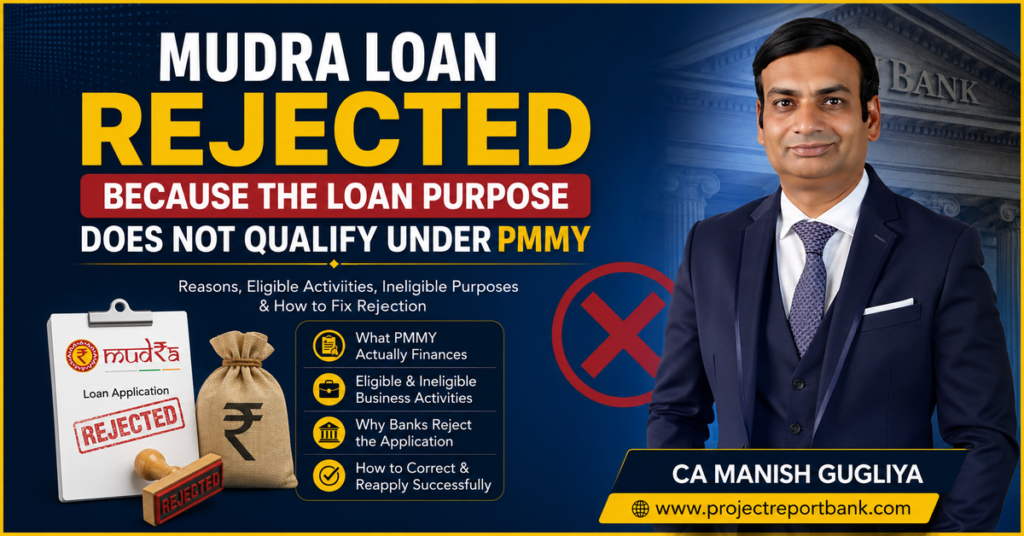
If your mudra loan was rejected because the bank said your loan purpose is not eligible under PMMY, this guide explains exactly why it happened and what you can do next.
Key Takeaways
- Many mudra loan rejections happen not because of poor CIBIL or missing documents, but because the proposed business activity does not qualify under Pradhan Mantri Mudra Yojana (PMMY). Banks strictly verify whether the stated purpose fits within scheme guidelines.
- The pradhan mantri mudra yojana finances only income generating, non farm, non corporate small business activities in manufacturing, trading, and services. PMMY loans are classified into four categories: Shishu loans (up to ₹50,000), Kishore loans (₹50,001 to ₹5 lakh), Tarun loans (₹5 lakh to ₹10 lakh), and Tarun Plus loans (₹10 lakh to ₹20 lakh). The maximum loan amount under PMMY is ₹20 lakh.
- Mudra loans cannot be used for personal expenses, education, or medical treatment. Other ineligible purposes include house renovation, land purchase, marriage, pure agriculture cultivation, speculation, and repayment of old loans.
- If your loan was rejected for ineligible purpose, you can often reapply with a revised, PMMY-compliant business purpose and a professionally prepared project report demonstrating income and repayment capacity.
- Approval is always at the bank’s discretion based on PMMY guidelines, internal policy, viability, and documents. A CA-prepared project report significantly reduces the chance of rejection for wrong purpose.
Why Was My Mudra Loan Rejected Due to Loan Purpose? (Quick Answer)
Banks reject mudra loans when the stated use of funds does not fit PMMY rules. If you wrote something like “home renovation,” “personal needs,” or any activity outside the eligible non farm MSME sector, the bank will record your application as “loan purpose not eligible under PMMY.”
Loan applications may be denied if they do not align with PMMY guidelines. Common examples of ineligible purposes include personal expenses, vehicle purchases for personal use, and educational costs. If a loan application is vague or lacks justification, it may also lead to rejection.
Why was my Mudra loan rejected due to loan purpose? Your mudra loan was rejected because the business activity or end-use you declared does not fall within the eligible categories prescribed by the Pradhan Mantri Mudra Yojana. PMMY only finances income generating non farm business activities in manufacturing, trading, and service sectors.
This rejection is different from denial due to low CIBIL, weak income, or non-viable business plans, which are separate issues entirely.
Table of Contents
What Does Pradhan Mantri Mudra Yojana (PMMY) Actually Finance?
In my experience as a Chartered Accountant handling hundreds of mudra loan applications, the most common confusion is about what the mudra scheme actually covers. Entrepreneurs often assume every small business automatically qualifies. That is not the case.
Mudra Yojana was launched on April 8, 2015 as a flagship scheme of the Government of India. The scheme supports income generation and employment creation for micro enterprises. It provides financial assistance through collateral free loans to beneficiary micro unit entrepreneurs running non corporate small enterprises.
Here is what PMMY finances:
- Manufacturing: Small units making garments, food products, handicrafts, agarbatti, etc.
- Trading: Retail and wholesale businesses, vendors, medical stores, grocery shops
- Service sector: Salons, tailoring, mobile repair, computer services, transport
- Allied agricultural activities: Beekeeping, poultry, dairy, fishery (not crop cultivation)
Mudra loans are strictly for income generating activities. The activity must create regular business cash flow that can repay EMI. Mudra loans are intended to finance working capital, equipment purchases, and commercial vehicles for business use. A clear business plan is required to demonstrate how the loan will generate income.
Mudra loans are not available for corporate borrowers – only for proprietorships, partnerships, and small unincorporated enterprises. Mudra Yojana offers collateral free loans up to ₹10 lakh, and applicants must be aged between 18 to 65 years. Interest rates for mudra loans are generally lower than traditional loans.

Eligible vs Ineligible Business Purposes Under Mudra Loan
Most “loan purpose not eligible” remarks arise because the proposed activity falls outside PMMY’s defined scope, even though the applicant believes it qualifies as a business use. Here is a clear comparison.
Typical eligible purposes:
- Garment stitching or small manufacturing unit
- Retail or wholesale trading shop
- Medical store or pharmacy
- Beauty salon, barbershop, or spa
- Tailoring and boutique
- Mobile or computer repair centre
- Printing, photocopy, and DTP services
- Commercial vehicle for goods transport or auto-rickshaw
- Home-based food processing or bakery
- Agro-processing, dairy, poultry, or beekeeping
Eligible businesses include shop owners, vendors, and service providers. Both trading business and service sector activities qualify when genuinely income generating and properly documented.
Common ineligible purposes:
- Purchase of agricultural land or crop cultivation finance
- House construction or renovation for personal residence
- Marriage, social functions, or family ceremonies
- Personal medical treatment or hospitalisation
- Foreign or higher education fees
- Share market investment, speculation, or gambling
- Luxury vehicle for personal use
- Repayment of existing personal or business loans
- Any purely personal expense
Agricultural activities such as crop cultivation and purchasing land for farming are not permitted under mudra loans. Loans for purely trading activities without value addition may also be ineligible in certain cases. Necessary registrations like Udyam registration must be provided for a business to qualify.
Borderline cases: Buying a vehicle half for personal and half for business use is risky. Banks insist on clear commercial justification – contracts, expected earnings, route details – before approving such applications. Without documented business use, expect rejection.
How Banks Check Whether Your Mudra Loan Purpose Is Eligible
From my experience, bank officers must satisfy both PMMY guidelines and their own internal credit policy before approving any business loan under the mudra yojana.
Here is the typical step-by-step appraisal:
- Application form scrutiny: Purpose field, Shishu/Kishore/Tarun category selection, loan amount requested
- Personal discussion: Officer asks about the business, its location, and expected income
- Document and quotation review: Invoices, machinery quotes, stock estimates cross-checked against declared activity
- Site visit or tele-verification: Physical confirmation that business premises exist or are planned
- Credit appraisal note: Final assessment of turnover, margin, EMI coverage, and end-use compliance
Banks look for consistency among the declared activity, business registration (GST, Udyam, shop license), the project report, and actual premises. Red flags include purpose written vaguely as “general needs,” mismatch between a trading license and claimed manufacturing activity, or quotations that look like home renovation items rather than business equipment.
You can apply for a mudra loan online through portals like Jan Samarth, and applications can also be submitted offline at lending institutions. Mudra loans are available through commercial banks, small finance banks, micro finance institutions, and NBFCs. Mudra loans are processed quickly if documents are complete and the purpose is clearly eligible.
A professionally prepared project report with realistic cash-flow projections often prevents confusion at this stage.
Common Mistakes, Real Case-Style Examples, and How to Reapply Correctly
In many mudra loan files I have reviewed, rejection was avoidable if the entrepreneur had described the business purpose correctly and aligned it with PMMY-eligible activities.
Common mistakes applicants make:
- Writing “for personal needs” or “household expenses” in the purpose column
- Submitting quotations for home tiles and furniture instead of shop or business items
- Mismatch between GST category and the proposed activity
- Showing no clear income generation plan
- Copying a generic project report unrelated to the actual business
- Declaring “loan repayment” as purpose
Realistic case examples:
| Original Purpose (Rejected) | Reason | Corrected Purpose |
|---|---|---|
| Home renovation (₹3 lakh) | Not income generating | Convert front room into beauty salon with revenue plan |
| Buy agricultural land | Pure farming excluded | Lease land for poultry farming with income projections |
| Vehicle for family use | Personal, not commercial | Auto-rickshaw for passenger transport with route plan |
| “Business expansion” with no details | Vague, no project report | Grocery store stock expansion with supplier quotations |
| Repay old personal loan | Debt repayment excluded | Purchase inventory for existing trading shop |
| Home-based cooking – no plan | No income evidence | Tiffin service with customer contracts and pricing |
When to reapply:
- Change your declared purpose to a genuinely eligible MSME activity
- Prepare a fresh project report with realistic revenue and EMI coverage
- Revise quotations to match the new business purpose and apply at the same or a different bank
Reapplying does not guarantee approval. The decision rests with the lending institution based on their assessment of eligibility criteria, documentation, and business viability.
FAQs: Mudra Loan Rejected Because Loan Purpose Not Eligible
These FAQs address specific doubts not fully covered above.
Can I use a Mudra loan for partial personal and partial business purposes?
No. The mudra scheme is strictly for business use. Mixing significant personal expenses with business funding can lead to rejection or later misuse classification by the bank. Keep personal and business needs completely separate.
Will a Mudra loan rejection for ineligible purpose affect my CIBIL score?
A simple rejection does not lower your CIBIL score. However, multiple loan inquiries across banks within a short period can marginally impact your credit profile. Purpose-based rejection alone does not create any default record.
Can I switch to a normal business loan if my purpose is ineligible under PMMY?
Yes. Some purposes that do not qualify under the mudra yojana may qualify under a bank’s regular business loan products. However, these will not be collateral free, may carry a different interest rate, and will have separate eligibility criteria.
Should I hire a CA to prepare my project report before reapplying?
For any loan amount above ₹2–3 lakh, a CA-prepared project report clarifies your business purpose, projected income, working capital needs, and repayment capacity. In my professional experience, this significantly reduces the chance of rejection for unclear or ineligible loan purpose. A strong project report serves as a reliable reference point for the bank officer during appraisal.
Can I reapply after changing my business purpose to an eligible activity?
Yes. If you genuinely start or plan an eligible business, you can reapply with a revised application, updated business registration, fresh quotations, and a new project report. Clearly disclose the corrected, PMMY-compliant purpose in your application form.
- Roller Flour Mill Setup Cost in India: Professional Investment & Project Cost Guide


- Poha, Puffed Rice & Value-Added Rice Products Project Report & Processing Opportunities

- Integrated Value-Added Rice Products Processing Plant Project Report & DPR

- Integrated Rice Plant Bank Loan, Feasibility, ROI, IRR, Payback & Sensitivity Analysis

- Integrated Rice Processing Plant Financial Projections, Working Capital & DSCR

- Integrated Rice Products Revenue Model, Market Strategy & Profitability

- Integrated Value-Added Rice Plant Project Cost & Means of Finance

- Raw Material Procurement & Inventory Planning for Integrated Value-Added Rice Plant

- Common Utilities, Warehousing, Packaging & Material Handling for Integrated Rice Plant