Key Takeaways
An automatic feed pellet and crumble plant is an industrial feed mill configuration designed to produce pellet feed and crumble feed for poultry, cattle and other livestock with high consistency, low wastage and automated process control. The manufacturing process includes several stages from raw material reception to packaging, with ring die pellet mills, steam conditioners, coolers and crumblers forming the core processing line.
For a typical 5 to 20 TPH automatic pellet plant in India, total project cost runs into multiple crores once land, civil construction, machinery, boilers, electrical infrastructure and working capital are accounted for. A 1 TPH biomass pellet plant costs considerably less than larger plants, but industrial-scale feed manufacturing for poultry and cattle markets requires capacity, automation and quality systems that push investment well beyond entry-level equipment.
This article covers technology and process flow, capacity planning across 2 to 20 TPH configurations, plant setup cost structure, feed production economics per MT, project finance and DSCR/IRR analysis, working capital assessment and regulatory requirements. The perspective throughout is that of a Chartered Accountant-led project finance and DPR consultancy; Project Report Bank is not a machinery supplier. Related resources on integrated animal feed mill project reports, poultry feed manufacturing plant projects are linked where relevant.
A customised Automatic Feed Pellet Manufacturing Plant Project Report is critical for bank finance, investor discussions and risk mitigation, particularly where project cost exceeds ₹5 crore and debt funding is planned.
Introduction
India’s organised animal feed sector produced approximately 57.7 million tonnes in 2025, with broiler, layer and dairy feed accounting for roughly 94% of that volume. Within this market, a visible shift from loose mash feed to pellet feed and crumble feed is underway. Poultry integrators demand pellet feed for better feed conversion ratios. Dairy cooperatives and large cattle farms are moving toward compound cattle feed pellets because cattle feed pellets improve digestion and nutritional quality for cattle. The commercial logic is straightforward: pellet feed reduces segregation, lowers fines, improves voluntary intake and decreases wastage at the feeder.
An Automatic Feed Pellet Manufacturing Plant Project Report typically covers technical configuration, plant layout, project cost, means of finance, working capital assessment, 8 to 10 year financial projections, DSCR analysis, IRR computation, risk identification and sensitivity analysis. The report should include sections like executive summary and market potential analysis, along with detailed capital investment and working capital assessment.
The focus of this article is on industrial automatic pellet plant projects where investment is approximately ₹5 crore or above, not small 5 HP pellet machines or micro-scale cottage operations. The content is relevant for 2 to 3 TPH, 5 TPH, 10 TPH, 15 to 20 TPH and larger feed pellet plants. All financial and technical illustrations in this article are indicative. Real projects must be based on up-to-date supplier quotations, site conditions, raw material markets and promoter-specific assumptions.
What Is an Automatic Feed Pellet & Crumble Manufacturing Plant?
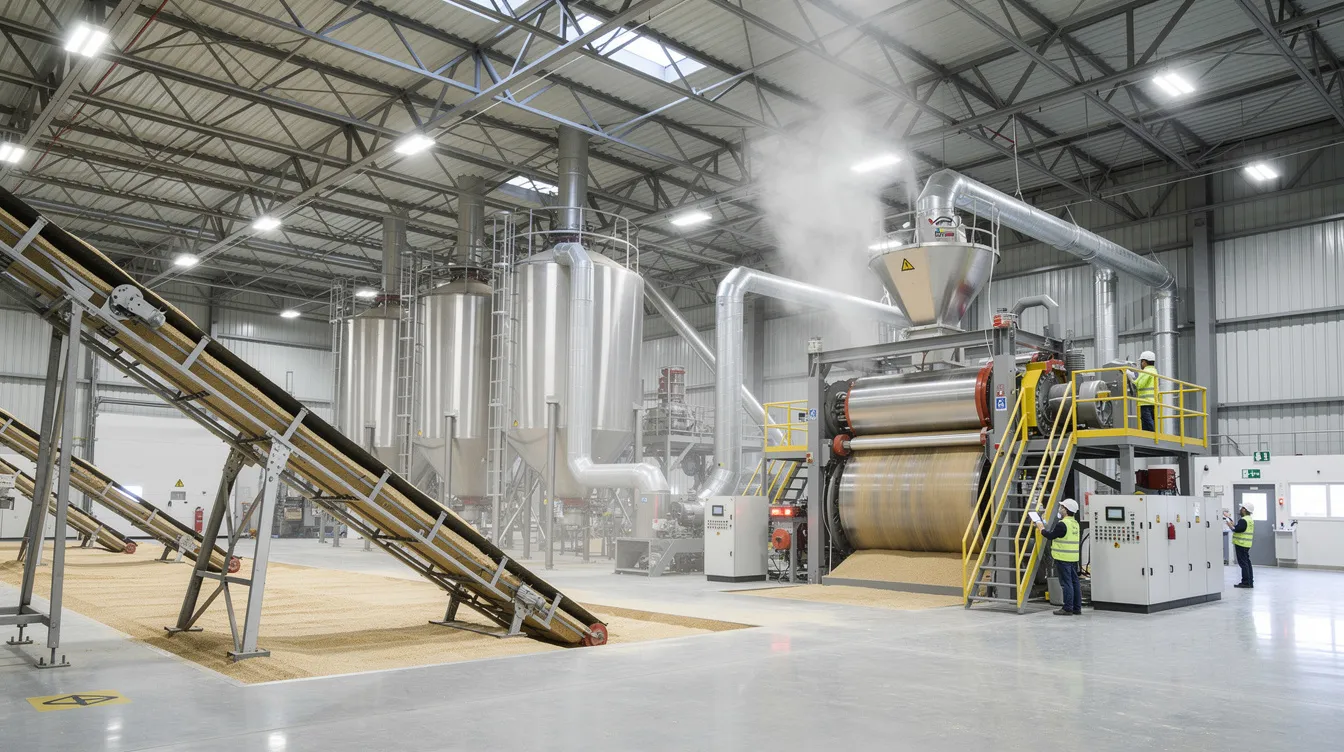
An automatic pellet feed plant is an engineered production line where raw material such as grains, oil cakes, bran and premixes is cleaned, ground, batched, mixed, steam-conditioned, pelletised in a ring die pellet mill, cooled, optionally crumbled and packed. Most steps are controlled via PLC-based systems, which allows recipe management, interlocked safety and consistent output across shifts.
Mash feed has a fineness of about 2.5 mm or more and is essentially a powdered mixture. Pellet feed is formed by pressing this mash through a die under heat and pressure. Poultry feed pellets typically range from 2 to 5 mm in diameter, while cattle feed pellets can be 4 to 8 mm or larger. Crumble feed is processed from pellets into 2 to 4 mm pieces by passing cooled pellets through roller-type crumblers, producing a granular form suitable for young chicks and birds that cannot handle full-sized pellets. Complete feed in pellet or crumble form meets all poultry nutritional needs when formulated correctly.
The commercial advantages of pellet and crumble feed over mash include reduced ingredient segregation, better nutrient uniformity, lower fines and wastage, and higher voluntary intake. These benefits apply across poultry feed, cattle feed and feeds for other species such as ducks and fish.
A complete automatic feed mill handles everything from raw material intake through grinding, batching, mixing to finished mash, pellet and crumble feed. A stand-alone automatic pellet and crumble line, by contrast, can be bolted onto an existing mash feed plant, reducing capital outlay when grinding and mixing capacity already exists.
| Feed Form | Typical Particle Size/Shape | Common Use in India | Key Advantages | Key Limitations |
|---|---|---|---|---|
| Mash Feed | ~2.5 mm+ powder/coarse | Small poultry farms, cattle | Low cost of processing, simple equipment | Ingredient segregation, higher wastage, dust |
| Pellet Feed | 2–8 mm cylindrical | Broiler, layer, cattle, aqua | Uniform nutrient content, reduced wastage, dense for transportation | Higher processing cost, needs steam and pellet mill |
| Crumble Feed | 2–4 mm granular | Chicks, starter feeds, ducks | Easy intake for young birds, retains pellet benefits | Extra processing step, some fines generated |
Market Opportunities and Commercial Applications in India
Organised poultry feed manufacturing (broiler starter, grower, finisher pellets and crumbles), cattle and dairy nutrition, and aqua feed segments increasingly favour pellet feed and crumble feed for performance and uniformity. Contract manufacturing and third-party pelletising for regional brands and integrators is a growing segment. Captive pellet feed plants built by large poultry integrators and dairy farms often sell surplus feed commercially, creating dual revenue streams.
Starting a small cattle feed plant costs $20,000 to $30,000 at the entry level, a small cattle feed plant can produce around 2,000 tonnes annually, and profit from a small cattle feed plant can reach $100,000 per year under favourable conditions. These figures illustrate the economics at the smallest end of the spectrum. Industrial-scale plants of 5 to 20 TPH operate in a different cost and margin environment, where volume, automation and raw material procurement efficiency determine viability.
Demand drivers include growth in organised poultry farming, focus on FCR improvement, consolidation of feed distribution, preference for branded feed pellets, and logistics efficiencies of dense pellets versus bulky mash. Constraints include intense price competition per kg of feed, raw material price volatility (maize and soybean meal prices can swing by 15 to 30% within a crop year), working capital intensity, credit risk from dealers and farmers, and regional variation in feed preferences. Entrepreneurs evaluating a complete integrated facility may refer to the Industrial Cattle Feed Manufacturing Plant Project Report for deeper integration options.
Automatic Feed Pellet Manufacturing Plant Capacity Planning
Pellet mill capacity is rated in TPH (tonnes per hour), but rated capacity differs from actual output. Formulation energy density, conditioning moisture, fat content, die hole diameter and real operating hours all affect throughput. A ring die pellet mill rated at 10 TPH on cattle feed (6 mm pellets) may deliver only 7 to 8 TPH on broiler feed (3 mm pellets) because smaller die holes create more resistance. The FABON poultry feed plant can produce up to 2000 kg/hr, illustrating a practical mid-range capacity benchmark.
Commercially common configurations: 2 to 3 TPH for regional feed plants, 5 TPH for medium poultry feed operations, 10 TPH for state-level players, and 15 to 20 TPH for large integrated feed manufacturers. Multi-line installations with two or three pellet mills serve corporate groups producing 50,000+ MT per year.
| Nominal Line Capacity (TPH) | Effective Hours/Day (assumed) | Daily Output (MT) | Operating Days/Year | Annual Output at 80% Utilisation (MT) |
|---|---|---|---|---|
| 3 | 16 | 48 | 300 | 11,520 |
| 5 | 16 | 80 | 300 | 19,200 |
| 10 | 16 | 160 | 310 | 39,680 |
| 20 | 18 | 360 | 310 | 89,280 |
Assumptions: effective hours account for changeovers, cleaning and minor maintenance. Utilisation applied on effective daily output. Actual throughput depends on pellet diameter, formulation and die condition.
Typical bottlenecks include hammer mill throughput, mixer cycle time, pellet mill kW rating and die area, cooler capacity, crumbler screening capacity and finished goods loading constraints. Phased expansion planning, such as designing the building and utilities for a future second pellet line while initially installing one ring die pellet mill, should be modelled in financial projections to avoid premature capital commitment.
Automatic Feed Pellet & Crumble Manufacturing Process
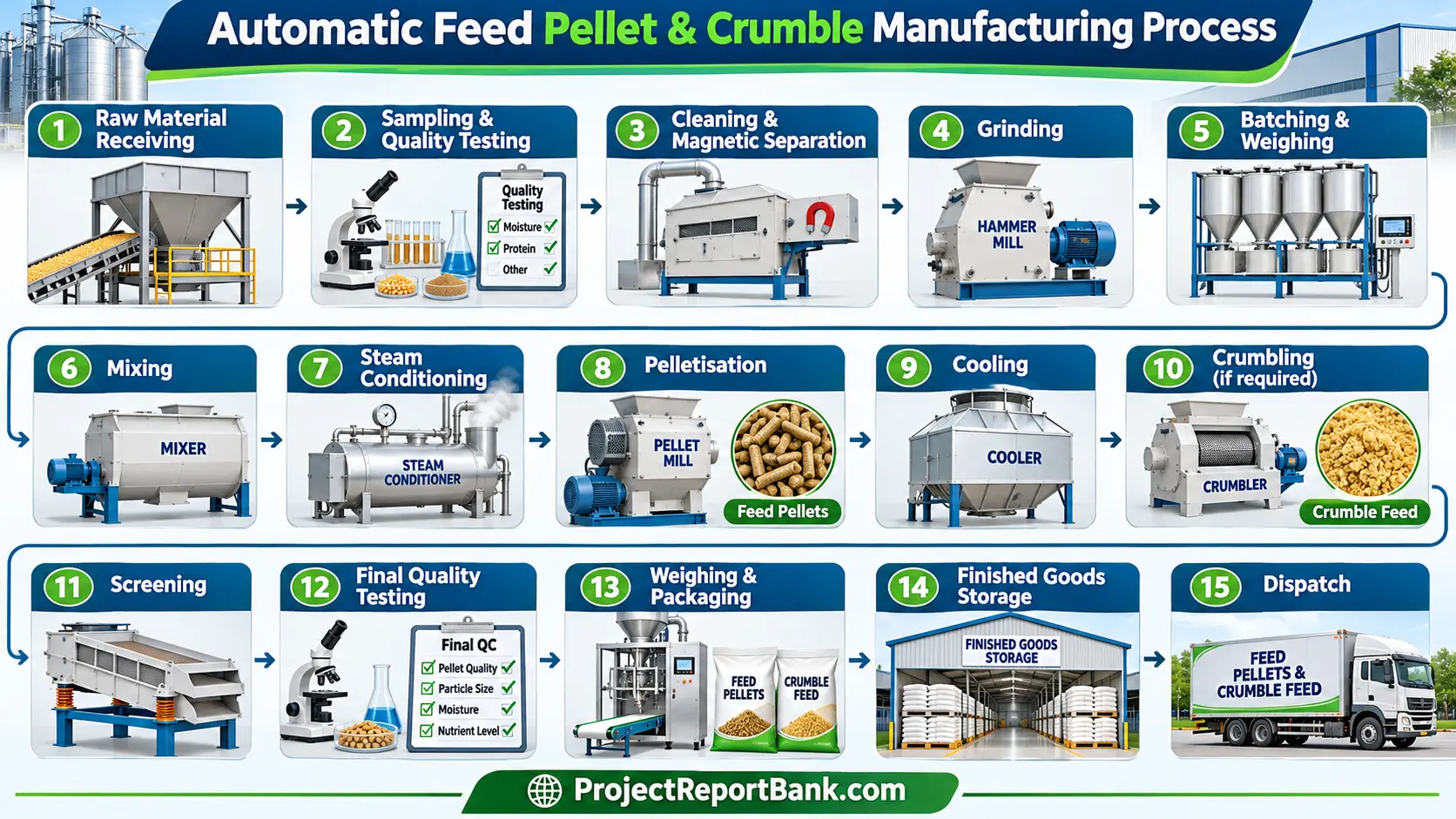
The plant follows a continuous, largely automated flow where batch control and quality checks are critical for safe, consistent animal feed. Quality control protocols for raw ingredients and finished pellets are essential at every stage. The technical process and manufacturing flow should detail the technological workflow for automated pelleting. Plant layout should avoid cross-contamination and facilitate efficient material flow between sections.
Process steps:
- Raw material receiving and sampling at weighbridge or intake pit; each incoming lot tested for moisture and impurities.
- Quality testing and segregation in a small laboratory covering moisture, foreign matter and basic proximate analysis.
- Cleaning and magnetic separation using sieves, aspiration and magnets to remove stones and ferrous metal.
- Grinding in hammer mills to target particle size ranges appropriate for the intended species and feed type.
- Ingredient batching and weighing via automatic dosing bins and load cells; the mixing section ensures uniform nutrient distribution with CV ≤ 5%.
- Homogeneous mixing in ribbon or double-shaft paddle mixers with liquid dosing for oils and additives.
- Steam conditioning in a conditioner mounted above the pellet mill; moisture and heat improve pellet binding and durability.
- Ring die pelletisation: pelletizing involves pressing mixed ingredients through a pellet mill, where mash is forced through die holes and cut to length by knives.
- Pellet cooling using counter-flow coolers to bring pellets near ambient temperature.
- Pellet crumbling (if crumble feed is desired): crumble feed is produced by crushing pellets into smaller pieces using a roller-type crumbler.
- Screening and fines separation to remove undersized particles and recycle fines back to the conditioner.
- Final product quality testing covering physical appearance, bulk density, moisture and microbiological parameters.
- Weighing, packing in 25 to 50 kg bags or bulk loading, and finished goods storage.
- Dispatch via trucks to dealers, farms and integrators.
Process Flow: Raw Material Receiving → Sampling & Quality Testing → Cleaning & Magnetic Separation → Grinding → Batching & Weighing → Mixing → Steam Conditioning → Pelletisation → Cooling → Crumbling (if required) → Screening → Final Quality Testing → Weighing & Packaging → Finished Goods Storage → Dispatch
Quality assurance systems should monitor raw materials, in-process materials and finished products throughout. Hygiene and biosecurity considerations include prevention of salmonella and mould, cleaning protocols between different types of pellet feed, and proper storage of raw material and finished feed pellets.
Automatic Feed Pellet Making Machine and Machinery Requirements
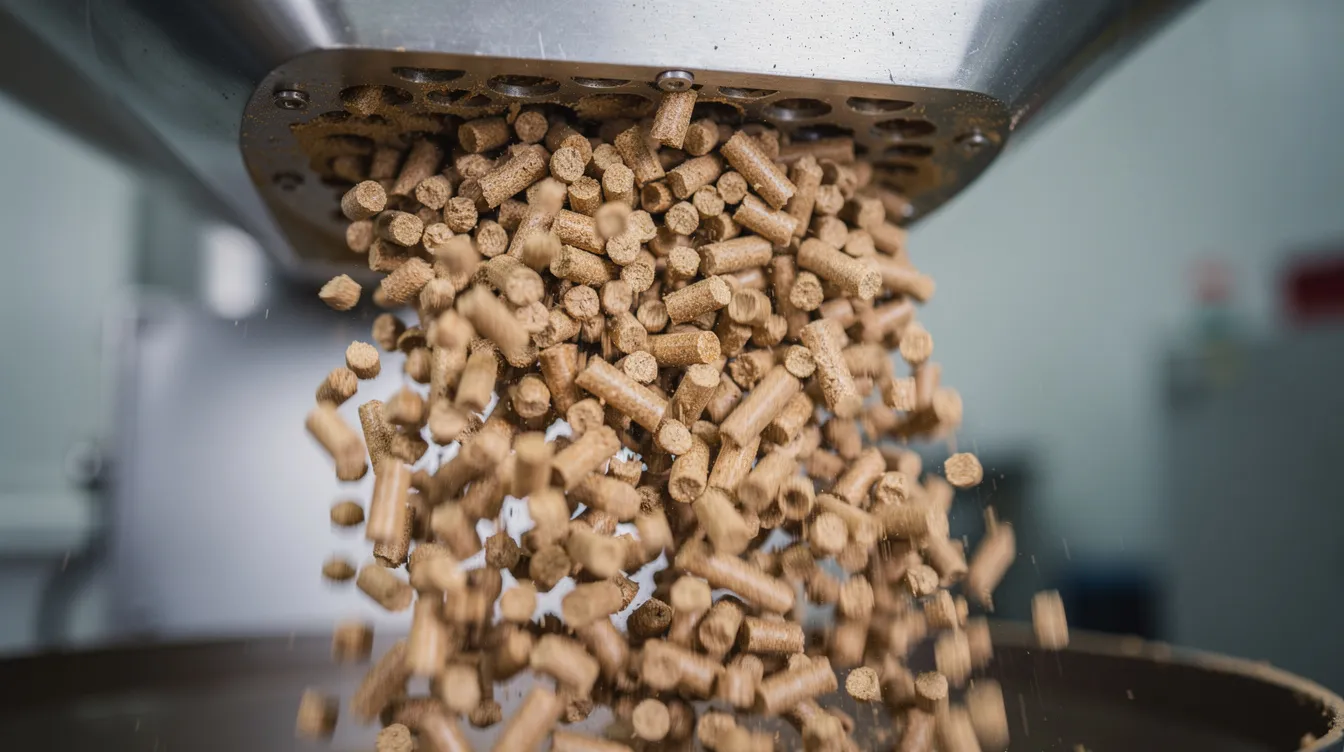
The core of a modern automatic pellet plant is the ring die pellet mill, but supporting equipment, including intake, grinding, mixing, steam generation, cooling, crumbling and conveying systems, largely determines overall plant performance and feed pellet quality. The selection of machinery should be based on production capacity and investment scale. Automation systems enhance efficiency in ingredient dosing, mixing and monitoring. Automation in pellet plants raises initial investment but lowers operating costs over time. Automation levels can range from manual to fully automated systems depending on budget and throughput requirements.
| Machinery | Purpose | Capacity Selection Factors | Important Technical Considerations |
|---|---|---|---|
| Hammer Mill | Grinding raw materials to target particle size | Motor HP, screen size, aspiration | Dust control; multiple units for redundancy at 10+ TPH |
| Feed Mixer | Homogeneous blending of ingredients | Batch size, cycle time, liquid dosing | Ribbon vs paddle; CV ≤ 5% mixing uniformity |
| Ring Die Pellet Mill | Pelletising conditioned mash into pellets | Die diameter, motor kW, L/D ratio | Die metallurgy, hole count, conditioning integration |
| Pellet Cooler | Reducing pellet temperature post-pelletisation | Cooling capacity vs line TPH | Counter-flow type preferred; residence time and air flow |
| Crumbler | Breaking pellets into crumble feed | Roll gap adjustability, throughput | Adjustable for 2 to 4 mm crumble for chicks |
| Boiler | Steam generation for conditioning | Kg steam/hour based on line TPH | IBR compliance for larger units; fuel type affects cost |
| Bagging Machine | Weighing, filling and stitching bags | Bags per hour, accuracy | Automatic vs semi-automatic based on volume |
| PLC/SCADA | Recipe management, plant monitoring | Number of I/O points, integration | Customization for multi-recipe operations |
The distinction between ex-works machinery price and full installed project cost is material. Civil foundations, structural supports, electrification, compressed air lines, steam piping, commissioning, taxes, insurance and contingencies typically add 40 to 60% over the basic machinery quotation. A ring die pellet press for 1 to 2 TPH may cost ₹29 to 65 lakh ex-works, but the complete installed line including auxiliaries can reach ₹1.2 to 1.6 crore.
Automatic Feed Pellet Plant Setup Cost in India
Automatic feed pellet plant cost varies widely with capacity, land cost, civil design, automation level and whether the plant is greenfield or an expansion. Typical investment for a pellet plant varies by capacity; a sample 32 MT/day cattle feed pellet unit (approximately 4 to 5 TPH class) had a total project cost of approximately ₹3.80 crore, with machinery at ₹1.66 crore, land and building at ₹1.37 crore and working capital margin at ₹37 lakh. Scaling to 5 TPH and above pushes project cost to ₹5 to 10 crore or higher, depending on integration and scope.
| Cost Head | 5 TPH Plant (% of FCI) | 10 TPH Plant (% of FCI) | 20 TPH Plant (% of FCI) |
|---|---|---|---|
| Land & Site Development | 10–15% | 8–12% | 6–10% |
| Building & Civil Works | 20–25% | 22–28% | 20–25% |
| Plant & Machinery | 35–42% | 38–45% | 40–48% |
| Utilities & Electrical | 8–12% | 8–10% | 7–10% |
| Misc. Fixed Assets | 3–5% | 2–4% | 2–3% |
| Pre-operative Expenses | 4–6% | 3–5% | 3–4% |
| Contingencies | 5–8% | 5–7% | 4–6% |
Absolute rupee amounts are not universal and must be developed from current quotations for each project. Higher moisture raw materials increase processing costs and may require additional drying equipment.
Fixed Capital Investment (FCI) covers tangible long-term assets. Project Cost equals FCI plus margin for working capital. Total Funding Requirement includes project cost plus reserves for unforeseen overruns. For bank appraisal, the DPR should include a detailed cost sheet with line-by-line items, GST treatment and phasing of capital expenditure across the implementation period.
Raw Materials and Feed Formulation Requirements
Raw material costs dominate total feed production cost per MT, typically accounting for 80% or more of variable cost. Small changes in formulation or ingredient prices materially impact profitability. Key raw materials include energy sources (maize, broken rice, wheat, millets, rice polish), protein sources (soybean meal, groundnut cake, rapeseed meal, cottonseed meal, fish meal where permitted), by-products and fibre (wheat bran, rice bran), minerals and vitamins premixes, salt, limestone, fats and oils, and functional feed additives such as enzymes, probiotics and toxin binders. Protein supplements for chickens contain over 30% protein and form a critical component of poultry ration formulation.
Feed formulation is species- and stage-specific. Broiler starter formulations differ from finisher or layer feed; calf feed differs from milch cattle feed. A generic formula does not work across species. Consistent raw material quality (moisture, foreign matter, mycotoxins), proper storage in silos or godowns with aeration and fumigation, supplier diversification, and inventory holding strategies balancing price volatility versus storage cost are all important for sustained operations.
Utilities, Power, Steam and Infrastructure
Automatic pellet feed plants are power- and steam-intensive. Connected electrical load for hammer mills, pellet mills, coolers, elevators, compressors and bagging machines in a 10 TPH plant can reach 500 to 800 kVA. Actual running power consumption will be lower but must be established from supplier data sheets. Steam generation capacity in kg/hour is linked to conditioning requirements per MT of feed pellets; fuel options (coal, briquettes, agro-waste, gas) directly impact operating cost.
Water is needed for boiler feed, cooling, cleaning and staff use, with treatment required to limit boiler scale and corrosion. Compressed air serves actuators, bag filters, cleaning lines and instrumentation. Storage and warehousing layout must accommodate raw material intake, separate mineral and premix storage, finished goods stacking and vehicle movement. Fire protection, dust extraction and explosion risk management at hammer mills and bag filters require attention in both design and operating procedures.
Automatic Pellet Feed Plant Operating Cost and Production Economics
Pellet feed manufacturing is a high-volume, low-margin business. Profitability depends on efficient plant operation and raw material supply. Manpower planning must outline the required workforce and their roles across production, quality, maintenance and administration.
Illustrative cost per MT (10 TPH poultry feed pellets plant at 75% utilisation):
| Cost Component | Indicative ₹/MT |
|---|---|
| Raw Materials | 24,000–28,000 |
| Power & Electricity | 400–600 |
| Boiler Fuel / Steam | 300–500 |
| Packaging | 150–250 |
| Direct Labour | 100–200 |
| Repairs, Dies & Spares | 150–300 |
| Overheads & Admin | 200–400 |
| Total Manufacturing Cost | 25,300–30,250 |
These are illustrative figures, not current market prices. Actual costs depend on location, raw material rates, power tariff, fuel choice and scale of operations.
If selling price is assumed at ₹30,000 to ₹32,000 per MT, the contribution margin per MT ranges from ₹750 to ₹4,700 before interest, depreciation and taxation. Captive pellet feed production economics differ from commercial sale economics, where selling and distribution expenses further reduce margins. Monitoring pellet durability index (PDI), production yield and fines reprocessing is essential to protect margins.
Financial Projections for Automatic Feed Pellet Manufacturing Plant
An 8 to 10 year projection is standard for term loan appraisal in India. Financial projections should distinguish between fixed and variable costs and should include capital investment and working capital assessment.
Key building blocks include year-wise capacity utilisation assumptions, product mix between poultry feed pellets, crumble feed and cattle feed pellets, selling price assumptions per MT, raw material cost with escalation, variable manufacturing expenses and fixed operating expenses. Standard financial statements in the DPR include projected profit and loss, balance sheet, cash flow statements, term loan drawdown and repayment schedule and depreciation schedule.
EBITDA and EBITDA margin serve as measures of operating health. Break-even sales volume, cumulative cash flows and payback period estimation are tracked across the projection horizon. No “guaranteed” profitability should be claimed in projections; all assumptions must be transparently documented.
Bank Loan, Project Finance and Funding Structure
A typical 5 to 20 TPH automatic feed pellet plant is funded through a combination of promoter contribution (equity), term loan for fixed assets, and working capital limits (cash credit, working capital term loans) for day-to-day operations. Indian banks generally expect a debt-equity ratio in the range of 2:1 to 3:1 for manufacturing projects, with promoter margin of 25 to 30% on fixed assets.
CMA Data preparation, a bankable DPR with project cost and means of finance, and security arrangements (primary charge on assets, collateral, guarantees) form the documentation framework. DSCR is the primary metric for bank appraisal; sample projects show average DSCR of 1.75 with a minimum acceptable level around 1.25 to 1.50. Government incentives can reduce the overall cost of biomass and feed pellet projects through capital subsidies under applicable schemes. Interest rate, loan tenure, moratorium period and collateral requirements depend on the lending institution’s current policies.
Working Capital Assessment
Feed pellet plants require substantial working capital because raw material must often be bought in bulk during harvest season while finished feed is sold on credit to dealers and large farms. Components include raw material inventory (20 to 30 days), packaging material inventory, work-in-progress (limited), finished goods inventory (7 to 10 days), trade receivables (15 to 30 days), operating cash, less trade payables from suppliers.
Illustrative working capital (5,000 MT/month production):
| Component | Days | Value at assumed cost/MT | Amount (₹ Lakh) |
|---|---|---|---|
| Raw Material Inventory | 25 | ₹26,000/MT | 108 |
| Finished Goods | 8 | ₹28,000/MT | 37 |
| Receivables | 20 | ₹31,000/MT | 103 |
| Less: Trade Payables | 15 | ₹26,000/MT | (65) |
| Net Working Capital | ~183 |
Illustrative computation. Actual requirement depends on production scale, credit terms, raw material pricing and seasonal procurement patterns.
Underestimating working capital leads to inability to buy raw materials at favourable prices, stock-outs of key ingredients and inability to extend credit to reliable customers, all of which reduce capacity utilisation and DSCR.
Financial Feasibility, DSCR, IRR and Break-Even Analysis
Financial feasibility should assess cash flow, profitability and return on investment together, not in isolation. A feasibility study should evaluate competition, pricing and target markets specific to the project location. Break-even analysis determines the sales level needed to cover costs; in a sample 32 MT/day cattle feed project, break-even was approximately 41% capacity utilisation.
| Parameter | Adverse Case | Base Case | Favourable Case |
|---|---|---|---|
| Selling Price per MT | ₹29,000 | ₹31,000 | ₹33,000 |
| Raw Material Cost per MT | ₹27,500 | ₹26,000 | ₹24,500 |
| Capacity Utilisation | 65% | 80% | 90% |
| EBITDA Margin | 2–4% | 8–12% | 14–18% |
| Average DSCR | 0.9–1.1 | 1.5–1.8 | 2.0+ |
The report should include sensitivity analysis to assess financial risks. A 3 to 5% adverse movement in selling price or raw material cost can sharply compress DSCR in low-margin feed manufacturing. No single capacity threshold can be declared universally profitable.
Licences, Registrations and Regulatory Requirements in India
Statutory approvals are essential for environmental compliance and factory registration. Statutory approvals vary by project type and location, including regulatory compliance at state level. Key requirements include business entity registration, PAN, TAN, GST, factory licence under the Factories Act, State Pollution Control Board CTE and CTO for air and water emissions, fire safety NOC, building plan approval, boiler registration where applicable, and labour law compliances (EPF, ESI, health and safety provisions).
Environmental compliance includes dust control and wastewater management. Certain BIS standards for compounded animal feed may apply or may be adopted voluntarily. Animal feed is distinct from human food under FSSAI; the precise licensing responsibility depends on the product mix and local regulatory interpretation. The DPR should flag this for verification.
Major Project Risks and Mitigation
| Key Risk | Potential Impact | Suggested Mitigation |
|---|---|---|
| Raw material price volatility | Margin erosion, cash flow stress | Diversified sourcing, forward contracting, inventory strategy |
| Low capacity utilisation | Poor DSCR, inability to service debt | Pre-secured offtake contracts, phased capacity build |
| Pellet quality inconsistency | Customer complaints, returns, brand damage | Regular die maintenance, conditioning control, QC lab |
| Machinery breakdown | Production loss, delivery defaults | Preventive maintenance, critical spares inventory |
| Working capital shortage | Raw material stock-outs, lost sales | Realistic WC assessment, adequate bank limits |
| Project implementation delays | Cost overruns, interest during construction | Professional project management, milestone monitoring |
| Customer concentration risk | Revenue loss if key buyer exits | Diversified customer base across regions and segments |
A professional DPR and phased implementation plan reduce many of these risks by validating capacity, capital structure, product mix and supply contracts before large sums are committed.
Automatic Feed Pellet Plant vs Integrated Compound Feed Mill
A focused automatic feed pellet and crumble plant primarily provides the pelletising line, often fed from an existing grinding and mixing system. A fully integrated compound animal feed mill includes raw grain handling, cleaning, drying, long-term storage, grinding, mixing, pelleting, crumbling and sometimes premix production. The integrated format offers greater flexibility in product forms (mash, pellet feed, crumble feed, specialised products) but requires higher capital investment and longer implementation.
Some promoters start with an automatic pellet and crumble line and later upgrade to a more integrated format as volumes grow. The Integrated Animal Feed Mill Project Report covers that broader scope. The choice between these options should be based on target market, existing assets, funding capacity and long-term strategy, evaluated through a customised DPR.
Why a Professional DPR Is Essential for an Automatic Feed Pellet Manufacturing Plant
A professionally prepared Detailed Project Report converts a broad project idea into a bankable technical and financial blueprint. Detailed project reports assist in obtaining financing and securing government approvals. A project report for an automatic feed pellet manufacturing plant should cover technical feasibility along with financial projections. Project reports need to analyze market demand, supply and competitor analysis relevant to the project region.
A good DPR covers clear definition of project scope and product mix, site evaluation, machinery configuration with vendor comparison, utility load estimation, raw material availability assessment, detailed capital cost estimates with implementation schedule, working capital cycle study, 8 to 10 year financial projections, DSCR, IRR, NPV, break-even and payback analysis, scenario and sensitivity analysis, and risk register with mitigation strategies.
A DPR tailored to the promoter’s location, capacity choice, product focus and financing structure is far more useful than generic templates or off-the-shelf reports.
Professional DPR and Financial Feasibility Services by CA Manish Gugliya
CA Manish Gugliya, FCA, DISA (ICAI), leads Project Report Bank as a Chartered Accountant-led advisory practice specialising in bankable DPRs, CMA Data and project finance for manufacturing projects across India, including automatic feed pellet plants and integrated animal feed mills. With more than 20 years of professional experience, the practice provides customised financial analysis and documentation rather than generic templates.
Core services for feed pellet and animal feed projects include:
- Customised Bank Finance Detailed Project Reports for automatic feed pellet and crumble plants
- Industrial project feasibility and viability studies
- Capital cost estimation and means-of-finance planning
- 10-year financial projections, DSCR and loan repayment analysis
- CMA Data preparation and bank loan proposal assistance
- Working capital assessment and loan structuring advisory
- Investor-ready DPR, financial models and pitch decks for equity funding
Every assignment is based on project-specific data: proposed capacity (5, 10 or 20 TPH pellet plant), location, targeted products (poultry feed pellets, cattle feed pellets, crumble feed), technology options and up-to-date quotations. No guaranteed funding, subsidy or returns are promised.
Prospective clients interested in commissioning a customised DPR may share via WhatsApp or email: proposed plant capacity (TPH), project location (state, district), approximate investment budget, whether the unit is new or an expansion of existing operations, and indicative bank or investor funding requirement. After an initial discussion, a scope of work, timeline and professional fee quote will be provided.
Frequently Asked Questions
How long does it typically take to set up an automatic pellet feed plant in India?
A realistic implementation timeline for a 5 to 10 TPH plant includes 2 to 4 months for land finalisation, approvals and detailed engineering; 4 to 6 months for civil works overlapping with machinery manufacturing and shipping; and 1 to 2 months for erection, commissioning and trial runs. Total duration is typically 8 to 14 months from project sanction. Actual duration varies with capacity, site conditions, regulatory clearances and funding availability. Larger plants or those with complex civil works may take 14 to 18 months.
Can one plant produce both poultry feed pellets and cattle feed pellets?
The same core machines (hammer mill, mixer, pellet mill, cooler, crumbler) can produce different types of animal feed pellets. The plant needs flexible batching, multiple die sets (2 to 3 mm for chicks, 4 to 6 mm for cattle) and appropriate cleaning and segregation practices between batches. Formulations, nutritional requirements and pellet sizes differ between poultry feed and cattle feed, so the batching system and recipe management must accommodate these variations. This flexibility should be designed into the plant from the start and documented in the DPR.
Is full PLC automation mandatory for a successful feed pellet plant?
While a very small plant can run with semi-automatic controls, a medium or large automatic pellet plant benefits from PLC-based batching, recipe management and interlocked safety. Automation improves accuracy, labour productivity, traceability and consistency. The investment in PLC and SCADA adds to initial cost but reduces per-MT operating expenses and quality variability over the plant’s operating life. The appropriate automation level should be selected based on scale, manpower cost, quality requirements and budget, and modelled in the DPR.
How can a new promoter decide the best location for a pellet feed plant?
Plant location must be near raw material sources and transportation hubs. Prefer locations with access to grain belts or oilseed-processing clusters, proximity to target poultry and cattle farming regions, reliable power and water supply, reasonable land cost, and suitable industrial zoning. State-level industrial policies, transport infrastructure for both inbound raw material and outbound finished goods, and availability of skilled labour are additional factors. Project Report Bank can incorporate these considerations into a structured location and logistics analysis.
What is the minimum investment to set up a viable commercial feed pellet plant?
For an industrial-scale automatic pellet and crumble plant suitable for commercial poultry feed or cattle feed sale, project cost typically starts at ₹3 to 5 crore for a 2 to 3 TPH configuration (including land, building, machinery, utilities and working capital). Smaller semi-automatic setups can be established at lower cost, but may not deliver the consistency, throughput or quality required for branded feed markets or large integrator contracts. Investment planning should be based on the target market, required capacity, product mix and financial return expectations, all of which are evaluated in a customised DPR.
Conclusion
Automatic feed pellet and crumble plants form the backbone of modern poultry feed and cattle feed manufacturing in India. They enable high-volume, consistent production of pellet feed and crumble feed with lower wastage, balanced nutrition and automated process control. However, the investment is substantial, the margins are thin and the risks are real.
Project cost for a 5 to 20 TPH automatic pellet plant involves land, buildings, pellet mill lines, boilers, electrical systems and working capital running into several crores. Profitability depends on disciplined raw material procurement, strong sales networks, efficient operations and prudent debt structuring. No generic template can save a promoter from the consequences of unrealistic assumptions.
A customised Automatic Feed Pellet Manufacturing Plant Project Report covering technical configuration, project cost, working capital, feed production economics, financial projections, DSCR, IRR and sensitivity analysis is the foundation for any serious investment decision or bank finance application. Promoters and investors ready to invest in an automatic pellet feed plant may contact CA Manish Gugliya at Project Report Bank for tailored DPR preparation, financial modelling and project finance advisory.