Key Takeaways
- You can approach the same investor again after rejection, but only when you have fixed concrete gaps in your DPR, financial projections, valuation and execution plan – not simply by repeating the same pitch.
- Investors often say “no for now” due to weak assumptions, unclear feasibility or mandate mismatch, not because the project is permanently uninvestable.
- Early stage founders and manufacturing promoters should reapproach only after measurable milestones such as land acquisition, regulatory licences, customer orders and improved cash flow projections.
- Revised investor-ready DPRs, realistic DSCR and IRR analysis, and corrected business valuation are essential before reconnecting with investors from the same company.
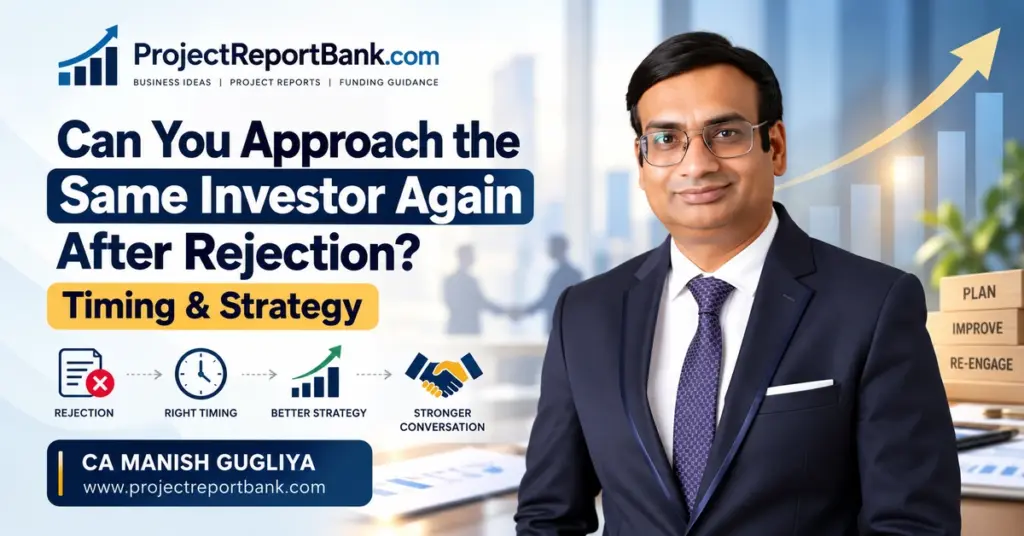
- Project Report Bank, led by CA Manish Gugliya, provides professional support in strengthening DPR, financial models and fundraising strategy before any second approach.
Introduction: Rejection Does Not Always Mean “Never”
Consider a manufacturing promoter planning a ₹20 crore greenfield food processing plant who approaches an investor for ₹10 crore in equity. The pitch goes well, the DPR is submitted, but two weeks later, the investor declines. The sting is real, but does this mean the doors are permanently closed?
Not necessarily. A rejection is often a no for now rather than a permanent decision. Investors may say “not ready” for various reasons – the financial model may have weak assumptions, the valuation may appear aggressive, the project may lack regulatory clarity, or the opportunity may simply fall outside the fund’s current mandate. A startup can receive a “no” today and a “yes” later if the underlying business fundamentals improve.
The hardest part for entrepreneurs is understanding what “no” actually means. Was it a comment on your idea, your numbers, or the investor’s own constraints? This article provides a practical, finance-led framework – from a Chartered Accountant’s perspective – for when and how to approach the same investor again after rejection. It covers timing, what must change in the DPR and financial model, and how to communicate with clarity and confidence rather than desperation.
Rejection is part of the startup journey. Each rejection can provide valuable feedback. The real question is whether you can convert that feedback into a stronger equity funding rejection follow-up strategy.
Can You Approach the Same Investor Again After Rejection?
Yes – but only in specific situations, and always backed by improved fundamentals rather than repeated requests. Re-engaging an investor who previously said no can be successful when the promoter has addressed the core reasons behind the original decline.
Not all rejections are equal. Understanding the type of rejection is the first step in this process:
- Temporary “not now” rejections – The investor sees potential but wants more traction, better clarity on land approvals, or firmer customer commitments before they invest.
- Financial or operational weakness rejections – The DPR assumptions, cash flow, DSCR or capacity utilisation projections are not credible enough to support the proposed funding.
- Valuation and term-sheet disagreements – The investor may have liked the business but could not justify the proposed valuation or dilution terms internally.
- Mandate or sector mismatch – The fund’s policy does not permit investment in that sector, ticket size or geography. This is structural, not personal.
Temporary rejections and fixable weaknesses usually allow for a well-timed second approach. Valuation-based rejections may also be revisited if the promoter adjusts expectations. However, mandate mismatches and explicit final decisions typically mean you should not reapproach the same company’s investment team.
The primary reason for previous rejections should be clarified before any outreach. Founders should carefully read the investor’s wording – emails, meeting notes, verbal feedback – to understand which category applies. Repeated approaches without correcting core issues can damage credibility in that space permanently.
Why Do Equity Investors Reject Manufacturing Projects?
Manufacturing and industrial projects are capital intensive, and investors evaluate them with rigorous scrutiny. Investors want to understand the market opportunity size, need evidence of traction before investing, and look for urgency in the funding opportunity. When these elements are missing or unconvincing, rejection follows.
Common rejection reasons include:
- Unrealistic sales projections and over-optimistic ramp-up curves – Assuming 90% capacity utilisation in the first year without firm orders.
- High raw-material price or supply risk – Especially in agro-processing, food processing and commodity-linked sectors where price volatility is significant. An Assocham survey highlighted that high compliance costs and capital gaps remain major constraints for Indian manufacturers.
- Weak cash flows and adverse DSCR – Projects where the debt service coverage ratio falls below 1.25× under base-case scenarios raise immediate red flags.
- Inadequate promoter contribution – If promoter equity is below 15% of project cost, investors see misaligned incentives.
- Aggressive valuation with low promoter dilution – Expecting high valuation without proportionate fundamentals.
- Unclear land, licences and statutory approvals – Vague timelines on environmental clearance, factory licences or FSSAI registration.
- Generic or templated DPR – A report that does not reflect project-specific realities is often rejected on first read.
Investors typically focus on common investor rejection reasons and funding gaps in manufacturing projects, typical financial model red flags in cash flow, IRR and DSCR, and key manufacturing project risks around capacity, raw material and sales. Understanding the real reason for rejection is the foundation of any follow-up strategy.
When Is the Right Time to Approach the Same Investor Again?
There is no fixed universal waiting period. The timing of re-engagement should follow achieving significant milestones, not an arbitrary calendar date. Investors want updates on significant business changes before reconsidering investment. Key milestones can be compelling reasons to re-engage with investors.
A practical decision framework:
| Rejection Reason | Improvement Required | Suitable Conditions to Reapproach |
|---|---|---|
| Weak financial model and DPR | Corrected assumptions, realistic DSCR/IRR | 30–90 days after thorough revision |
| Overestimated capacity utilisation | Conservative ramp-up (50–60% Year 1) | When revised projections are stress-tested |
| Land and approvals not confirmed | Registered sale deed or lease, licences filed | 3–6 months after securing land/approvals |
| No customer traction | LOIs, trial orders, supply agreements signed | When 2–3 firm customer commitments exist |
| Low promoter contribution | Increased equity from promoter’s own funds | When promoter share reaches 20–30% of project cost |
| Valuation disagreement | Revised DCF, comparables, acceptable IRR | When valuation is recalculated with defensible assumptions |
Early stage founders should not wait indefinitely. They can improve their proposal and simultaneously approach new, better-aligned investors while planning a measured reapproach. A course correction of 30–90 days is typical for documentation and financial model fixes. For operational milestones, 3–6 months or more may be appropriate.

What Should Change Before You Reapproach an Investor?
A second approach is justified only when substantive changes have been made – not cosmetic edits. Presenting measurable progress is crucial when re-engaging investors. Demonstrating improved financial metrics can counter concerns regarding profitability. Sharing concrete metrics can alleviate investor hesitations voiced in prior meetings.
The following areas must show genuine improvement:
- Revised investor-ready DPR reflecting corrected assumptions, updated project cost and realistic timelines.
- Improved project feasibility analysis with credible market data and localised research.
- Updated capital expenditure estimates with fresh machinery quotations and 10–15% contingency provision.
- Raw-material procurement strategy backed by supplier discussions or MOUs.
- Revenue and capacity utilisation projections aligned with market size – typically 40–60% in Year 1, 70–80% in Year 2.
- Detailed EBITDA, free cash flow and debt servicing analysis showing DSCR ≥ 1.25× in base case.
- Clear comparison of project IRR vs equity IRR – many Indian investors expect equity IRR of 18–25% for manufacturing projects.
- Revised business valuation aligned with financial projections and India’s equity risk premium of approximately 7%.
- Improved funding structure showing promoter contribution, term loan, working capital and investor equity.
- Supporting evidence – quotations, LOIs, term sheets, approvals – that backs every major claim.
Providing market validation can counter previous concerns about market potential. Highlighting new strategic hires can address concerns about team capability. Simply increasing projected profits or compressing payback periods without evidence reduces self confidence in the eyes of investors and is counterproductive.
For practical guidance, refer to how to revise an investor-ready DPR after funding rejection and the investor-ready DPR checklist for equity funding.
Project Report Bank prepares customised DPRs and financial models based on realistic, project-specific assumptions rather than generic templates. This can significantly improve the quality of a second approach.
How to Address Previous Investor Rejection Feedback
Rejection can provide valuable feedback for improvement. Each rejection can highlight challenges to address in your pitch. Rejection often provides valuable feedback for improvement. Feedback from rejection helps refine your pitch for future meetings. Addressing past concerns shows maturity and responsiveness to feedback.
The most effective thing a promoter can do is ask investors what needs to be true for them to invest. That answer becomes the roadmap for your revision. Rejection can serve as a roadmap to improve your startup.
Prepare a structured “feedback correction note” with the following format:
| Investor’s Previous Concern | Original Weakness | Corrective Action | Supporting Evidence | Remaining Risk |
|---|---|---|---|---|
| Capacity utilisation at 90% in Year 1 is unrealistic | No customer pipeline to support assumption | Revised to 55% Year 1, 75% Year 2 with 3 LOIs | Customer LOIs attached | Market demand sensitivity shown |
| Raw-material price volatility unaddressed | No supplier contracts, spot-market reliance | 2-year supply MOUs with 3 local suppliers | MOU copies attached | Price escalation clause capped at 8% |
| Working capital insufficient for 90-day receivables | WC calculated on 30-day cycle | Recalculated with 90-day receivables, 45-day creditors | Revised CMA data and cash flow | Bank WC limit sanction in process |
| Promoter equity too low at 10% | ₹2.5 crore on ₹25 crore project | Increased to ₹6.25 crore (25%) | Bank statements, property valuation | Remaining funded via term loan |
| IRR below investor threshold | Equity IRR shown at 14% | Revised to 21% with corrected projections | Updated financial model | Sensitivity analysis on downside |
Address previous objections directly when re-engaging an investor. Sending such a clear analytical matrix signals professionalism and respect for their evaluation. Each rejection is an opportunity to refine your pitch and learn from the conversation.
How to Reapproach an Investor Without Appearing Desperate
Investor rejection can shake a founder’s confidence, but emotional follow-ups or pressure tactics usually close doors permanently. Keeping the initial touchpoint succinct and low-pressure is advisable. A re-engagement email should focus on value rather than an immediate pitch.
Professional do’s:
- Send a concise, data-backed update explaining what has materially changed since the last meeting.
- Ask politely if the investor is open to reviewing a revised DPR or financial model.
- Focus on commercial logic, risk mitigation and improved metrics rather than emotional appeals.
- Maintain a warm relationship – continuous updates keep the investor informed and engaged with developments.
- Using a knowledgeable intermediary can help re-establish communication with investors when direct outreach feels awkward.
Clear don’ts:
- Do not repeatedly call or message senior partners at the same company.
- Do not complain about previous rejection decisions or compare them with other investors.
- Do not overstate progress, traction or approvals that are not yet final.
A structured follow-up can help maintain investor interest without pressure. Consider one well-prepared follow-up email, then perhaps one gentle reminder after 10–14 days. Acknowledge previous feedback respectfully during re-engagement. Maintain a funding pipeline with multiple investors so you never appear fully dependent on a single decision – much like a digital verification process where you submit your request and wait patiently. Think of it as je verzoek wordt geverifieerd – your proposal is being reviewed. Vernieuw deze pagina niet; do not keep refreshing. Give it een paar seconden doorgaan before expecting a response. The analogy applies perfectly to investor follow-ups.
Keeping communication professional is more important than keeping it frequent.
Sample Email to Reapproach an Investor After Rejection
Below is a ready-to-use template for an Indian manufacturing promoter approaching an investor after an earlier decline. Investors respect founders who update them with evidence of progress.
Subject: Updated Investment Proposal – [Project Name] – Material Progress Since Our Last Discussion
Dear [Investor Name],
Thank you for the time you invested in reviewing our project proposal for [Project Name] during our meeting in [Month/Year]. Your feedback on [specific concerns, e.g., capacity utilisation assumptions and valuation] was valuable, and we have used it constructively.
Since our last discussion, we have made the following material improvements:
- Land acquisition completed – Registered sale deed executed in [District, State].
- Revised DPR and financial model – Capacity utilisation revised to 55% in Year 1, DSCR improved to 1.45× in base case, equity IRR recalculated at 21%.
- Customer traction – Secured 3 LOIs from institutional buyers representing approximately 40% of Year 1 projected revenue.
- Promoter equity increased – Promoter contribution raised from 10% to 25% of total project cost.
- Valuation adjusted – Revised to reflect updated DCF and comparable transactions.
We understand that your fund’s priorities may have evolved. If you are open to reviewing the updated proposal, I would be happy to share the revised documents at your convenience.
We remain committed to building this project on sound commercial fundamentals, and we respect your evaluation process fully.
Warm regards, [Promoter Name] [Contact Details]
This template can be customised for any sector – agro-processing, engineering goods, chemicals or dairy. The tone should sound confident and commercially focused, neither apologetic nor aggressive.
Can a Revised Business Valuation Convince an Investor?
Many promoters believe that lowering valuation alone will reopen doors. In the real world, seasoned investors focus first on business viability and risk-adjusted returns. A lower valuation without improved fundamentals can actually signal desperation.
A revised valuation helps when the original proposal was clearly overpriced relative to peers and cash flows, when the investor otherwise appreciated the project, or when the promoter is now willing to offer a proportionate stake yielding an acceptable IRR over 5–7 years.
However, if the underlying DPR, financial model and execution risk remain weak, even a lower valuation rarely changes a “no” to a “yes”. For deeper guidance, refer to our article on business valuation rejected by investors and practical solutions.
The line between realistic valuation adjustment and desperate discounting is thin. Promoters must find it carefully.
Special Considerations for Greenfield Manufacturing Projects
Greenfield projects with no operating history are particularly difficult to fund. Investors cannot rely on past financial performance and must depend entirely on the DPR, feasibility study and promoter credibility. The pain of rejection is sharper here because every assumption is forward-looking.
Key areas promoters must address before considering a second approach:
- Land ownership or registered long-term lease clearly documented.
- Final machinery quotations and technology tie-ups with reputable suppliers.
- Statutory approvals – pollution clearance, factory licence, FSSAI for food processing – with realistic timelines.
- Detailed implementation schedule covering civil work, machinery erection, trial runs and commercial production.
- Customer interest letters or offtake agreements for key products.
- Raw-material availability and logistics analysis for at least 3–5 years.
- Substantial promoter financial commitment – not just reliance on investor equity and bank loans.
- Sensitivity analysis of downside scenarios and their impact on DSCR and IRR, similar to how a dairy project sensitivity and risk analysis is structured.
For instance, a dairy processing facility in Maharashtra rejected initially for vague raw-material sourcing could strengthen its case with village-level milk procurement MOUs and cold chain logistics plans. An engineering components plant in Gujarat rejected for low promoter equity could return after the promoter injects additional capital and secures a firm offtake agreement with an OEM buyer. A rice milling project in Madhya Pradesh could improve by documenting paddy procurement contracts and showing realistic milling recovery rates.
Professional feasibility studies become even more important for greenfield projects in building investor confidence.
When Should You Stop Approaching the Same Investor?
Knowing when to stop is as important as knowing when to persist. Time and reputation are limited resources for promoters in the fundraising world.
Stop approaching the same company’s investor team when:
- The fund has given explicit written communication that the decision is final.
- There is a clear sector or ticket-size mismatch – for example, the VC only invests in late-stage SaaS, not early stage manufacturing.
- Expectations on governance, control rights or board composition are fundamentally different.
- Valuation or deal structure cannot be aligned despite multiple rounds of talking.
- No meaningful business improvement has occurred since the last interaction.
In such cases, redirect energy toward better-matched investors. Refer to guidance on when promoters should reject an equity investor offer and resources on where to find genuine business investors in India.
Stopping repeated approaches to one investor does not mean giving up on equity funding. It means reallocating effort to investors structurally aligned with your project’s stage, sector and vision.
Practical Case Study – Reapproaching an Investor for a ₹25 Crore Manufacturing Project
This is an explicitly hypothetical case study for illustration.
Scenario: A promoter plans a ₹25 crore engineering components plant. The initial funding plan proposes ₹10 crore equity from an investor, ₹15 crore term loan, and minimal promoter contribution of ₹2.5 crore. The investor rejects the proposal citing low promoter skin-in-the-game, aggressive capacity utilisation of 85% in Year 1, and an equity IRR of only 15% – below their threshold.
What changed in 120 days:
| Parameter | Original Proposal | Revised Proposal |
|---|---|---|
| Promoter contribution | ₹2.5 crore (10%) | ₹6.25 crore (25%) |
| Year 1 capacity utilisation | 85% | 55% |
| Year 2 capacity utilisation | 95% | 75% |
| Equity IRR | 15% | 22% |
| DSCR (base case) | 1.15× | 1.48× |
| Customer LOIs | None | 3 institutional buyers |
| Land status | Agreement to sell | Registered sale deed |
The promoter, guided by a professional financial advisor, also prepared a stress-tested downside scenario showing the project remains viable even with 15% lower sales and 10% higher raw-material costs.
The difference between the first and second approach was not persuasion – it was evidence. Every “no” brings you closer to a “yes” when you treat rejection as diagnostic input. The investor moved from outright rejection to requesting a detailed meeting. Whether this leads to funding depends on further diligence, but the conversation was reopened on commercial merit.
How Professional DPR and Financial Modelling Support Investor Reconsideration
Reapproaching the same investor after rejection requires stronger evidence than the first attempt. A professionally prepared, investor-ready DPR provides that evidence through accurate project cost estimation, clear means of finance, detailed revenue modelling, working capital assessment, DSCR analysis, break-even analysis, ROI, IRR and payback period calculations, and sensitivity analysis addressing key risk variables.
When these elements are prepared by an experienced Chartered Accountant with project finance expertise, investors are more likely to reconsider because the analysis is robust and transparent. Today, this level of rigour is increasingly expected even in round one.
Project Report Bank, led by CA Manish Gugliya, focuses on customised, bankable and investor-ready DPRs, financial models and feasibility studies for manufacturing, agro-processing, food processing, dairy and other industrial sectors across India. Even the best DPR cannot guarantee funding approval, but it can materially improve the quality of conversations with both existing and new investors. You can read and check our project-specific resources to learn how we apply these principles across sectors.
Packing pitch meetings tightly helps maintain morale during the fundraising process. Practicing rejection responses can build confidence for subsequent discussions. The story you tell in your DPR must be one the numbers can defend.
Frequently Asked Questions
Can I pitch the same investor twice for the same project?
You can approach the same investor again, but only if there is a meaningful change in your DPR, financial model, traction, approvals or valuation. Simply repeating the same pitch with minor cosmetic changes is rarely productive and can lead to permanent loss of access to that fund. Investors hear dozens of proposals; they remember those who returned with genuine progress.
How long should I wait after an investor rejects my proposal?
For documentation and financial model corrections, 30–90 days is often sufficient. For operational milestones such as land acquisition, regulatory approvals or customer traction, 3–6 months may be more appropriate. The right interval depends on the scale of improvements required, not on an arbitrary waiting period. Rejection offers valuable insights from experienced investors – use the time to act on them.
Should I approach new investors while planning to reapproach a previous one?
Yes. Promoters should usually explore other investors in parallel to maintain momentum and bargaining power. Staying dependent on a single investor’s decision weakens your negotiating position. Building a diversified pipeline is essential. Share your proposal with well-matched funds, family offices and strategic investors while preparing your evidence-based second approach. You can also share public updates via professional networks or even a Facebook business page to stay visible.
What documents must I update before reconnecting with rejected investors?
Key documents include a revised DPR with corrected assumptions, updated financial projections and cash flow statements, recalculated working capital assessment, updated project cost with fresh quotations and contingency, revised means of finance, and where relevant, a revised valuation note with DCF and comparable analysis. Attach supporting evidence such as LOIs, supplier MOUs and regulatory approvals. This offers the investor clear proof that something material has changed.
Does a professional DPR guarantee funding on the second attempt?
No DPR or advisor can guarantee equity funding. However, a professionally prepared investor-ready DPR and robust financial model significantly improve your chances of serious reconsideration. They provide the analytical foundation that allows investors to apply their own judgement with greater confidence in the underlying data. Finally, the quality of your preparation determines whether an investor sees an opportunity worth exploring.
Conclusion – Reapproach With Evidence, Not Repeated Requests
Approaching the same investor again after rejection is sensible only when backed by tangible business improvements, stronger documentation and more realistic financials. No amount of follow-up emails or phone calls can substitute for a DPR that tells a credible, defensible story supported by real evidence.
Investors respond to proof: cleaner DPRs, better project feasibility, clarified risks, rational valuation and visible promoter commitment. The thinking behind your proposal matters more than the number of no’s you have received. Evaluate your project honestly, address the gaps highlighted, and then approach investors with renewed confidence and a commercially stronger value proposition.
The hardest thing is not hearing “no” – it is doing the real work required to deserve a “yes.”
Need to Strengthen Your Investor-Ready DPR Before Approaching Investors Again?
CA Manish Gugliya, FCA, DISA (ICAI), with more than 20 years of professional experience, provides professional assistance in investor-ready detailed project reports, project feasibility studies, financial projections, financial modelling and investment documentation for Indian manufacturing and industrial projects.
If you are a manufacturing promoter or an entrepreneur whose equity funding proposal has been rejected, and you are planning a structured second approach, share your project details, estimated investment requirement, existing DPR and key investor concerns through ProjectReportBank.com. Our services include customised DPR preparation, CMA data, financial modelling, project feasibility, investor-ready pitch documentation and fundraising advisory. We do not offer guaranteed funding, assured investor introductions or investment approval.
Author: CA Manish Gugliya, FCA, DISA (ICAI) Practising Chartered Accountant | 20+ Years of Professional Experience Website: https://projectreportbank.com/