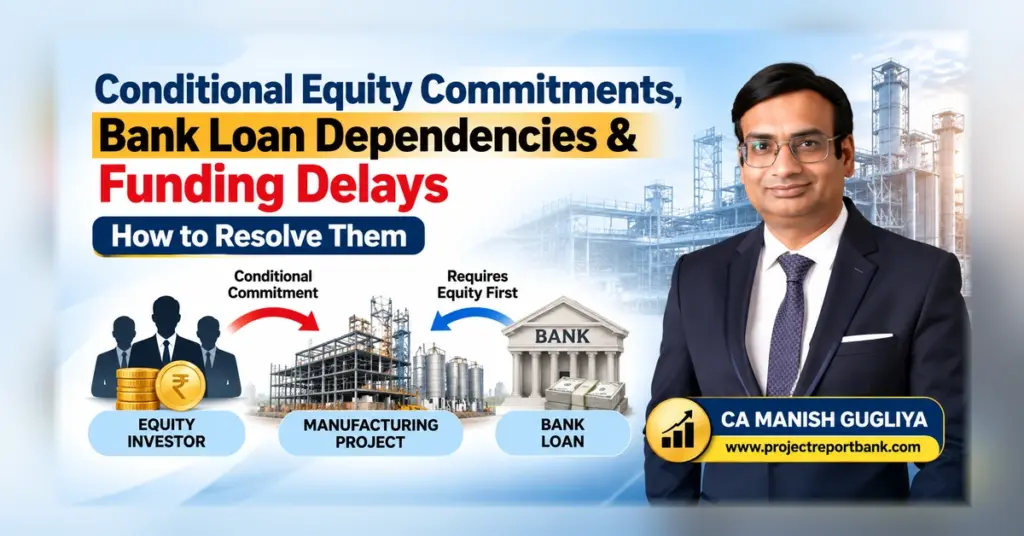
Key Takeaways
- Conditional equity funding in India creates a circular dependency: equity investors wait for bank loan sanction before releasing funds, while banks require proof of equity before sanctioning or disbursing the term loan. Neither moves first, and the project stalls.
- Most investors and lenders can be coordinated through a unified project cost and means-of-finance statement, realistic and enforceable term sheets, a clearly defined funding sequence, and robust financial modelling covering DSCR, IRR, and sensitivity analysis for delay scenarios.
- Delays in conditional investment commitments directly increase project cost through higher interest during construction, machinery price escalation, and extended pre-operative expenses, weakening DSCR and profitability if not proactively managed.
- Conditional equity funding ties capital issuance to specific future milestones such as bank sanction, land registration, or statutory approvals. It is common in manufacturing and expansion projects, but promoters must distinguish between committed capital and actually received capital.
- Project Report Bank, led by CA Manish Gugliya (FCA, DISA, 20+ years of experience), assists promoters with investor-ready DPRs, bankable projections, and coordinated funding structures. No advisory can guarantee bank loans or equity funding.
Introduction: The Circular Dependency Problem in Conditional Equity Funding
Consider a common scenario in Indian manufacturing. A promoter secures an encouraging equity commitment from an investor for a ₹25 crore greenfield project. The investor agrees to bring in ₹6 crore, but only after the bank sanctions the term loan. The bank, following its appraisal norms, insists on proof that promoter and investor equity is available before issuing the sanction letter. The promoter, who has ₹4 crore of personal contribution but depends on the investor for the rest, finds both funding sources locked in a standoff.
This is the circular dependency problem in conditional equity funding in India, and it affects projects across manufacturing, processing, and industrial expansion.
The immediate consequences are tangible: inability to place machinery orders, delayed civil construction, lost supplier discounts, extension of implementation timelines, and rising pre-operative expenses. Complex projects typically have longer implementation durations, and every month of funding delay compounds the financial damage.
The solution involves five coordinated actions: (a) aligning project cost and means-of-finance into a single, defensible structure, (b) negotiating achievable conditions precedent with investors, (c) securing in-principle bank comfort or conditional sanction where possible, (d) defining a clear sequence of equity infusion and term loan drawdown, and (e) supporting all of this with a professional DPR, integrated financial model, and unambiguous documentation.
Project Report Bank, led by CA Manish Gugliya with over two decades of project finance experience, provides professional advisory on exactly these challenges. The sections below lay out frameworks, tables, and checklists for resolving conditional investment commitments.
What Is Conditional Equity Funding in India?
Conditional equity funding means an equity investor is willing to invest in a company or project, but subject to clearly defined conditions being satisfied before the money is released. These conditions may include bank loan sanction, completion of due diligence, agreed business valuation, land title clearance, or statutory approvals. Until these conditions are met, the investor’s commitment remains a promise, not a fund.
This is distinct from unconditional, upfront equity where money is already infused and fully at the promoter’s disposal. It is also different from non-binding expressions of interest, such as emails after a pitch meeting or informal notes, which carry no obligation whatsoever.
In Indian practice, conditional equity arrangements are often structured through legal frameworks like the Companies Act and may involve convertible instruments like Convertible Notes and Compulsorily Convertible Preference Shares (CCPS). These instruments are common in conditional equity arrangements. When foreign investment is involved, compliance with FEMA regulations is crucial for structuring such deals. Regulatory compliance is critical in structuring conditional equity under Indian law.
Conditional equity can mitigate the pressure of immediate ownership dilution for founders, and conditional equity arrangements help manage immediate financial pressures for startups and growing businesses. However, conditional equity arrangements may also involve repayment obligations if milestones are not achieved, which adds risk for promoters.
Conditional equity funding is often used among startups facing unpredictable markets, but it is equally prevalent in manufacturing and MSME project finance.
The gap between committed capital and actually received capital is critical. Banks and financial institutions treat these very differently:
| Stage / Document | Nature of Obligation | Binding? | Proof of Funds for Bank? |
|---|---|---|---|
| Investor meeting or pitch feedback | None | No | No |
| Non-binding term sheet | Indicative, subject to conditions | Generally no | No |
| Signed term sheet with binding CPs | Partially binding | Mixed | Usually insufficient |
| Definitive SSA/SHA executed | Legally binding, subject to CPs | Yes | Maybe, subject to bank policy |
| Funds received in company bank account | Capital available | Not applicable | Yes |
Investors typically include conditions precedent (CPs), which must be satisfied before equity infusion, and conditions subsequent (CSs), which are obligations after the funds are released, such as use-of-funds compliance or minority shareholder protections.
Why Do Equity Investors Make Funding Commitments Conditional?
From a project finance perspective, most investors structure conditional investment commitments to control risk, align with their investment committee process, and ensure that bank loans, approvals, and promoter contribution are in place before they deploy capital. Private equity investors seek long-term partnerships, and private equity funding is selective and competitive. Equity investors expect a return only if the company grows, which makes risk management a natural priority.
Typical investor conditions in Indian manufacturing projects include:
- Bank term loan sanction from a scheduled commercial bank or leading NBFC.
- Minimum promoter contribution brought in as equity prior to investor funds.
- Completion of financial, legal, technical, and commercial due diligence.
- Clear title to land, mutation, and required local approvals (factory licence, pollution NOC, building plan approval).
- Final project cost and means-of-finance within predefined ranges.
- Agreed business valuation and share price, since delaying company valuation helps avoid premature equity pricing in many situations.
- Finalisation of financial projections, IRR, and DSCR assumptions.
- Board approvals, shareholder resolutions, and execution of definitive Share Subscription and Shareholders’ Agreements.
- Specific milestones may include product launches, regulatory approvals, or revenue targets.
Equity financing does not require monthly repayments, unlike debt financing, which makes it attractive for capital-intensive projects. However, equity financing requires giving up ownership stakes, which is why investors insist on risk controls before committing.
Conditional equity arrangements also help manage immediate financial pressures by linking deployment to progress rather than time. Utilizing structured investments aligns investor incentives with operational goals.
The line between legitimate risk control and excessive conditions matters. A reasonable condition might be equity funding after receipt of a written bank sanction subject to standard documentation. An excessive condition would be one where the investor can walk away for very broad material adverse change clauses. Promoters should understand manufacturing project risks from the investor’s perspective to negotiate more effectively.
Bank Loan and Equity Funding Dependency – Understanding the Circular Problem
The classic dependency works like this: investor funding is conditional on bank loan sanction, bank loan sanction requires promoter and investor equity to be in place, and the promoter cannot independently bridge the full equity gap. The result is a funding deadlock.
In practice, the sequence typically unfolds as follows:
- Promoter signs a non-binding or conditional term sheet with an investor.
- Promoter approaches a bank with a project report and the investor’s letter as part of means-of-finance.
- Bank appraisal notes that conditional investor equity cannot fully substitute for confirmed promoter contribution. RBI guidelines typically expect promoter contribution of 25–30% of project cost.
- Bank seeks proof of equity – bank statements, net worth certificates, share capital already infused – before issuing sanction or before first disbursement.
- Investor insists on receiving the final bank sanction letter and loan documents before wiring funds.
Debt financing involves borrowing money that must be repaid with interest, and debt financing can provide tax-deductible interest payments. But debt financing does not dilute ownership, while it does incur regular payments. Bank loans require collateral for approval, and bank loans can be obtained relatively smoothly if financial criteria are met. These different characteristics mean that banks and equity investors operate with fundamentally different concerns.
It is important to distinguish between distinct stages at the bank:
- Preliminary discussion: No legal obligation; an in-principle comfort.
- Formal sanction letter: Credit appraisal completed, terms specified, but conditions attached.
- Documentation: Loan agreements, security creation, mortgage, charge registration.
- Disbursement: Stage-wise release linked to margin contribution and project progress.
Some banks may issue sanction letters contingent on specified minimum promoter equity infusion, which still leaves timing issues when that equity itself is conditional. Resolving this circularity is not about forcing either party but about designing an acceptable funding structure, sequence, and documentation. A professionally prepared bankable project report for term loan appraisal is the starting point.
Conditional Investor Commitment vs Actual Equity Disbursement
Many promoters confuse a positive meeting or term sheet with funds in hand. When building means-of-finance assumptions for a project worth ₹5–100 crore, this can be a serious error. Debt financing includes regular interest payments, and private equity does not require repayment like loans do, but neither fact changes the reality that uncommitted equity is not money.
| Stage / Document | Is This Proof of Available Capital for Bank? |
|---|---|
| Investor meeting or pitch call | No |
| Expression of interest email | No |
| Non-binding indicative offer | No |
| Detailed term sheet with conditions | Generally no |
| Signed SSA with escrow funding | Possibly, subject to bank’s policy |
| Funds credited to company bank account | Yes |
From a banker’s perspective, only funds actually received, or in limited cases very strong and legally binding commitments from recognised institutional investors, can be treated as reliable equity. Promoters should review term sheet red flags in equity investment before treating any document as confirmation of funding.
Practical Example – ₹20 Crore Manufacturing Project Facing Funding Delays
Consider a hypothetical greenfield manufacturing unit with a total project cost of ₹20 crore, located in an industrial area, planning commercial production within 18 months.
| Funding Component | Amount (₹ Crore) |
|---|---|
| Promoter contribution | 3.00 |
| External investor equity | 5.00 |
| Bank term loan | 12.00 |
| Total project funding | 20.00 |
The problem: the investor’s ₹5 crore is conditional on bank loan sanction and execution of final loan documents. The bank requires at least 40% of total equity (₹3.2 crore) to be brought in before the first major term loan disbursement, along with proof of balance equity tie-up. The promoter has only ₹3 crore liquid. There is no room to substitute with unsecured loans if the bank insists on pure equity.
Result: bank delays sanction or disbursement, the investor refuses to wire funds without the bank’s final sanction, and machinery procurement and construction get postponed by 3–6 months.
Resolution approach:
- A unified Detailed Project Report and means-of-finance statement, used for both bank appraisal and investor due diligence.
- Investor agreement providing for staged equity infusion: ₹1.5 crore on signing SSA and filing forms, ₹1.5 crore on bank sanction, ₹2 crore aligned with first major machinery payment. Milestone-linked funding improves alignment between project progress and investor support.
- Bank sanction letter clearly stating required equity sequencing and agreeing to accept specific investor documents as provisional equity proof, subject to actual receipt before disbursement beyond a threshold.
Illustrative funding timetable:
| Period | Milestone | Promoter Action | Investor Action | Bank Action |
|---|---|---|---|---|
| Month 0–1 | SSA signing | ₹1.5 Cr equity infused | ₹1.5 Cr first tranche | – |
| Month 2–3 | Bank sanction | Security documents | ₹1.5 Cr second tranche | Sanction letter issued |
| Month 4–8 | Civil work, machinery advances | Balance equity | ₹2 Cr third tranche | Initial disbursements |
| Month 9–14 | Installation, trial runs | – | – | Balance disbursement |
Any such structure is subject to the bank’s internal policy, investor consent, and proper legal documentation. Conditional commitments should not be assumed as equity without explicit bank acceptance.
Main Reasons for Investor Funding Delays in Manufacturing Projects
Project delays can occur due to poor planning, and poor planning can significantly contribute to investment delays. Communication breakdowns often cause delays in project completion, and changes in project scope can severely delay timelines. Inadequate resources can lead to project delays at every stage.
The common reasons for investor funding delays in Indian manufacturing include:
| Issue | Financial Impact | Corrective Action |
|---|---|---|
| Delayed bank appraisal due to incomplete DPR | Extended pre-operative costs | Submit complete, professionally prepared DPR |
| Incomplete investor due diligence | Equity infusion postponed | Provide organised data room and timely information |
| Unrealistic or revised project cost | Confusion about funding gap | Prepare realistic cost estimates with contingencies |
| Weak projected cash flows and DSCR | Both bank and investor uncomfortable | Rework financial model with credible assumptions |
| Inadequate promoter contribution | Lower bank leverage | Explore staged contribution or additional partners |
| Unresolved land or statutory approvals | Uncertainty for all parties | Begin approval process early; delays in permitting can extend project timelines by 18–36 months |
| Valuation disagreements | Prolonged negotiation | Use defensible valuation methodology |
| Governance rights disputes | Legal documentation delayed | Agree on key terms before detailed drafting |
| Cost overruns or scope changes | Increases total cost, reduces IRR | Reassess means-of-finance and project scope |
| Investor IC or liquidity constraints | Months of delay; institutional investment decisions often take months to finalise, and top-quartile funds now take approximately 17 months to close | Maintain parallel investor conversations |
How to Resolve Conditional Equity Commitments and Bank Loan Dependencies
This section provides the practical framework for Indian promoters handling bank loan and equity funding dependency simultaneously.
Step 1 – Prepare a unified project cost and means-of-finance. Use a single DPR and financial model for both bank and investor, ensuring project cost and means-of-finance add up consistently. Include interest during construction, pre-operative expenses, and contingencies.
Step 2 – Coordinate communication and assumptions. Arrange discussions so bank, investor, and promoter align on capacity utilisation, sales realisation, working capital cycle, and implementation schedule. Ensure each party understands the other’s conditions for disbursement.
Step 3 – Negotiate realistic funding conditions. Convert vague phrases like “subject to satisfactory sanction” into measurable conditions. Avoid structures where the investor only funds after 100% of term loan is disbursed. Instead, use milestone-based equity infusion linked to verifiable actions.
Step 4 – Define the sequence of equity infusion and bank disbursement. Promoters and investors should bring in minimum equity upfront before initial land payments and civil work, followed by staggered infusions that unlock corresponding bank disbursements. Each bank has its own policy on margin contribution timing.
Step 5 – Consider escrow or simultaneous closing mechanisms. An escrow account could hold initial investor equity until both bank documentation and investor conditions are satisfied. Caution: escrow arrangements require proper legal documentation and are not standard in all MSME deals.
Step 6 – Build contingency and long-stop dates. Negotiate realistic timelines in investor documents so protracted delays trigger re-negotiation rather than indefinite uncertainty. Maintain a modest contingency plan if some equity is delayed.
Step 7 – Strengthen promoter contribution visibility. Keep clear bank statements, net worth statements, and documentary evidence ready. Banks in India prefer a solid minimum promoter contribution, even when substantial external equity is expected.
Step 8 – Recalculate project viability if delays occur. When funding delays exceed 3–6 months, refresh the financial model to incorporate cost escalation and extended interest during construction. Seek independent legal advice on enforceability of investor obligations.
Effective conditional equity agreements clearly define obligations and performance metrics. Exceeding performance targets can attract investor funding in future rounds as well. For integrated funding structures, professional project finance advisory and loan structuring support is valuable.
Financial Closure – Coordinating Banks, Investors and Promoters
Financial closure is the point at which all major sources of funds are tied through enforceable documents, conditions precedent are substantially satisfied, and both debt and equity providers are prepared to disburse per the agreed schedule.
Key components include:
- Confirmed sources: promoter equity, investor equity, term loan, working capital, subsidies.
- Executed equity documents: SSA/SHA, board resolutions, company law filings.
- Loan sanction letters and executed loan agreements with security documents.
- Registered charges and mortgages.
- Necessary statutory approvals.
Financial Closure Checklist:
- [ ] Detailed Project Report finalised and accepted by bank and investor
- [ ] Investor-ready DPR checklist completed
- [ ] SSA/SHA executed with binding CPs and long-stop dates
- [ ] Bank sanction letter with clear conditions
- [ ] Loan agreements and security documents executed
- [ ] Title deeds and mortgage papers in order
- [ ] ROC charge filings completed
- [ ] Factory licence, pollution clearance, building plan approved
- [ ] Financial model stress-tested for delay scenarios
- [ ] Implementation plan with disbursement milestones mapped
- [ ] Working capital arrangements confirmed
How Funding Delays Affect Project Cost, IRR, DSCR and Profitability
Funding delays are not merely timing inconveniences. They alter project economics and can make an otherwise viable manufacturing project unattractive. Unexpected risks can significantly impact project timelines, and the financial consequences compound rapidly.
Key financial impacts:
- Higher interest during construction (IDC): Term loan interest accrues longer before revenue begins.
- Increased pre-operative expenses: Salaries, utilities, consultancy costs during extended implementation.
- Machinery price escalation: Lost early-bird discounts push up capital cost. For perspective, new mines take nearly 18 years from discovery to production, illustrating how extended timelines escalate costs in capital-intensive projects.
- Delayed commercial production: Foregone revenues and profit.
- Working capital shortages: If cost overruns consume part of the working capital margin.
Illustrative Sensitivity Table (Hypothetical)
| Parameter | Base Case | 3-Month Delay | 6-Month Delay | 12-Month Delay |
|---|---|---|---|---|
| Total project cost (₹ Cr) | 20.00 | 20.60 | 21.30 | 22.80 |
| IDC (₹ Cr) | 1.20 | 1.55 | 1.90 | 2.65 |
| Project IRR (%) | 18.5 | 17.2 | 15.8 | 13.1 |
| Average DSCR | 1.65 | 1.52 | 1.40 | 1.18 |
Note: These figures are purely illustrative, not industry benchmarks.
A robust financial model for conditional equity funding should test both upside and downside cases, including funding delays, cost escalation, and partial equity infusions. Models that ignore delay scenarios often contain critical financial model red flags.
Investor Term Sheet Clauses That Can Create Funding Problems
An investor term sheet in Indian practice often mixes commercial terms with legal concepts that directly affect timing and certainty of funding. Conversion conditions can create challenges if performance metrics are ambiguous, and certain clauses deserve careful scrutiny.
Problematic clauses include:
- Conditions precedent defined too broadly (e.g., “all approvals to investor’s satisfaction” without objective criteria).
- Unrealistic funding deadlines and long-stop dates that lapse before bank processes complete.
- Exclusivity provisions preventing promoters from speaking to other investors even when the existing investor is slow.
- Material adverse change (MAC) clauses allowing the investor to walk away for broad reasons, including market or political shifts.
- Clauses linking funding to bank sanction terms without specifying acceptable ranges for tenor, interest rate, or security.
Governance and control-related clauses also matter to lenders. Board seats and veto rights on major decisions affect bank comfort. Reserved matters requiring investor consent for further borrowing or asset sale can restrict operational flexibility.
All clauses must be evaluated together, not in isolation. A combination of strict CPs, aggressive MAC clauses, and tight deadlines can make funding practically uncertain. Promoters should review term sheet red flags before signing.
What Should Promoters Do If an Investor Repeatedly Delays Funding?
A realistic scenario: term sheet signed six months ago, multiple revised dates for equity infusion, but the investor cites internal committee delays or ongoing due diligence each time. Project timelines are slipping.
A disciplined assessment framework:
- Identify genuine unresolved conditions. Is an actual CP still incomplete, such as land documentation or bank sanction?
- Review signed documents. What is binding, what deadlines exist, and what rights does each party have on delay?
- Request written status updates. Avoid relying only on verbal assurances.
- Verify investor capacity. Request evidence of committed funds to the extent commercially acceptable. Understand whether IC approval is already obtained.
- Assess revised deadlines. Are they credible, or is the investor managing doubt and uncertainty without genuine commitment?
If delays persist, consider exploring strategic versus financial investor alternatives, or adjusted project scope. Any decision to terminate or legally enforce commitments should come only after obtaining independent legal advice.
Evaluate whether continuing with a slow-moving investor remains commercially sensible, especially when funding delays materially damage project IRR and DSCR. Sometimes rejecting an equity investor offer is the more prudent path. Promoters who need to restart outreach should prepare thoroughly, as described in the guide on how to approach investors in India.
How an Investor-Ready DPR Helps Resolve Funding Dependencies
An investor-ready DPR is a thoroughly prepared document and financial model that meets the expectations of both banks and equity investors, aligned on project cost, technical details, and projected cash flows.
Such a DPR supports conditional equity funding by providing:
- Clear project cost break-up with realistic contingencies and interest during construction.
- Transparent means-of-finance structure showing promoter contribution, investor equity, term loan, and any government subsidy, with timing of each component.
- Integrated financial projections showing DSCR, project IRR, and equity IRR under base case and delayed-funding scenarios.
- Credible technical and market research for the chosen product, location, and capacity, building confidence for investors and bankers alike.
Consistent numbers between the bank DPR, investor presentations, and internal planning documents minimise confusion and rework. An investor-ready DPR does not guarantee funding but significantly improves clarity, speeds up due diligence, and reduces avoidable queries.
For professional investor-ready DPR and fundraising support, or for deeper feasibility analysis before committing to a funding structure, professional advisory adds value at every stage.
Practical Funding Readiness Checklist Before Signing Investor Agreements
Before executing conditional investment documents, serious promoters should assess readiness across four dimensions:
Financial Readiness:
- [ ] Updated, realistic project cost statement (land, building, machinery, IDC, margin for working capital, contingencies)
- [ ] Integrated financial model tested for base case and 3–6 month delay scenarios
- [ ] Clarity on promoter’s actual liquidity and timing of contribution
- [ ] Budgets for pre-operative expenses and interest during construction
Bank Readiness:
- [ ] Draft or final DPR suitable for bank appraisal
- [ ] Understanding of possible security, collateral, and repayment expectations
- [ ] Preliminary interaction with at least one lender to gauge appetite and indicative terms
Investor Readiness:
- [ ] Clear view of how much equity the project requires and acceptable dilution for the promoter
- [ ] Shared understanding of governance rights, information rights, and exit expectations
- [ ] Draft project timetable mapping equity tranches to milestones and bank disbursements
Documentation and Compliance:
- [ ] Clean corporate records, updated ROC filings, KYC of promoters
- [ ] Clarity on land title and ownership status
- [ ] Awareness of required statutory approvals and their expected timelines
- [ ] Access to professional advisors for legal, taxation, and financial structuring questions
Promoters should not sign conditional equity term sheets until they are broadly comfortable across all these points, otherwise they risk agreeing to conditions they cannot meet within the agreed timeframe.
Need an Investor-Ready DPR and Coordinated Bank–Equity Funding Plan?
In my professional assessment, a significant proportion of project funding delays and solutions revolve around documentation quality and funding structure design rather than fundamental project viability. Many promoters have sound business ideas and capable management but lose months because their DPR, financial model, and funding structure are not aligned for both bank and investor appraisal.
Through Project Report Bank, I assist promoters with:
- Customised, bankable Detailed Project Reports tailored to specific manufacturing and processing sectors.
- Integrated financial projections and financial models that test DSCR, IRR, and delay scenarios.
- Practical means-of-finance structures, balancing bank loans, promoter equity, and conditional investor equity.
- CMA Data and loan proposal preparation for bank finance as part of a coordinated debt financing strategy.
Professional DPRs and structured financial models significantly improve preparedness and clarity, but they cannot guarantee bank sanction, investor funding, or the timing of disbursements.
If you are a serious project promoter planning a ₹5–100 crore manufacturing or processing project, or raising equity of ₹5 crore and above, I encourage you to share preliminary details through the WhatsApp option or enquiry form on ProjectReportBank.com. All discussions are treated confidentially.
Frequently Asked Questions on Conditional Equity Funding in India
These FAQs address practical questions that promoters frequently raise when dealing with conditional equity commitments, bank loans, and project funding delays.
Can a bank sanction a loan before investor equity is received?
Yes, many banks can issue a sanction letter before investor equity is fully received, but the sanction will typically include conditions requiring evidence of equity infusion before disbursement begins or crosses a specified threshold. The sanction itself does not release funds – it confirms the bank’s willingness to lend subject to conditions being met. Each lender’s policy on this differ, and promoters should clarify the exact sequencing requirements during the appraisal stage.
How can conditional equity clauses interact with government subsidies or incentives?
Many state and central schemes require the project to achieve commercial operation within a defined period and maintain a certain debt-equity structure. Delayed equity can push timelines and may affect subsidy eligibility. For example, under the PLI scheme for bulk drugs, only about 1.3% of approved outlay had been disbursed as of early 2026 because projects had not reached commercial production, partly due to land clearance and approval hurdles. Promoters should factor subsidy conditions into their overall funding timeline.
Is it better to reduce project size instead of waiting indefinitely for conditional investors?
In some cases, resizing or phasing the project to match realistic funding availability – bank loans plus promoter contribution, with or without a smaller investor – may be financially safer than waiting many months for conditional investment. This is especially true if delays are already affecting cost, IRR, and DSCR. The development of a phased approach requires careful financial modelling but can preserve project viability.
Can conditional equity funding work for working capital as well as term loans?
External equity investors typically focus on long-term capital rather than short-term working capital gaps. However, the same equity money improves overall gearing and net worth, which can support higher working capital limits from banks if structured properly in the DPR and CMA Data. The value of equity lies in strengthening the company’s balance sheet for multiple financing purposes.
What documents are typically needed for financial closure in manufacturing projects?
Financial closure requires executed equity documents (SSA/SHA), bank sanction letters with loan agreements, security and collateral documentation, registered charges and mortgages, statutory approvals (factory licence, pollution clearance, building plan), a finalised DPR with financial model, and an implementation plan with mapped disbursement milestones. All of these must be coordinated to achieve closure within acceptable timelines.
Conclusion
Conditional equity funding in India is commercially rational from an investor’s perspective, but it becomes problematic when investors and banks depend on each other to move first, creating circular dependencies and project funding delays. The play between equity and debt requires active management, not passive waiting.
The solution lies in clear project costing and means-of-finance, robust DPR and financial modelling that tests delay scenarios, negotiated and practical term sheets, well-defined sequencing of promoter equity, investor equity, and bank disbursement, and continuous communication between all three stakeholders. The future of every project depends on how well these elements are coordinated during the critical pre-implementation phase.
Promoters should proactively measure how delays affect interest during construction, IRR, DSCR, and payback period, updating their strategy rather than simply hoping that both bank loans and conditional investment commitments will eventually materialise. Treating funding structure planning with the same seriousness as plant design or market strategy is not optional for capital-intensive manufacturing investments – it is essential.
Author Bio
CA Manish Gugliya, FCA, DISA (ICAI) is a practising Chartered Accountant since 2006 with over 20 years of professional experience. Through ProjectReportBank.com, he provides professional assistance in Detailed Project Reports, CMA Data, project finance, financial projections, feasibility analysis, business valuation, and investor-ready documentation for businesses across India.