Key Takeaways
Consider a ₹20 crore manufacturing plant with ₹4 crore in promoter funds, ₹6 crore from an external investor and a ₹10 crore bank term loan. On paper, total funding matches total project cost. Yet if the investor’s second equity tranche of ₹2 crore arrives 60 days late, machinery dispatch stalls, civil contractors idle, and interest during construction accumulates – even though nobody has reduced their overall commitment. The timing of equity infusion and bank loan disbursement matters as much as the total amount sanctioned.
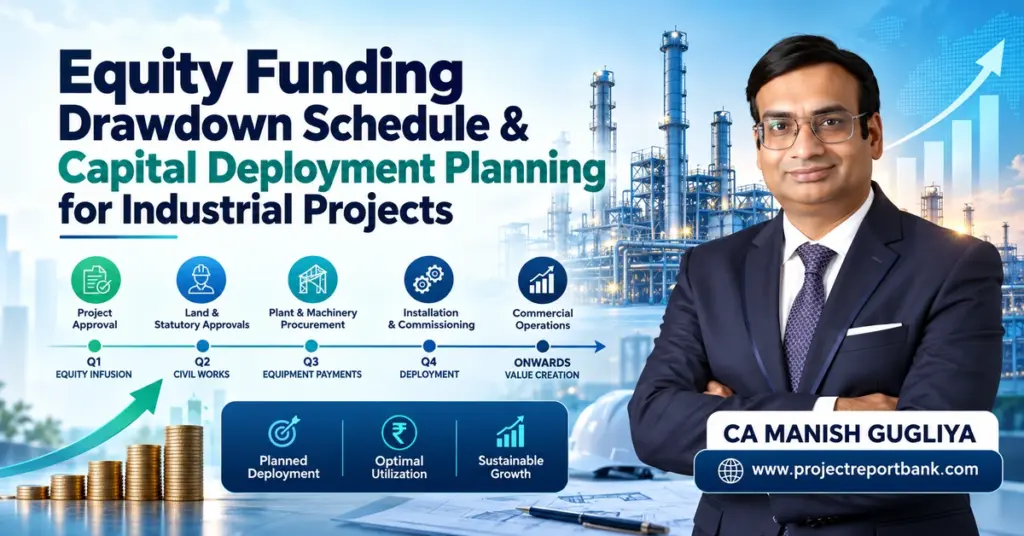
- An equity funding drawdown schedule maps three things simultaneously: when project cash outflows occur, when promoters and investors actually bring in equity, and when banks disburse term loans against eligible expenditure.
- Committed equity is not the same as cash in the company’s bank account. Capital calls, board approvals, share allotment, valuation certificates and regulatory filings create timing gaps that routinely take 3–8 weeks depending on whether equity is domestic or involves foreign investors.
- Poor coordination between expenditure, equity tranche releases and term-loan drawdowns can delay construction, increase interest during construction, trigger contractor remobilisation costs and force unplanned promoter top-ups that were never part of the original capital plan.
- An equity funding drawdown schedule helps companies manage cash flow and operational continuity by ensuring that every material payment obligation has an identified, time-matched funding source.
- At Project Report Bank, led by CA Manish Gugliya, FCA, DISA (ICAI), we use integrated financial modelling, monthly cash flow projections and disciplined capital planning to align funding schedules with project implementation for Indian industrial projects.
Introduction: Why Funding Timing Matters as Much as Funding Amount
Imagine a food-processing plant in central India with an estimated project cost of ₹20 crore. The promoter has ₹4 crore of own funds. An external investor has signed a term sheet committing ₹6 crore. A bank has sanctioned a ₹10 crore term loan. Everything appears in order – until Month 5, when a ₹1.4 crore machinery advance becomes payable and the investor’s second tranche has not yet been credited because the company’s board resolution for preferential allotment is still awaiting a special resolution.
A signed term sheet or investor commitment letter does not mean money is instantly available. An equity funding drawdown schedule dictates when investors transfer committed equity capital, and the actual receipt depends on completing legal documentation, satisfying conditions precedent, obtaining valuation certificates and, in many foreign-investment scenarios, filing FC-GPR with the RBI. Domestic equity rounds commonly take 3–6 weeks from board resolution to funds-in-account; foreign rounds may require 4–8 weeks or longer.
Capital planning for industrial projects must therefore align capital deployment with land acquisition, civil construction, machinery advances, installation charges and pre-operative expenses – not merely with total project cost. The capital planning process should integrate capital budgeting decisions with cross functional collaboration between finance teams, engineering departments and operations teams so that resource allocation matches the implementation schedule. Leveraging data analytics within the financial model helps promoters make informed decisions about which payments can be deferred and which require immediate liquidity.
Understanding when to raise equity funding and assess cash runway is as important as knowing how much to raise.
What Is an Equity Funding Drawdown Schedule?
An equity funding drawdown schedule is a period-wise plan – typically monthly or quarterly – showing how much equity from promoters and external investors will be brought into the project company in each period, linked to project milestones, capital expenditure timing and expected future cash flows. It is a critical bridge between strategic capital planning and the operational approval of specific payments for land, buildings, plant and machinery, and other capital projects.
A drawdown is a request for committed capital. Investors legally pledge a total amount of capital but release funds in segments. Capital in a funding drawdown is disbursed in increments known as tranches or drawdowns. Each drawdown includes details like purpose and amount. In private equity and venture capital structures, these are implemented through formal capital calls, where Limited Partners typically have 5–10 business days to fund drawdowns. In a typical Indian industrial project with one or two strategic investors, the mechanism is more commonly referred to as an equity infusion schedule or investor equity tranche release schedule.
There are important distinctions to keep clear. Committed equity is the total amount agreed in a shareholders’ agreement or term sheet. Actual equity received is the amount credited to the company’s bank account after all formalities. A bank term-loan sanction is approval to borrow; actual loan drawdown is the release of funds against eligible expenditure and certified milestones. Time-based tranches involve releasing capital on fixed calendar dates regardless of milestones, while milestone-based tranches are triggered by verified project progress. The drawdown schedule provides a basis for accountability between management and investors.
The schedule is typically prepared before financial close as part of the DPR and financial model, then updated monthly during implementation as contracts are signed and actual cash flows emerge.
Why Is Capital Deployment Planning Important for Industrial Projects?
In manufacturing and processing projects in India, fixed-asset and pre-operative cash outflows are lumpy and milestone-linked, while equity and bank disbursements are subject to contractual and regulatory conditions. A mismatch between these two schedules creates real operational damage.
Factory construction slows down because a slab-casting bill cannot be paid on time. Imported machinery sits at port because customs duty was not cleared due to lack of funds. Utility connections are delayed because statutory fees were not budgeted in the right month. These are not hypothetical problems – they are common consequences of weak capital deployment planning.
Key cost components affected by timing include land registration and stamp duty, civil contractors’ running account (RA) bills, machinery advances (often 30–40% on order confirmation), LC margins for imported equipment, GST payments, installation charges, consultant fees and interest during construction. Capital planning allocates limited resources to strategic projects, and when the capital allocation is misaligned with on-ground requirements, total project cost increases through extended interest during construction, demurrage and storage charges, contractor remobilisation costs, rising supply costs for materials, and missed early-payment discounts from suppliers.
From a project finance perspective, effective capital planning requires stakeholder approval across departments and helps organisations manage financial risks effectively. Carefully planned capital deployment helps align capital planning with on-ground implementation, improves cash flow stability and reduces the probability of project cost overruns or liquidity crises.
How to Calculate the Total Equity Funding Requirement
Before preparing any drawdown schedule, the total equity requirement must be calculated. This requires separating several distinct concepts: total project cost, total funding requirement, lender-eligible cost, promoter contribution, external investor equity, internal accruals and any subsidy or grant components.
Total project cost for an Indian manufacturing plant typically comprises land and site development, buildings and civil works, plant and machinery, electrical installations, utilities (boilers, compressors, transformers), preliminary and pre-operative expenses, interest during construction, contingencies (usually 5–10% of core cost) and initial working-capital margin. Financial projections include income statements and cash flow forecasts that help size these components realistically.
Banks usually finance only eligible capital expenditure – typically 65–75% of fixed assets such as plant, machinery, core buildings and utilities. The remainder must come from promoter and investor equity. For example, if a bank finances ₹10 crore of eligible cost in a ₹20 crore project, equity of ₹10 crore is required. The planning formula is:
External Equity Requirement = (Total Funding Requirement including contingencies and working-capital margin) − (Confirmed Promoter Funding + Sanctioned Term Loans + Other documented sources)
This is a planning identity, not a legal formula. Simply assuming “bank loan equals 70% of project cost and equity equals 30%” can be misleading because actual bank eligibility, risk assessment norms and sector-specific guidelines vary, and because working-capital needs and contingencies may push equity higher. Accurate financial projections are crucial for effective capital planning. Promoters should undertake a detailed promoter contribution, debt-equity mix and funding gap analysis before finalising their means of finance.
How to Prepare an Equity Funding Drawdown Schedule – Step by Step
This section provides a practical guide. Financial modeling quantifies the impact of capital investments, and the steps below show how to translate that analysis into a usable funding calendar.
Step 1 – Finalise project cost. Prepare a detailed project cost statement covering item-wise capital expenditure, pre-operative expenses, interest during construction and contingencies. Ensure totals reconcile with the proposed capital plan. Capital planning evaluates projects using quantitative and qualitative criteria, and the cost statement is the quantitative foundation.
Step 2 – Develop the implementation schedule. Frame a Gantt-style schedule covering Months 1–12 (or longer): land purchase and approvals in the early months, building phases in Months 2–5, machinery ordering and dispatch in Months 3–7, installation in Months 6–9, and trial production and commissioning in Months 10–12. Project managers and project teams should collaborate with finance to ensure engineering timelines drive the cash-outflow calendar.
Step 3 – Determine timing of expenditure. Convert project schedules and supplier terms into month-wise cash payment obligations. For example, a machinery supplier may require 30% advance on order in Month 3, 50% on dispatch in Month 6, and 20% on commissioning in Month 9. Schedule targets for civil contractors’ RA bills, statutory payments and consultant invoices should also be mapped.
Step 4 – Identify confirmed funding sources. Separately identify confirmed promoter infusion (own funds, unsecured loans), signed investor equity commitments with their conditions precedent, sanctioned term loans and any government subsidy timing. A structured capital planning process improves decision-making and accountability at this stage.
Step 5 – Prepare the equity infusion schedule. Allocate promoter and investor equity across implementation months. Promoters typically infuse more in early months for land and civil work. External investors contribute through phased equity funding for manufacturing projects as milestones are met. Companies should align equity drawdowns with expected business milestones and financial requirements.
Step 6 – Coordinate debt disbursements. Bank term-loan disbursement is linked to margin money payment, vendor bills, site inspections and independent engineer certifications. Under the RBI’s Project Finance Directions, 2025, the loan agreement must include a project-specific disbursement schedule vis-à-vis stage of completion. Map expected loan drawdowns against eligible invoices without double counting.
Step 7 – Calculate cumulative funding and shortfalls. Set up a monthly spreadsheet that cumulates project expenditure and cumulates funding receipts. Any month where cumulative expenditure exceeds cumulative available cash signals a need to adjust capital planning.
Step 8 – Introduce contingency and timing buffers. Include 5–10% cost contingency and at least one to two months’ timing buffer for equity tranche receipts to assess risk. Project owners and capital planners should avoid overly optimistic schedules that leave no room for documentation delays.
Step 9 – Monitor and revise. During implementation, the finance team should update actual vs planned expenditure and funding receipts monthly, using data analytics and cross functional collaboration with project management and procurement teams. Delivery teams, operations teams and finance teams must maintain a common capital planning baseline.
Illustrative Equity Funding Drawdown Schedule for a ₹20 Crore Manufacturing Project
The following table presents a hypothetical six-phase drawdown for a ₹20 crore manufacturing project. All figures are illustrative and subject to project-specific customisation through careful financial modeling.
| Period | Project Expenditure | Promoter Funds | Investor Equity | Bank Loan |
|---|---|---|---|---|
| Months 1–2 | ₹2 cr | ₹2 cr | – | – |
| Months 3–4 | ₹4 cr | ₹2 cr | ₹2 cr | – |
| Months 5–6 | ₹5 cr | – | ₹2 cr | ₹3 cr |
| Months 7–8 | ₹5 cr | – | ₹2 cr | ₹3 cr |
| Months 9–10 | ₹3 cr | – | – | ₹3 cr |
| Months 11–12 | ₹1 cr | – | – | ₹1 cr |
| Total | ₹20 cr | ₹4 cr | ₹6 cr | ₹10 cr |
Months 1–2 cover land registration, basic site development and statutory approvals – funded entirely by promoter equity. Months 3–4 involve civil construction commencement and the first machinery advance – the investor’s first tranche joins promoter funds. Months 5–8 represent major machinery deliveries, installation and utility infrastructure – bank term-loan drawdowns begin against eligible invoices alongside the second and third investor tranches. Months 9–12 cover commissioning, trial production and pre-operative overheads, funded primarily through remaining bank disbursements.
Investor equity is deliberately phased: first tranche at signing and initial construction, second at machinery order placement, third at pre-dispatch verification. Monitoring actual drawdowns against the schedule ensures that funding is received as planned. Each drawdown includes details like purpose and amount, enabling stakeholder alignment.
Even if each two-month block balances on paper, intra-period bunching of payments – such as two large invoices falling in the same week – may still create temporary cash shortfalls. Successful capital planning requires maintaining a minimum opening cash balance or standby arrangement.
A monthly cash flow report should be structured as: opening balance + equity receipts + term-loan drawdowns − project payments − IDC = closing balance. This reinforces the importance of capital allocation to maintain liquidity throughout the year. All figures above are purely illustrative. Actual bank disbursement patterns, promoter equity timing and investor tranche conditions must be customised for each project through Financial Projections and Financial Modelling Services.

Linking Equity Funding Tranches with Project Milestones
Most institutional or strategic investors focus on milestone-based equity tranches rather than one-time upfront funding. Milestone-based tranches protect investors by minimizing risks associated with funding underperforming ventures. Disbursals of funds may depend on specific operational goals or milestones.
Typical milestone triggers in Indian industrial deals include company incorporation and initial promoter capital infusion, proof of land ownership or lease, receipt of key environmental and statutory approvals, completion of 50% civil work, placement of the main machinery order, machinery dispatch, mechanical completion and successful trial production.
The shareholders’ agreement or investment agreement will define conditions precedent – such as board composition, security documents and regulatory filings – for each tranche release. Capital call notices may give investors a defined window (10–15 days) to transfer funds after a milestone certificate is issued by the project management office or an independent engineer.
Promoters should evaluate the pros and cons of single-round versus phased equity funding at the planning stage. If a milestone is delayed or documentation is incomplete, the investor may defer the tranche, affecting the overall capital plan and requiring the promoter to manage risk through contingency reserves.
Coordinating Promoter Contribution, Investor Equity and Bank Loan Disbursement
Effective capital planning requires a holistic view of all funding sources. Promoter contribution, investor equity tranches and bank term-loan drawdowns must be sequenced to meet project payments without breaching lender or investor covenants. Legal and financial compliance is essential when finalizing a drawdown schedule.
Common bank requirements in India: lenders often insist that promoters deploy a minimum percentage of their contribution before or along with the initial term-loan disbursement. Banks may not count investor equity until shares are actually allotted and funds credited. Under RIICO’s industrial term-loan scheme, for instance, the first disbursement of up to 20% of the sanctioned loan may be released only after full promoter contribution is deployed and legal documentation is completed.
Early-stage expenses such as land, approvals and basic civil work are largely funded by promoters, while bank loans are drawn later against machinery invoices and certified RA bills. External equity is phased in between to maintain the agreed debt-equity ratio. Promoters seeking professional support may consider Project Finance Advisory and Loan Structuring to calibrate this sequencing accurately.
Double counting must be avoided – the same promoter funds cannot simultaneously satisfy bank margin requirements and finance additional working capital without acknowledging the resulting funding gap in the financial resources statement.
Integrating Capital Deployment with Industrial Project CAPEX
A well-prepared equity funding drawdown schedule must be consistent with the project’s detailed capital expenditure plan, mapping funding sources to each major CAPEX head and time period. Project feasibility studies assess potential project success by ensuring that expenditure plans are grounded in technical and commercial reality. Feasibility analysis includes financial, technical and operational assessments that directly inform the CAPEX schedule.
Main CAPEX heads for manufacturing projects include land and site development, factory and ancillary buildings, plant and machinery, electrical installations, utilities, effluent treatment plant, roads, boundary walls and office infrastructure. Each CAPEX head has its own payment pattern: civil contractors raise monthly RA bills, machinery suppliers require 30–40% advance and progress-linked instalments, and statutory bodies demand upfront payments.
Promoters should cross-reference their expenditure plan with existing guidance on capital expenditure planning for manufacturing projects. The CAPEX plan should clearly identify which costs are generally bank-eligible (plant and machinery, core buildings, utilities) and which are typically equity-funded (land for private projects, preliminary expenses, part of IDC and some contingencies). Mapping each CAPEX head to specific months and funding sources supports better capital allocation and helps prioritize projects and payments in the right sequence.
Working Capital and Liquidity Planning During Project Implementation
Many promoters plan term loans and equity meticulously for fixed CAPEX but underestimate the working capital required during commissioning and the first 3–6 months of commercial operations. This can undermine even the most carefully prepared capital plan.
Key cash-flow items during this transition include procurement of initial raw materials and packing materials, hiring and training staff, utility and overhead payments before full production, trial-batch wastage, and credit given to initial customers. Market analysis identifies target customers and market opportunities, but it also determines the receivable collection periods that drive working-capital needs. A solid business plan includes an executive summary and a clear working-capital assessment, without which financial projections show expected revenue and expenses over time but miss the liquidity reality.
Initial working-capital requirements are usually funded through a combination of working-capital banking limits, promoter funds and sometimes a portion of investor equity earmarked as working-capital margin. This must be explicitly built into the funding drawdown model. Diverting funds originally earmarked for machinery or civil work to plug short-term operating expenses creates later-stage CAPEX shortages. Promoters should study working capital planning before equity funding to integrate term-loan, working-capital finance and equity planning in one consolidated cash flow.
What Happens When an Equity Funding Tranche Is Delayed?
Using the earlier ₹20 crore example: assume the third investor equity tranche of ₹2 crore expected in Months 5–6 is delayed by approximately 60 days due to pending documentation or internal investor approvals. Equity drawdowns can be adjusted based on emerging business conditions or phases, but the interim consequences are real.
Specific payments affected in that window include balance machinery payment and part of installation charges. This creates a temporary funding gap even though total equity commitment remains ₹6 crore. Drawdowns occur when funds are needed for investments or expenses, and a delay directly disrupts that schedule.
Financial consequences include potential penalties or loss of supplier discounts, rescheduling of contractor work, extended interest during construction and postponement of the commercial operation date. Supply chain disruptions compound the problem if machinery dispatch is held up by non-payment. Project delays of this nature can push DCCO back, and under RBI norms, non-infrastructure projects may see reclassification risk if DCCO is deferred beyond one year.
Realistic mitigation options include promoters bringing in short-term internal funds, renegotiating payment schedules with suppliers, drawing down from sanctioned bank limits if permissible, or adjusting the equity funding drawdown schedule by preponing later tranches. Understanding project cost overruns and contingency planning at the DPR stage helps build contingency equity to absorb such delays. Any revised plan must be evaluated through updated project cash-flow and DSCR analysis – bridging finance or additional bank loans are not automatic.
Financial Monitoring, Capital Utilisation and Investor Reporting
Once implementation begins, the equity funding drawdown schedule becomes a living control document. A well-prepared equity drawdown schedule facilitates cash flow management and capital efficiency only if it is updated using actual data and shared with investors and lenders through regular reporting. Equity drawdown schedules help establish liquidity planning for investors by outlining funding requirements transparently.
Key monitoring reports include original vs revised project cost, budgeted vs actual CAPEX by head, investor commitment vs actual equity received, pending procurement commitments, age-wise payable schedules and updated forecasts of monthly cash surpluses or shortfalls. These reports help track performance and support compliance with investor and lender covenants. Governance tools and project management tools should maintain version control so that all stakeholders rely on consistent numbers.
Investors often expect periodic utilisation statements showing how each tranche was deployed against approved budget heads, supported by invoices and certifications. Detailed discussions on internal controls and fund governance are covered separately under investor capital deployment and fund utilisation controls.
Consistency between the DPR, updated financial model, bank submissions and investor updates is critical. All stakeholders should rely on a common capital planning baseline. Performance measurement across these reports flags deviations early, enabling organizations to adjust before liquidity stress appears.
How an Investor-Ready DPR Supports Funding Drawdown Planning
An Investor-Ready Detailed Project Report combines technical, market and financial analysis with integrated financial projections, specifically designed for discussions with equity investors and lenders. It is not merely a compliance document – it is a strategy development tool. A business plan should highlight the management team’s experience, and the DPR frames that experience within a structured financial narrative. A pitch deck summarizes your business plan visually, but the DPR provides the analytical depth behind it.
A robust DPR should include itemised project cost, an informed means-of-finance statement, a phased implementation schedule, detailed projected profit and loss, balance sheet and cash flows, and an embedded equity funding drawdown schedule aligned with term-loan drawdowns. Investors expect realistic financial projections to assess profitability, and financial projections help in evaluating project feasibility and funding needs. A strong feasibility study can prevent costly project failures by identifying risks before capital is committed.
Integrated financial modeling – ideally on a monthly basis during the project phase – can simulate different equity tranche timings, cost overruns and commissioning delays through scenario analysis and sensitivity testing, allowing promoters to assess risk and adjust capital planning. Promoters preparing for investor due diligence should review the investor-ready DPR documentation checklist.
While a strong DPR improves clarity and investor confidence, it does not guarantee funding. It strengthens the promoter’s ability to negotiate realistic equity infusion schedules and capital deployment plans.

Common Mistakes in Equity Funding Drawdown Planning
Many implementation problems in industrial projects arise not from project economics but from avoidable planning errors around equity infusion and liquidity. Feasibility studies help prioritize projects based on strategic goals, but even feasible projects fail when drawdown planning is weak.
Mistake 1: Treating non-binding investor interest or an unsigned term sheet as committed equity and starting major CAPEX without legally enforceable agreements. Potential investments must be distinguished from confirmed funding.
Mistake 2: Assuming the entire committed equity will be infused immediately after signing, ignoring the agreed phasing and conditions precedent. This leads to optimistic capital budgeting and funding gaps.
Mistake 3: Ignoring specific supplier and contractor payment deadlines and preparing only an annual or broad quarterly funding plan rather than a detailed month-wise cash flow aligned to contracts.
Mistake 4: Failing to coordinate promoter contribution timing with lender requirements, resulting in delayed term-loan disbursement because margin money has not been fully deployed.
Mistake 5: Omitting adequate contingency and realistic working-capital requirements. Quantitative criteria like ROI are crucial in feasibility assessments, but ignoring liquidity makes even strong ROI irrelevant during implementation. External factors such as material cost inflation or market demand shifts compound the problem.
Mistake 6: Assuming that mere achievement of a technical milestone will automatically trigger investor funding, without ensuring that all documentary conditions and compliance requirements are also fulfilled. The intake process for each tranche involves multiple verifications.
Mistake 7: Not updating the equity funding drawdown schedule after a six-month delay in civil construction or machinery delivery, causing subsequent schedules for debt and equity to become misaligned. The capital plan must reflect current reality, not outdated assumptions.
Mistake 8: Relying solely on spreadsheets without version control or integrated project management tools, leading to inconsistent numbers across the DPR, bank submissions and investor presentations, making cross functional collaboration difficult. Increasingly complex projects demand better governance tools and systematic data analytics.
Professional Recommendations for Industrial Project Promoters
From a Chartered Accountant’s advisory perspective, industrial promoters should treat funding timing and liquidity as core project risks, not afterthoughts. Capital planning helps organizations manage financial risks effectively, and the following recommendations reflect that principle.
Recommendation 1: Prepare a realistic, item-wise project cost and implementation plan before negotiating equity or debt. Use professional input to align capital planning with engineering schedules, the organization’s strategic goals and regulatory timelines. Strategy development at this stage prevents costly misalignment later. Environmental impact assessments, energy efficiency standards and compliance with aging infrastructure requirements should be factored in early.
Recommendation 2: Use a detailed monthly cash-flow model during the construction phase. Capture all capital expenditure, interest during construction and working-capital needs. Test alternative equity and debt drawdown patterns through scenario analysis, discounted cash flow modelling and net present value assessment. Internal rate of return and rate of return IRR calculations are directly affected by drawdown timing – drawdowns improve internal rate of return calculations for investors because invested capital is deployed only when needed.
Recommendation 3: Insist on clearly drafted investment agreements defining equity tranche amounts, milestones, conditions precedent, longstop dates and dispute mechanisms. Ensure strategic alignment between investor expectations and the promoter’s broader business goals. Do not assume flexibility where it is not expressly provided. Avoid pet projects diverting financial resources from the core capital plan.
Recommendation 4: Maintain sufficient contingency – both in cost and funding. Additional promoter liquidity or standby equity should be available to manage risk from delays and cost inflation without jeopardising the capital plan. The expected value of contingency reserves should be proportionate to project complexity. Bond measures or additional security may support these arrangements where appropriate.
Recommendation 5: Establish internal governance and reporting practices that monitor equity receipts, bank drawdowns and fund utilisation at least monthly. Project owners, project managers and finance teams should update the drawdown schedule whenever significant deviations occur. Quantitative measures and valuation method consistency across documents are essential.
Recommendation 6: Seek professional project finance advisory support early to calibrate promoter contribution, investor equity, bank term loans and working-capital facilities into a coherent capital allocation framework. A rigorous project evaluation process ensures that long term organizational objectives are served and that multiple projects, if planned simultaneously, receive appropriate resource allocation. This approach to successful capital planning enables enabling organizations to leverage technology and manage increasingly complex capital investments with confidence. Business operations benefit directly from this discipline.
Frequently Asked Questions
The following questions address practical doubts not fully covered in the main discussion.
How often should an equity funding drawdown schedule be updated during implementation?
In most industrial projects, the schedule should be reviewed monthly or immediately after any major event such as a large variation order, machinery delivery delay or change in investor tranche dates. Frequent updates allow promoters to adjust capital allocation, refine capital budgeting and, where necessary, adjust capital planning or implementation pacing before liquidity stress appears. The capital planning process benefits from continuous data analytics applied to actual vs planned expenditure.
Is it safer to bring in all investor equity upfront instead of phasing it?
While upfront equity improves liquidity, many investors prefer phased equity funding for manufacturing projects aligned with milestones to manage their own cash flow and risk. Pre-seed funding often comes from personal savings or family, seed funding typically involves angel investors for early-stage startups, and venture capital firms invest millions in startups with high growth potential – in each case, capital deployment timing is matched to the investee’s stage and needs. Crowdfunding platforms allow raising money from many small investors with their own phasing expectations. The optimal approach depends on project risk, trust between parties and negotiation. Small business loans require a good credit score and solid business plan, while grants from government agencies do not require repayment but are competitive – each funding source introduces its own timeline. Both options are discussed conceptually under single-round versus phased equity funding.
Can promoters rely on short-term bridge loans to cover delayed equity tranches?
Bridge finance may be possible in some cases but usually comes with higher cost and additional conditions. Lenders may be reluctant if they perceive fundamental investor uncertainty. I recommend that such decisions be modelled carefully in the project’s cash flow and DSCR analysis. Promoters should not assume bridge funds will automatically be available without formal sanction. The net present value impact of bridge-finance costs should be assessed before committing.
What level of detail is appropriate for a drawdown schedule when presenting to investors?
At the term-sheet stage, a quarter-wise schedule with clear milestone descriptions is generally sufficient. As legal documentation progresses and construction contracts are finalised, move to month-wise detail. Investors usually expect enough detail to understand capital calls, risk drivers and contingency planning without being overloaded with every small bill. A capital allocation line mapping cumulative funding against cumulative expenditure is particularly effective. Investors focus on whether the schedule is internally consistent and supported by realistic assumptions.
Can the same equity funding drawdown model be reused for multiple projects?
The structure and formulas of a model – period-wise funding vs expenditure – can be reused, but the assumptions, amounts, risk factors and capital planning details must be customised for each project’s sector, location and implementation timeline. Copying schedules without project-specific adjustments can misalign capital planning and expose promoters to unforeseen funding gaps. Critical assets, market demand and production capacity differ across projects, and the drawdown schedule must reflect these differences.
Conclusion – Plan Capital Availability Before Committing Project Expenditure
An effective equity funding drawdown schedule ensures that committed equity, promoter funds and bank term loans are all available in the right amounts at the right time – not merely in aggregate figures that balance on a means-of-finance page. Capital planning establishes the foundation for implementation success when it synchronises actual payment obligations across land, civil work, machinery, utilities and working capital with the timing of fund receipts.
Realistic project costs, clearly structured investment agreements, disciplined monitoring and professional financial modelling together reduce the risk that a technically viable project fails due to liquidity gaps during implementation. In my professional assessment, promoters who treat drawdown planning as an integral part of their overall capital planning process – rather than a purely accounting or compliance exercise – are significantly better positioned to deliver their projects on schedule and within budget.
Planning Equity Funding for an Industrial Project?
Serious industrial projects benefit from integrated planning of project cost and means of finance, promoter and investor contribution, capital expenditure and implementation schedule, equity infusion and debt drawdowns, monthly cash flow projections and funding gap analysis. At Project Report Bank, CA Manish Gugliya, FCA, DISA (ICAI), with more than 20 years of professional experience, provides customised Investor-Ready DPR preparation, financial modelling, project finance advisory and capital deployment documentation for manufacturing and processing projects across India.
If you are planning a project of ₹5 crore to ₹100 crore and need professional support to prepare an equity funding drawdown schedule, means-of-finance plan and investor-ready financial projections, share your business activity, approximate project cost, expected equity funding requirement and current project stage through our website’s WhatsApp enquiry option.
Explore our Investor-Ready DPR and Fundraising Assistance services for a professional assessment tailored to your project.