Key Takeaways
- Dal mill capacity planning determines machinery size, plant cost, working capital requirement and long-term profitability for any pulse processing business in India.
- The four common capacity benchmarks – 5 TPD, 10 TPD, 20 TPD and 50 TPD – suit different entrepreneur profiles, raw material access levels and market reach.
- TPD and TPH ratings refer to raw pulses input capacity; finished dal output is always lower due to dehusking losses, broken pulses and by-products.
- Realistic capacity utilisation of 60–80% in initial years is critical for credible bank loan DPRs, DSCR calculations and cash flow planning.
- Project Report Bank, led by CA Manish Gugliya (FCA, DISA, 20+ years’ experience), provides customised DPR preparation, CMA Data and financial modelling support for dal mill projects of all scales.
Introduction – Why Dal Mill Capacity Planning Matters
Dal is a staple food item with consistent demand across India, and the dal processing industry offers excellent growth potential for MSME entrepreneurs. Yet, the capacity decision made during project planning locks in machinery investment, building size, power load, workforce and bank finance obligations for the next 8–10 years. Getting this wrong – either too small or too large – creates problems that are expensive to fix later.
Most entrepreneurs in India consider machinery quotes from a dal mill plant manufacturer first and only later think about production capacity. The sequence should be reversed. Planning the capacity for a dal mill requires balancing raw material availability, machinery throughput, and market demand before selecting vendors.
This article examines 5 TPD, 10 TPD, 20 TPD and 50 TPD dal mill plants as common benchmarks for small, medium and industrial-scale operations. It is written from the perspective of CA Manish Gugliya, with more than 20 years of professional experience in project finance, and connects plant capacity with DPR, CMA Data, DSCR and bank loan appraisal realities.
Understanding Dal Mill Capacity – TPD, TPH and Annual Production
A dal mill plant manufacturer typically quotes capacity in TPD (tonnes per day) or TPH (tonnes per hour) for raw pulses processed. A dal mill plant processes pulses into consumable dal, and understanding these units correctly is the first stage of capacity planning.
TPH represents the rated continuous throughput of a bottleneck machine – usually the emery roll or dehusker – under standardised conditions. Dal mill plants can process 1.5 to 10 tons per hour depending on scale and automation level. TPD is derived from TPH multiplied by productive operating hours per day, not total clock hours.
The basic formula is:
Daily Raw Pulse Input (TPD) = Effective Processing Rate (TPH) × Productive Operating Hours per Day
Installed capacity as listed in a manufacturer’s catalogue rarely matches actual achieved throughput. Effective capacity is influenced by the actual physical conditions of the milling machinery – cleaning stoppages, bag changes, lunch breaks, power cuts and minor adjustments reduce output. A machine rated at 1.25 TPH may deliver only 1.0–1.1 TPH in sustained operation.
Annual production capacity equals daily input multiplied by working days per year (commonly 300), adjusted by capacity utilisation assumptions – for instance 65%, 75% and 85% across Years 1 to 3. Raw pulse input capacity is always higher than finished dal output because husk, broken dal and bran are separated during processing.
Dal Mill Capacity Comparison – 5 TPD, 10 TPD, 20 TPD & 50 TPD
The following table compares four common dal mill plant capacities under consistent assumptions of 8 productive hours per day and 300 working days per year.
| Parameter | 5 TPD | 10 TPD | 20 TPD | 50 TPD |
|---|---|---|---|---|
| Installed Raw Pulse Capacity | 5 tonnes/day | 10 tonnes/day | 20 tonnes/day | 50 tonnes/day |
| Indicative TPH Requirement | ~0.6 TPH | ~1.25 TPH | ~2.5 TPH (or ~1.25 TPH × 2 shifts) | ~3.0–3.5 TPH (2–3 shifts) |
| Typical Shifts | Single (8 hrs) | Single extended or two shifts | Two shifts (2 × 8 hrs) | Two to three shifts |
| Machinery Configuration | Manual / semi-automatic | Semi-automatic dal mill | Automatic dal mill plant | Fully automatic dal mill plant |
| Approximate Manpower | 5–8 persons | 10–15 persons | 18–25 persons | 30–50+ persons |
| Working Capital Intensity | Low–moderate | Moderate | High | Very high |
| Business Scale | Local / taluka | District / regional | Regional / multi-district | Regional / national / B2B |
Assumptions: 8 productive hours per shift, 300 operating days/year. Figures are indicative and vary with pulse type, machinery make and operating conditions.
A dal mill plant costs approximately Rs 1.63 crore for a medium-capacity commercial setup including civil works, utilities and working capital margin – though actual costs vary significantly with automation level and location. Doubling capacity does not double total project cost because infrastructure like land, boundary walls, office space and basic utilities do not scale proportionally. To understand how capacity selection influences total investment, refer to Dal Mill Plant Setup Cost in India.
Margins per tonne tend to improve with scale in an automatic dal mill plant due to better recovery, lower power per tonne and improved labour productivity, but procurement and market risks also grow.
5 TPD Dal Mill Plant – Capacity and Production Planning
A 5 TPD dal mill is an entry-level commercial plant suitable for entrepreneurs upgrading from trading or job-work. It typically operates in a single 8–10 hour shift with manual or semi-automatic handling.
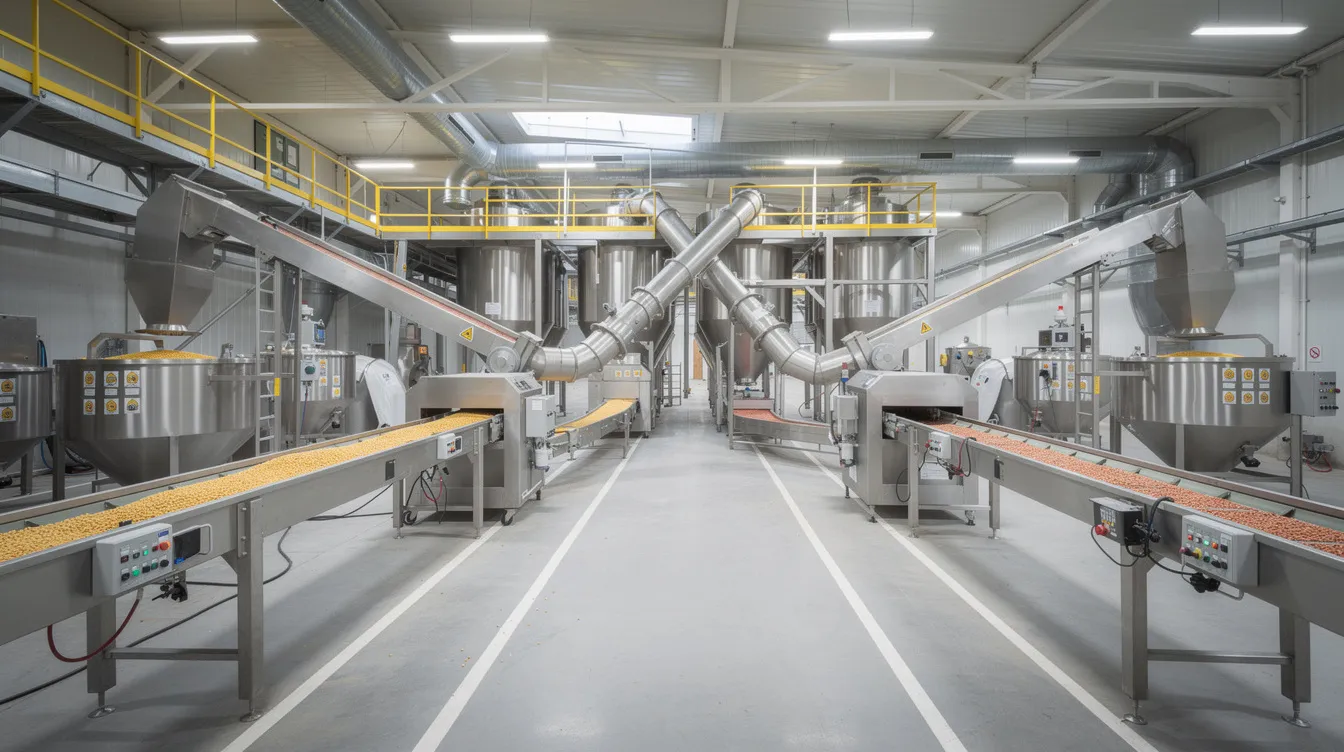
The processing line includes a pre-cleaner, grader, destoner, small emery roll or huller, splitter, aspirator, mini dal polisher and basic packing arrangement. At 5 TPD raw pulses input and an illustrative recovery of 70–78%, daily finished dal output would range from approximately 3.5 to 3.9 tonnes, with the remainder comprising husk, broken pulses, powder and minor handling losses. These figures are illustrative only and depend on pulse type and process conditions.
Market research helps in selecting the right product mix – many 5 TPD units focus on one or two products such as chana dal or toor dal, supplying local kirana shops and small wholesalers within a 50–75 km radius. Benefits include lower project cost, simpler layout, a smaller electricity connection and manageable raw material volumes. Limitations include higher unit overhead cost per tonne, difficulty serving modern retail chains and limited scope for processing multiple pulses types without frequent changeovers.
10 TPD Dal Mill Plant – Capacity and Operational Requirements
A 10 TPD pulses mill plant suits entrepreneurs with established trading networks or existing agri-businesses. It typically operates either in a single extended shift of 10–12 productive hours or two shorter shifts, balancing labor availability and electricity tariffs.
Machinery configuration includes larger cleaners and graders, higher-capacity emery rolls, improved aspirators, a proper dal mill dryer arrangement and more organised packing systems. Quality checks are implemented at every production stage, which becomes feasible at this scale because a dedicated quality person can be justified. Moisture content and quality of incoming raw pulses directly impact the conditioning process and milling recovery rates.
Raw pulse procurement for a 10 TPD plant running at 75% utilisation totals roughly 2,250 tonnes per year, requiring dedicated storage space and working capital planning. Compared to a 5 TPD business, a 10 TPD unit offers better ability to negotiate raw pulse prices from suppliers, serve distributors across nearby districts and justify initial levels of automation. Challenges include ensuring steady volumes of tur, chana or moong throughout the year and maintaining uniform recovery percentages to meet contract specifications.
20 TPD Dal Mill Plant – Commercial and Financial Planning
A 20 TPD dal mill plant targets organised distribution, regional brands and institutional buyers such as hostel caterers and food processors. At this scale, a two-shift operation (2 × 8 hours) becomes commercially viable to fully utilise expensive automatic dal mill machines while allowing maintenance windows.
Market demand fluctuations influence production methods – some 20 TPD plants alternate between continuous bulk production for wholesale orders and flexible batch processing for retail packs. Machinery redundancy becomes relevant: duplicate critical machines like cleaners or polishers reduce the risk of downtime affecting daily throughput. Planned storage with separate covered godowns for raw pulses and finished dal, proper ventilation and pest control becomes essential.
From a financial planning perspective, a 20 TPD unit involves higher fixed investment in plant and machinery, larger electrical load (dal mill machines at this scale operate on 150–450 HP motor power collectively), increased working capital for inventories and receivables, and stricter monitoring of capacity utilisation for DSCR calculations. Working capital assessment is crucial for dal mill operations at this scale. A formal Detailed Project Report and CMA Data with realistic financial projections are practically mandatory for bank term loans.
50 TPD Dal Mill Plant – Industrial-Scale Capacity Planning
A 50 TPD capacity represents an industrial-scale automatic dal mill plant, typically part of an integrated multi-pulse processing business or corporate-backed agro-processing project. Such a plant may run 16–20 productive hours daily in two or three shifts. Some dal mills at this scale can process up to 5 tons of pulses per hour, requiring strong production planning, preventive maintenance schedules and trained supervisors.
Advanced machinery integration includes multi-stage cleaning, colour sorting, sophisticated drying systems, full aspiration and dust collection for worker safety and regulatory compliance, and automated bagging lines. Bulk material handling through conveyors, elevators, hoppers and weighbridges demands a carefully designed plant layout to avoid cross-movement of raw and finished goods. There must be storage capacity for both raw grain and finished products to avoid idle production during lean seasons.
Heavy working capital is needed: large raw material lots purchased at harvest, hedging or forward contracts where feasible, and detailed cash-flow planning to service sizeable EMIs. Entrepreneurs considering tur, moong, urad, chana and masoor under one roof should refer to the Integrated Multi-Pulse Processing Plant Project Report for a comprehensive range of planning considerations.
How to Calculate Dal Mill Production Capacity
Follow this step-wise framework:
- Identify the bottleneck machine’s TPH rating (usually the dehusker or emery roll)
- Decide productive hours per shift and number of shifts
- Convert to TPD: TPH × productive hours = daily raw pulse input
- Multiply by working days per year (commonly 300)
- Adjust for realistic capacity utilisation
- Apply recovery yield to estimate finished dal output
Worked Example – 10 TPD Plant: A 10 TPD dal mill operating 8 effective hours requires a machine rated at approximately 1.25 TPH. At 75% utilisation over 300 days, annual raw pulse input = 10 × 300 × 0.75 = 2,250 tonnes. Assuming 75% average recovery, finished dal output ≈ 1,688 tonnes per year, with approximately 562 tonnes of by-products (husk, brokens, powder).
| Parameter | 5 TPD | 10 TPD | 20 TPD | 50 TPD |
|---|---|---|---|---|
| Annual Raw Input at 75% Utilisation (tonnes) | 1,125 | 2,250 | 4,500 | 11,250 |
| Finished Dal Output at 75% Recovery (tonnes) | ~844 | ~1,688 | ~3,375 | ~8,438 |
| By-Products (tonnes) | ~281 | ~562 | ~1,125 | ~2,812 |
Assumptions: 8 productive hours/day, 300 days/year, 75% utilisation, 75% average recovery. Actual results depend on pulse type, moisture, machine condition and operator skill.
Optimal machinery throughput should be determined by auditing the processing rates of individual line components. For bank loan DPRs, capacity calculations must be transparent and consistent across installed capacity, production schedule, raw material consumption and sales volumes.
Dal Mill Recovery Percentage and Finished Product Yield
Recovery in dal processing generates several product streams: head pulses (full-size splits), broken dal, husk (bhusi), powder or bran, and minor refractions. Recovery of head pulses in dal mills ranges from 70% to 86%, while overall milling recovery rates typically range from 65% to 82% depending on the pulse variety and moisture content.
Processing characteristics differ across pulse types. Chana tends to have less husk adherence and often yields higher finished splits. Pigeon peas (tur or toor dal) and urad require conditioning through soaking and drying, with more roller passes, increasing broken fractions. Moong and masoor fall between these extremes. Dal undergoes a meticulous quality inspection post-polishing, and grading ensures uniform separation of dal grains by size before packaging.
Illustrative Recovery Distribution (per 1,000 kg raw input):
| Product | Approximate Range |
|---|---|
| Head Dal (splits) | 700–860 kg |
| Broken Dal | 30–80 kg |
| Husk / Bhusi | 100–150 kg |
| Powder / Bran / Losses | 20–60 kg |
These ranges are illustrative. Actual distribution varies with pulse origin, moisture, conditioning and machinery.
Small improvements in recovery – even 1–2 percentage points – can significantly impact profitability for 20–50 TPD plants, justifying investments in better machinery and process control. Quality assurance ensures compliance with food safety standards and builds consumer trust. For a detailed understanding of each processing stage, refer to Dal Milling Process & Flow Chart.
Machinery Selection Based on Dal Mill Capacity
Machine sizing must be aligned across the entire processing line – pre-cleaners, graders, destoners, dryers, emery rolls, splitters, polishers and packing units – so that no single dal mill machine becomes a bottleneck. The processing line should be designed to ensure continuous material flow without bottlenecks relative to the target TPD.
Dal mill machinery includes pre-cleaners, graders and dryers as standard components. Dal mill machines collectively operate on 150–450 HP motor power depending on capacity, with ms motor power and construction ms power consumption scaling with plant size. A fully automatic dal mill plant can process 2 tons per hour, and fully automatic configurations ensure optimal efficiency through reduced manual intervention.
For 5–10 TPD plants, semi-automatic setups with manual feeding work adequately. For 20–50 TPD plants, fully automatic dal mill plant designs with conveyors and automation become necessary. A leading manufacturer’s quotes must be evaluated not only for upfront price but for power consumption, service support, spares availability and realistic throughput under local conditions. Detailed equipment specifications and cost bands are discussed in Dal Mill Machinery, Equipment & Cost.
Raw Material Requirement and Procurement Planning
Daily, monthly and annual raw pulse requirements flow directly from planned TPD and capacity utilisation. At 75% utilisation, a 5 TPD plant needs approximately 1,125 tonnes annually, while a 50 TPD plant needs over 11,000 tonnes. Pulses have specific harvest cycles that must be considered – chana is primarily a rabi crop, tur is kharif, and moong has both seasons – meaning raw material availability affects capacity planning due to seasonality and local sourcing logistics.
Quality raw materials are essential for high-quality dal production, and high-quality pulses directly impact the final product’s market reputation. Procurement models range from buying directly from farmers and APMC mandis to engaging aggregators and suppliers. Larger 20–50 TPD mills may sell directly to institutional buyers, requiring contract supply arrangements for volume consistency.
Raw material planning connects directly to working capital assessment in a DPR: higher TPD automatically increases inventory size, margin money requirement and CMA Data projections. Many promoters underestimate the cash blocked in raw pulses held for two to three months of operation.
Land, Building, Storage and Utility Requirements
Land and building planning should follow capacity choice. A 5–10 TPD dal mill may operate in a modest industrial shed of 2,000–3,000 sq. ft. in rural areas, while a 20–50 TPD plant needs larger plots with separate zones for raw material storage, machinery floor, finished goods, utilities and office.
A well-designed plant layout optimises workflow and safety. Material flow should progress logically from raw pulses receiving and weighment through pre-cleaning, milling, polishing, grading, packing and dispatch, minimising backtracking. Power requirement increases with capacity – a three phase electricity connection is mandatory, and larger plants may need dedicated transformers, DG backup and dust collection systems for compliance.
Specific square footage or kVA figures must be customised by a professional designer. A phase country electrical supply suitable for industrial loads is essential, with the sanctioned power load verified against actual connected equipment before installation.
Capacity Utilisation and Its Impact on Profitability
Capacity utilisation should be expressed consistently against installed raw material input capacity. Utilisation should plan for approximately 70% to 80% in initial years to accommodate ramp-up and unexpected demand spikes. Operational capacity should include allowances for maintenance and unplanned downtimes.
Under-utilisation spreads fixed costs – salaries, interest, depreciation and factory overheads – over fewer tonnes, raising per-tonne cost and reducing profitability.
Illustrative Sensitivity – 20 TPD Plant (8 hrs/day, 300 days/year):
| Utilisation | Annual Raw Input (tonnes) | Fixed Cost/Tonne (Index) | Indicative Margin Impact |
|---|---|---|---|
| 60% | 3,600 | 100 (base) | Thin or breakeven |
| 70% | 4,200 | 86 | Moderate margin |
| 80% | 4,800 | 75 | Healthy margin |
| 90% | 5,400 | 67 | Strong margin |
Fixed cost index is illustrative; actual figures depend on project-specific cost structure.
Real-world factors keeping utilisation below nameplate capacity include breakdowns, scheduled maintenance, power outages, labor absenteeism, raw material non-availability and slower sales than projected. In bank loan appraisal, projections assuming 100% utilisation from Year 1 are routinely questioned. Transparent ramp-up assumptions – say 60%, 70% and 80% across the first three years – appear far more credible.
Dal Mill Capacity Planning for Bank Loan DPR
The selected dal mill plant capacity becomes the starting point for a Detailed Project Report covering technical feasibility and financial viability. Documentation should include a comprehensive project report covering production capacity, machinery, raw material, project cost, means of finance and profitability analysis.
Key DPR components affected by capacity include:
- Project cost estimation (plant and machinery, building, utilities)
- Means of finance and promoter contribution
- Production schedule and raw material consumption
- Manpower planning and power load
- Working capital estimation and CMA Data
- Projected profit and loss, cash flow and balance sheet
- DSCR and loan repayment capacity over the tenure
Financial projections are essential for applying for financial assistance from banks. Factors affecting project financing include raw material costs, operational costs, and anticipated margins – all of which change with capacity selection. CA Manish Gugliya prepares projections using clearly stated assumptions on capacity utilisation, selling prices, raw material costs and interest rates, along with sensitivity analysis for downside scenarios. Dal mill plants are designed to meet international food safety standards, and this compliance should be documented in the DPR.
For professional support with Bank Finance DPR & Loan Proposal Assistance, entrepreneurs should engage experienced advisors rather than relying on generic templates or machinery-vendor brochures.
Which Dal Mill Capacity Should You Select?
Capacity choice should be driven by five factors: confirmed or realistically attainable demand, assured raw material access, the promoter’s own capital and bank finance eligibility, managerial capability, and long-term expansion vision. Market demand for specific pulses should be analysed before capacity planning, and capacity planning should account for financial aspects such as break-even point, variabilities in cost and revenue.
A practical profiling:
- First-time MSME promoter: Start at 5–10 TPD to build operational efficiency and market presence
- Existing trader with strong market linkages: 10–20 TPD to leverage existing supplier and customer networks
- Corporate or multi-partner venture with proven channels: 50 TPD with integrated operations
Consider phased expansion – design land and layout for 20 TPD while initially installing 10 TPD machinery, controlling risk but keeping future scaling open. Compare multiple capacity scenarios with separate financial projections to evaluate payback period, DSCR and peak funding requirement. An efficiently run 10 TPD dal mill with 80–85% utilisation can be more profitable and bankable than an underutilised 50 TPD plant. High demand alone does not justify oversized capacity without matching supply chains and financial resilience.
Common Mistakes in Dal Mill Capacity Planning
- Assuming 100% capacity utilisation from Day 1 in financial projections, which banks and experienced evaluators will question
- Ignoring cleaning losses, process losses and the gap between raw input and finished dal output
- Overestimating selling prices based on peak-season rates rather than annual averages
- Buying mismatched machinery – for example, oversized cleaners with undersized polishers – creating bottlenecks that prevent reaching rated TPD even with adequate raw pulses
- Underestimating working capital: planning for machinery cost but not the cash blocked in raw pulses, finished dal inventory, receivables and statutory dues
- Not planning for future expansion – selecting too small a land parcel or building height, forcing costly relocation instead of scalable growth
- Relying on optimistic vendor presentations or informal market feedback rather than validating assumptions through a professionally prepared DPR with sensitivity analysis
Frequently Asked Questions
The following questions address common practical doubts on dal mill capacity planning that may not have been fully covered in earlier sections.
What is the minimum practical capacity for a new dal mill in India?
While micro-scale units below 5 TPD exist, a 5 TPD dal mill is generally considered the minimum practical capacity for a bank-financed MSME unit targeting commercial sales in the food processing industry rather than purely local job work. Very small capacities struggle with high per-tonne overheads, difficulty in securing term loans from banks, and limited scope to supply wholesalers or institutional buyers. Government support through schemes like PM FME may be available for smaller units, but commercial viability improves at 5 TPD and above.
Can one dal mill process multiple pulses like chana, toor, moong and urad on the same line?
Most dal mill plants can process multiple pulses on the same core machinery – cleaners, dehuskers, splitters – but require changeover adjustments, separate conditioning parameters and careful cleaning between batches. Processing various types of grains on one line is feasible, though handling multiple pulses types simultaneously needs dedicated bins and sometimes separate finishing lines for high-volume products to maintain operational efficiency and success in quality standards.
How easy is it to upgrade from a 5 TPD to a 10 or 20 TPD dal mill later?
Upgradation feasibility depends on initial layout, land availability, structural design and whether core utilities (power, transformers, foundations) were planned with future expansion in mind. Promoters wanting eventual 20 TPD should ideally design civil and utility infrastructure upfront for that level, installing only part of the machinery initially. This approach reduces rework costs and avoids the expensive mistake of outgrowing a facility within three to four years.
Should capacity decisions be based more on raw material availability or market demand?
Both are equally critical. Without assured raw pulses within a realistic procurement radius, even strong market demand cannot be served. Without demand, procured stock becomes risky inventory. The recommended approach is to estimate secure raw material volumes, cross-check them against conservative sales projections, and only then finalise TPD. For esteemed customers of institutional buyers and modern retail, contract certainty matters as much as volume.
Do banks prefer any specific dal mill capacity range while sanctioning loans?
Banks do not prescribe a fixed capacity such as 5 TPD or 10 TPD. They examine whether the proposed capacity aligns with promoter experience, equity contribution, market size, working capital support and overall project viability. A professionally prepared DPR for a tur dal or multi-pulse project demonstrating realistic capacity utilisation and cash flows matters far more to lenders than absolute TPD numbers. DSCR of 1.25 or above and transparent ramp-up assumptions are typically the focus of appraisal.
Conclusion – Selecting the Right Dal Mill Capacity
Dal mill capacity planning is a technical as well as financial decision that connects TPD to machinery selection, land requirements, raw material procurement, manpower, working capital and long-term profitability. Each capacity tier – 5, 10, 20 and 50 TPD – has a logical place, from small MSME units focusing on local chana dal or toor dal markets to integrated automatic dal mill plants serving regional or national demand through a comprehensive range of pulse products.
The importance of realistic capacity utilisation, carefully tested recovery assumptions and conservative financial projections cannot be overstated. Every number in a bank loan DPR or investor discussion should be defensible and internally consistent.
For customised dal mill DPR preparation, capacity selection support, CMA Data, financial modelling and bank finance advisory, entrepreneurs are invited to contact Project Report Bank, led by CA Manish Gugliya, FCA, DISA (ICAI), with more than 20 years of professional experience. Reach out through www.projectreportbank.com or the WhatsApp enquiry option on the website for project-specific advisory on dal mill capacity planning in India.