Choosing the right machinery for a dal mill is one of the most consequential investment decisions an entrepreneur or MSME promoter will make. This guide provides a structured, practical reference covering dal mill machinery cost in India, complete equipment lists, capacity-wise comparisons, automation trade-offs, and procurement planning – written from a project finance and feasibility perspective.
Key Takeaways
This article offers 2026-relevant guidance on dal mill machinery cost in India for capacities ranging from mini dal mill units suitable for farmers and startups to 50 TPD integrated pulse processing plants designed for industrial-scale dal processing. The perspective combines technical machinery knowledge with the financial and investment advisory experience of a practising Chartered Accountant.
- The cost of dal mill machinery ranges from ₹35,000 to over ₹50 lakh for individual machines, while a mini dal mill machine is available for as low as Rs 67,000 at the entry level. A 10 TPD semi-automatic dal mill plant typically requires machinery investment in the range of ₹60–90 lakh, and a 50 TPD integrated pulse processing plant can cross ₹6–8 crore depending on automation, brand and scope of supply. These are indicative, supplier-quotation-dependent costs for 2025–26.
- Machinery cost is not the same as total dal mill plant setup cost. Total project cost includes land, building, civil works, utilities, pre-operative expenses and working capital. For a detailed breakdown of all project-cost components, readers may refer to the separate article on dal mill plant setup cost in India.
- Choosing between mini, semi-automatic and fully automatic dal mill machinery impacts not only the price but also dal recovery, labour requirement, power consumption, production capacity and the project’s ability to service bank loans. The level of automation affects the overall cost of dal mill machinery and its long-term financial viability.
- Production capacity is a primary cost driver for dal mill machinery. Small-scale dal mills process 100 to 500 kg per day, medium-scale dal mills process 1 to 2 tons per day, and large-scale dal mills process 5 tons or more per day. Total capital investment for dal mills varies based on scale and configuration.
Planning a dal mill or pulses mill plant project? Project Report Bank, led by CA Manish Gugliya (FCA, DISA ICAI), can assist with Detailed Project Reports, machinery investment planning, CMA Data and project finance analysis for dal mill projects across India.
Introduction – Understanding Dal Mill Machinery Investment in India
India is among the world’s largest pulses-consuming and pulses-processing countries. The growing demand for branded, clean, polished quality dal – whether tur, chana, moong, urad or masoor – has raised quality expectations significantly. Modern dal processing equipment for cleaning, destoning, conditioning, dehusking, splitting, polishing and colour sorting directly influences the final product grade, market price and profitability of a dal mill plant.
For a new dal mill plant or pulses mill plant, machinery and equipment usually account for 35–55% of total project cost, depending on land and building arrangements, automation level and whether ancillary equipment such as colour sorters and automatic packaging lines are included. In the PMFME project model documented by NIFTEM, a small 200 kg/hour gram-based dal mill had a total project cost of approximately ₹17.7 lakh, of which machinery comprised about ₹5.78 lakh – roughly 33% of total cost.
It is important to understand the terminology. A standalone dal mill machine may refer to one or two processing units (dehusker plus splitter or grader) suitable for very small operations or farmers. A mini dal mill typically handles 0.3–0.5 TPD raw input with semi-automatic or manual operations and easy operation. A semi-automatic dal mill plant includes some mechanisation but retains manual feeding and bagging. A fully automatic dal mill plant features continuous material handling with bucket elevators, conveyors, automatic weighing and packing, possibly PLC control, and minimal manual intervention.
Dal mill machines recover 78% to 80% of head pulses under well-configured processing lines. This recovery percentage, combined with capacity utilisation, operating margin and efficient processing, determines whether the project can generate sufficient cash flow for loan repayment. Simply buying the cheapest machine without evaluating its impact on recovery, breakage and operating cost is risky from a bankability perspective.
Complete Dal Mill Machinery and Equipment List
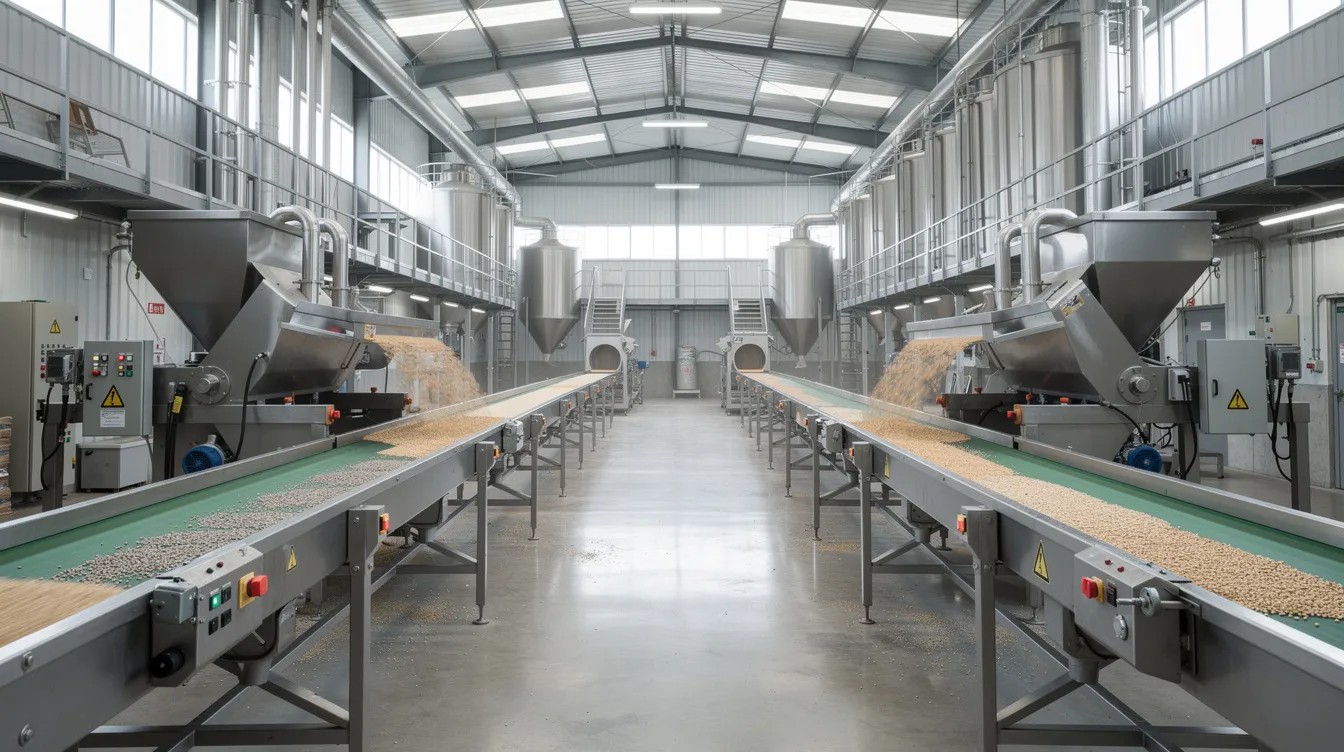
The following table lists typical dal mill plant equipment from raw-material intake to finished dal packing, suitable for 5–50 TPD commercial plants. The inclusion of additional equipment like graders and polishers affects pricing, so promoters should map each item against their specific process flow and target pulses.
| Machinery / Equipment | Function | Typical Capacity (10–20 TPD line) | Approximate Cost Range (₹, 2025–26) | Essential / Optional |
|---|---|---|---|---|
| Raw Pulse Receiving System | Intake hopper, feeding into cleaning line | 1–2 TPH | ₹1–2 lakh | Essential |
| Pre-Cleaner / Vibrating Separator | Removes dust, chaff, light impurities | 1.5–2 TPH | ₹1.5–4 lakh | Essential |
| Destoner | Removes stones and heavy inert particles | 1–2 TPH | ₹2–5 lakh | Essential |
| Grading and Sizing Machines | Sizes pulses by diameter for consistency | 1.5–2 TPH | ₹1.5–3 lakh | Essential |
| Magnetic Separator | Removes metallic contamination | Matching grader capacity | ₹0.5–1.5 lakh | Essential |
| Pitting / Scratching Machine | Loosens pits for better dehusking (tur/arhar) | ~1 TPH | ₹2–4 lakh | Essential for tur |
| Pulse Conditioning Unit | Adjusts moisture profile before dehusking | Line capacity | ₹1–3 lakh | Essential |
| Soaking / Tempering System | Pre-treatment for tur/chana | 1–2 ton batch | ₹1–2.5 lakh | Optional |
| Drying Equipment | Brings moisture to safe levels post-soaking | 1–2 TPH | ₹3–6 lakh | Optional |
| Emery Roller Dehusker | Removes husk via mechanical abrasion | 1–2 TPH | ₹2.5–5 lakh | Essential |
| Dal Splitting Machine | Splits dehusked kernels into dal | ~1 TPH | ₹3–6 lakh | Essential |
| Husk Separator / Aspiration System | Separates husk and lighter waste | Line capacity | ₹1–2 lakh | Essential |
| Dal Polisher | Improves appearance, removes residual husk | ~1 TPH | ₹2–4 lakh | Optional |
| Final Grader / Screening Machine | Sorts dal size, removes broken pieces | ~1 TPH | ₹1–2.5 lakh | Essential |
| Optical Colour Sorter | Removes colour defects for premium dal | 1–4 TPH | Supplier-quotation dependent, ~₹40–120 lakh+ based on brand and throughput | Optional but recommended |
| Bucket Elevators (multiple) | Vertical lifting between processing stages | 3–5 units in line | ₹2–4 lakh cumulative | Essential |
| Screw / Belt Conveyors | Inter-machine conveying | Various lengths | ₹2–5 lakh collectively | Essential |
| Pneumatic Conveying System | Dust/husk removal to collection bins | Matching aspiration flow | ₹1–3 lakh | Optional |
| Storage Bins / Hoppers | Buffer inventory for raw, cleaned, processed pulses | Few tonnes each | ₹1–3 lakh | Essential |
| Automatic Weighing & Packing Machine | Final dal packaging | 1–2 TPH | ₹3–8 lakh | Optional/Essential |
| Dust Collection / Filtration System | Controls dust, ensures hygiene compliance | As per capacity (CFM) | ₹1.5–3 lakh | Essential |
| Air Compressor | Supplies compressed air for sorters, pneumatics | 50–100+ CFM | ₹2–5 lakh | Required with sorters |
| Electrical Panels, Motors, VFDs, Automation | Power, control and automation across plant | Various HP ratings | ₹2–6 lakh | Essential |
| Laboratory & QC Equipment | Moisture meters, colour testing, sample splitters | Basic lab | ₹0.5–1 lakh | Optional |
Important notes: These costs are indicative 2025–26 Indian-market estimates for medium-scale commercial-grade equipment with three phase body material and MS or SS construction as specified, exclusive of GST (typically 18%), freight, erection and civil/structural work. Materials such as stainless steel can increase the price due to quality standards for food-contact surfaces. For very small mini dal mill units (≤0.5 TPD), several of these machines are integrated into a single compact processing machine with features designed for easy operation but lower throughput and flexibility. Detailed supplier quotations must be obtained before finalising any DPR.
Dal Mill Machinery Cost in India – Capacity-Wise Comparison
In dal mill project planning, TPD refers to tonnes per day of raw pulse input, typically based on 8–10 working hours per shift. Finished dal output is lower by the recovery factor (usually 70–80%). Comparing machinery cost per TPD helps investors and medium scale businesses benchmark their project against industry norms.
| Plant Capacity (Raw Pulses TPD) | Typical Machinery Configuration | Estimated Machinery Cost Range (₹, equipment only) | Automation Level | Typical Suitability |
|---|---|---|---|---|
| Mini Dal Mill (0.3–0.5 TPD) | Compact combination machine with hopper, cleaner, dehusker, grader. Mini dal mill machines typically use a 3 HP motor. | ₹2–5 lakh (a 3 HP PKV Dal Mill Machine costs ₹95,000) | Semi-automatic / minimal | Farmers, cooperative societies, startups testing market |
| 5 TPD | Separate pre-cleaning, destoning, emery dehusking, splitting, aspiration, manual bagging | ₹35–55 lakh | Semi-automatic | Small commercial producers, local markets |
| 10 TPD | Complete line with colour sorter option, semi-automatic packing, elevators/conveyors | ₹60–90 lakh (Dal Mill Plant Machinery is priced at Rs 99,00,000 in some configurations) | Semi to high automation | Mid-sized producers, branded dal, retail chains |
| 20 TPD | Higher automation, conveyors, multiple elevators, drying units, automatic packing | ₹1.5–2.5 crore | High automation / fully automatic | Regional processors, multi-state supply, export |
| 50 TPD Integrated Plant | Fully automatic line: silos, dryers, multiple graders, colour sorters, auto weigh-pack, smart controls | ₹6–8 crore+ | Fully automatic | Industrial processors, export units, integrated operations |
Several specific market-referenced price points provide additional context. A 1 TPH dal mill plant is priced at Rs 46,75,000, while a 2 TPH dal mill plant is priced at Rs 1,13,10,000 – a 2 TPH dal mill plant processes 2 tons per hour, ideal for plants operating single-shift at roughly 16 TPD raw input. A 5 TPH pulses mill plant costs Rs 2,82,75,000. An Automatic Dal Mill Plant costs Rs 1,63,10,000, and a Fully Automatic Dal Mill Plant costs Rs 1,46,55,000 in certain supplier configurations.
It is essential to distinguish between three different cost concepts:
- Ex-factory machinery price covers the supplier’s quote for supply of machines alone, excluding freight, installation and duties.
- Installed machinery cost includes freight, erection, civil foundations, structural steel, electrical panels and wiring, commissioning and testing. This often adds 15–30% above ex-works cost.
- Total project cost includes land, building, utilities, pre-operative expenses, working capital margin and statutory approvals.
These are indicative planning ranges for 2025–26. Actual dal mill machine price in India changes by supplier, region (Gujarat and Maharashtra tend to have more competitive pricing due to concentrated manufacturing), steel prices, and rupee exchange rates for imported components.
Automatic vs Semi-Automatic Dal Mill Machinery
A semi-automatic dal mill plant has some mechanisation but retains manual operations in feeding, bagging and inter-stage transfer. A fully automatic dal mill plant uses bucket elevators, conveyors, automatic weighing and packing lines, often with PLC control and advanced technology for process monitoring.
| Aspect | Semi-Automatic Plant | Fully Automatic Plant |
|---|---|---|
| Initial machinery investment | Lower (20–40% less for same TPD) | Higher, especially with sorters and auto-packing |
| Required manpower per shift | Higher – manual feeding, bagging, supervision | Reduced – skilled operators and technicians |
| Production consistency | Greater variation in output quality | Tighter control, more uniform quality dal |
| Dal recovery range | Slightly lower due to manual inefficiencies | Higher recovery, less wastage |
| Power consumption per tonne | Lower idle loads but process inefficiencies | Higher connected load but better duty cycles |
| Flexibility for different pulses | More forgiving for frequent changeovers | Needs changeable screens, more changeover time |
| Maintenance complexity | Simpler, easier spare parts | More complex – PLC, conveyors, calibration |
| Suitability for bank-financed projects | Good for smaller credit demands | Better for larger projects with strong DSCR |
Fully automatic dal mills include integrated systems for cleaning and packaging, resulting in higher productivity and consistency. High-efficiency machines yield a higher percentage of whole pulses, impacting cost per tonne favourably. The 7.5 HP Automatic Dal Mill Machine is priced at ₹4,50,000 and enhances operational efficiency for medium scale operations, while the 10 HP automatic dal mill machine is designed for high productivity at slightly higher volumes. A strong motor is necessary for machines processing larger volumes of pulses in automatic configurations.
Illustrative example: For a 10 TPD raw input plant, a semi-automatic line may cost machinery of approximately ₹70 lakh with annual labour cost of ₹12–15 lakh. A fully automatic line may cost ₹90–110 lakh but reduce annual labour by 30–40% and improve dal recovery by 2–4 percentage points. Over five years, the labour savings and revenue from better recovery can offset the extra machinery investment.
Promoters should undertake detailed financial projections and financial modelling before deciding on automation level, especially where term loans and investors are involved.
Machinery Requirements for Different Pulse Varieties
Tur (arhar), chana, moong, urad and masoor each behave differently during cleaning, dehusking, splitting and polishing. Processing multiple pulses material on a single line requires understanding each variety’s characteristics and adjusting the processing machine settings accordingly.
Tur / Arhar dal requires effective pitting and pre-conditioning (often oil or water treatment followed by drying and tempering), robust emery roller dehusking, proper aspiration and often dual-stage dehusking. Recovery rates of 72–78% are achievable with well-matched machines. Promoters planning tur-specific lines may refer to the detailed tur dal mill project report for process-specific guidance.
Chana dal involves harder kernels requiring strong dehusking force. Some plants combine dal processing with besan (gram flour) production, making upstream grading stages important. For chana-besan integration, the besan mill project report provides additional planning context.
Moong dal has a thin husk requiring gentle dehusking to avoid excessive kernel splitting. Polishing and finishing need care to prevent breakage, and shorter soaking or conditioning cycles may be suitable for some moong processing machine lines.
Urad dal has oil content and a tendency to smear, requiring correct selection of roller surface, RPM and airflow. Polishing options vary for value-added white or black split urad products.
Masoor dal is generally easier to dehusk than tur of Indian origin, but the small kernel size demands correct grader combinations and aspiration to manage broken fractions and ensure clean husk removal.
Many automatic dal mill plant lines are built as integrated multi-pulse processing systems with changeable screens, adjustable pneumatic settings and modular dehusker types to handle several varieties. However, frequent changeovers add downtime and require additional cleaning between batches. For plants designed to handle tur, moong, urad, chana and masoor within a single setup, the integrated multi-pulse processing plant project report provides a comprehensive reference.
Dal Mill Machinery Capacity Planning – TPH and TPD
Suppliers often quote dal mill machinery in TPH (tonnes per hour), while bank DPRs and feasibility studies use TPD (tonnes per day) and annual tonnage. This distinction matters for accurate financial planning.
Key planning parameters include:
- Operating hours per shift: usually 8 hours
- Number of shifts per day: 1 or 2
- Working days per year: 250–300
- Targeted capacity utilisation: 50–60% in year one, rising to 80–90%
- Expected processing losses: husk, broken pieces, moisture adjustment
Illustrative example for a 10 TPD raw input plant:
If a plant operates one shift (8 hours/day) for 300 working days, annual raw input = 10 × 300 = 3,000 tonnes. With dal recovery at 75%, finished dal output = 3,000 × 0.75 = 2,250 tonnes per year. If the dehusker is rated at only 0.8 TPH while other machines handle 1.2 TPH, the dehusker becomes the bottleneck, limiting effective throughput.
Even if most machines are rated for higher throughput, the lowest-capacity critical machine limits the effective line capacity. Common bottlenecks are the dehusker, dryer and polishing section.
Oversizing certain common equipment – such as cleaners, destoners and elevators – for future 50–100% capacity expansion is often cheaper than replacing them later. This connects directly to long-term capital budgeting and IRR considerations. A professional project feasibility study and viability assessment should validate capacity planning assumptions, particularly for large dal mill or pulses mill plant investments.
Dal Mill Machinery Power Consumption and Electrical Requirements
Correctly estimating connected load and operating demand for a dal mill plant affects transformer sizing, sanctioned load from DISCOM (pulses electricity connection requirements), and monthly power bills. Most commercial dal mill machinery uses three phase induction motors, with machines requiring a three phase type electricity connection for stable operation.
The distinction between connected load (sum of all motor HP/kW ratings) and average running load (accounting for diversity factor and intermittent operation) is important. DPRs should use realistic kWh per tonne energy consumption figures rather than simply summing motor ratings.
Approximate connected-load ranges:
- 0.5 TPD mini dal mill: ~5–10 HP (construction MS power consumption is modest at this scale)
- 5 TPD plant: ~60–90 HP
- 10 TPD plant: ~120–180 HP
- 20 TPD plant: ~250–350 HP
- 50 TPD integrated plant: 400–800+ HP
The MS motor power ratings of individual machines range from 1–3 HP for small elevators and blowers to 15–30 HP for emery dehuskers and main dryer fans. VFDs (variable-frequency drives) help reduce power consumption and improve process control in fans, blowers and conveyors.
Other energy consumers beyond motors include hot-air dryers (which may use diesel, biomass husk, gas or steam), colour sorter electronics, air compressor for pneumatic systems, dust collection fans and facility lighting. The phase type and motor power specifications should be confirmed with suppliers for each machine.
Well-designed electrical control panels, MCCs (motor control centres), cabling, earthing and safety systems are essential but frequently not included in the basic dal mill machine price quoted by vendors. Backup power options such as DG sets or solar hybrid solutions should be evaluated, and power cost scenarios incorporated into financial projections and DSCR analysis.
Dal Mill Machinery Price Breakdown and Installation Cost
Many investors underestimate the gap between ex-factory machinery price and full installed machinery cost. Setup costs must include electrical installations and site preparations beyond the basic machine supply.
The main components of machinery-related capital expenditure include:
- Basic machine/equipment cost (ex-factory)
- Material of construction upgrades (e.g., SS vs MS contact parts for processing ms pulses)
- Supporting steel structures and platforms
- Interconnecting ducting, chutes and spouting
- Bucket elevators and conveyors
- Electrical panels, cabling and wiring
- Erection and commissioning charges
- Freight and insurance
- Foundation and minor civil work
- GST and taxes (typically 18% on machinery)
- Contingency and price-variation margin (5–10%)
Illustrative breakdown for a 10 TPD semi-automatic dal mill plant (approximate percentage shares):
| Cost Component | Share of Installed Machinery Cost |
|---|---|
| Basic machinery ex-works | 70–75% |
| Erection and commissioning | 8–12% |
| Freight and insurance | 5–8% |
| Panels, wiring, structures | 10–15% |
| Contingency and pre-operative | 5–8% |
GST is usually capitalised for depreciation purposes but must be financed upfront as part of total project funding, unless input credit adjustment is applicable. A professional Detailed Project Report should treat machinery cost and plant & machinery including erection, electrification and taxes as separate schedules within the overall project cost statement.
Dal Mill Machinery Manufacturers and Supplier Selection in India
India has a strong base of dal mill and pulse processing machine manufacturers spread across states like Gujarat (Rajkot, Ahmedabad), Maharashtra (Nagpur, Jalgaon, Akola), Madhya Pradesh, Punjab and parts of Karnataka and Tamil Nadu. This article focuses on selection criteria rather than promoting specific brands – promoters should cross-check any manufacturer’s credentials, references and existing installations.
Among notable suppliers, Annapurna Agronics is a leading dal mill machine manufacturer. Tulsi Agro Engi Mech offers a 2 TPH dal mill plant. Samay Agro Tech manufactures automatic dal mill plants in India. Parth Engineering provides various automatic dal mill machines. Laxmi Flour Mill offers mini dal mill machines for small businesses. Each leading manufacturer typically specialises in specific capacity ranges and pulse types.
Key supplier evaluation parameters include:
- Adherence to stated capacity (TPH raw input, not just theoretical output)
- Dal recovery and quality guarantees with documented trial data
- Suitability of machinery for targeted pulses and multiple varieties
- Structural robustness and long lasting performance of components
- ISO or equivalent certifications and experience with similar TPD projects
- After-sales service presence, spare parts availability (emery rollers, screens, bearings) and response time
- Delivery time commitments aligned with project implementation schedule
Insist on test runs at the supplier’s existing plant or demonstration line using actual or similar raw pulses, measuring recovery, breakage and moisture content during the trial.
Turnkey Dal Mill Plant vs Individual Machinery Procurement
A turnkey dal mill plant supplier designs, manufactures or integrates, installs, commissions and hands over a running dal mill plant. The alternative is buying each processing machine separately from multiple suppliers.
Turnkey advantages:
- Single-point accountability for plant performance
- Coordinated plant layout and process balance
- Reduced integration risk and faster commissioning
- Consistent warranties across the line
Turnkey limitations:
- Less transparency in individual component pricing
- Dependence on one vendor
- Potentially higher upfront quote incorporating margin
Multi-vendor procurement can make sense when a promoter wants a specific imported colour sorter combined with local cleaners and dehuskers, or already owns some equipment. However, integration risk increases significantly – fixing responsibility becomes difficult if the plant does not achieve rated TPD or recovery when multiple suppliers are involved.
The lowest dal mill machine price on paper may not translate into the lowest total installed cost once engineering, downtime risk and extra integration work are accounted for.
Dal Mill Machinery Maintenance and Operating Costs
Long-term feasibility of a dal mill plant depends not only on initial machinery cost but also on annual maintenance, spare parts and downtime-related losses. Mill owners who neglect maintenance face reduced recovery and increased cost per tonne.
Routine maintenance items include:
- Periodic lubrication and bearing replacement
- Belt and pulley alignment
- Screen and sieve replacement for grading stages
- Emery roller re-surfacing or replacement (high-wear item)
- Cleaning of dust-collection filters and cyclone systems
- Tightening of bolts and checking conveyor alignment
Annual maintenance budgets are commonly planned at 2.5–4.0% of new machinery cost per year under moderate to high utilisation. Actual figures depend on operating hours, raw material quality (stones, sand, moisture) and housekeeping standards.
Poor maintenance increases broken pulses, reduces dal recovery and raises energy consumption, resulting in lower profitability and weaker DSCR for bank-financed projects. Maintaining a critical-spares inventory on-site – belts, bearings, electrical contactors, screens and at least one spare emery roller set – helps ensure smooth operation and minimal downtime.
Dal Mill Machinery Investment, Bank Finance and DPR Requirements
Any serious dal mill or integrated pulse processing plant project involving a term loan should be backed by a professionally prepared, bankable Detailed Project Report. Cost assessment is crucial for determining financing needs in project planning, and project-specific assumptions guide financial assessments throughout.
Banks typically expect:
- Authenticated machinery quotations with capacity, make and model
- Detailed dal mill plant machinery list with price and specifications
- Layout drawings showing process flow and material handling
- Electrical-load summary matching the stated production capacity
- Explanation of how planned machinery achieves the stated TPD and dal recovery
Machinery selection feeds directly into the project-cost section of the DPR through the plant & machinery schedule, erection and electrification cost, depreciation calculations (under Companies Act and Income Tax Act) and interest cost. Higher machinery investment increases fixed charges but may improve dal recovery, reduce labour and produce higher-grade products – these trade-offs are captured in profitability, cash flow and DSCR calculations.
Working capital needs to cover initial raw materials and operational expenses, with assessment considering inventory days for raw pulses, finished dal and by-products, and the receivables/payables cycle. Financial projections and CMA Data are forecasts based on assumptions, not guarantees, and lenders use them for appraisal combined with their own risk assessment.
Government schemes provide subsidies for setting up pulse processing units in India, including the PMFME scheme which has offered capital subsidy and interest relief for eligible projects. Eligibility and terms change periodically, so promoters should verify current scheme availability with local DIC or NABARD offices.
For professional assistance with bankable DPRs and CMA Data for dal mill plant projects, promoters may explore bank finance DPR and loan proposal assistance services. Professional fees for DPR and bank proposal assignments typically start from ₹25,000 and vary based on plant capacity and complexity.
Common Machinery Selection Mistakes Investors Should Avoid
Several dal mill projects struggle because of avoidable machinery-selection mistakes rather than lack of market demand. Based on practical experience across many dal processing projects, the following errors are commonly observed:
- Buying purely on lowest machinery quote without verifying scope (supply only vs supply + installation + warranty + control system)
- Not checking whether offered capacity is raw input or finished dal output
- Ignoring the need for adequate pre-cleaning and destoning, leading to equipment damage and poor recovery
- Under-sizing dust-collection and aspiration systems, causing hygiene and regulatory problems
- Choosing dehuskers rated for higher TPH than upstream cleaners, creating bottlenecks
- Not planning silos and intermediate storage, causing loading and unloading congestion
- Failing to confirm three phase power availability and sanctioned load before ordering machinery
- Overlooking future expansion when deciding building height, column spacing and elevator capacities – forcing expensive modifications when upgrading from 10 TPD to 20 TPD
- Purchasing second-hand or refurbished dal mill machinery without proper technical inspection, with uncertain spares support
- Underestimating working capital requirements, particularly for raw pulse procurement during peak season
Feasibility studies are essential for evaluating project viability and investment decisions before committing to machinery orders.
Practical Machinery Procurement Checklist
This checklist helps entrepreneurs approach suppliers for dal mill machinery quotations systematically:
Planning phase:
- Define target pulses (tur, chana, moong, urad, masoor or combination)
- Specify desired daily capacity (TPD) and product mix (polished vs unpolished, with or without grinding for besan)
- Decide intended automation level (mini, semi-automatic, fully automatic dal)
Technical specifications:
- Required TPH/TPD at specific moisture level
- Working hours per day and shifts per year
- Recovery targets and acceptable broken percentage
- Specific equipment requirements (colour sorter, automatic bagging, lab equipment)
Electrical and utility queries:
- Total connected HP/kW and recommended contract demand in kVA
- Compressed-air requirement for sorters
- Fuel type and consumption for dryers
- Recommended dust-collection CFM
Commercial and contractual checks:
- Detailed dal mill machinery list with price breakup (supply vs erection)
- Warranty period, AMC options and training commitment
- Performance guarantees linked to trial runs
- Payment milestones tied to manufacturing and dispatch
- Delivery time commitment and penalty clauses
Request a detailed quote from each supplier and reconcile all quotations into a comparable format. Where needed, seek independent professional review as part of DPR preparation before finalising orders.
How CA Manish Gugliya Can Assist with Dal Mill Project Planning
Project Report Bank is a Chartered Accountant-led project finance and industrial advisory practice with over 20 years of professional experience across manufacturing and agro-processing DPRs, serving clients ranging from small MSME promoters to large industrial businesses.
Services specific to dal mill and pulse processing projects include:
- Customised Detailed Project Reports with appropriate dal mill plant machinery list and configuration assessment
- Estimation of machinery and installation cost, complete project cost and means-of-finance structuring
- CMA Data preparation, term-loan proposals and integrated financial projections and financial modelling
- Project feasibility study and viability assessment for greenfield dal mill plants and expansion of existing pulses mill plants
- DSCR, break-even and sensitivity analysis
Professional fees for bankable DPR and loan proposal mandates generally start from ₹25,000 and are tailored to project size and scope. Our team works with promoters to translate their business plans into structured financial proposals that can be discussed confidently with banks and investors.
Interested entrepreneurs and MSME promoters may share basic project details via WhatsApp or the website contact form for a preliminary discussion on scope, timelines and fee estimate.
Frequently Asked Questions
These FAQs address additional practical questions on dal mill machinery cost and planning.
What is the typical dal mill machinery cost for a startup mini dal mill in India?
Mini dal mill machines (0.3–0.5 TPD) usually cost about ₹2–5 lakh for basic equipment, with entry-level units starting lower – a mini dal mill machine costs Rs 67,000 at the most basic level. The price depends on brand, degree of automation and whether the unit uses a single-phase or three phase motor. These figures exclude building, electrification and working capital, and should be treated as indicative starting points pending supplier quotations. For reference, the dal mill project report provides structured cost and revenue estimates for small to medium scale dal mill setups.
How much does it cost to add a colour sorter to an existing dal mill plant?
Entry-level, low-capacity dal colour sorters for pulses may start around ₹25–35 lakh, while higher-capacity or imported units can range from ₹40 lakh to over ₹1 crore. Additional costs for installation, air compressor, electrical integration and civil modifications must also be budgeted. Colour sorters improve quality dal output significantly and are increasingly considered essential for premium products.
Can I start with semi-automatic dal mill machinery and upgrade to full automation later?
Many promoters begin with semi-automatic configuration and later add elevators, conveyors, automatic weighing-packing machines and colour sorters. The key is to design building layout, heights and electrical provisions with future automation in mind to avoid costly rework. Foundation strength, column spacing and sanctioned electrical load should anticipate the expanded configuration from the outset.
How long does it usually take to procure and install dal mill machinery?
From formal purchase order to commissioning, mini dal mill units may take 4–8 weeks. Commercial plants of 10–20 TPD often require 3–6 months depending on supplier lead time, civil construction progress, availability of three phase power and the complexity of integration. Realistic scheduling should be incorporated into DPRs and bank submissions to avoid implementation delays that can affect project economics.
What should be included in a dal mill machinery quotation from suppliers?
A complete quotation should specify: machine-wise capacity (TPH), motor HP and phase type, body material (MS or SS), scope of supply (machines only vs installation), applicable GST, freight terms, warranty period, spare parts pricing, erection charges, commissioning support, training commitment and performance guarantee conditions. Promoters should operate on the basis of comparable, like-for-like quotations to make informed decisions.
Conclusion
Dal mill machinery cost decisions should be based on process suitability, long-term operating economics and financial feasibility – not only the lowest initial price. The capacity, automation level and target pulse varieties must all be aligned with the project’s commercial strategy, market positioning and financing structure.
It is important to distinguish clearly between core dal mill machinery cost, installed machinery cost (including erection, electrification and taxes) and the full dal mill plant setup cost. Each requires different budgeting and financing treatment. Up-to-date supplier quotations, realistic technical assumptions and transparent financial analysis form the foundation of a bankable and commercially viable project proposal.
Planning to establish a Dal Mill or Integrated Pulse Processing Plant?
Get professional assistance with Detailed Project Reports, machinery investment planning, financial projections, working capital assessment and bank finance proposals.
CA Manish Gugliya, FCA, DISA (ICAI) 20+ Years of Professional Experience Manish Gugliya & Company, Chartered Accountants www.projectreportbank.com
WhatsApp for Project Advisory & DPR Enquiries