Key Takeaways
- This guide by CA Manish Gugliya (ProjectReportBank.com) covers the complete process of preparing a resort project report for bank loan approval in India, from initial concept through financial projections to lender appraisal.
- The journey a promoter must follow runs through: project concept, feasibility study, project cost estimation, means of finance, revenue model, integrated financial projections, DSCR and break-even analysis, sensitivity testing, and structured bank presentation.
- Banks assess resort project finance primarily on realistic occupancy assumptions, ARR/ADR, RevPAR, projected cash flows and debt service coverage ratio (DSCR); land value or collateral alone does not establish bankability.
- A bankable resort DPR must contain detailed project cost with supporting quotations, financial projections (profit and loss account, cash flow statement, projected balance sheet), CMA data where applicable, and clearly documented assumptions for room revenue, F&B income and banquet or event income.
- ProjectReportBank.com hosts nine specialised guides covering resort feasibility, setup cost, revenue model, financial projections, occupancy analysis and bank term-loan assessment; this article serves as the central hub connecting all of them.
Explore Resort Project Report / DPR Guides
Explore our Resort Project Report and DPR guides covering setup cost, equipment, project cost, revenue, financial projections, occupancy, feasibility and bank finance.
Introduction: Resort Investment, Financing & the Need for a DPR
A resort in India is a capital-intensive hospitality project. Total investment for a meaningful property with 20 to 80 rooms or cottages, a restaurant, banquet facilities and amenities like a swimming pool or spa can range from a few crore to well above ₹50 crore. Most promoters cannot self-fund this entire outlay. Resort projects typically require 65-75% financing from banks, which means the lending institution bears a large share of the risk and expects a structured, bankable document before releasing funds.
India’s hospitality sector contributed 7.5% to GDP in 2019, and the country improved its Travel and Tourism Competitiveness Index from 65th to 34th over the past decade. Though the hospitality industry experienced a major setback in 2020 due to COVID-19, recovery has been steady, and investment in tourism infrastructure continues to strengthen the sector’s growth. This creates opportunities for resort development across hill stations, beach destinations, weekend getaway circuits and destination-wedding locations.
The commercial drivers that determine whether a resort project succeeds or fails are interconnected: location, land and construction cost, room count, amenities, achievable occupancy, ARR/ADR, F&B contribution, banquet or event income, operating costs, seasonality and debt-servicing ability. A resort project report, or detailed project report (DPR) for bank loan, pulls all of these together into a coherent, data-backed case covering feasibility, project cost, means of finance, financial projections and risk analysis. This guide walks through every layer of that process.
What Is a Resort Project Report / Detailed Project Report (DPR)?
A resort project report is a detailed project report prepared to assess the viability and bankability of a proposed resort. It is the document a lender reads to decide whether a hospitality project deserves financing. A comprehensive resort project report serves as a strategic blueprint and financial pitch; a comprehensive project report includes an executive summary and financial projections alongside market data, technical details and risk analysis.
This differs from a basic business plan, which might run 5-10 pages summarising the concept, target market and broad numbers. An internal financial estimate may capture costs and rough revenue targets for the promoter’s own planning. A formal, bankable resort DPR, by contrast, often runs 60-120 pages with annexures and CMA data. It is structured for a credit officer’s review, not a casual investor pitch.
A lender-oriented resort DPR should include: promoter background, project concept, site and location details, capacity (rooms, cottages, beds), amenities, market and competition analysis, detailed project cost, means of finance, implementation schedule, licences and approvals, projected profit and loss account, cash flow statement, projected balance sheet, break even analysis, DSCR calculations and risk-mitigation measures. A DPR must include project cost estimation and analysis. For larger projects (term loan above ₹5-10 crore), banks expect more detailed technical and market studies, possibly third-party appraisals. For smaller MSME resorts, a concise but internally consistent DPR may suffice. Banks may also require separate CMA data formats for working capital and project term loans, aligned with RBI and bank-specific norms.
Why a Resort DPR Is Critical for Bank Loan & Project Finance
Lenders use the resort DPR as the primary document to understand what is being financed. A credit officer reviewing a 40-key eco resort with pool, spa and banquet needs to see the project scope, estimated completion date and every cost head laid out with supporting estimates. The DPR is not optional; a bankable DPR format is required for loan appraisal.
Banks examine the DPR to verify total project cost, promoter contribution (equity and unsecured loans), proposed loan amount, disbursement schedule and implementation risks. A project report should demonstrate commercial viability and operational feasibility. The DPR allows credit officers to assess repayment capacity via projected cash flows, DSCR, sensitivity to occupancy and ARR changes, and break-even occupancy.
Preparing a resort DPR or financial projections does not guarantee loan sanction. Approval depends on overall credit appraisal, internal policies, security, credit history and regulatory guidelines. In my experience with project finance proposals, lenders almost always raise pointed questions about seasonality, pricing assumptions and the promoter’s past track record. The DPR should pre-emptively address these queries with data rather than leave them for the appraisal stage.
Types of Resort Projects Covered in a Resort Project Report
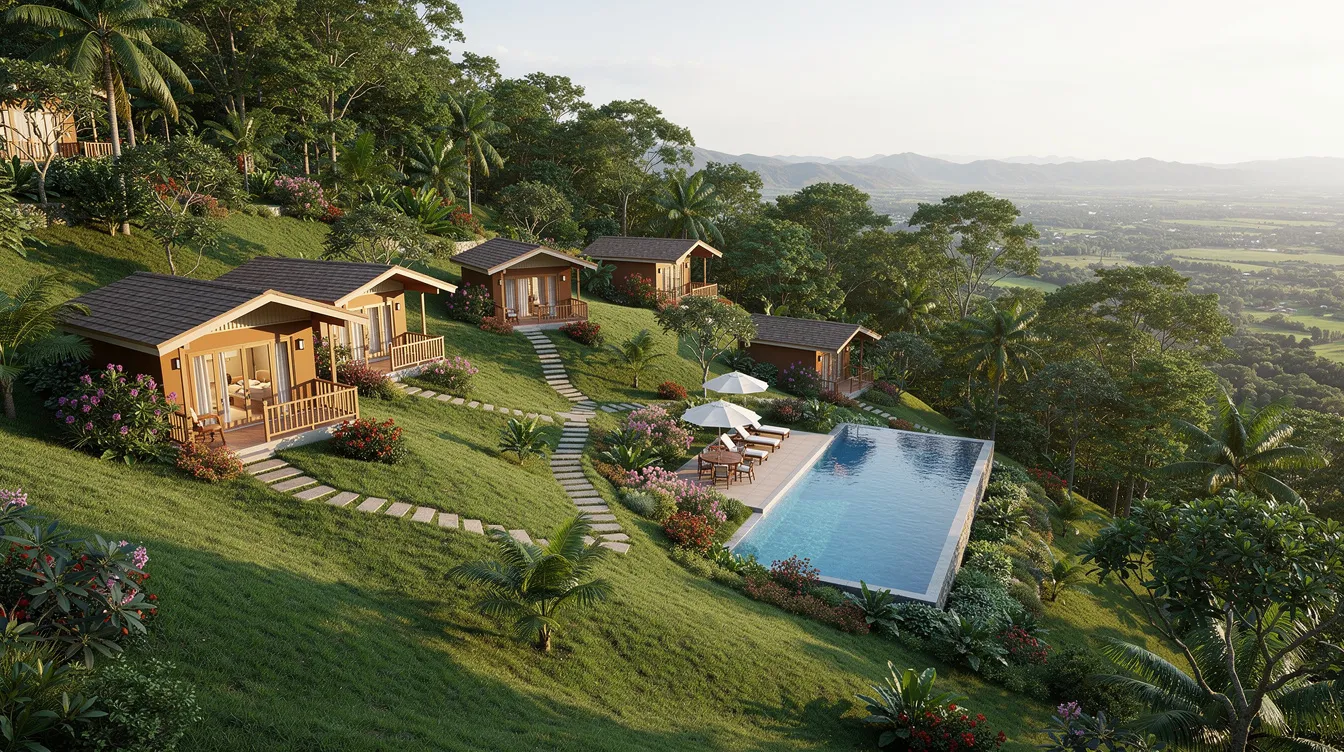
The DPR format is broadly similar across resort types, but project cost, revenue model and risks differ by concept and location. Formats that promoters commonly pursue include: holiday resorts near popular tourist circuits, destination wedding resorts with large banquets and lawns, eco resort projects in forest or backwater areas with cottage-based accommodation, wellness resorts focusing on spa and Ayurveda services, boutique resorts with 15-35 rooms in heritage or design-led properties, adventure resorts offering trekking, rope courses and adventure activities, and mixed room-and-cottage developments targeting families and corporate groups.
The resort project report should explicitly state the chosen format and positioning. A “32-key nature and wellness resort near Rishikesh” has different target clientele, ARR expectations, F&B mix and capex requirements than a “60-room wedding resort near Udaipur.” In India, many resorts also function as marriage gardens or destination-wedding venues; the DPR must quantify expected banquet and event income along with related operating costs.
Lenders do not treat an eco resort as fundamentally different from a hotel project for appraisal purposes. They still focus on viability, DSCR and compliance with environmental and land-use regulations.
Resort Location & Market Assessment
In project appraisal, location and market potential carry more weight than architectural design. A realistic market assessment is expected in every resort project report. Market analysis is essential for evaluating target customer segments and competitors in the area.
Specific location factors the DPR should cover include: proximity to tourist attractions (within 10-15 km of a major temple, viewpoint or beach), road and airport connectivity, visibility from main roads, land contour and suitability for construction, and availability of utilities like power and water. A feasibility report evaluates plot size and location to determine whether the site supports the proposed scale of development. Environmental compliance requires assessing zoning permits and ecological impact before finalising the site.
Market assessment elements should include current and projected tourism inflows to the district or state, existing and upcoming hotels and resorts in the catchment area, indicative occupancy and ADR of comparable properties, seasonality patterns (weekend vs weekday, peak vs off-season) and potential for destination weddings and corporate events. The DPR should present concrete examples such as: “Within a 20 km radius of the proposed site near Udaipur, there are X operational resorts with average weekend occupancy of 70-80% in October-February based on field visits and published industry sources.”
A beautiful site or low land cost alone does not prove feasibility. The DPR must connect location characteristics with the realistic occupancy and ARR assumptions used in financial projections.
Resort Feasibility Study & Project Viability
Before finalising investment and bank loan discussions, promoters should carry out a structured resort feasibility study. A feasibility report provides a fact-based picture of project viability, not a marketing narrative. Experienced architects or project management consultants often prepare the technical portions, while financial feasibility is modelled by professionals such as a chartered accountant with hospitality sector experience.
The DPR should summarise four dimensions of feasibility: market feasibility (demand from target segments, competition, seasonality and market conditions), technical feasibility (site conditions, soil stability, design suitability, utilities and regulatory approvals), operational feasibility (availability of skilled manpower, local vendor supply chains, management expertise) and financial feasibility (total project cost, expected returns, DSCR and break-even). A feasibility report also outlines government redevelopment rules and permissible FSI relevant to the site. It estimates project completion timelines and identifies regulatory requirements early in the planning process.
Debt-servicing feasibility is the dimension banks care about most. Projections must show that net operating cash flows will reasonably cover interest and principal instalments with a buffer.
For step-by-step guidance on conducting each dimension of feasibility analysis, refer to the detailed guide on resort feasibility study and project viability.
A 40-room wedding resort near Jaipur may be viable at 55-60% average annual occupancy if ARR and banquet income are supported by market data. A smaller 16-cottage eco resort in a remote location will likely require more conservative occupancy and ARR assumptions and may need lower break-even cost structures.
Resort Setup Cost in India
There is no single “standard” per-room cost for resort development. Investment for small resorts ranges from ₹25 lakh to ₹1.5 crore. Medium resorts require an investment of ₹1.5 crore to ₹8 crore. Large resorts need an investment of ₹8 crore to ₹50 crore or more. Per-key construction cost (excluding land) varies by positioning: mid-scale or 3-star resorts typically fall in the ₹35-60 lakh per key range, while upscale or 5-star properties run ₹1-1.8 crore per key.
Main cost drivers the DPR should detail include: land purchase or long-term lease premium, site development (levelling, boundary wall, internal roads), civil construction (rooms, cottages, reception, restaurant, banquet halls, staff areas), amenities (swimming pool, spa, kids’ play area, adventure infrastructure) and landscaping. Other important heads are electrical and plumbing infrastructure, borewell and water-treatment plant, generator and solar systems, parking, signage and fire-fighting systems.
The DPR should use actual quotations or recent estimates from architects and contractors, dated to current-year rates, to support cost reasonableness.
For detailed cost ranges and per-key illustrations, refer to the specialised guide on resort setup cost in India.
Resort Equipment, Furniture & FF&E
FF&E (Furniture, Fixtures and Equipment) is a major component of resort project cost that often gets underestimated in early budgets. A 40-room resort with full F&B and banquet facilities can easily spend 15-25% of project cost on FF&E alone.
Typical guest-room and cottage FF&E includes beds and mattresses, wardrobes, study desks, seating, curtains, lighting fixtures, room refrigerators and mini-bars, TVs, in-room safes, plus bathroom hardware and accessories. F&B and back-of-house equipment that must be captured in the DPR includes commercial kitchen lines, refrigeration units, dishwashing systems, exhaust and fresh-air systems, restaurant and banquet furniture, bar counters and POS systems.
Plant and equipment items related to operations include HVAC systems, laundry machines, DG sets, water-treatment and sewage-treatment plants, CCTV and access-control systems, Wi-Fi infrastructure and property-management system (PMS) hardware.
A separate guide on resort equipment, furniture and FF&E cost provides granular asset lists and cost illustrations.
Resort Project Cost: Structure & Illustrative Headings
In a resort project report, total project cost should be broken into clearly defined heads compatible with standard bank appraisal formats. Project cost analysis breaks down expenses for land, construction, and operational needs so that each eligible item can be mapped for term-loan funding.
The following table is purely illustrative. Actual structuring varies by project and bank norms.
| Project Cost Component | What It May Include |
|---|---|
| Land / Site Development | Land acquisition, levelling, boundary wall, internal roads |
| Civil Construction | Rooms, cottages, reception, restaurant, banquet, staff quarters |
| Plant & Equipment | Kitchen equipment, HVAC, generators, water treatment |
| Furniture & FF&E | Guest room furniture, restaurant furniture, linen, fixtures |
| Amenities & Recreation | Pool, spa, landscaping, adventure facilities, lawns |
| Preliminary Expenses | Professional fees, approval-related expenses |
| Pre-operative Expenses | Interest during construction, pre-opening salaries, launch marketing |
| Contingency | Provision for cost variations (often 5-10% on relevant heads) |
| Working Capital Margin | Initial operational funding requirement |
Pre-operative expenses and contingency must be explicitly provided in the DPR. For deeper discussion on each cost head, see the guide on resort project cost and means of finance.
Means of Finance for Resort Projects
Project cost must be matched with a clear means-of-finance plan within the DPR, usually presented in a structured table showing promoter contribution on one side and proposed borrowing on the other.
Major financing components include: promoter equity, unsecured or subordinated loans from promoters or group entities (where acceptable to the lender), term loan from a bank or financial institution, and other sources such as capital subsidies or government tourism-promotion soft loans where applicable. Lenders examine the debt-equity mix to ensure promoters have adequate stake. While exact ratios differ by bank and scheme, under-capitalised projects are a common cause of stress.
Interest during construction may be financed as part of the term loan in some structures, subject to bank policy. The DPR should specify assumptions on moratorium and repayment start date.
A detailed discussion on structuring these elements is available in the resort project cost and means of finance guide.
Explore the Resort Project Report Guides
ProjectReportBank.com hosts a cluster of in-depth guides on specific aspects of resort DPRs. This article is the central hub; the specialised resources below cover each subject in detail.
Resort Revenue Model: Rooms, F&B, Banquet & Other Income
The DPR must show that the resort revenue model is diversified and based on operational capacity rather than arbitrary percentages. Revenue projections must include room, F&B, and ancillary services. Revenue projections include room revenue, F&B income, and event bookings as the three primary pillars.
Key revenue streams to describe in the DPR: room and cottage revenue (rack rate, corporate rate, OTA rate after commission), F&B revenue from restaurant and bar operations, banquet and lawn hire income for weddings and conferences, spa and wellness services, adventure activities (trekking, zipline, boating) and ancillary income like laundry, transfers and rentals.
Revenue assumptions should be derived from occupancy multiplied by ADR for rooms, realistic covers and average check for F&B, and expected event-days per year for banquets, with conservative buildup in the first 2-3 years. Overestimation of banquet or destination wedding income is a frequent issue in resort project reports. Banks often ask for historical data from comparable venues in the region; projections without supporting precedent are challenged.
For detailed segment-wise illustrations and revenue model templates, see the dedicated guide on resort revenue model.
Occupancy, ARR/ADR & RevPAR in Resort DPRs
Three metrics form the backbone of room revenue projections in any resort DPR: occupancy percentage, average room rate (ARR, also called average daily rate or ADR) and revenue per available room (RevPAR). Getting these wrong distorts every downstream number, from EBITDA to DSCR.
The formulas are straightforward:
- Occupancy % = Occupied Room Nights / Available Room Nights x 100
- ARR / ADR = Room Revenue / Occupied Room Nights
- RevPAR = Room Revenue / Available Room Nights (or Occupancy x ARR)
For a new resort, projections should show a ramp-up in occupancy. A first-year average of 25-35% is common for properties in developing locations, rising to 40-55% in Year 2 and stabilising at 60-65% by Year 3 or 4 depending on market conditions. ARR may also increase modestly as the property gains reputation and direct bookings grow. Occupancy forecasts should model peak, shoulder, and off-seasons separately rather than relying on flat annual averages. Occupancy forecasts should account for seasonal demand and local tourism patterns in the catchment area.
According to RevNext’s Hotel Revenue Management Benchmark Report 2025, seasonal resorts in India see ADR in the range of ₹7,500-₹14,500 and annual occupancy between 54% and 76%. Projections that assume 80-90% average annual occupancy from the first year at a premium room rate will be challenged by any competent credit officer.
For structured methods to build seasonal occupancy calendars and break-even occupancy calculations, refer to the guide on resort occupancy, ARR, RevPAR and break-even analysis.

Operating Expenses & Cost Structure of a Resort
The DPR must provide a realistic view of operating costs, distinguishing between fixed and variable components, to arrive at accurate EBITDA and net profit margin projections.
Key operating expense heads include:
- Salaries and wages (management, front office, housekeeping, kitchen, service, maintenance, security)
- Food and beverage cost of sales
- Utilities (electricity, fuel, water)
- Housekeeping and laundry supplies
- Repairs and maintenance
- Marketing and OTA commissions (OTA commissions alone can run 15-25% of room revenue booked through those channels)
- Administration and office expenses
- Insurance and statutory licences
- Landscaping and recreation maintenance
- Security services
Utilities and staffing form a large portion of fixed costs, while F&B cost and amenities-related consumables vary with occupancy and event volumes. Marketing strategies should detail digital marketing and seasonal promotional campaigns to support revenue assumptions. The resort project report should benchmark major expense ratios (payroll as a percentage of revenue, for example) against indicative hospitality industry norms where available, while acknowledging that actual performance may differ. Underestimation of payroll, maintenance and marketing expenses is a common weakness in resort DPRs.
Resort Financial Projections for DPR
Bankable resort DPRs must include integrated financial projections for at least 5-7 years, summarising profitability, cash flow and balance sheet position. Financial projections should include capital expenditure and profit-loss estimates alongside cash flow and balance sheet statements.
The core projected financial statements to prepare are:
- Profit and loss account (revenue, operating costs, EBITDA, depreciation, interest, profit after tax)
- Projected balance sheet (fixed assets, term loan balances, working capital, equity)
- Cash flow statement or fund-flow statement (cash generated from operations, debt servicing, capex)
Assumptions must reconcile across all statements. Room revenue should equal projected occupancy multiplied by available rooms multiplied by ARR. Loan interest should tie to outstanding balances in the repayment schedule. Closing term-loan figures must match between the financing schedule, P&L, cash flow and projected balance sheet. Key ratios like DSCR, interest coverage, net profit margin and return on capital employed should be calculated and interpreted within the DPR.
For structuring spreadsheets, linking assumptions and preparing CMA data formats, see the dedicated guide on resort financial projections for DPR.
DSCR & Loan Repayment Capacity
Debt Service Coverage Ratio (DSCR) is a central metric in resort term-loan appraisal. It measures the project’s ability to service interest and principal repayments from net operating cash flows. DSCR is computed by dividing net cash accruals (profit after tax plus depreciation plus interest, adjusted for changes in working capital where applicable) by total debt-service obligations (interest plus scheduled principal) for each year.
While lender thresholds vary by institution and scheme, many banks in India expect DSCR to be 1.5 or higher in every loan year. Projections should show reasonably comfortable DSCR throughout the loan tenure, particularly during initial years when occupancy is still ramping up. A Year-1 DSCR that dips below acceptable levels is a frequent red flag.
The repayment schedule should align with the project’s implementation period and expected stabilisation. For example, a one-year moratorium on principal during construction and initial operations, followed by graded repayments over 8-10 years, is a structure some lenders consider. Aggressive repayment schedules that ignore seasonality or leave no cushion for delays can be flagged as high risk during bank appraisal.
Break-Even Analysis for Resort Projects
Break-even analysis helps promoters and lenders understand the minimum business volume required to cover all operating costs before interest and tax. The basic components are fixed costs (salaries, base utilities, maintenance), variable costs (F&B cost, activity supplies, room amenities) and the resulting contribution margin.
For resorts, break-even can be expressed as break-even occupancy percentage at a given ARR. If fixed operating costs are ₹60 lakh per year and average contribution per occupied room night is ₹3,000, the resort needs 2,000 occupied room nights per year to break even on operating costs alone. For a 30-room property, that translates to roughly 18% average occupancy, which is below typical resort performance.
In seasonal destinations, average-annual break-even can be misleading. The DPR should show how strong peak-season months compensate for lean months when occupancy may drop to single digits. For formulas and worked examples, refer to the guide on resort occupancy, ARR, RevPAR and break-even analysis.
Bank Loan for Resort Project: Term Loan & Working Capital
Resort project finance in India involves a term loan for fixed-asset creation and, where applicable, a separate working capital facility for operational needs post-commissioning. MSME term loans and other schemes may apply depending on project size and promoter constitution.
The DPR should specify in relation to the proposed term loan: amount required, purpose-wise utilisation (construction, FF&E, plant and machinery, pre-operative expenses), proposed tenure and repayment schedule, and any requested moratorium period. Working capital assessment depends on the projected operating cycle, credit terms with vendors, expected receivable cycles (especially from OTAs and corporate clients with 30-60 day payment cycles) and minimum cash buffer for off-season or lean months.
Actual loan quantum, margin requirements, security and pricing depend on individual bank policies, schemes and borrower risk profile. The article cannot promise any fixed structure.
For detailed discussion on loan structures, schemes and appraisal points, see the guide on bank loan for resort project finance.
How Banks Assess a Resort Term Loan Proposal
Beyond numbers, lenders evaluate the overall strength of the promoter group and project. The DPR should be prepared with this perspective in mind.
Key aspects banks review include: promoter background and experience in the hospitality sector or related business, credit history and CIBIL score, net worth and financial capacity, quality and location of the resort site, project cost reasonableness, occupancy and ARR assumptions benchmarked against local comparables, projected profitability and DSCR, implementation timetable, statutory approvals, and availability of security or collateral. ICRA’s FY2026 estimates show premium hotel industry occupancy at 72-74% with ARR around ₹8,200-₹8,500; banks may use such benchmarks to test whether a new resort’s assumptions are within a reasonable range for its category.
Banks carry out sensitivity analysis (testing the impact of 10-15% lower occupancy or ARR) to see how DSCR and cash flows change. An attractive design or strong collateral does not substitute for cash-flow viability. Projections must demonstrate reasonable debt-repayment capacity under realistic scenarios.
For deeper insight into bank credit processes and appraisal criteria, see the guide on how banks assess a resort term loan proposal.
Resort DPR: Financial & Bank Finance Guides
Readers focusing on financial modelling and bank appraisal can use the following quick-reference table of advanced guides available on ProjectReportBank.com.
| Detailed Guide | Best For |
|---|---|
| Resort Financial Projections for DPR | P&L, cash flow, balance sheet and repayment projections |
| Resort Occupancy, ARR, RevPAR & Break-Even | Operating assumptions and break-even |
| Resort Feasibility Study & Project Viability | Market and financial feasibility |
| Bank Loan for Resort – Project Finance Guide | Loan structure and project finance |
| How Banks Assess a Resort Term Loan Proposal | Understanding bank appraisal |
This article is the central hub connecting all nine supporting resort DPR resources on ProjectReportBank.com.
Documents Generally Required for Resort Project Finance
Each lender has its own checklist, but a resort project report should be accompanied by a comprehensive set of documents. A detailed project report should include appendices with supporting documents to avoid delays and repeated queries.
Promoter and entity documents typically include: KYC (PAN, Aadhaar, address proof), constitution documents (Partnership Deed, LLP Agreement, Memorandum and Articles of Association, trust or society registration), Udyam registration where applicable, and brief promoter biodata highlighting qualifications and experience.
Project-related documents include: land ownership papers or registered lease agreements, latest encumbrance certificate, approved site plan and building plans, architectural drawings, civil and electrical estimates, quotations for major equipment and FF&E, and copies of applications or approvals for licences (tourism permissions, environmental clearances, fire NOC, local-body approvals). Regulatory compliance includes obtaining environmental impact assessments and local building permits.
Financial documents cover: last 3 years’ financial statements and income-tax returns of promoters and group entities, latest bank statements, details of existing loans, net-worth statements, projected financials and CMA data aligned with the DPR. For larger projects, banks may request independent valuation reports for collateral properties and technical appraisals of project cost.
Resort Project Implementation Schedule & Timelines
Practical implementation timelines are critical because delays cause cost overruns, additional interest during construction and postponed revenue, directly affecting DSCR. A project implementation schedule tracks progress from pre-construction to grand opening.
Key stages the DPR should outline: land acquisition and clear title, design finalisation and architectural drawings, statutory approvals and NOCs, civil construction and structural completion, MEP (mechanical, electrical, plumbing) installation, procurement and installation of equipment and FF&E, landscaping and external development, staff recruitment and training, soft launch or trial runs, and final Commercial Operation Date (COD). A feasibility report estimates project completion timelines based on local conditions and contractor capacity.
The implementation schedule should be presented with month-wise milestones: for example, Month 1-3 for approvals, Month 4-14 for core construction and MEP, Month 15-18 for FF&E, landscaping and pre-opening activities. Interest during construction must be computed based on these timelines. Banks look for evidence that the promoter has contingency plans for delays, such as buffer time and cost provisions.
Sensitivity Analysis & Stress Testing of Projections
A well-prepared resort DPR includes sensitivity analysis showing how DSCR and net cash flows behave under adverse but plausible scenarios. Risk analysis should identify potential risks and mitigation strategies for resort projects rather than just presenting one optimistic projection.
Example sensitivities to model:
- Occupancy 10-20% lower than base case
- ARR lower by 5-10%
- Construction cost escalation by 10-15%
- Delay in project completion by 6-9 months
- Operating expenses higher by 5-10%
- Interest rate increase within a reasonable range (e.g., 1-2 percentage points)
Each scenario’s impact on annual DSCR should be computed. A resort that maintains DSCR above acceptable levels even at 15% lower occupancy demonstrates resilience. A project that drops below breakeven at just 10% lower occupancy is fragile.
In my experience, sensitivity analysis often becomes a differentiator between a generic and a genuinely bankable resort project report. Lenders appreciate DPRs that transparently acknowledge risks and show that the project remains reasonably viable under moderate stress.
Common Mistakes in Resort DPRs & How to Avoid Them
This section is a practical checklist of pitfalls I observe in resort project reports submitted to banks across India.
Financial and assumption-related mistakes include: projecting occupancy of 70% or higher from the first year of operations, ignoring seasonality and using flat annual averages, overstating ARR compared to similar local properties in the same category, under-budgeting for FF&E and amenities (spa and pool filtration equipment alone can cost ₹15-30 lakh in a mid-scale resort), omitting contingency provisions, and leaving out pre-operative expenses like interest during construction and pre-opening salaries.
Structural and modelling errors are equally damaging: revenue and occupancy numbers not matching between text and the projected financials, incorrect interest calculations that do not tie to outstanding loan balances, mismatch between the loan amortisation schedule and projected balance sheet, and DSCR calculated on gross revenue instead of net cash accruals.
Qualitative gaps undermine credibility: weak or generic market analysis copied from unrelated locations, no justification for wedding or banquet revenue estimates, insufficient explanation of the promoter’s role in day-to-day operations, and over-reliance on collateral value instead of demonstrating cash-flow-based repayment. A common issue I observe is promoters submitting the entire report with assumptions that work only under ideal conditions; when a bank runs its own stress test, the numbers collapse.
Carefully prepared, internally consistent DPRs improve clarity in bank discussions, even though they do not guarantee sanction.
Illustrative Resort DPR Financial Framework (Example)
The following figures are purely illustrative. Actual project cost, revenue, financing structure and financial viability must be determined project-wise.
Consider a hypothetical 32-room plus 8-cottage leisure and wedding resort near a Tier-2 city in Rajasthan, positioned as a mid-upscale property with pool, banquet lawn, restaurant and basic spa.
| Parameter | Illustrative Assumption |
|---|---|
| Total rooms/cottages | 40 keys |
| Estimated total project cost | ₹18 crore (including land, construction, FF&E, pre-operative expenses, contingency, working capital margin) |
| Promoter contribution (30%) | ₹5.40 crore |
| Proposed term loan (70%) | ₹12.60 crore |
| Occupancy ramp-up (Year 1 to 5) | 30%, 45%, 55%, 60%, 62% |
| Indicative ARR (Year 1, growing 5-7% p.a.) | ₹5,500 |
| F&B revenue (% of room revenue, stabilised) | 30-35% |
| Banquet/event income (stabilised) | 10-15% of total revenue |
| Approximate EBITDA margin (stabilised) | 25-30% |
| Proposed loan tenure | 10 years (1-year moratorium, subject to bank norms) |
This structure feeds into DSCR calculations: at 60% occupancy in Year 4 with an ARR of approximately ₹6,500, estimated room revenue would be around ₹5.7 crore, plus F&B and events. After operating costs, the resulting cash flow should cover interest and principal with a DSCR above 1.5 if cost assumptions hold.
For any actual resort or hotel project, project-specific quotations, market data and customised financial models are necessary. Promoters should not lift figures from generic examples.
How to Prepare a Bankable Resort DPR: Step-by-Step Flow
The sequential workflow runs as follows:
- Define project concept and positioning (resort type, target market, category).
- Conduct preliminary market and location assessment (tourism data, competition, accessibility).
- Freeze tentative capacity (number of rooms/cottages, banquet size, amenities, other facilities).
- Obtain initial cost estimates from architects and contractors with current-year quotations.
- Prepare a feasibility study covering market, technical, operational and financial dimensions.
- Refine total project cost and prepare project work schedule with means of finance.
Then build the financial model:
- Develop detailed revenue assumptions for room, F&B and events based on occupancy and ARR, reflecting high demand periods and lean months separately.
- Estimate operating expenses and staffing plan using current local rates.
- Prepare integrated financial projections (P&L, cash flow, balance sheet) for at least 5-7 years.
- Compute DSCR and break-even. Run sensitivity scenarios.
Once the core model is internally consistent, the DPR can be drafted section-wise: promoter profile, project details, market analysis, technical details, project cost and means of finance, projected financials, risk assessment and implementation schedule, followed by annexures and CMA data.
All assumptions (occupancy ramp-up, ARR growth, staff cost inflation, interest rate) should be documented in a clear “Assumptions” section so that bankers can understand and test them. Before submission, review the DPR for arithmetic accuracy, cross-statement consistency and alignment with bank formats to produce a hassle free appraisal process and minimise revision cycles.
Professional Role in Resort DPR Preparation
Preparing a resort project report for bank loan is not a matter of filling a template. It requires integrating technical, market and financial perspectives into a coherent, bank-friendly document. The growing interest in resort investment across India means more promoters are entering the hospitality and resort development space, many without prior experience in hotel development. A professionally structured DPR bridges that gap.
A practising chartered accountant can assist with structuring project cost and means of finance, developing financial projections, preparing CMA data for bank submissions and aligning DPR content with typical bank appraisal requirements. Financial projections are based on information, quotations and assumptions provided or agreed by the promoter; they are not certifications or guarantees of future performance.
At ProjectReportBank.com, the focus of our project work is connecting operational drivers (capacity, occupancy, ARR, F&B mix) with financial outcomes (EBITDA, cash flows, DSCR) so that investors and banks can logically follow the resort business story from concept through repayment. Where promoters feel the need for structured financial modelling and DPR preparation, professional assistance can add clarity and a clear understanding of bankability.
FAQs on Resort Project Report & DPR for Bank Loan
This section answers focused questions that prospective resort promoters and borrowers frequently raise about resort DPRs and project finance in India.
What is the difference between a resort project report and a simple resort business plan?
A basic resort business plan is usually prepared for internal understanding or an investor pitch and may summarise concept, market and broad numbers in 5-10 pages. A resort project report or DPR for bank loan is a more detailed, data-backed document that also covers technical details, sanctioned plans, a comprehensive project cost breakdown, means of finance and integrated financial projections including profit and loss account, cash flow statement, projected balance sheet and DSCR. It is the format banks require for formal credit appraisal of a hotel resort or resort project.
How many years of financial projections should a resort DPR include?
Most banks in India expect at least 5 years of financial projections. For longer-tenure term loans (10-12 years), many lenders prefer projections covering the full repayment period. A prudent resort project report will include 7-10 years of P&L, cash flow and balance sheet projections along with DSCR calculations for each projected year.
Do banks insist on CMA data along with the resort project report?
For working capital limits and many MSME or larger project loans, banks commonly require CMA data in prescribed formats. In a new resort project, this means preparing projected CMA data aligned with the DPR’s financial model so that term-loan and working-capital assessments are based on the same underlying assumptions.
Can an existing hotel or marriage garden be converted into a resort under the same DPR?
Where a promoter plans to expand or convert an existing hotel, guest house or marriage garden into a full-fledged resort, the DPR should clearly distinguish between existing assets and proposed additions, provide historical financial statements of the current business, and present incremental project cost, revised capacity, updated revenue model and consolidated projections. This allows banks to assess both past performance and future viability under the new resort format.
Who can prepare a resort project report for bank loan?
Resort DPRs are typically prepared by practising chartered accountants, management consultants or project finance professionals with experience in hospitality sector projects. Experienced architects or project management consultants often handle technical sections such as cost estimation, site feasibility and construction planning. The financial model, CMA data and bank-aligned documentation are usually handled by a finance professional. Promoters looking for a bankable resort DPR should engage professionals who understand both resort operations and bank appraisal requirements.
Continue Exploring Our Resort Project Finance Guides
Continue with our detailed Resort DPR resources for project planning, investment estimation, financial analysis, feasibility and bank loan appraisal.
Conclusion: Building a Bankable Resort Project Report
A resort project report for bank loan must logically connect project concept, project location and market demand with detailed investment estimates, realistic revenue projections, operating costs, profitability, cash flows and debt-servicing capacity. Each layer must reconcile with the others. If occupancy assumptions are generous but the market analysis shows limited tourism inflow, the disconnect will surface during bank appraisal.
Lenders in India increasingly focus on viability indicators like DSCR, break-even occupancy and sensitivity to occupancy and ARR rather than relying only on collateral or the balance sheet value of land. A well-prepared DPR addresses these concerns with data and transparent assumptions.
No DPR can guarantee project finance sanction. But a structured, internally consistent and data-backed resort project report improves clarity in discussions with banks and helps promoters take more informed investment decisions themselves. Entrepreneurs, MSME promoters and existing hoteliers planning resort projects who require assistance with resort project reports, financial projections, CMA data and bank-loan documentation can approach CA Manish Gugliya and the ProjectReportBank.com team for specialised, hospitality-focused DPR support.