Key Takeaways
- Most mudra loan issues stem from normal banking rules, but certain patterns – like unauthorized fees, forced insurance, or refusal to accept applications – may indicate unfair or illegal practices.
- Under Pradhan Mantri Mudra Yojana (PMMY), banks must follow RBI and PMMY guidelines and cannot demand collateral for loans up to ₹10 lakh, collect undisclosed charges, or force extra products on applicants.
- Always insist on an application acknowledgement, written communication for any rejection, and keep copies of all forms, SMS, emails, and fee receipts.
- Suspected illegal bank practices during the mudra loan process should be escalated step by step: branch manager, regional office, bank grievance portal, and finally RBI Ombudsman where applicable.
- This article is written from the perspective of CA Manish Gugliya (FCA) of ProjectReportBank.com and is meant as educational guidance, not a substitute for legal advice or bank appraisal.
Introduction: Why Understanding Illegal Bank Practices in Mudra Loans Matters
A mudra loan under PMMY offers collateral-free credit up to ₹10 lakh for micro and small business owners across three categories – Shishu (up to ₹50,000), Kishore (₹50,001–₹5 lakh), and Tarun (₹5,00,001–₹10 lakh). For many first-time entrepreneurs, this scheme is often the first real interaction with formal banking, and the process can feel overwhelming and confusing.
Several illegal practices have been reported regarding the Pradhan Mantri Mudra Yojana, yet many applicants lack awareness of eligibility criteria and their own rights. It is important to understand early that a bank rejecting your application after a genuine credit appraisal – say, due to a low CIBIL score, a weak business plan, or insufficient income proof – is not automatically illegal. “Illegal” means the bank’s conduct directly conflicts with RBI circulars, PMMY operational guidelines, or its own approved policy.
Common complaints include branches refusing to accept the form, asking for “extra charges” in cash, insisting on insurance purchases to speed up approval, or delaying the file for months with no clear reason. As CA Manish Gugliya (FCA), with over 20 years of experience in MSME finance and mudra loan consultancy, my aim here is to explain – in simple English – how to recognize possible bank misconduct without blaming every rejection.
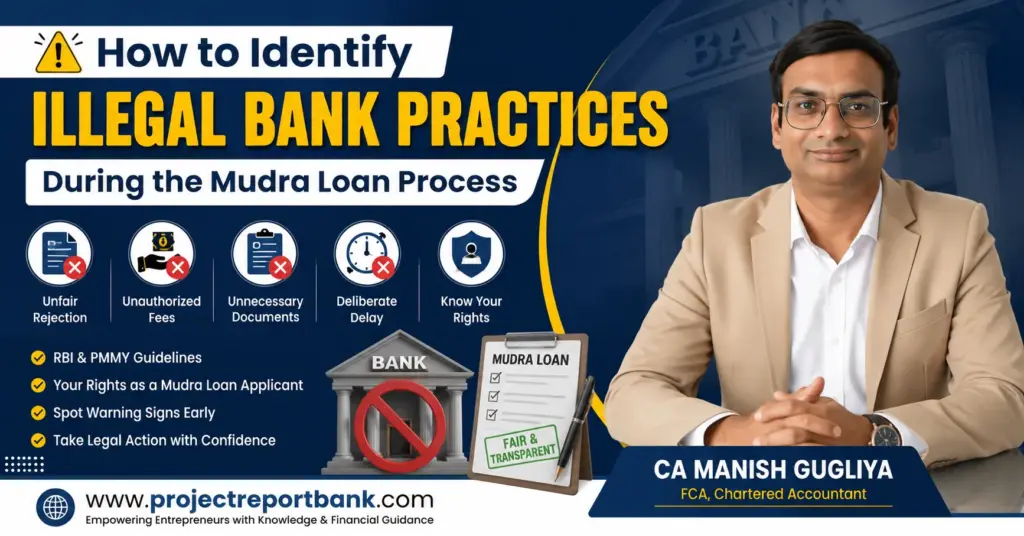
In this guide, you will learn: the meaning of illegal bank practices during the mudra loan process, major warning signs, how to verify actions against RBI/PMMY guidelines, what documents to preserve, and how to complain properly and legally.

Table of Contents
What Are Illegal Bank Practices in the Mudra Loan Process?
An illegal or unfair banking practice in the mudra context is any action that clearly violates applicable RBI circulars, PMMY operational guidelines, or the bank’s approved mudra loan policy – especially when it harms or misleads applicants.
Not every refusal is improper. Banks can legally reject a mudra loan for reasons like:
- Weak repayment capacity or poor cash flow projections
- A CIBIL score below 650, which may result in application denial
- Incomplete documentation, which can lead to immediate rejection
- Non-viable project report or business plan
- Missing KYC documents (Aadhaar, PAN, etc.)
- Absence of basic business registration where the bank’s policy requires it
However, the following types of conduct are potentially improper:
- Refusing to accept a properly filled application form without any policy basis
- Not issuing any receipt or acknowledgement for a submitted application
- Asking for collateral for Shishu or Kishore loans when scheme rules say collateral-free
- Demanding cash “service charges” or “speed money” beyond officially disclosed processing fees
- Forcing applicants to buy insurance, credit cards, or other unrelated products
- Deliberately delaying the file for months with no update or explanation
RBI and PMMY guidelines expect fair treatment during mudra loan processing – meaning similar applicants at the same branch should be assessed on consistent, non-discriminatory parameters.
Here is a comparison table to make the distinction clear:
| Legitimate Banking Practice | Potentially Improper Practice |
|---|---|
| Asking for standard KYC: Aadhaar, PAN, address proof | Demanding unrelated documents with no written explanation |
| Charging a disclosed, receipt-backed processing fee | Collecting cash in a staff member’s personal account |
| Requiring a basic business plan or quotations | Insisting on GST registration for a ₹30,000 Shishu loan when policy does not require it |
| Rejecting with a written reason (e.g., “poor credit history”) | Verbally telling applicant “we don’t do mudra here” when the branch is officially listed |
| Standard CIBIL check and income verification | Approving similar profiles from one group while rejecting others without neutral reasons |
Only a regulator, court, or competent authority can finally declare an action “illegal.” But applicants should question any pattern that conflicts with mandatory RBI and PMMY guidelines for banks or written bank policy.
Now let’s look at the top warning signs drawn from real consulting experience with micro entrepreneurs.
Top Warning Signs of Illegal Bank Practices During Mudra Loans
Below are common red flags, organized into individual situations. For each, I describe the issue, a simple example, and how it may connect to RBI/PMMY rules – while also noting when the same situation might be legitimate.
Bank Refuses to Accept the Application
If a bank staff member says “we don’t do mudra loan here” even though the branch is officially listed as a PMMY lending institution, that is a serious warning sign. Every applicant has the right to submit their form at an eligible branch. Refusal to accept the paperwork prevents the applicant from even starting the process.
No Acknowledgement Is Issued
When you submit a mudra loan application, you should typically receive at least an application number, a stamped copy, or an SMS confirmation. The RBI Fair Practices Code mandates that banks issue acknowledgement of receipt for loan applications. Without this, filing a complaint later becomes extremely difficult. Learn more about your mudra loan application acknowledgement rights.
Repeated Unnecessary Document Requests
Banks can legitimately ask for additional income proof, quotations, or licences. But when requests have no connection to official checklists – for example, demanding utility bills from three years ago for a ₹40,000 loan – it may be a delay tactic. Cross-check with resources like can banks ask extra documents for mudra loan.
Demanding Collateral Where Not Applicable
Mudra loans are designed to be collateral-free up to ₹10 lakh. If a branch insists on property papers or fixed deposit pledges for a Shishu or Kishore loan, this directly conflicts with the scheme’s core principle. Read more about collateral rules under mudra loan and whether a bank can demand collateral for mudra loan.
Charging Unauthorized Fees
Official mudra loans do not require processing fees or advance charges beyond what is officially disclosed and receipted by the bank. Any off-the-record cash payment, “speed money,” or “file charge” collected without a proper receipt is a strong indicator of unfair practice. Check details on mudra loan processing charges and unauthorized fees in mudra loans.
Forcing Insurance or Other Products
When a bank says “your mudra approval will only happen if you buy our insurance policy or open a recurring deposit,” that is forced cross-selling. RBI has repeatedly instructed banks against this. Insurance may be recommended, but it should never be a condition for loan sanction unless the applicant gives clear, written consent.
Deliberately Delaying Processing
Processing delays often occur without status updates for applicants. If your complete file has been sitting for 60–90 days with no decision and no written explanation, that delay may breach fair-treatment norms. Delay in obtaining funds and financial loss may occur due to such improper conduct. Understand when banks can legally delay mudra loan processing.
Rejecting Without Proper Communication
Every applicant deserves at least a basic written reason for rejection. A simple note like “rejected due to poor repayment capacity” is acceptable. But refusing to share any reason – verbally or in writing – is non-transparent. Learn whether a bank has to explain mudra loan rejection.
Providing Misleading Information
Some staff may misstate eligibility rules – for example, claiming “you must have GST even for a ₹50,000 Shishu loan” when their policy does not require it. Banks may also discourage applicants due to low profitability of small loans, indirectly steering them away. Rural applicants face digital access and awareness gaps that make them even more vulnerable to such misinformation.
Treating Applicants Unfairly Compared with Similar Cases
Discriminatory patterns – such as approving similar profiles from one community while rejecting others without neutral reasons – breach fair-treatment principles. While hard to prove individually, this becomes significant when combined with other red flags.
If you notice just one warning sign once, don’t panic. But when multiple red flags appear simultaneously during your mudra loan journey, take careful note and start documenting.

Common Illegal or Unfair Practices in Mudra Loans Explained with Examples
From professional experience across many banks and NBFCs, certain patterns keep re-appearing in complaints. Here is each one with a practical example.
Illegal or unauthorized fees: Some applicants are asked to pay “file charges” or “agency fees” in cash, with no official receipt. In reported cases, victims pay processing fees for non-existent mudra loans – sometimes thousands of rupees to agents who vanish. Contrast this with legitimate, disclosed fees that appear on your bank statement with a proper entry.
Forced cross-selling: A small trader applying for a ₹2 lakh Kishore loan is told to purchase a ₹15,000 insurance policy for “faster approval.” RBI guidelines explicitly discourage such forced bundling.
Delay tactics and repeated visits: A vegetable vendor has to visit the branch 10–12 times over three months. Staff gives verbal assurances but no written status. The entrepreneur loses daily income with each visit. After a reasonable number of visits, applicants should put their queries in writing.
Refusal to explain decisions: A written note saying “rejected due to insufficient income” is acceptable. Refusing to share even a basic reason is not.
Ignoring RBI and PMMY instructions: Banks cannot simply ignore mandatory guidelines on collateral-free lending or transparency of charges. When they do, applicants should know what happens when a bank violates RBI/PMMY guidelines.
Demanding unofficial payments or commissions: If a staff member hints that paying a “commission” will help pass the file, refuse immediately. Preserve any evidence and complain through official channels.
Asking for unnecessary guarantees: There is a difference between a legally permitted third-party guarantee under a bank’s written policy and an unreasonable demand for multiple guarantors for a small Shishu loan with no policy basis.
Agent and middlemen fraud: Unauthorized agents falsely claim to guarantee loan approvals for fees. In one reported Ahmedabad case, an agent used forged documents to get a ₹9.5 lakh mudra loan sanctioned in someone else’s name. Fraudsters use Mudra Ltd.’s logo to create fake documents, and a fraudulent loan approval letter has been circulated online to deceive borrowers. Mudra loan fraud exploits the scheme’s popularity to target uninformed individuals.
Discriminatory behaviour: Ignoring street vendors in favour of existing salaried customers, without any neutral policy reason, is a subtle but real form of unfair treatment.
Remember: MUDRA does not provide direct loans to individuals or micro entrepreneurs. It refinances lending institutions. Anyone claiming to provide direct loans “from MUDRA” is misrepresenting the scheme. Always apply only through authorized banks or RBI-registered microfinance institutions.
Each case must be evaluated against specific RBI/PMMY circulars and the bank’s written mudra policy. Where needed, take professional help to interpret those documents.
How to Check If the Bank’s Action Is Really Improper or Within Rules
Some actions that feel unfair may actually be valid internal risk policies. Before accusing the bank, verify the facts systematically.
- Read PMMY operational guidelines: Refer to official documents to understand collateral-free lending rules, eligible activities, and categories. Compare these with what the branch is telling you.
- Check RBI circulars and bank-level instructions: Use the RBI website or educational summaries like are RBI circulars legally binding for Mudra loans to understand how much flexibility branches actually have.
- Ask for written communication: Politely request written confirmation for claims like “collateral is mandatory for all mudra loans.” This written record becomes crucial if you need to complain later.
- Preserve application records: Keep copies of the filled loan application, project report, KYC documents, and any business registration proof so there is no doubt about what was originally submitted.
- Compare document requests with official checklists: Cross-check the branch’s demand list with checklists from official websites and bank brochures. Note any unexplained additions.
- Verify internal branch procedures: Calmly ask whether the same rules apply to all mudra loan customers. If possible, speak with another officer or the branch manager to confirm unusual demands.
- Escalate step by step: If, after checking, you still believe the bank is wrong, approach the branch manager first, then the regional or zonal office, then the bank’s head-office grievance cell, and finally the RBI Integrated Ombudsman Scheme.
- Take professional help: Applicants with complex issues should consider consulting an experienced CA or mudra finance professional to review documents and guide next steps.
Documents You Should Preserve to Protect Your Rights
In any dispute about illegal bank practices during the mudra loan process, documentary evidence matters far more than verbal conversations. Build a simple but complete file:
- Mudra loan application copy: Keep a photocopy or scanned copy of the filled form, including the date and branch stamp.
- Application acknowledgement or reference number: Insist on a receipt, acknowledgement slip, or SMS/email reference. This proves the bank accepted your application on a specific date.
- Email and letter communications: Save all emails sent to or received from bank officials, including physical letters. Note dates and the names and designations of the officers addressed.
- SMS and WhatsApp messages: Take screenshots or backups of any official messages. Be cautious about treating informal WhatsApp chats as final proof unless the number clearly belongs to the bank.
- Fee receipts and bank debits: Keep all printed receipts, passbook entries, or bank statements showing charges related to the mudra loan. These are critical if you later claim unauthorized fees were collected.
- Details of branch visits: Maintain a simple diary with dates, times, names of staff met, and topics discussed. This supports your timeline when complaining about delay.
- Call records and notes: Save call logs, note the date, time, and person spoken to, and write down key points immediately after important calls. Rules on call recording vary – respect local laws.
- Other supporting documents: Business registration certificates (Udyam, GST, Shop & Establishment Act), project report, CMA data, quotations, rental agreement copies, photographs of business premises, and bank details like recent statements all help prove genuine business activity.
Well-organized documents greatly strengthen a case before higher authorities or the RBI Ombudsman.

What to Do If You Suspect Illegal Bank Practices in Your Mudra Loan Case
Reacting emotionally or arguing loudly in the branch usually weakens your position. Follow a calm, written, step-by-step strategy instead.
Step 1 – Talk to the Branch Manager. Schedule a polite meeting. Explain the issue clearly, carry all your documents, and request the manager to clarify the bank’s written policy or give a reasoned order on your file.
Step 2 – Write an official complaint to the branch. Submit a written letter or email summarizing facts with dates. Attach copies of documents. Ask for a written reply within 7–15 days.
Step 3 – Escalate to higher authorities. Approach the regional or zonal office and the bank’s official grievance redressal portal. Quote your earlier complaint number and enclose acknowledgements and evidence. Complaints about illegal practices can be reported to higher bank authorities at every level.
Step 4 – Use bank and government grievance portals. Upload clear scans and maintain complaint reference numbers for future follow-up. Suspicious activity regarding loans should always be reported to the appropriate authorities.
Step 5 – Approach RBI Ombudsman if eligible. If the bank fails to respond within the prescribed time or you are not satisfied, approach the RBI Integrated Ombudsman Scheme with your documentary evidence.
Step 6 – Seek professional support. For large or complex cases, take help from a CA, advocate, or experienced mudra loan consultant – for example, services offered by ProjectReportBank.com – especially where financial analysis or interpretation of RBI guidelines is required.
At no stage should you offer or agree to unofficial payments. Rely on evidence, guidelines, and formal complaint channels.
Mistakes Mudra Loan Applicants Should Avoid
Many genuine applicants weaken their own position by making avoidable mistakes.
- Arguing emotionally or threatening staff: Angry outbursts or recording videos inside the branch without permission may lead to security issues and shift focus away from your real concern.
- Not collecting or organizing evidence: Failing to keep copies of forms, acknowledgements, and messages leaves you with only verbal claims, which regulators do not rely on.
- Paying unofficial charges: Never pay advance fees to anyone claiming to speed up a loan process. Paying cash “to move the file” encourages corruption and leaves no paper trail.
- Relying only on verbal promises: Some applicants trust assurances like “your mudra loan is confirmed” and then discover the loan was never sanctioned. Always insist on written sanction letters and clear terms.
- Posting strong public allegations without proof: Making defamatory social-media posts naming individual officers without evidence may create legal problems for you and rarely resolves anything.
- Ignoring eligibility and documentation norms: You must still satisfy basic conditions – KYC, repayment capacity assessment, income proof, and compliance with business registration or licence requirements. No guideline forces banks to assess and sanction every mudra application.
- Sharing personal data carelessly: Borrowers should not share personal bank details, Aadhaar, or PAN with untrusted parties. Fake websites impersonate officials and collect personal information. Always verify the identity of anyone asking for your details.
Combine awareness of your rights with responsible behaviour and realistic expectations.
Expert Guidance from CA Manish Gugliya (FCA) for Mudra Applicants
Over the past two decades, I have prepared thousands of project reports, CMA data files, and mudra yojana applications for micro and small businesses across different banks since PMMY started in 2015. Here is what I consistently advise:
Prepare a solid project report. A clear business model with projected sales, expenses, and a realistic loan repayment plan reduces both genuine rejections and the scope for arbitrary decisions. When your loan amount is well-justified and your file is strong, banks have less room for excuses.
Maintain documentation discipline. A neat file of all mudra-related papers – acknowledgements, Udyam registration, bank statements, tax returns, and even a rental agreement for your business premises – gives you more credibility and confidence before the bank.
Learn to differentiate genuine checks from harassment. Asking for bank statements, basic licences, or a guarantor can be normal. Demanding unrelated documents or non-receipted cash should immediately raise questions. A good rule of thumb: if the bank cannot show you a written policy for the demand, question it politely.
Be patient but not passive. Give the bank a reasonable period to process your application. But if the file remains stuck beyond what seems justified, escalate through formal channels as I described earlier. Don’t let anyone – agents, middlemen, or unofficial contacts – convince you to pay money outside the system.
Explore educational resources on ProjectReportBank.com about common misinterpretations of RBI/PMMY guidelines, applicant rights, extra document demands, and delay handling to strengthen your knowledge.
Most banks, in my experience, are willing to correct mistakes when approached properly with facts, documents, and reference to RBI/PMMY guidelines. The key is knowing when to push and how.
Conclusion: Using Your Rights Wisely in the Mudra Loan Process
Understanding and identifying illegal bank practices during the mudra loan process helps you protect yourself – but remember that final sanction is always subject to the bank’s credit appraisal, eligibility verification, and documentation review. A justified rejection is not the same as misconduct.
Watch for the key warning signs: unauthorized fees, unnecessary collateral demands, forced insurance, unexplained delays, and refusal to provide written reasons. Preserve every document. Insist on written communication. Use official grievance and Ombudsman mechanisms instead of informal shortcuts or unofficial payments.
Your rights as a mudra loan applicant are real and enforceable – but only when backed by evidence and exercised through proper channels. Explore more detailed guides on ProjectReportBank.com about mudra applicant rights, processing charges, collateral rules, and delay-related issues to ensure you start your business journey on solid ground.
Disclaimer: This article is for educational purposes only and does not constitute legal advice. Every mudra loan decision remains at the sole discretion of the lending bank based on its credit policy and applicable RBI/PMMY guidelines. Applicants should refer to official bank policies and regulatory mechanisms for specific matters.
FAQs About Illegal Bank Practices During the Mudra Loan Process
What exactly counts as an illegal bank practice in a Mudra loan?
An illegal or unfair practice is behaviour that clearly conflicts with RBI/PMMY rules or the bank’s written policy. Examples include demanding collateral for eligible collateral-free mudra loans, collecting cash without receipt, refusing to accept a properly filled application without any policy reason, or forcing applicants to buy unrelated products for loan approval.
If one bank delays or rejects my Mudra loan, can I apply somewhere else?
Yes, applicants are normally free to approach another bank, NBFC, Regional Rural Bank, or microfinance institution participating in PMMY. However, it is a good idea to correct any issues – like weak documents, poor credit history, or an incomplete business plan – that caused the earlier rejection before you apply again.
Are verbal promises by bank staff about Mudra approval legally binding?
Verbal assurances are not legally reliable. Only written sanctions, terms and conditions, and formally issued letters or emails should be trusted. If a staff member tells you “your loan is approved,” always ask for the written sanction letter before making any business commitments.
Can I record meetings or calls with bank staff as evidence?
Laws on recording vary by jurisdiction, and applicants should respect privacy and legal norms. Instead of relying on recordings, focus primarily on written communication, emails, and official acknowledgements. These are generally more acceptable before regulators and ombudsmen.
Does every delay or rejection in Mudra loan mean the bank is doing something illegal?
No. Many delays or rejections happen due to genuine banking reasons – verification requirements, workload, or a weak credit profile. Only when the conduct clearly conflicts with RBI/PMMY norms or the bank’s own written policy should it be considered potentially improper and challenged through official grievance channels.
- Mudra Loan Illegal Bank Practices: Complete Guide to Identify, Prevent & Report Unfair Banking Practices


- Can Banks Change Mudra Loan Terms Without Informing the Applicant?
- Red Flags That Indicate Unfair Bank Practices in Mudra Loans: Warning Signs Every Applicant Should Know

- What Evidence Should You Collect If a Bank Violates Mudra Loan Rules?
- How to Report Illegal Bank Practices in Mudra Loans
- How to Protect Yourself from Illegal Bank Practices in Mudra Loans
- How to Identify Illegal Bank Practices During the Mudra Loan Process
- Is It Legal for Banks to Delay Mudra Loan Processing Without Reason?
- Are Banks Allowed to Charge Unauthorized Fees for Mudra Loans? Complete Guide by CA Manish Gugliya