Key Takeaways
- A Mudra loan approved after bank change became possible only after fixing documentation gaps, strengthening the business plan, and preparing realistic CMA Data – not simply by shifting banks.
- This case follows a micro-manufacturing entrepreneur in Jaipur who secured a ₹10 lakh Tarun loan after moving from a nationalised bank to HDFC Bank with a professionally prepared project report.
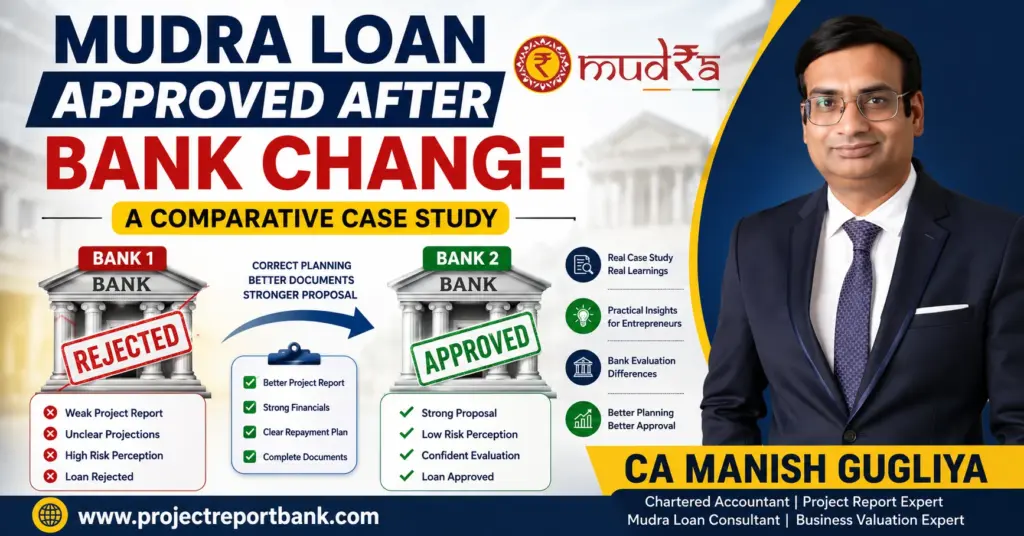
- Bank 1 rejected the application due to a weak business plan, missing CMA Data, and unsubstantiated loan amount. Bank 2 approved after the applicant presented realistic projections and complete documentation.
- Entrepreneurs should always upgrade their documents and financial projections before considering a bank change, especially for mudra loans above 5 lakh.
- This article includes a comparative table, a practical checklist, and FAQs to serve as a reference point for your own Pradhan Mantri Mudra Yojana application.
Introduction – Mudra Loan Rejection Is Not the End
Many entrepreneurs in India assume that rejection by one bank means every lender will say no. Under the Pradhan Mantri Mudra Yojana (PMMY), each participating bank sets its own lending decisions based on its credit policy. The same applicant, same business, and similar loan amount can receive different outcomes at different banks – but only when weaknesses are corrected first.
The scheme, launched by the government to provide financial assistance to small and micro businesses, operates through four categories: Shishu loans for amounts up to ₹50,000, Kishore loans ranging from ₹50,001 to 5 lakh, Tarun loans ranging from ₹5 lakh to 10 lakh, and the newer Tarun Plus loans for repeat borrowers who have successfully repaid previous loans (upto rs 20 lakh). Mudra loans are for non-corporate, non farm enterprises and can be accessed through commercial banks, small finance banks, cooperative banks, NBFCs, and various financial institutions. Business activities must be eligible under PMMY to qualify – this includes manufacturing, trading, services, food processing, and allied agricultural activities, though not crop loans.
This case study, drawn from my consulting experience as a CA, walks through exactly what went wrong at Bank 1, what was fixed, and why Bank 2 approved.
Table of Contents
Applicant Profile – Who Applied for the Mudra Loan?
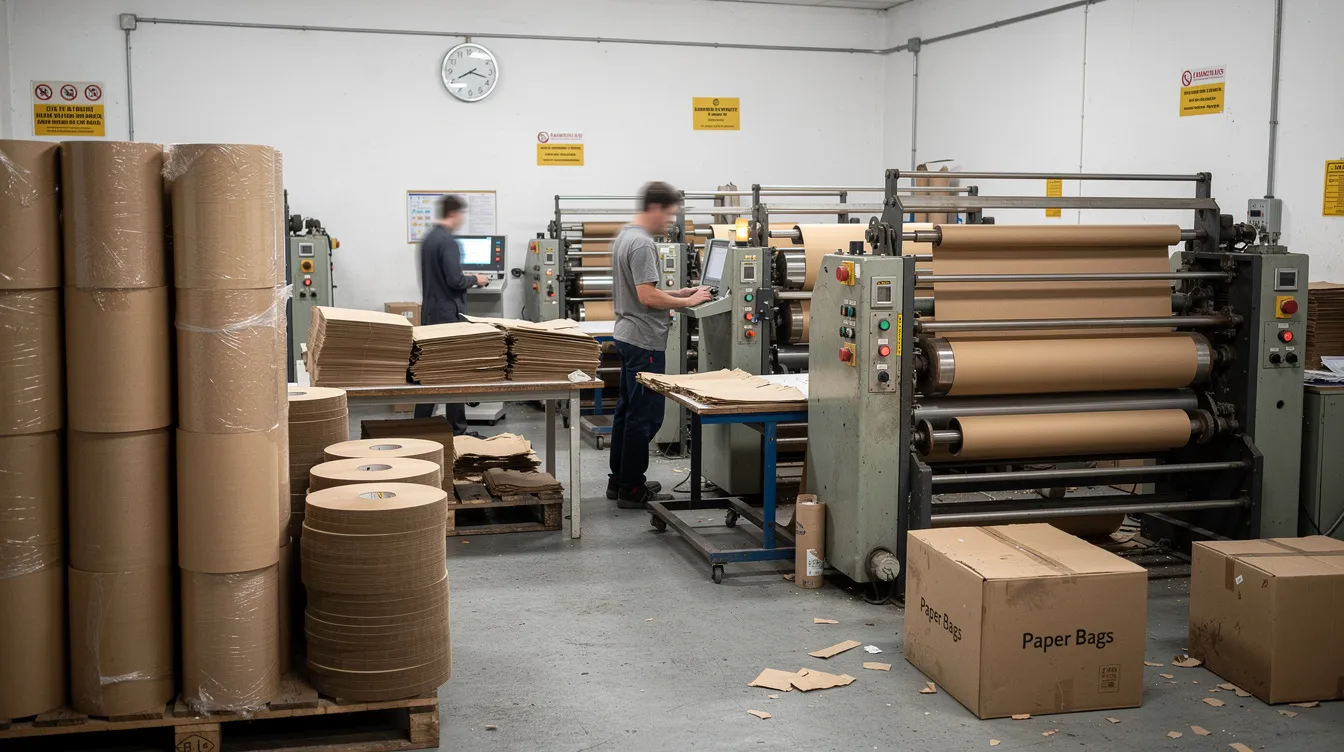
Mr. Rajesh Sharma, a 34-year-old proprietor of “Sharma Eco-Pack Solutions” in Jaipur, ran a small eco-friendly paper bag manufacturing unit from a rented shed. He had 3 years of trading experience in packaging material and 1 year of small in-house production. His proposed activity was supplying paper bags to local kirana stores, bakeries, and small retailers – micro businesses with steady demand after plastic restrictions.
His funding needs were clear: ₹10 lakh under the Tarun category for semi-automatic machines (capital assets), working capital for raw material, and modest shop-floor improvements. He had a savings and current account with a large PSU bank for 6 years, routing average monthly turnover of ₹1.5–2 lakh. His CIBIL score was around 712, with no defaults – a satisfactory credit track record. He committed ₹2.5 lakh as promoter’s margin from savings and family support.
No specific educational qualification is required under PMMY, but the applicant must demonstrate necessary skills and knowledge for the proposed business purpose. On paper, Rajesh met the eligibility criteria under mantri mudra yojana pmmy as an individual borrower, yet Bank 1 still rejected his application.
Bank 1 Evaluation – Why the First Mudra Loan Application Was Rejected
Bank 1, a nationalised bank branch where Rajesh already held his account, followed its standard credit process. Know Your Customer rules are strictly followed by banks for loan approvals, and Rajesh submitted basic kyc documents (PAN, Aadhaar), Udyam registration, GST registration, 12-month bank statements, a simple two-page business plan, and a quotation for only one machine.
The problems were fundamental. His project report was a generic, copy-paste template with turnover projections jumping from ₹18 lakh to ₹60 lakh in year one – completely unrealistic. There was no CMA Data, no cash flow statement, and no working capital calculation. A business plan is mandatory for Kishore and Tarun loans, and his fell far short.
The credit officer questioned his sales volumes, sourcing of kraft paper, capacity utilisation, and how he planned to absorb increased output. The branch noted his low average current account balance, frequent cash withdrawals, and mixing of family and business expenses. A weak business plan can lead to loan application denial, and that is precisely what happened. The bank found the project not viable at the proposed scale, with financial projections unsupported by past performance.
His core mistake: applying for the maximum Mudra limit simply because it was available, without a bankable file to justify it.
Improvements Before Applying to Another Bank – Strengthening the Proposal
After rejection, Rajesh did not rush elsewhere. He spent about 5 weeks upgrading his entire file with professional guidance. Here is what changed:
- Customised project report: Industry-specific capacity planning, item-wise machinery list with costs, installation details, power load, labour requirements, and compliance with local pollution norms.
- Proper CMA Data: 5-year projected P&L, Balance Sheet, and Cash Flow with DSCR (Debt Service Coverage Ratio) kept above 1.25 – conservative but bankable.
- Realistic financial projections: Turnover growing gradually from ₹18 lakh to ₹32 lakh, then ₹42 lakh, with gross profit margins aligned to actual market rates and seasonal variations factored in.
- Cash flow planning: EMI structured within 30–35% of projected net cash accruals. Monthly inflows from orders clearly covering EMI, rent, wages, and raw material.
- Stronger documentation: Quotations from two machine suppliers, rental agreement, electricity bills, photographs of the existing unit, proof of margin money in the bank, and identity proof, address proof, and income proof all updated and consistent.
- Corrected assumptions: Realistic raw material cost per kg, 8–10% wastage ratios, conservative 50–60% capacity utilisation in year one, and selling price benchmarked to local competition.
- Communication preparation: Rajesh practiced explaining his business model, customer base, competition, and how he planned to expand during lean months through job-work for bigger units.
Documentation requirements can influence loan approval time, and these improvements ensured the file was ready for any lending institution.
Bank 2 Evaluation – How the Mudra Loan Finally Got Approved After Bank Change
Rajesh opened a fresh current account at HDFC Bank and applied for a Mudra Tarun loan of ₹10 lakh. Switching banks requires starting the evaluation from scratch – the bank treated this as a completely fresh PMMY application with independent verification. Banks evaluate the nature of your business as a factor in loan approval, and the credit officer examined everything from machine capacity and break-even point to target customers and contingency plans.
The financial assessment focused on DSCR, promoter contribution, existing obligations, and sensitivity analysis. Proof of business operations is required for loan approval, so the bank conducted an on-site visit to the rented shed, checked the existing small machine, raw material stock, and a few invoices to local stores.
Additional queries covered electricity load sanction, estimated installation date, and a written confirmation from a major buyer. Businesses must provide updated KYC documents when switching banks, and KYC documents must match exactly to avoid rejection – Rajesh ensured every document was consistent.
The loan extended after branch recommendation and credit cell clearance took approximately 3–4 weeks. A recent bank switch can cause temporary delays in loan disbursement, but the improved proposal moved through smoothly. The beneficiary micro unit finally received its funding.
Comparative Analysis – Bank 1 vs Bank 2 Approach to the Same Mudra Loan
| Evaluation Criteria | Bank 1 (Before Improvements) | Bank 2 (After Improvements) |
|---|---|---|
| Application Quality | Incomplete, hastily assembled | Complete, professionally structured |
| Project Report | Generic template, unrealistic scale | Customised, industry-specific with compliance details |
| CMA Data | Not submitted | 5-year projections with DSCR above 1.25 |
| Business Plan Clarity | Vague 2-page summary | Detailed model with customer segments and competition |
| Financial Projections | ₹18L to ₹60L jump (unrealistic) | Gradual growth: ₹18L → ₹32L → ₹42L |
| Documentation | Missing quotations, no margin proof | Multiple quotations, margin money evidenced |
| Communication | Unprepared for questions | Confident, rehearsed explanations |
| Risk Perception | High – unsubstantiated claims | Manageable – numbers matched ground reality |
| Approval Chances | Very low | Strong |
| Final Decision | Rejected | Approved (₹10 lakh Tarun) |
The table makes clear: the Mudra loan approved after bank change was driven by transformed application quality, not bank leniency. Each applicant’s proposal is assessed based on documented facts, regardless of which bank or financial institution they approach.
Key Reasons the Mudra Loan Was Finally Approved
Bank 2 saw the same borrower and business but with fundamentally stronger documentation. The key reasons for approval included: better financial planning with realistic revenue estimates grounded in actual market data; a project report aligned with paper bag manufacturing norms; properly prepared CMA Data showing acceptable DSCR and cash flows; a clear business model with defined customer segments covering loans for working capital and machinery; properly justified loan amount and tenure; evidence of the promoter’s capital contribution; accurate working capital calculation matching the operating cycle; and improved repayment planning with buffers for slower months.
The assets created from the loan – machines, raw material inventory – were clearly documented. In many similar cases across micro enterprises engaged in manufacturing and services, this same pattern holds: fix documentation first, choose bank second.
Common Mistakes Entrepreneurs Make Before Changing Banks
From my practice, eligible borrowers often repeat the same errors after rejection:
- Immediately applying to another bank without identifying the actual reason for rejection
- Reusing the same unrealistic project report at the next financial institution
- Ignoring financial weaknesses like low profit margins or high existing debt
- Assuming PMMY is a “guaranteed” government scheme where banks cannot reject
- Applying for maximum ₹10 lakh when the business justifies only ₹3–5 lakh
- Submitting incomplete or mismatched documents – incomplete or mismatched documents cause most loan rejections under the scheme
- Not disclosing existing EMIs or settled loans; credit score affects loan approval regardless of the bank chosen, and existing loan defaults result in immediate rejection
- Low or no CIBIL score leads to loan rejection – applicants must not have a history of loan defaults
Treat your first rejection as a free audit. It costs nothing but teaches everything.
When Does It Make Sense to Change Banks for a Mudra Loan?
Changing banks is a strategic step, not an emotional reaction. It makes sense when you have significantly improved your project report, CMA Data, and documents; when your current bank has a conservative lending preference for your sector; when there are visible delays or limited product offerings at the existing branch; or when another bank shows stronger focus on MSME and Tarun loans.
Do not change banks when your CIBIL is weak, your business is not operational, projected cash flows cannot support EMI, or fundamental eligibility under PMMY is unmet. For a deeper comparison, see same bank vs another bank for Mudra reapplication.
Practical Checklist Before You Change Banks for a Mudra Loan
Use this pre-reapplication checklist before visiting another bank:
- ✅ Customised project report with realistic assumptions for your specific industry
- ✅ CMA Data for 3–5 years with DSCR calculations
- ✅ Clear business plan covering product, pricing, customers, and competition
- ✅ KYC documents, Udyam Registration (recommended for Kishore and Tarun loans), GST, and business proof in consistent form
- ✅ Last 12 months bank statements without heavy unexplained cash movements
- ✅ Latest income tax returns and GST returns filed on time
- ✅ CIBIL report reviewed and errors disputed
- ✅ Promoter’s margin money visible in bank account
- ✅ Quotations for machinery and major capital assets
- ✅ Working capital calculation based on stock-debtor-creditor cycle
- ✅ Loan amount aligned with actual business requirement, not just the maximum PMMY limit
Mudra loans can also be applied online through JanSamarth portal, but the strength of your file determines the outcome. Processing time for Shishu loans is 7 to 10 working days, but Tarun category applications naturally take longer due to deeper evaluation.
Expert Guidance from a Practising CA – How to Use This Case Study
In over two decades of handling project finance for micro enterprises and micro units across India, I have seen the same pattern: entrepreneurs who treat rejection as feedback and invest time in preparation almost always succeed in the next phase.
Interpret the bank’s rejection as an illustrative list of what needs fixing. Convert each concern into an improvement task – documentation, projections, business model clarity, or CIBIL repair. Realistic projections grounded in Business Valuation principles (expected return, industry margins, stress-testing) make proposals bankable. A well-structured project report under PMMY highlights the promoter’s strengths, addresses credit officer queries, and documents risk mitigation strategies. This approach works whether you are in trading, services, or manufacturing – the guidelines remain the same.
View the Mudra loan process as a discipline-building exercise, not just a source of interest-free or low-interest finance and easy funding. This mindset shift leads to faster approvals for eligible micro and small businesses looking to expand.

Conclusion – Bank Change Plus Better Preparation Leads to Approval
The Mudra loan approved after bank change headline tells only half the story. The real difference came from an improved project report, realistic business plan, stronger CMA Data, and better communication with the lender.
PMMY loans through the Pradhan Mantri Mudra Yojana, especially Tarun loans covering loans from ₹5 lakh to ₹10 lakh, are evaluated like any collateral-free business loan. Government backing does not remove the need for viability. Treat rejection as feedback. Fix your documents. Clarify your business model. Then approach another bank with confidence. With proper planning and persistence, every eligible borrower can access Mudra loans and build a sustainable enterprise.
Frequently Asked Questions (FAQ)
These FAQs address common concerns after a Mudra loan rejection or when considering a bank change.
Can I apply for a Mudra loan at another bank immediately after rejection?
Technically, there is no cooling-off period under PMMY. However, it is strongly advisable to first fix the issues – documents, business plan, CIBIL – identified during the previous evaluation. A practical timeline of 4–8 weeks to upgrade your project report and CMA Data is recommended before approaching a new bank, especially for Kishore and Tarun loans.
Will the second bank know that my Mudra loan was rejected by the first bank?
There is no central “Mudra rejection” database. However, multiple loan enquiries and previous sanctioned loans appear in your CIBIL report, which every bank will review. Be transparent about past rejection if asked, and demonstrate how you have improved your proposal since then.
Should I change my business plan or use the same one when applying to another bank?
Simply reusing the same weak business plan is a major mistake. Banks follow similar credit logic, so the second bank is likely to reject for the same reasons. Rework your business plan and financial projections to align with real market data, capacity, and working capital needs before reapplying.
Does changing banks increase my chances of getting the full ₹10 lakh Mudra Tarun loan?
The loan amount depends on business viability, repayment capacity, and documented need – not on which bank you choose. For first-time borrowers, getting a slightly lower sanctioned amount that fits your current business scale may be wiser than chasing the maximum PMMY limit. According to government data, Tarun accounts for only about 2% of total Mudra loans but roughly 24-25% of the total amount sanctioned, which explains why banks scrutinise these applications more carefully.
Is a professionally prepared project report mandatory for a Mudra loan?
PMMY guidelines do not legally mandate a CA-prepared project report. However, banks – especially for loans above ₹5 lakh – strongly prefer structured, realistic documents. Professional support reduces errors in assumptions, improves CMA Data quality, and helps you answer banker queries confidently, thereby improving approval probability significantly.
- Integrated Value-Added Rice Products Processing Plant Project Report & DPR
- Integrated Rice Plant Bank Loan, Feasibility, ROI, IRR, Payback & Sensitivity Analysis


- Integrated Rice Processing Plant Financial Projections, Working Capital & DSCR

- Integrated Rice Products Revenue Model, Market Strategy & Profitability

- Integrated Value-Added Rice Plant Project Cost & Means of Finance

- Raw Material Procurement & Inventory Planning for Integrated Value-Added Rice Plant

- Common Utilities, Warehousing, Packaging & Material Handling for Integrated Rice Plant

- Integrated Rice Processing Plant Land, Building & Multi-Line Plant Layout – A Practical Guide for DPR & Bank Finance

- Integrated Rice Processing Plant Capacity Planning & Product Mix