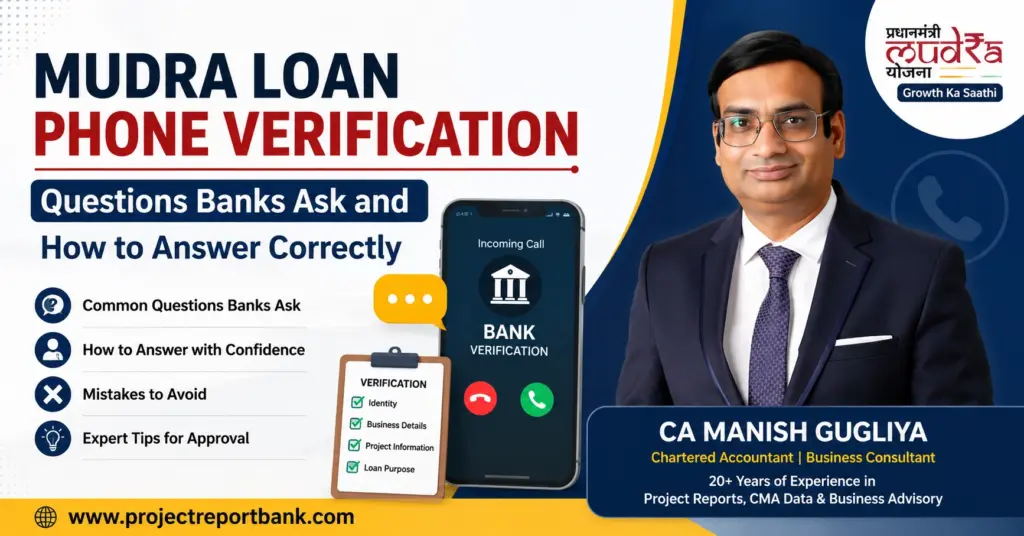
Key Takeaways
A single Mudra Loan phone verification call can decide whether your loan moves toward approval or gets rejected. Here is what every applicant must know before that call comes:
- Banks usually call within a few days after you submit your Mudra loan application or project report. They expect clear, consistent answers about your business, loan amount, and repayment capacity.
- Most Mudra Loan verification questions are straightforward – business type, address, turnover, purpose of loan – but your answers must exactly match your documents and project report.
- Keep copies of your Mudra Yojana application, project report, quotations, and bank statements nearby during the call so you never have to guess.
- Honest, confident, and consistent replies significantly increase your chances of approval, while wrong or changing figures can trigger rejection or reduction of the sanctioned loan amount.
- The verification process varies across banks and branches – some call before site inspection, others after – so stay prepared from the day you submit your file.
Introduction – Why Mudra Loan Phone Verification Matters
Many Mudra loan applicants believe that once they submit their documents at the bank, the hard work is done. In my 20+ years of advising MSME borrowers, I have seen this assumption cause more loan rejections than almost any other mistake. The truth is, the Mudra Loan phone verification call is often the real deciding step in the approval process.
Here is what happens in actual banking practice. A few days after submission, a loan officer or verification agency picks up the phone and calls you. The conversation lasts about 5 to 15 minutes. They ask simple questions – your name, business details, turnover, loan purpose, project cost. If your answers match your file, the application moves forward. If they do not, the file can be sent back, the loan amount reduced, or the application rejected outright.
This verification applies to all three categories under Pradhan Mantri Mudra Yojana – Shishu, Kishore, and Tarun – covering loans for micro enterprises in the non farm sector, typically from ₹50,000 upto rs 10 lakh or even ₹20 lakh for repeat borrowers under Tarun Plus. The scheme, launched on April 8, 2015, provides funding to non corporate, non farm small business enterprises, and mudra loans can now also be applied online through the JanSamarth portal.
In this article, I will walk you through exactly what happens during the call, who calls, what questions they ask, mistakes to avoid, a preparation checklist, and practical expert tips – everything you need to clear this stage smoothly.

Table of Contents
Basics of Mudra Loan Phone Verification – Purpose, Timing, and Callers
Mudra Loan phone verification is a telephonic cross-check done by the bank before final sanction or disbursement. In simple terms, a trained bank representative calls the registered mobile number on your application to confirm that the details you submitted are genuine, your business exists, and the loan purpose matches your project report. Phone verification is a due diligence step in the Mudra loan application process, and it plays a critical role in how banks assess risk before approving the loan.
The verification process typically includes a background check conducted by a bank officer. It is not a casual formality – the answers from this call are often logged in the bank’s loan processing system and reviewed by credit approvers before making the final decision.
When Does the Call Usually Happen?
- 1–5 working days after submitting the Mudra loan application and documents at the branch.
- Just before field verification – some banks prefer to verify details over the phone first, then send an officer for a physical site visit.
- After site inspection but before sanction – other banks reverse the order and use the phone call as a final confirmation after the field visit.
- Different banks follow different sequences. Even within the same bank, branch-level practice can vary depending on the loan amount, the applicant’s profile, and local workload.
An application number is generated after submission of the application, and this number is usually referenced during the verification call.
Who Makes the Verification Call?
- Branch Manager – common in smaller towns and rural branches where the manager handles loan files personally.
- Loan Officer or Credit Officer – in bigger branches, a dedicated officer handles the Mudra loan verification call.
- Empanelled third-party verification agency – many banks, including SBI, empanel external agencies specifically for business phone verification. These agencies may use recorded calls as part of their verification process.
- A branch representative also conducts field verification after initial digital application approval.
Key Details About the Call
- Expected duration: 5–15 minutes for most Mudra applications.
- Calls are usually made during banking hours – roughly 10:30 a.m. to 5:00 p.m. on working days.
- Phone verification often involves sending an OTP to the mobile number linked to Aadhaar as part of the initial login and authentication. KYC norms require that the phone number be linked to Aadhaar and other documents.
- The main objectives are: confirming your identity, verifying that the business address and activity are real, ensuring the proposed loan amount and purpose match the mudra yojana project report and documents, and checking your repayment capacity.
Physical site visits may confirm the existence of the business for loan processing, and the phone call is typically the first layer of this verification.
Eligible borrowers include individuals and partnership firms. Applicants must not be defaulters to any bank, and the applicant should have a satisfactory credit track record. Educational qualifications depend on the proposed activity’s requirements – there is no fixed educational bar for most Mudra loan categories. Mudra loans are also available through small finance banks, NBFCs, and MFIs apart from regular commercial banks.
Under the Pradhan Mantri Mudra Yojana, loans are available for non-corporate, non-farm small enterprises. PMMY has disbursed over ₹15.52 lakh crore to nearly 29.55 crore beneficiaries – that scale means thousands of verification calls happen across india every single day.
MUDRA loans are classified into three categories:
- Shishu loans – amounts upto Rs. 50,000. Processing charges for shishu loans are often waived by banks.
- Kishore loans – ranging from Rs. 50,000 to Rs. 5 lakhs.
- Tarun loans – covering amounts from Rs. 5 lakhs to Rs. 10 lakhs.
- Tarun Plus loans – can go up to Rs. 20 lakhs for repeat borrowers with good track records.
So Pradhan Mantri Mudra Yojana provides loans up to Rs. 20 lakhs, covering a wide range of business needs.

Common Mudra Loan Phone Verification Questions and How to Answer
This is the most important part of this article. The table below lists real questions that bank officers and verification agencies commonly ask during a Mudra Loan verification call. For each question, I have explained why the bank asks it and how you should answer correctly.
Your answers must match what is written in the Mudra loan application form, project report, CMA data (if prepared), bank statement pattern, and any quotations attached in the file. Required documents include ID proof and address proof, and the officer will cross-check your spoken responses against these.
| Bank Question | Why Bank Asks It | Correct Way to Answer |
|---|---|---|
| What is your full name? | To match with PAN, Aadhaar, and application form | State your name exactly as it appears on your PAN card and passport or Aadhaar. Do not use nicknames. |
| What is your father’s / husband’s name? | Identity confirmation and document cross-check | Give the name exactly as mentioned in your application and ID proof. |
| What is your date of birth? | To verify identity against records | State it clearly as per your Aadhaar or PAN. |
| What is your current mobile number? | To confirm ownership of the registered contact | Confirm the number you provided in the Mudra loan application. This is the number they are calling on. |
| Do you have an alternate contact number? | For backup contact and references | Provide one if you mentioned it in the application. If not, say you did not provide one. |
| Did you personally submit this Mudra loan application? | To rule out fraud or third-party filing without applicant’s knowledge | Say “Yes, I submitted it personally at [branch name] on [approximate date].” |
| What is your business? | To verify the nature of activity matches the application | Describe clearly: “I run a readymade garments shop” or “I operate a beauty parlour” – exactly as written in your project report. |
| Since when have you been running this business? | To check business continuity and experience | Give the exact year or month: “Since March 2019” – matching what you wrote in your application. |
| Is your business new or existing? | Banks treat new and existing businesses differently in risk assessment | Be honest. If it is existing, say so with the start date. If new, explain your plan clearly. |
| What is the exact business address? | To cross-check with documents and plan the field verification visit | Give the complete address including shop number, floor, landmark – matching your application, rent agreement, and business proof documents. |
| Is your business premises owned or rented? | To verify ownership and stability of location | State clearly: “Rented” or “Owned.” If rented, mention approximate monthly rent as per your rent agreement. |
| Is your business home-based? | To understand setup and plan verification accordingly | If yes, explain the arrangement: “I run it from the front room of my house” – be specific. See tips for home-based business verification. |
| What are your approximate monthly sales? | To match with bank statement turnover and project report | Give a realistic round figure: “Around ₹1.5 lakh per month.” This must match your last six months bank statement average, not an aspirational number. |
| What are your monthly business expenses? | To assess profitability and repayment capacity | List major heads briefly: “Rent ₹8,000, salary ₹12,000, raw material about ₹60,000, electricity ₹3,000.” |
| What is your approximate monthly profit? | To verify that you can repay the loan EMI | State the net figure: “About ₹25,000 to ₹30,000 per month after all expenses.” This should match the statement and project report. |
| How many employees do you have? | To gauge the scale and genuineness of the business | Give the exact number: “I have 2 helpers” or “I work alone.” |
| What percentage of your sales is cash vs digital? | To understand banking pattern and verify bank statement credits | Be honest: “About 60% cash and 40% through UPI/card.” |
| Why do you need this Mudra loan? | To confirm the loan purpose matches the application | State clearly: “To purchase a new stitching machine and buy initial stock” – matching the project report. |
| What is the total loan amount you have applied for? | To confirm awareness and match the file | State the exact figure: “I have applied for ₹5 lakh under Kishore category.” |
| What is the total project cost? | To verify own contribution and loan sought | Say: “Total project cost is ₹6.5 lakh. I am putting ₹1.5 lakh from my savings, and I have sought ₹5 lakh as loan.” |
| What machinery or equipment will you buy? | To match with quotations in the file | Name each item and approximate cost: “One industrial sewing machine – ₹1.2 lakh, one cutting table – ₹35,000” – matching quotations submitted. |
| Do you have Udyam registration? | To verify MSME classification | Say “Yes, my Udyam number is…” If you do not have it, mention that honestly. See why Udyam matters. |
| Do you have GST registration? | To check compliance and scale | If registered, give your GSTIN. If turnover is below threshold, say: “I am not required to register under GST as my turnover is below the limit.” |
| Do you have any existing loans? | To calculate total EMI burden and repayment capacity | Be fully transparent: “I have a vehicle loan with ₹4,500 EMI and no other borrowing.” Hiding loans leads to rejection when the bank checks your credit report. |
| What is your monthly EMI obligation? | To check whether new EMI is affordable | State the total: “₹4,500 per month for vehicle loan. No credit card outstanding.” |
| Which bank is your main accounts with? | To verify banking relationship and check statement consistency | Name the bank and branch: “I hold a current account with Bank of India, Main Branch.” |
| What is your average monthly bank balance? | To check financial discipline | Give a realistic figure matching your statement: “Around ₹20,000 to ₹30,000.” |
| What are your normal business working hours? | To plan the site inspection and verify activity | State honestly: “9 a.m. to 8 p.m., Monday to Saturday.” |
| Who prepared your project report? | To verify that you understand the report content and it is not a generic copy-paste document | Say: “It was prepared by my CA / consultant and I have reviewed all the figures.” Never say “I don’t know.” See why copy-paste project reports get rejected. |
| What is your estimated first-year turnover as per the project report? | To match with the financial projections | State the figure from your report: “Approximately ₹18 lakh in the first year.” Make sure this is realistic – see guidance on financial projections. |
| Can the bank visit your business premises for verification? | To confirm you are open to physical inspection | Always say: “Yes, you are welcome anytime during business hours.” |
| Who are your main suppliers? | To verify trading activity and raw material sourcing | Name 1–2 suppliers: “I buy fabric from Surat market and accessories from a local wholesaler.” |
| What type of customers do you serve? | To understand business model and market | Describe briefly: “Mostly retail walk-in customers and some wholesale orders.” |
Always remember: the bank is not trying to trick you. They are simply matching your spoken words with your written file. If both match, the file moves forward. If they do not, red flags are raised.

Mistakes to Avoid, Handling Missed Calls, and Who Should Answer
Even applicants with genuine businesses and complete documents sometimes fail the Mudra loan telephonic verification – not because their business is weak, but because they make avoidable mistakes during the call. Let me walk you through the most common problems I have seen in real cases.
Banks compare your call answers against every document in your file – PAN, Aadhaar, bank statements, Udyam, GST certificate, rent agreement, electricity bill, quotations, and photographs taken during site inspection. Even a small mismatch between what you say and what the documents show raises red flags in the processing system.
Common Mistakes During Verification Calls
- Giving a different business address than what is on the application form.
- Changing turnover figures – saying ₹2 lakh monthly on the call when the project report says ₹1.2 lakh.
- Over-inflating profit to impress the officer, which does not match the bank statement.
- Mixing personal and business income when asked about monthly earnings.
- Forgetting the project cost breakdown – unable to say how much is your own contribution versus the loan amount sought.
- Speaking in a hurry, sounding confused, or guessing numbers instead of giving clear answers.
- Arguing with the caller or assuming the call is a scam and disconnecting without confirming the caller’s identity.
- Providing details about machinery or equipment that do not match the quotations submitted in the file.
- Hiding existing loans, credit card EMIs, or a settled loan account – banks will check your CIBIL report regardless.
What Happens If You Miss the Verification Call?
- If you miss one call, most banks will try again once or twice within the next few days.
- If you repeatedly miss or ignore the calls, the application may be kept pending, the loan amount may be reduced, or the application may be closed with a remark: “contact not established.”
- What to do: Call back on the branch’s official landline or the number provided in your application receipt. Visit the branch on the next working day with your ID proof. Request the officer to schedule the verification call at a convenient time window during banking hours.
Who Should Answer the Call?
- Always the applicant – the person whose name is on the Mudra loan application (proprietor, partner, or director).
- In some conditions, a business partner or an informed family member may answer, but they must know core business details, loan amount, and project figures.
- A key employee can answer operational questions (working hours, stock details), but financial questions should be answered by the borrower.
- Never let an uninformed person answer. I have personally seen cases where someone at the residence said “we don’t have any shop here” or “he is not doing any business” – and the Mudra loan was rejected the same day.
Providing fake information, hiding major existing liabilities, or misrepresenting business operations can lead not only to rejection but can also affect your future banking relationships and signify poor creditworthiness in the bank’s records.
Preparation Checklist, Sample Conversation, and Expert Advice
Proper preparation converts a risky Mudra loan verification call into a smooth formality. In my experience, applicants who spend 30 minutes reviewing their own file before the call clear verification without any issues. Here is a step-by-step approach.
Pre-Call Preparation Checklist
Keep these documents and details near you from the day you submit your application until the loan is sanctioned:
- Mudra loan application form (your copy)
- Project report and CMA data (if prepared) – review key figures
- Machinery or equipment quotations with supplier names and prices
- Rent agreement or ownership documents for business premises
- Udyam registration certificate
- GST registration certificate (if applicable)
- Bank statements for the last six months (know your average monthly credits)
- PAN card and Aadhaar card
- Other documents like trade licence, FSSAI licence, or shop and establishment registration
- A note with key numbers: total project cost, own contribution, loan amount applied for, monthly sales, monthly expenses, monthly profit, and current EMI obligations
Numbers You Must Revise
The day before the expected call (or right after applying), go through these figures:
- Requested loan amount and the scheme category (Shishu, Kishore, or Tarun)
- Total project cost and your own contribution
- Monthly turnover (should match bank statement average, not a projected figure)
- Monthly rent, salary, electricity, and raw material expenses
- Current EMI payments on any existing loans
- Expected first-year turnover and profit margin from the project report
Behavioural Tips
- Sit in a quiet place with no background noise.
- Ensure your phone battery and network are good.
- Answer in a polite, relaxed tone – do not rush.
- Listen to the complete question before replying.
- If something is not clear, politely ask the officer to repeat it.
- If you do not remember an exact figure, say “as per my project report, it is approximately…” rather than guessing a random number.

Sample Phone Verification Conversation
Here is a realistic sample conversation for a ₹5 lakh Mudra loan under Kishore category, applied for by a readymade garment shop owner:
Loan Officer: Good morning. Am I speaking with Mr. Rajesh Kumar?
Applicant: Yes, I am Rajesh Kumar.
Loan Officer: I am calling from State Bank of India, Civil Lines Branch, regarding your Mudra loan application. Can I ask a few questions to verify your details?
Applicant: Yes, please go ahead.
Loan Officer: What business are you running?
Applicant: I run a readymade garments shop – men’s and women’s clothing – at Shop No. 12, Market Road, Indore.
Loan Officer: Since when have you been operating this business?
Applicant: Since January 2020 – about six years now.
Loan Officer: Is the shop owned or rented?
Applicant: It is rented. I pay ₹10,000 per month as rent.
Loan Officer: What is your approximate monthly sales turnover?
Applicant: Around ₹1.8 lakh to ₹2 lakh per month, depending on the season. This is reflected in my bank statement as well.
Loan Officer: What is the loan amount you have applied for, and what will you use it for?
Applicant: I have applied for ₹5 lakh. I plan to use ₹3 lakh for purchasing new stock for the wedding season and ₹2 lakh for a display renovation. The total project cost is ₹6.5 lakh, and my own contribution is ₹1.5 lakh.
Loan Officer: Do you have any existing loans?
Applicant: Yes, I have a two-wheeler loan with an EMI of ₹3,200 per month. No other borrowing.
Loan Officer: Do you have Udyam registration?
Applicant: Yes, I registered under Udyam last year. I have the certificate.
Loan Officer: Can the bank visit your shop for verification?
Applicant: Absolutely. I am available at the shop from 10 a.m. to 8 p.m., Monday to Saturday.
Loan Officer: Thank you, Mr. Rajesh. That is all for now.
Notice how every answer is short, confident, and consistent with the documents. No guessing, no inflated numbers.
Expert Advice from CA Manish Gugliya
From my years of working with Mudra loan applicants across manufacturing, trading, and service businesses, here are the insights that matter most:
- Understand your own project report. Many applicants get their report prepared by a consultant but never read it. When the bank asks “What is your expected profit margin?” and you cannot answer, it raises serious doubts. My clients who take 30 minutes to understand the report always clear this stage.
- Match your spoken turnover to your bank statement, not your project report’s future projections. Bank officers often ask for figures in round numbers – “approximately how much is your monthly sale?” Your answer should match the average monthly credits in your bank account for the last six months, not what you hope to achieve after the loan.
- For manufacturing units, know your machinery costs accurately. If your quotation says ₹2.5 lakh for a machine and you say ₹3 lakh on the call, the officer will note the mismatch. Unrealistic or inflated costs often lead to the sanctioned amount being reduced.
- Never use a copy-paste project report. If the bank officer asks you to explain your break-even or working capital cycle and you cannot, it signals that the report was not prepared for your specific business.
- Be honest about your approach to repayment. If asked “How will you repay the EMI?”, a clear answer like “From my monthly profit of ₹25,000, I can comfortably pay ₹8,000 EMI” is far more convincing than vague promises.
Your Mudra loan file is only as strong as your ability to explain it. A well-prepared borrower with a modest business will always do better in verification than a large business owner who cannot explain their own numbers.
If you want a project report and CMA data that you can actually understand and confidently explain during phone verification, consider getting it prepared by an experienced professional. A bank-ready project report is not just a document – it is your script for every conversation with the bank, from the application stage to the final disbursement.

Frequently Asked Questions – Mudra Loan Phone Verification
Below are answers to questions that applicants frequently ask about the Mudra loan telephonic verification process but are not fully covered in the sections above.
Is Mudra Loan phone verification compulsory for every applicant?
In most public and private sector banks, some form of telephonic verification is now standard practice for mudra loans, especially for loan amounts above ₹50,000 under the Kishore and Tarun categories. However, the exact procedure, strictness, and stage at which the call happens can vary significantly by bank, branch, loan amount, and the risk profile of the applicant. For very small shishu loans processed through e-Mudra or digital channels, verification may be limited to OTP-based Aadhaar authentication, though even then some branches may follow up with a brief call.
How long after submitting my Mudra Loan application can I expect the verification call?
In normal situations, most borrowers receive the call within 2 to 7 working days of submitting their complete documents at the branch. In smaller towns, where branch workload is lighter and field visits take more time, the call may come within 1 to 3 days. During months of heavy loan applications or if your documentation is incomplete, the call may be delayed. If you have not received any communication within 10 working days, it is worth visiting the branch to fill any gaps in your file and confirm the status.
Can the verification be done on my alternate number or WhatsApp call?
Banks generally prefer calling the primary mobile number mentioned in the Mudra application, as this is the number linked to your Aadhaar and banking records. Some officers may confirm a few details over an alternate number or even through an official WhatsApp call in rare cases, but all numbers used and details provided during the call are usually recorded in the file. It is always safer to keep your primary registered number active and reachable.
Will the bank only rely on the phone call, or will they also visit my shop?
For many Mudra loans, especially in the Kishore and Tarun categories, banks combine phone verification with a physical site inspection to check business activity, stock, machinery, and address before final sanction or disbursement. The phone call and the site visit serve different purposes – the call verifies your awareness and consistency, while the visit confirms physical presence. For service-based businesses, the verification approach may differ – read more about verification for service businesses.
Can I reschedule the Mudra Loan phone verification call to a suitable time?
Yes. If you are busy or travelling when the bank calls, politely request the officer to call again within banking hours. Alternatively, call the branch the same day using the official number to fix a convenient time. Do not simply ignore the call – repeated missed calls can lead the bank to close your application with the remark “contact not established,” which delays everything. Being proactive about rescheduling shows seriousness and helps keep your Mudra loan application on track.
- Can Bank Reduce Mudra Loan Amount Without Your Consent? Complete Practical Guide (2026)


- What to Do If You Cannot Pay Your Mudra Loan EMI (2026 Guide)

- Can a Bank Refuse a Mudra Loan Because the Target Is Completed? Complete Guide (2026)

- Bank Refused My Mudra Loan Application – What Are My Rights?

- Mudra Loan for Used Vehicles (2026): Eligibility, Documents, Bank Rules & Complete Guide

- Rejected Mudra Loan – What to Do Next? Appeal Process Explained (2026)

- Mudra Loan Project Report Madhya Pradesh – Bank-Ready DPR & CMA Guide

- Project Report for Mudra Loan Maharashtra: Complete Guide for MSMEs, Startups and Small Businesses (2026)

- Mudra Loan Uttar Pradesh: Complete Guide for MSMEs, Startups and Small Businesses (2026)

- Mudra Loan Bihar 2026: Eligibility, Documents, Online Application Process & Project Report Guide

- Jan Samarth Mudra Loan 2026: Complete Guide to Online Application, Eligibility, Documents & Approval Process

- MSME Mudra Loan: Complete Guide for Small Businesses, Startups & Manufacturing Units in India (2026)

- Is the Mudra Loan Subsidy Real or Fake? Get the Facts Here

- Mudra Loan Without CIBIL Score: How to Qualify and Apply

- Mudra Loan for Used Machine (2026 Guide) – Eligibility, Documents, Valuation & Approval Tips